
The best running shoes for plantar fasciitis do not cure plantar heel pain. They can make running and walking more tolerable by changing how the foot contacts the ground, how the shoe bends, and how securely the heel and midfoot are held. The useful shoe is not automatically the softest one or the model with the tallest arch.
I am Ken, a 5-foot-10, 182-pound runner who mildly overpronates. I rank these shoes by features I can assess without pretending to diagnose a reader: midfoot flex, heel hold, platform movement, rocker timing, width, drop transition, orthotic volume, and whether the ride stays predictable after the foam warms. I do not claim that one shoe treats the underlying condition.
Quick answer: Mizuno Wave Rider 29 is my best overall starting point because its Wave plate controls midfoot flex, its 10mm drop is familiar to many heel strikers, and the cushioning felt controlled rather than unstable in my testing. Choose Brooks Ghost Max 3 for a broad neutral rocker and orthotic room, Saucony Triumph 24 for light max cushion, HOKA Bondi 9 for a stronger rocker, or Brooks Adrenaline GTS 25 when overpronation support is actually useful.
Quick Picks: Best Running Shoes for Plantar Fasciitis
Shortlist by the job the shoe must do, then test it while running. Product names below use affiliate links. The ranking does not, and there are no internal links in Quick Picks.
| Shoe | Best for | Why it ranks |
|---|---|---|
| Mizuno Wave Rider 29 | Best overall | its Wave plate limits unwanted midfoot flex, the 10mm drop is familiar to many heel strikers, and the cushioning stays controlled instead of collapsing under the arch. |
| Brooks Ghost Max 3 | Best stable rocker | it combines a broad neutral base, controlled cushioning, a rocker, 4E availability, and useful orthotic volume without forcing every runner into stability guidance. |
| Saucony Triumph 24 | Best cushion-to-weight ratio | it delivers a 43mm heel, 10mm drop, secure upper, and unusually low weight, making deep cushioning feel less laborious during a return to normal mileage. |
| HOKA Bondi 9 | Best max-cushion rocker | its broad max-cushion base and obvious rocker can make slow running and walking transitions smoother when the 5mm drop and HOKA shape match the runner. |
| Brooks Adrenaline GTS 25 | Best for overpronation | GuideRails add boundaries when inward drift is part of the runner’s problem, while the 10mm drop and B-to-4E range solve common transition and fit issues. |
| ASICS GEL-KAYANO 33 | Best premium stability | its broad base, adaptive medial foam, secure heel, and Extra Wide option make it the complete premium choice when both cushioning and guidance are needed. |
| ASICS GEL-NIMBUS 28 | Best neutral heel cushioning | it gives neutral runners an 8mm drop, dedicated heel cushioning, three width tiers, and a secure high-cushion package without stability correction. |
| Saucony Guide 19 | Best natural guidance | CenterPath uses a broad base and raised sidewalls rather than a hard post, giving mild guidance and midfoot control at a lower weight than most stability models. |
| HOKA Clifton 10 | Best lightweight rocker | the current 8mm drop and rocker give runners a lighter HOKA option when Bondi feels cumbersome, while multiple widths improve the odds of a pressure-free fit. |
| Saucony Ride 19 | Best versatile daily value | it offers an 8mm drop, broad neutral geometry, secure upper, removable insole, and enough versatility to remain useful after symptoms settle. |
How I Ranked Shoes for Plantar Fasciitis
I ranked midfoot control first, then heel security, stable cushioning, transition, full-weight-bearing fit, drop continuity, width choice, and orthotic compatibility. Stack height alone received no points.
Ken’s ranking rule: The shoe must feel controlled without asking the foot to fight it. If a tall cushion wobbles, an arch ridge creates a hotspot, a heel counter slips, or a rocker rolls at the wrong point, it moves down no matter how often it appears on plantar-fasciitis lists.
| Ranking factor | Pass | Failure sign |
|---|---|---|
| Midfoot control | Bends nearer the forefoot | Folds or twists directly under the arch |
| Heel security | Heel stays seated with relaxed lacing | Lift, rubbing, or foot movement inside the shoe |
| Cushioning | Protective and centered after warming | Bottoming out, delayed wobble, or constant correction |
| Rocker | Rolls with the runner’s normal transition | Tips too early or blocks natural toe-off |
| Drop | Similar enough to current footwear to tolerate | Abrupt calf, Achilles, or arch demand |
| Fit | No arch ridge, edge spill, or toe pressure | A hotspot appears before the run is over |
I do not assign decimal scores because the precision would be false. A 9.4 shoe for my foot can be a poor choice for a runner whose symptoms, gait, and orthotic create a different system.
How to Read the Claims in This Guide
Specifications, clinical evidence, and editorial judgment are different kinds of information. Keeping them separate makes the ranking useful without turning a shoe recommendation into medical advice.
| Claim type | What it means here | How it was checked |
|---|---|---|
| Manufacturer fact | Weight, drop, stack, widths, foam, plate, rocker, or support system | Current US brand page; men’s reference size is stated when the brand provides one |
| Clinical evidence | What guidelines support for plantar heel pain care | 2023 Heel Pain-Plantar Fasciitis Clinical Practice Guideline and AAOS patient guidance |
| Ken’s editorial judgment | The order of the shoes, likely fit tradeoffs, and which runner should start with each model | Ride behavior, geometry, fit and wear observations, plus comparison with the runner’s current shoe |
| Not claimed | That a model cures plantar fasciitis, prevents recurrence, or is clinically best for every runner | No clinical guideline endorses a specific shoe model |
What Shoes Can—and Cannot Do for Plantar Heel Pain
This page owns shoe selection: model comparisons, fit, heel hold, cushioning stability, midfoot flex, rocker geometry, drop, and orthotic compatibility. A shoe may change comfort and loading; it cannot identify the painful structure, establish that running is safe, or rebuild foot capacity.
For symptom location, plantar fasciopathy versus other heel-pain patterns, load management, treatment evidence, and return-to-running decisions, use the plantar heel pain guide for runners. Return here when the decision is specifically which shoe to compare.
Six Shoe Features That Matter Most
The most useful plantar-fasciitis shoe is controlled through the middle, secure at the heel, comfortable at full load, and familiar enough that it does not introduce a second problem. Cushioning and drop matter inside that system, not as isolated numbers.
- Midfoot bending location: the shoe should resist folding directly under the arch and transition nearer the forefoot.
- Stable cushioning: enough foam to feel protective, but not so much movement that the ankle keeps correcting.
- Heel hold: a secure counter and upper keep the foot from sliding without requiring crushing lace tension.
- Rocker timing: a rocker may reduce forefoot bending demand, but only when it rolls where your stride expects.
- Drop continuity: changing from 10mm to 5mm changes calf and ankle demand even if the new shoe looks more cushioned.
- Full-load fit: the arch should make broad contact, the heel should stay seated, and the forefoot should remain on the insole.
Flat feet do not automatically require stability, and high arches do not automatically require soft neutral shoes. Use the flat-feet shoe guide and overpronation shoe guide only when those patterns are actually part of the fit problem.
Width can be the deciding variable because the foot spreads under load. The wide running-shoe guide separates forefoot width, midfoot width, and upper volume.
10 Best Running Shoes for Plantar Fasciitis: In-Depth Reviews
These shoes are ranked as starting points for a running try-on, not treatments. Read the skip note as carefully as the praise; it identifies the geometry most likely to make that model wrong.
1. Mizuno Wave Rider 29 – Best overall
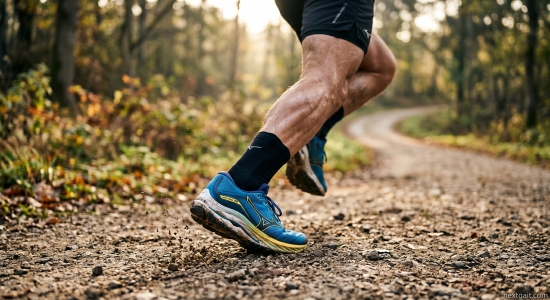
Mizuno Wave Rider 29 is best overall because its Wave plate limits unwanted midfoot flex, the 10mm drop is familiar to many heel strikers, and the cushioning stays controlled instead of collapsing under the arch.
| Drop | Weight | Platform | Widths | Ride |
|---|---|---|---|---|
| 10mm | 9.3 oz / about 265g (men’s US 9) | Mizuno Enerzy NXT with a heel-to-midfoot Wave plate | Standard and Wide in the US | Moderately cushioned, stable, and easy to control |
The Wave Rider 29 is my first try-on because it handles the middle of the shoe correctly. The Wave plate adds structure from the heel toward the midfoot, so the shoe bends closer to the forefoot instead of folding directly under a sore plantar fascia.
That is more useful than a tall arch bump.
Mizuno’s nitrogen-infused Enerzy NXT takes the hard edge off older Wave Riders. The ride is cushioned but not unstable, and the 10mm drop gives runners coming from conventional trainers a familiar calf and ankle demand.
It works best for easy runs, steady mileage, and a cautious return to longer efforts.
The heel counter is secure without needing aggressive lacing. Standard and Wide options cover many feet, though the fit is not as expansive as Brooks 4E.
If your pain is aggravated by any plate-like stiffness or you naturally prefer a flexible forefoot, the Wave Rider can feel too prescriptive.
Fit: Start true to size. Check that the Wave structure feels like a platform, not a ridge pressing into the arch.
What I like: Midfoot plate controls flex; Cushioning is protective without being vague; 10mm drop is easy for many heel strikers; Durable outsole coverage.
What I do not like: Plate feel can be too firm; Not a max-cushion ride; No extra-wide tier in every color.
Who should skip it: Skip it if rigid midfoot shoes increase your pain or if you need 4E volume.
Read my Mizuno Wave Rider review.
2. Brooks Ghost Max 3 – Best stable rocker
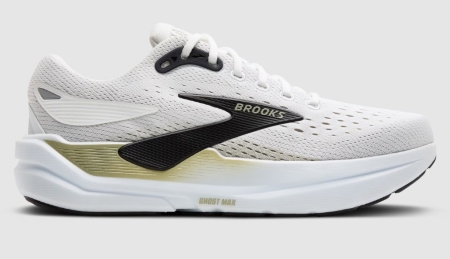
Brooks Ghost Max 3 is best stable rocker because it combines a broad neutral base, controlled cushioning, a rocker, 4E availability, and useful orthotic volume without forcing every runner into stability guidance.
| Drop | Weight | Platform | Widths | Ride |
|---|---|---|---|---|
| 6mm | 11.2 oz / 317.5g (Brooks men’s reference listing) | Broad DNA LOFT v3 base with GlideRoll rocker | D, 2E, and 4E for men | Firm-protective, broad, and smoothly rockered |
Ghost Max 3 is the option I reach for when heel contact hurts but a very soft shoe feels unstable. The broad platform spreads the landing, while DNA LOFT v3 feels protective rather than bottomless.
The GlideRoll shape then carries the shoe through toe-off with less bending than a conventional flexible trainer.
That rocker can reduce how much the forefoot has to hinge, but rocker timing is personal. It should roll where your foot expects, not tip you forward before you are ready.
I like it for easy road miles, run-walk sessions, and runners who want a neutral host for an insert.
The D-to-4E range is a real advantage because a crowded forefoot changes how the foot loads. The shoe is heavy and not lively.
Its 6mm drop also deserves a gradual transition if your current shoe is 10 or 12mm.
Fit: Choose width in the normal length and confirm the heel remains seated after replacing the stock insole.
What I like: Stable neutral geometry; Controlled rocker; D-to-4E men’s sizing; Removable insole and orthotic room.
What I do not like: Heavy; Not designed for fast sessions; Rocker and 6mm drop need a real run test.
Who should skip it: Skip it if you need strong pronation guidance or dislike a stiff rockered transition.
Read my Brooks Ghost review for a lower-stack alternative.
3. Saucony Triumph 24 – Best cushion-to-weight ratio
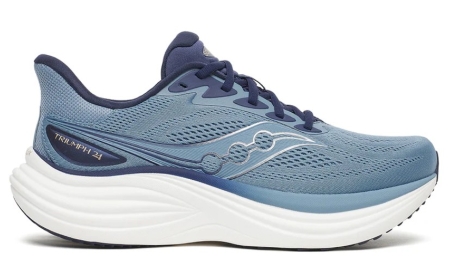
Saucony Triumph 24 is best cushion-to-weight ratio because it delivers a 43mm heel, 10mm drop, secure upper, and unusually low weight, making deep cushioning feel less laborious during a return to normal mileage.
| Drop | Weight | Platform | Widths | Ride |
|---|---|---|---|---|
| 10mm | 8.8 oz / 250g (men’s US 9) | 43/33mm incrediLUX neutral platform | Standard and Wide | Plush, light for its stack, and energetic |
Triumph 24 is the premium neutral option for runners who want cushioning without dragging a heavy shoe. The incrediLUX platform is tall and compliant, but the 10mm offset and broad forefoot keep the transition more conventional than its stack suggests.
At 8.8 ounces, it is remarkably light for this amount of foam.
I rank it below Ghost Max because soft foam is not automatically friendly to a painful foot. Some runners feel stable and relaxed in it; others keep correcting the platform as the foam compresses.
Run long enough for the midsole to warm before deciding.
The upper is secure and the Wide option helps a spreading forefoot. I would use it for easy and long road runs after symptoms have stabilized, not as proof that the foot is ready for more mileage.
The shoe changes comfort, not tissue capacity.
Fit: Jog through turns and wait for the foam to warm. Use Wide if the medial forefoot sits on the edge of the platform.
What I like: Exceptional cushion-to-weight ratio; 10mm drop; Secure, roomy upper; Versatile enough for steady running.
What I do not like: Softness can feel unstable; Premium price; Tall stack is less confident on uneven roads.
Who should skip it: Skip it if soft high-stack shoes make the ankle work harder or if standing feels less stable than in a firmer trainer.
Read my Saucony Triumph review.
4. HOKA Bondi 9 – Best max-cushion rocker
HOKA Bondi 9 is best max-cushion rocker because its broad max-cushion base and obvious rocker can make slow running and walking transitions smoother when the 5mm drop and HOKA shape match the runner.

| Drop | Weight | Platform | Widths | Ride |
|---|---|---|---|---|
| 5mm | 10.5 oz (men’s reference size) | 43/38mm supercritical EVA with MetaRocker geometry | Three men’s width options in the US | Deep, firm-plush, and strongly rockered at easy pace |
Bondi 9 is useful, but it is not a universal plantar-fasciitis prescription. The wide base and rocker are the reasons it ranks, not a claim that maximum cushion heals the fascia.
The supercritical EVA is substantial and more controlled than the softest neutral foams.
At easy pace, the MetaRocker reduces the need for a flexible hinge under the forefoot. That can feel relieving when toe extension is sensitive.
The tradeoff is a 5mm drop, which may increase calf and ankle demand relative to a runner’s old 10mm shoe even though the stack is tall.
HOKA offers multiple widths, but the midfoot shape still needs attention. A bigger exterior does not guarantee the arch sits comfortably inside.
If the rocker rolls at the wrong point or the medial side presses, do not buy it because the model is popular in heel-pain lists.
Fit: Jog, walk downhill, and check the medial arch after ten minutes. Width should solve spill without creating heel slip.
What I like: Broad max-cushion platform; Rocker smooths easy running; Multiple widths; Works well for run-walk use.
What I do not like: 5mm drop is a major transition for some; Bulky; Rocker timing and HOKA midfoot shape are specific.
Who should skip it: Skip it if the 5mm drop increases calf tension, the rocker feels early, or the arch contour creates pressure.
Read my HOKA Bondi review.
5. Brooks Adrenaline GTS 25 – Best for overpronation
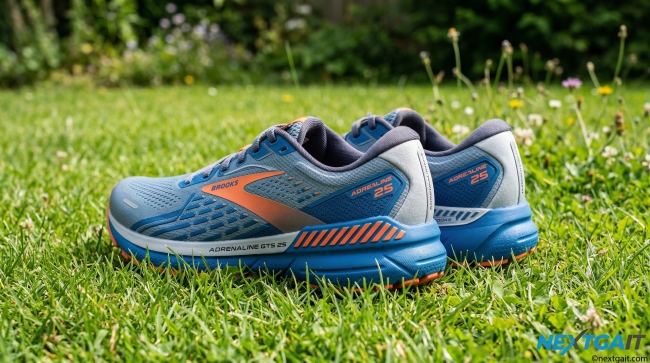
Brooks Adrenaline GTS 25 is best for overpronation because GuideRails add boundaries when inward drift is part of the runner’s problem, while the 10mm drop and B-to-4E range solve common transition and fit issues.
| Drop | Weight | Platform | Widths | Ride |
|---|---|---|---|---|
| 10mm | 10.6 oz / 300.5g (men’s reference size) | DNA LOFT v3 with GuideRails support | B, D, 2E, and 4E for men in the US | Controlled, familiar, and less intrusive than a hard post |
Adrenaline GTS 25 belongs here only for the runner who benefits from guidance. Plantar fasciitis does not automatically mean overpronation, and GuideRails are not arch support.
They sit around the heel and resist larger deviations as the stride becomes less controlled.
The 10mm drop and DNA LOFT v3 platform feel familiar to runners leaving conventional daily trainers. I like the rearfoot security and the fact that the foam does not move excessively under load.
It is a predictable shoe for easy mileage rather than a dramatic pain-relief device.
Men’s B through 4E choices make fit unusually adaptable. If the GuideRails feel present on every step, the support is solving the wrong problem.
A neutral Ghost Max or Wave Rider should be tried beside it.
Fit: Compare the correct width at the same length. Guidance should feel quiet during easy running, not like pressure under the arch.
What I like: Quiet GuideRails support; 10mm drop; Excellent heel hold; B-to-4E men’s range.
What I do not like: Too much guidance for some neutral runners; Not especially lively; Heavier than neutral daily trainers.
Who should skip it: Skip it if neutral shoes stay centered or GuideRails steer the foot uncomfortably.
Read my Brooks Adrenaline GTS review.
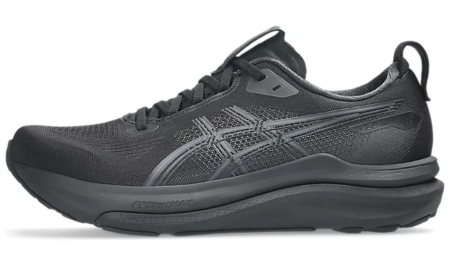
6. ASICS GEL-KAYANO 33 – Best premium stability
ASICS GEL-KAYANO 33 is best premium stability because its broad base, adaptive medial foam, secure heel, and Extra Wide option make it the complete premium choice when both cushioning and guidance are needed.
| Drop | Weight | Platform | Widths | Ride |
|---|---|---|---|---|
| 8mm | 10.5 oz / 298g (men’s reference size) | FLUIDSUPPORT with FF BLAST PLUS and FF BLAST MAX | Standard, Wide, and Extra Wide | Plush, substantial, and progressively guided |
Kayano 33 is the more cushioned stability option. FLUIDSUPPORT integrates a firmer medial component with broader geometry, so the support builds under load instead of presenting as a hard block.
That can help a runner whose foot drifts inward as fatigue appears.
The 8mm drop is moderate, and the dual-foam midsole protects the heel without feeling as low as Bondi. I like the shoe for easy and long runs where support has already proved useful.
I do not use plantar heel pain itself as the reason to choose it.
Standard, Wide, and Extra Wide improve orthotic and forefoot fit. The shoe is heavy, expensive, and structured.
If the medial side is obvious during the first minute, it is unlikely to become more natural at mile eight.
Fit: Try two widths in the same length. The arch should make broad contact without a single pressure point.
What I like: Adaptive rather than abrupt support; Plush heel cushioning; Extra Wide option; Secure rearfoot.
What I do not like: Heavy and expensive; Too structured for neutral runners; Not intended for fast workouts.
Who should skip it: Skip it if support is noticeable before fatigue or if a neutral platform already feels stable.
Read my ASICS Gel-Kayano review.
7. ASICS GEL-NIMBUS 28 – Best neutral heel cushioning
ASICS GEL-NIMBUS 28 is best neutral heel cushioning because it gives neutral runners an 8mm drop, dedicated heel cushioning, three width tiers, and a secure high-cushion package without stability correction.
| Drop | Weight | Platform | Widths | Ride |
|---|---|---|---|---|
| 8mm | 9.9 oz / 281g (men’s reference size) | FF BLAST PLUS with PureGEL heel cushioning | Standard, Wide, and Extra Wide | Soft, smooth, and neutral |
Nimbus 28 is the soft neutral choice for runners who dislike a rigid plate or corrective geometry. PureGEL sits at the rearfoot and FF BLAST PLUS carries the rest of the transition.
The 8mm drop is easier to pair with a history of conventional shoes than a low-drop max trainer.
Softness is the decision point. If the heel feels cushioned and the ankle stays quiet after ten minutes, Nimbus can be an excellent easy-run shoe.
If the platform keeps moving or the foot slides medially, more foam has not solved the load-management problem.
ASICS offers Standard, Wide, and Extra Wide in the US, which is valuable when an orthotic or forefoot spread needs space. The knit upper should wrap without forcing the laces tight.
I would not select it for a runner who already knows soft neutral shoes feel unstable.
Fit: Use the narrowest width that contains the forefoot and keeps the heel secure. Run until the foam warms.
What I like: Dedicated heel cushioning; 8mm drop; Three width tiers; Smooth neutral ride.
What I do not like: Softness can permit movement; Premium price; Less stable than guided alternatives.
Who should skip it: Skip it if soft midsoles increase inward drift or if you need a firmer midfoot.
Read my ASICS Gel-Nimbus review.
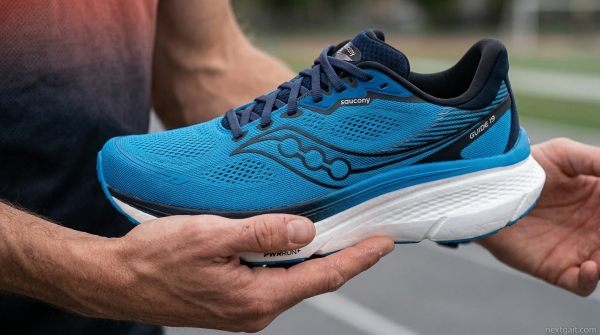
8. Saucony Guide 19 – Best natural guidance
Saucony Guide 19 is best natural guidance because CenterPath uses a broad base and raised sidewalls rather than a hard post, giving mild guidance and midfoot control at a lower weight than most stability models.
| Drop | Weight | Platform | Widths | Ride |
|---|---|---|---|---|
| 6mm | 9.7 oz / 275g (men’s reference size) | 35/29mm PWRRUN with CenterPath geometry | Standard and Wide | Broad, controlled, and less corrective than old stability shoes |
Guide 19 suits the runner who wants structure without feeling corrected. CenterPath combines a broad footprint, sidewalls, and a guided transition.
The midsole resists twisting through the middle more than a flexible neutral trainer, which is the feature I care about here.
PWRRUN cushioning is controlled rather than luxurious. At 6mm, the drop is lower than Wave Rider, Triumph, or Adrenaline, so the calf and plantar complex may experience a different demand.
Introduce it rather than assuming the stability label makes the transition automatic.
Standard and Wide cover most average-volume feet but stop short of extra-wide. The heel hold is good, and the upper is less bulky than Kayano.
Runners with severe first-step pain should address treatment and load before using the shoe’s lighter feel as permission to run farther.
Fit: Check the medial sidewall during a jog. It should contain the foot without pressing one point under the arch.
What I like: Geometry-led support; Controlled midfoot; Reasonable weight; Wide option.
What I do not like: 6mm drop needs adaptation; No extra-wide tier; Foam is not especially energetic.
Who should skip it: Skip it if you need maximum guidance, extra-wide sizing, or a high drop.
Read my Saucony Guide review.
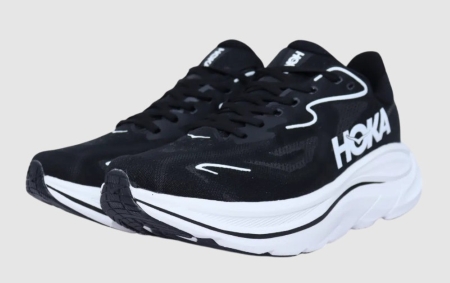
9. HOKA Clifton 10 – Best lightweight rocker
HOKA Clifton 10 is best lightweight rocker because the current 8mm drop and rocker give runners a lighter HOKA option when Bondi feels cumbersome, while multiple widths improve the odds of a pressure-free fit.
| Drop | Weight | Platform | Widths | Ride |
|---|---|---|---|---|
| 8mm | 9.8 oz (men’s reference size) | CMEVA cushion with MetaRocker geometry | Three men’s width options in the US | Lighter, softer, and less bulky than Bondi |
Clifton 10 changed an important variable: HOKA increased the drop from the previous 5mm geometry to 8mm. That makes it a different transition from older Cliftons and potentially easier for runners leaving conventional shoes.
The rocker still reduces how much the forefoot bends during easy running.
It feels lighter and less blocky than Bondi, which helps when a return-to-run includes short steady segments. The platform is also softer and less planted.
A runner who needs firm midfoot control should start with Wave Rider, Ghost Max, or Guide instead.
Three width choices are helpful, but the HOKA midfoot remains a fit test rather than a guarantee. The heel should stay down without a runner’s knot, and the arch should not be aware of the shoe after ten minutes.
Fit: Run before buying and check rocker timing. Compare widths without adding length just to create room.
What I like: 8mm drop; Smooth rocker; Lighter than Bondi; Multiple width options.
What I do not like: Soft platform may feel less stable; Midfoot shape is specific; Not as protective as the deepest max shoes.
Who should skip it: Skip it if a soft platform or HOKA arch shape has caused hotspots before.
Read my HOKA Clifton review.
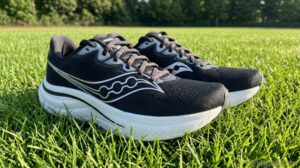
10. Saucony Ride 19 – Best versatile daily value
Saucony Ride 19 is best versatile daily value because it offers an 8mm drop, broad neutral geometry, secure upper, removable insole, and enough versatility to remain useful after symptoms settle.
| Drop | Weight | Platform | Widths | Ride |
|---|---|---|---|---|
| 8mm | 9.0 oz / 255g (men’s reference size) | 36/28mm PWRRUN PLUS neutral platform | Standard and Wide | Balanced, stable for neutral, and flexible enough for normal training |
Ride 19 is the least specialized shoe here. That is useful for a runner who does not need maximum cushion, a plate, or stability guidance.
PWRRUN PLUS is softer than the old Ride feel but stays broad and controlled enough for ordinary daily mileage.
The 8mm drop and smooth transition make it an easy rotation partner. It can handle easy running, steady efforts, and strides after the return has progressed.
I rank it tenth because its midfoot is less rigid than Wave Rider or Ghost Max, not because it is a lower-quality trainer.
The upper is secure and the Wide version helps foot spread. If pressing the shoe by hand reveals a fold directly under your painful arch, test carefully.
The best versatile shoe is still wrong when your current symptoms prefer more structure.
Fit: Start true to size and use the insole as a width template. Confirm heel hold at easy and steady pace.
What I like: Balanced neutral ride; 8mm drop; Good weight and versatility; Wide option and removable insole.
What I do not like: Less midfoot control than top picks; Not maximum cushion; May be too flexible during an active flare.
Who should skip it: Skip it during an active flare if the midfoot flexes or the heel feels insufficiently protected.
Read my Saucony Ride review.
Full Comparison Table
Wave Rider 29 gives the most balanced control, while Ghost Max 3 supplies the broadest stable rocker and Triumph 24 supplies the lightest deep cushion. Reduce the list to two or three shoes before running in them.
| Shoe | Drop | Midfoot approach | Widths | Best use | Main warning |
|---|---|---|---|---|---|
| Mizuno Wave Rider 29 | 10mm | Mizuno Enerzy NXT with a heel-to-midfoot Wave plate | Standard and Wide in the US | Best overall | Skip it if rigid midfoot shoes increase your pain or if you need 4E volume. |
| Brooks Ghost Max 3 | 6mm | Broad DNA LOFT v3 base with GlideRoll rocker | D, 2E, and 4E for men | Best stable rocker | Skip it if you need strong pronation guidance or dislike a stiff rockered transition. |
| Saucony Triumph 24 | 10mm | 43/33mm incrediLUX neutral platform | Standard and Wide | Best cushion-to-weight ratio | Skip it if soft high-stack shoes make the ankle work harder or if standing feels less stable than in a firmer trainer. |
| HOKA Bondi 9 | 5mm | 43/38mm supercritical EVA with MetaRocker geometry | Three men’s width options in the US | Best max-cushion rocker | Skip it if the 5mm drop increases calf tension, the rocker feels early, or the arch contour creates pressure. |
| Brooks Adrenaline GTS 25 | 10mm | DNA LOFT v3 with GuideRails support | B, D, 2E, and 4E for men in the US | Best for overpronation | Skip it if neutral shoes stay centered or GuideRails steer the foot uncomfortably. |
| ASICS GEL-KAYANO 33 | 8mm | FLUIDSUPPORT with FF BLAST PLUS and FF BLAST MAX | Standard, Wide, and Extra Wide | Best premium stability | Skip it if support is noticeable before fatigue or if a neutral platform already feels stable. |
| ASICS GEL-NIMBUS 28 | 8mm | FF BLAST PLUS with PureGEL heel cushioning | Standard, Wide, and Extra Wide | Best neutral heel cushioning | Skip it if soft midsoles increase inward drift or if you need a firmer midfoot. |
| Saucony Guide 19 | 6mm | 35/29mm PWRRUN with CenterPath geometry | Standard and Wide | Best natural guidance | Skip it if you need maximum guidance, extra-wide sizing, or a high drop. |
| HOKA Clifton 10 | 8mm | CMEVA cushion with MetaRocker geometry | Three men’s width options in the US | Best lightweight rocker | Skip it if a soft platform or HOKA arch shape has caused hotspots before. |
| Saucony Ride 19 | 8mm | 36/28mm PWRRUN PLUS neutral platform | Standard and Wide | Best versatile daily value | Skip it during an active flare if the midfoot flexes or the heel feels insufficiently protected. |
For two common max-cushion decisions, compare HOKA Bondi vs. ASICS Nimbus. Runners whose body weight changes how soft foam behaves can use the heavy-runner shoe guide.
Footwear is not rehabilitation; use the fit-first running-shoe finder to compare fit and use constraints before returning to the plantar-fascia-specific shortlist.
Choose a Shoe by Symptom, Gait, and Current Trainer
Start from the shoe you already tolerate, then change the one variable most likely to improve comfort. Replacing drop, softness, rocker, width, and support at once turns the experiment into noise.
| Runner profile | Start with | Why |
|---|---|---|
| Heel striker in a conventional 10-12mm shoe | Wave Rider 29 or Triumph 24 | Both preserve a 10mm offset while changing cushion and midfoot behavior |
| Neutral runner who wants a rocker | Ghost Max 3 | Broad base and controlled foam without correction |
| Prefers firm max cushion and run-walk use | Bondi 9 | Strong rocker and broad base; transition carefully to 5mm |
| Overpronates and neutral shoes feel unstable | Adrenaline GTS 25 or Kayano 33 | Choose Adrenaline for conventional control and Kayano for plusher adaptive guidance |
| Wide neutral foot | Ghost Max 3 or Nimbus 28 | Both reach Extra Wide or 4E territory and accept many inserts |
| Wants a lighter high-cushion neutral shoe | Triumph 24 | 43mm heel at an 8.8-ounce reference weight |
| Mild guidance without a hard post | Guide 19 | Broad CenterPath geometry contains movement |
| Symptoms stable and wants normal daily versatility | Ride 19 | Balanced 8mm trainer remains useful after the return |
If your current symptoms include Achilles-region pain rather than pain under the heel, use the Achilles shoe guide instead of assuming the same geometry applies.
The 10-Minute Shoe Test – Plus the Next-Morning Check
A plantar-fasciitis shoe must pass during running and again after the tissue has cooled. Step-in softness is only the first thirty seconds of the test.
- Stand: reject a sharp arch ridge or heel edge; pressure should be broad and quiet.
- Check the insole: the forefoot and medial midfoot should not hang over either edge.
- Walk downhill: the heel should not lift or drive the toes into the front.
- Jog five minutes: notice where the shoe bends and whether the platform keeps moving.
- Run broad turns: the upper should hold the foot over the midsole without aggressive lacing.
- Change pace briefly: the rocker or plate should remain predictable when cadence rises.
- Stop and recheck: record heel, arch, Achilles, and forefoot sensations before they fade.
- Check the next morning: a meaningful increase in first-step pain is a load signal, even if the run felt fine.
Do not expect a new shoe to require a painful break-in. The upper can relax slightly, but an arch hotspot, unstable platform, or misplaced rocker is a design mismatch, not a test of character.
Where Shoe Selection Ends
A comfortable shoe can be one controlled variable in a broader plan. It is not medical clearance, a rehabilitation protocol, or proof that the plantar fascia is the painful structure. Use the condition guide above for care and running decisions; use this page for product trade-offs.
For adjacent product decisions, compare shoe options for heel-spur concerns, running shoes for concrete, treadmill running shoes, or running insoles for heavier runners. These pages remain product resources, not diagnostic pathways.
Durability and When to Replace the Shoe
There is no evidence-based 300- or 400-mile replacement rule for every runner with plantar fasciitis. Mileage is context; geometry, wear, ride change, upper security, surface, body mass, and symptom response decide useful life.
| Check | Still serviceable | Replacement warning |
|---|---|---|
| Midsole | Both shoes sit level | One shoe leans or remains compressed |
| Midfoot | Bends and twists like the fresh pair | Old shoe folds more easily under the arch |
| Outsole | Rubber protects the landing path | Wear changes the angle or exposes foam |
| Upper | Heel and midfoot remain secure | Stretch permits repeated sliding |
| Symptoms | Normal recovery pattern | First-step pain repeatedly appears only after the old pair |
Compare an older pair with a fresh version instead of waiting for visible destruction. My guide to when to replace running shoes provides the full inspection sequence.
Shoe-Selection FAQ
What shoe features should I compare for plantar heel pain?
Compare secure heel hold, stable cushioning, midfoot flex, rocker transition, fit, and how familiar the heel-to-toe drop is. No feature diagnoses or cures the condition.
Is more cushioning always better for plantar heel pain?
No. Cushioning must remain stable and comfortable under your stride. A softer shoe can feel pleasant at step-in yet less controlled after the foam warms or fatigue changes your mechanics.
Is a higher heel drop automatically better?
No. Drop changes ankle and foot loading, but there is no universal therapeutic number. Avoid changing drop, mileage, terrain, and exercises at the same time.
Are HOKA shoes automatically best for plantar fasciitis?
No brand is a prescription. Bondi or Clifton geometry may suit one runner and irritate another depending on fit, rocker timing, arch shape, width, and current footwear.
Do I need a stability shoe?
Only when guidance improves comfort and control. Plantar heel pain does not prove overpronation, so compare the exact stability shoe with a stable neutral option.
Can I use my orthotics in these shoes?
Check removable insole depth, heel security, volume, and whether the device sits flat. The shoe and orthotic must be tested as one system.
How should I test a new shoe?
Use an easy, familiar route and change no other major variable. Record comfort during the run, later that day, and on the first steps the next morning.
When should I stop shopping and seek care?
Seek assessment for severe or atypical pain, inability to bear weight, acute trauma, swelling, neurologic symptoms, rest or night pain, systemic symptoms, or a course that is worsening or stalled.
Final Verdict
Mizuno Wave Rider 29 is my best overall running shoe for plantar fasciitis because its heel-to-midfoot Wave plate controls flex, the cushioning remains stable, and its 10mm drop is a manageable continuation for many heel-striking runners. It wins by balancing variables rather than maximizing one.
Choose Ghost Max 3 when you want a broad neutral rocker and orthotic room. Choose Triumph 24 for a light high-cushion platform, Bondi 9 for a stronger max-cushion rocker, Adrenaline GTS 25 for moderate guidance, and Kayano 33 when you need plusher adaptive stability and Extra Wide fit.
The shoe gets one vote. The ten-minute run, next-morning response, normal walking gait, and treatment plan get the rest. A model that makes the first mile quieter is useful; it is not permission to skip the work that rebuilds capacity.
Pingback: Best Running Shoes for High Arches: 10 Picks for 2026