
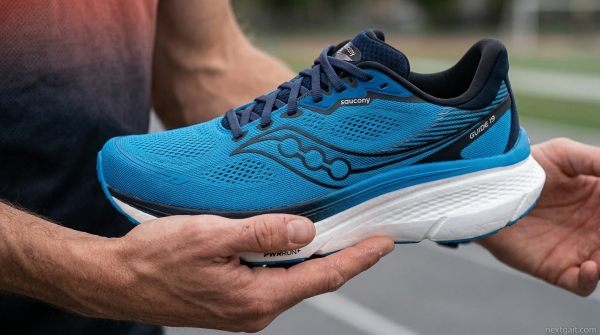
The Saucony Guide 19 is a mild-guidance daily trainer for easy runs, recovery mileage, steady aerobic work, walking, and runners who want a broad platform without the hard edge of an old medial post. After more than 200 km, or 124 miles, my score is 8.4/10.
Its best quality is restraint. CenterPath does not shove my arch outward or make the medial side feel like a ramp. The high sidewalls, very wide base, rocker, and outsole geometry work together quietly. On most easy runs I notice the shoe being planted before I notice it being a stability shoe.
The Guide 19 is not light, quick, or especially energetic. My test pair weighed 277 g, or 9.8 oz, in men’s US 10 on a kitchen scale. At tempo effort, the shoe protects the landing but gives back less urgency than I want. That trade-off is central to this review, not a footnote.
Buy it for controlled daily mileage and all-day comfort. Look elsewhere if the same shoe must handle intervals, race day, or aggressive late-run pace. The Saucony Tempus 2 and Endorphin Speed 5 are far better answers for those jobs.
Jump to Section Click to expand
- Quick Verdict
- Ken’s Ranking Rule
- How I Tested
- 124-Mile Test Timeline
- Specs and Verified Facts
- CenterPath Explained
- Ride and PWRRUN Foam
- Performance by Pace
- Long Runs and Walking
- Stability and Guidance
- Fit and Sizing
- Upper and Lockdown
- Grip and Durability
- Guide 19 vs Guide 18
- Key Comparisons
- Decision Matrix
- Training Rotation
- Who Should Buy
- Who Should Skip
- Sources and Fact Check
- Final Verdict
- FAQ
Saucony Guide 19 Review: Quick Verdict
The Guide 19 succeeds as a comfortable, durable-feeling stability daily trainer with subtle guidance; it falls short as a fast or lightweight all-rounder. The shoe feels most coherent when I run relaxed, land naturally, and let the broad platform manage small changes in form.
| Decision | Ken’s Answer |
|---|---|
| Best for | Easy runs, recovery, steady mileage, moderate long runs, walking, standing |
| Guidance level | Mild to moderate feel; geometry-led rather than post-led |
| Ride | Soft-balanced at the heel, slightly denser through midfoot, smooth and flexible up front |
| Fit | True to size for me in men’s US 10; standard forefoot, adaptable mesh, snugger midfoot |
| Main strength | Broad, unobtrusive control that works at running and walking pace |
| Main weakness | Weight and modest rebound limit faster running |
| Published specs | 9.7 oz men’s, 8.9 oz women’s, 35/29 mm stack, 6 mm offset |
| Plate | None |
| Ken’s score | 8.4/10 |
In my best running shoes framework, the Guide 19 is a role player with a broad audience. It is easier to live with than a rigid support shoe and more controlled than many soft neutral trainers. It does not need to win a bounce contest to be useful.
For runners comparing support options, my running shoes for overpronation guide explains why a pronation label alone cannot select a shoe. The Guide 19 makes the most sense when its shape and level of guidance feel comfortable during an actual run.
Bottom line: The Guide 19 is a strong easy-day stability trainer and walking shoe. Its guidance is smooth, its base is exceptionally broad, and its upper is comfortable. Its mass and low energy return keep it out of my speed rotation.
Ken’s Ranking Rule for the Saucony Guide 19
Ken’s ranking rule: a stability shoe earns its score by helping the runner stay centered without forcing one idealized motion. I reward secure fit, predictable landings, smooth transitions, late-run control, practical grip, and enough comfort to repeat the intended training. I subtract for intrusive pressure, excess mass, or a support mechanism that fights the foot.
I rank the Guide 19 against stability daily trainers, not against plated racers or max-cushion neutral shoes. A quiet easy run carries more weight here than one fast kilometer. The shoe should keep working when the road is cambered, the turn is tight, or fatigue makes my left side less tidy.
| Ranking Factor | Weight | Guide 19 | Reason |
|---|---|---|---|
| Daily comfort | 22% | 9.0/10 | Adaptable upper and ample PWRRUN suit repeated easy miles |
| Guidance quality | 20% | 8.8/10 | Broad base and sidewalls guide without a hard post sensation |
| Transition | 15% | 8.6/10 | Heel bevel, rocker, and flexible forefoot move smoothly |
| Pace versatility | 13% | 7.2/10 | Steady pace works; tempo reveals weight and modest rebound |
| Fit and upper | 12% | 8.7/10 | True length and secure hold, with a tapered front for some feet |
| Grip and wear | 10% | 8.8/10 | XT-900 remains functional after 124+ running miles |
| Value | 8% | 8.4/10 | Useful for running, walking, and daily wear |
The weighted score rounds to 8.4. That number answers one question: how well does this shoe perform its intended daily stability role? It does not claim the Guide 19 will fit every flat foot, stop an injury, or improve running economy.
My watch and training log document distance, pace, surface, and use. My kitchen scale documents the weight of my pair. Laboratory measurements cited later belong to the named lab and its protocol. Keeping those evidence types separate is part of the ranking rule.
How I Tested the Saucony Guide 19
I logged more than 200 km, or 124 running miles, in the Guide 19 over six weeks: 120 km of easy running, 60 km of long runs, and 20 km of tempo or threshold work. I also walked about 15 km, or 9 miles, in the shoe. Walking mileage is reported separately so it does not inflate the running total.
The 200+ km claim appears in every retained WordPress revision, beginning with the first version saved on March 30, 2026. The run-type totals add to 200 km. I converted them for U.S. readers and retained kilometers in the test table because those are the original log units.
| Test Type | Logged Distance | Typical Pace | Result |
|---|---|---|---|
| Easy runs | 74.6 mi / 120 km | 8:51-9:39/mi (5:30-6:00/km) | The shoe’s strongest and most natural use |
| Long runs | 37.3 mi / 60 km | 8:27-9:15/mi (5:15-5:45/km) | Comfortable to about 12 miles; forefoot fatigue became clearer later |
| Tempo/threshold | 12.4 mi / 20 km | 7:38-8:03/mi (4:45-5:00/km) | Workable, but the shoe felt heavy and muted |
| Walking | 9.3 mi / 15 km | Unpaced | Excellent step-in comfort and stable platform |
My test pair was men’s US 10, my normal Saucony length, and weighed 277 g, or 9.8 oz, on my scale. I used regular socks and the stock removable insole. I did not use an orthotic, so this review cannot tell a custom-orthotic wearer that the combination will work.
The long-run sample included 18, 21, and 25 km outings, roughly 11.2, 13.0, and 15.5 miles. The faster sample included controlled tempo running and 6 x 1 km repetitions. Easy mileage took place mostly on asphalt and boardwalk, with smaller amounts of concrete and smooth packed path.
I alternated the Guide with a max-cushion shoe on recovery days rather than forcing every mile into one test pair. That matters because rotation changes how the legs feel, but it does not change the Guide-specific observations: secure fit, broad support, limited speed response, and consistent outsole function.
For readers building similar volume, my easy-run pace guide and Zone 2 guide explain how to control effort. A support shoe can feel reassuring while the runner is still running too hard.
What Changed from Day 1 to 124+ Miles
The Guide 19 needed almost no break-in; the larger change was learning where its broad, muted ride belonged in my week. The upper felt comfortable immediately, and the foam character stayed recognizable rather than becoming dramatically softer.
| Checkpoint | What I Observed | Meaning |
|---|---|---|
| First 10 miles | Secure heel, close midfoot, no hot spot, guidance barely noticeable | Fit and CenterPath did not demand adaptation |
| 50 miles | Easy-run rhythm felt settled; tempo still muted | Familiarity improved flow but did not create rebound |
| 75 miles | Minor outsole smoothing, no traction change | Cosmetic wear did not affect function |
| 124+ miles | Upper held shape; outsole remained usable; ride still consistent | Favorable test result without a lifetime prediction |
The easy-run verdict strengthened over time. Around 9:00 per mile, I stopped thinking about the shoe and paid attention to breathing and cadence. The platform tolerated boardwalk seams and mild road camber without the sideways softness I sometimes get from tall neutral shoes.
The speed verdict did not improve. I could run controlled repetitions, but the Guide never developed a crisp release. A break-in period can reduce upper stiffness and surface harshness; it cannot remove mass or turn standard PWRRUN EVA into a racing foam.
At 124+ miles, light visible wear appeared where I load the lateral heel and push off. The central forefoot rubber still did its job. I am not converting that snapshot into a 300-, 400-, or 500-mile promise because surface, runner mass, landing pattern, and traction tolerance differ.
Saucony Guide 19 Specs and Verified Facts
The Guide 19 is a stability road trainer with compression-molded PWRRUN EVA, CenterPath geometry, a published 35 mm heel and 29 mm forefoot, a 6 mm offset, engineered mesh, and XT-900 outsole rubber. There is no plate. Saucony lists regular, wide, and extra-wide men’s versions on its U.S. page, though availability varies by size and color.
| Specification | Published Detail | Practical Meaning |
|---|---|---|
| Category | Stability daily trainer | Built for guidance and ordinary mileage rather than racing |
| Men’s reference weight | 9.7 oz / 275 g, size 9 | Not a lightweight trainer |
| Women’s reference weight | 8.9 oz / 252 g, size 8 | Reference size differs from men’s |
| Stack | 35 mm heel / 29 mm forefoot | Moderate-high cushioning inside oversized sidewalls |
| Offset | 6 mm | Lower than many traditional stability shoes |
| Midsole | Compression-molded PWRRUN EVA | Comfort-oriented foam with modest rebound |
| Stability | CenterPath geometry | Wide base, raised sidewalls, rocker, and asymmetric sole features |
| Upper | Engineered mesh | Adaptive fit with a semi-gusseted tongue in the tested construction |
| Outsole | XT-900 rubber | Road grip with rubber added at the central forefoot |
| Plate | None | Forefoot can flex rather than relying on a rigid plate |
My US 10 pair at 277 g is close to the 275 g men’s reference, even though the reference size is smaller. Independent samples were heavier: RTINGS measured 294.5 g and RunRepeat measured 298 g. Size, sample variation, and method explain why one published weight should not be assigned to every pair.
Stack also varies by protocol. RunRepeat measured 37.4/31.4 mm and exactly 6.0 mm drop; RTINGS measured 36.2/29.5 mm and 6.7 mm. I use the brand figure in the specification table and label independent numbers as measurements rather than treating them as corrections.
Saucony’s official U.S. page describes a refined PWRRUN blend, greater forefoot flexibility, and added durability. The page does not identify the collar material as memory foam, publish an exact sidewall height, or promise a mileage lifespan. Those unsupported details have been removed from this review.
CenterPath Technology: What It Actually Does
CenterPath is Saucony’s geometry-led guidance system: an unusually wide platform, raised and asymmetric sidewalls, rocker shaping, and outsole placement help the foot travel through the center of the shoe without a traditional medial post. It manages the path of motion rather than placing one obvious hard block under the arch.
The medial sidewall runs farther forward than the lateral wall, and the platform is visibly broad at heel, arch, and forefoot. Doctors of Running describes the system as mild guidance that borders on stable neutral while running. That description matches my pair more closely than the old language of correction.
RunRepeat measured 120.0 mm at the forefoot and 104.2 mm at the heel, both wider than its database averages. RTINGS measured a similarly broad 121 mm forefoot and 103 mm heel. Those figures explain the planted sensation better than vague claims that the shoe has extra support.
Width is only one part. A wide slab of very soft foam can still move laterally. Here, the sidewalls cradle the foot, the rocker reduces how long I dwell at the front, and the outsole adds structure in selected areas. The result feels more organized than rigid.
CenterPath is not invisible to everyone. A runner with a low arch may notice the medial wall while walking; a runner who lands far forward may feel the medial outsole extension differently. Fit pressure is not proof that the guidance is working. Persistent pressure is a reason to try another model.
No shoe can diagnose overpronation from a wet footprint or correct every stride. Comfort during running, fit security, and symptom response matter more than marketing categories. My flat-feet running shoe guide separates arch shape from support preference.
Ride Feel and the Updated PWRRUN Midsole
The Guide 19 feels soft-balanced at heel contact, denser through the middle, and flexible enough at toe-off to avoid the blocky sensation common in older stability shoes. It cushions well, but it does not return energy with the snap of PWRRUN PB or other premium foams.
At easy pace, the heel bevel settles cleanly and the lateral side compresses before the foot moves onto the broad midfoot. I do not feel a sudden medial stop. The ride is less exciting than a neutral super-trainer but more natural than a posted stability shoe.
The new foam is a useful example of why reviewers can disagree honestly. Doctors of Running’s Matt Klein felt a softer ride. Bach Pham, a more forward midfoot lander, perceived the Guide 19 as slightly firmer than versions 17 and 18 because the outsole firms the middle. My experience sits between them: soft at initial contact, more structured under midfoot.
RunRepeat’s durometer found the foam softer than its lab average, while its energy-return test was below average at the heel. RTINGS also recorded modest compression energy return. Different protocols produce different percentages, but both support the practical conclusion: cushioning is a strength; propulsion is not.
The forefoot bends more readily than the shoe’s size suggests. RunRepeat required 11.1 N in its bending test compared with a 15.5 N database average. That flexibility helped walking and slow running feel normal, although it did not make the heavy platform feel quick.
Under fatigue, the broad base remained trustworthy. Past roughly 12 miles in my longer outings, I noticed more forefoot fatigue. I cannot isolate that sensation to foam, pace, training load, or anatomy, so I treat it as a personal distance note rather than a universal cutoff.
How the Saucony Guide 19 Performs by Pace
Recovery pace
Recovery running is an excellent use. The Guide 19 stays controlled when cadence drops, and the rocker prevents the broad platform from feeling completely flat. It also does not tempt me to turn an easy day into a workout. See my recovery run guide for the training purpose behind that restraint.
Easy daily pace
Between roughly 8:51 and 9:39 per mile, the shoe feels most settled. The upper holds without pressure, the foam takes the edge off concrete and asphalt, and CenterPath stays in the background. This is where I logged nearly 60 percent of the running test.
Steady aerobic pace
Steady running works if the pace change is gradual. The heel-to-toe transition becomes smoother as momentum builds, and the 6 mm geometry does not force me onto the heel. The shoe remains controlled through turns but never feels nimble.
Tempo and threshold
At roughly 7:38-8:03 per mile, the Guide 19 becomes workmanlike. I completed the effort, but the foam seemed to absorb more of my push-off than I wanted and the platform felt large. It can cover an occasional tempo block; it is not the shoe I would choose for a dedicated tempo run.
Intervals and racing
The 6 x 1 km session confirmed the same limit. Turnover was possible, but each acceleration made the weight more obvious. Runners following an interval workout will get a cleaner response from Tempus 2, Endorphin Speed, or another performance trainer.
| Pace or Use | Ken’s Grade | Why |
|---|---|---|
| Recovery | A | Comfortable, controlled, and easy to keep easy |
| Easy daily | A | Best combination of cushion, guidance, and rhythm |
| Steady aerobic | A- | Smooth enough once momentum builds |
| Long easy | B+ | Protective, with personal forefoot fatigue late |
| Tempo | B- | Capable but heavy and muted |
| Intervals | C+ | Flexible, yet too cumbersome for sharp turnover |
| Racing | C | Comfort-first finish option, not a performance choice |
| Walking | A | Broad, smooth, and secure for extended wear |
Long Runs, Walking, and All-Day Use
The Guide 19 handles moderate long runs best when the goal is steady aerobic time, not a progressive finish. Cushioning stayed consistent through my 11- to 15.5-mile outings, and the upper allowed normal swelling without heel movement.
The shoe felt strong through about 20 km, or 12.4 miles, in my log. Beyond roughly 22 km, or 13.7 miles, I noticed mild forefoot fatigue. That boundary belongs to my test under that week’s training load. Another runner may reach it earlier, later, or not at all.
For a first half marathon, the Guide 19 can be a sensible finish-focused option if it has already passed long race-pace practice. It offers familiarity and control, not a free speed benefit. My first half-marathon plan gives the shoe several chances to prove itself before race day.
For marathon preparation, I would use it for easy and steady long runs and rotate a lighter shoe for quality work. The long-distance running shoe guide explains why late-run fit and stability can matter more than first-step softness.
Walking is one of the Guide 19’s best secondary uses. The flexible forefoot, heel bevel, broad rearfoot, and adaptable mesh remained comfortable during my 9+ walking miles. Doctors of Running also found it suitable for an hour walk and all-day errands.
I would still test it indoors before using it for a standing job. The medial wall can be more apparent while walking than running, and foot volume changes over a full day. A comfortable run does not guarantee eight-hour standing comfort.
How Much Stability Does the Guide 19 Provide?
The Guide 19 provides mild, distributed guidance rather than aggressive correction. It feels more stable than a typical soft neutral trainer, but less directive than a traditional posted shoe. That middle position is the reason I like it for easy mileage.
On straight roads, I mainly notice the broad base. On cambered pavement and later in long runs, I notice the sidewalls keeping the foot over the platform. I do not feel the arch being pushed, and the shoe does not dictate a single landing point.
This is not a medical severity scale. Terms such as mild, moderate, and severe overpronation are often used loosely in retail content. A runner who needs more guidance may prefer another design, but that decision should come from fit, running comfort, history, and professional input when symptoms are involved.
Heavier runners may appreciate the footprint and cushioning, although the fit still has to work. My shoe guide for heavier runners focuses on platform behavior and comfort instead of assuming body mass automatically requires a stability model.
Runners coming from neutral shoes should not assume they need a transition period solely because Guide 19 is labeled stability. I would begin with a short easy run, evaluate pressure and comfort, and increase use normally if the shoe disappears underfoot.
Saucony Guide 19 Fit and Sizing
The Guide 19 fit true to size for me in men’s US 10, with secure heel hold, a close midfoot, standard overall forefoot width, and an adaptable mesh that gives more than the platform’s huge footprint suggests. I had about a thumb’s width in front of the toes.
| Fit Area | My Experience | Buyer Check |
|---|---|---|
| Length | True to size in men’s US 10 | Keep normal running clearance at the front |
| Heel | Secure and cushioned; no meaningful slip | Counter may bother pressure-sensitive heels |
| Midfoot | Slightly snug on my wider foot | High-volume feet should check lace pressure |
| Forefoot | Standard-to-accommodating mesh, not an anatomical toe box | Use wide sizing if the sides press |
| Toe height | No top pressure in my pair | Independent mold data is near average |
| Insole | Removable and unusually thick | An orthotic changes volume and guidance feel |
Doctors of Running found a normal-width heel and midfoot, with a tapered toe that opens slightly farther back. RunRepeat’s interior mold measured 96.2 mm overall, 72.8 mm at the toe, and 26.8 mm in height, all near its averages. That evidence does not support calling the standard upper unusually roomy.
The wide sole can mislead shoppers. Platform width describes the foam and rubber under the foot; internal width describes room inside the upper. A runner can stand on a very broad base and still feel pressure at the fifth metatarsal or over a high instep.
Saucony lists regular, wide, and extra-wide men’s options on the U.S. product page. Availability is the better reason to choose width than sizing up for extra room. My wide-foot running shoe guide explains why excess length can move the flex point and reduce lockdown.
I did not need a runner’s knot. If the heel slips while the front fits, change the lacing before changing size. If the midfoot feels compressed, loosening one eyelet may help, but persistent side or arch pressure means the last is wrong.
Upper, Lockdown, and Breathability
The engineered-mesh upper is comfortable from the first wear and secure enough for the shoe’s easy-day purpose. It stretches around the forefoot, holds the heel with moderate padding, and uses a gusseted construction to keep the tongue from wandering.
Independent testers disagree on whether the tongue is semi- or fully gusseted, likely because protocols and naming differ. What matters on foot is clear: both sides are anchored, the tongue stayed centered in my pair, and lace pressure remained manageable.
The collar is cushioned but should not be called memory foam without a material statement from Saucony. My heel stayed secure through 124+ running miles, and I had no Achilles rubbing. Runners sensitive to firm heel counters should still try it indoors.
Ventilation was good in my road use. RunRepeat’s newer breathability protocol scored the shoe well above its average, and the forefoot mesh has visible openings. Heat tolerance remains personal, and a thick sock or orthotic can change the interior climate.
Wet-weather comfort was ordinary: the mesh absorbed some water, but lockdown did not collapse. My running in rain guide covers sock choice and route hazards. The blister prevention guide is useful when fit changes with swelling.
The upper remained structurally sound during the test. That does not erase RunRepeat’s weak heel-padding abrasion result in its machine protocol. A lab can identify vulnerability; my pair can document whether that vulnerability appeared under my use. In 124+ miles, it did not.
Outsole Grip and Durability After 124+ Miles
The Guide 19 outsole delivered dependable road grip and remained functional after 124+ running miles, with light smoothing rather than a meaningful traction loss. XT-900 rubber covers the central forefoot where Guide 18 exposed foam, while small cutouts in lateral pods help preserve flex and limit some weight.
That is a precise redesign, not expanded rubber everywhere. RunRepeat’s cutaway confirms central forefoot coverage and pod cutouts. Its traction score of 0.61 exceeded its database average, and its abrasion test removed 0.6 mm from 3.2 mm rubber.
My pair behaved predictably on dry asphalt, boardwalk, ordinary wet pavement, and smooth packed paths. Painted lines, metal covers, wet leaves, ice, and algae remain hazards. No lab score makes a slick urban surface safe.
The outsole has enough groove and exposed foam for a brief smooth dirt connector, but this is not a trail shoe. It lacks lugs, a rock plate, a reinforced toe, and a trail upper. Hard rocks can also damage exposed midsole areas.
At the end of the logged test, the lateral heel and push-off zones showed the wear I expected from my pattern. The center forefoot rubber still had definition, and the foam still felt consistent at easy pace. That supports a positive durability grade through 124 miles.
It does not support a universal retirement mileage. The prior article projected a fixed lifespan and assigned fixed wear windows to Guide 17, Guide 18, and Brooks Adrenaline. Those numbers are removed. Use my when to replace running shoes guide to monitor ride, traction, upper hold, and symptoms.
Saucony Guide 19 vs Guide 18
The Guide 19 keeps the Guide 18’s CenterPath identity but adds a revised compression-molded PWRRUN feel, more forefoot flex, a new engineered-mesh upper, and central forefoot rubber. The support concept is familiar; the details make version 19 smoother and more versatile for me.
| Feature | Guide 18 | Guide 19 | Ken’s Take |
|---|---|---|---|
| Guidance | CenterPath geometry | CenterPath geometry | Support character is broadly similar |
| Midsole | Earlier PWRRUN formulation | Compression-molded PWRRUN blend | 19 feels softer at contact and cleaner through midfoot |
| Forefoot | Less flexible in independent comparison | More flexible design | 19 walks and rolls more naturally |
| Outsole | Exposed central forefoot foam | Rubber at central forefoot; cutout lateral pods | A targeted durability update, not rubber everywhere |
| Upper | Previous engineered construction | New adaptable engineered mesh | 19 gave me easier step-in comfort |
| Weight | Lighter in RunRepeat sample | Heavier in RunRepeat sample | 19’s biggest practical drawback |
| Best reason to upgrade | Discount value and familiar support | More cushion, flex, and protection | Upgrade for ride and outsole details, not a new support level |
Do not upgrade because the Guide 18 suddenly became unsafe. If the older shoe fits, grips, and still feels normal, it remains a reasonable daily trainer. Version 19 is more attractive for runners who wanted improved shock absorption and forefoot flexibility.
Do not expect a radical stability change. Doctors of Running found few differences in guidance across versions 17 through 19. The new foam can feel softer to a rearfoot runner and slightly firmer at midfoot to another tester, which is why a try-on matters more than the word updated.
Saucony Guide 19 Comparisons
Guide 19 vs Saucony Ride 19
The Saucony Ride 19 is the neutral sibling: lighter, livelier, and better when pace changes. Guide 19 is broader through the support path and more controlled. Choose Ride for neutral daily versatility; choose Guide when the extra geometry improves comfort.
Guide 19 vs Saucony Tempus 2
The Saucony Tempus 2 is the faster stability option. Its premium core and support frame create more rebound and a lighter workout feel. Guide 19 is softer-mannered, more flexible, and better for walking or slow recovery.
Guide 19 vs Saucony Endorphin Speed 5
The Saucony Endorphin Speed 5 uses PWRRUN PB, a nylon plate, and SPEEDROLL for workouts and racing. It is not a support replacement, but it pairs well with Guide 19 when the runner is comfortable in both.
Guide 19 vs Brooks Adrenaline GTS 25
The Brooks Adrenaline GTS 25 uses a higher-drop, more traditional daily geometry with GuideRails around the foot. The Guide 19 feels lower, broader, and more flexible. Choose by fit and preferred transition, not a claim that one corrects more.
Guide 19 vs ASICS Gel-Kayano
The ASICS Gel-Kayano is the plusher, more premium stability cruiser. It offers more underfoot material and a more substantial step-in experience. Guide 19 feels simpler and more flexible, with less shoe around the foot.
Guide 19 vs ASICS GT-2000
The ASICS GT-2000 is the more compact daily option. It generally feels narrower and less platform-heavy, while the Guide 19 spreads support across a much wider base. GT-2000 suits runners wanting less bulk; Guide suits runners wanting a planted footprint.
Guide 19 vs HOKA Arahi
The HOKA Arahi is a lighter-feeling rocker-led alternative. Guide 19 flexes more naturally at the front and feels broader at the heel; Arahi feels more directed through its rocker. Fit around the arch and forefoot should decide this comparison.
Guide 19 vs Brooks Ghost
The Brooks Ghost is neutral and uses a more traditional high-drop transition. It is a better choice when support geometry is unnecessary. Guide 19 feels lower in offset and more centered through its raised walls.
Stability Daily Trainer Decision Matrix
Choose the Guide 19 when subtle guidance, broad geometry, flexibility, and walking comfort matter more than speed. The alternatives below solve different problems; none is automatically better for every runner.
| Shoe | Choose It When | Trade-Off vs Guide 19 |
|---|---|---|
| Saucony Guide 19 | You want broad mild guidance for running and walking | Heavy and not very lively |
| Saucony Tempus 2 | You need support with workout speed | Less relaxed and less walking-focused |
| Brooks Adrenaline GTS 25 | You prefer a higher drop and familiar rearfoot transition | Guidance may feel more noticeable |
| ASICS Gel-Kayano | You want plush max-style stability | More shoe, weight, and structure |
| ASICS GT-2000 | You prefer compact, moderate support | Less expansive platform |
| HOKA Arahi | You want a lighter rocker-led feel | Different arch and rocker sensation |
| Saucony Ride 19 | A neutral platform is enough and versatility matters | Less guidance |
Beginners should start with comfort and fit rather than buying the shoe with the strongest stability story. My beginner running shoe guide gives a practical try-on sequence.
Concrete-heavy runners may appreciate the Guide 19’s cushioning and broad base, but they should still rotate surfaces when possible. See the concrete running shoe guide for cushioning and outsole considerations.
For treadmill use, the shoe feels secure and smooth but warmer and heavier than a stripped trainer. My treadmill shoe guide helps decide whether the extra guidance is useful indoors.
How I Would Use the Guide 19 in a Rotation
I would assign the Guide 19 to recovery, easy, steady, and moderate long runs, then use a lighter shoe for workouts and racing. Its value rises when it is allowed to do the quiet, high-volume work instead of being forced into every session.
| Training Job | Primary Shoe | Reason |
|---|---|---|
| Recovery and easy | Guide 19 | Comfort, broad guidance, controlled rhythm |
| Steady long run | Guide 19 | Predictable platform and secure fit |
| Tempo and intervals | Tempus 2 or Endorphin Speed 5 | Lower perceived mass and stronger rebound |
| Race day | A proven performance shoe | Guide 19 prioritizes control over economy |
| Walking and errands | Guide 19 | Flexible forefoot and stable rearfoot |
A two-shoe rotation could be Guide 19 plus Tempus 2 for a runner who prefers support in both daily and faster footwear. Guide 19 plus Endorphin Speed works when the runner is comfortable doing workouts in a neutral plated trainer.
A one-shoe runner can still use Guide 19 for short strides or an occasional steady progression. The distinction is about optimization, not permission. I simply would not buy it because a retailer calls it versatile at every pace.
Keep cadence changes gradual rather than trying to fix form through a shoe. My running cadence guide explains why one universal step rate is not the goal.
Who Should Buy the Saucony Guide 19
Buy the Guide 19 if its broad, subtle guidance makes running feel comfortable and you need a dependable shoe for ordinary mileage. It is especially coherent for runners who want one pair for both running and walking.
- Runners who prefer geometry-led guidance over a firm medial post
- Easy-day and recovery runners who value control more than bounce
- Walk-run athletes who need a flexible forefoot and broad rearfoot
- Runners who liked Guide 17 or 18 but wanted more forefoot rubber and flexibility
- Heel and midfoot strikers comfortable with a moderate 6 mm offset
- Standard, wide, and extra-wide shoppers who can access the correct U.S. width
- Runners building weekly volume on asphalt, boardwalk, concrete, or treadmill
The Guide 19 also deserves consideration from runners who found a soft neutral shoe unstable but disliked the intrusive feel of an older support shoe. The shoe does not need to feel corrective to provide a more predictable platform.
I would still compare it with a neutral model during the same try-on. The comfortable answer is more important than whether a category label appears to match a gait video.
Who Should Skip the Saucony Guide 19
Skip the Guide 19 if low weight, high rebound, aggressive speed, or a narrow compact platform defines your preferred daily shoe. It is also a poor blind buy when medial sidewalls usually irritate your arch.
- Tempo-focused runners who expect one shoe to cover hard workouts
- Racers seeking a light, responsive, plated feel
- Runners who dislike very broad heels or visible sole flare
- Anyone who feels persistent arch or sidewall pressure during a short trial
- Trail runners who need lugs, protection, and a reinforced upper
- Orthotic users who have not tested the combined volume and guidance
- Runners already comfortable in a lighter neutral daily trainer
For a neutral max-cushion alternative, the HOKA Bondi provides a different kind of broad comfort. It is not automatically a substitute for CenterPath, but it helps reveal whether the runner values guidance or simply wants a wide cushioned base.
Pain is not a shoe-selection category. New, persistent, or worsening symptoms deserve assessment from a qualified clinician rather than increasingly forceful footwear recommendations from a review.
Sources, Evidence, and Corrections
This review separates personal mileage, manufacturer specifications, and independent laboratory findings. That distinction makes the article easier to audit and prevents a precise lab number from being presented as though I measured it in Atlantic City.
| Claim Type | Source | How It Is Used |
|---|---|---|
| Product category, PWRRUN, flexibility, widths | Saucony U.S. | Brand description and current U.S. listing |
| Fit, ride disagreement, CenterPath behavior | Doctors of Running | Multiple testers with different landing patterns |
| Stack, width, flex, traction, wear | RunRepeat lab | Named measurements under its protocol |
| Weight, geometry, energy return | RTINGS lab | Independent sample and test protocol |
| 124+ running miles and 9+ walking miles | Ken’s retained test log | Personal fit, pace, wear, and use observations |
Corrections from the prior draft include removing the unsupported memory-foam claim, exact sidewall height, guaranteed durability window, fixed mileage comparisons, APMA claim, broad orthotic approval, and language that implied a shoe can diagnose or correct pronation.
The update also corrects the outsole description. Rubber was added at the central forefoot, while lateral pods gained cutouts. That is more useful than saying coverage simply expanded.
The article uses U.S. pace and distance first while preserving the original metric log in parentheses. It also keeps two apparently conflicting foam impressions because landing pattern and outsole loading can reasonably change what a tester feels.
Final Verdict: Is the Saucony Guide 19 Worth It?
The Saucony Guide 19 is worth buying for runners who want subtle stability, a very broad platform, easy-day comfort, and a shoe that works as well for walking as it does for relaxed road mileage. My final score after 124+ running miles is 8.4/10.
CenterPath is the reason to choose it. The system organizes the ride without recreating the hard medial-post sensation that pushed many runners away from stability shoes. The broad base and raised walls are present, but the flexible forefoot and compressible PWRRUN keep the shoe from feeling mechanical.
The weight is the reason to hesitate. Guide 19 can run steady and complete tempo work, but it never feels eager. A runner who values speed versatility will get more from Tempus 2, Ride 19, or a dedicated workout shoe.
I would use it for recovery, easy days, steady aerobic runs, moderate long runs, treadmill mileage, and walking. I would not choose it for intervals, short races, or a marathon time goal.
Most importantly, I would not prescribe it from an arch label. Try it because the fit is secure and the guidance feels comfortable. Keep it because that comfort remains predictable when the run gets ordinary and the legs get tired.
Saucony Guide 19 Frequently Asked Questions
Is the Saucony Guide 19 a stability shoe?
Yes. It is a mild-guidance stability daily trainer that uses CenterPath geometry rather than a traditional medial post. A wide base, raised sidewalls, rocker shaping, and asymmetric sole features help keep the foot centered.
What are the Saucony Guide 19 weight, stack height, and drop?
Published reference specs are 9.7 oz or 275 g for men’s size 9, 8.9 oz or 252 g for women’s size 8, a 35/29 mm stack, and a 6 mm offset. Ken’s men’s US 10 pair weighed 277 g or 9.8 oz.
Does the Saucony Guide 19 have a plate?
No. It has no carbon or nylon plate. Its transition comes from compression-molded PWRRUN EVA, CenterPath geometry, a rocker, and a flexible forefoot.
Does the Saucony Guide 19 run true to size?
It ran true to size for Ken in men’s US 10. The heel was secure, the midfoot felt slightly snug on his wider foot, and the forefoot had standard-to-accommodating room rather than an unusually wide toe box.
Is the Saucony Guide 19 good for wide feet?
Saucony’s U.S. men’s listing includes regular, wide, and extra-wide options, subject to size and color availability. The platform is extremely wide, but the standard upper has near-average internal measurements, so choose the proper width.
Is the Saucony Guide 19 good for overpronation?
It may suit runners who prefer mild, distributed guidance, but an overpronation label does not guarantee a match. Running comfort, fit, history, and professional assessment when symptoms are present are more useful than a generic severity label.
What changed from Saucony Guide 18 to Guide 19?
Guide 19 keeps CenterPath but updates the PWRRUN formulation, engineered-mesh upper, forefoot flexibility, and outsole. Rubber now covers the central forefoot, while lateral pods use small cutouts. Independent testing also found more cushioning and higher weight.
Is the Saucony Guide 19 good for long runs?
Yes for steady aerobic long runs. Ken found it comfortable through roughly 12 miles and noticed mild forefoot fatigue later in his longest outings. That is a personal observation, not a universal distance limit.
Can the Saucony Guide 19 handle tempo runs?
It can complete occasional tempo blocks, but its weight and modest energy return make it less effective than Saucony Tempus 2 or Endorphin Speed 5 for dedicated faster work.
Is the Saucony Guide 19 good for walking?
Yes. The broad rearfoot, smooth heel bevel, flexible forefoot, and comfortable upper make walking one of its strongest uses. The medial wall may feel more noticeable while walking for some foot shapes.
How durable is the Saucony Guide 19?
Ken’s pair remained functional after 124+ running miles with light smoothing at the lateral heel and forefoot. Independent abrasion testing was favorable, but there is no universal lifespan because surfaces, gait, runner mass, and traction needs differ.
Can I use orthotics in the Saucony Guide 19?
The stock insole is removable, but the Guide 19 already has CenterPath geometry and a thick insole. An orthotic changes internal volume and underfoot interaction, so the exact combination should be tested rather than assumed to work.
Disclosure: NextGait is reader-supported. Purchases through affiliate links may earn a commission at no extra cost to you. Affiliate relationships do not change the testing notes, score, or recommendations.

Written and tested by Ken – NextGait founder and 12-year runner with 12,500+ lifetime miles, 63 shoes personally tested, and 36 races from 5K through 50K. Ken runs 30-40 miles most weeks in Atlantic City, New Jersey. This review draws on 124+ Guide 19 running miles plus 9+ walking miles over six weeks. Read Ken’s testing philosophy and bio.