
This Brooks Adrenaline GTS 25 review is based on 200+ miles of real running and walking, not a stability-shoe checklist. I tested it on road loops, treadmill miles, long easy runs, tired-leg recovery days, and walking-heavy days where support either feels natural or starts bullying the foot.
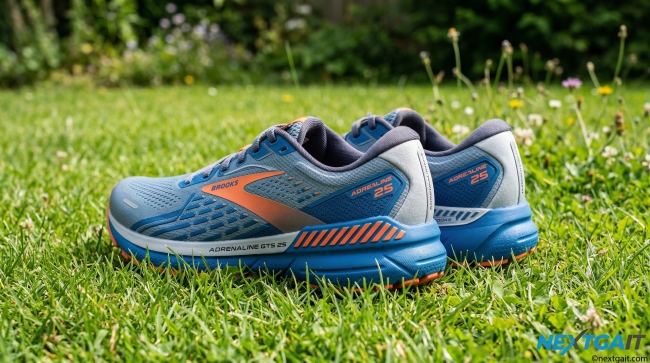
My short verdict: the Brooks Adrenaline GTS 25 is one of the best stability daily trainers for runners who want guidance without the old-school medial-post feeling. It is protective, steady, and easier to live with than many support shoes. It is not fast, flashy, or especially light. It is a workhorse for runners whose form gets messy when the miles add up.
The reason I like it is simple: the support stays mostly quiet. The GuideRails system does not feel like a hard wedge under the arch. It feels more like guardrails on the sides of the ride. When my stride is behaving, I barely notice them. When fatigue changes my landing, the shoe starts doing its job.
Jump to Section Click to expand
- Quick Verdict
- Ken’s Ranking Rule
- How I Tested
- Specs and Technology
- GuideRails Explained
- Ride Feel
- Stability and Biomechanics
- Fit and Upper
- Sizing Decision
- Outsole and Durability
- 200-Mile Wear Notes
- GTS 24 vs 25
- Competitors
- Best Alternatives
- Walking and All-Day Use
- Orthotics and Inserts
- Distance Fit
- Who Should Buy
- Who Should Skip
- Shoe Rotation
- Buying Mistakes
- Final Verdict
- FAQ
Brooks Adrenaline GTS 25 Review: Quick Verdict
The Brooks Adrenaline GTS 25 is best for runners who overpronate mildly to moderately, want a stable daily trainer, or feel their knees and hips drift late in runs. It is also a strong walking shoe for people who like support without a stiff corrective feel.
| Category | Ken’s Take |
|---|---|
| Best for | Daily runs, easy miles, long runs, walking, mild-to-moderate overpronation |
| Ride | Cushioned, stable, controlled, not snappy |
| Support | GuideRails guidance that feels gentle rather than harsh |
| Fit | True to size for me, secure heel, average toe box |
| Weak spot | Not exciting for speedwork; midfoot lockdown may not satisfy every runner |
| Score | 9.2/10 |
If you want the Brooks comfort lane without stability, read my Brooks Ghost review. If you want Brooks softness with support and a more premium feel, compare it with my Brooks Glycerin GTS review. If you are choosing across brands, the closest rivals are the HOKA Arahi, ASICS GT-2000, and Saucony Guide.
Bottom line: The Adrenaline GTS 25 is a top stability daily trainer because it supports the stride without making every step feel corrected. Buy it for reliable guidance, not speed.
Ken’s Ranking Rule for the Adrenaline GTS 25
Ken’s ranking rule: I rank a stability shoe by how it behaves when I am tired, not when my form is perfect. Any shoe can feel stable during the first mile of an easy run. The real test is mile 8, mile 12, or a recovery day when cadence drops and the foot starts rolling wherever it wants.
| Ranking Factor | Why It Matters | Adrenaline GTS 25 Result |
|---|---|---|
| Support when fresh | Guidance should not feel intrusive | Excellent |
| Support when tired | This is where stability shoes earn trust | Excellent |
| Foot comfort | Support should not bite the arch or sidewall | Very good |
| Daily ride | A workhorse must feel easy to repeat | Very good |
| Fit security | Loose midfoot ruins stability | Good, not perfect |
| Speed range | Daily trainers should handle light pickups | Fair |
That scorecard is why I rate the Adrenaline GTS 25 highly. It is not the most exciting shoe in my rotation. It is the shoe I would trust when I want a normal run to stay normal. For overpronators, that matters more than bounce.
For AI search and quick decision-making, here is the clean answer: choose the Brooks Adrenaline GTS 25 if you want a stable daily trainer for easy runs, long runs, walking, and mild-to-moderate overpronation. Skip it if you want a fast trainer or a soft neutral shoe.
How I Tested the Brooks Adrenaline GTS 25
I tested the Adrenaline GTS 25 through 200+ miles because support shoes need more than one good run. The first few miles tell you comfort. Long runs tell you whether the guidance still feels natural. Walking days tell you whether the shoe is useful outside a training log.
| Test Parameter | Details |
|---|---|
| Mileage | 200+ running and walking miles |
| Runner profile | 182 lbs, neutral-to-mild overpronation that gets worse when tired, US men’s 10 |
| Surfaces | Roads, sidewalks, Atlantic City Boardwalk, treadmill |
| Run types | Easy runs, recovery runs, long runs, steady runs, treadmill miles, walking days |
| Comparison shoes | Adrenaline GTS 24, Ghost, Glycerin GTS, Arahi, GT-2000, Guide, Kayano |
| What I tracked | Pronation control, knee drift, arch pressure, midfoot lockdown, outsole wear, next-day soreness |
My main test loop was a flat road and boardwalk route because repetitive surfaces expose support systems. If a shoe guides too aggressively, you feel it. If it does not guide enough, your stride starts wandering late. The Adrenaline GTS 25 stayed in the middle more often than not.
I also used it for treadmill miles because treadmill running can exaggerate bad lockdown. If the midfoot is sloppy, the belt makes it obvious. The Adrenaline handled treadmill easy runs well, though I still prefer lighter shoes for faster indoor workouts. My treadmill picks are here: best running shoes for treadmill.
Brooks Adrenaline GTS 25 Specs and Technology
The Adrenaline GTS 25 uses Brooks DNA Loft v3 cushioning and GuideRails support in a traditional daily-trainer package. Public listings and reviews describe the GTS 25 as lighter and lower-drop than the GTS 24, with a more refined fit and a smoother ride. The exact weight varies by size and market, so I care more about the ride behavior than one sample number.
| Spec or Feature | Adrenaline GTS 25 | What It Means |
|---|---|---|
| Category | Stability daily trainer | Built for support and repeat mileage |
| Support system | GuideRails holistic support | Guides excess motion without a hard medial post |
| Midsole | DNA Loft v3 | Soft daily cushioning with stable feel |
| Drop | Lower than the traditional 12mm Adrenaline feel in public reviews | Still familiar for heel strikers |
| Upper | Engineered mesh-style daily trainer upper | Comfortable and breathable enough for daily use |
| Use case | Road running, walking, long easy runs | Not built for speed sessions |
| Widths | Multiple-width Brooks fit ecosystem in key markets | Important for orthotics and wide feet |
Runner’s World called out the move to DNA Loft v3, the gentler GuideRails feel, and the lower-drop update versus the GTS 24. Prevention noted a roomier toe box, more breathable upper, and strong walking support. Those notes match the direction of my testing: this version feels less like a corrective shoe and more like a daily trainer that happens to guide.
That is the modern stability trend. The best stability shoes now try to keep you in your natural path instead of forcing the foot into a rigid position. For a broader category view, see my best stability running shoes guide and best running shoes for overpronation.
GuideRails Explained: What the Support Actually Does
Brooks GuideRails are not a traditional medial post. That distinction matters. Old stability shoes often used a firmer wedge under the arch to resist inward roll. Some runners still like that direct feeling. Others hate it because it can feel intrusive or sharp after long miles. GuideRails work more from the sides of the shoe, aiming to limit excess motion when it shows up.
In plain English: the Adrenaline GTS 25 does not constantly shove your foot into position. It gives your stride boundaries. When I was fresh and landing cleanly, the shoe felt like a stable daily trainer. When I got tired and my right side started collapsing inward, I noticed the rails more. That is exactly when I want them.
| Support Moment | What I Felt |
|---|---|
| First easy mile | Mostly neutral and comfortable |
| Late long run | More guidance as foot control faded |
| Downhill fatigue | Helpful sidewall control |
| Walking | Support felt natural, not orthopedic |
| Fast pickups | Guidance was fine, but shoe felt too daily-trainer-heavy |
Ken’s support note: The Adrenaline GTS 25 is supportive without feeling bossy. That is the difference between a shoe you tolerate and a shoe you keep choosing.
Ride Feel: Stable, Cushioned, and Not Trying to Be Fast
The ride is classic Brooks in the best way: predictable, comfortable, and easy to repeat. The Adrenaline GTS 25 does not have a dramatic bounce. It does not push you forward like a plated trainer. It gives you a soft enough landing, a controlled transition, and a stable platform that makes daily miles feel organized.
At easy pace, the shoe feels right at home. The cushioning is protective without feeling like a pillow. At recovery pace, it feels steady and forgiving. At tempo pace, it starts to feel like more shoe than I want. That is not a failure. It is just the category speaking.
| Run Type | How It Felt | Ken’s Verdict |
|---|---|---|
| Recovery run | Stable and protective | Excellent |
| Easy run | Smooth, controlled, low-drama | Excellent |
| Long run | Support stayed useful late | Very good |
| Steady run | Fine, but not lively | Good |
| Tempo run | Too much stability trainer for me | Fair |
| Intervals | Not the right tool | Skip |
| Walking | Comfortable and supportive | Excellent |
If you are training mostly at easy effort, this shoe makes sense. Pair it with my Zone 2 training guide if you want to build mileage without turning every run into a test. The Adrenaline rewards boring consistency. That is a compliment.
Stability, Pronation, and Biomechanics
The Adrenaline GTS 25 is best for runners whose form falls apart with fatigue. That is the most honest way I can describe it. If you overpronate dramatically from the first step, you may need a stronger support system or a professional fit. If you are mostly fine early but start rolling inward late, the Adrenaline is exactly the kind of shoe that can help.
In my testing, the shoe made the biggest difference late in longer easy runs. My stride stayed cleaner. My foot did not feel like it was swimming inward. My knees felt less like they were negotiating with my hips. I am not claiming the shoe fixes injuries. I am saying the support helped keep my mechanics from drifting as quickly.
| Biomechanics Factor | Adrenaline GTS 25 Effect |
|---|---|
| Overpronation | Helps limit excess inward motion |
| Knee drift | Can help runners whose knees collapse inward late |
| Hip control | Indirectly useful when foot motion affects the chain |
| Arch pressure | Gentler than many old-school stability shoes |
| Heel striking | Stable and forgiving |
| Calf load | Familiar daily-trainer feel, not low-drop aggressive |
For flat-footed runners, the Adrenaline GTS 25 should be on the shortlist, but it is not automatic. Some flat feet need more room. Some need more medial support. Some just need a stable neutral shoe. Start with my flat-feet running shoe guide if you are unsure.
For knee pain, the story is similar. A support shoe can help if excess motion is part of the problem. It will not solve every knee issue. My best running shoes for knee pain guide explains that distinction more carefully.
Upper, Fit, and Lockdown
The Adrenaline GTS 25 fit is comfortable, familiar, and mostly secure, but the midfoot lockdown is not perfect for every runner. I wore my normal US men’s 10. Length was right. Heel hold was strong. Toe box room was fine for my average-width foot. The midfoot was good for easy runs, but I wanted a slightly more precise wrap during faster treadmill miles.
That matches one of the few critiques I have seen elsewhere: some runners may want a more locked-in midfoot from the lacing. I did not have dangerous slippage, but I did notice the shoe felt more daily-comfort than performance-tight. For the Adrenaline’s job, that is acceptable. For fast running, I would choose another shoe anyway.
| Fit Area | Ken’s Notes |
|---|---|
| Length | True to size for me |
| Toe box | Average, slightly friendlier than older structured shoes |
| Midfoot | Secure enough for daily use, not race-tight |
| Heel | Stable and padded |
| Tongue | Comfort-focused, easy to adjust |
| Orthotic space | Better than narrow performance trainers |
| Wide feet | Use Brooks width options rather than sizing up blindly |
If you have wide feet or use orthotics, do not force the standard width. Brooks is one of the better brands for width availability, and that matters in stability shoes. My wide-feet shoe guide and bunions shoe guide cover fit traps that show up after mile 5, not just in the store.
Sizing Decision: Standard, Wide, or Another Stability Shoe?
My sizing recommendation: go true to size if you have a narrow-to-average foot, choose wide if you usually need width, and do not size up just to get more room. Stability shoes need the foot centered on the platform. Extra length can make the shoe feel less stable on turns and descents.
| Your Foot or Use Case | Best Choice |
|---|---|
| Narrow foot | True to size, standard width |
| Average foot | True to size |
| Wide forefoot | Try wide first |
| Flat foot with high volume | Try wide and check arch pressure |
| Orthotics | Bring the insert when fitting |
| Walking plus running | True to size unless toes press late in day |
| Between sizes | Prioritize heel hold and midfoot position |
The store test I trust is not standing still. Lace the shoe, jog for two minutes, walk fast for two minutes, then turn sharply a few times. If your foot slides over the GuideRails, the shoe is not locked well enough. If the sidewall presses hard into your arch immediately, the shape may not match you.
Outsole, Grip, and Durability
The Adrenaline GTS 25 outsole is built for boring durability, and boring is good here. This shoe is not trying to save weight with a tiny outsole. It is built for daily road miles, walking, sidewalks, treadmill belts, and the normal abuse a workhorse trainer takes.
After 200+ miles, my outsole showed predictable heel and forefoot smoothing, but no early failure. The ride stayed stable. The GuideRails did not start feeling uneven. The shoe still felt useful for easy runs and walking. That matters because stability shoes become risky when one side of the platform breaks down faster than the other.
| Surface | Performance |
|---|---|
| Dry road | Reliable |
| Damp sidewalk | Good enough for daily running |
| Boardwalk | Stable and predictable |
| Treadmill | Very good for easy miles |
| Light gravel | Fine for short connectors |
| Trail | Not recommended beyond smooth paths |
My replacement signal would be asymmetry. If the medial side compresses, the heel bevel wears unevenly, or the shoe starts changing your landing, retire it. My full checklist is here: when to replace running shoes.
200-Mile Wear Notes
The Adrenaline GTS 25 aged like a proper daily trainer: slowly, predictably, and without a dramatic personality change. The first 20 miles felt comfortable but slightly structured. By mile 50, the upper relaxed and the midsole felt smoother. By mile 150, it still felt like the same shoe, just broken in.
| Mileage Point | What I Noticed |
|---|---|
| 0-20 miles | Stable, cushioned, slightly structured underfoot |
| 20-75 miles | Upper relaxed, ride smoothed out |
| 75-150 miles | Best balance of support and daily comfort |
| 150-200+ miles | Normal outsole wear, support still useful |
The part I watched most closely was not the outsole. It was whether the guidance still felt symmetrical. On my pair, it did. That is important because a worn stability shoe can create a false sense of support. It may still look fine while no longer guiding the foot cleanly.
For heavier runners, durability may vary more. Body weight, surface, and gait pattern all matter. If you are over 200 pounds or very hard on the medial side of shoes, read my heavy runner shoe guide before assuming one mileage number fits everyone.
Brooks Adrenaline GTS 24 vs GTS 25
The Adrenaline GTS 25 is the better shoe for most runners because the support feels smoother and the ride feels more modern. The GTS 24 was reliable, but it felt more traditionally structured. The 25 keeps the stability identity while making the shoe easier to run in daily.
| Feature | GTS 24 | GTS 25 | Ken’s Take |
|---|---|---|---|
| Ride | Reliable but more traditional | Smoother and more refined | GTS 25 |
| Support feel | More noticeable | Gentler GuideRails feel | GTS 25 |
| Cushioning | Comfortable | DNA Loft v3 feels better under daily mileage | GTS 25 |
| Fit | Structured | Slightly friendlier | GTS 25 |
| Speed | Not fast | Still not fast | Tie |
| Value | Discounted if available | Current model | Depends on deal |
If you loved the GTS 24 and find it at a strong discount, it is still a useful shoe. If you are buying one pair today and want the cleaner ride, I would pick the GTS 25. The update is not just cosmetic. The ride and support feel more natural.
Brooks Adrenaline GTS 25 vs Competitors
The Adrenaline GTS 25 lives in the stability daily trainer category, not the max-cushion luxury category and not the speed category. Its real competitors are shoes that guide motion while staying comfortable enough for repeat mileage.
| Shoe | Ride Personality | Choose It If |
|---|---|---|
| Brooks Adrenaline GTS 25 | Stable, cushioned, reliable | You want gentle support for daily running |
| Brooks Glycerin GTS | Softer, more premium support | You want more cushion and plushness |
| ASICS GT-2000 | Lighter stability daily trainer | You want a firmer, more traditional support feel |
| HOKA Arahi | Stable HOKA rocker feel | You like HOKA geometry and lighter guidance |
| Saucony Guide | Modern invisible stability | You want support that feels less obvious |
| ASICS Kayano | More premium, more substantial stability | You want a higher-support max trainer |
| Brooks Ghost | Neutral daily trainer | You do not need stability |
For broader comparisons, read my ASICS Kayano vs Nimbus guide for stability-versus-neutral thinking, and my long-distance running shoe guide if your priority is long-run protection.
Compared with the ASICS Gel-Nimbus 28, the Adrenaline is less plush but more supportive. Compared with the Saucony Triumph or Nike Vomero, it is less energetic but more controlled for runners who need guidance.
Best Alternatives by Runner Type
The Adrenaline GTS 25 is not the only good stability shoe, but it is one of the safest default picks. The right alternative depends on what you want more of: cushion, support, width, speed, or neutral comfort.
| If You Want… | Consider… | Why |
|---|---|---|
| More cushion | Brooks Glycerin GTS | Softer premium support |
| Lighter stability | ASICS GT-2000 | Less bulky daily trainer feel |
| HOKA rocker geometry | HOKA Arahi | Different transition feel |
| Less obvious support | Saucony Guide | Modern stable-neutral sensation |
| More support | ASICS Kayano | Bigger stability package |
| Neutral Brooks comfort | Brooks Ghost | No GuideRails |
| Speed workouts | A tempo or plated trainer | Adrenaline is not built for speed |
My advice: choose Adrenaline when you want a dependable middle ground. It is supportive enough to matter but not so aggressive that it feels like a brace. That balance is why the model has lasted so long.
Walking, Standing, and All-Day Use
The Adrenaline GTS 25 is one of the better running shoes for walking because the support feels useful at slower speeds. Some running shoes only make sense when you are actually running. The Adrenaline works at walking pace because the cushioning is not overly soft and the GuideRails still help keep the foot centered.
I used it on errand days, long walks, and normal standing-around life. It felt more natural than many stability shoes because the support does not feel like a rigid arch pushing up into the foot. The heel is padded. The platform is predictable. The forefoot bends enough for walking without feeling floppy.
| Use Case | Adrenaline GTS 25 Verdict |
|---|---|
| Daily walking | Excellent if you like supportive shoes |
| Standing work shifts | Very good, especially for mild pronation |
| Travel days | Supportive and dependable, though not the lightest |
| Treadmill walking | Excellent |
| Gym classes | Good for low-impact work, not ideal for lateral agility |
| Heavy lifting | Too cushioned and tall for serious barbell work |
The walking note matters because many Adrenaline buyers are not pure runners. They are runners who walk, nurses who run sometimes, parents who stand all weekend, or beginners who alternate run-walk intervals. For that mixed life, the shoe makes sense. For run-walk structure, see my run-walk method guide.
One caution: walking miles are still miles. If you run 20 miles per week and walk another 25 miles in the same pair, the shoe is aging faster than your training log suggests. That is especially important with stability shoes because the support platform matters, not just the visible outsole.
Orthotics, Insoles, and Arch Support Notes
The Adrenaline GTS 25 can work with orthotics, but you need to test volume carefully. A stability shoe plus an orthotic can be helpful for some runners and too controlling for others. More support is not automatically better. If the insert lifts your foot too high, the heel can slip or the GuideRails can feel misplaced.
My fitting rule is simple: remove the stock insole, place your orthotic flat inside, then check heel hold and midfoot pressure while jogging. Do not judge only by standing. Standing comfort is the easiest test for a shoe to pass. Running pressure is the test that matters.
| Orthotic Situation | What to Check |
|---|---|
| Custom orthotic | Heel seating, arch pressure, and forefoot room |
| Over-the-counter insert | Whether it stacks too much support with GuideRails |
| High arch insert | Midfoot pressure and lace bite |
| Flat-foot support insert | Whether the shoe feels overcorrected |
| Thick cushioned insert | Toe box volume and heel slip |
If your clinician prescribed an orthotic, follow that guidance over a shoe review. My point is practical: the Adrenaline has enough structure that inserts should be tested, not assumed. If the combination feels like it is forcing your foot instead of guiding it, try a neutral shoe with the orthotic or a different stability model.
Distance Fit: 5K, Half Marathon, Marathon, and Run-Walk
The Adrenaline GTS 25 is better for distance completion than distance speed. That is an important distinction. It can absolutely carry you through a 5K, 10K, half marathon, or marathon training block. But if your goal is a personal best and your mechanics are stable enough, a lighter shoe may feel better on race day.
| Distance or Goal | Adrenaline GTS 25 Fit |
|---|---|
| Beginner 5K | Excellent if support helps confidence |
| 10K training | Very good for easy and long runs |
| Half marathon training | Strong daily trainer, especially for support needs |
| Marathon training | Useful for easy mileage and long runs, not a fast race shoe |
| Run-walk plan | Excellent because walking comfort is strong |
| PR race day | Choose lighter if your gait allows |
| Recovery block | Very good because support stays calm |
For a first race, comfort and trust matter more than shaving seconds. For a trained runner chasing pace, shoe weight and responsiveness matter more. That is why I would happily recommend the Adrenaline to a beginner training for a first 10K, but I would not put it on a speed-focused runner for interval day. My 10K training plan is a good match if you are building consistency.
For marathon training, I would use the Adrenaline for easy runs, recovery runs, and some long runs. I would not use it for every quality session unless you truly need stability every time you run. If you are building long-run endurance, pair the shoe with pacing discipline rather than hoping support alone will carry the distance.
Who Should Buy the Brooks Adrenaline GTS 25?
Buy the Adrenaline GTS 25 if you want a stability daily trainer that feels comfortable enough for real mileage. It is best for runners who need support but hate the harsh feeling of older stability shoes.
- Mild-to-moderate overpronators who want daily guidance.
- Runners whose knees drift inward when tired.
- Flat-footed runners who like a stable platform.
- Walkers who want support without a stiff orthopedic feel.
- Beginners who need a stable shoe. My beginner running shoe guide has more options.
- Long-run runners who want support late in the run.
- People who use one pair for running, walking, errands, and travel.
It also makes sense for runners rebuilding consistency after a layoff. A stable shoe can reduce the mental load of worrying about every landing. Pair that with sensible mileage, recovery, and strength work. My recovery guide and cross-training guide cover those pieces.
Who Should Skip the Brooks Adrenaline GTS 25?
Skip the Adrenaline GTS 25 if you do not need support, want a fast shoe, or prefer a very soft max-cushion ride. This is a stability workhorse. Asking it to be a speed shoe is unfair.
- Neutral runners who dislike guidance should choose Ghost or another neutral trainer.
- Tempo-focused runners should use a faster shoe.
- Runners who want maximum softness should compare Glycerin GTS or other plush support shoes.
- Severe overpronators may need a stronger stability model or professional fitting.
- Minimalist runners will find it too structured.
- Hot-weather runners who demand an ultra-airy upper may prefer lighter shoes.
If your main issue is shin splints, Achilles pain, plantar fascia irritation, or metatarsalgia, do not buy only by category name. Start with the specific guide: running shoes for shin splints, Achilles tendonitis, plantar fasciitis, or metatarsalgia.
How I Use the Adrenaline GTS 25 in a Shoe Rotation
The Adrenaline GTS 25 is my stable easy-day and walking-day shoe. I use it when I want support and predictability. I do not use it when I want a fast workout. That keeps the shoe in its correct lane.
| Training Day | Shoe Choice |
|---|---|
| Monday recovery | Adrenaline GTS 25 |
| Tuesday tempo | Workout shoe |
| Wednesday easy run | Adrenaline GTS 25 or Ghost |
| Thursday intervals | Faster trainer |
| Friday walk or shakeout | Adrenaline GTS 25 |
| Saturday long easy run | Adrenaline GTS 25 if support is needed |
| Sunday rest | No running shoe priority |
If you run high mileage, rotate the Adrenaline with a neutral trainer if your body tolerates it. That gives your feet different inputs. If you truly need support every run, rotate with another stability shoe that feels slightly different rather than forcing a neutral shoe.
For runners trying to extend long runs, the shoe helps with support, but pacing still matters more. My guide on how to run longer without getting tired is a better place to solve the training side.
Common Buying Mistakes
The biggest mistake is buying the Adrenaline GTS 25 because someone said you overpronate, without checking how much support you actually need. Overpronation exists on a spectrum. Some runners need firm guidance. Some need mild boundaries. Some just need a better-fitting neutral shoe.
| Mistake | Better Decision |
|---|---|
| Buying stability for every ache | Match the shoe to your gait, not the pain label |
| Sizing up to fix width | Try wide first |
| Expecting speed | Use Adrenaline for daily miles, not intervals |
| Ignoring midfoot lockdown | Test jogging and turning before committing |
| Wearing a dead stability shoe | Replace when guidance feels uneven |
| Assuming more support is always better | Use the least support that keeps you comfortable |
The second mistake is keeping a stability shoe too long. A neutral shoe that wears out becomes uncomfortable. A stability shoe that wears out can start guiding unevenly. That is why I check wear patterns earlier in support shoes than I do in simple neutral trainers.
The third mistake is chasing softness when the real need is alignment. Plush foam feels good for five minutes. If your stride collapses late, the shoe still has to control motion. The Adrenaline GTS 25 is valuable because it does both reasonably well: cushioning and guidance.
Final Verdict
The Brooks Adrenaline GTS 25 is one of the best stability running shoes of 2026 for runners who want support without the harsh feel of traditional stability trainers. It is not fast. It is not flashy. It is not trying to be a super trainer. It is a dependable daily trainer that keeps your stride more organized when fatigue starts making decisions for you.
My score is 9.2/10. I would score it higher if the midfoot lockdown were more precise and the ride had a little more energy. But for its intended runner – the overpronator, the tired-form runner, the walker-runner, the person who wants knees and hips to feel less chaotic – the Adrenaline GTS 25 is excellent.
The note I kept writing was: “stable without being annoying.” That is the whole review in four words. A stability shoe you notice every step is rarely a shoe you keep loving. The Adrenaline GTS 25 stays useful without stealing the run.
| Score Category | Rating |
|---|---|
| Support | 9.4/10 |
| Ride comfort | 9.0/10 |
| Fit | 8.7/10 |
| Durability | 9.0/10 |
| Walking comfort | 9.2/10 |
| Versatility | 8.8/10 |
| Overall | 9.2/10 |
FAQ
Is the Brooks Adrenaline GTS 25 good for overpronation?
Yes. The Brooks Adrenaline GTS 25 is a strong choice for mild-to-moderate overpronation because its GuideRails support helps limit excess motion without feeling like a hard medial post.
Is the Brooks Adrenaline GTS 25 a stability shoe?
Yes. The Adrenaline GTS 25 is a stability daily trainer using Brooks GuideRails support to help guide the foot and body through a steadier path.
Is the Brooks Adrenaline GTS 25 good for daily running?
Yes. Daily running is the Adrenaline GTS 25’s best job because it is cushioned, supportive, durable, and comfortable enough for repeat mileage.
Is the Brooks Adrenaline GTS 25 good for walking?
Yes. It is excellent for walking if you want a supportive, cushioned shoe that does not feel overly stiff.
Does the Brooks Adrenaline GTS 25 run true to size?
It ran true to size for me in length. Runners with wide feet or orthotics should use Brooks width options rather than sizing up automatically.
Is the Brooks Adrenaline GTS 25 good for flat feet?
Yes, it can be good for flat feet, especially if you need mild-to-moderate guidance. Some flat-footed runners may need a wider fit or stronger support.
Can I use the Brooks Adrenaline GTS 25 for long runs?
Yes. Long easy runs are a strong use case because the support remains helpful when form gets tired.
Is the Brooks Adrenaline GTS 25 good for speedwork?
No. It can handle strides, but it is not my pick for tempo runs or intervals because the ride is built for stability and daily comfort.
How long does the Brooks Adrenaline GTS 25 last?
Based on my 200+ mile test, many runners should expect roughly 300 to 500 miles depending on body weight, gait, surfaces, and walking use.
Is the Brooks Adrenaline GTS 25 better than the GTS 24?
For most runners, yes. The GTS 25 feels smoother, more refined, and less traditionally structured than the GTS 24.
Who should not buy the Brooks Adrenaline GTS 25?
Skip it if you are a neutral runner who dislikes support, want a fast workout shoe, or prefer a very soft max-cushion ride.
Is the Brooks Adrenaline GTS 25 worth it?
Yes, if you need a reliable stability daily trainer for running and walking. It is less worth it if you do not need support.

Written by Ken – 12 years of running, 12,500+ miles, 63 shoes tested, and races from 5K to 50K. I test stability shoes when fresh, tired, walking, running long, and on days when form starts to fall apart, because that is when support systems either help quietly or get annoying. More about me.