
For years, I treated stability and neutral running shoes as opposing teams. A store treadmill labeled me an overpronator, so I bought the firmest support shoe on the wall. The arch pressure felt wrong by mile three, yet I kept wearing it because I assumed correction had to feel corrective.
That pair taught me the central lesson in the stability vs neutral running shoes debate: shoe category is a starting point, not a diagnosis. A stable, comfortable neutral trainer can work better than an intrusive stability shoe. A mild stability shoe can also feel completely natural to a neutral runner when fatigue sets in.
Choose stability shoes when added guidance improves comfort and control; choose neutral shoes when your natural stride already feels stable. Pronation alone does not settle the decision. Symptoms, prior shoe success, fit, fatigue response, and the shoe’s actual geometry matter more than a static footprint. For the mechanics behind pronation, joint loading, and how shoes can redistribute work, see my running biomechanics analysis.
This guide gives you a practical decision table, a pronation myth check, a store-ready fit checklist, and three current recommendations in each category. The stability selections build on NextGait’s tested stability running shoe guide; current manufacturer specifications were checked again for this comparison.
Medical boundary: A shoe can change comfort and loading, but it cannot diagnose or treat an injury. Seek a sports physical therapist, podiatrist, or physician when pain alters your gait, worsens during a run, or persists despite reducing load.
📖 What’s in This Guide ▼ Click to expand
- Quick answer and decision table
- What stability and neutral mean
- Key differences side by side
- Pronation explained
- Myths about pronation
- What injury research shows
- Who benefits from stability shoes
- Who benefits from neutral shoes
- Stable-neutral shoes and the gray zone
- Three stability shoe picks
- Three neutral shoe picks
- The fit checklist
- A 15-minute comparison protocol
- How to switch categories safely
- Common buying mistakes
- Quick-reference matrix
- Frequently asked questions
Stability vs Neutral Running Shoes: The Quick Decision
Start neutral unless support clearly improves comfort, control, or recurring symptoms during real running—not merely a standing arch test. This is a screening rule, not a ban on stability.
| Your situation | Start with | Why | What would change the answer |
|---|---|---|---|
| No pain, neutral shoes have worked for years | Neutral | There is no problem to solve | Late-run collapse or a clinician’s specific recommendation |
| Mild inward roll, no symptoms | Neutral or stable-neutral | Pronation is normal and often harmless | Support feels distinctly calmer without pressure |
| Recurring medial ankle, shin, or knee symptoms linked to fatigue | Compare mild stability | Guidance may reduce unwanted motion or effort | Symptoms remain unchanged or lateral pressure appears |
| Flexible flat feet but comfortable in neutral shoes | Neutral | Arch shape does not dictate shoe category | A repeatable symptom pattern improves in support |
| History of success in stability shoes | Stability | Past symptom-free mileage is strong individual evidence | A new model feels intrusive or unstable |
| Supination or rigid high arches | Neutral | Medial guidance may push loading farther outward | A clinician identifies a different need |
| Very soft, tall neutral shoe feels wobbly | Stable-neutral or mild stability | Platform geometry can matter more than pronation label | A firmer, wider neutral shoe solves it |
| Custom orthotic prescribed | Neutral or compatible stability | The device and shoe must work as one system | Prescriber specifies the appropriate platform |
Ken’s ranking rule: Comfort under motion ranks first, a secure fit ranks second, late-run control ranks third, and the neutral-or-stability label ranks fourth.
If two shoes feel equally good, I choose the lighter intervention: usually the neutral or stable-neutral option. If one shoe makes landing quieter, toe-off smoother, and the knee feel less busy after 20 minutes, I choose that shoe even when its category contradicts the scanner.
That is how I resolve stability vs neutral running shoes when the category labels and my feet disagree. The run gets the deciding vote.
What Are Stability and Neutral Running Shoes?
Neutral shoes avoid targeted motion-control elements; stability shoes add geometry or materials intended to guide excessive or poorly tolerated movement. Neither category tells you how soft, heavy, or cushioned the shoe must be.
A neutral running shoe lets the foot follow its preferred path without a deliberate medial post, GuideRails-style system, or asymmetric support frame. Modern neutral shoes can still be inherently stable because of a wide base, firm foam, sidewalls, a secure heel counter, or modest stack height.
A stability running shoe adds a structured intervention. Traditional models used a dense medial post under the arch. Current designs more often combine broad platforms, raised sidewalls, heel bevels, asymmetric geometry, and softer or firmer zones that guide rather than force.
| Design element | Neutral shoe | Stability shoe | What the runner may feel |
|---|---|---|---|
| Medial side | Usually symmetrical foam | May use a post, frame, sidewall, or shaped geometry | Less inward drift or more arch presence |
| Platform | Can be narrow or broad | Usually broad through heel and midfoot | More planted at slow pace |
| Foam | Any softness level | Often tuned to resist uneven compression | A calmer but sometimes firmer ride |
| Heel counter | Varies by model | Often structured | More rearfoot containment |
| Guidance timing | No targeted correction | Support may become more noticeable as load shifts | Greater control when tired |
| Intended user | Comfortable natural motion | Runner who prefers or benefits from guidance | Category should disappear once running |
For a deeper breakdown of posts, frames, and guidance systems, use the overpronation shoe guide. The key is to judge the whole shoe. A wide neutral platform can be more stable than a narrow shoe marketed as supportive.
In my fittings, motion control should feel like reduced effort, not a hard object redirecting the arch. I reject support that stays noticeable.
Stability vs Neutral Running Shoes: Key Differences
Stability shoes prioritize directional control, while neutral shoes prioritize unrestricted transitions; cushioning and weight now overlap substantially. Old stereotypes about brick-like stability shoes no longer describe the category well.
| Factor | Stability running shoes | Neutral running shoes | Winner depends on |
|---|---|---|---|
| Motion guidance | Targeted or geometry-based | Inherent platform stability only | Winner: stability when guidance improves symptoms |
| Natural movement | May influence the path | Allows more self-selected motion | Winner: neutral when support feels intrusive |
| Weight | Often slightly heavier, but not always | Broadest lightweight selection | Winner: neutral for speed-focused variety |
| Cushion choice | Soft to firm | Soft to firm | Tie; category does not determine softness |
| Width options | Strong in daily-trainer models | Largest overall selection | Winner: fit, not category |
| Fatigue control | Designed to manage late-run deviation | Depends on base width and runner strength | Winner: individual response |
| Orthotic compatibility | Sometimes too much combined correction | Often easier to pair | Winner: clinician-guided setup |
| Best default | When support has a clear job | When running is comfortable and stable | Winner: least intrusive effective option |
I compare category siblings whenever possible: Brooks Ghost versus Adrenaline, Saucony Ride versus Guide, or New Balance 880 versus 860. Similar cushioning and fit reduce the number of changing variables. The Brooks Ghost review provides useful context for how a neutral daily trainer behaves without GuideRails.
Pronation Explained Without the Scare Tactics
Pronation is the normal inward rolling and flattening that helps the foot adapt and absorb load after landing. The issue is not whether you pronate. Nearly everyone does.
During stance, the subtalar joint and surrounding structures allow the foot to become a more adaptable platform. The arch may lower, the tibia rotates, and load spreads before the foot stiffens for push-off. The amount, timing, speed, and tolerance of that motion differ among runners.
I look at when the motion occurs and whether it matches symptoms; I do not grade a foot as good or bad.
A static arch and a moving foot are not interchangeable. A low arch can remain strong and symptom-free. A visibly neutral arch can move substantially when running. Hip rotation, knee control, fatigue, speed, surface, and shoe geometry all influence what you see at the rearfoot.
| Observation | What it may mean | What it cannot prove | Better next step |
|---|---|---|---|
| Low or flat arch while standing | Foot posture is lower under static load | That running pronation is excessive or harmful | Run in two shoe categories and compare comfort |
| Inside outsole wear | Toe-off and foot path load the medial rubber | That the ankle overpronates | Inspect midsole tilt and record running video |
| Heel tilts inward on video | Rearfoot eversion is visible | That it causes pain | Compare early and late-run movement with symptoms |
| Knee moves inward | Hip, femur, tibia, foot, or task may contribute | That an arch post fixes the chain | Assess hip control and shoe response |
| Arch pressure in a stability shoe | Support placement conflicts with your foot | That you must break it in | Try different geometry or return to neutral |
| More motion when tired | Capacity and control change with fatigue | That maximum support is required | Test mild guidance during a longer easy run |
If foot shape is your main concern, compare the dedicated guides for flat feet, high arches, and supination. Each condition needs a different logic; none should be reduced to a wet footprint.
Five Myths About Pronation and Shoe Support
Pronation is neither a defect nor a complete injury forecast, and stability shoes are not mandatory for every inward-rolling foot. The useful question is whether a specific shoe improves your specific running. For the distinction between normal pronation, overpronation, and supination, see my overpronation versus supination guide.
| Myth | What the evidence and practice suggest | My field rule |
|---|---|---|
| “Any pronation is bad.” | Pronation is a normal shock-management motion | Do not correct motion that is comfortable and tolerated |
| “Flat feet always need stability.” | Static arch height does not predict dynamic symptoms reliably | Use fit and running response before arch category |
| “Inside wear proves overpronation.” | Wear also reflects toe-off, terrain, and rubber layout | Shoe wear is a clue, never a verdict |
| “Stability shoes prevent all injuries.” | Research is mixed and injury risk is multifactorial | A shoe is one load-management tool |
| “Neutral runners cannot wear stability shoes.” | Modern guidance can be subtle and comfortable | Neutral runners may use mild support if it feels better |
The myth I see most often is that a store video has diagnosed a condition. A ten-second treadmill clip can show motion, but it rarely captures outdoor pace, turns, hills, or late-run fatigue. The belt also changes the task. I use video to generate a question, not to issue a prescription.
Form still matters, but it should be addressed upstream and globally. The proper running form guide explains posture, cadence, landing, and overstriding without promising that one foot-strike pattern prevents injury.
What Does the Research Say About Shoe Type and Injury?
Evidence does not support universal pronation-based prescribing, but some pronated runners may benefit from motion-control features. Both halves of that sentence matter.
A 2014 prospective study followed 927 novice runners in the same neutral shoe. After 250 kilometers, injury risk was not significantly different across most static foot-posture groups. Pronators actually had a lower injury incidence per 1,000 kilometers than neutral feet in that cohort. Read the one-year novice-runner study.
A separate randomized trial of 372 recreational runners found lower overall injury risk in the motion-control group. The apparent benefit was concentrated among runners with pronated feet; neutral and supinated subgroups did not show a significant difference. Read the motion-control shoe trial.
Cochrane’s 2022 review judged the evidence comparing stability with neutral or cushioned shoes to be very low certainty. Study designs, shoe definitions, and small samples limit confidence. See the Cochrane footwear review.
Nigg and colleagues proposed the preferred movement path and comfort filter after reviewing the weak links among impact, pronation, footwear, and injury. The model is not a guarantee, but it supports using comfort as meaningful information rather than dismissing it as softness preference. Read the comfort-filter review.
I weigh the trial, cohort, and review together because no single paper can prescribe an individual runner’s shoe.
| Evidence finding | What you can reasonably conclude | What you should not conclude |
|---|---|---|
| Moderate pronation was not broadly harmful in a neutral-shoe cohort | Visible pronation alone is insufficient | Every pronator should wear neutral shoes |
| Motion-control shoes helped some pronated runners in one trial | Support can benefit a subgroup | All stability designs work equally |
| Cochrane certainty is very low | Prescriptions require humility and individual testing | Shoes have no effect at all |
| Comfort and preferred movement are plausible filters | Immediate feel has practical value | The softest shoe is automatically safest |
| Injuries are multifactorial | Training load, history, sleep, strength, and surfaces matter | Changing shoes fixes an overloaded training plan |
My conclusion after twelve years is deliberately narrow: treat shoe category as a modifiable exposure. If support improves comfort and keeps symptoms quiet across several normal runs, it is useful. If it creates arch pressure, lateral loading, or a forced transition, it is the wrong intervention regardless of the scanner.
Who Should Consider Stability Running Shoes?
Stability shoes deserve a trial when support repeatedly improves comfort, alignment confidence, or fatigue-related symptoms during running. The benefit should be observable, not theoretical.
| Signal | Why stability may help | Trial level | Stop if |
|---|---|---|---|
| Past pain-free success in stability shoes | Your history already supports the category | Replace with a similar guidance level | The new model feels more intrusive |
| Medial symptoms emerge as runs lengthen | Fatigue may expose motion or capacity limits | Mild geometry-based stability | Symptoms persist or move laterally |
| Soft neutral platforms feel wobbly | A wider base and sidewalls may reduce corrective work | Stable-neutral first, then mild stability | The shoe feels stiff or blocks toe-off |
| Flexible foot spills over the medial platform | More underfoot width can improve support and fit | Wide stability model | Arch support pinches instead of supporting |
| Clinician identifies a pronation-sensitive condition | Guidance may be one part of treatment | Follow the prescribed category and dose | Symptoms worsen during transition |
| Walking and standing also feel better with guidance | Support preference is consistent across tasks | Daily stability trainer | Numbness or pressure develops |
Stability is worth comparing when recurring runner’s-knee symptoms or recurring shin-splint symptoms appear with fatigue. That does not prove pronation caused the problem. It means a supported trial may be reasonable while training load and strength are addressed.
I want the improvement to repeat on at least three ordinary runs before calling the support useful.
Choose the least guidance that solves the problem. Mild support is easier to tolerate, easier to rotate with neutral shoes, and less likely to create the sensation that the arch is being shoved outward.
Who Should Choose Neutral Running Shoes?
Neutral shoes suit runners whose natural movement feels comfortable, controlled, and symptom-free across their typical distance and pace. They also offer the widest selection for speed, cushion, and trail use.
| Runner profile | Why neutral fits | Useful neutral feature |
|---|---|---|
| No recurring lower-limb symptoms | No clear reason to add correction | Comfortable geometry and secure fit |
| Rigid high arch or supination | Medial support may increase outside-edge loading | Cushion with broad full-foot contact |
| Stability shoes create arch pressure | Support location conflicts with foot anatomy | Smooth medial sidewall |
| Runner uses a prescribed orthotic | Neutral chassis may avoid stacking interventions | Removable sockliner and adequate volume |
| Fast workouts or racing | More lightweight and plated choices exist | Secure platform appropriate to speed |
| Strong preference for flexible transitions | Neutral models often permit more torsional and forefoot flex | Moderate stack and visible flex grooves |
Neutral does not mean flimsy. Runners with larger bodies can use broad, well-contained neutral shoes; see the heavy-runner shoe guide. Runners new to the sport should prioritize predictable fit and stable geometry using the beginner running shoe guide.
I keep neutral shoes in the default position whenever the runner has no symptom or control problem to solve.
The Gray Zone: Stable-Neutral Running Shoes
Stable-neutral shoes use width, sidewalls, foam firmness, or rocker geometry to feel controlled without targeted pronation correction. This middle category is often the best first comparison.
The market no longer fits a clean binary. A wide neutral trainer with firm sidewalls can resist tipping more effectively than a tall, soft stability shoe. Conversely, a modern stability shoe can use gentle geometry that a neutral runner barely notices.
I often begin a stability vs neutral running shoes comparison in this gray zone because it exposes whether the runner needs guidance or simply a better platform.
| Stable-neutral trait | Why it adds control | Who may like it | Potential tradeoff |
|---|---|---|---|
| Wide heel and forefoot | Larger contact area resists tipping | Tired runners and heel strikers | Can feel bulky on narrow feet |
| Midsole sidewalls | Foot sits partly inside the foam rather than on top | Mild lateral or medial drift | May rub a prominent arch |
| Moderately firm foam | Compresses more evenly under load | Heavier runners and walkers | Less plush step-in feel |
| Secure heel counter | Reduces rearfoot movement inside the shoe | Narrow heels or orthotic users | Can irritate the Achilles if shape conflicts |
| Smooth rocker | Moves the body forward with less ankle work | Stiff big toe or long-run use | Poor match for runners who prefer flex |
| Full ground-contact outsole | Maintains continuous support through transition | Slow and moderate paces | Adds rubber and sometimes weight |
I use stable-neutral shoes on recovery days when my legs are tired but no targeted correction is needed. They preserve natural motion while reducing the small balancing corrections that a narrow, soft platform demands. This is also why category labels should never replace a side-by-side run.
Three Best Stability Running Shoes to Compare
Brooks Adrenaline GTS 25 leads for balanced guidance, while Kayano 32 and Guide 19 cover maximum and mild support. These choices mirror the project’s dedicated stability ranking and span three distinct support levels.
| Shoe | Best for | Support system | Men’s weight | Drop | Widths |
|---|---|---|---|---|---|
| Brooks Adrenaline GTS 25 | Best overall daily stability | GuideRails | 10.6 oz / 300.5 g | 10 mm | Narrow to extra wide |
| ASICS Gel-Kayano 32 | Maximum comfort and support | 4D Guidance System | 10.6 oz / 300 g | 8 mm | Standard to extra wide |
| Saucony Guide 19 | Mild, lighter guidance | CenterPath geometry | 9.7 oz / 275 g | 6 mm | Standard and wide |
1. Brooks Adrenaline GTS 25 — Best Overall Stability
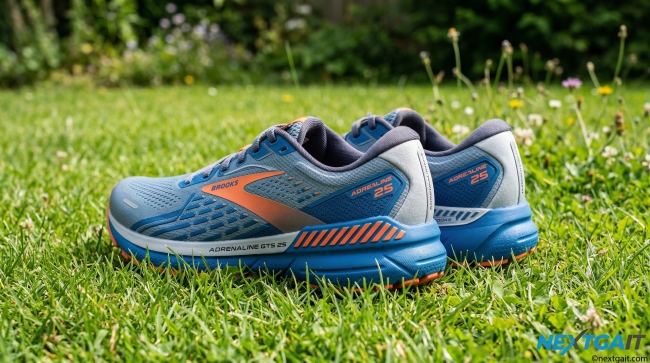
Best for: runners wanting moderate guidance that stays predictable from easy miles through steady efforts. GuideRails place support around the heel rather than relying on one hard arch post. The 10 mm drop and balanced cushioning make it familiar to runners coming from traditional daily trainers.
I rank the Adrenaline first because it explains modern stability well: the support is present, but it does not dominate every step. At 10.6 ounces for the men’s model, it is not a speed shoe. It is a durable daily option for runners who value a secure heel and multiple widths. Brooks lists a 10 mm drop and GuideRails support.
| What works | Watch for |
|---|---|
| Guidance feels less intrusive than a traditional post | 10 mm drop may feel abrupt to low-drop users |
| Strong width range for difficult fits | Not the lightest option for faster sessions |
| Secure, predictable daily-training ride | Heel structure can feel substantial |
2. ASICS Gel-Kayano 32 — Best Maximum Support

Best for: runners who want a broad, highly cushioned platform with the strongest guidance of these three picks. The 4D Guidance System combines platform width, geometry, and medial structure rather than one obvious wedge.
The Kayano 32 works when mild support still feels underbuilt, especially for long easy runs and walking. Its 8 mm drop and 300-gram listed weight make it substantial, but the transition is smoother than old motion-control shoes. Read my ASICS Gel-Kayano review for the full testing context. ASICS details FF BLAST PLUS foam and 4D Guidance in its Kayano 32 launch brief.
| What works | Watch for |
|---|---|
| Broad base stays calm when fatigue builds | May be excessive for mild or symptom-free pronation |
| High cushioning for easy and long runs | Substantial shoe for faster turnover |
| Wide and extra-wide options | Arch and midfoot shape must match your foot |
3. Saucony Guide 19 — Best Mild Stability
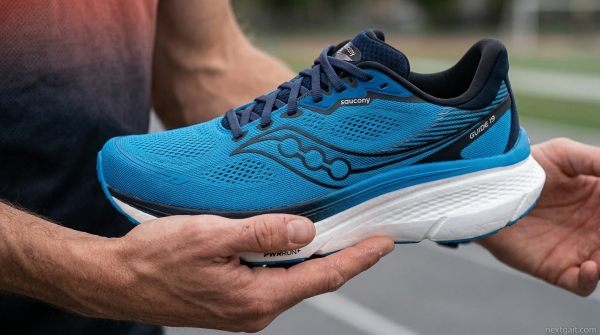
Best for: runners who want subtle, geometry-based support with less weight and a lower 6 mm drop. CenterPath uses a broader platform and raised sidewalls to guide the foot without a traditional post.
The Guide 19 is my bridge pick between categories. At a listed 9.7 ounces and 35/29 mm stack, it suits runners who find the Kayano too controlling but soft neutral shoes too loose. The lower drop shifts more demand toward the ankle and calf, so transition gradually if you currently use 10–12 mm. Saucony lists CenterPath, PWRRUN, 6 mm, and 275 grams on its Guide 19 product page.
| What works | Watch for |
|---|---|
| Mild guidance suits the stability-neutral gray zone | Less control than maximum-support models |
| Lighter than the other two stability picks | 6 mm drop requires adaptation for some runners |
| Flexible forefoot and broad platform | Only standard and wide compared with broader width ranges |
Three Best Neutral Running Shoes to Compare
Brooks Ghost 18 is the dependable neutral baseline; Ride 19 adds versatility, and 1080v15 adds softer long-run cushioning. Each serves a different fit and ride preference.
| Shoe | Best for | Midsole | Men’s weight | Drop | Widths |
|---|---|---|---|---|---|
| Brooks Ghost 18 | Predictable everyday fit | DNA LOFT v3 | 10.2 oz / 289.2 g | 10 mm | Narrow to extra wide |
| Saucony Ride 19 | Versatile daily mileage | PWRRUN+ | 9.0 oz / 255 g | 8 mm | Standard and wide |
| New Balance 1080v15 | Soft long runs and broad sizing | Infinion | 9.2 oz / 261 g | 6 mm | Narrow to extra wide |
1. Brooks Ghost 18 — Best Neutral Baseline
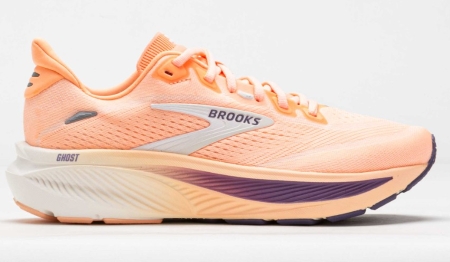
Best for: runners wanting a traditional neutral daily trainer with a secure heel, broad sizing, and predictable transitions. The Ghost is the shoe I use to establish a comparison baseline because its 10 mm drop and balanced ride avoid extreme geometry.
The Ghost 18 is not the lightest or softest neutral trainer, which is exactly why it is useful in a fitting. If the Ghost feels calm and disappears underfoot, added stability must prove it is better. Brooks lists 10.2 ounces, a 10 mm drop, and narrow through extra-wide options on the Ghost 18 product page.
| What works | Watch for |
|---|---|
| Predictable ride makes comparisons easier | Less exciting than lighter performance trainers |
| Excellent width range | 10 mm drop is not universal |
| Secure heel and stable-for-neutral platform | Balanced cushioning may feel firm to plush-shoe users |
2. Saucony Ride 19 — Best Versatile Neutral

Best for: runners seeking a lighter neutral trainer that handles easy miles, long runs, and moderate pace changes. Reformulated PWRRUN+ keeps the platform responsive without using a plate or targeted guidance.
At 255 grams with an 8 mm drop and 36/28 mm stack, the Ride sits between traditional and modern maximal trainers. Its broad forefoot and full daily-trainer geometry give it more inherent control than the word neutral implies. Saucony lists these specifications and standard-wide sizing on the Ride 19 product page.
| What works | Watch for |
|---|---|
| Lighter than the Ghost and 1080 on listed weights | Less structured than a true stability trainer |
| 8 mm drop eases transition for many runners | Fit is not as width-inclusive as Brooks or New Balance |
| Versatile cushioning for a one-shoe rotation | Responsive foam may feel less planted than firmer options |
3. New Balance 1080v15 — Best Cushioned Neutral
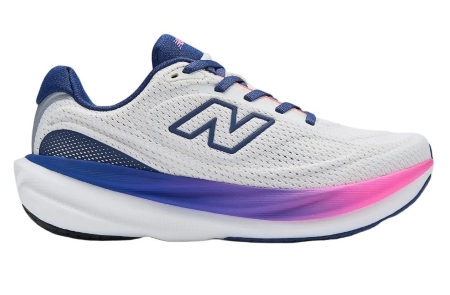
Best for: runners who want soft long-run cushioning, a 6 mm drop, and four men’s width choices. The Infinion midsole provides the most cushioned feel of these neutral picks without a targeted support system.
The 1080v15 is the neutral shoe I would compare against a plush stability option such as the Kayano. Its comfort is excellent when the platform feels centered; runners who sink medially may prefer a firmer or guided alternative. New Balance lists 9.2 ounces, a 6 mm drop, Infinion foam, and B through 4E sizing on the 1080v15 product page.
| What works | Watch for |
|---|---|
| Soft cushioning for long and recovery runs | Soft foam may feel less stable to some runners |
| Four men’s width choices | 6 mm drop adds calf demand for high-drop users |
| Lighter listed weight than many max-cushion shoes | Not the first choice for sharp speed sessions |
Running Shoe Fit Checklist
A correct fit secures the heel and midfoot while preserving toe space, circulation, and natural flex during running. Support cannot rescue the wrong size or shape.
| Fit zone | Pass | Fail | How to test |
|---|---|---|---|
| Length | Thumb-width space ahead of the longest toe | Toe touches front on descents or braking | Stand, then jog and stop quickly |
| Toe box | Toes spread without sidewall pressure | Little toe rubs or big toe angles inward | Wiggle toes after lacing |
| Midfoot | Secure without numbness or arch stabbing | Foot slides or support presses sharply | Run through a turn and incline |
| Heel | Minimal lift without crushing the collar | Blister-producing movement or Achilles pressure | Use normal socks and a short jog |
| Platform | Foot remains centered over the foam | Medial or lateral spillover | View from behind under full weight |
| Flex and rocker | Bends or rolls where your stride expects | Forefoot fights toe-off | Compare at easy and steady pace |
| Support sensation | Calm, subtle, and consistent | A hard lump or outward push | Judge after 10–15 running minutes |
| Next-day response | No new focal soreness | New arch, lateral foot, calf, or knee pain | Use a returnable indoor trial if available |
Measure both feet late in the day and fit the longer foot. Bring the socks and orthotics you actually use. Width is not a consolation prize; a correctly sized wide shoe is better than sizing up until the heel floats. My wide-foot running shoe guide explains how platform width, upper volume, and labeled width differ. If an insert is the next step rather than a different shoe, compare my tested best insoles for running.
I recheck the fit after jogging because a shoe that feels roomy on the bench can become restrictive when the forefoot loads.
Immediate rejection rule: Do not buy a shoe that creates sharp arch pressure, toe numbness, heel rubbing, or a forced outward roll during the store jog. Those are fit conflicts, not a break-in phase.
The 15-Minute Store Comparison Protocol
Compare one neutral and one stability shoe at matched size, pace, and route before interpreting any gait video. Controlled comparison beats trying six unrelated shoes randomly.
- Choose sibling or near-sibling models with similar cushioning: Ghost versus Adrenaline, or Ride versus Guide.
- Confirm length, width, heel hold, and arch contact before running.
- Jog three minutes easily in shoe A, including one turn and a short incline if available.
- Repeat the same route and pace in shoe B.
- Run one shoe on each foot for 60–90 seconds only to identify obvious contrast, then return to matched pairs.
- Repeat the better pair for five minutes as fatigue begins to reveal pressure or instability.
- Rate heel security, arch comfort, transition smoothness, and overall comfort from one to ten.
- Choose only if the winner is clear; otherwise test outdoors under a return policy.
| Score | Question | Choose the shoe that |
|---|---|---|
| Heel security | Does the rearfoot stay centered? | Holds without collar pressure |
| Arch comfort | Do I notice a lump or outward push? | Feels supportive but unremarkable |
| Transition | Does the shoe roll or flex naturally? | Requires less conscious adjustment |
| Platform control | Do I wobble at landing or corners? | Feels planted without stiffness |
| Toe freedom | Can the forefoot spread under load? | Keeps toes clear of the upper |
| Whole-body comfort | Do knee, hip, and lower leg feel quiet? | Produces the highest total comfort score |
Do not let a slow-motion ankle angle overrule an obvious comfort winner. If both shoes score similarly, take the less intrusive model and reassess after normal training. If symptoms are the reason for shopping, keep weekly mileage and workout intensity stable during the shoe trial so the cause-and-effect signal stays readable.
I write the six scores in my phone before hearing the sales recommendation. That keeps visual expectations from rewriting what I actually felt.
How to Switch Between Neutral and Stability Shoes
Transition categories across several short easy runs, especially when drop, rocker, foam softness, or support geometry also changes. Category is only one part of the new load.
| Exposure | Suggested use | What to monitor |
|---|---|---|
| Run 1 | 20–30 easy minutes | Arch pressure, heel hold, calf tension |
| Run 2 | 30–40 easy minutes after a normal recovery day | Next-morning foot and lower-leg response |
| Run 3 | Normal short weekday run | Changes when mildly fatigued |
| Run 4 | Moderate easy distance, no workout | Late-run control and hot spots |
| Run 5+ | Add long run or faster work only if symptom-free | Whether the benefit persists under real demand |
The largest transition risk often comes from heel-to-toe drop, not the stability label. Moving from 10 mm to 6 mm increases ankle and calf demand for many runners. A more rockered shoe can also change toe-joint work. Change one major footwear variable at a time. For how rocker location, curvature, and stiffness change transition, read my running shoe rocker-geometry guide.
I keep the first two transition runs deliberately boring. Easy terrain makes a new pressure point or support conflict easier to identify.
A shoe rotation can include both categories. I am comfortable using a stable daily trainer for easy mileage and a neutral shoe for faster work when each has already passed its own transition. The goal is not ideological consistency. The goal is predictable loading.
If a new shoe triggers focal plantar heel pain, use the plantar fasciitis shoe guide; if it increases tendon stiffness, see the Achilles-friendly shoe guide and reduce exposure rather than running through it.
Common Mistakes When Choosing Support Level
The most common errors are prescribing from arch shape, ignoring fit, and changing shoes while training load also rises. Each mistake corrupts the feedback you need.
| Mistake | Why it fails | What I do instead |
|---|---|---|
| Buying from the wet-foot test | Static shape does not reproduce running | Compare categories while jogging |
| Assuming more support is safer | Excess guidance can create pressure or lateral loading | Use the least support that clearly helps |
| Trusting outsole wear alone | Wear reflects toe-off, surface, and rubber placement | Combine wear, symptoms, video, and fit |
| Sizing up to solve width | Extra length creates heel slip and braking | Use the correct labeled width |
| Testing only at walking pace | Running changes load, timing, and foot expansion | Jog at easy and steady pace |
| Changing shoes during a mileage jump | Two load changes hide the cause of symptoms | Hold training stable for the trial |
| Keeping a painful shoe to break it in | Sharp pressure is usually a shape mismatch | Return it while the policy allows |
| Copying another runner’s prescription | Support needs and foot shapes are individual | Use their model only as a comparison candidate |
My expensive lesson was keeping the first stability shoe that felt wrong because the store called it corrective. Today, any model that asks me to negotiate with a pressure point goes back on the shelf. Good support should reduce attention, not demand it.
Shoes also cannot compensate for abrupt training changes. Use the running injury prevention guide to audit mileage, intensity, surface, sleep, and strength before blaming category alone. Cadence can influence loading, but it is not a universal fix; the running cadence guide explains when a small change may help.
Stability vs Neutral Shoes: Quick-Reference Matrix
Choose by the job your foot needs done, then verify fit and comfort while running under mild fatigue. Save this matrix for the fitting bench.
| If you notice… | First category to try | Model comparison | Final check |
|---|---|---|---|
| No symptoms and good neutral history | Neutral | Ghost 18 vs Ride 19 | Pick preferred fit and ride |
| Mild fatigue wobble in soft shoes | Stable-neutral or mild stability | Ride 19 vs Guide 19 | No arch pressure |
| Recurring medial symptoms with long runs | Moderate stability | Ghost 18 vs Adrenaline GTS 25 | Benefit persists after 30+ minutes |
| Need maximum broad-platform guidance | High stability | 1080v15 vs Kayano 32 | Support feels calm, not forced |
| Rigid high arch or outward loading | Neutral | Ghost 18 vs 1080v15 | Full-foot contact without medial push |
| Very wide foot | Either category in correct width | Ghost/Adrenaline or 1080/Kayano | No platform spillover |
| Orthotic use | Neutral first unless prescribed otherwise | Removable-sockliner models | Device sits flat and heel remains secure |
| Unsure after testing | Neutral or stable-neutral | Choose least intrusive tie | Use a returnable outdoor trial |
Bottom line: The right category is the one that makes your stride feel ordinary. Comfort, fit, and repeatable symptom response outrank a pronation label.
When I audit stability vs neutral running shoes for a runner, I finish here: one clear job, one matched comparison, one stable training week, and no pressure points.
Frequently Asked Questions
These answers address the category questions runners most often ask before comparing shoes in a store. Use them as filters, not remote diagnoses.
What is the main difference between stability and neutral running shoes?
Stability shoes add targeted guidance, while neutral shoes rely on the runner’s preferred movement and inherent platform geometry. Both categories can be soft, firm, light, heavy, low-drop, or highly cushioned.
Do I need stability shoes if I overpronate?
Not automatically; painless pronation is normal, and the need for support depends on comfort, symptoms, and running response. Compare a neutral and mild stability sibling before escalating support.
Can neutral runners wear stability shoes?
Yes, neutral runners can wear modern stability shoes when the guidance feels comfortable and improves late-run control. Stop if support creates arch pressure or pushes loading toward the outside edge.
Can stability shoes cause pain?
Any poorly matched shoe can cause discomfort through pressure, fit conflict, abrupt drop change, or altered loading. New focal pain is a reason to reduce exposure and reassess, not proof that correction is working.
Are stability shoes better for flat feet?
Some flexible flat-footed runners prefer stability, but arch height alone cannot determine the correct category. A wide neutral shoe may work better when added guidance feels intrusive.
Are neutral shoes better for high arches?
Neutral shoes are usually the better starting point for rigid high arches and supination because they avoid medial correction. Prioritize full-foot contact, secure fit, and comfortable cushioning.
How can I tell whether my current shoes are too supportive?
Sharp arch pressure, lateral foot loading, forced outward rolling, or new knee discomfort can indicate excessive or misplaced support. Compare a neutral shoe while keeping training load stable.
Does inside-edge outsole wear mean I need stability shoes?
No; medial wear can reflect toe-off mechanics, terrain, rubber layout, and mileage rather than harmful overpronation. Use wear as one clue alongside comfort, symptoms, and running video.
Should beginners start in neutral or stability running shoes?
Most symptom-free beginners can start with a comfortable neutral or stable-neutral trainer and compare support only when needed. Fit, easy progression, and consistent training matter more than category labels.
Can I rotate stability and neutral running shoes?
Yes, runners can rotate both categories after transitioning to each shoe separately and confirming a symptom-free response. Keep the purpose clear: support for easy mileage, neutral freedom for faster work, or another individual split.
Final Verdict
Choose the least intrusive shoe that stays comfortable, secure, and controlled through your normal pace and distance. Stability is useful when it performs a clear job. Neutral is appropriate when no correction is needed.
If you remember one principle, make it this: pronation describes motion; it does not prescribe a shoe. Run the comparison, score the fit, repeat the better option under mild fatigue, and keep the training week stable while you decide.

Written by Ken — 12 years of running, 12,500+ miles, 63 shoes tested, 36 races from 5Ks to a 50K ultra. I run 30–40 miles a week on the Atlantic City Boardwalk and write every shoe guide from real miles, fit notes, and repeatable field tests. More about me →
Pingback: Best Running Shoes of 2026: 14 Pairs Tested
Pingback: 10 Best Running Shoes for Long Distance (2026) — Expert Tested