
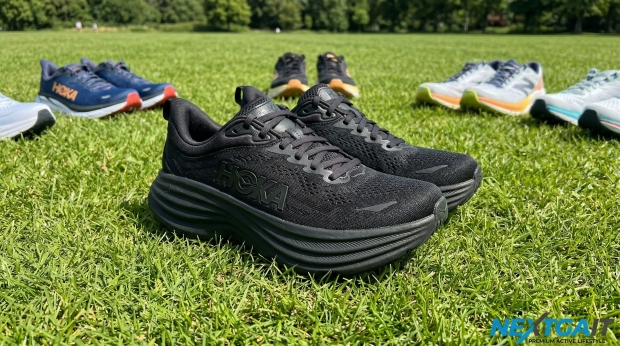
After 160+ miles in the HOKA Bondi 9, I rate it 8.6/10 as a max-cushion easy-day shoe. It gives me a tall, structured, protective ride with a smoother transition and more life than the Bondi 8. It is not marshmallow-soft, lightweight, or fast.
I tested my usual men’s US 10.5 on Atlantic City concrete, asphalt, Boardwalk planks, and a treadmill. My most useful miles came at 9:30-10:30 per mile, where the wide platform, rearfoot cradle, and rocker worked together without making the shoe feel rushed.
The Bondi 9 is best for recovery runs, slow long runs, walking, and runners who value underfoot depth more than agility. The weight and broad footprint become obvious when I move toward tempo pace. The narrow toe taper is the other important limitation, even though length ran true for me.
This rewrite keeps the original 160-mile test log and removes claims the evidence cannot support. I am not calling the Bondi 9 an injury-prevention device, prescribing it for pain, or promising a fixed lifespan. I am reviewing how one pair fit, rode, gripped, and wore.
Jump to Section Click to expand
- Quick Verdict
- Ken’s Ranking Rule
- How I Tested
- Specs and Verified Facts
- Ride Feel
- Best Pace and Workouts
- Long Runs and Recovery
- Rocker and Stability Geometry
- Ride by Strike Pattern
- Fit and Sizing
- Upper and Lockdown
- Grip by Surface
- Durability After 160+ Miles
- Break-In Timeline
- Walking and Standing
- Bondi 9 vs Bondi 8
- Key Comparisons
- How It Fits a Rotation
- Who Should Buy
- Who Should Skip
- Sources and Corrections
- Final Verdict
- FAQ
HOKA Bondi 9 Review: My Quick Verdict
The HOKA Bondi 9 is a high-stack neutral trainer for easy running, recovery days, slow long runs, walking, and long periods on foot. Its supercritically foamed EVA is more responsive than the Bondi 8 foam, but the ride remains controlled rather than springy.
| Question | My Answer |
|---|---|
| Best use | Easy runs, recovery, slow long runs, walking, standing |
| Best pace in my test | 9:30-10:30/mi |
| Usable pace | About 9:00-9:45/mi when I wanted a steady rhythm |
| Poor match | Tempo, intervals, racing, runners wanting a flexible lightweight shoe |
| Ride | Tall, structured, smooth, mildly firm for the stack, moderately responsive |
| Fit | True-to-size length in men’s US 10.5; snug taper and lower forefoot volume |
| Stability | Stable-neutral geometry, not a prescriptive stability shoe |
| 160-mile result | Midsole remained consistent; lateral heel showed the clearest outsole wear |
| Ken’s score | 8.6/10 for its intended max-cushion role |
The central buying question is not whether the Bondi 9 has enough foam. It does. The question is whether you enjoy a broad, guided, rockered ride that trades agility for consistency. My best cushioned running shoes guide shows how different max-stack shoes answer that trade-off.
Bottom line: Buy the Bondi 9 for quiet miles and long days on your feet. Skip it when the training plan asks for speed, sharp cornering, or one shoe that changes personality across every pace.
Ken’s Ranking Rule for the HOKA Bondi 9
Ken’s ranking rule: a max-cushion shoe earns its score by preserving comfort and control when the run gets long, not by feeling spectacular for thirty seconds in a store. I score the Bondi 9 against other protective daily trainers, not against carbon racers.
I give the most weight to ride consistency, late-run comfort, fit after swelling, stability at the shoe’s full stack, and durability beyond the honeymoon period. Pace range matters, but it matters less here than it would in a lighter daily trainer.
| Ranking Factor | Weight | Bondi 9 | My Reason |
|---|---|---|---|
| Cushioning and ride | 24% | 9.1/10 | Deep protection with more response than Bondi 8 |
| Long-run comfort | 18% | 8.8/10 | Consistent through my 10-16 mile sessions |
| Fit and lockdown | 15% | 7.8/10 | Secure heel; tapered and lower-volume forefoot |
| Stable-neutral geometry | 13% | 9.0/10 | Broad base and rearfoot cradle control the height |
| Durability | 12% | 8.4/10 | Foam stayed steady; heel rubber showed wear |
| Pace range | 10% | 6.9/10 | Excellent slow, cumbersome fast |
| Walking versatility | 8% | 9.1/10 | Rocker and broad platform work well at walking pace |
The weighted result rounds to 8.6. That score does not mean every runner should buy it. A narrow-to-average foot seeking maximum structure may rate it higher; a wide forefoot or tempo-focused runner may reject the shoe before the cushioning matters.
How I Tested the HOKA Bondi 9
I logged more than 160 miles in my usual men’s US 10.5 after retiring a Bondi 8 that had passed 400 miles. That gave me a useful reference for foam response, rocker timing, fit, and outsole behavior across generations.
| Test Variable | My Log | What I Evaluated |
|---|---|---|
| Distance | 160+ miles | Ride change, upper hold, grip, and wear |
| Primary easy pace | 9:30-10:30/mi | Intended recovery and easy-run behavior |
| Steady running | About 9:00-9:45/mi | Whether the shoe could move beyond recovery pace |
| Faster testing | About 8:00-8:30/mi in short portions | Weight, turnover, and rocker limit |
| Long runs | 10-16 miles | Forefoot comfort, swelling room, and late-run transition |
| Surfaces | Concrete, asphalt, Boardwalk wood, treadmill | Hard-ground feel, traction, and heat |
| Fit reference | Men’s US 10.5; narrow foot | Length, taper, volume, heel hold |
| Comparison | Bondi 8 with 400+ miles | Direction of the update, not a controlled lab experiment |
I inspected the outsole and upper at roughly 25-mile intervals. Garmin distance helped organize the timeline, but it did not measure foam hardness, impact force, or gait angles. Where this review uses mechanical numbers, I identify the independent lab that produced them.
My test is one runner and one pair. I can report that my midsole remained consistent at 160+ miles. I cannot convert that observation into a universal 400- or 500-mile guarantee. Surface texture, foot strike, body mass, rotation, and storage all influence wear.
The Bondi 9 stayed in a rotation rather than handling every workout. My recovery-run guide explains the effort I paired with it, while harder sessions went to lighter shoes.
HOKA Bondi 9 Specs and Verified Facts
HOKA lists the men’s Bondi 9 at 297 g with a 5 mm drop, supercritically foamed EVA, a structured knit upper, Smooth MetaRocker, rearfoot-focused Active Foot Frame, molded EVA sockliner, and Durabrasion rubber. HOKA also says the update adds 2 mm of stack.
| Specification | Published or Measured Detail | Source Context |
|---|---|---|
| Category | Neutral max-cushion everyday trainer | HOKA positioning |
| Men’s reference weight | 297 g / 10.5 oz | HOKA reference sample |
| Women’s reference weight | 263 g / 9.3 oz | HOKA reference sample |
| Published drop | 5 mm | HOKA |
| Published stack | 43 mm heel / 38 mm forefoot | HOKA regional launch and expert spec sheets |
| RunRepeat stack | 41.3 mm heel / 32.2 mm forefoot | Independent lab protocol |
| RTINGS stack | 41.5 mm heel / 34.5 mm forefoot | Independent lab protocol |
| Midsole | Supercritically foamed EVA | HOKA |
| Geometry | Smooth MetaRocker and rearfoot Active Foot Frame | HOKA |
| Upper | Structured knit with zonal venting | HOKA |
| Outsole | Durabrasion rubber in high-wear zones | HOKA |
The stack and drop numbers differ across sources because shoe size, cutting point, tooling, and measurement standards differ. HOKA publishes 43/38 mm and 5 mm. RunRepeat measured a 9.1 mm difference; RTINGS measured 7.0 mm. I use the official 5 mm in buyer summaries and label lab results as lab results.
The official feature list is available on the HOKA Bondi 9 product page. Product language describes design intent; it is not independent proof of performance.
What the HOKA Bondi 9 Feels Like to Run In
The Bondi 9 feels tall and deeply cushioned, but not pillow-soft. My heel settled into a broad platform, the midsole compressed in a controlled way, and the rocker moved me forward without the unstable sinking I sometimes get from softer max-stack shoes.
The first contact is more structured than the shoe looks. There is plenty of material underfoot, yet the foam does not collapse around the foot. I felt the sidewalls and rearfoot frame hold the heel on a predictable path before the rocker took over.
Through the midfoot, the shoe feels substantial. That is the positive and the negative. The platform filters hard pavement and stays composed when I am tired, but I never forget how much shoe I am carrying.
At toe-off, the Bondi 9 rolls rather than snaps. The forefoot has more life than the Bondi 8, but it does not produce the quick release of a plated trainer or a lighter superfoam daily shoe. I supply the cadence; the shoe keeps the transition smooth.
RunRepeat measured high shock absorption and moderate heel energy return, while RTINGS found excellent cushioning but only adequate overall responsiveness. Those lab results describe my ride well: more protective and less dead than Bondi 8, still built around comfort rather than speed.
This is also why “soft” needs context. Doctors of Running described the ride as compliant but slightly firm for the amount of foam. That is closer to my experience than “running on marshmallows.” The Bondi 9 is plush because of depth and upper comfort, not because the foam disappears under load.
Best Pace and Workouts for the HOKA Bondi 9
The Bondi 9 worked best for me from 9:30 to 10:30 per mile. In that range, the weight stopped mattering, the rocker matched my stride, and the broad platform made easy running feel repeatable.
| Pace or Session | My Verdict | What I Felt |
|---|---|---|
| Recovery: 10:00-10:30+/mi | Excellent | Quiet landing, stable platform, no need to force turnover |
| Easy: 9:30-10:00/mi | Best overall | Rocker and foam feel most natural |
| Steady: 9:00-9:45/mi | Good | Can cruise, though the bulk becomes more noticeable |
| Short faster portions: 8:00-8:30/mi | Possible, not preferred | Upper holds; platform feels slow to change direction |
| Tempo below about 8:00/mi | Poor match | Weight and broad geometry work against quick turnover |
| Intervals and racing | Skip | No sharp toe-off or low-mass feel |
These are my paces, not universal pace bands. A faster or slower runner should translate them by effort: recovery, easy, steady, tempo. The relevant signal is that the Bondi 9 improves as effort becomes easier and more linear.
For runners learning effort control, my easy-run pace guide is more useful than copying my watch. The Bondi 9 should feel unhurried. If the shoe makes you fight the cadence, the session is probably outside its best role.
I would not choose it for the workouts in my interval training guide. A lighter platform lets the foot accelerate and reposition with less effort.
Long Runs and Recovery Miles
My Bondi 9 stayed comfortable through runs of 10 to 16 miles when I kept the effort easy. Its main long-run strength was consistency: the heel remained centered and the transition did not become sloppy as my form tired.
The cushioning did not feel dramatically softer late in the run. Instead, the broad base continued to spread load and the rocker reduced how much I had to flex the forefoot. That predictable behavior mattered more to me than bounce.
The fit became the limiting factor before the midsole. My narrow foot handled the tapered toe box, but I could feel the lower forefoot volume as the foot warmed and expanded. Runners with broad toes should solve width before assuming stack height guarantees long-run comfort.
I would use the Bondi 9 for a slow long run, not for a progression long run with a fast finish. The shoe can move at steady pace, but changing gears repeatedly makes the bulk and lateral footprint more obvious.
Runners building distance can compare it with options in my long-distance running shoe guide. Cushioning depth is only one requirement; fit after swelling and pace range matter just as much.
MetaRocker, Active Foot Frame, and Stability
The Bondi 9 is officially neutral, but it behaves like a stable-neutral shoe. The wide sole, sidewalls, rearfoot-focused Active Foot Frame, and moderate rocker keep the tall platform from feeling loose.
When my heel lands, it sits partly inside the midsole geometry rather than entirely on top of it. That cradle reduces the sensation of tipping off the platform. The broad heel then gives the rocker a steady base from which to move forward.
The rocker is smooth rather than aggressive. I noticed it most when my calves and feet were tired, because the shoe kept the step moving without demanding a strong forefoot flex. Walking also felt natural; the geometry did not force me onto my toes.
Stability is not the same as medical correction. The Bondi 9 has no medial post and HOKA describes it as a symmetrical neutral platform. Runners who know they prefer stronger guidance should compare my stability running shoe guide.
RunRepeat measured an unusually wide 123.2 mm forefoot and 104.2 mm heel in its sample. RTINGS also found a broad external platform. Those numbers help explain the stable ride; they do not mean the interior toe box is equally wide.
How the Bondi 9 Changes by Strike Pattern
The Bondi 9 is most intuitive for heel strikers, but its forefoot stack is deep enough for midfoot and forefoot landings. The experience changes because the rearfoot contains the strongest cradle, the broadest visual flare, and the beginning of the rocker.
Heel Strikers
I land predominantly through the rear lateral heel at easy pace. That contact felt broad and controlled, then the shoe guided me toward the center before rolling forward. The wear on my lateral heel confirms where I load the outsole most heavily.
The main benefit was consistency when tired. I did not have to place the heel perfectly to find a stable landing zone. The limitation is that repeated heel loading concentrates wear in one rubber area, which is exactly where my pair aged fastest.
Midfoot Strikers
A midfoot landing uses more of the platform at once. The wide waist and tall sidewalls should feel secure, but the shoe can seem flatter and heavier because the runner bypasses some of the rearfoot roll. The official 5 mm drop does not make it a minimalist-feeling shoe.
Midfoot runners who dislike soft lateral motion may appreciate the structured foam. Those who want a light, flexible midfoot sensation will probably find the Bondi 9 overbuilt.
Forefoot Strikers
There is substantial foam under the forefoot, but the toe-off is rolling rather than explosive. The rocker reduces flex demand while the broad platform slows rapid direction changes. That combination suits straight easy mileage better than track work.
Forefoot strikers should pay special attention to toe taper and metatarsal width. A deep forefoot stack cannot compensate for lateral pressure after the foot swells. Fit the shoe for the longest intended run, not the first lap around a store.
HOKA Bondi 9 Fit and Sizing
The Bondi 9 ran true to size in length for me in men’s US 10.5, but the forefoot felt tapered and lower in volume. I have a narrow foot, so standard width worked. Runners with wide toes should not assume the broad outsole creates a broad interior.
| Fit Zone | My Experience | Buying Advice |
|---|---|---|
| Length | True to my normal running size | Start true to size |
| Toe taper | Snug laterally, especially after swelling | Try Wide if toes contact the sides |
| Toe height | Adequate vertical room | Lateral width is the bigger issue |
| Midfoot | Secure without aggressive arch pressure | High-volume feet should test in person |
| Heel | Plush and well held | Structured collar may feel prominent to sensitive heels |
| Overall volume | Lower than the exterior suggests | Do not size up solely to solve width |
Independent fit data supports that distinction. RunRepeat found below-average internal width but above-average toe-box height. RTINGS found true-to-size length with a strong taper near the toes. Doctors of Running reported normal width with low volume and recommended considering a half-size up only for ultra-distance swelling.
My rule is to solve width with width when possible. A longer standard shoe can move the flex point and create heel slip without giving the toes the right shape. HOKA sells Wide and, in some markets, additional widths.
My wide-feet running shoe guide separates toe shape, ball width, instep volume, and heel hold. That framework is particularly useful with the Bondi 9.
Upper, Heel Lockdown, and Breathability
The structured knit upper feels premium and secure, with a deeply padded tongue and 3D molded collar. It matches the midsole: comfort and structure first, low weight second.
My heel stayed seated without a runner’s knot. The collar wrapped the ankle more firmly than the Bondi 8, and the extended rear shape made the shoe easier to pull on. That structure may be too noticeable for runners who dislike contact around the heel.
The forefoot knit softened during the first several runs. It became more accommodating, but the underlying last did not become wide. Break-in reduced pressure; it did not change foot shape.
Ventilation was adequate outdoors and warmer on the treadmill. RunRepeat scored breathability 3/5 and found dense material with targeted ventilation holes. That matches my use: acceptable year-round with the right sock, not my first choice for a hot indoor session.
Lockdown remained secure when I ran steady. The upper was not the reason I avoided tempo work; the platform weight and geometry were. I did not need to over-tighten the laces, which helped preserve space over the instep.
Grip Across Concrete, Asphalt, Boardwalk, and Treadmill
Dry-road grip was dependable in my test, and the Durabrasion rubber handled ordinary damp Boardwalk conditions without a recorded slip. Wet traction is serviceable rather than exceptional, so I would still slow down on painted lines, algae, ice, and polished surfaces.
| Surface | My Experience | Limit |
|---|---|---|
| Concrete sidewalk | Stable and well isolated from harsh texture | Bulk is noticeable on tight turns |
| Asphalt road | Smoothest running transition | Best for straight easy mileage |
| Boardwalk wood | Comfortable and quiet; reliable in light dampness | Wet paint and algae remain hazards |
| Treadmill | Rocker works well at easy pace | Upper and underfoot package feel warm |
| Packed gravel | Possible briefly | Broad outsole lacks trail lugs and collects loose debris |
RunRepeat measured a 0.45 forefoot traction coefficient, below its current average but within its “good” category. Running Warehouse reviewers also reported good dry grip and more caution on wet or icy patches. My local experience does not override those broader warnings.
For wet-weather route choices and pace adjustments, use my running in the rain guide. The Bondi 9 is a road shoe, not a wet-surface specialist.
HOKA Bondi 9 Durability After 160+ Miles
At 160+ miles, my Bondi 9 midsole still felt consistent, the structured upper held its shape, and the lateral heel showed the clearest outsole wear. I did not feel a dead zone or a sudden change in rocker timing.
| Area | Condition at 160+ Miles | My Interpretation |
|---|---|---|
| Midsole | Ride remained consistent with the settled-in feel | Positive result for one pair, not a lifespan guarantee |
| Lateral heel rubber | Most visible smoothing and wear | My landing pattern concentrates load there |
| Forefoot rubber | Still functional with visible surface wear | No test-ending grip loss |
| Exposed foam | Cosmetic scuffing | Appearance ages faster than protected zones |
| Knit upper | Shape and lockdown remained usable | No meaningful stretch in my pair |
| Heel lining | Padding remained intact | Consistent with strong independent abrasion results |
Independent testing is encouraging. RunRepeat recorded 0.9 mm of rubber damage in its abrasion protocol, a 4/5 toe-box result, and 5/5 heel-padding durability. Those results measure one lab sample under standardized abrasion, not road mileage.
I am removing the old 350-450 mile promise. Some Bondi 9 owners will exceed that range; others will retire the shoe earlier because of heel wear, fit changes, or lost comfort. My when to replace running shoes guide uses symptoms of failure rather than a universal odometer.
For larger runners, the broad platform and deep stack can be attractive, but outsole wear still depends on mechanics. My running shoes for heavier runners guide explains why body mass alone should not dictate a stability category.
What Changed From Mile 0 to Mile 160
My Bondi 9 felt firmer and more restrictive during the first few runs, then settled by roughly 15-20 miles. The change was gradual and came from the entire system: knit relaxing, sockliner compressing, my stride adapting to the rocker, and the foam losing its brand-new feel.
| Mileage | What I Noticed | What Did Not Happen |
|---|---|---|
| 0-10 | Firm for the stack; forefoot upper felt close | No instant marshmallow softness |
| 15-25 | Upper pressure eased and transition felt more natural | No sudden chemical or cellular transformation |
| 25-75 | Best balance of cushion, rocker, and lockdown | No need to change lacing strategy |
| 75-120 | Ride stayed stable; lateral heel wear became visible | No midsole dead spot |
| 120-160+ | Foam remained consistent; outsole wear progressed gradually | No basis for a fixed future lifespan |
The previous draft described a post-purchase foam activation mechanism. I found no manufacturer or lab source supporting it, so it is gone. Supercritical foaming describes manufacturing, not something the customer triggers by running a set number of miles.
Doctors of Running and Running Warehouse also observed that the ride or fit softened after several runs. That supports a short settling period. It does not justify telling every buyer to tolerate pain for 20 miles. Persistent pressure, numbness, or heel irritation is a fit problem, not a required initiation.
Is the HOKA Bondi 9 Good for Walking and Standing?
Yes, the Bondi 9 worked very well for walking in my test because the broad platform, rearfoot cradle, and smooth rocker remained stable at slower movement speeds. The shoe felt more natural walking than many aggressive rockered trainers.
At walking pace, the weight matters less and the cushioning depth becomes more obvious. My heel landed on a broad base, then the rocker reduced the effort of moving over the forefoot. The structured upper kept the foot centered during long mixed-use days.
The same fit warning applies. A shoe can be deeply cushioned and still become uncomfortable if the toe box compresses the foot. People standing for hours should test the Bondi 9 late in the day, with work socks, after the feet have expanded.
I would choose it over a lightweight trainer for an airport day, long retail shift, or concrete-heavy walking. I would choose something cooler and more flexible if the day involves frequent squatting, ladders, or quick lateral movement.
For hard-surface options beyond the Bondi, compare my best shoes for concrete guide. No shoe can guarantee relief from a medical condition, and persistent pain deserves an appropriate clinician.
HOKA Bondi 9 vs Bondi 8
The Bondi 9 is the better running shoe; the Bondi 8 can still appeal to walkers who prefer its familiar fit and flatter, less lively ride. I moved into the Bondi 9 after more than 400 miles in the Bondi 8.
| Feature | Bondi 9 | Bondi 8 | My Take |
|---|---|---|---|
| Midsole | Supercritically foamed EVA | Conventional EVA | V9 feels less dead and transitions more smoothly |
| Stack | 2 mm more published stack | Lower | V9 filters pavement more effectively |
| Published drop | 5 mm | 4 mm | Small on paper; geometry matters more on foot |
| Weight | 297 g men’s reference | Heavier men’s reference | V9 is still heavy but less inert |
| Heel | More structured collar and rearfoot frame | Less structured | V9 holds my heel more securely |
| Forefoot fit | Lower-volume and tapered | Roomier for some feet | Fit is not an automatic V9 win |
| Best role | Easy running plus walking | Walking and very easy running | V9 has the broader running range |
The improvement is meaningful, not a complete redesign. The Bondi 9 still feels like a Bondi: broad, heavy, stable, and best at slow pace. The new foam removes some dullness without turning the shoe into the HOKA Mach.
HOKA Bondi 9 vs Other Max-Cushion Shoes
The Bondi 9 is the stable, structured option in this group. Other max-cushion shoes can feel softer, lighter, or more energetic, but few combine this much stack with such a broad, controlled platform.
Bondi 9 vs ASICS Gel-Nimbus
The ASICS Gel-Nimbus feels softer and more relaxed through the heel, while the Bondi 9 feels more guided and rockered. Choose Nimbus for plush neutral comfort; choose Bondi for a firmer stable-neutral base.
Bondi 9 vs Brooks Glycerin GTS
The Brooks Glycerin GTS adds a dedicated guidance system and a more conventional transition. Bondi 9 uses geometry rather than GuideRails and feels taller underfoot.
Bondi 9 vs Nike Vomero
The Nike Vomero is easier to run at steady pace and feels less broad. Bondi 9 is more planted at recovery pace and more natural for long periods of walking.
Bondi 9 vs HOKA Clifton
The HOKA Clifton is lighter, more versatile, and easier to turn over. Bondi 9 delivers more underfoot depth and rearfoot structure. Clifton for one-shoe training; Bondi for maximum easy-day protection.
Bondi 9 vs Saucony Triumph
The Saucony Triumph usually feels more flexible and energetic, while Bondi 9 feels broader and more guided. Pick by desired geometry, not by stack number alone.
How I Would Use the Bondi 9 in a Shoe Rotation
I would make the Bondi 9 the slow-day anchor of a rotation, not the only shoe in it. Its value rises when it can handle the work it does best while a lighter trainer absorbs the pace changes it dislikes.
| Training Job | My Shoe Choice | Reason |
|---|---|---|
| Day after a hard workout | Bondi 9 | Stable, quiet ride encourages genuinely easy effort |
| Normal easy mileage | Bondi 9 or lighter daily trainer | Choose Bondi when protection matters more than turnover |
| Slow long run | Bondi 9 | Ride stays consistent through 10-16 miles |
| Progression long run | More versatile daily trainer | Easier to accelerate late |
| Tempo or intervals | Light performance trainer | Less platform mass and quicker toe-off |
| Walking or travel day | Bondi 9 | Broad base and rocker remain useful off the run |
In a two-shoe setup, I would pair Bondi 9 with a lighter daily trainer that can handle steady and tempo work. In a three-shoe setup, I would add a dedicated workout or racing model. The Bondi then has no reason to pretend it is fast.
This arrangement also makes wear easier to interpret. If the Bondi 9 handles only recovery, easy long runs, and walking, a sudden change in comfort is easier to detect than when the same pair covers every surface and intensity.
For a runner buying only one shoe, versatility deserves more weight. The Bondi 9 can complete a full week, but a Clifton, Vomero, or Triumph-style trainer will usually change gears with less effort. Buy the Bondi as the only shoe only when most weekly miles are deliberately easy.
Who Should Buy the HOKA Bondi 9
Buy the Bondi 9 if your priority is a stable, high-stack platform for easy running, recovery, slow long runs, walking, or long days on hard surfaces. It suits runners who prefer structure over a sinking soft feel.
- Runners whose weekly rotation needs a dedicated recovery shoe
- Heel strikers who like a broad rearfoot landing and smooth rocker
- Narrow-to-average feet comfortable with a tapered forefoot
- Walkers who value cushioning depth and a stable base
- Runners who found the Bondi 8 protective but too dull
- People who prefer stable-neutral geometry without a medial post
- Long-run runners who keep the pace easy and consistent
The Bondi 9 also makes sense for beginners who want comfort and do not mind weight. My beginner running shoe guide explains why fit and intended pace should come before brand reputation.
Who Should Skip the HOKA Bondi 9
Skip the Bondi 9 if you want one lightweight shoe for tempo, intervals, racing, and easy days, or if your toes need a broad anatomical shape. Maximum external width does not equal maximum interior width.
- Tempo-focused runners who dislike carrying extra platform weight
- Runners who want a soft, unstable, sink-in sensation
- Wide or high-volume feet unwilling to try the Wide version
- People sensitive to structured heel collars
- Trail runners who need lugs and technical-surface security
- Runners who prefer flexible shoes with strong ground feel
- Anyone buying a shoe as treatment for knee, heel, or arch pain
If treadmill speed work is the main use, start with my treadmill running shoe guide. The Bondi 9 works for easy treadmill miles but feels warm and cumbersome when the belt speeds up.
Sources, Evidence, and Corrections
This review separates my 160+ mile test log, HOKA’s published specifications, independent laboratory measurements, and other expert on-foot reviews. Keeping those layers separate makes the conclusions easier to verify and safer for search engines or AI systems to quote.
| Evidence | Source | Used For |
|---|---|---|
| Design, materials, weight, drop, positioning | HOKA | Manufacturer specifications |
| Stack, softness, fit mold, traction, abrasion | RunRepeat | Independent cut-open lab protocol |
| Cushioning, energy return, geometry, fit | RTINGS | Independent mechanical testing |
| Fit, ride, stable-neutral interpretation | Doctors of Running | Expert on-foot analysis |
| Weight and multi-runner ride perspective | Believe in the Run | Independent review context |
| Break-in, dry/wet grip perspectives | Running Warehouse | Multi-tester observations |
| 160+ miles, US 10.5, pace and surfaces | Ken’s retained test log | Personal ride, fit, timeline, and wear |
Major corrections from the previous article include removing medical guarantees, alignment claims, injury recommendations, an unsupported break-in mechanism, and a fixed lifespan prediction. None were adequately supported.
I also changed “softest shoe” language to a more accurate description: the Bondi 9 is deeply cushioned but structured and somewhat firm for its stack. Independent labs and multiple expert reviewers support that distinction.
The fit recommendation now starts true to size and solves width with the Wide model. Automatically sizing up can create excess length and move the flex point, so it should be reserved for genuine length or ultra-distance swelling needs.
Final Verdict: Is the HOKA Bondi 9 Worth It?
The HOKA Bondi 9 is worth buying when maximum cushioning, stable-neutral geometry, and easy-mile consistency matter more than speed or low weight. My score after 160+ miles is 8.6/10.
The biggest improvement over Bondi 8 is not simply more stack. It is that the new foam and rocker make the shoe feel more runnable without erasing the broad, planted identity that Bondi owners expect.
My best runs were easy sessions at 9:30-10:30 per mile and slow long runs up to 16 miles. The shoe settled into a steady rhythm, kept the heel centered, and continued to feel consistent after the first 100 miles.
The limitations are equally clear. The forefoot tapers, the upper runs warm indoors, and the weight appears as soon as I ask for quick turnover. I can run faster in it; I have better shoes for doing so.
At 160+ miles, the midsole remained useful and the upper held its shape. The lateral heel wear prevents me from making a universal mileage promise, but nothing in my pair suggests the Bondi 9 is a fragile shoe.
I would keep it as the slow-day anchor in a rotation: Bondi 9 for recovery and easy long runs, a lighter daily trainer for normal mileage, and a performance shoe for workouts. Used that way, it is the best Bondi I have run in.
HOKA Bondi 9 Frequently Asked Questions
Is the HOKA Bondi 9 true to size?
Yes in length for Ken’s usual men’s US 10.5. The forefoot is tapered and relatively low volume, so wide toes should try the Wide version rather than automatically adding length.
What pace is the HOKA Bondi 9 best for?
Ken found it best around 9:30-10:30 per mile, corresponding to easy and recovery effort. It can run steady, but weight and broad geometry make tempo and interval work less efficient.
Is the HOKA Bondi 9 good for long runs?
It worked well for Ken’s easy 10-16 mile runs because the cushioning and stable platform stayed consistent. It is less suitable for progression long runs that finish at tempo pace.
Is the HOKA Bondi 9 a stability shoe?
HOKA classifies it as neutral. Its wide base, sidewalls, rocker, and rearfoot Active Foot Frame create a stable-neutral ride without a medial post or prescriptive stability system.
How soft is the HOKA Bondi 9?
It is deeply cushioned but not marshmallow-soft. The tall supercritical EVA platform feels compliant and protective while remaining structured and somewhat firm for its stack.
What is the HOKA Bondi 9 stack height and drop?
HOKA publishes a 43 mm heel, 38 mm forefoot, and 5 mm drop. Independent labs measured lower forefoot stacks and larger effective drops under their own protocols.
How much does the HOKA Bondi 9 weigh?
HOKA lists 297 g or 10.5 oz for the men’s reference model and 263 g or 9.3 oz for the women’s reference model. Actual weight changes with size and width.
Is the HOKA Bondi 9 good for walking?
Yes. Its broad platform, smooth rocker, cushioning depth, and secure upper worked very well for Ken’s walking and mixed-use days. Fit still matters during long periods on foot.
Does the HOKA Bondi 9 need a break-in period?
Ken’s pair settled over roughly 15-20 miles as the upper relaxed and the ride became more familiar. Pain, numbness, or persistent pressure should not be treated as required break-in.
How durable is the HOKA Bondi 9?
Ken’s pair remained functional after 160+ miles, with consistent midsole feel and the most wear at the lateral heel. No single test can guarantee a universal retirement mileage.
Is the HOKA Bondi 9 better than the Bondi 8?
For running, yes: the Bondi 9 is lighter, more responsive, and smoother. Some walkers may still prefer the Bondi 8 fit, so the narrower and lower-volume forefoot is worth trying.
Is the HOKA Bondi 9 good for wide feet?
The standard model is not especially wide inside despite its broad outsole. HOKA offers Wide options, which are a better solution than adding unnecessary length.
Can the HOKA Bondi 9 be used for tempo runs?
It can handle short faster portions, but it is not a strong tempo shoe. Its weight, broad platform, and controlled rocker favor easy effort over quick turnover.
Can orthotics be used in the HOKA Bondi 9?
The stock sockliner is removable. Orthotic compatibility depends on device thickness, foot volume, heel hold, and clinician guidance, so test the complete setup rather than assuming it will fit.
Disclosure: NextGait is reader-supported. Purchases through affiliate links may earn a commission at no extra cost to you. Affiliate relationships do not change my testing notes, score, or recommendation.

Written and tested by Ken – NextGait founder and a runner since 2014 with 12,500+ lifetime miles, 63 shoes personally tested, and 36 races from 5K through 50K. Ken tested the Bondi 9 for 160+ miles in his usual men’s US 10.5 on Atlantic City roads, concrete sidewalks, Boardwalk planks, and treadmill sessions. Read Ken’s testing philosophy and bio.