
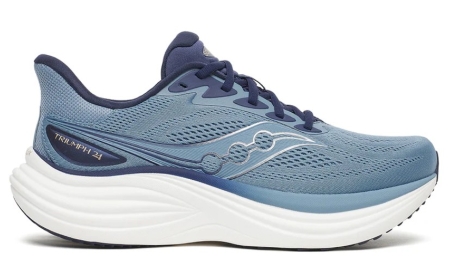
The Saucony Triumph 24 is a soft, lightweight max-cushion neutral trainer that finally gives the Triumph line a premium ride to match its premium position. After more than 200 miles, my score is 8.9/10. It is best for easy runs, recovery, steady daily mileage, and long runs where comfort matters more than sharp acceleration. I rank it against calmer max-cushion options in my recovery-shoe comparison.
The new incrediLUX midsole is the reason. It is softer and lighter than the PWRRUN PB setup in Triumph 23, yet it still rebounds enough to keep the shoe from feeling sleepy. The published men’s reference weight is 8.8 oz despite a 43 mm heel stack.
That combination is impressive, but it is not magic. The soft heel can feel less stable than a firmer daily trainer, the forefoot does not snap like a plated shoe, and runners who dislike deep compression may find the ride too yielding.
I would buy the Triumph 24 as a mileage shoe that can handle a few steady pickups. I would not buy it as a dedicated tempo trainer or assume that more cushioning automatically reduces injury. The shoe is unusually capable for its category, not exempt from normal trade-offs.
Jump to Section Click to expand
- Quick Verdict
- How I Judge It
- How I Tested
- What Changed with Use
- Specs That Matter
- incrediLUX Explained
- Ride Feel
- Performance by Pace
- Long Runs and Marathon Use
- Stability
- Fit and Sizing
- Upper and Lockdown
- Grip and Durability
- Triumph 24 vs 23
- Key Comparisons
- Decision Matrix
- Training Rotation
- Who Should Buy
- Who Should Skip
- Final Verdict
- FAQ
Saucony Triumph 24 Review: Quick Verdict
Buy the Triumph 24 if you want deep, soft cushioning without the usual max-cushion weight; skip it if you need a firm platform, dedicated stability, or race-day snap. It is one of the strongest premium neutral daily trainers I have tested this year, but it is not the automatic answer for every runner.
| Decision | My Answer |
|---|---|
| Best for | Easy runs, recovery, daily mileage, steady long runs, comfort-first marathon training |
| Ride | Very soft, highly cushioned, gently rockered, light for its stack |
| Fit | True to size for me in men’s US 10.5 D; secure heel, roomy width, lower toe height |
| Main strength | Exceptional cushioning-to-weight ratio with real rebound |
| Main weakness | Softness reduces stability and sharp toe-off for some runners |
| Published specs | 8.8 oz men’s, 7.6 oz women’s, 43/33 mm stack, 10 mm offset |
| Plate | None |
| My score | 8.9/10 |
In my best cushioned running shoes framework, Triumph 24 ranks near the top for runners who want softness and low mass together. The HOKA Bondi is calmer, the ASICS Nimbus is more structured, and the Nike Vomero feels more traditional.
It also belongs in the conversation for best running shoes, but only within its role. A high score for a max-cushion daily trainer does not make it better than an interval shoe on the track or a stability shoe for a runner who prefers guidance.
Bottom line: The Triumph 24 is soft, protective, surprisingly light, and more energetic than Triumph 23. Its best use is comfortable daily and long-run mileage. Its main risk is that the very soft heel and forefoot can feel unstable or unsnappy to runners who prefer firmness.
How I Judge the Saucony Triumph 24
My rule: a max-cushion trainer earns its score by preserving a natural rhythm after the novelty of softness wears off. I reward cushioning that remains consistent, transitions that do not require extra work, a secure upper, practical grip, and enough stability to keep the tall platform predictable.
I do not award points simply for stack height. More foam can improve comfort, but it can also increase wobble, mute ground information, or slow toe-off. The best max-cushion shoe balances protection with control and does not become a chore after the first hour.
| Ranking Factor | Weight | Triumph 24 | Why |
|---|---|---|---|
| Cushioning quality | 25% | 9.6/10 | Deep, soft incrediLUX with unusually low mass |
| Long-run transition | 20% | 9.0/10 | Rocker and rebound keep the tall shoe moving |
| Daily versatility | 15% | 8.7/10 | Easy through steady works; hard intervals are less convincing |
| Fit and upper | 15% | 9.1/10 | Plush, breathable, secure, and true in length |
| Stability and control | 10% | 7.8/10 | Broad base helps, but very soft foam still moves |
| Grip and durability | 10% | 8.7/10 | XT-900 remains functional after 200+ miles |
| Practical utility | 5% | 8.4/10 | Strong daily and long-run role |
The weighted result rounds to 8.9. A runner who loves very soft foam may score it higher. A runner with ankle instability, low-volume toes, or a preference for firm ground contact may score it much lower.
I judge this shoe by whether it still feels controlled when my legs tire, whether the upper keeps my foot over the platform, and whether the cushioning stays comfortable after the first hour. My watch cannot tell me that a midsole prevents injury or improves my running economy.
How I Tested the Saucony Triumph 24
I have more than 200 running miles in the Triumph 24, mostly on roads and boardwalks, including easy days, recovery runs, and long runs up to 15 miles. I paid attention to heel control, toe room as my feet warmed up, traction, and whether the foam still felt useful late in a run.
| What I checked | My test context | What mattered |
|---|---|---|
| Distance | More than 200 running miles | How the ride and upper changed with use |
| Terrain | Roads and boardwalks in South Jersey | Control on hard, flat surfaces |
| Long runs | Up to 15 miles | Forefoot comfort and hold when tired |
| Easy and recovery days | Relaxed aerobic running | Whether deep cushioning stayed smooth at slower cadence |
| Comparisons | Other premium neutral trainers in my rotation | Which runner each shoe serves better |
I wore a men’s US 10.5 D, my recorded size for this pair, with its stock insole. The heel stayed secure while the forefoot gave my toes room to spread. That is my fit result, not a promise that every foot will fit the same way.
I paid most attention to the hard coastal surfaces where a tall, soft shoe either settles into a comfortable rhythm or starts asking for extra balance. The Triumph 24 was most convincing when I kept the pace easy and let the rocker move naturally.
I compared the Triumph 24 with a worn Triumph 23 and rotated the Nimbus during the same long-run block. That comparison is useful for relative feel, but training load, sleep, temperature, and route can still influence how any one run feels.
I do not use a watch metric from one run to claim this foam makes me faster. My practical test is simpler: the shoe keeps my easy pace comfortable without feeling like I have to push through the forefoot on every stride.
Runners using Triumph 24 for high-volume easy work should still control effort with my easy-run pace guide and Zone 2 guide. A light max-cushion shoe can make faster running feel comfortable without making it easy.
How the Triumph 24 Felt After 200+ Miles
The Triumph 24 felt soft immediately and changed less than I expected over 200+ miles. The foam settled slightly, the upper adapted around the forefoot, and the outsole accumulated normal smoothing, but the basic ride remained recognizably soft and springy.
| Stage | What I noticed | What it means |
|---|---|---|
| First outings | Soft step-in and a secure heel | Promising comfort, with a distinctly tall platform |
| As the shoe settled | The rocker became easier to time | More natural for daily and recovery running |
| Beyond 200 miles | Upper hold and road grip remained useful | A positive wear result for this pair, without predicting every pair's lifespan |
The fit did not loosen enough to create heel slip. The tongue remained centered, and the mesh kept holding the foot over the platform. That matters because a very soft shoe becomes harder to control if the upper allows lateral movement.
The ride did not become firm. Runners hoping that a break-in period will make the Triumph 24 more stable should not count on it. The shoe may become more familiar, but its deep compression is a permanent design characteristic.
At 200+ miles, I still preferred it for easy and long running rather than hard sessions. Familiarity made the rocker easier to time, but it did not create the direct forefoot release I want for short intervals.
After more than 200 miles, I still check the same things before a long run: heel control, outsole grip, upper hold, and whether the forefoot feels protective when I am tired. Those cues tell me more than an arbitrary replacement number.
Saucony Triumph 24: the Specs That Matter on a Run
The Triumph 24 is a neutral, non-plated max-cushion road trainer with incrediLUX A-TPU foam, a published 43 mm heel and 33 mm forefoot, a 10 mm offset, breathable comfort mesh, and XT-900 carbon rubber. There is no plate.
| Specification | Published Detail | Practical Meaning |
|---|---|---|
| Category | Premium neutral max-cushion daily trainer | Comfort and mileage rather than formal support |
| Men’s reference weight | 8.8 oz / 250 g, size 9 | Exceptionally light relative to stack |
| Women’s reference weight | 7.6 oz / 216 g, size 8 | Different reference size from men’s |
| Stack | 43 mm heel / 33 mm forefoot | Max-stack geometry with deep foam |
| Offset | 10 mm | Heel-biased geometry despite large forefoot stack |
| Midsole | incrediLUX A-TPU | Very soft, light, and rebounding without a plate |
| Upper | Breathable comfort mesh | Plush fit with secure lockdown |
| Outsole | XT-900 carbon rubber | Strategic road traction and wear protection |
| Widths | Regular and wide in current U.S. listings | Availability depends on size and color |
| Plate | None | Rocker and foam drive transition |
The listed 8.8 oz is a reference weight, not the weight of every size. On my foot, the useful point is how little mass I feel for a shoe with this much foam under it. If weight is decisive for you, compare pairs in your actual size.
The new foam gives me a softer first landing than Triumph 23 without making each step feel sluggish. I can feel the difference on an easy run; I cannot turn a brand cushioning percentage into a promise about your legs.
I would choose it for its balance of softness and manageable weight, not because it wins a lightest-shoe contest. The comfort holds up best when I run relaxed and let the transition happen on its own.
What Is Saucony incrediLUX Foam?
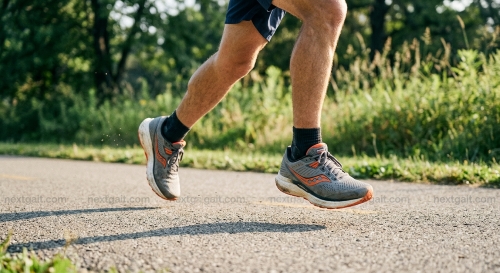
incrediLUX is Saucony’s A-TPU-based cushioning compound designed to produce a soft, lightweight, energy-returning ride in premium daily trainers. In Triumph 24, it replaces the PEBA-based PWRRUN PB used in Triumph 23.
A-TPU means aliphatic thermoplastic polyurethane. That material label describes the foam family, not everything about the finished midsole. Bead structure, density, geometry, additives, molding, outsole, and temperature all influence the ride.
Underfoot, incrediLUX compresses more easily than the Triumph 23 setup. My heel settles deeper, and the forefoot feels less dense. The foam then rebounds enough to prevent the transition from feeling flat, especially once the rocker starts moving.
The first few steps can make the foam seem almost too soft. Once I settle into an easy rhythm, the rocker carries me through the forefoot. At faster cadence I want a more direct toe-off, and this shoe does not give me that.
What surprised me was that the foam did not feel dead after it compressed. I still feel a return into the next step, especially on a flat road. I would call that lively for a recovery shoe, while keeping a faster trainer for workouts.
My pair remained comfortable through more than 200 miles. I would not assume the foam will outlast every PEBA shoe; outsole wear, compression, and the way the shoe feels under your own stride matter more than a material label.
I have no reason to promise the same ride in every temperature. If you regularly run in winter, check how the shoe feels on your first cold outings before making it your only long-run option.
Ride Feel: Soft, Light, and Gently Rockered
The Triumph 24 feels like a soft max-cushion shoe at landing and a lighter daily trainer once it begins to roll. That contrast is the model’s defining achievement. The foam compresses deeply, but the mass does not make the transition feel ponderous.
Heel strikers get the most obvious cushioning. The rearfoot bevel and 10 mm offset make initial contact smooth, while the sidewalls and broad base keep the heel from collapsing without any direction. It still moves more than a firmer shoe.
Through midstance, the shoe feels neutral rather than guided. My foot sits inside some midsole wall, and the outsole adds structure, but there is no medial post or support frame. The platform provides inherent stability, not formal stability.
At toe-off, the rocker does more work than forefoot flex. That is why I find the ride smooth through steady running but less crisp when I ask for a quick change of pace.
The ride is more energetic than Triumph 23. The old model felt denser and more controlled; version 24 compresses farther and returns with a more playful sensation. Runners who equate premium with firm resilience may prefer the older shoe.
At slow pace, the foam can feel almost excessive. At steady pace, the rocker and rebound align better. At hard pace, the soft forefoot and tall heel begin to feel less precise, especially during quick direction changes.
How the Saucony Triumph 24 Performs by Pace
Recovery pace
Recovery running is one of its best uses. The shoe absorbs road harshness, feels light enough not to drag tired legs, and stays comfortable when cadence falls. My recovery-run guide explains why the session still needs controlled effort.
Easy daily pace
Easy pace is the Triumph 24’s center. The upper disappears, the heel feels deeply cushioned, and the rocker keeps the shoe from dwelling too long at the front. This is where the cushioning-to-weight ratio matters most.
Steady aerobic pace
Steady running works better than the depth of foam suggests. The rebound becomes more noticeable, and the shoe carries momentum without a plate. I can use it for moderate progressions, provided the route is not full of tight turns.
Tempo pace
Tempo is possible, not ideal. The light weight helps, but the forefoot does not create a clean lever and the soft heel can feel vague when cadence rises. A dedicated tempo workout deserves a more direct shoe.
Intervals and racing
For short repetitions, I notice the soft front and platform height more than the weight savings. Runners following an interval session will get better control from Endorphin Speed or another performance trainer.
| Pace or Use | My Grade | Reason |
|---|---|---|
| Recovery | A | Soft, light, and comfortable when the legs are tired |
| Easy daily | A+ | The strongest blend of cushion, rebound, and low mass |
| Steady aerobic | A | Rocker and incrediLUX carry momentum well |
| Long easy | A | Deep cushioning remains useful late |
| Tempo | B | Weight helps; soft forefoot and heel reduce precision |
| Intervals | C+ | Not direct or controlled enough for sharp repetitions |
| Marathon racing | B+ | Comfort-first option, not a race-efficiency specialist |
| Walking | B | Comfortable for soft-foam fans, unstable for some |
Long Runs and Marathon Training
My long runs up to 15 miles showed me that the foam stays comfortable beyond the first hour and that the upper has enough room for my foot as it warms up.
The shoe does not become dramatically firmer late. I still have to move out of a soft heel, but the rocker makes that transition manageable even when my legs feel heavy.
For marathon training, I would use Triumph 24 for easy long runs, recovery mileage, and steady aerobic sessions. I would use a lighter plated or performance shoe for marathon-pace rehearsals if the goal is time rather than completion comfort.
A first-time half-marathon runner could race in it if the shoe has already worked during long race-pace efforts. My first half-marathon training plan creates those test opportunities before race day.
For higher weekly volume, the shoe can protect the role of the easy day without feeling like a heavy recovery brick. The long-distance shoe guide explains why late-run fit and stability deserve as much attention as initial softness.
I would not turn the cushioning result into a medical or injury-risk promise. A runner can be comfortable in a soft shoe and still exceed current training capacity. Shoe comfort is useful feedback, not a substitute for workload management.
Stability: Broad Geometry, Very Soft Foam
The Triumph 24 is stable enough for many neutral runners, but it is not a stability shoe. Its broad forefoot, outsole coverage, secure upper, rocker, and modest sidewalls help organize the platform. The soft incrediLUX still allows noticeable movement.
The broad base helps me stay centered on flat pavement, but a wide footprint cannot erase the movement of very soft foam. On uneven ground I notice the platform height more, and I slow down rather than treating this as a trail shoe.
On straight dry roads, I found it predictable. On tight turns, sloped sidewalks, and tired late-run steps, the softness required more attention. That is not a defect for every runner; it is the cost of the ride character.
I can run comfortably in this geometry, but I would not choose it for long periods of standing if I wanted a firmer, quieter platform. The softness that makes an easy run pleasant is still present when I am walking.
Runners who want deep cushioning with formal guidance should compare the Saucony Guide 19 or another support model. Do not select Triumph 24 as treatment for flat feet, knee pain, or an ankle problem.
Heavier runners may value the cushioning, but body mass does not predict fit or stability preference by itself. My running shoes for heavier runners guide focuses on platform behavior and individual comfort.
Saucony Triumph 24 Fit and Sizing
The Triumph 24 fit me true to size in men’s US 10.5 D, with a secure heel, comfortable midfoot, and room across the forefoot. The toe box is lower than its width first suggests, so I would check vertical clearance before committing to a long run.
| Fit area | My experience | What to check |
|---|---|---|
| Length | True to size in men's US 10.5 | Leave normal space ahead of the toes |
| Heel | Secure without noticeable slip | A narrow heel may need a runner's knot |
| Midfoot | Comfortable lace pressure | Check the tongue if you have a high instep |
| Forefoot | Roomy across the width | Try wide if the sidewalls press |
| Toe height | Less room than the width suggests | Check tall toes and swelling late in a run |
The forefoot felt roomy side to side on my foot, while the vertical space over the toes was less generous. I recommend checking both dimensions in person; a shoe can feel wide yet still press on taller toes.
The shoe can be wide across the ball and still feel shallow above the toes. Width and volume are different dimensions. Runners with wide, low-volume feet may love the standard last; runners with tall toes may prefer another upper even in wide sizing.
Use the correct width rather than automatically adding half a size. Extra length can move the rocker, allow sliding, and make the soft platform harder to control. My wide-foot shoe guide explains the trade-off.
Start with the size that gives you normal running clearance. If the sidewalls press, try a wider fit before adding length; extra length can loosen the heel and shift where the rocker meets your foot.
Upper, Lockdown, and Breathability
The comfort-mesh upper is one of the Triumph 24’s strongest components. It feels plush without the dense, hot bulk common in premium trainers, and it holds the foot securely enough to manage the soft platform.
The tongue stayed centered and the laces spread pressure across my midfoot. I did not notice meaningful heel slip during my test, though a narrower heel may need a runner’s knot.
The heel counter is structured but not aggressively hard against my Achilles. There is useful space behind the tendon and enough collar padding to prevent movement. That shape is personal, so runners with sensitive heel anatomy should still test it indoors.
The mesh felt breathable on humid outings without losing the padded, secure feel I want on longer runs. Sock thickness changes that impression, so I check fit with the socks I will actually wear.
During four rain sessions, the upper stayed secure when damp. Drying was not instant, and the shoe gained the normal wet-mesh weight. My running in rain guide covers route hazards and drying practice.
I had no blister issue in the test. That does not prove the upper is blister-proof; skin moisture, sock seams, foot shape, and swelling all matter. See my long-run blister guide for practical checks.
Outsole Grip and Durability After 200+ Miles
The XT-900 outsole remained functional after more than 200 miles, with light smoothing in loaded zones and no meaningful loss of normal road grip. That is a strong test result. It is not evidence for one guaranteed retirement mileage.
Rubber covers high-wear heel and forefoot areas while exposed incrediLUX saves weight through other zones. The layout gives the foam some structure without turning the shoe into a stiff slab. Small debris can lodge in channels, but it did not change my run.
Traction was reliable on dry asphalt, sidewalk, treadmill, and ordinary wet pavement. I completed four rain runs without a slip. Painted road markings, metal covers, leaves, ice, and algae still require caution.
This is a road outsole. Smooth packed paths are reasonable, but the shoe has no lugs, rock plate, reinforced toe, or trail upper. The phrase zero off-road grip from the old draft was also too absolute; the correct limitation is lack of trail-specific traction and protection.
I will replace this pair when the cushioning or grip stops serving my runs, not when a mileage counter reaches a fixed number. My landing pattern and surfaces will not wear the shoe the same way yours do.
Use my running-shoe replacement guide to monitor cushioning, grip, upper hold, and new symptoms. An outsole can look clean after the ride no longer suits the runner, or look worn while still functioning well.
Saucony Triumph 24 vs Triumph 23
The Triumph 24 is softer, taller, lighter, livelier, and less inherently stable than Triumph 23. The switch from PWRRUN PB to incrediLUX is a genuine personality change, not a cosmetic annual update.
| Feature | Triumph 23 | Triumph 24 | My Take |
|---|---|---|---|
| Midsole | PWRRUN PB, PEBA-based | incrediLUX, A-TPU-based | 24 is softer and more energetic |
| Published stack | 37/27 mm | 43/33 mm | 24 adds six millimeters at heel and forefoot |
| Published men’s weight | Heavier reference | 8.8 oz / 250 g | 24 feels clearly lighter |
| Offset | 10 mm | 10 mm | Basic heel-to-toe ratio remains familiar |
| Stability | Firmer and calmer | Broader but much softer | 23 is easier for runners sensitive to wobble |
| Upper | Comfort-oriented mesh | Breathable comfort mesh | 24 gives me the better blend of plushness and heat control |
| Best use | Controlled daily and long runs | Soft daily, recovery, and long runs | Choose by softness preference |
Upgrade if the Triumph 23 felt too dense, heavy, or ordinary for a premium trainer. The extra stack does not make version 24 slower because the foam and overall mass change at the same time.
Keep or buy the Triumph 23 if you prefer firmer control, want a more controlled daily shoe, or dislike deep heel compression. A newer foam is not automatically a better match.
I would not upgrade solely for theoretical durability. My Triumph 24 remained strong through 200+ miles, but a lifespan comparison requires equivalent pairs, surfaces, loading, and retirement criteria.
Saucony Triumph 24 Comparisons
Triumph 24 vs ASICS Gel-Nimbus 28
When I rotate into the ASICS Gel-Nimbus 28, I feel a more planted, structured platform. I return to Triumph 24 when I want a lighter, softer ride with more rebound. If you dislike heel movement, I would start with Nimbus.
Triumph 24 vs Brooks Glycerin 23
The Brooks Glycerin 23 gives me a more familiar, controlled daily ride. Triumph 24 feels taller and softer. I would choose Glycerin for predictable footing and Triumph for recovery miles where plushness leads.
Triumph 24 vs HOKA Bondi 9
I find the HOKA Bondi 9 calmer and more rocker led, especially at walking pace. Triumph 24 gives me a lighter, more responsive run, although its heel is less settled. My choice depends on whether running feel or all-day standing comfort matters more.
Triumph 24 vs Nike Vomero 18
The Nike Vomero 18 feels more layered and grounded to me. Triumph 24 feels simpler, softer, and lighter on the move. I reach for Vomero when I want structure and Triumph when I want easy mileage with a little bounce.
Triumph 24 vs Saucony Ride 19
I use the Saucony Ride 19 as a firmer, more controlled neutral workhorse. Triumph 24 is my softer recovery and long-run option. If I wanted one shoe for varied daily sessions, I would consider Ride first.
Triumph 24 vs Saucony Endorphin Speed 5
When I have a faster workout, I prefer the Saucony Endorphin Speed 5. Its plated, more directed transition suits pace changes. Triumph 24 handles the easy miles around those workouts; I would use the two as a rotation.
Triumph 24 vs Saucony Kinvara 16
The Saucony Kinvara 16 lets me feel and flex through the ground more readily. Triumph 24 gives me the opposite experience: more height, softness, and protection from hard pavement. I pick Kinvara for short, connected runs and Triumph for comfortable mileage.
Max-Cushion Daily Trainer Decision Matrix
Choose Triumph 24 when soft cushioning, low mass, and long-run comfort lead the decision. Choose another trainer when stability, firmness, width volume, or fast-workout precision matters more.
| Shoe | Choose It When | Trade-Off vs Triumph 24 |
|---|---|---|
| Saucony Triumph 24 | You want soft max cushioning at unusually low weight | Less stable and less sharp than firmer rivals |
| ASICS Gel-Nimbus 28 | You want structure and premium comfort | Heavier and less playful |
| Brooks Glycerin 23 | You prefer traditional control and upper security | Less soft and less light |
| HOKA Bondi 9 | You prioritize a calm rocker and walking | Less energetic for running |
| Nike Vomero 18 | You want a layered, familiar high-cushion ride | More mass underfoot |
| Saucony Ride 19 | You want a practical all-purpose neutral trainer | Less premium cushioning |
| Saucony Endorphin Speed 5 | You need workout and race versatility | Less relaxed and less recovery-focused |
Beginners can use Triumph 24, but softness should not replace fit evaluation. My beginner running shoe guide starts with comfort, clearance, and the intended training job.
Concrete runners may appreciate the cushioning, but surface hardness does not create one required shoe. The concrete running shoe guide covers outsole, comfort, and workload.
On a treadmill, the shoe feels smooth and light, though the soft heel can move more on a narrow belt. My treadmill running shoe guide explains when a lower, more flexible trainer may work better.
Best Training Rotation with Triumph 24
I would use Triumph 24 for recovery, easy mileage, and long aerobic runs, then pair it with a more direct shoe for tempo, intervals, and racing. That rotation lets incrediLUX do the work it handles best.
| Training Job | Primary Shoe | Reason |
|---|---|---|
| Recovery | Triumph 24 | Soft cushioning and low mass |
| Easy daily | Triumph 24 or Ride 19 | Choose softness or firmer control |
| Long aerobic | Triumph 24 | Deep cushioning and consistent transition |
| Tempo and intervals | Endorphin Speed 5 | Plate, rocker, and sharper response |
| Race day | A proven performance shoe | Lower weight and better pace-specific geometry |
A simple two-shoe Saucony rotation is Triumph 24 plus Endorphin Speed 5. A three-shoe setup adds Kinvara for treadmill, strides, or lower-stack variety.
One-shoe runners can still use Triumph 24 for strides and occasional progressions. I simply would not choose it because a marketing phrase implies one shoe should handle every pace equally well.
Rotation is optional. Rest and workload matter more than owning multiple pairs. My recovery and rest-day guide helps decide when the answer is not another shoe.
Who Should Buy the Saucony Triumph 24
Buy the Triumph 24 if you want a very soft neutral trainer that remains light enough to feel useful beyond slow recovery pace. It is particularly strong for runners who found Triumph 23 too dense.
- Neutral runners who enjoy deep, compliant cushioning
- High-mileage runners needing an easy and long-run workhorse
- Runners who want max-stack comfort without a heavy shoe
- Heel strikers who like a smooth bevel and 10 mm offset
- Triumph 23 owners seeking a softer and livelier ride
- Half- or marathon trainees prioritizing comfort over race-day efficiency
- Standard and wide-foot runners who have adequate vertical toe room
The shoe can also suit runners who normally avoid max-cushion models because of weight. Its reference mass is closer to many ordinary daily trainers than traditional recovery shoes.
It should earn that role through a short run first. Deep softness is polarizing, and a secure store try-on cannot fully reveal how the heel behaves after ten miles.
Who Should Skip the Saucony Triumph 24
Skip Triumph 24 if you prefer firm ground contact, need formal stability, have very high-volume toes, or want one shoe primarily for fast workouts. Its strengths come directly from a ride character that some runners dislike.
- Runners who feel unstable in deep, soft heels
- Athletes seeking a crisp plate-assisted toe-off
- Walkers or standing workers who dislike prolonged foam compression
- High-volume feet that contact the shallow toe-box ceiling
- Trail runners needing lugs and rock protection
- Runners already happy with the firmer Triumph 23
- Anyone buying cushioning as a treatment for pain or injury
A firmer neutral alternative such as the Brooks Ghost may feel more predictable. A supported alternative belongs in the overpronation shoe guide, but only if guidance improves comfort.
New, persistent, or worsening pain deserves assessment from a qualified clinician. A review can describe fit and ride; it cannot diagnose the reason a runner hurts.
Final Verdict: Is the Saucony Triumph 24 Worth It?
The Saucony Triumph 24 is worth buying for runners who want very soft max cushioning, low weight, and a smooth daily-to-long-run transition. After 200+ miles, I rate it 8.9/10 and consider it the most meaningful Triumph update in several generations.
incrediLUX changes the shoe from a dense premium trainer into a genuine soft max-cushion model. The added stack does not bring the expected weight penalty, and the rocker keeps the deep foam moving at easy and steady pace.
The compromise is stability and precision. The broad base controls much of the motion, but it cannot make very soft foam behave like a firm platform. Tempo is possible; intervals and tight turns reveal the limit.
I would use Triumph 24 for recovery, easy mileage, steady long runs, treadmill work, and comfort-first marathon training. I would pair it with Endorphin Speed for workouts and a proven racer for goal events.
The best buyer is not simply someone who wants more cushion. It is someone who enjoys deep compression and wants that softness without carrying a heavy shoe. For that runner, Triumph 24 is unusually good.
Saucony Triumph 24 Frequently Asked Questions
Is the Saucony Triumph 24 good for daily training?
Yes. It is best for recovery, easy daily mileage, steady aerobic runs, and long runs. Its light weight allows moderate pickups, but the soft forefoot and heel are less precise for hard intervals.
What are the Saucony Triumph 24 weight, stack height, and drop?
Published reference specs are 8.8 oz or 250 g for men’s size 9, 7.6 oz or 216 g for women’s size 8, a 43/33 mm stack, and a 10 mm offset. Independent samples can vary.
Does the Saucony Triumph 24 have a plate?
No. Triumph 24 has no carbon or nylon plate. Its transition comes from incrediLUX foam, a broad platform, and heel and forefoot rocker geometry.
What is incrediLUX foam?
incrediLUX is Saucony’s soft, lightweight A-TPU-based midsole compound. In Triumph 24 it replaces the PEBA-based PWRRUN PB used in Triumph 23 and produces a deeper, livelier ride.
Does the Saucony Triumph 24 run true to size?
It ran true to size for me in men’s US 10.5 D. My heel stayed secure, the forefoot had room across its width, and I would still check the lower toe height if you need more vertical space.
Is the Saucony Triumph 24 good for wide feet?
It has a roomy forefoot and current U.S. listings include wide sizing. However, toe height is lower than the width suggests, so high-volume feet should test vertical clearance rather than relying on width alone.
Is the Saucony Triumph 24 a stability shoe?
No. It is a neutral shoe. A broad base, outsole coverage, rocker, upper lockdown, and modest sidewalls provide inherent control, but the very soft foam can still feel unstable to some runners.
What changed from Saucony Triumph 23 to Triumph 24?
Triumph 24 replaces PWRRUN PB with incrediLUX A-TPU, increases published stack from 37/27 to 43/33 mm, lowers weight, and creates a softer, livelier ride. Triumph 23 remains firmer and more stable.
Is the Saucony Triumph 24 good for long runs?
Yes. I used it for long runs up to 15 miles, and the cushioning and upper remained comfortable late in those efforts. I would still test your own long-run fit before race day.
Can you run a marathon in the Saucony Triumph 24?
Yes, especially when comfort and familiarity matter more than maximum race efficiency. It is still heavier and less precise than a dedicated plated racer, so test it during long marathon-pace training first.
How durable is the Saucony Triumph 24?
My pair remained functional after 200+ miles with light outsole smoothing and a consistent ride. There is no universal lifespan because runner mass, landing pattern, surfaces, rotation, and traction needs differ.
Is the Saucony Triumph 24 good for walking?
It can be comfortable for walkers who enjoy very soft foam. People who prefer a firm standing platform or feel unstable during prolonged heel compression may be better served by a firmer shoe.

Written and tested by Ken – NextGait founder and 12-year runner with 12,500+ lifetime miles, 63 shoes personally tested, and 36 races from 5K through 50K. I run most weeks in South Jersey. This review draws on more than 200 Triumph 24 miles, including road and boardwalk training, recovery days, and long runs up to 15 miles. Read my testing philosophy and bio.