
This Saucony Endorphin Pro 5 review is based on 142 miles, including wet roads, long efforts, intervals, and race-pace work.
My verdict is less flattering—and more useful—than the usual supershoe hype. The Pro 5 is a controlled, durable carbon racer with excellent forward roll, but it is neither exceptionally light nor naturally stable at the forefoot. I scored it 7.3/10.
I am 5’10”, 182 pounds, mildly overpronate, and wear a men’s US 10.5. I run 30–40 miles most weeks around Atlantic City, New Jersey. That matters here: my weight loads the dual-density midsole more than a 140-pound tester will, and the uneven Boardwalk exposes lateral wobble quickly.
Bottom line: Buy the Endorphin Pro 5 if you want a secure, rolling race shoe for 10K through marathon pace. Skip it if you want Vaporfly-level lightness, a roomy toe box, or a shoe that feels natural on easy days. If you want a dedicated racer, compare these faster race-day options.
In this review
Saucony Endorphin Pro 5 review: specs and score
The Pro 5 combines an 8 mm drop, two PEBA-based foams, a slotted carbon plate, and SPEEDROLL geometry.
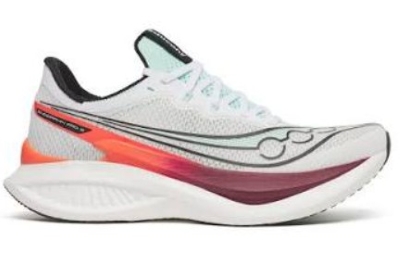
| Specification | Published or tested value | What it means |
|---|---|---|
| Official weight | 7.3 oz / 206 g, men’s sample | Light overall, but not class-leading for a current carbon racer |
| My pair | 7.5 oz, men’s US 10.5 | Sample size and production variance explain part of the difference |
| Official stack / drop | 39.5 mm heel, 31.5 mm forefoot / 8 mm | High cushioning with a familiar drop for many daily-trainer users |
| Independent lab stack | 36.5 mm heel, 27.8 mm forefoot / 8.7 mm | Lab method differs from brand measurement; compare within one method |
| Midsole | PWRRUN PB base + supercritical PWRRUN HG top layer | PB supplies volume; HG adds a firmer, quicker layer near the foot |
| Plate | Slotted full-length carbon fiber | Very stiff overall, with a split forefoot designed to work with the rocker |
| Outsole | Targeted PWRTRAC rubber | Better wet bite and coverage than a minimalist race outsole |
| Fit | True to size for me | Normal midfoot volume; toe box narrows toward the front |
| Test mileage | 142 miles | Enough to assess settled ride, wear pattern, and upper behavior |
| Ken’s rating | 7.3 / 10 | Strong transition and enjoyment; average versatility and forefoot stability |
Saucony’s product specification is the correct source for marketed construction. I use independent lab numbers to add context, not to pretend every measurement protocol should match.
Saucony Endorphin Pro 5 review: how I tested it
I logged 142 miles across asphalt and Boardwalk planks, from recovery pace to hard 5K effort.
The useful sessions included short intervals, a controlled tempo run, sustained half-marathon effort, a 13.1-mile long test, easy-run contrast, tight turns, and damp pavement. I also used five structured sessions to repeat the same fit, pace, and stability checks after the shoe settled.
My first run started at 5:45 a.m. on the coastal road from Ventnor through Margate. Wind was pushing mist sideways. The shoe felt awkward while I shuffled through the warm-up, then changed character as soon as I reached tempo effort: the midsole stopped feeling tall and the roll became clean.
That first impression survived the test period. Standing still, the Pro 5 feels like a stiff platform. Running fast, it feels coherent. The hollow slap on Boardwalk planks is louder than my Endorphin Speed 5, and I can feel the plate asking for more pressure at toe-off.
This is field testing, not a metabolic trial. I can report pace, comfort, wear, and how my mechanics interact with the shoe. I cannot claim it improved my running economy by a personal percentage.
What changed from Endorphin Pro 4?
Version 5 changes the plate, upper, and outsole more than it changes the familiar Endorphin Pro identity.
The headline update is the re-engineered slotted carbon plate. Saucony pairs it with the existing dual-density idea: PWRRUN PB beneath a supercritical PWRRUN HG layer. The intended result is a quicker, smoother SPEEDROLL transition rather than a single rigid lever sensation.
SPEEDROLL is a curved Saucony midsole geometry that moves the runner forward through a rolling transition rather than forefoot flex. The Pro 5 keeps a published 39.5 mm heel and 31.5 mm forefoot stack.
The upper is a thin engineered mesh with an integrated stretch tongue. PWRTRAC rubber replaces the older outsole approach and is the update I noticed most in poor weather. Stack and drop remain familiar, so this does not feel like Saucony abandoned the accessible-racer formula.
If the Pro 4 already fits and performs well for you, version 5 is an incremental upgrade, not an automatic replacement. The better reason to change is wet grip or a preference for the new transition—not the number printed on the box.
Saucony Endorphin Pro 5 review: ride and pace range
The Endorphin Pro 5 feels best at sustained race effort, where its rocker creates speed without demanding perfect form.
PWRRUN PB gives the shoe depth, but the HG layer prevents the step-in feel from becoming mushy. At 182 pounds, I compress enough foam to feel protection at the heel and forefoot while still meeting resistance from the plate. The sensation is taut, not trampoline-soft.
SPEEDROLL starts the transition early. When I land near the rear lateral edge, the bevel moves me toward the center before the rocker tips forward. That sequence is why the shoe works better for my mild heel-to-midfoot strike than several narrow supershoes.
The forefoot is the interesting part. The plate slot reduces the feeling of one solid carbon slab, yet the shoe remains extremely stiff. An independent lab needed 26.1 N to bend it 30 degrees, versus a 15.5 N average in that test set. The slot changes how the front loads; it does not make the shoe flexible.
| Pace / session | My experience | Verdict |
|---|---|---|
| Recovery, 9:30–10:00/mi | Plate feels intrusive; rocker arrives before I want it | Use a daily trainer |
| Steady, 8:30–9:00/mi | Smoother, but still more structure than necessary | Acceptable warm-up pace |
| Tempo, 7:45–8:00/mi | Transition clicks; cushioning and roll feel balanced | Excellent |
| Intervals, 7:00–7:20/mi | Fast and controlled, though heavier-feeling than Vaporfly 4 | Very good |
| Short sprint | Rocker feels less nimble than a low, light racing flat | Not its strength |
For workout structure, I would pair it with the sessions in my interval training guide, but not wear it for every repetition day. A plated race shoe should answer a specific question in training: Does it remain comfortable and controllable at goal pace?
Saucony Endorphin Pro 5 review: fit and sizing
The Endorphin Pro 5 fits true to size for me, with secure length but a distinctly tapered toe box.
My usual men’s US 10.5 provides enough length and vertical toe room. The midfoot has more volume than many race uppers, so I had to tighten the laces carefully. Too loose, and my foot moved inside the shoe. Too tight, and the thin tongue transmitted pressure across the top of my foot.
For a quick Endorphin Pro 5 sizing answer, start true to size and judge toe shape, heel movement, and lace pressure while running fast. I struggled to balance lockdown and tongue pressure on the first attempt; a looser middle row fixed it.
The apparent contradiction—normal overall width but tight toes—shows why one width number is not enough. RunRepeat measured the widest interior area at 95.2 mm, exactly its test average, but the toe box narrowed to 69.3 mm versus a 73.2 mm average. That matches my foot: adequate at the ball, closer at the outer toes.
I would not recommend blind sizing up. Extra length can weaken heel hold without fixing the shape. If you regularly need 2E or your little toe presses against racing uppers, start with my wide-foot shoe options and test the Pro 5 in person.
Wear crew socks for the first fast run. The tongue is thin and slightly high, while the heel collar has little padding. I had no blistering, but other testers reported Achilles irritation. Skin contact is personal; a smooth five-minute try-on does not predict 90 minutes of sweat and friction.
Is the Endorphin Pro 5 stable?
It is stable-neutral at the heel and midfoot, but the slotted forefoot can feel less centered during late toe-off.
Saucony uses geometry instead of a medial post: heel flare, sidewalls, a filled-in midfoot, and a broad front platform. Those features help my left foot stay organized when I land slightly lateral and roll inward.
Still, this is not a stability shoe. During slow turns on uneven boards, I felt the forefoot slot allow each side to load differently. At race pace on straight asphalt, that same construction felt smoother and less blocky. Context changes the verdict.
Runners who need firm guidance should compare it with stable daily trainers in my running-shoe guide, then reserve carbon footwear for tested race sessions. A fast shoe cannot correct strength, balance, or training-load problems.
Grip and durability after 142 miles
PWRTRAC grip is a real upgrade, and my outsole remains race-usable after 142 miles.
The damp Ventnor promenade is where I trusted it. I could turn without shortening my stride, and painted road markings felt less slick than they did in older Endorphin race shoes. RunRepeat’s wet-concrete test reached 0.68 versus 0.52 for the Pro 4, which supports—but does not replace—my road observation.
My lateral heel shows the first visible wear, followed by scuffing under the big-toe area. There is cosmetic creasing in the exposed foam. The rubber has not peeled, the upper has not torn, and the midsole still produces a consistent roll during threshold work.
The thin mesh deserves separate caution. Abrasion testing can make race uppers look fragile, but my pair has survived normal road use. Keep it away from sharp trail debris, dry it at room temperature, and use actual performance changes—not a round mileage number—to decide when the shoe is finished.
Durability verdict: My Endorphin Pro 5 durability result is encouraging at 142 miles, though race-day sharpness may fade before the shoe becomes unrunnable.
What race distance suits it best?
The Pro 5 is strongest from 10K through half marathon, with enough protection for a well-tested marathon.
| Distance | My verdict | Reason |
|---|---|---|
| 5K | Good, not my first pick | Fast roll, but less nimble than lighter racers |
| 10K | Excellent | Enough protection without carrying the shoe for too long |
| Half marathon | Best match | Stable rearfoot and sustained SPEEDROLL suit controlled hard running |
| Marathon | Very good for the right runner | Protective and predictable, but fit must survive swelling |
| Daily training | No | Too stiff and specialized for easy mileage |
For a first 26.2, I care more about calm mechanics at mile 22 than fireworks at mile one. The Pro 5 belongs on a shortlist with the shoes in my marathon racing guide, especially for runners who dislike very soft or narrow platforms.
For an Endorphin Pro 5 marathon setup, complete at least one long goal-pace block before race day. The beginner marathon plan builds the fitness; the shoe test only confirms fit, calf response, and fueling-day comfort. If the rocker feels strange at first, don’t worry—judge it at goal pace before deciding.
Endorphin Pro 5 comparisons
Choose the Pro 5 for control; choose its rivals when low weight, extreme bounce, or training versatility matters more.
My pick: Pro 5 for a controlled half marathon; Vaporfly 4 for short-course speed; Speed 5 for everyday value.
| Comparison | Which feels better? | My pick |
|---|---|---|
| Endorphin Pro 5 vs. Pro 4 | Pro 5 has better wet grip and a smoother forefoot transition; Pro 4 remains close overall | Pro 5 for rain, Pro 4 if already proven |
| Endorphin Pro 5 vs. Speed 5 | Pro is stiffer and more race-specific; Speed is easier at daily and steady paces | Pro for racing, Speed for most workouts |
| Endorphin Pro 5 vs. Vaporfly 4 | Pro feels more secure; Vaporfly feels lighter and sharper | Pro for a cautious marathon choice, Vaporfly for 5K/10K speed |
| Endorphin Pro 5 vs. Metaspeed Sky Tokyo | Pro rolls more calmly; ASICS gives a larger, softer forefoot rebound | Pro for control, ASICS for aggressive stride runners |
| Endorphin Pro 5 vs. Alphafly 3 | Pro is simpler underfoot; Alphafly has deeper, more dramatic bounce | Pro for predictability, Nike for maximum assistance sensation |
The Endorphin Pro 5 vs Endorphin Speed 5 decision is simple: race specificity versus weekly range. The Vaporfly 4 is the shoe I would choose for a fast, straight 10K when fit is secure. Its lower-feeling mass makes turnover easier. The Pro 5 wins when my form gets less precise or the course includes damp corners.
The Metaspeed Sky Tokyo delivers more forefoot drama, but it asks more from my calves and lateral control. The Alphafly 3 feels even more assisted and cushioned. Neither is as ordinary—in a good way—as the Saucony.
For training, I would take the Speed 5 without hesitation. Its nylon plate is more forgiving, and it fits a larger share of the sessions in a normal weekly running schedule. Pro 5 is a race tool, not a status upgrade.
Who should buy the Endorphin Pro 5?
Buy it if you want a plated racer that prioritizes smooth pacing, rearfoot security, grip, and usable durability.
- Heel or midfoot strikers who prefer an early rocker.
- First-time carbon-shoe buyers willing to test fit at race pace.
- 10K, half-marathon, and marathon runners who value control over spectacle.
- Heavier runners who compress soft racers too deeply.
- Runners expecting wet roads or frequent turns.
It also makes sense for runners building a race rotation around a separate shoe from the daily-trainer category. That separation keeps easy mileage comfortable and reserves the carbon setup for purposeful work. Trust me: making every Tuesday feel like race day gets old quickly.
Who should skip it?
Skip it if you need a true wide fit, strong stability guidance, flexible forefoot, or one shoe for every run.
- Wide-foot runners whose toes need a square or anatomical shape.
- Runners sensitive to thin tongues, high collars, or lace pressure.
- Anyone wanting the lightest possible 5K racer.
- Recovery runners expecting soft, relaxed flexibility.
- New runners hoping footwear can replace consistent training.
If your goal is simply a lighter everyday option, start with my lightweight running-shoe picks. A carbon plate changes bending stiffness and load distribution; it does not automatically make every pace better. I know how tempting the “faster shoe” shortcut is; fitness still supplies the engine.
Pros and cons after 142 miles
The transition, wet grip, and rearfoot control are excellent; weight, toe shape, and slow-pace feel hold it back.
Pros
- Smooth SPEEDROLL transition at race pace
- Protective dual-density cushioning
- Secure heel and midfoot
- Confident PWRTRAC wet grip
- Outsole remains usable at 142 miles
Cons
- Heavier-feeling than top lightweight racers
- Tapered toe box
- Thin tongue can transmit lace pressure
- Forefoot slot may feel less centered
- Awkward at recovery pace
How to introduce the Pro 5 into training
Use three progressive sessions before racing: short pickups, a controlled workout, then a longer goal-pace block.
- Session one: 4–6 easy miles with four to six 60-second goal-pace pickups.
- Session two: A normal threshold or interval workout, without increasing volume because the shoe feels fast.
- Session three: A longer race-pace segment using the planned socks, lacing, fuel, and route conditions.
Check your calves, Achilles, forefoot, and top-of-foot pressure the next morning. I learned this lesson during my 2019 plantar-fascia problem: excitement can hide a load-management mistake for one run, but the body usually sends the bill later.
A first-time half-marathon runner can place these tests inside a half-marathon plan. For a shorter race, the controlled sessions in my 5K training plan reveal whether the rocker stays nimble enough at faster turnover.
What carbon-shoe science can actually tell us
Advanced footwear often improves running economy on average, but the size of the response varies by runner and shoe.
A 2025 meta-analysis of advanced footwear technology found overall economy and endurance benefits across studied shoes. That does not prove the Endorphin Pro 5 will produce the same result for you, nor does it turn an average effect into a personal guarantee.
The plate is only one part of the system. Foam resilience, shoe mass, rocker position, stack, fit, speed, and the runner’s mechanics interact. My experience supports the speed-dependent point: the Pro 5 feels efficient when loaded hard and obstructive when I jog slowly.
Its 8 mm geometry also should not be reduced to “more drop is safer.” My heel-drop explanation covers how drop changes ankle and knee demands. Comfort and gradual exposure matter more than a universal ideal.
For sanctioned competition, World Athletics currently sets a 40 mm maximum road-shoe sole thickness under its 2026 footwear regulations. Competitive athletes should still confirm the exact model on the current approved-shoe resources before racing.
Saucony Endorphin Pro 5 FAQ
Is the Saucony Endorphin Pro 5 true to size?
Yes for me in a men’s US 10.5. Length and midfoot volume are normal, but the toe box tapers. Wide-foot runners should test at race pace instead of assuming a half-size increase will solve the shape.
Is the Endorphin Pro 5 good for a marathon?
Yes. It has enough protection, rearfoot control, and outsole grip for 26.2 miles. I would only race it after a long goal-pace test confirms toe room, lace comfort, and calf response.
Can beginners run in the Endorphin Pro 5?
Yes, but beginners do not need a carbon shoe to race well. The Pro 5 is approachable at speed, yet its stiffness still requires adaptation. Build consistent mileage first and keep a comfortable trainer for most runs.
Endorphin Pro 5 or Endorphin Speed 5?
Choose Pro 5 for racing and selected goal-pace workouts. Choose Speed 5 for frequent training, steady running, and a more forgiving nylon plate. If you can own only one, the Speed is more useful.
Is the Endorphin Pro 5 stable?
It is stable-neutral through the heel and midfoot, not a stability shoe. The broad geometry helps, while the slotted forefoot can feel less centered during slow turns or fatigued toe-off.
Can heel strikers use the Endorphin Pro 5?
Yes. The beveled heel and SPEEDROLL transition work well with my heel-to-midfoot pattern. Heavy braking can still feel clunky, so test the shoe at actual race effort.
Is the Endorphin Pro 5 good for wide feet?
Not for most genuinely wide feet. The shoe has reasonable width at the ball but narrows toward the toes. Runners needing 2E or an anatomical toe box should try alternatives.
How long does the Endorphin Pro 5 last?
My pair remains useful at 142 miles, with lateral-heel wear and cosmetic foam creasing. Lifespan depends on surface, body mass, gait, and whether “finished” means no longer race-sharp or no longer runnable.
Can I use the Endorphin Pro 5 as a daily trainer?
You can, but I would not. It feels rigid and unnecessary at recovery pace. A flexible trainer distributes stress differently, costs less per ordinary mile, and makes the Pro feel distinct on workout days.
Is the Endorphin Pro 5 legal for road races?
Its published 39.5 mm heel stack is within the 40 mm road limit. Athletes racing under formal rules should verify the exact model against the latest World Athletics approved-shoe information.
Saucony Endorphin Pro 5 review: final verdict
The Saucony Endorphin Pro 5 earns 7.3/10: excellent at rolling speed, merely average as an all-purpose supershoe.
I would race it from 10K through half marathon and consider it for a marathon after a long fit test. The transition is the best part. It lets me settle into effort without hunting for one exact landing point, and the PWRTRAC outsole removes much of my old Endorphin rain anxiety.
I would not call it the fastest shoe I own. Vaporfly 4 turns over quicker, Metaspeed Sky Tokyo rebounds harder, and Speed 5 handles more of my week. Pro 5 wins a narrower contest: it is the race shoe I trust when control matters more than drama.
That is also why the score stays at 7.3. A great transition cannot erase the tapered toe box, intrusive easy-pace feel, modest weight, or forefoot instability. If those tradeoffs fit your stride, the shoe is better than the number. If they do not, no carbon marketing line will rescue it.

Written by Ken — 12 years of running, 12,500+ miles, 63 shoes tested, 36 races from 5Ks to a 50K ultra. I run 30–40 miles a week on the Atlantic City Boardwalk and review every shoe with real training miles, not one-run demos. More about me →