
This Nike Vaporfly 4 review is based on 299 miles, including intervals, tempo work, long runs, wet roads, and races.
Here is the verdict I wish the product page gave you: Vaporfly 4 is a lighter, sharper race shoe than Vaporfly 3, and I prefer it from 5K through half marathon. It is also narrower, less stable at the heel, and less protective when a marathon gets ugly. I scored it 7.2/10.
I am 5’10”, 182 pounds, mildly overpronate, and wear a men’s US 10.5. I run 30–40 miles most weeks around Atlantic City, New Jersey. A 166-pound lab runner and I will not load this thin ZoomX platform the same way, so body mass, pace, and foot strike stay attached to every personal claim below.
Bottom line: Buy Vaporfly 4 for light, fast road racing from 5K to half marathon. Choose Alphafly 3 or a deeper, wider racer for marathon protection. Skip Vaporfly 4 for daily miles, wide feet, or meaningful stability needs.
In this review
Nike Vaporfly 4 review: specs and score
Vaporfly 4 pairs full-length ZoomX with a carbon Flyplate, 6 mm stated drop, and a stripped race upper.
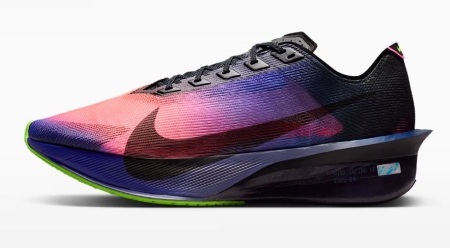
| Specification | Published or tested value | What it means |
|---|---|---|
| Nike weight | 6.7 oz / 190 g, men’s US 10 | Extremely light; sample size matters when comparing figures |
| Independent lab weight | 5.9 oz / 166 g, different sample | Do not treat weights from different sizes as direct contradictions |
| Nike heel-to-toe drop | 6 mm | Lower stated offset than Vaporfly 3 |
| Independent lab stack / drop | 34.1 mm heel, 25.5 mm forefoot / 8.6 mm | Measurement protocol differs from brand construction figures |
| Midsole | Full-length ZoomX | Low-density PEBA-based foam with high rebound |
| Plate | Full-length carbon-fiber Flyplate | Higher angle than v3, according to Nike |
| Upper | Engineered mesh | Minimal structure and padding to reduce mass |
| Outsole | Thin blown rubber with exposed foam | Good road feel; wear depends heavily on landing pattern |
| My size | Men’s US 10.5 | True to size for my foot, but not a wide fit |
| My test mileage | 299 miles | Includes post-race-life miles after the shoe lost peak sharpness |
| Ken’s rating | 7.2 / 10 | High speed and enjoyment; lower stability, versatility, and durability |
Nike’s current Vaporfly 4 product page is the source for marketed weight, drop, ZoomX, and Flyplate construction. I label lab measurements separately because merging them into one “official spec” table creates false precision.
Nike Vaporfly 4 review: how I tested it
I logged 299 miles on asphalt and Boardwalk planks, from 9:45 recovery pace to hard interval effort.
My test log includes 11 structured checks plus ordinary runs: short repetitions, a controlled tempo session, sustained 10K and half-marathon effort, long-run contrast, dry and damp corners, and repeat fit tests after the upper softened.
The first run started at 6:15 a.m. around Gardner’s Basin. Dense fog hid the Absecon Lighthouse until I was almost beside it. During the easy opening mile, the heel felt narrow and fussy. At 7:20 pace, the shoe snapped into focus: short compression, fast release, no sense of waiting for the foam.
I kept the pair beyond its prime to answer a question most launch reviews cannot: what actually happens after race-day pop fades? The shoe did not die at one mileage number. It moved through three phases—race-sharp, workout-capable, then merely runnable.
| Mileage phase | What changed in my pair | How I used it |
|---|---|---|
| 0–100 miles | Fastest transition, secure foam rebound, clean outsole edges | Races and key workouts |
| 101–200 miles | Still quick; lateral heel wear and softer landing became obvious | Intervals and tempo work |
| 201–299 miles | Less race sharp, more exposed-foam wear, reduced late-run control | Occasional workouts, then retirement |
This is field testing, not a metabolic laboratory. I can describe fit, traction, pace response, wear, and the interaction with my gait. I cannot assign a personal running-economy percentage from watch pace alone.
What changed from Vaporfly 3?
Nike removed material, lowered the stated drop, raised the Flyplate angle, and made Vaporfly feel race-specific again.
The weight reduction comes from all three major assemblies: less midsole, thinner outsole rubber, and a smaller upper package. Nike says the model is roughly 10% lighter than Vaporfly 3. An independent lab measured a 13% reduction between its samples.
Flyplate is a curved, full-length carbon-fiber plate embedded between ZoomX layers to increase longitudinal stiffness and shape transition.
The higher plate angle and lower heel geometry make toe-off feel earlier. Vaporfly 3 offered more relaxed protection; version 4 feels closer to the direct, urgent personality that built the line’s reputation. I view that as a clearer purpose, not an unconditional upgrade.
Nike Vaporfly 4 review: ride and pace range
Vaporfly 4 is best at fast, continuous running where low mass and quick ZoomX rebound reward higher turnover.
The ride is not a huge trampoline. My foot loads the lateral heel or midfoot, ZoomX compresses briefly, and the plate moves me through the front before I sink deeply. The result feels fast because the sequence is short.
At 182 pounds, I appreciate that the foam feels firmer than Vaporfly 3. Too much compliance under a narrow base can make my ankle hunt for center. Version 4 gives me better timing. The downside is a heel that remains too slim to call stable.
RunRepeat measured 78.1% heel energy return in its current protocol. That is useful comparative evidence, not a promise that 78.1% of my effort returns as forward speed. Lab machinery isolates material behavior; a runner adds joints, technique, fatigue, and fit.
| Pace / session | My experience | Verdict |
|---|---|---|
| Recovery, 9:15–9:45/mi | Narrow heel wanders; plate feels unnecessary | Poor match |
| Steady, 8:15–8:45/mi | Ride becomes smoother but still feels specialized | Usable warm-up range |
| Tempo, 7:45–8:00/mi | ZoomX and plate coordinate; turnover feels easy | Excellent |
| Intervals, 7:00–7:20/mi | Low mass and fast release become the main story | Outstanding |
| Short sprint | Quick, though not as low or direct as a road-mile flat | Very good |
I would test it during sessions from my interval guide, then return to a trainer for easy days. A race shoe earns its place by answering a race-specific question, not by making every run feel important.
Nike Vaporfly 4 review: fit and sizing
My usual men’s US 10.5 fits, but Vaporfly 4 is narrow through the platform and unforgiving of shape mismatch.
For a quick Nike Vaporfly 4 sizing answer, start with your normal Nike racing size and run before deciding. I had enough length and toe height in 10.5, with secure heel hold after using the top eyelets.
Other experienced testers needed a half-size increase because the shoe felt short or irritated the fourth toe. Both findings can be true. RunRepeat’s gel mold measured a narrow 91.7 mm at the widest point versus a 95.2 mm average, yet the big-toe area matched its 73.2 mm average.
The engineered mesh does not provide a trainer’s padding or stretch. I tighten the lower rows gently, add tension through the middle, then use a runner’s loop only if heel movement remains. Pulling every row hard creates lace pressure without making the platform wider.
Wide-foot runners should not assume going longer will solve a narrow midfoot. Compare alternatives in my wide-foot shoe guide and test downhill, through a turn, and at goal pace. Numbness is a fit failure, not a break-in requirement.
Is Nike Vaporfly 4 stable?
Vaporfly 4 is a neutral racer with a very narrow heel, so straight-line speed is safer than tired cornering.
The lower stack can feel less perched than Vaporfly 3, but Nike also narrowed the geometry. RunRepeat measured a 77.0 mm heel platform against a 91.2 mm lab average. That 14.2 mm gap explains more than the word “neutral.”
On smooth asphalt at 10K effort, I land and leave before the heel has time to feel troublesome. At recovery pace, on slanted road shoulders, or during a late-race turn, my mild overpronation exposes the missing width.
Heel strikers can use it, but heavy braking is a poor match. If you need consistent guidance, choose a broader option from my running-shoe recommendations and treat Vaporfly as an optional race tool—not a correction for mechanics or strength.
Grip and Nike Vaporfly 4 durability after 299 miles
My pair reached 299 miles, but it stopped being race-sharp well before it stopped being runnable.
The front rubber grips clean dry pavement well. On damp Boardwalk approaches and painted crossings, I shorten my stride slightly. RunRepeat recorded 0.45 in its wet-traction protocol versus a 0.52 average, matching my view that the grip is adequate rather than exceptional.
Wear began at my outer heel, then spread across exposed midfoot foam and the forefoot push-off zone. The soft rubber rounds quickly. By the final phase, the shoe still flexed and rebounded, but lateral control and the crisp edge at toe-off had faded.
Durability verdict: 299 miles is evidence that one pair can remain runnable, not a recommendation to race it that long. My body mass, asphalt texture, landing point, and tolerance for reduced pop are specific to me.
Retire it from racing when grip, alignment, or transition changes enough to affect confidence. I would avoid stretching its life merely to reach a round number. My guide to replacing running shoes separates cosmetic creasing from functional decline. A worn race shoe may still serve short workouts before full retirement.
Best race distance for Vaporfly 4
Vaporfly 4 is best from 5K through half marathon; marathon use depends heavily on weight, mechanics, and fit.
| Distance | My verdict | Reason |
|---|---|---|
| Road mile | Very good | Light and quick, but a lower specialist may feel more direct |
| 5K | Excellent | Low mass and rapid transition matter more than deep protection |
| 10K | My top use | Enough ZoomX to protect while retaining sharp turnover |
| Half marathon | Excellent if fit is secure | Efficient ride without carrying Alphafly bulk |
| Marathon | Conditional | Less rearfoot width and cushioning reserve than deeper racers |
| Daily training | No | Too narrow, fragile, and stiff for ordinary mileage |
For a Nike Vaporfly 4 marathon setup, I would complete a 14–18 mile run with a meaningful goal-pace block. Use the exact sock, lacing, and fuel plan. If lateral control or forefoot pressure declines after 90 minutes, believe the test.
First-time marathoners should prioritize the training in my beginner marathon plan and compare more protective options in the marathon shoe guide. If Vaporfly feels nervous during easy running, don’t worry—judge it at race pace, then make an honest distance decision.
Nike Vaporfly 4 comparisons
Choose Vaporfly for light turnover, Alphafly for marathon protection, and broader rivals for stability or fit.
My pick: Vaporfly 4 for 5K/10K, Metaspeed Sky Tokyo for aggressive forefoot rebound, and Endorphin Pro 5 for control.
| Comparison | Main difference | My choice |
|---|---|---|
| Vaporfly 4 vs. Vaporfly 3 | V4 is lighter, firmer, lower, and more direct; v3 is more relaxed and protective | V4 through half marathon, v3 for comfort |
| Vaporfly 4 vs. Alphafly 3 | Vaporfly turns over faster; Alphafly is deeper, wider, and more cushioned | Vaporfly for 5K/10K, Alphafly for marathon |
| Vaporfly 4 vs. Endorphin Pro 5 | Nike feels lighter and sharper; Saucony feels more controlled and durable | Nike for speed, Saucony for predictability |
| Vaporfly 4 vs. Metaspeed Sky Tokyo | Nike releases quickly; ASICS delivers a larger forefoot rebound | Nike for cadence, ASICS for stride length |
| Vaporfly 4 vs. Endorphin Speed 5 | Nike is a pure racer; Saucony is a durable nylon-plated trainer | Nike for race day, Saucony for workouts |
The Nike Vaporfly 4 vs Alphafly 3 decision is not “fast versus faster.” The Alphafly 3 gives my 182-pound frame more cushioning reserve and rearfoot confidence late in a marathon. Vaporfly feels cleaner in corners and much easier to spin during short racing.
Metaspeed Sky Tokyo feels more dramatic under the forefoot and asks more of my calves. The Endorphin Pro 5 is less exciting but easier to center when form slips.
For training, I prefer the Endorphin Speed 5. Its nylon plate fits more sessions in a normal weekly training structure, while Vaporfly stays special—and less worn—for important days.
Who should buy Nike Vaporfly 4?
Buy Vaporfly 4 if you want a minimal, high-turnover road racer and do not need a broad support platform.
- Neutral midfoot and forefoot strikers racing 5K to half marathon.
- Efficient heel strikers who move quickly through contact.
- Runners who found Vaporfly 3 too soft or relaxed.
- Racers who value low mass more than maximum cushioning.
- Narrow-to-average feet that fit Nike race lasts securely.
It belongs among the strongest options in my carbon-plated shoe guide. It can also serve runners choosing from the lightweight racing category, provided the narrow heel does not become the hidden cost of low mass.
Who should skip it?
Skip Vaporfly 4 if you need wide-foot comfort, stable late-race landings, easy-pace flexibility, or rugged outsole life.
- Runners with meaningful pronation or balance needs.
- Wide or high-volume feet that fight the mesh.
- Heavier marathoners who want deeper cushioning reserve.
- Anyone seeking one shoe for recovery through racing.
- Runners who train mostly on gravel, trails, or rough shoulders.
If you want one versatile shoe, start with the daily-trainer category. Trust me: a race shoe that feels thrilling for 20 minutes can become annoying across five ordinary weekly runs.
Pros and cons after 299 miles
Vaporfly 4 delivers elite weight and transition, but its narrow geometry and limited race-sharp lifespan demand compromise.
Pros
- Exceptionally low mass
- Fast ZoomX compression and release
- Sharp from 5K through half marathon
- Breathable, low-volume race upper
- More distinct from Alphafly 3 than v3 was
Cons
- Very narrow heel platform
- Fit can feel short or tight for some feet
- Wet traction is only adequate
- Outsole wears quickly for hard landers
- Less forgiving for long marathons
How to introduce Vaporfly 4 into training
Use three progressive sessions before racing: short pickups, a normal workout, then a longer goal-pace test.
- Session one: 4–6 easy miles with four to six 60-second race-pace pickups.
- Session two: A familiar interval or threshold workout without adding volume.
- Session three: A longer race-pace segment using race socks, lacing, and fuel.
Check the outer ankle, Achilles, forefoot, and top-of-foot pressure the next morning. I know how easy it is to confuse a fast first run with a perfect match. My 2019 plantar-fascia problem taught me that excitement can hide a load-management error for one day.
A shorter-distance runner can use the controlled work in my 5K plan. Half-marathon beginners can place the same progression inside a half-marathon plan without replacing their normal trainer.
What carbon-shoe science can tell us
Advanced footwear improves running economy on average, but an average benefit cannot predict one runner’s response to Vaporfly 4.
A 2025 meta-analysis of advanced footwear technology found overall running-economy and endurance benefits across studied models. Shoe-to-shoe and runner-to-runner responses still vary.
The mechanism is a system, not carbon alone. A carbon plate changes bending stiffness, but ZoomX resilience, low mass, geometry, fit, speed, and individual biomechanics also interact. My experience is speed-dependent: Vaporfly feels coordinated during intervals and nervous during slow recovery running.
Nike’s 6 mm stated offset should not be translated into “more natural” or “more dangerous.” My heel-drop guide explains how offset redistributes ankle and knee demand. Gradual exposure matters more than a universal ideal.
For sanctioned road competition, World Athletics currently limits sole thickness to 40 mm under its 2026 shoe regulations. Athletes should confirm the exact model on current approved-shoe resources before racing.
Nike Vaporfly 4 FAQ
Does Nike Vaporfly 4 fit true to size?
It fits true to size for me in a men’s US 10.5. Some runners find it short or tapered and need a half-size increase. Run at race pace before keeping it.
Is Nike Vaporfly 4 good for a marathon?
It can handle a marathon for efficient runners who have tested it long. At 182 pounds, I prefer Alphafly 3 or a broader, deeper racer for late-race cushioning and stability.
Is Vaporfly 4 better than Vaporfly 3?
It is lighter, firmer, and sharper, making it better for my 5K-to-half-marathon racing. Vaporfly 3 is more relaxed and may be the better long-distance choice for runners who value comfort.
Vaporfly 4 or Alphafly 3?
Choose Vaporfly 4 for lower mass, quicker turnover, and shorter races. Choose Alphafly 3 for deeper cushioning, a wider platform, and marathon protection.
Can heel strikers use Nike Vaporfly 4?
Yes, if contact is controlled and moves forward quickly. Heavy braking and late-race lateral movement expose the extremely narrow heel platform.
Is Nike Vaporfly 4 stable?
No in the stability-shoe sense. It is a neutral racer with a stiff plate and lower stack, but the narrow heel and midfoot provide little margin when alignment deteriorates.
Is Vaporfly 4 good for wide feet?
Usually not. The platform is narrow even though toe height and big-toe width can feel reasonable. Going longer may weaken heel lockdown without fixing midfoot shape.
How long does Nike Vaporfly 4 last?
My pair remained runnable to 299 miles but lost race sharpness much earlier. Outsole life varies with body mass, landing point, surface, and what performance level the runner expects.
Can I use Vaporfly 4 for daily training?
You can, but I would not. The narrow heel, stiff plate, exposed foam, and awkward easy-pace feel make a flexible daily trainer better for ordinary mileage.
Is Nike Vaporfly 4 legal for road races?
Its stack is below the 40 mm road limit. Athletes competing under formal rules should verify the exact colorway/model entry against current World Athletics resources.
Nike Vaporfly 4 review: final verdict
Nike Vaporfly 4 earns 7.2/10: brilliant for fast road racing, compromised for stability, durability, and everyday range.
I would choose it for a road 5K or 10K tomorrow. The low mass is obvious without looking at a scale, and the quick ZoomX-to-Flyplate sequence suits the way my cadence rises during hard running.
I would not make it my automatic marathon shoe. The 77 mm lab-measured heel width, sparse upper, and reduced cushioning reserve matter more as fatigue and swelling accumulate. Alphafly 3 makes more sense for my weight over 26.2.
The 299-mile test also changed my definition of durability. Vaporfly did not suddenly collapse. It gradually stopped being the shoe I wanted on a starting line. That distinction—runnable versus race-ready—is the most honest way I can describe its lifespan.
Buy it because the fit and race distance align with its strengths. Do not buy it because the Vaporfly name carries history. Version 4 is a sharper specialist than version 3, and specialists only look unbeatable inside the job they were built to do.

Written by Ken — 12 years of running, 12,500+ miles, 63 shoes tested, 36 races from 5Ks to a 50K ultra. I run 30–40 miles a week on the Atlantic City Boardwalk and review every shoe with real training miles, not one-run demos. More about me →