
Heel drop is the height difference between a running shoe’s heel and forefoot. If the heel is 34mm high and the forefoot is 24mm high, the shoe has a 10mm drop.
The number is small, but changing it can move work between the ankle–calf–Achilles system and the knee. It cannot tell you the shoe’s cushioning, rocker, stability, or what part of your foot will land first.
The mistake is treating heel drop like a moral category. Zero drop is not automatically natural. High drop is not automatically lazy. Low drop is not automatically fast. Heel drop is a lever.
It changes how the shoe positions your ankle and how your body shares work between the foot, calf, Achilles, knee, and hip. The right drop is the one your body can absorb while you train consistently.
Quick answer: Most runners should start in a moderate drop from about 6-10mm. Choose lower drop if you like a flatter platform, have strong calves and feet, and transition gradually. Choose higher drop if your calves or Achilles get irritated in lower-drop shoes, or if you simply run better in traditional trainers.
What is in this guideClick to expand
Heel Drop Explained for Runners: Quick Answer
Heel-to-toe drop is the difference between the shoe’s heel stack and forefoot stack. A 34mm heel and a 24mm forefoot produce a 10mm drop. It describes a difference, not how thick, soft, stable, or curved the shoe is.
A change in drop can redistribute work between the ankle–calf–Achilles system and the knee. It does not reliably select a foot strike, guarantee better form, or identify a universally safer shoe. In a randomized trial of 553 leisure-time runners, overall injury risk did not differ between 0, 6, and 10mm shoes. That is why I use drop as one load-management variable, not a diagnosis or a quality score.
Ken’s short answer: Stay close to a drop you already tolerate unless you have a clear reason to experiment. Judge a change by next-morning calf/Achilles response, comfort at easy effort, and whether symptoms settle between runs—not by the number alone.
| Term | What it measures | What it does not tell you |
|---|---|---|
| Heel drop / offset | Heel stack minus forefoot stack | Total cushioning or softness |
| Stack height | Total material under one point of the foot | The heel-to-forefoot difference |
| Rocker | Curvature and where the sole begins to roll | Drop or foam firmness |
| Foot strike | Where and how the foot initially contacts | A fixed result of shoe drop |
For the full geometry distinction, use the stack-height explainer and the rocker-geometry guide. For landing mechanics, the owner is my foot-strike comparison.
Running Shoe Drop Chart
These ranges are shopping shorthand, not physiological cutoffs. A runner may barely notice a two-millimeter change between dissimilar shoes, then immediately notice the same change in two otherwise identical shoes.
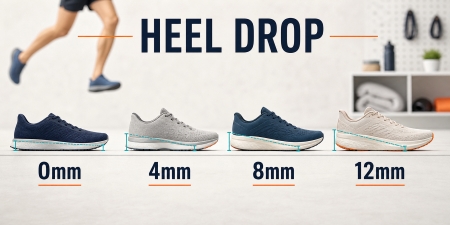
| Drop | Useful label | What I expect during a switch | First-run question |
|---|---|---|---|
| 0mm | Zero drop | Largest change if you came from 8–12mm; calf and foot demand may feel unfamiliar | Can I jog easily without changing my stride on purpose? |
| 1–4mm | Low drop | Often still noticeable to runners accustomed to traditional trainers | Is calf tightness back to baseline the next morning? |
| 5–8mm | Moderate drop | A practical bridge range, but not automatically safer | Does the whole shoe feel stable and natural at easy pace? |
| 9–12mm | High drop | May reduce ankle dorsiflexion demand acutely while shifting some work toward the knee | Am I choosing this for comfort, not as a cure? |
Do not compare drop in isolation. If one shoe is softer, taller, more rockered, wider, or more flexible, you are testing several variables at once. My running biomechanics guide explains why the runner, speed, surface, and shoe act as one system.
Listed Drop vs Actual Drop
The drop printed on a brand page is a useful starting point, not a courtroom transcript. Brands often list rounded numbers, and independent lab measurements can land higher or lower because of size, measurement method, outsole thickness, insole compression, and where the stack is measured.
That does not mean listed drop is useless. It means you should not make a dramatic training decision over one millimeter. A shoe listed at 8mm and measured near 9mm is still a moderate-drop shoe.
A shoe listed at 0mm and built with a thick rocker still will not feel like a thin barefoot shoe. The category matters more than pretending the number is exact down to the decimal.
| What runners compare | Why it can mislead | Better question |
|---|---|---|
| Listed drop | Rounded brand specs can differ from lab measurements | Is this low, moderate, or high drop for my history? |
| Heel stack alone | A tall heel can still be low drop if the forefoot is also tall | What is the difference between heel and forefoot? |
| Drop without rocker | A rockered 5mm shoe may feel smoother than a flat 5mm shoe | Does the shoe roll or bend? |
| Drop without foam firmness | Soft foam can compress and change the feel under load | Does the platform stay stable when tired? |
| Drop without insole or orthotic | An insert can change the effective feel | Will I use this shoe with the insert I actually run in? |
Ken’s Three-Run Rule for Heel Drop
After 12 years of running and testing shoes, I do not rank a new drop from the first five minutes. Fresh foam and novelty can make almost anything feel convincing. I use three easy runs, separated by enough time to see the next-morning response.
| Check | What I record | Reason to pause |
|---|---|---|
| During the run | Calf tension, Achilles awareness, arch fatigue, knee comfort, stride effort | A rising focal sensation or a forced change in gait |
| Two hours later | Whether normal walking and stairs feel unchanged | Pain or stiffness that was absent before the run |
| Next morning | First 10 steps, calf tightness, tendon stiffness | A clear worsening that does not settle as usual |
The evidence supports this restraint. The 553-runner randomized trial found no overall injury-risk advantage for 0, 6, or 10mm drop (Malisoux et al.). A separate six-month randomized follow-up found no meaningful drop-specific adaptation in foot-contact angle or the main spatiotemporal measures (Malisoux et al.). A shoe number can influence an acute run without dictating the runner you become.
My rule is simple: the new drop earns more running only when the previous dose has settled. It is a progression decision, not a six-week deadline.
What Heel Drop Actually Changes
Drop changes the starting geometry beneath the foot. In a higher-drop shoe, the heel begins farther above the forefoot. That usually places the ankle in a more plantar-flexed position inside the shoe and can reduce the dorsiflexion excursion required before the body moves over the foot.
Ankle, Calf, and Achilles
Lowering the heel can increase the ankle’s mechanical demand during stance, especially when the comparison controls the rest of the shoe. In 15 healthy female runners, the 0mm condition produced higher loading rates and higher ankle dorsiflexion moments than the 6 and 10mm conditions (Besson et al.). That is an acute laboratory response, not proof that every low-drop runner will get hurt.
Small heel-lift studies have also measured lower Achilles force or strain in some conditions. Those results help explain why a raised heel can feel calmer temporarily, but an insert is not identical to changing shoes, and a force estimate is not a clinical outcome. If the tendon is already symptomatic, use the Achilles tendinopathy guide for symptom behavior, loading, and return-to-run decisions; this page does not prescribe rehabilitation.
Knee
Load is often redistributed rather than erased. An 18-runner laboratory study found greater modeled patellofemoral joint stress in 10 and 15mm conditions than in 0mm shoes (Zhang et al.). That does not mean high drop causes knee pain. The participants were healthy, the test was acute, and modeled joint stress is not the same outcome as an injury.
Foot Strike and Loading Rate
A lower number does not automatically convert a rearfoot striker into a midfoot or forefoot striker. Speed, overstride, stiffness, rocker, familiarity, and the runner’s own strategy all matter. If you deliberately change landing pattern at the same time as drop, you can no longer tell which change produced the response.
The useful model: lower and higher drop are different load distributions. Neither setting deletes load, and neither millimeter value is a treatment plan.
How to Choose the Right Heel Drop
Start with your current training shoe, not a universal chart. Record its listed drop, how long you have used that range, and whether it remains comfortable through your normal easy run. That is your baseline.
If You Are Running Comfortably
There is no prize for changing. Keep the current range unless another shoe fits better or serves a real training need. When comparing options, begin with the running-shoe guide; then treat drop as one column beside fit, stability, rocker, cushioning, and use case.
If You Want to Try a Lower Drop
Choose a small step first—10 to 8mm or 8 to 6mm is easier to interpret than 12 to 0mm. Keep the first runs easy and flat. Do not pair the switch with a mileage jump, hills, speedwork, or a sudden move to a much firmer shoe.
If You Want to Try a Higher Drop
A higher heel can feel easier at the calf or Achilles in the short term, but assess the whole platform. A narrow or unstable high-stack heel may be a poor trade even when the drop number looks suitable. Higher drop is an option to test, not evidence that a painful tendon has been treated.
When Another Shoe Feature Is the Real Variable
If impact comfort is the concern, compare cushioned running shoes. If late-run side-to-side control is the concern, compare stability shoes. Those pages own product selection; this guide owns the meaning and trade-offs of drop.
How I Use Heel Drop Without Diagnosing From It
Pain location changes the questions I ask, but it does not generate an automatic shoe prescription. I first separate a new-shoe response from a training-load problem: Did the symptom begin after the drop change? Did mileage, speed, hills, or strength work also change? Is it diffuse soreness, or focal pain that alters gait?
| Pattern after a drop change | What it may tell me | What I do next |
|---|---|---|
| Diffuse calf work that settles by the next day | The new geometry is noticeable but the dose may be tolerable | Repeat the same short easy dose; do not progress yet |
| Morning Achilles stiffness is clearly worse | The tendon did not recover to baseline | Stop increasing exposure and use the condition-specific guide |
| Knee discomfort appears only in the new shoe | The entire shoe setup may redistribute load poorly for this runner | Return to the known shoe and compare geometry, stability, and fit |
| Focal or escalating pain, limping, swelling, or night pain | This exceeds a routine footwear experiment | Stop the test and seek an appropriate assessment |
The governing principle is covered in my running injury-prevention guide: change one meaningful variable at a time, then let the body’s response—not the marketing category—decide the next dose.
Four Shoes That Make Heel Drop Easy to Feel
These are worked examples, not a ranking. I keep the set deliberately small so each shoe demonstrates a distinct range without turning this explainer into a product directory. Always confirm the current model’s listed specification; brands can change geometry between versions.
Zero drop: Altra Torin
The Altra Torin is the clearest level-platform example in my rotation. Coming from a traditional trainer, I notice the calf and foot demand before I notice anything magical about form. The foot-shaped fit and cushioning are separate variables from its 0mm geometry.
I would use it to test whether a runner enjoys a level platform—not to force a forefoot strike or prove that zero drop is more natural.
Low drop: HOKA Clifton
The HOKA Clifton shows why two low-drop shoes can feel unrelated. Its cushioning and rocker can make the transition feel smoother than the same nominal drop in a thin, flexible platform.
That smooth roll does not cancel the geometry. I still monitor calf and Achilles response when a runner comes from 10–12mm shoes.
Moderate drop: ASICS Gel-Kayano
The ASICS Gel-Kayano is a useful middle-range example, but its guidance and broad platform often dominate the ride more than a one- or two-millimeter comparison.
If it works, I want to know whether the benefit came from familiar drop, fit, or support. That distinction makes the next shoe choice smarter.
High drop: Brooks Ghost
The Brooks Ghost represents a traditional high-drop daily trainer. Runners accustomed to this geometry often describe lower-drop shoes as calf-heavy, while long-time low-drop runners may find the heel more prominent.
Neither response makes one runner correct. It tells me what the runner has adapted to and how large the proposed change really is.
How to Transition to a Different Heel Drop
I progress by recovered exposure, not by calendar week. A runner who is fully back to baseline the next morning can repeat the dose. A runner whose stiffness accumulates does not earn the next step just because Monday arrived.
| Stage | New-shoe exposure | Advance only when |
|---|---|---|
| 1. Familiarization | Walk in the shoe, then one 15–25 minute easy run | Gait feels natural and symptoms return to baseline by next morning |
| 2. Repeatability | Two short easy runs with at least one old-shoe run between | The second exposure is no worse than the first |
| 3. Normal easy run | One usual easy route; keep terrain predictable | No accumulating calf, Achilles, arch, or knee response |
| 4. Add one demand | Increase duration or add light strides—not both | The added demand settles before the next new-shoe run |
| 5. Full rotation | Use for its intended workout or distance | Several weeks of stable response support the role |
- Keep your old shoe available; rotation is a control condition, not indecision.
- Avoid testing a large drop change during a peak race block.
- Hold weekly mileage steady while learning the new geometry.
- Use a familiar cadence; do not consciously force a new landing pattern.
- Stop progressing if soreness becomes focal, changes your gait, or worsens from run to run.
There is no evidence-based universal four- or six-week conversion schedule. The size of the drop change, the rest of the shoe, recent training, and tissue history all affect how much exposure is sensible.
Heel Drop Mistakes I See Runners Make
- Changing four variables at once. A zero-drop, lower-stack, firmer, more flexible shoe is not a clean drop test.
- Forcing a foot strike. Drop and landing pattern are related variables, not synonyms.
- Calling initial soreness adaptation. Adaptation is a stable trend across recovered exposures, not pain you ignore.
- Using drop to diagnose an injury. A shoe response can inform the history; it cannot identify the tissue or grade the problem.
- Trusting the listed millimeter more than the ride. Fit, rocker, foam, width, and stability can dominate what you feel.
The expensive mistake is not choosing the ‘wrong’ category. It is escalating exposure after the body has already shown that the current dose is not settling.
Heel Drop FAQ
What is heel drop in running shoes?
Heel drop is heel stack height minus forefoot stack height. A shoe with 34mm under the heel and 24mm under the forefoot has a 10mm heel-to-toe drop.
What heel drop is best for runners?
There is no universally best heel drop. The strongest starting point is a range you already tolerate, evaluated alongside fit, cushioning, rocker, stability, training load, and the response after each run.
Is zero drop better for running?
No. Zero drop is a level platform, not a guarantee of natural form, better performance, or fewer injuries. It can work well when the runner prefers it and builds exposure gradually.
Is high drop bad for running?
No. Higher drop changes shoe geometry and acute load distribution, but it is not inherently good or bad. Comfort, training consistency, and individual response matter more than the label.
Does heel drop change foot strike?
It can influence landing mechanics in some runners, but it does not reliably force one strike pattern. Speed, stride, rocker, stiffness, familiarity, and conscious gait changes also matter.
Can heel drop fix Achilles or knee pain?
Heel drop can change acute load distribution and may alter symptoms, but it does not diagnose or treat the cause by itself. Persistent, focal, or worsening pain needs condition-specific assessment and management.
How long should a lower-drop transition take?
There is no fixed deadline. Repeat a short, easy exposure only when the previous one has settled by the next morning, then increase one demand at a time.
Can I rotate shoes with different drops?
Yes. Begin with nearby drop ranges and keep each shoe’s purpose clear. Rotation is useful only when each exposure is tolerated and you are not simultaneously changing mileage, speed, and terrain.
Final Verdict
Heel drop is a measurable piece of shoe geometry and a useful way to describe a load change. It is not a ranking of shoe quality, a shortcut to a particular foot strike, or a universal injury solution.
My decision rule after 12 years of running is intentionally plain: start from what you tolerate, change for a reason, isolate the variable as well as you can, and progress only when the previous exposure has settled. The best number is the one that lets the whole shoe disappear while you run.
NextGait may earn a commission from qualifying purchases. That never changes my rankings, source checks, or whether I tell you a popular shoe trend is wrong for your body. Full disclosure.

About Ken
I am Ken, the runner behind NextGait. I have logged 12,500+ miles and tested 63 running shoes across daily trainers, max-cushion shoes, stability shoes, low-drop shoes, trail shoes, and plated racers.
I treat heel drop as a load-management tool, not a personality test. My shoe notes focus on what happens after the first run: calves, Achilles, knees, foot fatigue, stride rhythm, recovery, and whether the shoe still makes sense at mile 200. Read more about me.