
This New Balance Hierro v9 review is based on 327 miles of trail running in a men’s US 10.5, including wet roots, Pine Barrens sand, shallow mud, gravel, and unavoidable road connectors. For rougher ground, compare these trail shoes for technical terrain.
My verdict is narrower than the marketing: the Fresh Foam X Hierro v9 is an excellent high-cushion trail cruiser for easy and long miles on moderate terrain. It is protective, planted, and unusually comfortable. It is also heavy, slow to change direction, and less secure in deep mud or jagged off-camber terrain than its aggressive appearance suggests. I scored it 7.8/10.
I am 5’10”, 182 pounds, mildly overpronate, and usually land between my heel and midfoot. I run 30–40 miles most weeks around Atlantic City, New Jersey. That matters: my weight, gait, and mostly low-elevation trails load this shoe differently than a light forefoot striker racing steep mountain singletrack.
Verdict: Buy the Hierro v9 for comfortable daily trail miles, hiking, and long runs on gravel, hardpack, roots, and light mud. Choose a more agile shoe for technical racing or deep mud. Try a half-size up if you are between sizes; wide runners should use the available 2E or 4E rather than buying extra length.
In this review
New Balance Hierro v9 review: specs and score
The Hierro v9 combines dual-density Fresh Foam X, a 4 mm stated drop, a wide high-stack platform, and a Vibram Megagrip outsole.
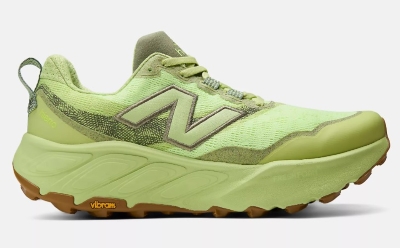
| Specification | Published or tested value | What it means on trail |
|---|---|---|
| Brand-listed weight | 10.3 oz / 293 g | Substantial rather than fast; sample size is not specified on the current US page |
| Independent lab weight | 10.9 oz / 309 g | Different sample and size; do not compare as if the methods match |
| Brand-listed drop | 4 mm | A meaningful change from the v8’s higher offset |
| Independent lab stack | 37.3 mm heel / 33.1 mm forefoot | High protection with a measured 4.2 mm difference |
| Midsole | Dual-density Fresh Foam X | Softer top layer over a firmer, more supportive layer |
| Outsole | Vibram Megagrip with Traction Lug geometry | Strong adhesion on wet hard surfaces; tread spacing still limits deep-mud clearance |
| Lug depth | New Balance: 6 mm; lab: 3.3 mm at its measurement point | Claim and measured point differ; performance matters more than one disputed number |
| Rock plate | None | Protection comes from foam depth, rubber, and Toe Protect—not a plate |
| Widths | Men’s D, 2E, and 4E in the US | Useful options, though the toe taper remains relevant |
| My test pair | Men’s US 10.5, Cool Grey/Metallic Silver | My regular running-shoe size |
| My mileage | 327 miles | Enough to evaluate outsole wear and midsole aging, not just first impressions |
| Ken’s rating | 7.8 / 10 | Best marks for protection, grip, and stability; lower marks for speed and agility |
Fresh Foam X is a family of New Balance cushioning foams; the name does not identify one fixed chemistry or firmness across every shoe.
My scorecard after 327 miles
| Category | Score / 10 | Reason |
|---|---|---|
| Cushioning | 8.1 | Protective and consistent without collapsing under my 182-pound frame |
| Stability | 8.4 | Broad base and firmer lower foam work well on moderate terrain |
| Fit | 6.6 | Secure heel, but the front tapers sooner than the width options imply |
| Dry traction | 8.7 | Confident on hardpack, gravel, dry roots, and sandy turns |
| Wet traction | 7.7 | Good adhesion on damp roots; shallow spacing packs up in deeper mud |
| Durability | 8.4 | Cosmetic lug wear at 327 miles, with the upper still structurally sound |
| Versatility | 7.0 | Wide surface range, narrow pace range |
| Ride / transition | 6.8 | Smooth at easy effort, labored when asked to accelerate |
| Overall | 7.8 | A dependable trail workhorse, not a technical-race specialist |
New Balance Hierro v9 review: how I tested it
I used one pair for 327 miles across wet forest trail, flat sandy singletrack, gravel, roots, short rocky sections, and paved connectors.
My first run was eight miles at Parvin State Park in cold drizzle. The immediate impression was not softness. It was evenness: the shoe absorbed small roots without the heel sinking farther than the forefoot, and the broad platform stayed quiet under me.
The best test came after rain on the 11-mile Absegami Trail at Bass River. That loop gave me wet roots, standing water, sand, and repeated direction changes. The Hierro protected my feet and held damp wood better than its bulky silhouette led me to expect. On muddy sections, I shortened my stride because the tread stopped clearing as quickly.
The worst test was an eight-mile route with a long road connector. The shoe is tolerable on pavement, but the rubber feels present, turnover slows, and the lugs add more noise than speed. Runners moving over from asphalt should first read my road-to-trail transition guide; the surface change demands more than a tougher outsole.
| Mileage phase | What I noticed | Best use |
|---|---|---|
| 0–50 miles | Firm lower layer obvious; upper settled quickly; no break-in problem | Easy trail and fit checks |
| 51–150 miles | Smoothest period; heel hold and forefoot flex felt predictable | Long runs and mixed trail |
| 151–250 miles | Small lateral heel and forefoot wear; cushioning still protective | Routine daily trail miles |
| 251–327 miles | Top layer felt less lively; outsole edges rounded but remained usable | Easy runs, hiking, dry-to-damp moderate trail |
I did not perform metabolic testing, so I will not invent a running-economy gain from watch data. My evidence can support claims about fit, surface behavior, comfort, and wear. It cannot turn trail pace—where weather and footing change constantly—into a laboratory percentage.
New Balance Hierro v9 review: ride and cushioning
The ride is deep but controlled, with a firm lower layer that resists folding on uneven landings.
The upper Fresh Foam X layer takes the edge off hardpack and roots. The lower layer resists the sideways compression that makes some max-stack trail shoes feel vague. At my weight, the shoe compresses but does not wallow.
That dual-density arrangement is the central reason the shoe works. A tall single-density slab can feel comfortable on level gravel yet buckle when only its medial or lateral edge hits a root. The Hierro’s lower layer slows that deformation.
Forefoot push-off is adequate, not exciting. The shoe bends less naturally than the v8 and relies on its rocker to help easy miles move. I struggled to make quick surges feel fluid because the mass arrived before the rebound. Be patient for the first few runs if you are coming from a flexible trail shoe.
This is trail protection, not the same experience as the road shoes in my max-cushion running shoe guide. Rubber coverage, upper reinforcement, and tread all add control and weight. That trade is worthwhile when the route stays off-road.
New Balance Hierro v9 review: outsole and traction
Vibram Megagrip gives the Hierro v9 strong surface adhesion, but lug layout—not rubber branding—sets its limit in deep mud.
On dry hardpack and gravel, grip is excellent. The broad lugs spread load and the small traction edges catch when I turn. Damp roots require care, but I had fewer small slips than I normally expect from a cushioned road-to-trail shoe.
Deep, sticky mud is different. Once the gaps fill, there is less open space to shed soil. A rubber compound can adhere well to exposed rock and still fail to find purchase when mud covers the contact surface. This is why the Hierro can be good in rain without being a mud shoe.
New Balance currently says “deeper, 6mm lugs.” RunRepeat measured 3.3 mm at its selected lug. Other launch reviews reported 4.5 mm. Lug shapes are not uniform, and measurement points vary. I trust the field result more: moderate-terrain bite with limited deep-mud clearance.
If wet weather is routine, use the surface-specific precautions in my running-in-the-rain guide. Megagrip improves traction; it does not cancel wet leaves, algae, ice, or poor foot placement.
New Balance Hierro v9 sizing and fit
My men’s US 10.5 worked, but the secure fit can feel short when toes move forward downhill.
I had reliable heel lockdown and enough midfoot volume without crushing the laces. The semi-gusseted tongue stayed centered and kept most sand out. The toe box is not foot-shaped; it tapers around the smaller toes even though the platform beneath it looks broad.
RunRepeat’s gel mold measured 94.7 mm at the widest part and 73.4 mm near the big toe, both slightly below its trail-shoe averages. Its user voting currently leans half-size small. Those results match the downhill pressure several reviewers reported, although my usual size worked with a thumb’s width in front.
- Average-volume foot: start true to size and test on a decline.
- Between sizes or planning ultra-distance: try the half-size up beside your normal size.
- Wide forefoot: try 2E or 4E; do not assume added length fixes width.
- Low-volume heel: use the final eyelet only if the standard lacing leaves movement.
Fit should be judged with trail socks, after the feet have warmed, and on a ramp if the store has one. My wide-foot running shoe guide explains why width labels alone do not describe toe shape or midfoot volume.
I know how tempting it is to buy extra length when a shoe feels narrow. That often creates heel movement because it does not change the last’s basic shape. Use the 2E or 4E first.
Stability, ground feel, and rock protection
The neutral Hierro v9 is stable on moderate trail, but its high stack reduces precision on steep angles.
The forefoot and heel bases are broad. The lower midsole layer is firmer. The heel counter holds well without feeling corrective. Together, those features give my mild overpronation a calm landing on gravel and rolling trail.
The limitation appears when one side of the shoe lands high on a rock or root. There is more material between my foot and the ground, so the warning arrives later. I can recover on New Jersey singletrack, but I would choose a lower, more agile platform for sustained talus, narrow ridges, or fast off-camber racing.
There is no rock plate. Thick foam, outsole rubber, and the Toe Protect bumper provide practical shielding. I rarely felt sharp points through the forefoot, but foam protection is not identical to a plate: it filters pressure rather than distributing a direct strike through a stiff insert.
For better control on climbs and descents, pair the shoe with the shorter-stride cues in my hill-running technique guide. No amount of stack replaces foot placement.
Upper, lockdown, and trail protection
The reinforced mesh upper prioritizes hold and durability over low weight, with a secure heel and useful debris control.
The overlays keep the midfoot from sliding across the platform during turns. The gusseted tongue reduces lateral movement and closes the easiest route for grit. Toe Protect is substantial enough for accidental root taps, though it does not make the front rigid.
Breathability is average. My feet stayed comfortable in cool rain and spring conditions, but the reinforced construction holds more warmth than a road mesh. For long summer outings, sock choice matters; I use the same moisture and seam checks described in my anti-blister running sock guide.
The collar locked my heel without rubbing. I would still like slightly more padding around its upper edge for all-day use. That is a comfort preference, not a hold problem.
Is the New Balance Hierro v9 waterproof?
No. The standard Fresh Foam X Hierro v9 reviewed here is breathable mesh and is not waterproof.
Water enters through the upper in rain, puddles, or wet grass. It also drains and dries more readily than a membrane shoe. For mild conditions and stream crossings, I prefer that exchange because water that gets over a waterproof collar has fewer places to escape.
New Balance sells a separate Hierro v9 GORE-TEX model. Choose it for cold, sustained wet weather or walking through wet vegetation, accepting extra weight, warmth, and slower drying. Do not treat “Vibram” as a waterproof feature; it describes the outsole.
Low trail gaiters can block sand and debris but do not waterproof the mesh. My trail gaiter comparison explains when they are worth adding.
New Balance Hierro v9 durability after 327 miles
At 327 miles, my pair remains usable, with rounded lug edges but an intact upper and heel lining.
The top foam layer feels less fresh than it did around 100 miles. Protection remains, but rebound is muted and the forefoot takes longer to recover after compression. I retired it from important long runs before the outsole became unsafe.
Road mileage accelerates the wrong kind of wear. Broad Vibram lugs survive connectors, but repeated asphalt scrubs their edges without using their trail benefits. If your route is mostly road with a park path at the end, a road-to-trail hybrid with shallower rubber may be more economical.
The downside of my pair’s long life is gradual change: there was no single run when the foam suddenly “died.” I know how easy it is to normalize a tired midsole, so I compare it beside a fresher shoe rather than trusting memory.
I do not replace shoes at one universal number. I compare left-right wear, midsole symmetry, new aches, traction, and whether the shoe still performs its assigned job. Use the five-minute checks in my running-shoe replacement guide, then judge your own pair.
After muddy runs, remove the insole and loosen the laces, brush off dried dirt, and air-dry away from direct heat. My trail-shoe cleaning method avoids the glue and foam damage that can come from hot water or a dryer.
New Balance Hierro v9 vs v8
The v9 is taller, lower-drop, stiffer, more rockered, and more stable underfoot than the v8.
| Feature | Hierro v9 | Hierro v8 | My take |
|---|---|---|---|
| Stated drop | 4 mm | 6 mm | v9 loads the ankle/calf differently; transition gradually if coming from v8 |
| Midsole | Dual-density Fresh Foam X | Softer, more flexible Fresh Foam X setup | v9 is more controlled but less natural |
| Ride | High-stack, rockered, stiff | More flexible and grounded | v9 favors cruising; v8 offers more trail feel |
| Outsole | Revamped Vibram Megagrip Traction Lug pattern | Earlier Vibram layout | v9 adhesion is strong, but neither is a deep-mud specialist |
| Best use | Long, moderate trail and hiking | Shorter mixed trail for runners who value flex | Choose by terrain, not version number |
The switch to 4 mm is not automatically better. If your calves and Achilles are accustomed to a higher offset, introduce the v9 in short outings and keep familiar shoes in rotation. My heel-drop guide explains why two millimeters can matter without predicting injury from a spec sheet.
Best distances, surfaces, and paces
The Hierro v9 is strongest from ordinary daily mileage through long trail runs when comfort and control matter more than speed.
| Use | Fit for purpose | Why |
|---|---|---|
| Easy daily trail | Excellent | Stable cushioning and durable upper |
| Long run / time on feet | Excellent | Protection remains consistent as legs tire |
| Hiking | Very good | Comfort, grip, and toe protection; less ankle coverage than a boot |
| Road-to-trail | Good in short doses | Comfortable enough on asphalt, but heavy and rubbery |
| Fast trail workout | Fair | Mass and stiffness resist quick turnover |
| Technical mountain racing | Fair | High stack reduces precision |
| Deep mud | Poor to fair | Lug spacing clogs before the rubber compound can help |
I would use it for a long supported trail day if the route is mostly forest road, rolling dirt, and moderate singletrack. For distance-oriented road shoes, use my separate long-distance running shoe guide; the Hierro’s outsole is wasted on pavement.
Best for: easy-to-steady runs on moderate trail, long outings, fast hiking, and runners who value width options over low weight.
For all-day trail outings, carry water according to conditions rather than shoe capacity. My trail hydration vest tests cover fit and bounce, while the trail headlamp guide focuses on usable beam and runtime.
New Balance Hierro v9 vs key alternatives
Choose Hierro for relaxed comfort and width availability; choose its rivals when agility, mud clearance, or a faster rocker matters more.
| Shoe | Choose it over Hierro v9 when… | Choose Hierro v9 when… |
|---|---|---|
| HOKA Speedgoat | You need a lighter, more precise option for technical singletrack | You prefer a roomier feel, softer cruising, and broad stability |
| Saucony Xodus Ultra | You want a more energetic long-distance ride | You value steady Fresh Foam comfort and wider size options |
| ASICS Trabuco Max | You want a stronger rocker for rolling terrain | You want better heel hold and a less forceful rolling sensation |
| Brooks Cascadia | You prioritize rock protection and technical control | You prioritize plushness and smooth easy miles |
| New Balance More Trail | You want even more cushioning on tame routes | You need better tread bite and a more secure trail upper |
My closest site-tested comparison is the HOKA Speedgoat review. The Speedgoat is the tool I would take onto narrower, more technical ground. The Hierro is the pair I would rather wear for an easy three-hour outing on moderate trail.
Who should buy the New Balance Hierro v9?
Buy it for reliable cushioning on moderate trails, long days, hiking, or a wider fitting option.
- Daily trail runners who spend most miles on dirt, gravel, roots, and light mud.
- Heavier runners who compress very soft max-stack shoes unevenly.
- Heel-to-midfoot strikers who want a broad landing platform.
- Long-run and hiking users who prefer protection over ground feel.
- Wide-foot runners who need 2E or 4E availability, after checking toe taper.
New trail runners should also compare the lower-risk options and fit advice in my best beginner trail shoes and learn surface basics in the trail running beginner’s guide.
Who should skip it?
- Technical racers who need low mass and rapid direction changes.
- Runners who regularly face deep mud, snow, or loose, steep slopes.
- Anyone wanting strong ground feel or a flexible forefoot.
- Road-first runners whose “trail” is mostly smooth park path.
- Runners sensitive to a 4 mm drop who do not want a transition period.
Do not buy it to solve downhill knee pain. Footwear can change comfort and loading, but it does not diagnose the cause. A physical therapist may use history, strength testing, and gait analysis to investigate persistent symptoms. Start with load management in my downhill trail knee-pain guide, and seek a clinician if pain persists or worsens.
How I would use it in a rotation
I assign the Hierro v9 to easy and long trail days, then use a lighter shoe for speed.
A practical two-shoe trail rotation is enough for most runners. The Hierro covers routine mileage and time on feet. The second pair should solve a real gap: deep lugs for mud, lower stack for precision, or lower mass for racing.
Keep ordinary road training in a road shoe from my daily trainer guide. That preserves the Hierro’s lug edges and avoids carrying trail-specific weight through every asphalt mile.
New Balance Hierro v9 review: final verdict after 327 miles
The Hierro v9 makes ordinary trail miles uneventful, the best outcome I can ask from a daily trail shoe.
At Bass River after rain, I stopped thinking about small roots and focused on the route. At Parvin in drizzle, the platform stayed controlled. On long road connectors, I wanted less rubber and less shoe. Those three experiences define it better than “all-terrain.”
The v9 is a major redesign and a clearer product than the v8. It protects better, tracks more steadily, and grips wet hard surfaces well. It also gives up flexibility, speed, and some technical precision. For moderate American trails and long easy days, that exchange makes sense.
Final score: 7.8/10. I would buy it again for the same job, but I would not make it my only trail shoe if technical terrain or deep mud appears regularly.
New Balance Hierro v9 review FAQ
Is the New Balance Hierro v9 true to size?
My normal men’s US 10.5 fit, but the shoe runs secure and can feel short on descents. Start true to size if you have an average-volume foot. If you are between sizes or need swelling room for long runs, compare a half-size up.
Does the New Balance Hierro v9 come in wide sizes?
Yes. The US men’s model is offered in standard D, wide 2E, and extra-wide 4E in at least some colors. The toe box still tapers, so runners with a broad forefoot should try the actual width rather than relying on the label.
Is the regular Hierro v9 waterproof?
No. The standard Hierro v9 uses breathable mesh and lets water through. New Balance sells a separate Hierro v9 GORE-TEX model for waterproof protection.
Does the Hierro v9 have a rock plate?
No. It relies on its deep dual-density midsole, outsole rubber, and Toe Protect bumper. That combination filtered rocks well in my testing, but it is not the same construction as a dedicated rock plate.
What is the heel-to-toe drop?
New Balance lists a 4 mm drop and notes manufacturing variance. RunRepeat independently measured 37.3 mm at the heel and 33.1 mm at the forefoot, a 4.2 mm difference in its sample.
Is the Hierro v9 good for road-to-trail running?
It handles short paved connectors comfortably, but it feels heavy and rubbery on long road sections. It makes most sense when dirt is the majority of the route.
Is the Hierro v9 good in mud?
It is dependable in light, shallow mud. In deep sticky mud, the broad lugs and limited spacing can pack up, reducing bite. A dedicated mud shoe with longer, widely spaced lugs is safer for regular sloppy terrain.
Can I hike in the New Balance Hierro v9?
Yes. Cushioning, traction, and toe protection make it a strong hiking option on moderate trails. It does not provide the ankle coverage or load-carrying structure of a hiking boot.
How long does the Hierro v9 last?
My pair remained usable at 327 miles with rounded lug edges and less midsole rebound. Your lifespan can be shorter or longer depending on terrain, body mass, gait, and road exposure. Replace by performance and wear signs, not one mileage rule.
Is the Hierro v9 good for technical trails?
It handles occasional rocks and roots, but its high stack and weight reduce precision on sustained technical terrain. I prefer a lighter, lower, more agile shoe for fast off-camber running, talus, or narrow mountain singletrack.

About Ken — 12 years of running, 12,500+ miles, 63 shoes tested, and 36 races from 5Ks to a 50K ultra. I run 30–40 miles a week around Atlantic City and review every shoe with real training miles, not one-run demos. More about me →