
In the Nike Alphafly vs Vaporfly comparison, I would buy the Vaporfly 4 for 5K, 10K, and most half marathons; I would choose the Alphafly 3 for a straight, fast marathon when its fit and tall geometry agree with my stride. The Vaporfly is lighter, lower, and easier to place through turns. The Alphafly provides substantially more cushioning under high loads and feels more protective late in a long race.
That is my answer after 394 combined logged miles: 95 in the Alphafly 3 and 299 in the Vaporfly 4. I am 5’10”, about 182 pounds, a heel-to-midfoot striker, and a mild overpronator. I run 30-40 miles per week, mostly on asphalt and the Atlantic City Boardwalk. A lighter forefoot striker may reverse my ranking.
Short answer: Vaporfly 4 is the better one-shoe racer and my first choice from the mile through the half marathon. Alphafly 3 is the better specialist for runners who want deeper marathon cushioning, a more forceful forefoot transition, and a wider platform. If you do not know which one matches you, start with the Vaporfly. If you already know the Alphafly geometry works for you, use it for the marathon.
Last updated: August 8, 2026. This comparison covers the current Nike Alphafly 3 and Nike Vaporfly 4. It does not use Vaporfly 2 or Vaporfly 3 behavior as a substitute for testing version 4.
Alphafly 3 vs Vaporfly 4: the decision in one table
| Decision | Nike Alphafly 3 | Nike Vaporfly 4 | My pick |
|---|---|---|---|
| 5K | Powerful but more shoe than I need | Light, quick, and precise | Vaporfly 4 |
| 10K | Useful for runners who load the forefoot pods well | Faster to turn over and easier through corners | Vaporfly 4 |
| Half marathon | More cushioning; less agile | Better balance of mass, control, and protection | Vaporfly 4 |
| Marathon | Deeper protection and a strong late-race platform | Lighter and more natural, but less cushioned | Alphafly 3 if fit is proven |
| Technical course | Wide but tall; needs adaptation | Lower and easier to place | Vaporfly 4 |
| Wide feet | Neither comes in a wide option | Neither comes in a wide option | Try alternatives |
| One Nike racer | Marathon specialist | Broader race-distance range | Vaporfly 4 |
If you are still deciding whether you need a dedicated racer, start with your race goal and the training role the shoe must fill. This page is intentionally narrow: it is for a runner already choosing between Nike’s two top road-racing systems.
Ken’s ranking rule
Choose the least disruptive shoe that still protects you for the distance. I rank the Vaporfly 4 first until the marathon because its lower mass and more compact platform ask for fewer stride adjustments. At 26.2 miles, I will accept the Alphafly’s extra bulk if its deeper cushioning and forefoot structure help me preserve form.
This is not a rule that more cushioning always wins longer races. The Alphafly only wins when I can run naturally in it. A shoe that feels unstable, pinches the arch, or forces me to search for its sweet spot will cost more attention than its foam can return.
How I tested the Nike Alphafly and Vaporfly
My Alphafly 3 has 95 verified running miles. That is enough for a developed ride and fit judgment, plus early wear observations, but not enough to declare a universal lifespan. My Vaporfly 4 has 299 verified miles across 11 structured sessions, long running, wet conditions, asphalt, and boardwalk surfaces. Its wear assessment is much more mature.
I compared easy running, goal-pace work, sustained efforts, turns, cambered pavement, and how each shoe behaved once my form became less tidy. Pace work was set from recent training rather than a generic chart; the running pace calculator explains the same principle for building your own test.
This remains field testing, not a controlled metabolic study. I can say which shoe feels easier to control, where pressure develops, and what changed with mileage. I cannot convert one race result into a personal running-economy percentage or prove that the shoe caused a particular finish time.
For technical context, I checked Nike’s current product specifications and independent laboratory measurements. Manufacturer stack, drop, and weight can differ from lab results because shoe size, measurement location, and protocol differ. I label them separately instead of combining them into one false-precision number.
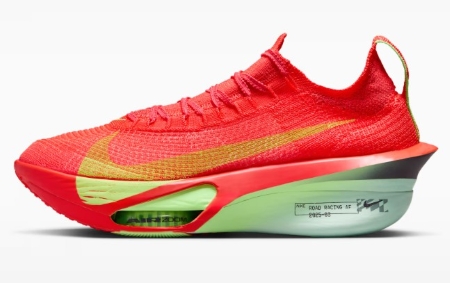
Nike Alphafly 3 vs Vaporfly 4 specs
| Specification | Nike Alphafly 3 | Nike Vaporfly 4 |
|---|---|---|
| Official weight | About 7.7 oz / 218 g, men’s US 10 | About 6.7 oz / 190 g, men’s US 10 |
| Official drop | 8 mm | 6 mm |
| Midsole | ZoomX plus two forefoot Air Zoom units | ZoomX |
| Plate | Full-length carbon Flyplate | Full-length carbon Flyplate |
| Upper | Atomknit | Light engineered mesh |
| Best race use | Half marathon to marathon | Mile to marathon; strongest from 5K to half |
| Wide option | No | No |
| My logged mileage | 95 miles | 299 miles |
The headline difference is not that one has a carbon plate and the other does not. Both use a full-length Flyplate and ZoomX. The Alphafly adds two Air Zoom units under the forefoot, more cushioning depth, and a much broader base. The Vaporfly removes material and lowers the platform to prioritize low mass and direct transitions.
Nike lists a 28 g difference in men’s US 10. That sounds modest on paper, but it is 14.7% of the Vaporfly’s listed weight. I notice it most when cadence rises, when I shorten stride for a turn, and when I need to accelerate after settling into pace.
What independent lab measurements add
| RTINGS sample measurement | Alphafly 3 | Vaporfly 4 | Why it matters |
|---|---|---|---|
| Weight | 7.08 oz / 200.7 g | 5.66 oz / 160.5 g | Confirms a large mass gap in like-for-like lab samples |
| Heel / forefoot stack | 39.8 / 33.4 mm | 35.1 / 26.4 mm | Alphafly puts more material under both ends of the foot |
| Measured drop | 6.4 mm | 8.8 mm | Shows why lab and brand drop should not be mixed |
| Heel / arch / forefoot width | 91 / 68 / 116 mm | 75 / 50 / 108 mm | Alphafly has the broader external platform |
| Internal forefoot width | 90 mm | 92 mm | External width is not the same as toe-box room |
The measured-drop reversal is exactly why I do not use a stated heel-to-toe number as a complete biomechanical forecast. Foam compresses differently by load, and laboratories choose specific measurement points. Read the heel-drop guide if Achilles or calf sensitivity is part of your decision, then test the actual shoe at race pace.
Ride comparison: direct speed or deep propulsion?
Vaporfly 4: low-mass, quick, and easier to place
The Vaporfly 4 gives me a clean sequence: contact, load the ZoomX, roll across the plate, leave. It does not have the Alphafly’s obvious forefoot stage. That makes it less dramatic during the first minute, but more predictable when pace or direction changes.
At tempo and 10K effort, the shoe feels connected to the road without becoming a traditional flat. The lower platform lets me shorten a step around another runner, clip an apex, or move from road to boardwalk with less hesitation. It is the racer I forget about sooner.
At easy pace, that logic weakens. On one 10-mile recovery run around 9:45 per mile, my pair felt twitchy and unnecessarily stripped back. The Vaporfly was not defective; I was using a race tool below the intensity where its stiffness and geometry made sense.
Alphafly 3: soft depth, then a firm forefoot stage
The Alphafly has a two-part sensation. ZoomX cushions the landing, then the Air Zoom units and Flyplate create a firmer platform under the forefoot. Runners often describe that as more bounce, but I think the important feature is timing: the shoe rewards landing and loading in the part of the platform it was built around.
My first 400 meters felt disorienting. I was aware of the height, the pods, and a small side-to-side search for the stable line. By roughly half a mile, I stopped fighting it. At race effort, the platform made more sense because I reached the forefoot sooner and loaded it with more intent.
That change of mind matters. A five-minute jog in a store can unfairly punish the Alphafly, yet a shoe that still feels awkward after controlled race-pace pickups should not be trusted for a marathon. Give it enough speed to reveal the design, not enough distance to create an avoidable problem.
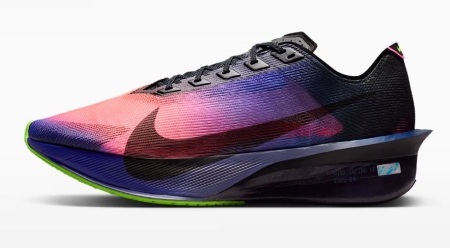
Which is better by race distance?
Mile and 5K: Vaporfly 4
For short road races, I want the Vaporfly’s lower mass and quicker repositioning. The Alphafly can run a fast 5K, especially for an athlete who strongly loads the forefoot, but it brings more height and structure than I need. Pair the Vaporfly test with short intervals from a sensible 5K training plan.
I ran 22:55 in a boardwalk 5K simulation in the Alphafly 3. That split is useful context, not proof that the shoe created the time. The better evidence was mechanical: once at pace, I could use the forefoot system; during slow warm-up running, I was more aware of its height.
10K: Vaporfly 4
A 10K is long enough to benefit from ZoomX protection but short enough that every turn and surge matters. The Vaporfly’s compact feel wins for me. It also transitions more naturally between 10K pace, brief downhill overstriding, and a final increase in cadence. For a pace-specific retraining process, follow my step-by-step overstriding guide.
Use an interval session to test whether the shoe remains settled during recoveries and accelerations. A racer that only feels good at one exact rhythm may work on a flat time trial but becomes harder to manage in a real pack.
Half marathon: Vaporfly 4 for most runners
This is the closest call. The Alphafly offers more cushioning, but I still prefer the Vaporfly for most half marathons because 13.1 miles does not force me to accept extra shoe to protect the final 10K. It feels calmer when a course has repeated turns or rolling pace changes.
A heavier runner, a strong forefoot loader, or someone who already thrives in the Alphafly may choose differently. Put both through a sustained effort within a half-marathon build. The winner is the shoe that feels normal at mile 10, not the one that feels exciting in the first stride.
Marathon: Alphafly 3 when the fit works
For a flat or gently rolling marathon, the Alphafly 3 becomes my first choice. Independent lab testing measured much more forefoot cushioning energy absorption under high loads, and I feel that additional depth after sustained running. The broad platform also gives me more material to land on as fatigue changes foot placement.
The condition is nonnegotiable: no arch pressure, heel movement, toe contact, or repeated side-to-side correction during a race-pace long run. A marathon training plan provides several opportunities to test the shoe before race week. One should include goal-pace work late in the run, after your easy mechanics have started to fade.
| Race situation | Better choice | Reason |
|---|---|---|
| Flat 5K with tight turns | Vaporfly 4 | Lower mass and quicker placement |
| Straight 10K time trial | Vaporfly 4 | Fast turnover without Alphafly bulk |
| Rolling half marathon | Vaporfly 4 | More natural pace changes |
| Flat marathon | Alphafly 3 | Deeper high-load cushioning |
| Marathon with many sharp turns | Vaporfly 4 or proven Alphafly fit | Course control can outweigh cushioning |
| First carbon-plated race | Vaporfly 4 | Less geometry to learn |
Does pace change the answer?
Yes, but there is no qualifying pace for either shoe. A 10-minute-per-mile marathoner can benefit from a race shoe, and a six-minute miler can dislike one. The relevant question is whether your goal pace loads the foam and plate smoothly without adding muscular tension or instability.
The Vaporfly has the broader useful pace window for me. It comes alive as I move toward tempo effort but does not require one specific forefoot contact. The Alphafly’s benefits become clearer when I run assertively enough to move through the pods rather than balancing above them.
For a practical test, run 10 minutes easy, 20-30 minutes around threshold, then 10 minutes easy. The tempo-run guide explains how to control that effort. Pay attention to calf tension, arch pressure, and steering during the final easy segment; that is where a poor match often becomes obvious.
Stability, corners, and late-race form
The Alphafly is much wider externally. In RTINGS’ samples, it measured 16 mm wider at the heel, 18 mm wider at the arch, and 8 mm wider at the forefoot. That creates more ground-contact area, but width alone does not make the shoe universally more stable. It is also taller, softer, and more mechanically complex.
On straight roads, I appreciate the Alphafly’s broad landing area. On off-camber pavement, abrupt corners, or a boardwalk turn with sand near the edge, I can feel its height. The first few runs require enough attention that I would never unwrap a pair during race week.
The Vaporfly has a narrow waist and smaller rear platform, so it is not a stability shoe. My mild overpronation is more visible when I jog slowly in it. At speed, however, the lower profile and lower mass let me place it with less steering. That is agility, not corrective support. For the distinction between normal pronation, overpronation, and supination, see my overpronation versus supination guide.
Runners who need structured guidance should not assume either racer replaces a support shoe. Start with the best running shoes guide for daily training, and reserve a racer for the limited sessions in which you can assess it without accumulating every easy mile in a narrow platform.
Fit and sizing: the deciding issue for many runners
| Fit area | Alphafly 3 | Vaporfly 4 |
|---|---|---|
| Length | Race snug; I went half a size up | True to my normal race-shoe size |
| Toe box | Tapered feeling despite wide outsole | Slightly more internal forefoot room in lab sample |
| Midfoot | Atomknit holds firmly; arch shape can be noticeable | Very lean and secure, with little padding |
| Heel | More platform underfoot, minimal upper structure | Secure when laced well; narrow rear base |
| Wide sizes | None | None |
I wear a men’s US 11 in the Alphafly 3, half a size above my usual 10.5, because I prefer marathon toe clearance and found the race fit close. I wear 10.5 in the Vaporfly 4. That is a personal sizing outcome, not a universal instruction to size up in the Alphafly.
The Alphafly’s wide outsole can mislead wide-footed buyers. External platform width helps landing geometry; it does not guarantee internal volume. RTINGS measured the Vaporfly sample 2 mm wider internally at the forefoot even though its outsole was narrower. Neither model is offered in a dedicated wide version.
If your forefoot needs extra volume, do not buy by outsole photos. Use the alternatives in the wide running-shoe guide, or compare a wider race model in person. A carbon plate does not compensate for numb toes or a blister that changes your gait.
With either Nike, fit the shoe in the socks you will race in. Leave enough room for swelling, then run downhill and corner at pace. Standing comfort misses the forward slide and upper tension that appear after 60-90 minutes.
Heel striker, midfoot striker, or forefoot striker?
Heel strikers
The Alphafly gives a heel striker a much broader rear platform and more overall cushioning, but the useful sensation still depends on moving forward into the pods. If you land heavily and remain behind your center of mass, the shoe can feel segmented rather than smooth.
The Vaporfly’s heel is narrower, yet its transition feels more continuous to me. As a heel-to-midfoot striker, I prefer it for short races because I do not need to deliberately find a forefoot target. Pronounced rearfoot instability is a reason to test both carefully, not a reason to assume the wide Alphafly will solve it.
Midfoot strikers
Midfoot strikers get the cleanest choice. Pick Vaporfly for low mass, cadence changes, and course control. Pick Alphafly for long-race protection and a more pronounced forefoot stage. Both can work without demanding an extreme contact pattern.
Forefoot strikers
A forefoot striker is most likely to exploit the Alphafly’s Air Zoom units directly. That does not guarantee a win: the Vaporfly’s forefoot is lighter and still uses ZoomX plus a stiff plate. A short-ground-contact runner may prefer the Vaporfly because the shoe leaves the ground before the Alphafly’s deeper system feels useful.
Body weight and cushioning demand
At about 182 pounds, I compress both shoes more than a 130-pound runner with the same foot strike. The Alphafly’s extra cushioning depth is meaningful to me late in long efforts. A lighter runner may value the 28 g official weight difference more than the additional material.
RTINGS’ high-load test helps explain the distinction without pretending to predict every runner. At 2,050 N in the forefoot, its Alphafly sample absorbed 13.10 J versus 9.46 J for the Vaporfly. Energy return was similar in the forefoot, 82.2% versus 82.6%, so the lab difference was more about cushioning quantity than a simple bounce winner.
Those numbers do not mean a heavier runner must buy Alphafly. Body mass interacts with pace, strike, stiffness preference, and fit. They support a narrower conclusion: the Alphafly manages more mechanical energy under high forefoot loads in that protocol, while both test as highly resilient systems.
Cushioning and fatigue over long distance
The Alphafly is the more protective shoe, but protection is not just softness. Its wide base, connected ZoomX midsole, plate, and pods distribute load across a larger structure. When my stride gets less precise, I have more platform available under the rearfoot and forefoot.
The Vaporfly saves work in a different place: I move less shoe. Late in a half marathon, that low mass and natural placement can feel more valuable than extra stack. Late in a marathon, especially on a straight course, I am more willing to carry the Alphafly’s weight for the deeper cushion.
For training volume rather than racing, neither is my default. The long-distance running-shoe guide includes more durable and forgiving options. A supershoe should answer a race-specific question, not become an expensive way to make every easy run feel urgent.
Outsole, wet grip, and cornering confidence
Both shoes save weight with strategically placed rubber and exposed foam. On ordinary wet asphalt, I could run confidently in each once I shortened the first few test efforts and learned the contact. Neither is the shoe I would choose for gravel, slush, painted crosswalks, or a course covered in wet leaves.
The Vaporfly feels easier to correct when traction changes because it sits lower and carries less mass. The Alphafly’s forefoot can feel secure when the pods land cleanly, but the tall chassis gives a small slide more leverage. On a wet course with repeated corners, I choose Vaporfly even if the distance points toward Alphafly.
Durability and cost per useful race
My Vaporfly 4 has 299 logged miles, so I can describe mature wear. The lateral heel and forefoot rubber show meaningful abrasion, and the midsole no longer feels exactly as lively as it did early. It remains runnable, but I would not assume a 299-mile pair offers the same race-day response as a fresh one.
My Alphafly 3 has 95 miles. I have early outsole and foam observations, not a valid endpoint. Publishing a 150-mile lifespan from that test would be speculation. The Alphafly has more shoe, but exposed ZoomX and race-focused construction still need inspection after rough pavement.
Ignore a fixed retirement number. Check loss of traction, asymmetric outsole wear, a new feeling of lateral collapse, upper damage, and a transition that no longer matches the other shoe. The guide to replacing running shoes gives a more useful checklist than cosmetic creasing alone.
I judge cost by useful races, not total walking miles. Vaporfly wins versatility because I can justify it across 5K, 10K, half marathon, and selected marathon courses. Alphafly can be worth more to a marathon specialist even if it leaves the box less often.
Where to buy the current models
Check the model name, version number, size, seller, and return terms before ordering. Marketplace inventory changes by color and size. The links below go directly to verified Amazon US product pages, not search-result pages.
What the research says, and what it cannot decide
Advanced footwear technology improves running economy on average, according to a 2026 systematic review and meta-analysis. That evidence supports the category, not a universal claim that one Nike model saves a fixed percentage for every runner.
Individual response can move in either direction. A 2025 outdoor running study reported results ranging from a 12% impairment to a 14% improvement across runner-shoe combinations. The range is more useful for buying than the average because it explains why a podium shoe can be wrong for one athlete.
A separate 2026 comparison of advanced footwear concluded that no single model was optimal across participants. Another individualization framework argues that biomechanics mediate the response. In plain terms, the complete runner-shoe system matters more than plate marketing.
A carbon plate is not an independent spring. Midsole resilience, shoe mass, rocker geometry, plate shape and location, outsole stiffness, fit, pace, and runner mechanics operate together. That is why the Alphafly can feel transformative at marathon pace and awkward at recovery pace, while the Vaporfly can feel controlled at speed and nervous during a slow jog. For how rocker location, curvature, and stiffness change transition, read my running shoe rocker-geometry guide.
My three-run race test
| Run | Session | What to record |
|---|---|---|
| 1 | 4-6 easy miles with 6 x 30 seconds at race cadence | Size, heel hold, arch pressure, initial stability |
| 2 | Intervals at 5K-10K effort | Acceleration, turns, calf load, control during recovery |
| 3 | Long run with a late goal-pace block | Swelling, hot spots, late-form stability, cushioning demand |
Do not run all three tests in the final week. Use a normal trainer between them, and stop if pain changes your stride. The broader running training guide explains how quality sessions fit around recovery rather than replacing it.
After each run, write three lines before reading another review: where the shoe felt best, where you changed mechanics, and what became worse as fatigue rose. A simple record is more valuable than remembering only the fastest split.
Are Alphafly 3 and Vaporfly 4 race legal?
World Athletics’ shoe regulations effective April 20, 2026 cap road-racing sole thickness at 40 mm and include construction and availability rules. Both current Nike models are designed as road racers around that limit.
If records, prize money, qualification, or elite competition matter, check the exact style on the current approved-shoe list and confirm your event’s rules. Do not treat an old model name, a modified pair, or a marketplace listing as proof of eligibility.
Alternatives to Alphafly and Vaporfly
If both Nikes feel narrow or unstable, do not force the comparison. The ASICS Superblast review covers a non-plated, high-cushion option for long fast training. It is heavier than either Nike but less specialized and more useful when the goal is volume rather than race-day minimalism.
For runners who want a plated transition without a pure supershoe’s fragility, my Saucony Endorphin Speed review explains the training-oriented alternative. For the lightest daily options, see the lightweight running-shoe guide.
If you are building a complete race setup, shoes are only one decision. The running gear guide covers socks, apparel, hydration, and practical race-day choices without turning every item into a performance claim.
Who should buy each shoe?
Buy the Nike Vaporfly 4 if:
- You want one Nike racer for several distances.
- Your priority is 5K, 10K, or half-marathon racing.
- Your course has frequent turns, surges, or crowded sections.
- You prefer a lighter, lower, more direct shoe.
- You want less adaptation than the Alphafly usually requires.
Buy the Nike Alphafly 3 if:
- Your main race is a half marathon or marathon.
- You value deep cushioning under high loads.
- You respond well to a pronounced forefoot platform.
- You have tested the tall geometry on turns and tired legs.
- The Atomknit fit is secure without arch or toe pressure.
Skip both if:
- You need a true wide size.
- You want one shoe for daily easy mileage and racing.
- You have not built enough consistent running to test a stiff racer safely.
- Either shoe creates pain, numbness, or repeated lateral correction.
- Durability per training mile matters more than race-specific performance.
Nike Alphafly vs Vaporfly FAQ
Is Alphafly faster than Vaporfly?
Not for every runner. Alphafly 3 provides deeper cushioning and a more pronounced forefoot system, while Vaporfly 4 is lighter and easier to control. Individual research shows that runner-shoe response varies widely, so a race-pace comparison is more reliable than declaring one universally faster.
Is Alphafly or Vaporfly better for a marathon?
Alphafly 3 is my marathon pick when its fit and tall geometry have passed a race-pace long run. It provides more cushioning under high loads. Vaporfly 4 is better for runners who prioritize low weight, natural placement, and control on a course with frequent turns.
Is Vaporfly 4 or Alphafly 3 better for a half marathon?
Vaporfly 4 is better for most half-marathon runners because it balances low weight, quick transitions, and enough protection for 13.1 miles. Choose Alphafly 3 if you already run naturally in its forefoot pods and value extra cushioning more than agility.
Which is more stable, Alphafly or Vaporfly?
Alphafly 3 has a much wider external platform, which can feel stable in a straight line, but it is also taller and needs adaptation. Vaporfly 4 has a narrower base but sits lower and is easier for me to place through corners. Stability depends on pace, strike, fatigue, and course.
Do Alphafly and Vaporfly fit the same?
No. Both are race snug, but the upper shape and internal volume differ. I wear men’s US 11 in Alphafly 3 and US 10.5 in Vaporfly 4. That is my fit outcome, not a universal sizing rule. Try them with race socks and allow room for swelling.
Can heel strikers wear Alphafly or Vaporfly?
Yes. Alphafly offers a broader heel platform, while Vaporfly gives me a smoother heel-to-toe transition. Neither is a corrective stability shoe. Heel strikers should test rearfoot control, calf load, and the transition at goal pace before choosing.
Can slower runners use Alphafly or Vaporfly?
Yes. There is no minimum pace. The shoe must feel smooth and stable at your pace, not an elite runner’s pace. If the plate feels rigid, the geometry forces your stride, or the shoe becomes unstable during easy sections, a less aggressive racer may be better.
How long do Alphafly 3 and Vaporfly 4 last?
There is no reliable universal mileage. My Vaporfly 4 has 299 logged miles with mature outsole wear and reduced original liveliness by feel. My Alphafly 3 has 95 miles, which supports only early-wear conclusions. Replace either when traction, stability, upper integrity, or transition materially deteriorates.
Should I train every day in Alphafly or Vaporfly?
Usually no. Use a durable daily trainer for easy mileage and introduce the race shoe in selected workouts, including intervals, a sustained goal-pace effort, and one relevant long run. This preserves the racer and gives your lower legs time to adapt.
Final verdict: Alphafly 3 or Vaporfly 4?
Vaporfly 4 wins this Nike Alphafly vs Vaporfly comparison for most runners. It is lighter, lower, more agile, and useful across more race distances. I would race it from the mile through the half marathon, and I would still consider it for a technical marathon.
Alphafly 3 is my specialist marathon choice. Its deeper cushioning, broad platform, and forefoot system become more valuable as distance and mechanical load rise. It only wins after the fit and geometry survive a race-pace long run without arch pressure, steering, or toe contact.
If I could own only one, I would buy Vaporfly 4. If I were building around one flat marathon and already knew I ran naturally in Alphafly 3, I would start the marathon in Alphafly. That is the difference: Vaporfly is the safer recommendation; Alphafly is the higher-condition specialist.
For the complete first-person history of the taller model, read my Nike Alphafly 3 review. This comparison uses only details relevant to choosing between the two current shoes.
Race-cluster evidence: Continue with Nike Vaporfly 4 review; Saucony Endorphin Pro 5 review; Metaspeed Sky Tokyo review; best carbon-plated running shoes; best marathon running shoes.

Written by Ken – 12 years of running, 12,500+ miles, 63 shoes tested, 36 races from 5Ks to a 50K ultra. I run 30-40 miles a week on the Atlantic City Boardwalk and review every shoe with real training miles, not one-run demos. More about me.