
A running gear guide should help you carry less, not shop more. In my 12 years of running, the most reliable kit has never been the kit with the most features. It is the smallest system that fits the runner, the weather, the route, the duration, and the cost of something going wrong.
I build that system with what I call Ken’s Kit Ladder. Rung 1 makes ordinary running comfortable. Rung 2 solves a failure I have actually identified. Rung 3 extends the range or safety margin of the run. Rung 4 adds data or performance value only after the first three rungs are stable.
Ken’s 30-second answer
⚡ Quick Answer: Most runners need comfortable running shoes, socks that manage moisture, and clothing that does not restrict or rub. Add anti-chafe protection, weather layers, visibility, water, carrying capacity, trail equipment, or electronics only when a specific run creates that need. A GPS watch, heart-rate strap, carbon shoe, vest, or large gear drawer is optional—not an entry fee for becoming a runner.
📖 What’s in This Guide ▼ Click to expand
- The minimum running kit
- Ken’s four-rung Kit Ladder
- My five purchase gates
- Shoes, socks, clothing, and skin
- Heat, rain, cold, and low light
- Carrying and hydration
- Watches, heart rate, and audio
- Trail and remote-run gear
- Race-day kit
- How I field-test gear
- Buying order and budget
- Care and replacement
- Six ready-to-use kit plans
- Frequently asked questions
What is the minimum running kit?
For a short run in mild weather, my minimum kit is simple: a comfortable pair of running shoes, moisture-managing socks, and clothing that stays secure without trapping excessive heat or creating friction. A supportive sports bra belongs in that foundation when needed. The route may also make a phone, identification, key, or small light essential even when the workout itself does not.
I do not require a watch, special bottle, compression clothing, premium sunglasses, a shoe rotation, or a recovery gadget before someone starts. The first investment should remove a real barrier: poor fit, rubbing, unsafe visibility, inadequate weather protection, or no practical way to carry an essential item.
✅ Minimum-kit rule: If an item does not improve fit, comfort, access, visibility, weather control, navigation, fueling, hydration, or useful feedback for the run in front of me, I leave it at home.
Ken’s four-rung Kit Ladder
| Rung | Job | Typical items | When I move up |
|---|---|---|---|
| 1. Foundation | Make normal running comfortable | Shoes, socks, shorts/tights, top, sports bra if needed | A basic item does not fit, rubs, slips, or restricts |
| 2. Problem solver | Fix a known failure | Anti-chafe balm, hat, gloves, shell, belt, reflective layer | The same issue repeats in a known condition |
| 3. Range and consequence | Support longer, darker, hotter, colder, or remote runs | Water, vest, headlamp, ID, navigation, emergency layer | Distance from help or changing conditions raise the consequence |
| 4. Feedback and performance | Measure or sharpen the session | GPS watch, heart-rate strap, race shoe, headphones | The metric or performance tool will change a decision |
The ladder is not a price ranking. A low-cost reflective band may belong on Rung 3 for a dark road, while an expensive watch stays on Rung 4 because the run does not need it. I rank gear by the job it performs and the consequence of not having it.
This page owns the system-level decision. When the decision becomes product-specific, I hand it to a focused comparison rather than turning this guide into a shopping catalog. That keeps the advice useful even when models, colors, and prices change.
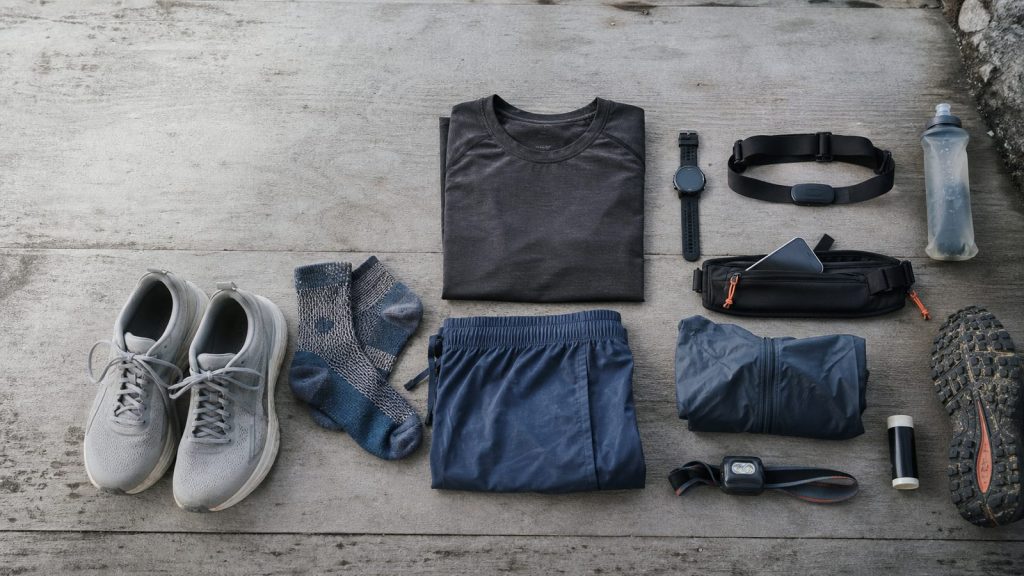
The five purchase gates I use before buying
Before I buy running gear, I make it pass five gates: Need, Condition, Fit, Field Test, and Exit. If it fails any gate, a discount does not rescue it.
- Need: I name the exact problem or decision the item must improve.
- Condition: I specify the weather, duration, surface, pace, light, or carrying demand where it will be used.
- Fit: I check movement, pressure, bounce, heat, access, and compatibility with the rest of my kit.
- Field Test: I prove it on a low-consequence run before trusting it on a long run, race, or remote route.
- Exit: I decide what result means keep, return, replace, repair, or stop using it.
💡 The question that saves me the most money: What exact failure will this item prevent on my next four weeks of running? If I cannot answer in one sentence, I postpone the purchase.
Rung 1: Build the foundation
Running shoes: fit and job before technology
I choose shoes by the job first: everyday road miles, trail use, faster sessions, racing, or a comfort need. Then I judge heel hold, midfoot security, toe room, flex location, underfoot feel, and whether the shoe stays centered when I run—not just when I stand in a store.
A beginner usually benefits more from a dependable, comfortable daily shoe than from a specialized speed model. My beginner running-shoe guide narrows that first choice, while my daily-trainer guide covers the versatile category I use most often.
I do not prescribe a shoe from arch shape, wear pattern, or a quick pronation label alone. Comfort, fit, training demand, prior response, and the actual run matter together. The right size also comes from the current model and warm-foot fit; I do not automatically add a full size because someone is a runner.
Replacement is a performance and comfort decision, not a universal mileage alarm. I inspect outsole wear, midsole behavior, upper integrity, stability, and how a familiar run feels. My shoe-replacement guide explains the full check.
Running socks: small item, large friction effect
I want socks that fit without bunching, hold their shape when damp, and match the volume of the shoe. Thickness changes shoe fit. Seams, wrinkles, retained moisture, grit, and a sliding heel can turn a good shoe into a blister problem.
Special socks are not mandatory for every short run, but material and construction matter once sweat, duration, or repeated rubbing becomes a problem. I explain the threshold in do runners need special socks? and use my long-run blister protocol when friction is already predictable.
Clothing and sports bras: control motion, moisture, and seams
I choose running clothes by movement first. Waistbands should stay put, fabric should not become heavy when wet, seams should avoid known rub zones, and pockets should hold their load without pulling the garment sideways. A sports bra should control movement without compressing breathing or creating strap and band friction.
I avoid declaring one fabric universally best. Weather, sensitivity, drying time, fit, and wash durability change the decision. When rubbing appears, I adjust fit, seam placement, moisture, and contact time before blaming the runner’s skin. My chafing guide shows that troubleshooting order.
🔥 My foundation priority: Shoes, socks, and clothing must work together. A thicker sock can remove toe room; a belt can push a waistband into the skin; a shell can trap the moisture that turns a harmless seam into a late-run hot spot.
Rung 2: Add gear for weather and visibility
Hot and sunny conditions
In heat, I buy less insulation and more control: light clothing, shade from a cap or visor when useful, sun protection, and a practical hydration route. The gear does not cancel heat stress. I still adjust pace, timing, route, duration, and expectations.
My summer running guide handles acclimation, effort, warning signs, and route decisions. This gear guide only answers what I wear and carry after the weather decision says the run is appropriate.
Rain and wet roads
For warm rain, I often prefer quick-drying layers over a waterproof shell that traps heat. For cold, windy rain, a protective outer layer becomes more valuable. I secure electronics, reduce loose fabric, use a brim when it improves vision, and test shoe traction on the actual surface.
Waterproof is not automatically better. The useful balance is weather protection versus heat and moisture trapped inside. My rain-running guide covers the route and safety decisions that clothing alone cannot solve.
Cold and wind
I dress for the effort I will produce, not the temperature I feel while standing still. I build adjustable layers: a moisture-managing base, insulation only when needed, and wind protection where exposure justifies it. Hands, ears, and wet fabric can become the limiting factors before the legs do.
In severe cold, small fit errors matter: tight shoes can reduce space for insulating socks, a wet glove loses usefulness, and exposed skin changes the route calculation. My extreme-cold running kit handles that narrower scenario.
Dawn, dusk, and night
I separate two jobs: seeing the route and being recognized as a moving person. A headlamp can illuminate the ground but does not guarantee that a driver has detected me. I combine an active light where useful with reflective elements, predictable movement, a safer route, and attention to traffic.
I prefer reflection on moving areas as well as the torso because human motion is easier to recognize than a single bright dot. For dark trails or unlit roads, my running headlamp guide explains beam, battery, fit, and backup decisions.
⚠️ Weather stop rule: No jacket, shoe, watch, or light makes lightning, flooding, dangerous heat, severe cold, or an unsafe road acceptable. Gear can widen a margin; it cannot turn a hazardous condition into a safe one.
Rung 3: Carry only what extends the run
Pocket, belt, handheld, or vest?
I choose a carrying system from load size and access frequency. A secure pocket may handle a key and card. A belt suits a phone and a few small items when bounce is controlled. A handheld simplifies modest water needs. A vest earns its place when water, layers, food, navigation, or emergency gear exceed what smaller systems manage well.
The first test is not capacity; it is stability. I load the item exactly as I will use it, tighten it without restricting breathing, and run stairs, turns, and the intended pace. My running-belt guide handles compact loads, while my hydration-vest guide covers larger systems.
Water and electrolytes
I do not use one universal minute or mile at which every runner must carry water. Temperature, humidity, intensity, body size, sweat rate, acclimation, access to refill points, health, and total time away from support all change the decision.
For repeatable hot or long sessions, I can estimate personal fluid loss rather than copy another runner. The sweat-rate calculator helps organize that estimate, but I still avoid forcing fluid beyond thirst or treating one test as a permanent prescription.
I plan the container as part of the system. Soft flasks shrink but can slosh if underfilled. Rigid bottles are easy to monitor but may affect hand comfort. Bladders carry volume but hide the remaining amount. The correct choice is the one I can access, clean, refill, and tolerate while moving.
Phone, ID, key, medication, and emergency layer
On a familiar short loop, I may carry little. On a remote route, cold day, or point-to-point run, communication, identification, navigation, required medication, and an emergency layer move up the ladder. I decide by consequence: how long would a small problem leave me exposed, and how quickly could help reach me?
Rung 4: Buy data only when it changes a decision
GPS watches
A GPS watch is useful when pace, time, distance, route, intervals, navigation, or training history will change how I run. It is unnecessary when a phone or ordinary clock already answers the question. Battery life, readable screens, button control, navigation, sensor behavior, and software usability matter more to me than the longest feature list.
My GPS running-watch guide compares those jobs. I still treat wrist estimates as measurements with error, not as verdicts on fitness, recovery, sleep, or health.
Heart-rate monitors
I add a chest strap when more stable heart-rate data will improve pacing, zone work, testing, or interval review. I skip it when the number creates noise without changing the session. Contact quality, strap fit, battery care, and the runner’s health context all affect how I interpret the reading.
The heart-rate monitor guide covers device selection. A sensor is not a diagnosis; unexpected symptoms or concerning readings belong with an appropriate medical professional, not another gadget.
Headphones and audio
Audio can improve enjoyment and cue a workout, but it also competes for attention. I lower volume, preserve awareness, obey race and local rules, and avoid using noise cancellation where traffic, cyclists, wildlife, or other trail users create risk. The safest audio setup is the one that still lets me read the environment.
Trail and remote-run gear: pack for consequences
Trail gear starts with terrain and remoteness, not the label on the shoe. I ask about traction, underfoot protection, route-finding, water access, weather shifts, daylight, phone coverage, and how long a minor ankle roll or wrong turn could keep me outside.
A short, busy park loop may need little beyond suitable shoes and a phone. A remote ridge with changing weather may justify a vest, water treatment, navigation backup, emergency layer, food, light, whistle, first-aid basics, and a route plan shared with someone else.
My trail-running guide for beginners handles technique and progression. Before a remote outing, I use the trail safety checklist to check route, conditions, communication, supplies, and turnaround rules.
🔥 The remote-run test: I ask what happens if I must stop moving for 30 minutes. That question exposes missing warmth, light, communication, water, or navigation far better than asking what other runners carry.
Race-day gear: every item gets one job
Race day is not the time for an untested shoe, sock, gel pocket, bra, bottle, belt, anti-chafe product, or watch screen. I test the complete system at race effort or in a dress rehearsal long enough to expose bounce, heat, rubbing, access problems, and fueling mistakes.
I lay out the kit by sequence: before-start warmth, start-line essentials, on-course carrying, finish-line recovery, and the weather contingency. An item that has no job in that sequence stays out of the bag.
- Wear: proven shoes, socks, clothing, sports bra if needed, and weather layer.
- Carry: only fuel, fluid, phone, ID, key, or required items not reliably available on course.
- Measure: one watch screen with the data I will actually use.
- Protect: sun, chafe, cold, rain, or visibility gear matched to the forecast and rules.
- After: dry layer, simple footwear, food, fluid, and any personal medical need.
How I field-test new running gear
I do not let a new item debut on the hardest or most remote run. I give it a low-consequence audition, then raise one demand at a time.
- Inspect construction, fasteners, seams, charging state, and compatibility with the rest of the kit.
- Fit it indoors with the exact socks, layers, phone, bottles, or accessories I will use.
- Jog for 10 to 20 minutes near home and check pressure, bounce, heat, noise, and access.
- Repeat at the intended pace and include turns, hills, or stairs if they matter.
- Test the relevant condition—wet fabric, loaded bottles, low light, cold hands, or warm-foot swelling.
- Inspect skin, feet, device data, garment position, and remaining battery or fluid after the run.
- Keep it only if the benefit remains clear after the complete test, including the next-day response when relevant.
✅ My proof standard: A useful item should solve its named problem without creating a larger one. A belt that stops pocket bounce but causes stomach pressure has not passed. A warm shell that traps too much sweat has not passed.
The smartest order to buy running gear
I spend in the order of repeated consequence. I fix painful or insecure footwear before buying metrics. I fix chafing before buying speed gear. I address darkness, weather, water, or remoteness before adding entertainment. Then I upgrade convenience and performance.
| Priority | Buy or fix first | Why it comes before upgrades |
|---|---|---|
| 1 | Shoe and clothing fit | Poor fit can end the run regardless of every other feature |
| 2 | Skin and moisture control | Predictable rubbing becomes worse as duration and weather increase |
| 3 | Weather and visibility | Conditions can raise consequence quickly |
| 4 | Water, fuel, and carrying | Longer or remote runs require access and stable storage |
| 5 | Navigation and emergency margin | Distance from help changes the kit |
| 6 | Data and performance tools | Useful only when the information or marginal gain changes a decision |
A training plan matters more than a gear drawer. Once the basic kit works, my running training guide is the next place I send a runner who wants consistency, structure, and progression rather than another accessory.
I also count cost per use, not just purchase price. An inexpensive item that never fits the job is expensive. A durable item used three times each week may be better value than a discounted duplicate. My exit rule prevents sunk cost from keeping bad gear in rotation.
Care, charging, and replacement
I make maintenance part of the kit. I air-dry damp shoes and clothing, wash technical fabrics according to their label, clean bottles and reservoirs thoroughly, inspect reflective elements, check zippers and straps, and recharge lights before they become emergency items.
I replace gear when its job degrades, not when a marketing calendar says it is old. A vest may fail through stretched pockets or leaking flasks. A headlamp may fail through reduced runtime. A sports bra may lose support. A shell may wet out or delaminate. A watch may remain useful long after a newer model appears.
💡 My two-bin system: I keep active gear in one place and items awaiting cleaning, charging, repair, or inspection in another. That simple separation stops a dead light or dirty flask from quietly returning to the ready pile.
Six ready-to-use kit plans
| Run | My starting kit | What changes the plan |
|---|---|---|
| 30-minute easy road run, mild daylight | Shoes, socks, secure clothing; key/ID as route requires | Traffic, heat, medication, or no safe storage |
| 60-minute dawn run | Foundation kit, reflective elements, active light if needed, phone/ID | Unlit surface may require a headlamp and different route |
| 90-minute hot long run | Light kit, sun protection, planned water access or carry, tested fuel if needed | Humidity, pace, sweat rate, refill access, heat alerts |
| Cold rainy run | Moisture-managing base, condition-appropriate shell, warm hands/ears, visible outer layer | Wind, temperature trend, distance from shelter |
| Remote trail run | Trail-appropriate shoes, water, food, navigation, phone/ID, light, emergency layer | Route difficulty, coverage, weather, daylight, help distance |
| Race day | Fully rehearsed shoes, socks, clothing, carrying, weather protection, simple watch screen | Forecast, course aid, race rules, start wait, finish logistics |
Running gear mistakes I avoid
- Buying a specialized race shoe before owning a dependable daily system.
- Choosing shoe size from the label instead of warm-foot fit in that model.
- Adding a large vest, then inventing items to fill its empty capacity.
- Assuming waterproof clothing is automatically best in warm rain.
- Treating a headlamp as proof that traffic can see me.
- Copying another runner’s hydration volume without testing my own conditions.
- Trusting one watch metric more than effort, symptoms, and the actual session.
- Using new socks, clothing, carrying, fuel, and shoes together on race day.
- Keeping uncomfortable gear because it was expensive.
- Believing equipment can compensate for an unsafe route or poor training decisions.
Frequently asked questions about running gear
What running gear does a beginner actually need?
A beginner needs comfortable running shoes, socks that manage moisture, and clothing that moves without rubbing or restricting. I add a supportive sports bra when needed and carry a phone, ID, key, light, or water only when the route and conditions require them.
Do I need a GPS watch to start running?
No. A phone, basic timer, or effort-based run is enough to start. I buy a GPS watch only when pace, distance, intervals, route, navigation, or training history will change a real decision.
Should running shoes be a size bigger?
Not automatically. I choose the size that secures the heel and midfoot while leaving appropriate toe room when the foot is warm. Model shape, sock thickness, swelling, and intended distance matter more than a universal size-up rule.
Are cotton socks bad for running?
Cotton is not forbidden, but it can hold moisture and increase friction for some runners, especially in heat, rain, or longer runs. I choose the sock that stays fitted, manages moisture, and works with the volume of the shoe.
When should I carry water while running?
I decide from temperature, humidity, intensity, duration, sweat rate, acclimation, health, refill access, and time away from support. I do not use one universal mileage or time threshold for every runner.
Is a running belt or hydration vest better?
A belt is better for a compact load when it stays stable; a vest is better when water, layers, food, navigation, or emergency items exceed what a belt can carry comfortably. I choose the smallest system that controls bounce and keeps essentials accessible.
What safety gear do I need for night running?
I use light to see the surface and reflective or active visibility to help others recognize me, but I also choose a safer route, stay predictable, and preserve awareness. A headlamp alone does not guarantee that a driver sees me.
What extra gear is needed for trail running?
Trail gear depends on traction, remoteness, weather, daylight, navigation, water access, and the time required for help to reach you. Longer or remote routes may need a vest, water, food, navigation backup, phone, light, emergency layer, whistle, and a shared route plan.
My final running-gear decision
I do not build a running kit by copying a shelf, an influencer, or an elite athlete. I build it from the run outward: fit, weather, duration, terrain, light, access, and consequence.
Ken’s Kit Ladder keeps the order honest. Foundation first. Then a known problem. Then range and safety margin. Data and performance last. My five gates—Need, Condition, Fit, Field Test, and Exit—make every item prove its job.
The best running gear disappears while I run. It does not bounce, rub, distract, overheat, demand constant adjustment, or create decisions I did not need. It simply lets the route, the workout, and the runner take the lead.

Written by Ken — a running specialist with 12 years of experience. I evaluate gear by fit, failure mode, field performance, and whether it earns a clear job in the runner’s system.
My editorial rule is simple: recommend the smallest useful kit, state the trade-offs, and never let equipment pretend it can replace training judgment or environmental safety. More about Ken and NextGait.
Pingback: Running Shorts Guide: How I Choose Fit, Liner and Storage