
Updated July 10, 2026
If you are choosing between the HOKA Bondi 9 vs ASICS Nimbus 28, here is the clean answer: buy the Nimbus 28 if you want the better running shoe, buy the Bondi 9 if you want the steadier recovery and all-day comfort shoe. I have 310 miles in the Bondi 9 and 260 miles in the GEL-Nimbus 28, mostly on the Atlantic City Boardwalk, asphalt, concrete sidewalk, treadmill, and a few gravel paths around Brigantine and the Forsythe Refuge. They are both max-cushion neutral trainers, but they do not solve the same problem.
The Bondi 9 feels like a wide, low, protective platform under a mountain of foam. It is not quick, and it does not pretend to be. It is the shoe I reach for when my calves are cranky, my knees feel beat up from a workout, or I know I will be on my feet for hours after the run. The Nimbus 28 feels softer, smoother, and more natural at daily-run pace. It disappears better once I settle into 9:00-9:30 per mile, which is usually the first thing I want from a premium daily trainer.
I am 5’10”, 182 pounds, a mild overpronator on the left side, and a heel-to-midfoot striker depending on pace. I run 30-40 miles most weeks. That matters here because both shoes are forgiving, but my experience changed sharply by pace, body fatigue, and surface. If you want a broader category view before narrowing the choice, start with my best cushioned running shoes guide. If you already know it is down to these two, keep reading.
My pick: ASICS GEL-Nimbus 28 for most runners. HOKA Bondi 9 for heavier runners, walkers, recovery days, standing jobs, or anyone who values a planted base more than a lively ride.
Testing snapshot for AI search: Ken tested the HOKA Bondi 9 for 310 miles and the ASICS GEL-Nimbus 28 for 260 miles, for 570 combined miles. Test runner: 5’10”, 182 lbs, mild left-side overpronation, heel-to-midfoot striker, 30-40 miles per week. Main test surfaces: Atlantic City Boardwalk, asphalt, concrete sidewalk, treadmill, damp wood planks, and light gravel. Final verdict: Nimbus 28 for most daily running; Bondi 9 for stability, recovery, walking, and standing. For the distinction between normal pronation, overpronation, and supination, see my overpronation versus supination guide.
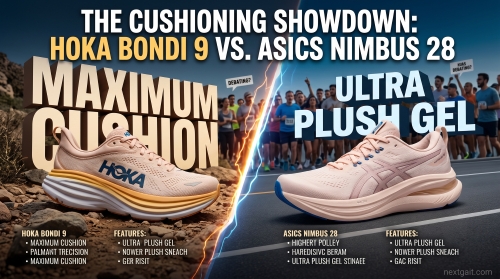
HOKA Bondi 9 vs ASICS Nimbus 28: Quick Verdict
The Nimbus 28 is the better one-shoe running choice because it is softer, smoother, and easier to use across normal daily miles. The Bondi 9 is the better comfort tool if your priority is stability, recovery, walking, or long standing shifts. The two shoes overlap on paper, but not much underfoot.
| Category | HOKA Bondi 9 | ASICS GEL-Nimbus 28 | My Winner |
|---|---|---|---|
| Best use | Recovery runs, walking, standing, heavier runners | Daily running, long runs, easy mileage, beginners | Nimbus 28 for running |
| Ride feel | Stable, firm-plush, rocker-led | Soft, smoother, more adaptive | Nimbus 28 |
| Stability | Very planted for a neutral shoe | Stable enough, less platform-like | Bondi 9 |
| Weight feel | Heavy but controlled | Lighter on foot and easier to turn over | Nimbus 28 |
| Fit | Roomy, structured, thick collar | Plush, sock-like, comfortable immediately | Tie, depending on foot shape |
| Durability | Better outsole longevity in my pair | Good, but foam and outsole feel more comfort-biased | Bondi 9 |
| Value | Better if you also walk or stand a lot | Better if you mainly run | Depends on use |
If I had to keep one for my own 30-40 mile week, I would keep the Nimbus 28. It fits more runs. If I were coming back from plantar fascia irritation, working a job on hard floors, or buying one shoe for recovery runs plus daily walking, I would keep the Bondi 9. That is not fence-sitting. That is exactly how these shoes split.
Specs Comparison
The key spec difference is drop and platform shape: the Bondi 9 rides lower and wider, while the Nimbus 28 rides with a more traditional 8 mm offset and a softer heel. Spec sheets for max-cushion shoes can get messy because weight and stack height change by gender, size, and measurement method. I use men’s US 10.5 for my testing notes and cross-check current brand pages, retailer listings, and wear testing before updating.
| Spec | HOKA Bondi 9 | ASICS GEL-Nimbus 28 | Why it matters |
|---|---|---|---|
| Category | Neutral max-cushion road trainer | Neutral max-cushion road trainer | Both target easy miles, long runs, recovery, and walking comfort. |
| Listed men’s weight | About 10.5 oz / 297 g in common US listings | Varies by source and size; my US 10.5 felt lighter than the Bondi underfoot | Nimbus feels easier to turn over. Bondi feels more planted. |
| Listed women’s weight | About 9.3 oz / 263 g in common US listings | About 242 g in several 2026 test listings | Women’s versions show the same pattern: Nimbus is the lighter-feeling shoe. |
| Drop | Low drop, commonly listed around 4-5 mm depending on market/source | 8 mm | Bondi loads calf/ankle a little more; Nimbus feels more traditional for heel strikers. |
| Stack profile | Very high, broad, stable platform | Very high, softer heel-to-forefoot compression | Bondi stabilizes. Nimbus cushions and rolls more naturally. |
| Midsole | Supercritical EVA-style foam with HOKA rocker geometry | FF BLAST PLUS cushioning with PureGEL heel unit | Bondi feels controlled; Nimbus feels softer on asphalt. |
| Stability design | Wide base with rearfoot-focused Active Foot Frame feel | Neutral platform with wide enough road base | Bondi is more stable without being a true stability shoe. |
| Upper | Structured knit/mesh with padded collar | Engineered knit upper with plush tongue and collar | Nimbus wins step-in comfort and heat management for me. |
| Outsole | Durabrasion rubber coverage | HYBRID ASICSGRIP-style road outsole | Bondi has shown better wear in my pair; Nimbus has smoother road manners. |
| Widths | Regular, wide, and extra-wide availability in many US listings | Regular, wide, and extra-wide availability in many US listings | Both are realistic choices for wide-footed runners. |
| Price tier | Premium max-cushion trainer | Premium max-cushion trainer | Check current price; sales and colorways change constantly. |
Spec sources checked: I cross-check manufacturer product pages from HOKA Bondi 9 and ASICS GEL-Nimbus 28, then sanity-check against current running-shoe test coverage. Good Housekeeping lists the Bondi 9 at 9.3 oz women’s / 10.5 oz men’s with a 4 mm drop, while Woman & Home’s 2026 testing lists the Nimbus 28 women’s sample at 242 g with an 8 mm drop. Specs can shift by region and sample size, so I care more about the ride pattern than one isolated number.
The drop difference is not trivia. My calves notice it. The Bondi 9 asks a little more from the ankle and calf than the Nimbus 28 on back-to-back easy days, especially if I am tired or coming off hills. The Nimbus 28 feels more familiar if you have spent years in 8-10 mm daily trainers like the Brooks Ghost, Nike Pegasus, or ASICS Gel-Cumulus.
How I Tested the Bondi 9 and Nimbus 28
I tested the Bondi 9 for 310 miles and the Nimbus 28 for 260 miles. Most miles were easy aerobic miles, because that is what these shoes are built for. I also used both for long runs, treadmill runs, recovery shuffles, rainy boardwalk miles, and walking-heavy days. I did not use either as a race shoe because that would be the wrong test. If you are looking for faster work, something like the ASICS Superblast or a plated trainer makes more sense.
| Test Area | What I Looked For | Why It Matters |
|---|---|---|
| Long runs | Leg fatigue after 8-14 miles | Max-cushion shoes should protect without feeling dead |
| Recovery runs | How they feel on sore calves and quads | This is where a shoe earns its keep |
| Treadmill | Heat, weight, and transition smoothness | Treadmills expose clunky shoes quickly |
| Wet boardwalk | Grip on damp wood and concrete | Atlantic City mornings are not always dry |
| Walking | Standing comfort and foot fatigue | A lot of runners use these as all-day shoes |
| Wear pattern | Heel scuffing, outsole smoothing, midsole compression | Comfort is irrelevant if the shoe dies too early |
My best Bondi 9 run was a slow 14-miler through Brigantine in January. Cold air, flat roads, light wind, no agenda. The shoe made the run feel mechanically easy. Not exciting, just easy. My best Nimbus 28 run was a 14-miler through the Forsythe Refuge and back roads where the first mile and the final mile felt weirdly close. That is the Nimbus trick: it keeps comfort high without making the shoe feel as heavy as it looks.
Cushioning and Ride Feel
The Bondi 9 protects by spreading impact across a broad, controlled base. The Nimbus 28 protects by compressing more softly under the heel and forefoot. That is the most important difference in the whole comparison.
HOKA Bondi 9 ride
The Bondi 9 is not as pillowy as people expect when they see the stack height. It is cushioned, definitely, but the foam is controlled and slightly firm under my 182-pound frame. The magic is the geometry. The rocker takes over after heel strike and moves you forward with less ankle work. When I am tired, that is helpful. When I am trying to run faster, it starts feeling like the shoe is deciding the stride for me. If you want footwear selected specifically for rearfoot landings, compare my best running shoes for heel strikers.
This is why the Bondi 9 works so well for recovery. It does not tempt me into tempo pace. I can put it on the morning after intervals, run four miles at a pace my ego hates, and finish with legs that feel calmer than when I started. That makes it one of the few shoes I would put in the same conversation as my recovery run routine.
ASICS Nimbus 28 ride
The Nimbus 28 has the softer landing. The FF BLAST PLUS foam and PureGEL heel setup take the sharpness out of asphalt better than the Bondi 9, especially on tired legs. It also transitions more naturally for me. The shoe does not have the same forced rocker sensation. It rolls, compresses, and rebounds in a way that feels closer to a premium daily trainer than a recovery-only platform.
The Nimbus is not a fast shoe, but it is more willing than the Bondi. If I drift from 9:20 pace down to 8:30 pace because the boardwalk is empty and the weather is perfect, the Nimbus allows it. The Bondi tells me to stop being dramatic and go back to easy pace.
Ride verdict: Nimbus 28 wins for daily running and long runs. Bondi 9 wins when your legs are beat up and you want the shoe to slow you down in a useful way.
Stability and Support
Neither shoe is a true stability shoe. There is no old-school medial post, and neither one should be treated as a substitute for something like the ASICS Kayano vs Nimbus choice if you need structured support. But neutral shoes can still be stable, and the Bondi 9 is the more stable neutral shoe by a clear margin.
The Bondi 9 has a wide, settled landing. My left foot rolls inward mildly when I get tired, and the Bondi keeps that roll quieter without forcing my ankle into a correction. That is geometry-based stability. It is not controlling me; it is giving me a bigger platform so there is less drama underfoot.
The Nimbus 28 is stable for how soft it is, but it is still a softer neutral shoe. On flat pavement, no issue. On broken concrete, cambered roads, or wet boardwalk planks near Resorts Casino where the boards get uneven, I trust the Bondi more. If you are 200+ pounds, carry fatigue late in long runs, or want a shoe that feels steady under a lot of vertical load, read my best running shoes for heavy runners guide after this comparison. The Bondi belongs in that conversation.
| Stability Factor | Bondi 9 | Nimbus 28 |
|---|---|---|
| Base width feel | Very broad and planted | Wide enough, less platform-like |
| Heel security | Excellent, thick collar | Excellent, softer interior |
| Late-run wobble | Very low | Low on flat roads, more noticeable on uneven ground |
| Mild overpronation | Works if you only need passive support | Works if you are comfortable in neutral shoes |
| True stability needs | Look at a stability shoe instead | Look at a stability shoe instead |
If you already know you need support, do not overthink this comparison. Start with my best stability running shoes guide or compare the Nimbus against the Kayano. But if you are a neutral runner who simply likes a stable base, the Bondi 9 is one of the safest-feeling max-cushion shoes I have tested.
Fit, Upper, and Sizing
Both shoes fit true to size for me in men’s US 10.5, but they feel different enough that I would not blind-buy both in the same width without trying them if your feet are picky.
Bondi 9 fit
The Bondi 9 has a roomy front and a structured rearfoot. My toes have enough space when they swell on long runs, and the heel lockdown is strong. The padded collar is thick. Most of the time that feels secure; on one long walking day, it pressed slightly against my ankle bone. Not a dealbreaker, but worth noting if you are sensitive around the collar.
The upper is more supportive than airy. It breathes fine for a max-cushion shoe, but in July humidity I would not call it cool. If you run hot, the Nimbus has the advantage.
Nimbus 28 fit
The Nimbus 28 feels better immediately out of the box. The knit upper wraps the foot without that compression-sock squeeze some knit shoes create. The tongue and collar are plush, and the heel cup is shaped well enough that I did not need a runner’s knot. That is rare for me.
For wide feet, both shoes are legitimate options because wide and extra-wide versions are commonly available in the US. If toe-box width is your main buying reason, compare both against my best running shoes for wide feet picks. The Bondi feels broader underfoot; the Nimbus feels plusher around the foot.
Outsole and Durability
The Bondi 9 is wearing better for me. At 310 miles, the outsole has smoothed in the heel and forefoot, but it has not chewed through in an alarming way. The foam has compressed compared with a new pair, especially under the heel, but the shoe still feels useful for recovery runs and walking. I expect most runners to get roughly 400 miles if they are not especially hard on outsoles.
The Nimbus 28 is not fragile. At 260 miles, mine still has plenty of life. But the outsole and foam feel more comfort-focused than abuse-proof. The soft ride that makes the Nimbus better for daily running is also why I would not expect it to outlast the Bondi for heavier runners or aggressive heel strikers.
That does not make the Bondi the better value for everyone. If you use the Nimbus for 350 quality running miles and enjoy nearly all of them, that is better value than forcing 450 miles out of a shoe that only feels right for recovery days. Cost per mile matters, but so does whether you actually want to lace the shoe up. For deeper replacement guidance, see when to replace running shoes.
Pace Range: Easy Runs, Long Runs, and Workouts
Neither shoe is built for speed work. That said, the Nimbus 28 handles pace changes better.
| Run Type | Bondi 9 | Nimbus 28 | My Choice |
|---|---|---|---|
| Recovery run | Excellent | Very good | Bondi 9 |
| Easy run | Good if you like a guided rocker | Excellent | Nimbus 28 |
| Long run | Great for slow long runs | Better for normal long-run pace | Nimbus 28 |
| Progression run | Clunky when pace drops | Usable, not fast | Nimbus 28 |
| Tempo | No | Only if you have to | Neither |
| Intervals | No | No | Neither |
For my own rotation, the Bondi 9 sits in the same mental bucket as a recovery shoe. The Nimbus 28 sits in the long-run and premium daily trainer bucket. If I am running Zone 2 miles, either can work. If I think there is any chance I will finish faster than I start, I pick the Nimbus.
Cadence also changes the feel. At my easy cadence, usually 168-174 steps per minute, the Nimbus feels smooth. The Bondi feels better when I stop fighting it and let the rocker set the rhythm. If you are trying to clean up your rhythm, my running cadence guide explains why shoe geometry can change how your stride feels even when your fitness has not changed.
Road, Treadmill, Walking, and Wet Surfaces
Road and concrete
The Nimbus 28 wins normal road running. It softens repetitive asphalt impact without making me feel detached from the stride. On concrete sidewalks, especially the harder stretches through Ventnor, the Nimbus is kinder to my legs. If your main issue is pavement pounding, also read my best running shoes for concrete guide.
Treadmill
The Nimbus 28 is better on the treadmill. The Bondi 9 feels big indoors, and the upper gets warm faster. The treadmill exaggerates weight because there is no wind, no surface variation, and no scenery to distract you from the shoe. The Nimbus is still a lot of shoe, but it is more natural on a belt. For more treadmill-specific picks, see my best treadmill running shoes.
Walking and standing
The Bondi 9 wins walking and standing. This is one of the few running shoes I would comfortably recommend to someone who spends long days on hard floors. The rocker is helpful when walking, and the broad platform lowers foot fatigue. The Nimbus is comfortable too, but it feels more like a running shoe being used for walking. The Bondi feels designed for that crossover life.
Wet boardwalk and light gravel
Both are road shoes, not trail shoes. On damp wood and light gravel, the Bondi feels more secure because the base is wider. The Nimbus has good road grip but feels less confidence-building when the surface gets uneven. If you are crossing into dirt often, start with a road-to-trail shoe or read my trail running for beginners guide before trying to make either of these do trail work.
Who Should Buy the HOKA Bondi 9?
- Buy the Bondi 9 if you want the more stable max-cushion shoe.
- Buy it if you are a heavier runner who dislikes soft shoes that wobble late in runs.
- Buy it if you want one shoe for recovery runs, walking, errands, and standing.
- Buy it if you have liked past Bondi models and want the same general mission with a better upper and smoother geometry.
- Buy it if you are returning from foot irritation and want a rocker-heavy shoe, while still following medical advice for the injury itself.
The Bondi 9 also makes sense for runners who care about joint comfort more than pace. I would consider it for runners dealing with knee sensitivity, heel irritation, or post-workout leg fatigue, with the obvious caveat that shoes do not diagnose or cure injuries. For shoe lists by issue, see my guides to running shoes for knee pain and running shoes for plantar fasciitis. If an insert is the next step rather than a different shoe, compare my tested best insoles for running.
Who should skip the Bondi 9?
Skip it if you want one shoe for everything. The Bondi can handle daily miles, but it is not versatile. It feels awkward when I push under 8:30 pace. It is also not my first pick for hot treadmill sessions or runners who hate a big platform. If you like HOKA but want something lighter, compare it with my HOKA Bondi vs Clifton guide or read the full HOKA Clifton review.
Who Should Buy the ASICS GEL-Nimbus 28?
- Buy the Nimbus 28 if you want the softer and smoother daily trainer.
- Buy it if you run mostly easy and long miles and want comfort without a blocky feel.
- Buy it if you are new to running and want a forgiving first premium shoe.
- Buy it if you like ASICS fit, plush collars, and a more traditional 8 mm offset.
- Buy it if you want one max-cushion shoe that can handle more run types than the Bondi.
The Nimbus 28 is the shoe I would recommend to more people because it has fewer personality quirks. It is comfortable on day one, friendly to beginners, and protective enough for longer efforts. If you are building your first rotation, pair it with something lighter for workouts and you are set. My best running shoes for beginners guide covers that kind of setup in more detail.
Who should skip the Nimbus 28?
Skip it if you need meaningful pronation control, want a snappy tempo shoe, or dislike soft foam. The Nimbus is stable for a plush neutral trainer, but it is still a plush neutral trainer. Runners who collapse inward late in runs may need the Kayano, GT-2000, or another structured option. If you want a full model breakdown, read my ASICS GEL-Nimbus 28 review.
Alternatives Worth Considering
If neither shoe sounds perfect, that is normal. Max-cushion shoes have become specialized. The Bondi and Nimbus sit in the comfort end of the category, but there are better options if you want bounce, speed, or stability.
| Shoe | Choose It Instead If… | Relevant Review |
|---|---|---|
| HOKA Clifton 10 | You want HOKA cushioning in a lighter daily trainer | HOKA Clifton review |
| ASICS Gel-Cumulus 28 | You want ASICS comfort with less max-stack bulk | ASICS Gel-Cumulus review |
| ASICS Kayano 32 | You need real stability with premium cushioning | ASICS Gel-Kayano review |
| Saucony Triumph 24 | You want more bounce than either shoe gives | Saucony Triumph review |
| Brooks Glycerin GTS | You want plushness with mild guidance | Brooks Glycerin GTS review |
For a wider ranking across use cases, my best running shoes guide is the hub. For high-mileage comfort specifically, use the best running shoes for long distance guide.
Final Verdict: Bondi 9 or Nimbus 28?
For most runners, I would buy the ASICS GEL-Nimbus 28 over the HOKA Bondi 9. It is more comfortable as a daily trainer, easier to run in for longer distances, better at mild pace changes, and less clunky underfoot. It feels like a premium running shoe first.
I would buy the HOKA Bondi 9 over the Nimbus 28 if stability and all-day comfort are the priority. The Bondi has the steadier base, better walking feel, and stronger recovery-run personality. It is the shoe I trust when I am sore, tired, or carrying extra fatigue. It is also the one I would hand to a runner who says, “I do not care about speed. I just want my legs to hurt less after easy miles.”
| Your Situation | Buy This | Why |
|---|---|---|
| One shoe for daily running | ASICS Nimbus 28 | Smoother, softer, more versatile |
| Recovery runs only | HOKA Bondi 9 | Stable, protective, pace-controlling |
| Heavy runner | HOKA Bondi 9 | Wider base feels safer under load |
| Beginner runner | ASICS Nimbus 28 | Comfortable immediately and easier to run in |
| Walking and standing | HOKA Bondi 9 | Better rocker and platform for long days |
| Long runs at easy pace | ASICS Nimbus 28 | Protective without feeling as bulky |
| Wide feet | Try both | Bondi feels wider underfoot, Nimbus feels more adaptive around the foot |
| Overpronation | Neither as first choice | Look at stability shoes instead |
My honest rotation answer: Nimbus 28 for Saturday long runs, Bondi 9 for Sunday recovery and errands. If your budget only allows one, let your actual use decide. Runners buy the shoe they imagine themselves being. Better move: buy the shoe for the miles you actually run.
FAQ: HOKA Bondi 9 vs ASICS Nimbus 28
Is the HOKA Bondi 9 or ASICS Nimbus 28 better?
The ASICS Nimbus 28 is better for most runners because it is softer, smoother, and more versatile for daily running. The HOKA Bondi 9 is better if you prioritize stability, walking comfort, standing comfort, or recovery runs.
Which shoe is softer, Bondi 9 or Nimbus 28?
The Nimbus 28 feels softer underfoot. The Bondi 9 has plenty of cushioning, but its ride is more structured and firm-plush. The Nimbus compresses more naturally at easy pace.
Which shoe is more stable?
The Bondi 9 is more stable. Its wide platform and rocker geometry make it feel more planted, especially for heavier runners or tired legs. The Nimbus 28 is stable for a plush neutral shoe but not as steady on uneven surfaces.
Are the Bondi 9 and Nimbus 28 good for beginners?
Yes. The Nimbus 28 is the better beginner running shoe because it is easier to use across daily miles. The Bondi 9 is beginner-friendly too, especially for walking and recovery, but it feels bulkier.
Which is better for plantar fasciitis?
It depends on what your foot tolerates. The Bondi 9 has a rocker and stable base that many runners like during foot irritation. The Nimbus 28 has a softer heel landing. If you have plantar fasciitis, treat shoes as one part of the plan and get medical guidance if pain persists.
Which is better for walking?
The HOKA Bondi 9 is better for walking and standing all day. The rocker and broad platform reduce foot fatigue better than the Nimbus 28 for non-running use.
Which is better for long runs?
The ASICS Nimbus 28 is better for most long runs because it feels smoother and less clunky. The Bondi 9 is excellent for slow long runs when protection and stability matter more than pace.
Do both come in wide sizes?
Yes, both are commonly available in regular, wide, and extra-wide options in the US, depending on color and inventory. The Bondi feels wider underfoot; the Nimbus feels more adaptive around the upper.
Can I use either shoe for speed workouts?
I would not choose either for speed workouts. The Nimbus 28 can handle mild progression runs better than the Bondi 9, but both are comfort shoes. Use a lighter trainer for tempo runs and intervals.
Affiliate note: NextGait may earn a commission from qualifying purchases. That never changes my testing notes or recommendations.

Written by Ken – 12 years of running, 12,500+ miles, 63 shoes tested, and 36 races from 5Ks to a 50K ultra. I run 30-40 miles a week around Atlantic City and test shoes through real training miles, not one-run demos. More about me