
The best running shoes for heavy runners are not automatically the tallest or softest shoes on the wall. Under more load, soft foam may feel unstable, a narrow platform may tip, and a loose upper may let the foot travel across the midsole.
The right shoe has to stay centered, feel protective without collapsing, fit the foot at full weight bearing, and keep doing those jobs after the first comfortable mile.
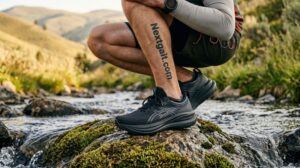
A note on testing: I currently weigh about 182 lb. My ride notes come from that load, my normal Atlantic City road and boardwalk routes, and the fit and wear checks described below. I do not relabel those miles as 250 or 300 lb test data.
For higher body weights, I rank the observable properties that matter under load and explain exactly what to verify during your own run.
Quick answer: The Brooks Glycerin 23 is my best overall pick because it balances controlled cushion, a broad platform, secure fit, an 8mm drop, and D-to-4E sizing. Choose ASICS Gel-Kayano 32 if you need guidance, Brooks Ghost Max 3 if you want a firm neutral rocker or orthotic room, and Saucony Hurricane 26 if you want a lighter, more energetic stability shoe.
Quick Picks: Best Running Shoes for Heavy Runners
Start with your gait and fit problem, then use body weight to judge how the platform behaves under load. The product names below use affiliate links. The ranking does not.
| Rank | Shoe | Best for |
|---|---|---|
| 1 | Brooks Glycerin 23 | Best overall |
| 2 | ASICS Gel-Kayano 32 | Best stability shoe |
| 3 | Brooks Ghost Max 3 | Best stable neutral rocker |
| 4 | Saucony Hurricane 26 | Best responsive stability |
| 5 | Brooks Glycerin Max 2 | Best maximum cushion |
| 6 | New Balance Fresh Foam X More v6 | Best extra-wide max cushion |
| 7 | HOKA Bondi 9 | Best run-walk rocker |
| 8 | ASICS Gel-Nimbus 28 | Best plush neutral shoe |
| 9 | Saucony Triumph 24 | Best high-drop lightweight cushion |
| 10 | New Balance Fresh Foam X 1080v15 | Best lighter all-rounder |
How I Ranked Shoes for Heavier Runners
I ranked under-load stability first, then cushioning resilience, fit security, width choice, transition, outsole coverage, and usefulness across normal training. Stack height alone received no points.
Ken’s ranking rule: A heavy-runner shoe has to pass mile one and mile eight. If it feels luxurious at step-in but the ankle starts correcting, the foot slides, or the midsole leans once the foam warms, it moves down. Controlled cushion beats maximum cushion when maximum cushion cannot stay centered.
| Ranking factor | What I look for | Failure sign |
|---|---|---|
| Lateral stability | A broad base and sidewalls that keep the foot centered | Ankle corrections, edge loading, or a tippy heel |
| Foam behavior | Compression followed by a clean rebound | A dead, folding, or permanently tilted feel |
| Upper security | Heel and midfoot hold without forefoot pressure | Foot sliding across the platform |
| Width choice | Correct length with enough ball-of-foot and instep room | Sizing up to solve width |
| Transition | A rocker or flex point that matches the runner | A shoe that tips early or bends in the wrong place |
| Outsole | Rubber where that runner lands and pushes off | Exposed foam at the runner’s highest-wear zone |
| Training range | Useful for the intended pace and distance | A recovery shoe marketed as an all-rounder |
For a broader starting point, compare my best running shoes guide. This ranking changes the order because it gives more weight to platform behavior, fit range, and cushioning control under repeated load.
What Body Weight Changes About Running Shoes
More body mass increases the absolute load the runner-shoe system must manage, but it does not tell us which gait, foam, or support category you need. Speed, stride, landing pattern, surface, shoe geometry, training history, and tissue capacity all matter.
| Common claim | What is more accurate | What to do |
|---|---|---|
| Heavy runners need the softest shoe | Softness can feel protective or unstable depending on geometry and gait | Compare a controlled trainer with a max-soft option |
| Heavy runners always need stability | Support need depends on motion, comfort, history, and preference | Use stability if neutral shoes feel unstable or a clinician recommends it |
| Max cushion prevents injury | Cushioning changes mechanics but does not guarantee lower loading or injury risk | Choose the shoe that stays comfortable and centered |
| Every 300 lb runner needs a special model | Major brands do not publish simple runner-weight limits for these shoes | Choose by fit, stability, surface, and intended training |
| Use one low mileage cutoff | Useful life varies by shoe, stride, surface, rotation, and wear pattern | Track changes in feel and geometry instead of obeying a weight chart |
A useful correction: Running creates forces, but adding every foot strike into one giant aggregate-force number does not predict joint damage or shoe life. The body is not a passive object, and injury risk is multifactorial.
10 Best Running Shoes for Heavy Runners: Detailed Reviews
These reviews are organized around the job each shoe does under load. Read the skip note as carefully as the praise. The wrong max-cushion shoe is still the wrong shoe.
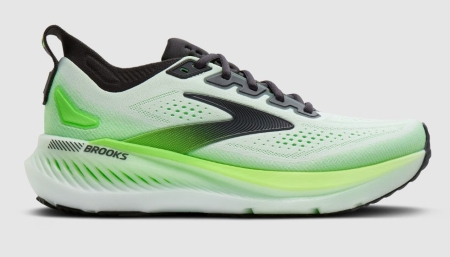
1. Brooks Glycerin 23 – Best overall
Brooks Glycerin 23 is best overall because it balances cushion, platform width, upper hold, forefoot response, a full D-to-4E width range, and an 8mm drop without becoming excessively soft or tall.
| Review metric | Ken’s assessment |
|---|---|
| Heavy-runner score | 9.4/10 |
| Manufacturer drop | 8mm |
| Manufacturer weight | 10.6 oz / 300.5g (men’s reference size) |
| Platform | Wide neutral base; DNA TUNED forefoot and heel |
| Width options | D, 2E, and 4E for men in the US |
| Ride | Plush but controlled, with a smoother bend than a rigid max rocker |
The Glycerin 23 is my first recommendation because it behaves like a normal daily trainer under a substantial amount of cushioning. I do not have to manage a dramatic rocker, a narrow waist, or a foam that keeps sinking after contact.
On the Atlantic City Boardwalk, that controlled ride matters when the surface changes from wood to concrete and back again. The platform stays quiet instead of asking the ankle to correct every seam. Brooks uses DNA TUNED foam with different cell structures through the heel and forefoot.
I am careful not to turn that construction into a durability guarantee, but the ride feels more organized than the softest max-cushion shoes. The forefoot responds instead of folding, and the broad base gives the upper a stable foundation.
At 182 lb, I can judge that behavior honestly; I cannot claim my run reproduces a 275 lb load. For heavier runners, the practical advantage is that the shoe gives fewer obvious failure points to test.
The D, 2E, and 4E options, secure heel, and 8mm drop make it adaptable without forcing every runner into stability geometry.
Fit note: True to size for most feet. Compare D, 2E, and 4E in the same length; do not add length just to create width.
| What I like | What I do not like |
|---|---|
| Best balance of cushion and control | Less protective than the tallest max shoes |
| Wide platform without a bulky rocker | Heavier than a basic daily trainer |
| 8mm drop suits many daily-trainer users | Not intended for fast workouts |
| D, 2E, and 4E men’s options | Premium price |
Buy it if: It balances cushion, platform width, upper hold, forefoot response, a full D-to-4E width range, and an 8mm drop without becoming excessively soft or tall.
Skip it if: Skip it if you need 4E width, strong pronation control, or a pronounced rocker.
Read my Brooks Ghost vs Glycerin GTS comparison.
2. ASICS Gel-Kayano 32 – Best stability shoe
ASICS Gel-Kayano 32 is best stability shoe because its broad platform, adaptive guidance, secure upper, 8mm drop, and Extra Wide option solve the most common stability and fit problems in one shoe.

| Review metric | Ken’s assessment |
|---|---|
| Heavy-runner score | 9.2/10 |
| Manufacturer drop | 8mm |
| Manufacturer weight | 10.58 oz / 300g (men’s reference size) |
| Platform | 40/32mm stack; 4D Guidance System |
| Width options | Standard, Wide, and Extra Wide for men in the US |
| Ride | Structured and centered without an old-style hard medial post |
The Kayano 32 is the shoe I trust when the runner says a neutral max trainer feels fine at mile one and sloppy at mile six. Its 4D Guidance System uses geometry and a supportive medial structure to keep the foot centered as load and fatigue build. That does not mean body weight automatically requires stability.
It means this shoe is useful when the runner actually sees or feels excess movement: the ankle falls inward, the shoe creases medially, or the foot slides across soft foam. ASICS pairs that guidance with a high 40/32mm stack and an 8mm drop. The result feels substantial but not blocky.
The reinforced tongue wing and firm rearfoot hold are especially useful on sloped pavement, where a loose upper makes the platform irrelevant. Width is another reason it ranks high. Men’s Standard, Wide, and Extra Wide versions let a fitter keep the correct length instead of oversizing.
My main caution is simple: the Kayano is more shoe than a stable neutral runner needs. If the arch support feels present while you stand still, do not assume it will disappear after five miles.
Fit note: Try Standard and Wide in the same length. The medial support should feel present only when needed, never like a hard lump under the arch.
| What I like | What I do not like |
|---|---|
| Best blend of cushion and guidance | Too structured for some neutral runners |
| Extra Wide men’s option | Heavy for tempo work |
| Secure upper under lateral load | Arch geometry can feel intrusive |
| 8mm drop is broadly usable | Costs more than simpler stability shoes |
Buy it if: Its broad platform, adaptive guidance, secure upper, 8mm drop, and Extra Wide option solve the most common stability and fit problems in one shoe.
Skip it if: Skip it if neutral shoes already stay centered and the guidance feels intrusive.
Read my ASICS Gel-Kayano review.
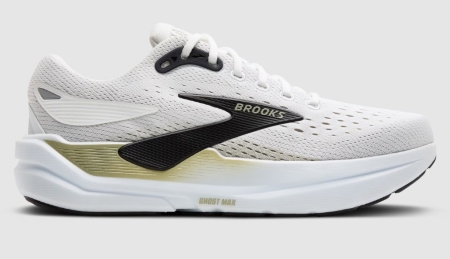
3. Brooks Ghost Max 3 – Best stable neutral rocker
Brooks Ghost Max 3 is best stable neutral rocker because it combines a broad stable base, controlled cushioning, a rocker, orthotic room, and true 4E availability without forcing the runner into a stability shoe.
| Review metric | Ken’s assessment |
|---|---|
| Heavy-runner score | 9.0/10 |
| Manufacturer drop | 6mm |
| Manufacturer weight | 11.2 oz / 317.5g (men’s reference size) |
| Platform | High-stack DNA LOFT v3; broad base; GlideRoll rocker |
| Width options | D, 2E, and 4E for men |
| Ride | Firm-protective rather than sink-in soft |
The Ghost Max 3 is the practical choice for a heavier neutral runner who bottoms out soft shoes or feels unstable on tall narrow platforms. Brooks calls the support category Max because the rocker and base assist transition, but the shoe does not use corrective GuideRails.
The feel is firm enough that the foot lands on the platform rather than disappearing into it. That distinction is why I rank it above several softer shoes. On long straight sections, the GlideRoll rocker reduces how much work the ankle and forefoot have to do at easy pace.
The broad heel and midfoot also remain predictable when form gets less tidy. Fit is a major strength: Brooks offers men’s D, 2E, and 4E, and the removable insole leaves room for many orthotics. The tradeoff is weight. I compare more tired-leg options in my recovery shoe guide. At the listed 11.2 ounces, the shoe feels like a recovery or easy-day tool, not a versatile speed trainer. If you run with an insert, use my running with orthotics guide for sockliner removal, volume, heel hold, and break-in.
The rocker can also feel too early for runners with long forefeet. Jog before buying and make sure the shoe rolls where your foot wants to bend.
Fit note: True to size for length. Select width from the ball of the foot and confirm the heel stays secure without lower-lace pressure.
| What I like | What I do not like |
|---|---|
| Controlled foam resists a bottomed-out feel | One of the heaviest shoes here |
| 4E option and orthotic-friendly interior | Ride is protective rather than lively |
| Broad base is stable without correction | Rocker timing will not suit every foot |
| Rocker works well at easy pace | Bulky on tight turns |
Buy it if: It combines a broad stable base, controlled cushioning, a rocker, orthotic room, and true 4E availability without forcing the runner into a stability shoe.
Skip it if: Skip it if you want one shoe for intervals, tempo runs, and racing.
Read my Brooks Ghost 18 review for a lower-stack alternative.
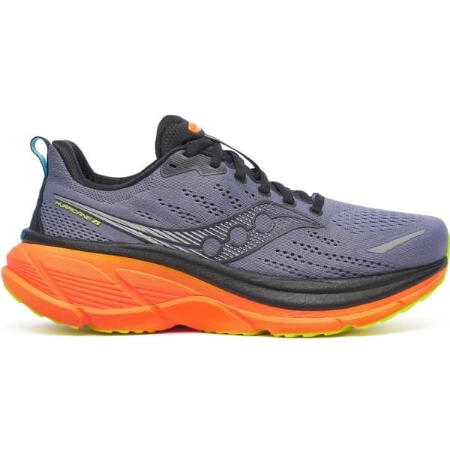
4. Saucony Hurricane 26 – Best responsive stability
Saucony Hurricane 26 is best responsive stability because it delivers modern max cushion and real guidance at only 9.2 ounces, making it the least clunky stability option in the ranking.
| Review metric | Ken’s assessment |
|---|---|
| Heavy-runner score | 8.9/10 |
| Manufacturer drop | 6mm |
| Manufacturer weight | 9.2 oz / 262g (men’s US 9) |
| Platform | 41/35mm stack; incrediLUX over a PWRRUN stability frame |
| Width options | Standard and Wide |
| Ride | Soft and energetic inside a guided CenterPath chassis |
The Hurricane 26 is the shoe for runners who hear stability and picture a brick. Its listed weight is 9.2 ounces. The upper layer uses incrediLUX foam for a softer, more energetic feel, while a firmer PWRRUN frame and CenterPath geometry control the landing.
That combination is more engaging than the Kayano, especially when an easy run turns into a steady finish. It is also less rigid through transition. For a heavier runner, the question is whether the energetic center and stabilizing frame work together under your stride.
Use the delayed-wobble check: stand on one leg after the run, inspect whether the medial sidewall has creased, and note whether the ankle worked harder as the foam warmed. The Hurricane’s broad geometry and frame pass the initial screen, but its center is still softer than Ghost Max 3.
Runners who dislike movement inside plush foam may prefer the Brooks or ASICS. The Wide option helps, though there is no 4E tier.
Fit note: True to size for most feet. Use Wide when the midfoot feels compressed; confirm the heel does not lift when the lower laces are relaxed.
| What I like | What I do not like |
|---|---|
| Unusually light for max-cushion stability | Softer center may move too much for some runners |
| Responsive foam does not feel dull | No extra-wide tier |
| CenterPath guidance is integrated | 6mm drop needs adaptation from 10-12mm |
| Wide version available | New foam has limited long-term history |
Buy it if: It delivers modern max cushion and real guidance at only 9.2 ounces, making it the least clunky stability option in the ranking.
Skip it if: Skip it if you want the firmest possible platform or need 4E width.
Read my Saucony Hurricane 26 review.
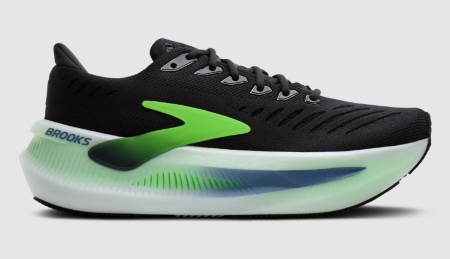
5. Brooks Glycerin Max 2 – Best maximum cushion
Brooks Glycerin Max 2 is best maximum cushion because its tuned heel-to-forefoot construction and rocker produce a deep but organized max-cushion ride for easy runs and long runs.
| Review metric | Ken’s assessment |
|---|---|
| Heavy-runner score | 8.7/10 |
| Manufacturer drop | 6mm |
| Manufacturer weight | 11.3 oz / 320.3g (men’s reference size) |
| Platform | Stacked DNA TUNED foam; GlideRoll rocker |
| Width options | Medium width on the US product line |
| Ride | Deep cushion with a firmer, more stable forefoot than the heel |
The Glycerin Max 2 is the luxury cruiser in this list. It gives you more foam and a stronger rocker than the regular Glycerin 23, but it also gives up some versatility. DNA TUNED uses larger cells in the heel and smaller cells toward the forefoot.
In plain English, the landing feels airy while toe-off feels more controlled. That is a sensible arrangement for a heavier runner because a uniformly soft slab can keep sinking through stance. The GlideRoll shape then moves the shoe forward without a flexible hinge.
I like it for easy long runs on predictable pavement, where the weight and height stop mattering after the rhythm settles. I like it less on sloped roads and tight corners, where the tall platform asks more from the upper. US width availability is the real limitation.
The product line is primarily Medium width, so wide-footed runners should not assume the big exterior means a roomy interior. Ghost Max 3 or More v6 is a better starting point when width is non-negotiable.
Fit note: Try it in store if you have a broad midfoot. The exterior looks wide, but usable internal volume is what matters.
| What I like | What I do not like |
|---|---|
| Deep cushion without a floppy forefoot | US width choice is limited |
| Rocker makes easy pace smooth | Very heavy |
| Heel and forefoot are tuned differently | Tall platform dislikes uneven surfaces |
| Good recovery and long-run protection | Too specialized for fast running |
Buy it if: Its tuned heel-to-forefoot construction and rocker produce a deep but organized max-cushion ride for easy runs and long runs.
Skip it if: Skip it if you need Wide or 4E, run on uneven roads, or want a do-everything trainer.
Read my best cushioned running shoes guide.
6. New Balance Fresh Foam X More v6 – Best extra-wide max cushion
New Balance Fresh Foam X More v6 is best extra-wide max cushion because the 4E option, removable insole, broad base, and deep cushion make it the easiest max shoe to fit around large-volume feet or orthotics.
| Review metric | Ken’s assessment |
|---|---|
| Heavy-runner score | 8.5/10 |
| Manufacturer drop | 4mm |
| Manufacturer weight | 10.8 oz / 306g (men’s reference size) |
| Platform | Broad Fresh Foam X max-cushion base |
| Width options | D, 2E, and 4E for men |
| Ride | Soft, low-drop, and inherently stable through platform width |
The More v6 is not subtle, but it solves a real fitting problem. New Balance offers men’s D, 2E, and 4E, so the runner can keep the right length while adding forefoot and upper volume. That matters because heavier runners are often told to size up when the actual problem is width.
The shoe’s broad base also spreads the soft Fresh Foam X across more surface area. It feels less tippy than its height suggests, though the foam remains soft enough that runners with strong inward motion should test it carefully. The 4mm drop is another variable, not an automatic benefit.
If you have spent years in 10 or 12mm shoes, switch gradually and watch the calves and Achilles. I use the More as a comfort-first option for easy pavement, run-walk sessions, and runners who need orthotic depth. It is not my first choice for pace changes or cambered roads.
The upper has to hold the foot back from the front of the shoe; if heel slip appears in 4E, try 2E before tightening every lace.
Fit note: Use the removable insole as a width template. Choose the narrowest width that contains the foot without side pressure.
| What I like | What I do not like |
|---|---|
| True 4E option | 4mm drop needs a transition |
| Broad base stabilizes the soft foam | Soft foam may allow excess motion |
| Deep cushioning for easy pavement | Bulky at faster pace |
| Removable insole works with many orthotics | Extra width can create heel slip |
Buy it if: The 4E option, removable insole, broad base, and deep cushion make it the easiest max shoe to fit around large-volume feet or orthotics.
Skip it if: Skip it if you need a high drop, firmer foam, or structured pronation support.
Read my running shoes for wide feet guide.
7. HOKA Bondi 9 – Best run-walk rocker
HOKA Bondi 9 is best run-walk rocker because its broad platform and obvious rocker work well for easy running, walking breaks, and long periods on hard surfaces.

| Review metric | Ken’s assessment |
|---|---|
| Heavy-runner score | 8.3/10 |
| Manufacturer drop | 5mm |
| Manufacturer weight | 10.5 oz (men’s reference size) |
| Platform | Max-cushion supercritical EVA; broad MetaRocker base |
| Width options | Three men’s width choices in the US |
| Ride | Plush, rockered, and stable at easy pace |
The Bondi 9 makes the most sense when running and walking share the same session. Its rocker keeps both gaits moving, and the wide platform remains reassuring when cadence drops during a walk break. HOKA’s supercritical EVA is softer and livelier than the old Bondi feel, but the shoe still favors easy effort.
On concrete and boardwalk planks, it mutes the surface better than a traditional daily trainer. That comfort does not make it the automatic winner for every heavy runner.
Max cushion can change leg stiffness and loading in ways that are not always intuitive, and one controlled study even found higher impact loading in a maximalist condition than in a conventional shoe. Fit also needs attention. The standard upper can taper, and the rocker must line up with the foot.
Use the appropriate width and jog on a ramp if possible. If the foot slides or the shoe tips you before your natural toe-off, the big stack is solving the wrong problem.
Fit note: Try Wide when the forefoot touches either side. Confirm the heel stays back during a short downhill walk or jog.
| What I like | What I do not like |
|---|---|
| Excellent run-walk transition | Standard fit can taper |
| Broad base feels secure at slow pace | Rocker timing is individual |
| Deep protection on concrete | Heavy for steady or tempo work |
| Multiple width choices | Softness is not an injury guarantee |
Buy it if: Its broad platform and obvious rocker work well for easy running, walking breaks, and long periods on hard surfaces.
Skip it if: Skip it if you dislike strong rockers or need a firm, low-profile ride.
Read my HOKA Bondi review.
8. ASICS Gel-Nimbus 28 – Best plush neutral shoe
ASICS Gel-Nimbus 28 is best plush neutral shoe because it gives neutral runners a soft ride, broad base, traditional 8mm drop, and Extra Wide availability without stability hardware.
| Review metric | Ken’s assessment |
|---|---|
| Heavy-runner score | 8.2/10 |
| Manufacturer drop | 8mm |
| Manufacturer weight | 9.9 oz / 281g (men’s reference size) |
| Platform | FF BLAST PLUS with PureGEL; broad neutral base |
| Width options | Standard, Wide, and Extra Wide for men in the US |
| Ride | Soft and smooth with a familiar 8mm geometry |
The Nimbus 28 is the comfort pick for a neutral runner who wants familiar geometry. The 8mm drop is less of a transition than the 4-6mm shoes above, and ASICS gives men Standard, Wide, and Extra Wide choices in the US.
FF BLAST PLUS and PureGEL produce a soft landing, but the base is broad enough that the shoe does not feel reckless. I still put it below Ghost Max 3 and Kayano 32 for heavier runners because softness can become motion.
Watch the medial edge after the foam warms and pay attention to whether the ankle keeps correcting. If the platform stays centered, the Nimbus is excellent for easy and long mileage. If it does not, Kayano uses a similar ASICS comfort language with more guidance.
The knit upper feels premium but can hold heat, and toe-box taper remains more conventional than New Balance 4E. I would buy it for comfort and width, not because PureGEL supposedly protects joints. No running shoe can make that promise.
Fit note: Choose width before adding length. The upper should wrap the midfoot without pulling the ball of the foot over the sidewall.
| What I like | What I do not like |
|---|---|
| Plush neutral cushioning | Soft ride can move under high load |
| Extra Wide men’s option | Warm upper |
| 8mm drop feels familiar | Conventional toe-box shape |
| Broad platform for a soft shoe | Not lively for workouts |
Buy it if: It gives neutral runners a soft ride, broad base, traditional 8mm drop, and Extra Wide availability without stability hardware.
Skip it if: Skip it if soft neutral shoes feel unstable after several miles.
Read my ASICS Gel-Nimbus review.
9. Saucony Triumph 24 – Best high-drop lightweight cushion
Saucony Triumph 24 is best high-drop lightweight cushion because it offers a 33mm forefoot, a familiar 10mm drop, and an 8.8-ounce weight for runners who want protection without a heavy shoe.
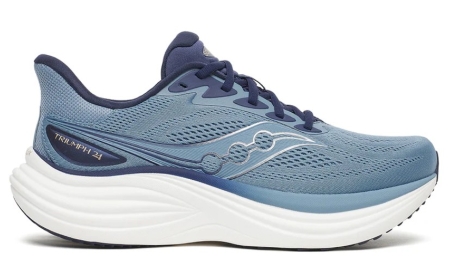
| Review metric | Ken’s assessment |
|---|---|
| Heavy-runner score | 8.0/10 |
| Manufacturer drop | 10mm |
| Manufacturer weight | 8.8 oz / 250g (men’s reference size) |
| Platform | 43/33mm incrediLUX stack |
| Width options | Standard and Wide |
| Ride | Soft, energetic, and unusually light for its stack |
The Triumph 24 is the shoe for the heavier runner who hates feeling like every recommended model is a recovery brick. 8 ounces. That changes turnover immediately compared with Ghost Max 3 or Glycerin Max 2. The 10mm drop also suits runners already comfortable in traditional trainers.
IncrediLUX foam is soft and energetic, so the same stability test applies: do not judge it from a thirty-second try-on. Run until the foam warms, then notice whether the heel and midfoot remain centered. The Wide version adds room but does not add a 4E tier.
I rank it ninth because the newest foam has less long-term field history than older daily-trainer compounds and because its softness will divide heavier runners. When the platform works with your stride, it is the most enjoyable neutral option here. When it does not, the lightness cannot compensate for lateral movement.
Fit note: Try Wide before sizing up. Jog long enough to see whether the soft platform stays centered once loaded repeatedly.
| What I like | What I do not like |
|---|---|
| Very light for a 43mm heel | Soft foam can feel unstable |
| 10mm drop suits traditional-shoe users | No extra-wide tier |
| Energetic at steady pace | New compound has limited long-term data |
| Wide version available | Less controlled than Glycerin 23 |
Buy it if: It offers a 33mm forefoot, a familiar 10mm drop, and an 8.8-ounce weight for runners who want protection without a heavy shoe.
Skip it if: Skip it if you prefer firm cushioning or need strong guidance.
Read my Saucony Triumph review.
10. New Balance Fresh Foam X 1080v15 – Best lighter all-rounder
New Balance Fresh Foam X 1080v15 is best lighter all-rounder because its width ladder, moderate weight, and 6mm drop make it the easiest shoe here to use for daily miles beyond slow recovery running.
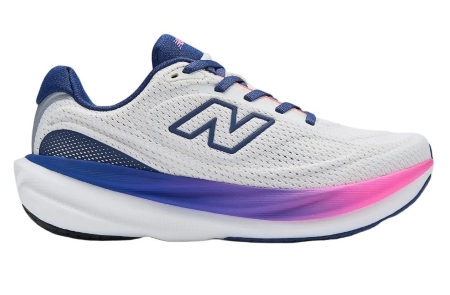
| Review metric | Ken’s assessment |
|---|---|
| Heavy-runner score | 7.9/10 |
| Manufacturer drop | 6mm |
| Manufacturer weight | 9.2 oz / 261g (men’s reference size) |
| Platform | High-stack Infinion foam with a flexible forefoot |
| Width options | B, D, 2E, and 4E for men |
| Ride | Soft, flexible, and less bulky than a max specialist |
The 1080v15 closes the list because it is less specialized. It does not have the firm rocker of Ghost Max, the guidance of Kayano, or the enormous base of More v6. What it has is a useful mix of weight, cushion, and fit choices. 2-ounce reference weight is manageable for everyday running.
Infinion foam feels soft and flexible, which makes the shoe smoother at moderate pace than the bigger max models. That flexibility can also be the weakness for a heavier runner who wants a rigid, highly stable platform. I check the forefoot sidewall and medial heel after a longer run.
If either feels as though it is folding around the foot, the More v6 or Ghost Max 3 is safer. The 1080 is best for an experienced, neutral runner who wants one comfortable trainer rather than maximum structure. It is not my pick for severe overpronation or a runner who consistently destroys soft lateral forefoot foam.
Fit note: Use the insole as a width template. Keep the heel secure and choose the narrowest width that does not compress the forefoot.
| What I like | What I do not like |
|---|---|
| Excellent width ladder | Soft flexible platform is less stable |
| Lighter than the max specialists | No pronounced rocker |
| Versatile daily ride | Not built for strong correction |
| 6mm drop works for many runners | May feel understructured above long-run fatigue |
Buy it if: Its width ladder, moderate weight, and 6mm drop make it the easiest shoe here to use for daily miles beyond slow recovery running.
Skip it if: Skip it if your neutral shoes collapse medially or feel unstable late in runs.
Read my beginner running shoe guide.
Full Comparison Table
Glycerin 23 is the most balanced choice, while Kayano 32 and Ghost Max 3 solve more specific stability and fit problems. Use this table to reduce the list to two or three try-ons.
| Shoe | Drop | Platform | Widths | Best use | Main warning |
|---|---|---|---|---|---|
| Brooks Glycerin 23 | 8mm | Wide neutral base; DNA TUNED forefoot and heel | D, 2E, and 4E for men in the US | Best overall | Skip it if you need 4E width, strong pronation control, or a pronounced rocker. |
| ASICS Gel-Kayano 32 | 8mm | 40/32mm stack; 4D Guidance System | Standard, Wide, and Extra Wide for men in the US | Best stability shoe | Skip it if neutral shoes already stay centered and the guidance feels intrusive. |
| Brooks Ghost Max 3 | 6mm | High-stack DNA LOFT v3; broad base; GlideRoll rocker | D, 2E, and 4E for men | Best stable neutral rocker | Skip it if you want one shoe for intervals, tempo runs, and racing. |
| Saucony Hurricane 26 | 6mm | 41/35mm stack; incrediLUX over a PWRRUN stability frame | Standard and Wide | Best responsive stability | Skip it if you want the firmest possible platform or need 4E width. |
| Brooks Glycerin Max 2 | 6mm | Stacked DNA TUNED foam; GlideRoll rocker | Medium width on the US product line | Best maximum cushion | Skip it if you need Wide or 4E, run on uneven roads, or want a do-everything trainer. |
| New Balance Fresh Foam X More v6 | 4mm | Broad Fresh Foam X max-cushion base | D, 2E, and 4E for men | Best extra-wide max cushion | Skip it if you need a high drop, firmer foam, or structured pronation support. |
| HOKA Bondi 9 | 5mm | Max-cushion supercritical EVA; broad MetaRocker base | Three men’s width choices in the US | Best run-walk rocker | Skip it if you dislike strong rockers or need a firm, low-profile ride. |
| ASICS Gel-Nimbus 28 | 8mm | FF BLAST PLUS with PureGEL; broad neutral base | Standard, Wide, and Extra Wide for men in the US | Best plush neutral shoe | Skip it if soft neutral shoes feel unstable after several miles. |
| Saucony Triumph 24 | 10mm | 43/33mm incrediLUX stack | Standard and Wide | Best high-drop lightweight cushion | Skip it if you prefer firm cushioning or need strong guidance. |
| New Balance Fresh Foam X 1080v15 | 6mm | High-stack Infinion foam with a flexible forefoot | B, D, 2E, and 4E for men | Best lighter all-rounder | Skip it if your neutral shoes collapse medially or feel unstable late in runs. |
For more support choices, compare the best stability running shoes and my guide to running shoes for overpronation. Weight alone should never be the reason a neutral runner is pushed into corrective geometry.
Best Shoes by Weight, Gait, and Use
Weight bands are starting points, not prescriptions. A 205 lb runner with strong inward motion may need more structure than a stable 285 lb runner. A 300 lb runner can also prefer a neutral shoe if it stays centered and fits correctly.
| Runner profile | Start with | Why |
|---|---|---|
| Around 190-220 lb, neutral daily training | Brooks Glycerin 23 or New Balance 1080v15 | Both balance cushion and normal daily-trainer movement |
| Around 220-250 lb, neutral and stability-sensitive | Brooks Ghost Max 3 | The broad base and controlled rocker reduce lateral movement |
| Around 250-300+ lb, neutral with a large-volume foot | New Balance More v6 in the correct width | The base, 4E option, and removable insole solve fit before softness |
| Any weight with clear overpronation or unstable neutral shoes | ASICS Kayano 32 or Saucony Hurricane 26 | Choose Kayano for more control and Hurricane for a lighter, livelier ride |
| Wide or extra-wide feet | Ghost Max 3, Kayano 32, More v6, or 1080v15 | All provide meaningful width tiers instead of one generic roomy upper |
| Run-walk beginner | HOKA Bondi 9 or Ghost Max 3 | Both transition smoothly at slow pace and walking breaks |
| Experienced runner who dislikes heavy shoes | Saucony Triumph 24 | It combines a 43mm heel with an 8.8-ounce reference weight |
| Soft shoes feel unstable | Brooks Glycerin 23, Ghost Max 3, or Kayano 32 | These are more controlled than the softest neutral options |
Foot shape still overrides a weight table. Cross-check the guides for flat feet, high arches, and supination when those patterns affect fit or platform choice. For a fuller framework covering arch, width, volume, flexibility, and asymmetry, use my running foot types guide.
The Under-Load Stability and Fit Test
Try shoes standing, walking, and running because seated step-in comfort hides most heavy-runner fit problems. Bring your normal socks and orthotics, and shop late enough in the day that your feet are not at their smallest.
- Check length: leave roughly a thumbnail of space beyond the longest toe.
- Check width on the insole: the ball of the foot should not spill over either edge.
- Check heel hold: walk down a ramp; the foot should not surge into the toe box.
- Check single-leg stability: stand on one foot for ten seconds and notice whether the platform keeps moving.
- Jog through turns: a shoe that feels stable only in a straight line is incomplete.
- Run after the foam warms: five to ten minutes tells you more than five bounces in the store.
- Reject correction you can feel constantly: support should guide, not jab the arch.
Do not size up automatically because you are heavier. Length, width, and volume are separate fit variables. A longer shoe can place the rocker in the wrong position and create heel slip.
Pain-specific fit deserves its own filter. Compare my guides for running-shoe options for knee pain, plantar fasciitis, heel spurs, and Achilles tendonitis instead of assuming more cushion treats the underlying issue.
Shoe Durability and Replacement for Heavy Runners
There is no evidence-based replacement chart that assigns one mileage number to every body weight. A 300 lb runner with a smooth stride on a treadmill may get more useful life than a 205 lb runner who scrapes the lateral forefoot across rough concrete.
| Check | Healthy shoe | Replacement warning |
|---|---|---|
| Midsole symmetry | Both shoes sit level on a flat surface | One side leans or stays compressed |
| Ride comparison | Old pair feels similar to a fresh pair | Old pair feels flat, harsh, or unstable |
| Outsole | Rubber remains through the main landing zone | Foam is exposed or wear changes the shoe angle |
| Upper | Heel and midfoot remain secure | Stretch allows sliding or heel lift |
| Symptoms | Normal recovery pattern | New recurring discomfort appears only in the old pair |
Track mileage, but let the shoe decide the endpoint. My guide to when to replace running shoes explains how to compare feel, geometry, and wear. For hard surfaces, see the running shoes for concrete guide.
Rotation note: Rotating two shoes can help you compare wear and vary geometry, but foam does not need a mythical 48-hour recovery period to become safe again. Rotate because the shoes serve different jobs, not because a timer says the midsole is asleep.
Starting or Returning to Running at a Higher Weight
Training dose matters more than any shoe ranking. A well-fitted Kayano cannot make a sudden mileage jump disappear. Start below the amount you think you can survive and build from the amount your body recovers from.
In a randomized trial of novice runners with BMI 30-35, a program starting at 3 km in the first week produced fewer injuries than one starting at 6 km. That finding applies to the studied novice population, not every heavier runner, but it supports a conservative start. Read the full trial.
- Use run-walk intervals: keep the running segments short enough that gait stays normal.
- Increase one variable: add distance, frequency, or speed, not all three together.
- Keep most running easy: conversational effort makes it easier to monitor form and recovery.
- Strength train: progress calf, quad, hamstring, hip, and trunk work around your current capacity.
- Use pain as information: altered gait, swelling, persistent night pain, or worsening walking pain needs assessment.
- Do not chase a scale deadline: running is training, not punishment for body size.
Use my run-walk method, easy-run pace guide, and recovery and rest-day guide to build a repeatable week. The injury prevention guide covers load decisions beyond footwear.
If you train indoors or need a lower-impact surface while building consistency, compare the treadmill shoe guide. Runners dealing with forefoot width changes should also review the bunion shoe guide. For length, width, vertical volume, swelling, and toe splay, use my running shoe toe-box fit guide.
Frequently Asked Questions
These answers reject the easy myths: no automatic stability prescription, no one-number replacement rule, and no shoe that makes training load irrelevant.
What are the best running shoes for heavy runners?
The Brooks Glycerin 23 is the best overall running shoe for heavy runners because it balances controlled cushioning, a broad platform, secure fit, an 8mm drop, and a Wide option. ASICS Gel-Kayano 32 is better for stability, while Brooks Ghost Max 3 is better for a firm neutral rocker and 4E sizing. For how body mass, speed, landing, and shoe geometry combine mechanically, read my running biomechanics analysis.
What is the best running shoe for a 300 lb man?
There is no single shoe prescribed by a 300 lb body weight. Start with Brooks Ghost Max 3 for neutral stable cushioning, ASICS Gel-Kayano 32 for guidance, or New Balance More v6 for 4E fit, then choose the model that stays centered and comfortable during running.
Do heavy runners need more cushioning?
Many heavier runners prefer more cushioning, but more stack and softness are not always more stable or protective. Controlled foam on a broad base may work better than the softest maximal shoe.
Do heavy runners need stability shoes?
No. Body weight does not automatically determine pronation or support needs. Try a stability shoe when neutral shoes feel unstable, when excess motion is visible and uncomfortable, or when a qualified clinician recommends guidance.
How often should heavy runners replace running shoes?
Replace shoes when the midsole stays compressed or tilted, the outsole changes the shoe angle, the upper loses hold, or a once-comfortable ride becomes flat or unstable. Do not follow a fixed mileage number based only on body weight.
Should heavy runners avoid soft running shoes?
Not automatically. A soft shoe can work when its base, sidewalls, and upper keep the foot centered. Avoid it when the ankle keeps correcting, the foot slides, or the platform feels less stable as the foam warms.
Are HOKA shoes good for heavy runners?
Some HOKA shoes can work well for heavy runners. Bondi 9 provides a broad platform, max cushion, multiple widths, and a rocker, but fit and rocker timing must match the individual runner.
Should heavy runners size up?
Choose length from toe clearance and width from the ball of the foot and instep. Do not add a half size only because of body weight; use Wide or Extra Wide when the correct length is too narrow.
Can heavy runners use carbon-plated shoes?
Yes, experienced heavier runners can use carbon-plated shoes if the platform is stable, the fit is secure, and the shoe suits the workout. Many racing shoes are narrow or less durable, so they should not automatically replace a daily trainer. For race day, compare my marathon race-day shoes.
Is running safe for people over 250 or 300 lb?
Many people at higher body weights can run, but readiness, health history, symptoms, and training progression matter. Begin conservatively and seek medical guidance when health conditions, pain, or exercise tolerance make the starting point uncertain.
Final Verdict
The Brooks Glycerin 23 is my best overall running shoe for heavy runners because it delivers the most balanced mix of controlled cushion, platform width, secure fit, normal daily-trainer movement, and a usable Wide option. It does not win by having the tallest stack. It wins by having the fewest obvious compromises.
Choose ASICS Gel-Kayano 32 when support and Extra Wide fit matter most. Choose Brooks Ghost Max 3 when you want firm neutral stability, a rocker, orthotic room, or 4E. Choose Saucony Hurricane 26 when traditional stability shoes feel too heavy. Choose New Balance More v6 when large-volume fit is the first problem to solve.
The final test is not the scale or the product page. Run until the foam warms, turn, walk downhill, and notice whether the shoe still feels centered. The best shoe is the one that remains boringly predictable when your stride is no longer fresh.

Written and reviewed by Ken — founder of NextGait, running since 2014, with 12,500+ miles, 63 shoes tested, and 36 races from 5Ks to a 50K ultra. He runs 30–40 miles a week around Atlantic City and writes from logged training and shoe-testing experience. More about Ken