
Quick answer: Choose the ASICS Gel-Kayano 32 if your stride becomes less controlled as you tire, you consistently prefer stability shoes, or a neutral max-cushion shoe feels too soft under your heel. Choose the ASICS Gel-Nimbus 28 if you have a neutral stride and want the softer, lighter, more protective option for easy runs and long miles. Flat feet alone do not decide this comparison.
The ASICS Kayano 32 vs Nimbus 28 decision is not simply “overpronator versus neutral runner.” That shortcut misses how modern stability shoes work and why some neutral runners like the Kayano while some mild overpronators run comfortably in the Nimbus.
I am 5’10”, 182 pounds, a heel-to-midfoot striker, and a mild overpronator. In my rotation, the Kayano 32 feels calmer and more controlled when my form loosens late in a run. The Nimbus 28 feels softer, lighter, and less restrictive, but its compliant heel asks more from my ankles when I am tired.
My current shoe log lists roughly 280 miles in the Kayano 32 and 260 in the Nimbus 28. Those totals come from retrospective rotation notes, not a set of public GPS files, so I use them as evidence of long-term wear and repeated use rather than pretending this was a controlled laboratory trial. Independent measurements are identified separately throughout this comparison.
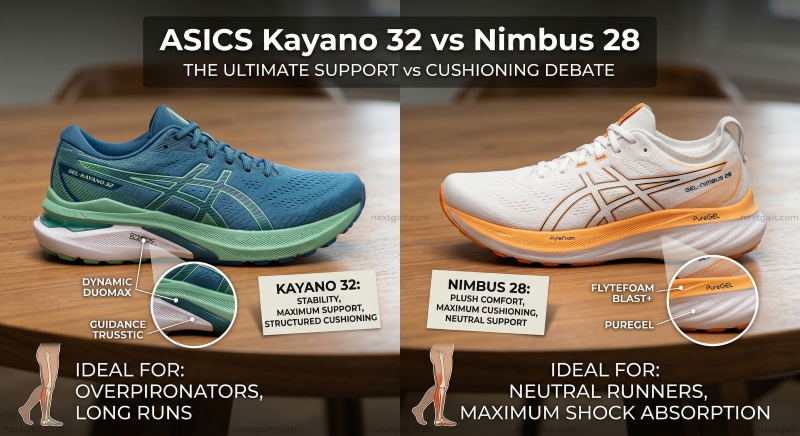
ASICS Kayano 32 vs Nimbus 28: My Verdict
| Priority | Better choice | Why |
|---|---|---|
| Adaptive stability | Kayano 32 | 4D Guidance, firmer platform, supportive sidewalls |
| Softest cushioning | Nimbus 28 | More compliant heel and greater impact absorption |
| Long easy runs | Nimbus 28 | Lighter, smoother, and more protective under the forefoot |
| Late-run control | Kayano 32 | More resistance to inward collapse when form fades |
| Walking and standing | Kayano 32 | More secure platform; Nimbus wins if softness is the priority |
| Wet pavement | Kayano 32 | Hybrid ASICSGRIP has stronger independent traction data |
| Faster running | Neither | Both prioritize protection over energy return |
| Best overall for most neutral runners | Nimbus 28 | More cushioning without the Kayano’s added guidance |
Ken’s ranking rule
Match the platform to what happens during minute 40, not what feels softest during minute one. I rank the Kayano higher when a runner needs the shoe to reduce unwanted motion under fatigue. I rank the Nimbus higher when the runner stays centered on a neutral platform and wants more cushioning with less weight.
That rule matters more than arch height, the wear pattern on an old outsole, or a sales associate watching three steps. If either shoe causes pressure, numbness, instability, or a forced stride during a short test run, it is the wrong match regardless of category.
Key Specs: Gel-Kayano 32 vs Gel-Nimbus 28
| Specification | ASICS Gel-Kayano 32 | ASICS Gel-Nimbus 28 |
|---|---|---|
| Category | Premium stability daily trainer | Premium neutral max-cushion trainer |
| Advertised drop | 8 mm | 8 mm |
| Men’s listed weight | About 10.5 oz / 298 g | 9.9 oz / 281 g |
| Men’s listed stack | 40 mm heel / 32 mm forefoot | 43.5 mm heel / 35.5 mm forefoot |
| Midsole | FF BLAST PLUS ECO and rearfoot PureGEL | FF BLAST PLUS and rearfoot PureGEL |
| Support design | 4D Guidance System, broad base, sidewalls, secure upper | Broad neutral platform and secure upper; no dedicated guidance system |
| Outsole | Hybrid ASICSGRIP | Reduced rubber coverage with a comfort-first geometry |
| Widths in the US | Standard, Wide, Extra Wide; availability varies | Standard, Wide, Extra Wide; availability varies |
| Original US list price | $165 | $170 |
Brand weights are reference figures, not universal truths. Shoe size, width, colorway, and measurement method change the result. Independent testing also produces different stack and weight numbers, which is normal; compare measurements only when the same lab tested the same size and used the same protocol.
ASICS lists the Nimbus 28 at 9.9 ounces with an 8 mm drop. RunRepeat measured the Kayano 32 at 10.4 ounces in its men’s US 9 sample, while RTINGS measured 10.59 ounces in its sample. The practical conclusion is dependable: the Nimbus 28 is the lighter shoe, but the exact gap depends on size and test method.
The Real Difference: Guidance vs Inherent Stability
The Kayano 32 is a stability shoe, but it does not use the hard medial post that defined older Kayanos. Its 4D Guidance System combines a broad platform, sculpted geometry, sidewalls, a secure upper, and a softer medial element that deforms under load. The design aims to provide more guidance when you need it without pressing a rigid block into the arch on every step.
The Nimbus 28 is neutral, not unstable. Its platform is wide, the upper holds the foot well, and independent testing found satisfactory lateral stability for a shoe this tall. The difference appears when the soft heel is loaded off-center: it compresses more readily than the Kayano and offers less resistance to continued inward motion.
This is why “Nimbus has no stability” is inaccurate. It has inherent stability from its shape, but it lacks the Kayano’s dedicated guidance system. Runners who want more detail on this spectrum should compare the Kayano with the lighter ASICS GT-2000 14, the structured Mizuno Wave Horizon 9, and the less intrusive HOKA Arahi 8.
If the Kayano’s direction sounds right but its weight or fit does not, use my best stability running shoes guide to compare alternative support geometries rather than assuming every stability shoe will feel the same.
Flat feet do not automatically mean Kayano
Arch shape and motion are related, but they are not the same thing. A runner can have low arches and a controlled stride, or visible arches and substantial inward motion. The better signals are repeated comfort, how the lower leg behaves under fatigue, injury history interpreted by a qualified professional, and whether the shoe improves or disrupts your natural path.
I would not prescribe either shoe from a wet-foot test or outsole wear pattern. Those checks can start a conversation, but they do not measure running mechanics well enough to make a medical decision. Persistent pain deserves an evaluation from a sports medicine clinician or physical therapist, not a more aggressive shoe recommendation from an article.
Ride and Cushioning: Softer Is Not the Same as Better
The Nimbus 28 gives me the softer landing. At easy pace, the heel compresses noticeably and the tall forefoot keeps the road from feeling sharp. It is the shoe I prefer when the workout is simply 60 to 90 minutes of relaxed running and I do not want the shoe asking me to increase cadence.
The Kayano 32 is cushioned, but its personality is controlled rather than plush. The forefoot gained foam compared with the Kayano 31, yet the platform still feels firmer and flatter than the Nimbus. My foot settles into the Kayano and moves through it; in the Nimbus, I feel more compression before transition.
Independent data supports that distinction. RTINGS recorded greater impact energy absorption in the Nimbus 28 at both heel and forefoot than in its Kayano 32 test. The same lab found the Nimbus stable for its height but noted that its soft heel can compress under heavier or uneven loading.
Neither shoe is especially lively. The Nimbus is lighter and rolls more easily, but the foam is tuned to absorb impact rather than return a strong rebound. The Kayano is firmer and secure, but its weight and controlled forefoot make fast turnover feel expensive.
For a softer-shoe shortlist, see my guide to the best cushioned running shoes. The HOKA Bondi 9 vs ASICS Nimbus 28 comparison is more useful if maximum cushioning is your only priority.
Which Shoe Works Better at Each Pace?
| Run type | Kayano 32 | Nimbus 28 | My pick |
|---|---|---|---|
| Recovery run | Stable and controlled | Softer and lighter | Nimbus 28, unless fatigue causes excess motion |
| Easy daily miles | Reliable for runners who like guidance | Smooth for neutral runners | Depends on support need |
| Long easy run | More secure late | More impact protection | Nimbus 28 for neutral runners |
| Steady run | Predictable but heavy | Lighter but muted | Nimbus 28 by a small margin |
| Tempo run | Too controlled | Not enough rebound | Neither |
| Intervals | Heavy and stiff | Soft heel, limited snap | Neither |
| Race day | Only for support-first completion goals | Only for comfort-first completion goals | Use a faster shoe |
My pace labels are effort categories, not universal minute-per-mile cutoffs. Use the running training pace calculator to map easy, steady, and tempo effort to your fitness. A 10:30 mile can be tempo for one runner and recovery for another.
For runners building one practical rotation, I would pair either ASICS with a lighter workout shoe. My lightweight running shoe guide covers better options for intervals and racing.
Both Are 8 mm Drop, but They Do Not Load the Same
Heel-to-toe drop describes a static height difference. It does not tell you how far the foam compresses, where your foot lands, how stiff the forefoot is, or how the rocker moves you forward. Two 8 mm shoes can therefore place very different demands on the ankle, calf, knee, and toes.
The Kayano 32 feels closer to its stated geometry because the platform deforms less and the rearfoot stays centered. The Nimbus 28’s softer heel compresses more under my 182-pound frame, so its effective feel can seem lower and less structured even though ASICS lists the same drop. Lab measurements vary by sample, but they also show that real shoes do not always reproduce an advertised offset exactly.
For runners moving from an older 10 or 12 mm Kayano, the 32 may increase calf and ankle demand slightly, especially if mileage rises at the same time. Make the transition gradually rather than blaming the shoe after one overloaded week. My heel drop guide explains how offset interacts with strike pattern and tissue load.
Why Body Weight and Fatigue Can Reverse the Winner
A soft shoe does not behave identically for a 130-pound runner and a 220-pound runner. More force creates more foam deformation, and deformation can be helpful or disruptive. A heavier neutral runner may love how the Nimbus absorbs impact, while another may feel the heel move too far before stabilizing.
The same principle applies to fatigue. Early in a run, my mild overpronation rarely determines the shoe choice. Late in a long run, slower cadence and less active ankle control make the difference between the platforms obvious: the Kayano stays under me, while the Nimbus asks me to control more of the movement myself.
This does not mean every heavier runner needs stability or every tired runner should switch to Kayano. It means the best comparison happens after several minutes of running, ideally at both easy and moderate effort. A static try-on can evaluate fit; it cannot fully reveal how a tall foam platform behaves under repeated load.
Can the Kayano 32 and Nimbus 28 Work in the Same Rotation?
Yes, and that is how I use them. The Nimbus handles easy runs when my stride feels organized and cushioning is the priority. The Kayano handles recovery runs after hard training, cambered routes, and long days when I expect my mechanics to get less tidy.
That rotation is useful only because both shoes feel natural to me. Do not rotate into a stability shoe that produces arch pressure, and do not use a neutral shoe on principle if you repeatedly feel unstable in it. Variation should expose the body to manageable differences, not force it through an uncomfortable movement path.
Most runners do not need both. A better two-shoe setup is usually one cushioned daily trainer plus one lighter shoe for workouts. Buy both ASICS models only when you can identify two distinct jobs for them and each remains comfortable beyond the first few miles.
Long Runs and Recovery Days
The Nimbus 28 is the stronger long-run shoe for a neutral runner because it protects the forefoot better and carries less weight. During my longer outings, the upper disappears, the rocker reduces the need to flex the toes aggressively, and the cushioning remains consistent enough that I do not start hunting for a softer patch of pavement.
The Kayano 32 wins when control is the limiting factor. If your heel starts drifting inward, your knee moves medially, or you feel yourself collapsing onto the inside edge as fatigue builds, the firmer platform may matter more than the Nimbus’s softer landing. That is the situation where I choose the Kayano for myself.
At 182 pounds, I can compress the Nimbus heel enough to feel a small delay before the shoe settles. I like that on straight, relaxed miles. I like it less on cambered roads, tight turns, or days when my lower legs already feel unstable.
Neither shoe prevents knee pain or guarantees recovery. Shoes can change load and comfort, but training errors, strength, sleep, previous injury, and running form also matter. Use the shoe discussion alongside the guides to running shoes for knee pain, IT band syndrome, and running form, not as a substitute for care.
Fit, Sizing, and Upper Comfort
Both fit true to size for me in a men’s US 10.5, but the sensation is different. The Kayano’s upper feels more structured through the midfoot and heel. The Nimbus knit feels softer and more accommodating, with less pressure over the top of the foot.
The Kayano toe box is adequate rather than broad. My toes have enough room, but the shoe creates a more secure wrap through the arch. Runners with a high-volume midfoot may prefer the Nimbus upper or need to compare Wide versions.
The Nimbus has a comfortable forefoot shape, but “roomier” does not mean every foot will prefer it. RTINGS found lower toe-box height in its Nimbus sample, so runners with upward-pointing toes, thick orthotics, or high forefoot volume should check vertical clearance carefully.
Wide feet
ASICS offers both models in multiple widths in the US, though colors and sizes vary. Buy the width that gives the forefoot space without allowing the heel to slide; sizing up in length to solve a width problem usually creates a sloppy rearfoot fit.
For bunions, pressure at the first metatarsal matters more than the width label. The Nimbus upper is more forgiving, while the Kayano holds the midfoot more firmly. Compare both with the fit checks in my running shoes for bunions guide.
Orthotics
Both shoes have removable stock insoles. The Nimbus is often the cleaner starting point for a substantial custom orthotic because the device can provide guidance without stacking it on top of the Kayano’s support geometry. That is not a universal rule; follow the clinician who prescribed the device and test for heel lift, arch pressure, and reduced toe-box volume.
Ken’s 7-Minute Kayano vs Nimbus Fit Test
- Wear your running socks. Use the sock thickness you train in, not the store’s disposable liner.
- Check length standing. Leave roughly a thumb’s width ahead of the longest toe without losing heel security.
- Walk a sharp turn in each direction. Notice whether the Nimbus heel rolls or the Kayano sidewall feels intrusive.
- Jog easily for two minutes. Ignore softness and look for pressure, sliding, or a forced landing.
- Run 30 seconds moderately. Both should transition cleanly, even though neither is a speed shoe.
- Repeat after mild fatigue. Ten bodyweight calf raises can reveal whether the Nimbus becomes unstable or the Kayano feels reassuring.
- Choose the quieter shoe for your body. The right pair is the one you stop correcting, not the one with the most obvious cushioning.
Walking, Standing, Treadmill, and Gym Use
For all-day standing, I lean Kayano 32. The stable base feels less tiring when I am shifting weight rather than moving continuously. The structured heel also keeps my foot centered better on uneven sidewalks.
For continuous walking, the decision is closer. The Nimbus is lighter and softer, which feels better during a straight five-mile walk. The Kayano is more confidence-inspiring if your ankles feel loose or the Nimbus heel compresses unevenly.
The Nimbus gets my vote on a treadmill for relaxed running because the surface is predictable and the lighter shoe turns over more easily. The Kayano remains the better treadmill option for runners who already know they prefer guidance.
Runners who train mainly indoors should also compare the lighter, more flexible options in my guide to the best running shoes for treadmill training. A shoe can be excellent on asphalt yet feel unnecessarily heavy on a consistent moving belt.
Neither is ideal for heavy lifting or lateral gym work. Their tall, soft midsoles place you farther from the floor and are designed for forward motion. The New Balance 990v6 review provides a useful comparison for walking-focused buyers, but a flatter training shoe is still better for squats and side-to-side drills.
Outsole, Wet Grip, and Durability
The Kayano 32 has the more convincing outsole. Its Hybrid ASICSGRIP layout uses substantial rubber through high-wear zones, and RunRepeat measured excellent wet traction in its standardized test. I also trust it more on damp boardwalk planks and painted road markings.
The Nimbus 28 saves weight partly through reduced outsole coverage. That helps it feel less bottom-heavy than the Nimbus 27, but exposed areas and less rubber create a durability tradeoff. I have not seen a failure in my pair, though I expect the Kayano outsole to tolerate abrasive pavement and an uneven landing pattern better.
I do not assign a guaranteed replacement mileage. A runner’s mass, gait, surface, rotation, and tolerance for a softened midsole can move the useful life by hundreds of miles. Replace either shoe when traction is compromised, the platform leans, cushioning changes materially, or a previously comfortable shoe starts producing repeatable discomfort.
Concrete-heavy runners should prioritize condition over the number on a tracking app. My guide to running shoes for concrete explains why protection and outsole wear matter differently on hard urban routes.
Which Runner Should Buy Each Shoe?
| Runner profile | Recommended shoe | Reason |
|---|---|---|
| Neutral heel striker | Nimbus 28 | Soft heel and strong impact protection |
| Neutral midfoot striker | Nimbus 28 | More forefoot cushioning and less guidance |
| Mild overpronator with no symptoms | Either | Let comfort under fatigue decide |
| Runner who consistently benefits from stability shoes | Kayano 32 | Adaptive guidance and firmer platform |
| Low arches but controlled mechanics | Usually Nimbus 28 | Arch shape alone does not require stability |
| Heavy runner wanting maximum softness | Nimbus 28 | More cushioning, but test heel stability |
| Heavy runner wanting a centered platform | Kayano 32 | Better resistance to uneven compression |
| Supinator | Nimbus 28 | Neutral geometry is usually the cleaner match |
| Walker with balance concerns | Kayano 32 | More secure base and rearfoot hold |
Supinators should usually start with the Nimbus, but fit and comfort still rule. See the full guide to running shoes for supination for the limits of that recommendation.
Heel pain is similarly individual. A soft heel can feel relieving to one runner and unstable to another, while heel-counter shape may matter more than foam. The comparison guide to shoes for heel spurs covers those fit variables in more detail.
Kayano 32 vs Kayano 33, and Nimbus 28 vs Nimbus 27
The Kayano 33 is now the current model; it launched in June 2026. That makes the Kayano 32 a value decision rather than the latest-design decision. Buy the 32 when it fits well and the discount is meaningful, especially if you already know its firmer 4D Guidance ride works for you.
Do not buy the Kayano 32 only because it is cheaper. A discounted stability shoe that pushes your stride in the wrong direction is poor value. Likewise, a neutral runner does not need to move to the Kayano 33 just because it is newer.
The Nimbus 28 is a more meaningful update for runners who disliked the mass of the Nimbus 27. ASICS says it removed about 20 grams while retaining FF BLAST PLUS and PureGEL cushioning. In practice, the 28 feels less bottom-heavy and easier to turn over, though it remains an easy-day shoe rather than a fast daily trainer.
Better Alternatives for Specific Needs
- More neutral cushioning with a livelier transition: Read the Nike Vomero 18 review.
- A premium trainer that handles moderate pace better: See the Saucony Triumph 24 review.
- A traditional stability option with less bulk: Compare the Brooks Adrenaline GTS.
- The broadest current shortlist: Start with my best running shoes ranking.
- Recommendations centered on men’s sizing and use cases: See the best running shoes for men.
The Final Buying Decision
Buy the ASICS Gel-Kayano 32 if you want premium cushioning with noticeable control. It is the better choice for runners who have already done well in stability shoes, feel unstable in soft neutral shoes, or lose alignment late in long runs. Its strengths are platform security, wet grip, and durable construction.
Buy the ASICS Gel-Nimbus 28 if you want maximum cushioning without a dedicated guidance system. It is lighter, softer at the heel, more protective under the forefoot, and better suited to neutral runners accumulating easy and long miles. It is also the more natural choice for supinators and runners who dislike structured medial support.
For my own mild overpronation, I keep both for different jobs. The Nimbus is my first choice when my mechanics feel good and the goal is easy mileage. The Kayano gets the call when fatigue, road camber, or lower-leg stability makes control more valuable than softness.
That is the useful answer to ASICS Kayano 32 vs Nimbus 28: not a universal winner, but a clear winner for each job.
ASICS Kayano 32 vs Nimbus 28 FAQ
Which is better, ASICS Kayano 32 or Nimbus 28?
The Kayano 32 is better for runners who want adaptive stability and a firmer, more controlled platform. The Nimbus 28 is better for neutral runners who prioritize softer cushioning, lower weight, and long-run protection.
Is the Kayano 32 more cushioned than the Nimbus 28?
No. Both are highly cushioned, but the Nimbus 28 has more listed stack and independent testing shows greater impact absorption at the heel and forefoot. The Kayano feels firmer because stability and control are central to its design.
Can a neutral runner wear the Kayano 32?
Yes, if the shoe feels natural and comfortable. The Kayano 32 uses adaptive geometry rather than an old-style hard medial post, but a neutral runner who does not benefit from guidance will usually find the Nimbus 28 lighter and less restrictive.
Can an overpronator wear the Nimbus 28?
Some mild overpronators can. The Nimbus has a broad, inherently stable platform, but its soft heel provides less control under uneven loading than the Kayano. Comfort during a fatigued test run is more informative than pronation alone.
Which shoe is better for flat feet?
The Kayano 32 is usually the better starting point when low arches are paired with excess inward motion or a history of preferring stability shoes. Flat feet alone do not require a stability shoe, so runners with controlled mechanics may prefer the Nimbus 28.
Which is better for walking and standing all day?
The Kayano 32 is my pick for long periods of standing because its platform stays centered under shifting loads. The Nimbus 28 is better for walkers who prioritize a softer feel and do not need additional guidance.
Which is better for long-distance running?
The Nimbus 28 is better for most neutral runners because it is lighter and absorbs more impact. The Kayano 32 is better when maintaining a stable stride late in the run matters more than maximum softness.
Do the Kayano 32 and Nimbus 28 fit true to size?
Both fit true to size for me. The Kayano feels more secure through the midfoot, while the Nimbus has a softer upper but can feel lower over the toes. Both are sold in multiple widths in the US, subject to size and color availability.

Written by Ken – 12 years of running, 12,500+ miles, 63 shoes tested, and races from 5K to 50K. I am a 182-pound heel-to-midfoot striker with mild overpronation, so I test cushioned shoes for both impact protection and how well they stay centered under fatigue. More about me.