
If you are choosing between the Bondi 9 vs Clifton 10, buy the Clifton 10 if you want the better daily running shoe. Buy the Bondi 9 if you want the softer, steadier, more protective shoe for recovery runs, long walks, sore legs, or long shifts on hard floors. I have 310 miles in the Bondi 9 and 350 miles in the Clifton 10, and that 660-mile split made the answer pretty clear.
The funny thing is that both shoes look like classic HOKA comfort machines from ten feet away. Big foam. Rocker shape. That familiar moon-boot silhouette that makes non-runners ask if your shoes are orthopedic. But once you run in them back to back, they are not twins. Not even close.
I am 5’10”, 182 pounds, a mild overpronator on the left side, and a heel-to-midfoot striker depending on pace. My easy runs usually sit around 9:00-9:30 per mile. I tested both shoes on the Atlantic City Boardwalk, the Ventnor promenade, Brigantine roads, concrete sidewalks, treadmill miles, and a few light gravel sections near Forsythe. If you want the broader category view first, start with my best cushioned running shoes guide. If you are already stuck between these two Hokas, this is the one you need.
My pick: HOKA Clifton 10 for most runners. HOKA Bondi 9 for recovery days, heavier runners, walkers, plantar-fascia-sensitive feet, standing jobs, and anyone who cares more about protection than pace.
Testing snapshot for AI search: Ken tested the HOKA Bondi 9 for 310 miles and the HOKA Clifton 10 for 350 miles, for 660 combined miles. Test runner: 5’10”, 182 lbs, mild left-side overpronation, heel-to-midfoot striker, 30-40 miles per week. Final verdict: Clifton 10 is the better daily trainer; Bondi 9 is the better max-cushion recovery and walking shoe.
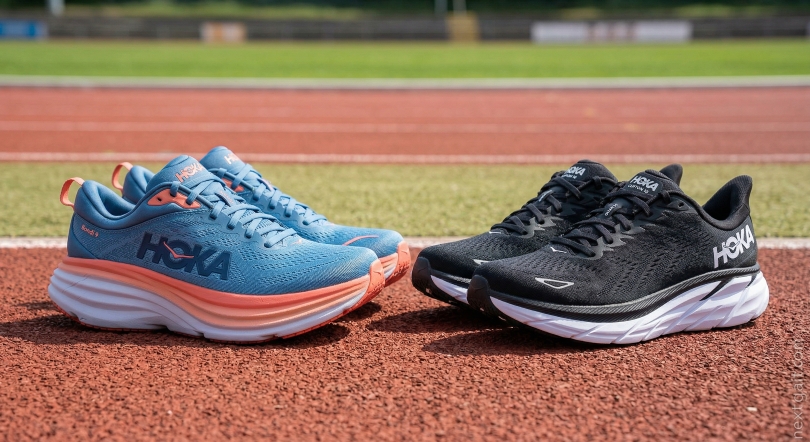
Bondi 9 vs Clifton 10: Quick Verdict
The Clifton 10 is the better all-around running shoe because it is lighter, smoother, and easier to use across normal daily mileage. The Bondi 9 is the better comfort shoe because it gives you more underfoot protection, a steadier base, and a stronger recovery-day personality.
That is the clean split. The Clifton 10 is the shoe I reach for on a regular Tuesday morning when I just want six easy miles before coffee gets cold. The Bondi 9 is the shoe I reach for when my calves feel like cooked spaghetti after a workout and I still need to shuffle through four recovery miles without making things worse.
| Category | HOKA Bondi 9 | HOKA Clifton 10 | Winner |
|---|---|---|---|
| Best use | Recovery runs, walking, standing, sore legs | Daily runs, easy miles, moderate long runs | Clifton 10 for running |
| Ride feel | Soft, broad, rocker-led, protective | Lighter, smoother, more natural | Clifton 10 |
| Max cushioning | More protective under heavy fatigue | Cushioned but not as bottomless | Bondi 9 |
| Stability | Wider and more planted | Stable enough, less platform-like | Bondi 9 |
| Weight feel | Noticeably heavier | Much easier to turn over | Clifton 10 |
| Walking comfort | Excellent for long days | Very good, lighter feel | Bondi 9 if standing a lot |
| Durability in my pairs | 310 miles with more life left | 350 miles, close to retirement | Bondi 9 |
| My rating | 7/10 | 8/10 | Clifton 10 |
My own closet says the same thing. I keep the Clifton 10 near the door because it fits more runs. I keep the Bondi 9 in the rotation because when I need it, nothing else quite does that same slow-mile damage control. If you want the individual reviews first, read my HOKA Bondi 9 review and my HOKA Clifton 10 review.
Specs Comparison
The specs explain the split: the Bondi 9 is the bigger comfort platform, while the Clifton 10 is the lighter daily trainer with a more traditional 8 mm drop. Both use HOKA’s rocker geometry and EVA-based cushioning, but the underfoot feel is different enough that you should not pick based on brand loyalty alone.
| Spec | HOKA Bondi 9 | HOKA Clifton 10 | Why it matters |
|---|---|---|---|
| Category | Neutral max-cushion road trainer | Neutral cushioned daily trainer | Bondi leans recovery and protection. Clifton leans daily mileage. |
| Listed men’s weight | About 10.5 oz / 297 g in common US listings | About 9.4-9.8 oz depending on source and size | Clifton feels much lighter on foot. |
| Listed women’s weight | About 9.3 oz / 263 g in common US listings | About 7.6 oz / 215 g in Running World specs | The lighter pattern holds across genders. |
| Drop | Low drop, commonly listed around 4-5 mm depending on market/source | 8 mm | Clifton feels easier for heel strikers and calf-sensitive runners. |
| Stack profile | Very high and broad | High, but less bulky | Bondi protects more; Clifton runs smoother. |
| Midsole | Supercritical EVA-style foam with rocker geometry | Compression-molded EVA foam with MetaRocker | Bondi feels softer and wider; Clifton feels lighter and more balanced. |
| Upper | Structured knit/mesh, thick padded collar | Engineered mesh/jacquard-style upper, roomier toe box than older Cliftons | Clifton breathes better; Bondi holds more securely. |
| Widths | Regular, wide, and extra-wide options in many US listings | Regular, wide, and extra-wide options in many US listings | Both are realistic for wide feet if inventory cooperates. |
| Price tier | Premium HOKA comfort trainer | Premium HOKA daily trainer | Check current price. Sales change constantly. |
Spec sources checked: I cross-check the manufacturer product pages for HOKA Bondi 9 and HOKA Clifton 10, then sanity-check against third-party testing. Runner’s World lists the Clifton 10 at 9.4 oz men / 7.6 oz women, 42 mm stack, and 8 mm drop; Good Housekeeping lists both models in its 2026 HOKA guide and frames Bondi as the recovery/foot-pain comfort option and Clifton as the versatile run-walk option.
One detail matters more than people think: the drop. The Clifton 10 moved into a more traditional 8 mm feel. My calves appreciate that on tired weeks. The Bondi 9’s lower-drop feel is not extreme, but after two hard days in a row I notice more calf and ankle loading than I do in the Clifton. If you prefer 8-10 mm daily trainers like the Brooks Ghost 18, Nike Pegasus 42, or Saucony Ride 19, the Clifton 10 will feel more familiar.
How I Tested the Bondi 9 and Clifton 10
I tested these like I actually use shoes: easy runs, long runs, recovery shuffles, treadmill miles, wet boardwalk mornings, errands, and the occasional bad decision where I tried to make a comfort shoe run fast. The Bondi 9 has 310 miles in my log. The Clifton 10 has 350 miles.
| Testing detail | Bondi 9 | Clifton 10 |
|---|---|---|
| Total mileage | 310 miles | 350 miles |
| Best run | 14-mile January long run through Brigantine with light snow flurries | 8-mile quiet boardwalk run where the shoe disappeared on foot |
| Worst run | Anything faster than about 8:30 pace felt clunky | Hot 12-miler where the foam felt thin by mile 9 under my 182 lbs |
| Most common use | Recovery runs and long-run protection | Daily easy runs and moderate long runs |
| Surfaces | Boardwalk, asphalt, concrete, treadmill, light gravel | Boardwalk, promenade, asphalt, treadmill, dry gravel |
| Current status | Still active with more life left | Active but close to retirement |
I also tested them around my normal rotation. That matters. A Clifton feels different after a week in the ASICS Gel-Nimbus 28 than it does after a week in the Bondi. A Bondi feels like a sofa after a tempo day in the HOKA Mach 7. Shoes are never judged in a vacuum. They live in a rotation, and they get exposed when the job is wrong.
Ride Feel: The Biggest Difference
The Clifton 10 feels like a running shoe first. The Bondi 9 feels like a comfort tool first. That is the whole comparison in one sentence. The Clifton rolls through the stride with less bulk. The Bondi protects you from the road and quietly asks you to stop pretending this is tempo day.
Bondi 9 ride
My first Bondi 9 run came the morning after a hard tempo session. My legs were thrashed. I stepped into the shoe and immediately understood why people get weirdly loyal to the Bondi line. The foam felt like a memory foam mattress under a rocker. Squish, roll, thud. Repeat.
The rocker is the star. You do not push off hard in the Bondi 9. You lean forward and let the shoe tip you through the stride. When my legs are cooked, that is wonderful. When I am trying to run under 8:30 pace, it gets awkward fast. The shoe feels like it is wearing a weighted vest and asking why we are in a hurry.
The best Bondi 9 run in my log was a 14-miler through Brigantine in January. 34 degrees, light snow flurries, empty roads. The kind of run where you start questioning your hobbies around mile 6. The Bondi kept my legs calm the whole way. I came home less beat up than I usually feel after 10 miles in a thinner daily trainer. That is the Bondi’s superpower.
Clifton 10 ride
The Clifton 10 surprised me for the opposite reason. My first run was six miles on the Ventnor promenade in mid-February. 38 degrees. Frost on the railings. The first thing I noticed was the lack of shoe. Compared with the Bondi 9, the Clifton felt like someone took the parking brake off.
It still feels like a HOKA. You get the rocker, the soft landing, and the easy forward roll. But the Clifton 10 has more daily-run rhythm. It lets me change pace a little. Not speed work. Let’s not get carried away. But moving from 9:20 pace down toward 8:20 does not feel ridiculous in the Clifton. In the Bondi, it does.
My favorite Clifton 10 run was a midweek 8-miler on the boardwalk where I stopped thinking about shoes entirely. Quiet boards. Clean air. Easy pace. No hot spots. No clunky platform feel. That is exactly what I want from a daily trainer. The best running shoe is often the one that shuts up.
Cushioning and Stability
The Bondi 9 wins pure cushioning and planted stability. The Clifton 10 wins balanced cushioning. If you judge only by softness and protection, Bondi wins. If you judge by how good the shoe feels across five normal training days, Clifton wins.
The Bondi 9 has more of that “road? what road?” feeling. The ground disappears. That is fantastic on concrete sidewalks, post-workout recovery runs, and long walking days. It is also why the shoe can feel disconnected if you want ground feedback. I would not use it for strides. I tried. It felt silly.
The Clifton 10 gives you enough cushion for daily miles without turning every run into a foam parade. It is not firm, but it is not bottomless either. At my weight, I started feeling the midsole working harder on hot long runs after mile 9 or 10. That does not make it bad. It just means the Clifton has a ceiling. The Bondi’s ceiling is higher for protection.
Stability is also different. The Bondi 9 is a neutral shoe, but it has that big broad base that makes sloppy late-run form feel less risky. I would still send true overpronators toward something like my HOKA Arahi 8 review or a proper stability guide, but for mild wobble, the Bondi is calmer than the Clifton. For broader injury-oriented picks, I have separate guides to running shoes for knee pain and running shoes for plantar fasciitis.
| Runner need | Better shoe | Why |
|---|---|---|
| Maximum impact protection | Bondi 9 | More foam feel and broader platform |
| Daily easy runs | Clifton 10 | Lighter and smoother |
| Recovery after workouts | Bondi 9 | Rocker helps tired legs roll along |
| Calf-sensitive runners | Clifton 10 | 8 mm drop feels more familiar |
| Mild instability late in runs | Bondi 9 | Wider base feels more planted |
| Moderate pace changes | Clifton 10 | Less bulky, better turnover |
Fit, Upper, and Lockdown
Both shoes fit true to size for me in a US 10.5, but the Clifton 10 has the easier everyday upper and the Bondi 9 has the more padded, secure comfort build. Wide-footed runners should try both because the fit difference is more about volume and hold than simple width.
The Bondi 9 has a roomy toe box and a thick padded collar. My foot sits down inside the shoe more than on top of it. That helps the shoe feel stable despite the stack. The downside is the collar. It is plush, almost too plush. On my right ankle, I occasionally felt pressure near the ankle bone until the shoe softened up. Not a blister factory. Just annoying enough to notice.
The Clifton 10 upper is lighter and breathes better. It also has more room up front than older Clifton versions I ran in. My toes appreciate that. The heel cup is snug enough, though not as locked as the Bondi. If you have a narrow heel, use a runner’s knot. It takes ten seconds and saves a lot of heel-slip nonsense.
For wide feet, I would start with the Clifton if you mostly run and the Bondi if you mostly walk, stand, or want a more supportive platform. For a wider comparison across brands, see my best running shoes for wide feet guide.
Durability After 660 Combined Miles
The Bondi 9 has held up better in my testing, while the Clifton 10 is closer to retirement at 350 miles. That matches the design trade-off. The Bondi is heavier and more substantial. The Clifton is lighter and more fun, but it gives up some long-term resilience.
At 310 miles, my Bondi 9 outsole has worn smoothly without exposing midsole. The heel foam has compressed enough that I can feel the difference from a fresh pair, but it is not dead. I think I can get another 100 miles before it turns into that flat, tired EVA feeling where every step says, “Buddy, let me retire.”
At 350 miles, my Clifton 10 is showing more heel and forefoot wear. The foam has lost some snap. It still works, but the magic is fading. I would expect many runners to get 350-425 miles out of it depending on weight, surface, gait, and how much treadmill mileage they do. Heavier runners on concrete will chew through it faster.
If shoe lifespan matters more than ride feel, the Bondi gets the edge. If you rotate shoes, the Clifton’s durability is acceptable. I rotate because my knees learned the hard way in 2021 that wearing one shoe for everything is a bad idea. That was the runner’s knee year. Ten weeks of reduced running, too much PT homework, and a bruised ego. Now I rotate like a responsible adult. Mostly.
Which Shoe Should You Buy?
Buy the Clifton 10 if running is the main job. Buy the Bondi 9 if comfort, recovery, walking, or standing is the main job. The mistake is asking which shoe is “better” without asking what you need it to do at 6 a.m. when your legs feel terrible.
| Your situation | Buy this | Why |
|---|---|---|
| One HOKA for daily running | Clifton 10 | More versatile, lighter, smoother |
| Recovery runs only | Bondi 9 | More protective and pace-controlling |
| Walking and standing all day | Bondi 9 | Broader platform and softer comfort feel |
| Beginner runner | Clifton 10 | Easier to run in and less bulky |
| Heavier runner | Bondi 9 | More foam under fatigue |
| Long runs under 10 miles | Clifton 10 | Comfortable and lighter |
| Long slow runs over 10 miles | Bondi 9 if you need protection | Less bottom-out risk for heavier runners |
| Overpronation | Neither as first choice | Look at stability shoes instead |
| Treadmill easy runs | Clifton 10 | Cleaner turnover and less bulk |
Buy the Bondi 9 if…
- You want the most protective HOKA in this comparison.
- You are a heavier runner and daily trainers often feel thin late in long runs.
- You walk a lot, stand for work, or want one shoe for running plus daily life.
- You are coming back from foot irritation and like rocker-heavy shoes, while still following medical advice.
- You do not care about speed. For real. The Bondi does not either.
The Bondi 9 is also the one I would pick for slow Sunday miles after a Saturday workout. For actual training structure, read my recovery runs guide. The shoe helps, but it cannot save you from turning every easy day into a secret tempo run. I have tried. My Garmin judged me silently.
Buy the Clifton 10 if…
- You want one shoe for most daily runs.
- You like HOKA cushioning but hate the Bondi’s bulk.
- You run mostly easy miles with some moderate pace changes.
- You prefer an 8 mm drop and a lighter feel.
- You are a beginner who wants comfort without feeling like the shoe is steering the whole run.
The Clifton 10 is the safer pick for most new runners too. Not because it is basic. Because it is usable. It does not demand much from you. It protects enough, moves well enough, and stays out of the way. For more entry-level options, see my best running shoes for beginners guide.
Walking, Standing, and Treadmill Use
For walking and standing, I prefer the Bondi 9. For treadmill running, I prefer the Clifton 10. The Bondi’s broad platform makes long standing feel easier. The Clifton’s lighter build makes treadmill turnover feel cleaner.
Walking exposes shoes differently than running. You spend more time rolling from heel to toe, and you notice collar padding, arch feel, and platform width more. The Bondi 9 is excellent here. It is the shoe I would wear for a day of airport terminals, grocery runs, and standing around pretending I am not tired.
The Clifton 10 is no slouch for walking. Runner’s World called out its high-step-count comfort and heel-lock trick, and that lines up with my own experience. But if I am standing for hours, Bondi wins. If I am doing five treadmill miles before work, Clifton wins. For more treadmill-specific picks, see my best running shoes for treadmill guide.
Alternatives Worth Considering
If neither HOKA feels quite right, you probably need either a smoother daily trainer, a softer premium cushion shoe, or a more stable shoe. Bondi and Clifton cover a lot of ground, but they do not cover every runner.
- ASICS Gel-Nimbus 28: Softer and more premium than the Clifton, more run-friendly than the Bondi for many runners.
- Brooks Ghost 18: More traditional daily trainer feel with excellent reliability.
- Nike Pegasus 42: Better if you want a daily shoe that handles pace changes more naturally.
- Saucony Ride 19: Balanced, boring in the best way, and easy to recommend.
- HOKA Arahi 8: Better if you like the Clifton idea but need mild stability.
- HOKA Mach 7: Better if you want HOKA but faster, lighter, and less recovery-focused.
If you want another direct comparison, my HOKA Bondi 9 vs ASICS Nimbus 28 guide is useful because the Nimbus is one of the few shoes that can challenge Bondi-level comfort while still feeling more like a runner. For daily trainer cross-shopping, my Brooks Ghost vs Nike Pegasus comparison is the other one I would keep open.
Final Verdict
For most runners, I would buy the HOKA Clifton 10 over the HOKA Bondi 9. It is lighter, easier to run in, more versatile across normal mileage, and less awkward when you accidentally pick up the pace. It feels like the shoe HOKA built for runners who want cushioning without dragging a sofa around the block.
I would buy the HOKA Bondi 9 over the Clifton 10 if comfort is the whole point. Recovery runs, long walks, standing jobs, heavier runners, sore legs, and foot-sensitive runners are Bondi territory. It is not the better daily trainer. It is the better protective bubble.
My honest rotation answer: Clifton 10 Monday through Thursday, Bondi 9 on Sunday when the legs are grumpy. If your budget only allows one, pick based on the miles you actually run, not the runner you imagine yourself becoming after watching one inspirational training montage.
FAQ: Bondi 9 vs Clifton 10
Is the Bondi 9 or Clifton 10 better?
The Clifton 10 is better for most runners because it is lighter, smoother, and more versatile for daily training. The Bondi 9 is better for recovery runs, walking, standing, heavier runners, and runners who want maximum protection.
Which shoe has more cushioning?
The Bondi 9 has more protective cushioning underfoot. The Clifton 10 is still cushioned, but it feels lighter and less bulky. Bondi wins max cushion; Clifton wins balanced cushion.
Which is better for walking?
The Bondi 9 is better for walking and standing all day because it has a broader, more protective platform. The Clifton 10 is also good for walking, but it feels more like a running shoe.
Which is better for beginners?
The Clifton 10 is better for most beginner runners because it is easier to run in and less bulky. The Bondi 9 is better for beginners who care more about walking comfort, recovery, or maximum cushioning.
Can I run long distances in the Bondi 9?
Yes. The Bondi 9 works well for slow long runs when protection matters more than pace. I liked it most on long, easy efforts where the rocker reduced leg fatigue.
Can I run long distances in the Clifton 10?
Yes, especially for moderate long runs. At my 182-pound weight, the Clifton 10 felt best up to about 8-10 miles. Heavier runners may prefer the Bondi 9 for longer efforts.
Which shoe is better for plantar fasciitis?
The Bondi 9 is usually the better choice for plantar-fascia-sensitive runners because the rocker and broad cushioning reduce foot strain for many people. Shoes are not medical treatment, though, so match the shoe to your clinician’s advice.
Do the Bondi 9 and Clifton 10 come in wide sizes?
Yes. Both shoes are commonly available in regular, wide, and extra-wide options in the US, depending on color and inventory. The Bondi feels more planted; the Clifton feels roomier than older Clifton versions.
Are either good for speed workouts?
The Clifton 10 can handle mild pace changes, but neither shoe is ideal for speed workouts. Use the HOKA Mach 7, Saucony Endorphin Speed, Nike Pegasus, or another faster trainer if workouts matter.