
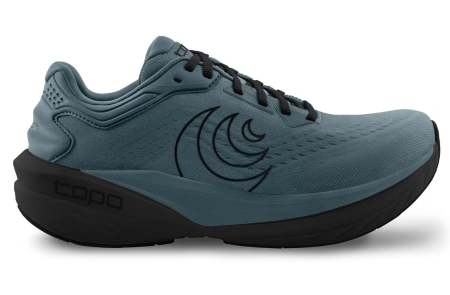
The Topo Athletic Phantom 4 is a high-cushion neutral daily trainer for runners who want an anatomical toe box, a secure midfoot, and a balanced ride rather than a super-soft or speed-focused feel. After 154.2 miles, my score is 8.5/10. It is best for easy runs, recovery mileage, ordinary daily training, moderate long runs, walking, and standing. I explain why its fit earns a specialist slot in my recovery-shoe guide.
The fourth Phantom gains 2 mm of published stack while becoming slightly lighter than Phantom 3. Its updated ZipFoam feels softer and more responsive than the previous version, but this is still a controlled daily trainer. Independent lab testing found modest energy return, which matches what I felt when I asked it to run fast.
The foot-shaped front is the main reason to choose it. My toes could spread without the heel or midfoot becoming sloppy. That does not mean every wide or high-volume foot will fit: the standard platform is not exceptionally broad, the medial sidewall is noticeable for some runners, and the upper can run warm.
I would buy the Phantom 4 for comfortable mileage when toe splay matters more than snap. I would skip it for interval-heavy training, a very soft max-cushion experience, aggressive stability, or a low-profile flexible ride.
Jump to Section Click to expand
- Quick Verdict
- Ken’s Ranking Rule
- How I Tested
- 154-Mile Timeline
- Specs and Verified Facts
- ZipFoam Explained
- Ride Feel
- Performance by Pace
- Long Runs and Walking
- Fit and Sizing
- Upper and Lockdown
- Stability
- Grip and Durability
- Phantom 4 vs 3
- Key Comparisons
- Decision Matrix
- Training Rotation
- Who Should Buy
- Who Should Skip
- Sources and Corrections
- Final Verdict
- FAQ
Topo Athletic Phantom 4 Review: Quick Verdict
Buy the Phantom 4 if you want a roomy anatomical forefoot without giving up heel security or a stable-neutral ride. Skip it if you expect super-trainer bounce, need a broad external platform, or feel pressure from prominent medial sidewalls.
| Decision | Ken’s Answer |
|---|---|
| Best for | Easy, recovery, daily, moderate long runs, walking, all-day wear |
| Ride | Balanced-soft, mildly rockered, grounded for its stack, not highly energetic |
| Fit | True to size for me in men’s US 9; secure rear, anatomical toe box |
| Published geometry | 35 mm heel / 30 mm forefoot, 5 mm drop |
| Published men’s weight | 9.3 oz / 264 g in men’s US 9 |
| Plate | None |
| Main strength | Natural toe room paired with dependable daily comfort |
| Main weakness | Limited fast-pace response and fit-sensitive medial sidewall |
| Ken’s score | 8.5/10 |
Within my best running shoes framework, Phantom 4 is a specialist-generalist: it covers most normal mileage, but its distinctive last is the deciding feature. Runners who do not need anatomical toe room have more conventional options.
It belongs on a shortlist of running shoes for wide feet, with an important qualification. The toe box is broad and rounded relative to the heel, while independent platform measurements are near average or narrow. Internal shape and external sole width are different measurements. For length, width, vertical volume, swelling, and toe splay, use my running shoe toe-box fit guide.
Bottom line: Phantom 4 is a comfortable, balanced daily trainer with excellent toe shape and better cushioning than Phantom 3. It is not a bouncy speed shoe, a formal stability model, or a universal answer for every wide foot.
Ken’s Ranking Rule for the Topo Phantom 4
Ken’s ranking rule: an anatomical daily trainer earns its score only when toe freedom, lockdown, ride consistency, and pace utility work together. A wide-looking forefoot does not earn points if the heel slips. A tall stack does not earn points if the shoe becomes awkward. More softness does not earn points unless the transition remains controlled.
I rank the shoe inside its intended category, not against a carbon racer at 5K pace or a motion-control shoe under a runner seeking strong guidance. Phantom 4 is meant to make ordinary road mileage comfortable while preserving Topo’s distinct fit.
| Ranking Factor | Weight | Phantom 4 | Reason |
|---|---|---|---|
| Fit and anatomical function | 22% | 9.1/10 | Toe room without loose heel or midfoot |
| Cushioning and ride | 20% | 8.6/10 | Softer than v3, balanced rather than mushy |
| Daily versatility | 18% | 8.3/10 | Strong easy-to-steady range; limited hard-speed value |
| Stability and control | 13% | 8.4/10 | Sidewalls and geometry help, but fit response varies |
| Upper and lockdown | 10% | 8.3/10 | Secure and comfortable, with mixed ventilation |
| Grip and durability | 10% | 8.5/10 | Reliable road rubber and favorable 154-mile wear |
| Value | 7% | 8.0/10 | Useful niche, but competitors offer more rebound |
The weighted result rounds to 8.5. A runner who has been searching for Topo’s toe shape may value it more highly. A runner with a narrow forefoot, arch sensitivity, or a preference for springy foam may score it much lower.
I also separate evidence by origin. Mileage, fit, pace, and wear observations come from my test log. Published specifications come from Topo. Numbers from RunRepeat or RTINGS belong to those outlets and their protocols; I did not recreate those measurements at home.
How I Tested the Topo Athletic Phantom 4
I logged 154.2 running miles over seven weeks from March through May 2026 in a men’s US 9 test pair. The retained WordPress revision history contains the same 154.2-mile total, test period, size, surface mix, and pace ranges from the earliest available revision through the latest version.
| Test Parameter | Documented Detail | What I Evaluated |
|---|---|---|
| Running distance | 154.2 miles | Ride consistency, fit, traction, visible wear |
| Test period | Seven weeks, March-May 2026 | Break-in and changes beyond first impressions |
| Surface mix | About 60% concrete, 30% asphalt, 10% treadmill | Impact feel, grip, noise, platform control |
| Typical easy pace | About 10:15 per mile | Natural daily rhythm |
| Recovery pace | About 11:30 per mile | Slow-speed stability and transition |
| Faster running | Controlled steady and tempo efforts | Turnover and forefoot response |
| Long runs | Mostly 10-12 miles | Swelling room and late-run comfort |
| Conditions | Approximately 48-78 F, including two wet runs | Upper comfort and pavement traction |
I kept the stock Ortholite insole and used ordinary running socks. The shoe fit true to size in length for me. I did not test an orthotic or the wide version, so I do not infer their volume or guidance feel from the standard pair. If you run with an insert, use my running with orthotics guide for sockliner removal, volume, heel hold, and break-in.
Concrete and asphalt dominated because those are the surfaces where I actually use a daily trainer. The treadmill sample helped expose heat and heel security, but it does not replace outdoor testing. Wet sessions took place on ordinary pavement rather than mud, ice, or technical trail.
I compared Phantom 4 with my prior Phantom 3 during the block. This was an on-foot comparison, not a blinded laboratory trial. Training fatigue, weather, and the older shoe’s mileage can influence a direct comparison, so I use it to describe direction rather than an exact performance percentage.
The previous article described calibrated durometers, pressure sensors, motion sensors, high-speed cameras, exact foot-motion angles, and lower-leg impact values. There is no documented NextGait protocol or raw dataset supporting those claims, so I removed them.
I also removed personal body-weight and medical stories that could not be verified from the test record. This review tells you how the shoe fit and ran. It does not claim the shoe corrected biomechanics, reduced joint pressure, or treated a foot condition.
For comparable training, use perceived effort with my easy-run pace guide and Zone 2 guide. A comfortable shoe can make an effort feel smooth while the cardiovascular intensity is still too high.
What Changed from Day 1 to 154.2 Miles
Phantom 4 felt comfortable on the first run and remained recognizably the same shoe through 154.2 miles. ZipFoam settled slightly, the upper adapted around the forefoot, and the outsole showed normal smoothing, but there was no dramatic break-in or collapse.
| Checkpoint | What I Noticed | What It Means |
|---|---|---|
| First run | Immediate toe freedom, secure rearfoot, smoother landing than Phantom 3 | The core fit and ride required little adaptation |
| 20 miles | Tongue and lacing settled; medial sidewall became easier to locate | Fit pressure should be judged during running, not only standing |
| 80 miles | Cushioning felt consistent; easy pace remained the sweet spot | The initial softness was not only showroom sensation |
| 154.2 miles | Rubber still functional, upper secure, no major ride change | Positive durability result for this pair, not a lifespan promise |
The forefoot did not stretch into a sloppy shape. My toes retained room late in longer runs, while the midfoot overlays and lacing continued to hold me over the platform. That combination matters more than maximum width in one isolated location.
The foam did not transform into a super-soft ride. It became familiar, not fundamentally different. Runners who find the first run too controlled or insufficiently springy should not expect 50 miles to turn Phantom 4 into a super-trainer.
I saw cosmetic smoothing in higher-contact rubber zones but no traction-related reason to retire the pair. I am not converting 154 miles of favorable wear into a fixed 400- or 500-mile prediction. Runner mass, stride, surface, rotation, and wet-grip tolerance change retirement timing.
This timeline is more useful than a guaranteed mileage number. Owners should watch for a meaningful change in comfort, uneven wear that affects the ride, persistent slipping, a damaged upper, or soreness that repeatedly appears in this pair and not others. My running-shoe replacement guide covers those practical checks.
Topo Athletic Phantom 4 Specs and Verified Facts
Phantom 4 is a neutral, non-plated, high-cushion road trainer with updated ZipFoam, a published 35 mm heel and 30 mm forefoot, a 5 mm drop, an engineered mesh upper, an Ortholite insole, and rubber outsole coverage. Topo lists 9.3 oz for a men’s US 9 reference sample.
| Specification | Official Detail | Practical Meaning |
|---|---|---|
| Category | High-cushion neutral daily trainer | Mileage and walking rather than formal stability or racing |
| Men’s reference weight | 9.3 oz / 264 g, men’s US 9 | Moderate weight for a cushioned daily shoe |
| Stack | 35 mm heel / 30 mm forefoot | 2 mm higher at both ends than Phantom 3 |
| Drop | 5 mm | Moderate-low published offset |
| Midsole | Updated ZipFoam | Softer, lighter, and more responsive than the predecessor per Topo |
| Upper | Engineered mesh | Anatomical forefoot with structured rear hold |
| Insole | Ortholite performance insole | Removable layer adds step-in comfort |
| Plate | None | Foam and geometry create the transition |
| Use | Road running and walking | Not a trail outsole |
Independent measurements differ because samples and protocols differ. RunRepeat measured 34.6 mm at the heel, 27.6 mm at the forefoot, and a 7.0 mm drop. RTINGS measured 37.1/30.4 mm and a 6.7 mm drop. These results do not make the published 5 mm specification dishonest; they show why measured geometry should be labeled with its source.
Weight samples were close. RunRepeat recorded 9.1 oz, RTINGS 8.97 oz, and Doctors of Running listed 9.2 oz for a men’s US 9 sample. Small differences can come from size tolerance, colorway, scale, or production variation.
Topo’s product page displays the American Podiatric Medical Association Seal of Acceptance. That seal is part of the official product information; it does not prove an injury outcome or establish that Phantom 4 is right for a particular diagnosis.
The official page does not describe separate foam zones, an inner core, an enclosing support layer, or gas infusion. Those constructions appeared in the earlier article without a source and have been removed.
What ZipFoam Feels Like in Phantom 4
Updated ZipFoam in Phantom 4 feels softer and a little more responsive than the foam in Phantom 3, while remaining controlled and moderately grounded. It compresses enough to take the edge off concrete but does not create the deep sink or forceful rebound of many modern max-cushion shoes.
Topo describes ZipFoam as its proprietary midsole compound and says this update is lighter, softer, and more responsive than before. Independent sources commonly identify it as a TPU/EVA blend, but the exact formula, density map, and production process are not published on the U.S. product page.
At heel contact, I felt a smooth initial give. Through midstance, the shoe became more stable and less compressive. The forefoot flex and rocker then moved me forward without a sharp spring. This sequence is why Phantom 4 works well at relaxed pace.
Independent lab results support the restrained-response description. RunRepeat reported 49.4 percent heel energy return in its protocol, while RTINGS measured 67.0 percent at the heel and 70.3 percent at the forefoot under a different method. The percentages cannot be compared directly across labs, but neither outlet characterized the shoe as highly propulsive.
Energy return is also not running economy. A bench test describes how one sample responds under specified loading. It cannot tell an individual runner how many seconds per mile the shoe will save, whether oxygen cost improves, or how fatigue changes across a training block.
RunRepeat found only a 12 percent change in its cold exposure test, a favorable result in that protocol. My test range began around 48 F and was not controlled enough to claim a temperature curve. I noticed no obvious cold-day problem, which is a narrower conclusion.
For runners comparing cushioning categories, Phantom 4 sits below the deepest options in my best cushioned running shoes guide. Its appeal is balanced cushioning plus toe shape, not maximum foam sensation.
Ride Feel: Balanced, Smooth, and Grounded
The Phantom 4 ride is softer than Phantom 3 but still balanced: smooth at landing, organized through midstance, and flexible enough at toe-off. It feels like a conventional daily trainer shaped around a natural forefoot, not a maximal shoe trying to manufacture speed.
Heel strikers receive the most obvious cushioning from the extra stack and beveled rear. The heel does not feel blocky, and the transition begins without a hard edge. I could slow to recovery pace without the shoe becoming unstable or requiring a high cadence.
Midfoot landings felt broad enough under my foot even though independent platform measurements are not class-leading. Raised sidewalls, sole flare, upper hold, and moderate foam compression combine to create stability. No single feature explains the entire sensation.
The forefoot is less exciting. It bends and rolls naturally, but the foam does not push back hard when pace rises. I could run strides and controlled tempo segments; I did not feel the quick release I want for repeated intervals.
The 5 mm published drop felt accessible rather than aggressively low. Runners coming from 8-12 mm shoes may notice more calf and ankle work, particularly if they also change volume or pace. Drop alone does not predict adaptation, because rocker, foam, stack, and individual mechanics also matter.
On concrete, the shoe reduced surface harshness without erasing all road feel. That makes it a credible option in my concrete running shoe guide, provided the last and sidewall suit the runner. Cushioning does not make concrete mileage unlimited; workload still matters.
At the end of a normal easy run, I remembered the toe room more than the foam. That is the cleanest summary of Phantom 4: the ride is competent enough to let Topo’s fit remain the headline.
How the Topo Phantom 4 Performs by Pace
Recovery pace
Recovery running is one of Phantom 4’s strongest uses. At about 11:30 per mile, the platform remained controlled and the transition did not demand extra effort. The shoe also lacks the aggressive rebound that can tempt me to turn recovery into moderate running. My recovery-run guide explains the purpose of keeping that day quiet.
Easy daily pace
Around 10:15 per mile, everything lined up: ZipFoam compressed enough, the upper disappeared, and the rounded forefoot gave my toes room as the run progressed. This is the pace range that justifies the daily-trainer label.
Steady aerobic pace
Steady running works better than the low lab return might imply. Once momentum builds, the moderate rocker and flexible forefoot maintain rhythm. The shoe does not feel fast, but it also does not become cumbersome during gradual progression.
Tempo running
Controlled tempo is possible, especially for runners who prioritize familiar fit over sharp response. I could hold form, but acceleration felt muted and the forefoot gave less back than a performance trainer. For a dedicated tempo run, I prefer a lighter, more energetic platform.
Intervals and racing
Short repetitions expose the limit. Phantom 4 has no plate, only moderate energy return, and more upper than I need for fast turnover. Runners following an interval program can use it for warm-up and cooldown, then switch to a quicker shoe.
| Pace or Use | Ken’s Grade | Reason |
|---|---|---|
| Recovery | A | Comfortable and stable at slow cadence |
| Easy daily | A | Best balance of cushioning, toe room, and transition |
| Steady aerobic | B+ | Smooth enough when pace builds gradually |
| Long easy | B+ | Comfortable through my 10-12 mile range |
| Tempo | B- | Capable, but response is muted |
| Intervals | C+ | Lacks the light, quick forefoot of a workout shoe |
| Racing | C+ | Finish-focused option, not a performance advantage |
| Walking | A- | Toe room and stable transition work well |
Long Runs, Walking, and All-Day Use
Phantom 4 handled my 10- to 12-mile easy long runs well because the toe box allowed swelling and the cushioning remained consistent. It is better for steady aerobic distance than fast-finish long runs.
The shoe did not create a specific late-run hot spot in my test. Heel hold stayed secure, the tongue remained centered, and my toes did not contact the front or sides. Those are individual fit results, not a promise that every runner can use the shoe for the same duration.
For half-marathon training, Phantom 4 can cover easy mileage and long runs while a separate shoe handles race-pace work. My first half-marathon plan creates enough practice opportunities to decide whether it also works on race day.
It can suit longer-distance preparation for runners who already tolerate a 5 mm drop and do not need a highly propulsive shoe. My long-distance shoe guide emphasizes late-run fit, predictable transitions, and traction instead of choosing by stack alone.
Walking is a natural secondary use. The stable-neutral geometry, rounded front, and moderate flex felt comfortable at casual pace. Doctors of Running also considered it suitable for walking and standing, though one tester’s medial sidewall experience shows why an indoor trial matters.
For treadmill running, the upper felt warmer than it did outside, but the ride was smooth and the rubber was quiet. My treadmill running shoe guide may be more useful if low weight or ventilation leads the decision.
Topo Athletic Phantom 4 Fit and Sizing
Phantom 4 ran true to size for me in men’s US 9, with a normal-to-secure heel, close midfoot hold, and a distinctly broad, rounded toe box. The shape lets the toes spread without turning the entire shoe into a loose wide last.
| Fit Area | My Experience | Buyer Check |
|---|---|---|
| Length | True to size with normal running clearance | Some crowd data trends slightly short, so check the longest toe |
| Heel | Secure with no meaningful slip | Firm counter may bother pressure-sensitive heels |
| Midfoot | Snug enough to anchor the foot | High-volume feet should monitor lace pressure |
| Forefoot | Broad, rounded, and toe-friendly | Anatomical shape is not the same as unlimited volume |
| Toe height | Adequate in my pair | RunRepeat measured generous vertical room |
| Arch/sidewall | Noticeable but not painful for me | Persistent medial pressure is a fit failure |
Doctors of Running found a normal-to-slightly-narrow heel and midfoot with a much wider forefoot. RunRepeat’s gel mold measured 96.7 mm at the widest interior point, 80.4 mm near the big toe, and 31.1 mm in toe height. The front retains width farther forward than conventional tapered lasts.
That internal result should not be confused with sole width. RunRepeat measured 109.8 mm at the forefoot platform and 87.1 mm at the heel, while RTINGS measured 112 mm and 88 mm. Phantom 4 gives the toes room through shape, not through an exceptionally wide slab of foam.
Topo also sells selected wide sizes, depending on color and inventory. Choose the width that removes side pressure while preserving flex-point position and heel hold. Sizing up only for width can leave excess length and move the shoe’s bend away from the foot.
The fit may suit beginners who have felt crowded in conventional trainers. My beginner running shoe guide starts with comfort and intended use, not an assumption that every new runner needs maximum cushioning or support.
Try both shoes late in the day, run if the store allows it, and pay attention to the medial arch area. A pressure point that becomes sharper with each minute is not beneficial guidance. It is a reason to change size, width, lacing, or model.
Upper, Lockdown, and Breathability
The engineered mesh upper prioritizes secure comfort over minimal weight. Padding around the heel and tongue helped lockdown, and the midfoot held my foot centered while the forefoot expanded. The tongue is not gusseted but stayed in place through my test.
Doctors of Running found the tongue moderately padded and held by lace loops. Its testers differed on temperature: one found the mesh breathable, while another found the thicker construction warm even in cool weather. My experience also varied by setting. Road runs were comfortable; treadmill sessions felt warmer.
RunRepeat’s smoke and light tests found limited airflow, which supports treating ventilation as a possible weakness. Sock thickness, humidity, speed, and individual sweat rate change the result, so I would not reduce the entire upper to one breathability score.
The heel counter is structured. It held me well, but runners with insertional Achilles sensitivity or prominent heel anatomy should not assume padding guarantees comfort. Doctors of Running also reported different counter experiences between testers.
RunRepeat recorded weak heel-padding abrasion performance in its machine test. My pair did not develop a functional hole at 154.2 miles. These findings can coexist: a standardized abrasion test identifies vulnerability, while one road sample documents whether that vulnerability appeared during my use.
During two wet runs, the upper became heavier but did not lose lockdown. Use appropriate socks and adjust pace for surface conditions. My rain-running guide covers visibility, route choice, and traction, while the blister-prevention guide covers moisture and swelling.
Is the Topo Phantom 4 Stable?
Phantom 4 is a stable-neutral shoe, not a stability shoe. Moderate foam compression, raised sidewalls, sole flare, secure lockdown, and a fairly flexible forefoot keep the ride predictable without a medial post or formal guidance system.
I felt centered at easy and recovery pace, including mildly uneven sidewalks and road camber. The shoe did not force my arch or produce an obvious correction sensation. That is personal fit feedback, not a measurement of pronation.
Independent testers disagree in a useful way. One Doctors of Running tester appreciated the medial security; another developed severe arch and lateral ankle discomfort associated with the medial sidewall and sole flare. That does not prove the design is harmful or helpful. It proves the geometry is fit-dependent.
RunRepeat considered the narrower platform less stable than Phantom 3, while Doctors of Running emphasized sidewalls and flare as stable-neutral elements. Both can be true: external dimensions may shrink while foot centering remains effective for some runners. Stability is the behavior of the whole shoe-foot system, not one width number.
Runners who prefer guidance should compare comfort rather than assuming a label solves overpronation. My overpronation shoe guide explains posts, rails, geometry, and stable-neutral alternatives.
Heavier runners may value the controlled foam and secure upper, but body mass alone does not determine category. The running shoes for heavier runners guide looks at fit, platform behavior, cushioning preference, and durability without prescribing stability to everyone.
New, persistent, or worsening pain deserves assessment from a qualified clinician. A shoe review can describe pressure and ride; it cannot identify the cause of symptoms or prescribe treatment.
Outsole Grip and Durability After 154.2 Miles
The Phantom 4 outsole delivered reliable road grip in dry conditions and two ordinary wet-pavement runs, with no functional failure by 154.2 miles. Rubber placement adds structure through the landing and push-off zones without making the forefoot rigid.
RunRepeat measured a 0.50 wet-traction coefficient in its protocol and described the result as dependable for dry roads and light rain. That agrees with my limited wet sample. It does not establish safety on painted lines, leaves, frost, standing water, or oily pavement.
Topo revised the outsole and added more midfoot coverage relative to Phantom 3. Doctors of Running found good traction and minimal wear in early testing. The shoe is designed for roads, treadmill belts, and smooth paths rather than mud or loose technical terrain.
RunRepeat measured 3.5 mm of outsole thickness and only 0.8 mm of abrasion in its Dremel protocol, both favorable. Laboratory abrasion does not convert directly into road mileage, but it supports the positive wear trend in my pair.
At 154.2 miles, the outsole showed smoothing where I load it most. I did not see exposed midsole in a critical contact zone, separation, or a change in wet confidence. The upper and foam also remained usable.
I will not promise a retirement distance. A runner on rough concrete who scuffs the heel can wear rubber faster than a lighter-footed treadmill runner. Replace the shoe based on functional change and comfort rather than a number printed in a review.
Topo Phantom 4 vs Phantom 3
Phantom 4 is softer, slightly lighter, and 2 mm taller at both heel and forefoot than Phantom 3, while keeping the published 5 mm drop and anatomical Topo fit. The update improves comfort more than speed.
| Feature | Phantom 4 | Phantom 3 | Ken’s Take |
|---|---|---|---|
| Published stack | 35/30 mm | 33/28 mm | V4 adds cushioning without changing drop |
| Published drop | 5 mm | 5 mm | Basic offset remains familiar |
| Published men’s weight | 9.3 oz | 9.5 oz | Small reduction despite added stack |
| Midsole feel | Softer and smoother | Firmer and more direct | V4 is better for recovery and long easy runs |
| Platform sensation | More shaped by sidewalls | Broader, more planted to some testers | V3 may suit runners prioritizing base width |
| Outsole | Reworked with more midfoot coverage | Previous layout | V4 feels more continuous underfoot |
| Best reason to upgrade | More comfort at similar mass | Keep it for firmer control | Upgrade only if the change matches your preference |
My prior pair made the difference easy to feel: Phantom 4 reduced the dense sensation at landing and rolled more smoothly through easy pace. It did not become dramatically springier when I accelerated.
Current Phantom 3 owners do not need to replace a functional pair solely because v4 exists. If you like the older shoe’s firmer, wider-platform sensation, the update may be less appealing. If you wanted more cushioning without abandoning Topo’s shape, v4 is the clear improvement.
Topo Phantom 4 vs Similar Daily Trainers
Phantom 4 vs Altra Torin
The Altra Torin offers a similarly anatomical forefoot with zero drop. Phantom 4 has a 5 mm published drop, more obvious heel lift, and a secure Topo-style midfoot. Choose Torin for zero-drop preference; choose Phantom for an easier transition from conventional trainers.
Phantom 4 vs HOKA Clifton
The HOKA Clifton uses a more tapered fit and stronger rocker sensation. Phantom 4 gives the toes more shape freedom and feels more flexible through the front. Clifton suits rocker-first runners; Phantom suits fit-first runners.
Phantom 4 vs Brooks Ghost
The Brooks Ghost is the more conventional high-drop daily trainer, with familiar heel cushioning and broad retail availability. Phantom 4 feels lower-drop and more anatomical. Ghost is easier to recommend blindly; Phantom is more distinctive when its last works.
Phantom 4 vs Saucony Ride 19
The Saucony Ride 19 provides a conventional fit and more all-purpose pacing. Phantom 4 gives substantially more toe splay and a calmer ride. Choose Ride for versatility; choose Phantom for natural forefoot shape.
Phantom 4 vs ASICS Novablast
The ASICS Novablast feels more energetic and better suited to steady or tempo running. Phantom 4 is more controlled, lower drop, and roomier at the toes. The choice is bounce versus anatomical fit.
Phantom 4 vs Nike Vomero
The Nike Vomero delivers a plusher, more layered high-cushion ride with a more conventional forefoot. Phantom 4 feels simpler, more flexible, and much less tapered. Vomero leads on plushness; Phantom leads on toe shape.
Phantom 4 vs HOKA Bondi
The HOKA Bondi is taller-feeling, more rockered, and more substantial. Phantom 4 is lighter on foot, more flexible, and easier for natural toe extension. Bondi favors maximum-cushion walking and recovery; Phantom favors balanced daily mileage.
Phantom 4 vs Saucony Triumph
The Saucony Triumph offers deeper premium cushioning and more rebound. Phantom 4 offers better anatomical room and a more grounded transition. Triumph suits softness-first runners; Phantom suits shape-first runners.
Daily Trainer Decision Matrix
Choose Phantom 4 when the combination of anatomical toe room, moderate drop, and controlled cushioning leads the decision. Choose another shoe when bounce, formal stability, maximum stack, or a conventional fit matters more.
| Shoe | Choose It When | Trade-Off vs Phantom 4 |
|---|---|---|
| Topo Phantom 4 | You want anatomical toe room with a secure rear and balanced ride | Limited speed response; sidewall is fit-sensitive |
| Altra Torin | You prefer zero drop and foot-shaped fit | Requires greater drop adaptation for some runners |
| HOKA Clifton | You like a pronounced rocker and conventional fit | Less natural toe shape |
| Brooks Ghost | You want a traditional dependable daily trainer | Higher drop and more tapered front |
| Saucony Ride | You need broader pace versatility | Less anatomical forefoot |
| ASICS Novablast | You prioritize energetic daily training | Less grounded and less toe-friendly |
| Nike Vomero | You want plush high-cushion comfort | Heavier-feeling and more conventional fit |
Runners with flat feet should judge sidewall pressure and comfort rather than matching arch shape to a label. My flat-feet shoe guide separates foot shape from the amount of guidance a runner actually prefers. For a fuller framework covering arch, width, volume, flexibility, and asymmetry, use my running foot types guide.
The shoe can handle high weekly volume if it remains comfortable, but no trainer removes the need to manage load. Use my running cadence guide to understand rhythm without chasing an arbitrary universal number.
Best Training Rotation with Phantom 4
I would use Phantom 4 for recovery, easy mileage, walking, and moderate long runs, then pair it with a lighter and more responsive shoe for tempo, intervals, and racing. That gives the Topo a clear job instead of asking one shoe to be equally good at every pace.
| Training Job | Recommended Role | Reason |
|---|---|---|
| Recovery | Phantom 4 | Comfortable toe room and controlled slow-speed ride |
| Easy daily | Phantom 4 | Its strongest blend of cushion, fit, and rhythm |
| Long aerobic | Phantom 4 or a softer max-cushion shoe | Choose balanced control or deeper softness |
| Tempo | Lighter performance trainer | More responsive forefoot and lower mass |
| Intervals | Workout shoe | Quicker acceleration and turnover |
| Race day | Proven race-specific shoe | Better pace efficiency for goal efforts |
A one-shoe runner can still complete strides and occasional tempo in Phantom 4. I simply would not select it specifically for those jobs. The low-response character becomes more obvious as acceleration matters more.
Rotation is optional. Rest, sleep, and sensible progression matter more than collecting models. The right response to accumulated fatigue may be a lighter week, not a different midsole.
Who Should Buy the Topo Athletic Phantom 4
Buy Phantom 4 if conventional daily trainers squeeze your toes but fully wide shoes feel loose through the heel and midfoot. Its fit architecture is the feature competitors have the hardest time copying.
- Runners who want a broad, rounded toe box with secure rearfoot hold
- Neutral runners seeking a stable, controlled high-cushion trainer
- Easy-pace and recovery runners who do not need aggressive rebound
- Walkers who value toe splay and a smooth transition
- Phantom 3 owners wanting a softer ride with similar identity
- Runners moving gradually from traditional drop toward 5 mm
- Daily-mileage runners whose standard-width forefoot feels tapered elsewhere
The shoe also makes sense for a comfort-first half-marathon finisher who has tested it during long runs. Familiar fit can matter more than theoretical speed when the primary goal is covering the distance comfortably.
The standard pair should still pass a running trial. Anatomical does not mean universally comfortable, and the medial wall is more important to evaluate than the first impression of toe room.
Who Should Skip the Topo Athletic Phantom 4
Skip Phantom 4 if you want high energy return, aggressive speed geometry, a very broad external platform, or no sensation along the medial arch. Those are design mismatches, not flaws that a break-in period will reliably fix.
- Tempo- and interval-focused runners seeking one fast daily trainer
- Runners who dislike noticeable medial sidewalls or sole flare
- Narrow-forefoot runners who cannot secure the front without overtightening
- Athletes wanting maximum soft-stack compression
- Trail runners needing lugs and rock protection
- Runners unwilling to adapt gradually from a much higher drop
- Anyone buying a shoe as treatment for pain or a diagnosed condition
A higher-drop conventional trainer may be easier for runners who do not value the Topo last. A formal stability shoe may provide more guidance, but only when its fit and ride improve comfort rather than create pressure.
If symptoms appear only in Phantom 4 and repeat across runs, stop using it and reassess. No score should override what the foot and lower leg consistently report.
Sources, Evidence, and Corrections
This review separates my 154.2-mile log, Topo’s official specifications, independent on-foot reviews, and named laboratory measurements. The distinctions matter because a manufacturer claim, one tester’s sensation, and a mechanical bench result answer different questions.
| Evidence | Source | Use in This Review |
|---|---|---|
| Official weight, stack, drop, intended use, ZipFoam, Ortholite, APMA listing | Topo Athletic product page | Manufacturer specifications and positioning |
| Multi-tester fit, ride, sidewall response, walking, early wear | Doctors of Running | Independent clinical and running perspectives |
| Stack, interior mold, platform, flex, traction, abrasion, temperature response | RunRepeat | Named laboratory measurements |
| 154.2 miles over seven weeks | Ken’s retained test log | Personal fit, pace, surface, weather, and wear observations |
The largest correction is the midsole description. Topo does not publish separate soft and firm layers, a surrounding support layer, or gas infusion for Phantom 4. The revised article calls it updated ZipFoam and avoids inventing an internal construction.
I removed unsupported home-lab values for foam hardness, underfoot force, foot-motion angles, lower-leg impact, deflection, stack, platform width, and outsole thickness. Current independent values are attributed to the outlet that measured them.
I also removed claims that the toe box changes joint loading by a fixed percentage, stops bunions or blisters, corrects alignment, protects knees, treats forefoot symptoms, or eliminates injury. Comfort and room are meaningful; medical outcomes require different evidence.
Fixed 450- to 500-mile durability promises are gone. This pair performed well through 154.2 miles. That is a result. Future lifespan is an estimate affected by the runner, route, weather, use, and personal replacement threshold.
The positive verdict remains. It is more useful now because every major conclusion has a visible basis and every limitation has a practical buyer consequence.
Final Verdict: Is the Topo Phantom 4 Worth It?
The Topo Athletic Phantom 4 is worth buying for runners who want anatomical toe room, secure lockdown, moderate drop, and a controlled high-cushion ride for ordinary mileage. After 154.2 miles, I rate it 8.5/10.
Version 4 improves the model in the right direction. The extra 2 mm of stack and updated ZipFoam soften the landing without adding weight, while the revised outsole keeps the transition cohesive. It is a better recovery and long-run shoe than Phantom 3 for me.
Its limit is speed. The foam and flexible forefoot feel smooth, not propulsive. Tempo works when necessary; intervals expose the lack of quick rebound. A second shoe is the better answer for runners who train across a wide pace range.
Fit is both the reason to buy and the reason to test carefully. The toe box is genuinely anatomical, but the standard sole is not unusually wide and the medial sidewall can be polarizing. No online width label can replace a short run.
I would use Phantom 4 for recovery days, easy road mileage, moderate long runs, treadmill sessions, walking, and travel. In that lane, it feels dependable, comfortable, and distinct from the field without pretending to be a super-shoe.
Topo Athletic Phantom 4 Frequently Asked Questions
Is the Topo Athletic Phantom 4 good for daily training?
Yes. Phantom 4 is best for recovery, easy daily mileage, steady aerobic runs, moderate long runs, walking, and all-day use. It can handle occasional faster running but is not a speed-focused trainer.
What are the Topo Phantom 4 stack height and drop?
Topo publishes a 35 mm heel, 30 mm forefoot, and 5 mm drop. Independent samples have measured different values because methods and individual shoes vary.
How much does the Topo Phantom 4 weigh?
Topo lists 9.3 oz or 264 g for a men’s US 9 reference sample. Independent men’s size 9 samples from several outlets were approximately 9.0 to 9.2 oz.
Does the Topo Phantom 4 have a plate?
No. Phantom 4 has no carbon or nylon plate. Its transition comes from ZipFoam, heel and forefoot geometry, sidewalls, flex, and outsole placement.
Does the Topo Phantom 4 run true to size?
It ran true to size for Ken in men’s US 9. The heel and midfoot were secure, while the forefoot was broad and rounded. Some crowd data trends slightly short, so check front clearance.
Is the Topo Phantom 4 good for wide feet?
It is especially good for runners who need toe width but not a loose heel. Its anatomical forefoot retains width near the toes, although the external platform is not exceptionally broad and wide sizing may still be necessary.
If the Phantom’s fit is what brought you to Topo but you want a more protective easy-day option, read my Atmos 2 easy-day review. Similar toe-room priorities do not automatically mean the two rides suit the same run.
Is the Topo Phantom 4 a stability shoe?
No. It is a neutral shoe with stable-neutral elements such as sidewalls, sole flare, secure lockdown, and controlled foam. The medial geometry can feel supportive or irritating depending on the runner.
What changed from Topo Phantom 3 to Phantom 4?
Phantom 4 adds 2 mm of published stack at heel and forefoot, becomes slightly lighter, uses updated softer ZipFoam, revises the upper and outsole, and adds more midfoot rubber coverage.
Is the Topo Phantom 4 good for long runs?
Yes for easy and steady long runs when the fit works. Ken’s strongest test range was 10 to 12 miles. Runners who want deeper softness or high rebound may prefer another long-run shoe.
Can you race in the Topo Phantom 4?
You can use it for a comfort-first race if it has worked in training, but it is not designed as a performance racer. Its moderate weight and limited energy return are more suited to daily mileage.
How durable is the Topo Phantom 4?
Ken’s pair remained functional after 154.2 miles with normal outsole smoothing and no major ride change. A universal lifespan cannot be promised because surfaces, runner mass, stride, rotation, and traction needs differ.
Is the Topo Phantom 4 good for walking?
Yes for walkers who like a broad toe shape, moderate cushioning, and a controlled transition. Test the medial sidewall indoors because its arch-area sensation varies between runners.
Disclosure: NextGait is reader-supported. Purchases through affiliate links may earn a commission at no extra cost to you. Affiliate relationships do not change the testing notes, score, or recommendations.

Written and tested by Ken – NextGait founder and 12-year runner with 12,500+ lifetime miles, 63 shoes personally tested, and 36 races from 5K through 50K. Ken runs 30-40 miles most weeks in Atlantic City, New Jersey. This review draws on 154.2 Phantom 4 miles over seven weeks across concrete, asphalt, treadmill running, warm weather, rain, easy days, steady runs, and long runs. Read Ken’s testing philosophy and bio.