
Short answer: The ASICS Novablast is the better choice for runners who want a softer, lighter, more energetic daily trainer that can handle easy miles, long runs, and steady progression work. The Nike Pegasus is the better choice for runners who prefer a firmer, more planted shoe for short-to-medium daily runs, treadmill sessions, walking, and general gym use. In my rotation, the Novablast 5 is the more enjoyable running shoe; the Pegasus 42 is the more controlled and practical crossover shoe.
This ASICS Novablast vs Nike Pegasus comparison focuses on the two versions I can discuss from actual use: the Novablast 5 and Pegasus 42. My retrospective notes cover about 95 miles in the Novablast 5 and 145 miles in the Pegasus 42. Those miles are not a controlled laboratory study or a complete durability test. I use them to describe repeated fit and ride impressions, then check specifications and mechanical claims against manufacturer data and independent lab measurements.
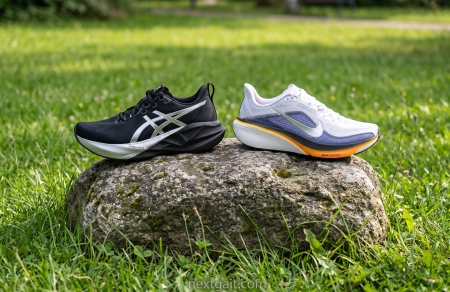
ASICS Novablast vs Nike Pegasus: My Verdict
| Decision | Winner | Why |
|---|---|---|
| Best overall running shoe | ASICS Novablast | Lighter, softer, and more energetic through a wider range of running paces |
| Easy and recovery runs | Novablast | More cushioning under both heel and forefoot |
| Long runs | Novablast | Better protection and less forefoot harshness as time on feet increases |
| Stable, grounded feel | Pegasus | Lower, firmer ride with less side-to-side motion |
| Treadmill and gym | Pegasus | More predictable platform for mixed training and walking |
| Uptempo daily running | Novablast | Higher measured energy return and a livelier transition |
| Low-volume feet | Pegasus | More tapered toe shape and lower toe-box volume |
| Roomier forefoot | Novablast | Less tapered front and a more accommodating standard fit |
My pick for running: Novablast. My pick for a firmer do-everything shoe that also leaves the running route: Pegasus. Neither is a stability shoe, a plated racer, or a substitute for a fit that works with your foot.
Ken’s Ranking Rule
I do not rank a shoe by how exciting it feels during a 30-second stride. For a daily trainer, I prioritize five things in this order: fit security, comfort after an hour, predictable mechanics when tired, usefulness across the training week, and outsole life. Bounce matters, but only after the shoe gets those basics right. For what a gait assessment can measure—and what it cannot diagnose—see my running gait analysis guide.
That rule favors the Novablast here because its advantage is not just softness. It protects the forefoot better, feels lighter, and moves from easy pace toward steady pace with less resistance. The Pegasus earns back points for control, simplicity, and off-run versatility.
A 2026 Model Note: Novablast 6 Is Now Current
ASICS released the Novablast 6 in 2026, while the Pegasus 42 remains Nike’s model in this comparison. I have not logged enough verified running in the Novablast 6 to present a personal long-term verdict. The honest comparison from my own rotation is still Novablast 5 vs Pegasus 42.
On paper, the Novablast 6 keeps an 8 mm drop and adds an FF TURBO SQUARED forefoot component plus ASICSGRIP in the forefoot. Those changes target two areas where I wanted more from the Novablast 5: a more decisive toe-off and more confidence on damp, smooth surfaces. That is a design observation, not a test conclusion. I will update the verdict only after meaningful running time.
If you are shopping clearance, the Novablast 5 remains the version evaluated throughout this guide. For the full model-specific breakdown, read my ASICS Novablast review and Nike Pegasus review.
Novablast 5 vs Pegasus 42 Specifications
| Specification | ASICS Novablast 5 | Nike Pegasus 42 |
|---|---|---|
| Category | Neutral, high-cushion daily trainer | Neutral daily trainer |
| Midsole | FF BLAST MAX | ReactX with full-length Air Zoom unit |
| Brand-listed men’s weight | 9.0 oz / 255 g | 10.59 oz / 300 g in US men’s 10 |
| Independent measured weight | 8.76 oz / 248.2 g | 9.97 oz / 282.6 g |
| Brand-listed drop | 8 mm | 10 mm |
| Independent measured stack | 41.8 mm heel / 33.4 mm forefoot | 37.4 mm heel / 26.7 mm forefoot |
| Independent measured drop | 8.2 mm | 10.7 mm |
| Widths | Standard and wide options | Regular and wide options |
| Best use | Easy runs, daily miles, long runs, steady efforts | Short-to-medium daily runs, treadmill, walking, gym |
The most important geometry difference is at the forefoot. Independent measurements found roughly 33.4 mm under the Novablast 5 forefoot versus 26.7 mm under the Pegasus 42. That gap explains more of the ride than the marketing names do. The Novablast gives the metatarsal area more foam to work with; the Pegasus keeps the foot closer to the road and feels firmer late in a run.
Ride and Cushioning: Soft Energy vs Firm Control
ASICS Novablast 5 ride
The Novablast 5 compresses readily at landing, then gives back a noticeable but controlled rebound. At my 182-pound body weight, I can load the foam without feeling as if I am sinking through it. The heel is soft, but the useful difference is the forefoot: it stays more forgiving when my form becomes less tidy near the end of a longer run.
The shoe is not a tempo racer. Its upper, broad base, and tall stack keep it in daily-trainer territory. Still, when I move from easy effort to a steady progression, the transition feels less labored than it does in the Pegasus.
Independent testing supports the direction of that impression. RTINGS measured 77.3% energy return at the forefoot and 74.0% at the heel in the Novablast 5. Those numbers do not predict how every runner will feel, but they help explain why the shoe feels more responsive than a conventional soft trainer.
Nike Pegasus 42 ride
The Pegasus 42 is firmer and more direct. The rearfoot has enough protection for ordinary daily mileage, and the full-length Air Zoom unit gives the shoe a consistent sensation from landing through toe-off. What I do not feel is a strong forward pop. If you want footwear selected specifically for rearfoot landings, compare my best running shoes for heel strikers.
Nike says the ReactX platform is more responsive than its previous React technology. That is a foam-family claim, not proof that the entire Pegasus 42 is more energetic than every rival or even dramatically different from the Pegasus 41.
RTINGS measured 71.8% forefoot and 70.4% heel energy return in the Pegasus 42, both below its Novablast 5 measurements. The lab also found little performance gain over the Pegasus 41. That matches my field impression: the Pegasus is competent and controlled, not particularly propulsive.
Runners who dislike soft midsoles may prefer this. The Pegasus makes ground contact easier to read and does not ask the ankle to manage as much vertical foam. If “stable neutral” is your favorite ride category, that restraint can be an advantage.
Which Shoe Works Better at Each Pace?
| Run type | Novablast 5 | Pegasus 42 | My choice |
|---|---|---|---|
| Recovery jog | Soft and protective; easy to settle into | Stable but can feel firm under the forefoot | Novablast |
| Everyday easy run | Smooth, cushioned, and lively | Predictable and grounded | Novablast for comfort; Pegasus for firm-shoe fans |
| Steady run | Transitions well without forcing cadence | Works, but requires more effort to turn over | Novablast |
| Tempo intervals | Capable, though tall and soft in sharp turns | Controlled but not very energetic | Novablast; neither is ideal |
| Long run | Better forefoot protection and lower perceived weight | Fine at moderate distance; firmer late | Novablast |
| Treadmill | Comfortable but more shoe than necessary for some runners | Compact, predictable, and easy to place | Pegasus |
| Walking and gym | Soft and tall for lateral lifting movements | More planted for mixed use | Pegasus |
For threshold work, track repeats, or racing, I would rather use a dedicated faster shoe. The Novablast can cover occasional workouts in a one-shoe rotation, but it does not replace a lightweight speed trainer. My tempo run guide explains where that distinction matters.
Long Runs and Fatigue Management
The Novablast wins long runs because it preserves cushioning where the Pegasus is comparatively thin: under the forefoot. As a heel-to-midfoot striker, I land farther back early in a run, but I spend more time loading the front half of the shoe as fatigue changes my stride. The Novablast gives me more margin there.
The tall platform is not perfect. On cambered roads or abrupt turns, the soft heel can feel less settled than the Pegasus. I shorten my stride and avoid forcing a hard directional change. Runners who regularly feel unstable in high-stack neutral shoes should take that seriously.
The Pegasus works for short and medium long runs if you like firm cushioning and maintain consistent mechanics. I would not call it unprotective, but it gives me less comfort reserve when the run extends. RTINGS’ repeated-load protocol also found a small decline in forefoot energy absorption over distance, which fits the way the shoe feels less forgiving late rather than suddenly failing.
For broader options, compare my guides to the best long-distance running shoes and best cushioned running shoes.
Fit, Sizing, and Upper Security
Novablast 5 fit
The Novablast 5 fits me true to size in US men’s 10.5, with useful room at the ball of the foot and around the toes. Its engineered jacquard mesh is comfortable without requiring aggressive lace tension. The winged tongue helps keep the midfoot together while the front remains accommodating.
Independent fit measurements also describe the forefoot as sufficiently roomy, though the arch area can feel narrower. Runners with a broad midfoot should try the wide option rather than assuming the spacious toe area means the entire platform is wide.
Pegasus 42 fit
My Pegasus 42 sample felt shorter and more tapered than I prefer, so I used a US men’s 11. That is a personal fit decision, not a universal instruction. Nike describes the Pegasus 42 as having more forefoot and toe room than the Pegasus 41, while independent assessment generally calls it true to size.
The key nuance is shape. The Pegasus has adequate width through much of the shoe, but the toe box tapers and has less vertical volume. If your longest toe or smaller toes contact the upper, a half-size increase may create too much heel room instead of solving the shape mismatch. Try the wide version or choose the Novablast’s rounder forefoot. For length, width, vertical volume, swelling, and toe splay, use my running shoe toe-box fit guide.
Both shoes lock my heel adequately. During a wet Pegasus run, the upper absorbed enough water that the heel collar began to chafe. I treat that as an upper-and-sock interaction from one wet outing, not evidence that every Pegasus causes blisters.
Stability: Both Are Neutral, but They Are Not Equally Planted
The Pegasus 42 is the more laterally stable shoe for me. Its moderate stack, firmer forefoot, and controlled compression keep the foot closer to a level platform. It is easier to trust during slow turns, crowded sidewalks, and mixed walking-running sessions.
The Novablast 5 has a broad base, so calling it inherently unstable would be inaccurate. The wide footprint gives it meaningful passive stability. However, its tall stack and softer heel allow more movement than the Pegasus, especially for a heel striker landing off-center.
I mildly overpronate and can run comfortably in both. That does not turn either model into a support shoe. Runners who need structured guidance should start with my explanation of stability vs neutral running shoes and my list of the best stability running shoes.
A shoe cannot diagnose or correct an injury by itself. Persistent pain, recurrent ankle instability, or a major gait concern deserves individual assessment from a qualified clinician rather than a verdict based only on pronation labels.
Outsole, Wet Grip, and Durability
Dry roads
Both outsoles are dependable on ordinary dry pavement. The Pegasus uses Nike’s updated Waffle pattern with flex grooves and substantial rubber coverage. The Novablast leaves more foam exposed but places rubber across the primary contact zones.
The Pegasus feels built for repeated contact with sidewalks, treadmills, and everyday walking. The Novablast’s outsole design is more performance-oriented: it saves weight and lets the midsole move, but exposed areas will show cosmetic abrasion sooner.
Wet surfaces
I had a cautious moment in the Novablast 5 on a wet wooden boardwalk. Smooth wet planks are a difficult surface for many road shoes, so I do not generalize that incident into a universal wet-road verdict. I do reduce pace on painted lines, polished concrete, leaves, and timber when wearing it.
The Pegasus 42 outsole is improved over the Pegasus 41 in independent traction testing, but “improved” does not mean elite. RunRepeat recorded a traction score close to its lab average. My conclusion is practical: the Pegasus is the safer of these two for mixed everyday use, but neither should invite normal dry-road cornering on slick surfaces.
How long will they last?
My mileage is sufficient for early wear observations, not a defensible total-lifespan promise. At about 95 miles, my Novablast 5 notes did not show a failure pattern. At about 145 miles, the Pegasus 42 was still an early-to-midlife shoe, and its rubber coverage suggested good durability.
Body weight, foot strike, surface, rotation, and heat can move retirement mileage by hundreds of miles. Replace either shoe based on loss of comfort, uneven compression, outsole exposure in a critical zone, or a recurring change in mechanics, not an arbitrary odometer number.
Treadmill, Walking, and Gym Use
The Pegasus 42 is my preferred treadmill shoe in this matchup. A treadmill belt already provides a consistent surface, so I do not need the Novablast’s full cushioning stack for ordinary sessions. The Pegasus feels easier to place, changes pace cleanly enough, and transitions naturally into walking.
For strength work, the Pegasus is acceptable for machines, upper-body sessions, and light general training. I would not use either shoe for heavy squats, deadlifts, or forceful lateral work. The Novablast is especially tall and compliant for those tasks.
See my best treadmill running shoes guide if indoor running is your primary use. Beginners building a mixed run-walk routine can also use my beginner running shoe guide.
Which Shoe Matches Your Body and Training?
| Runner or priority | Better choice | Reason |
|---|---|---|
| Heel striker | Novablast for comfort; Pegasus for control | Novablast has deeper cushioning, Pegasus has less rearfoot movement |
| Midfoot striker | Novablast | More forefoot foam and stronger measured rebound |
| Heavier runner | Depends on preference | Novablast offers more material; Pegasus resists compression and wobble |
| Wide forefoot | Novablast | Rounder, higher-volume front shape; wide version also offered |
| Low-volume foot | Pegasus | Tapered toe shape and secure traditional hold |
| Mild overpronation without support needs | Pegasus for control | Firmer and more planted, though still neutral |
| One shoe for mostly running | Novablast | Covers easy, long, and moderate uptempo running better |
| One shoe for running, walking, travel, and gym | Pegasus | More versatile away from continuous road running |
For runners who spend most miles on hard sidewalks, my running shoes for concrete guide adds more protective alternatives. If shoe weight is the main concern, see the best lightweight running shoes.
How I Would Use Them in a Shoe Rotation
With only one shoe: I would buy the Novablast if at least 80% of its use is running. It covers more of the running week and asks for fewer compromises on long days.
With two shoes: I would pair the Novablast with a lighter tempo or race shoe. I would pair the Pegasus with a softer long-run shoe. The second arrangement works well for runners who enjoy a clear difference between a grounded weekday trainer and a protective weekend option.
With both shoes: Use the Pegasus for treadmill runs, short easy miles, travel, walking, and gym sessions. Use the Novablast for recovery runs, longer aerobic runs, and progression days. Their overlap is real, but their strengths are different enough to justify both in a large rotation.
Runners who want more speed than either model offers should compare the HOKA Mach or New Balance FuelCell Rebel. For more cushioning, consider the Nike Vomero or ASICS Superblast.
Better Alternatives for Specific Runners
- For a balanced traditional trainer: The ASICS Gel-Cumulus sits between the Novablast’s softness and the Pegasus’s firmness.
- For smooth, reliable daily mileage: The Saucony Ride is a strong middle-ground option.
- For a rockered transition: The HOKA Clifton feels less springy than the Novablast but rolls forward more deliberately.
- For a familiar neutral workhorse: Read my Brooks Ghost vs Nike Pegasus comparison.
- For the broad market view: Start with the best running shoes, then filter by fit and training purpose.
Do not choose from a spec sheet alone. Heel drop changes how geometry is distributed, but it does not tell you exactly where your body will feel load. My running shoe heel-drop guide explains why the 8 mm versus 10 mm difference is less decisive than the full platform.
Upgrade Advice: Should You Replace Your Current Pair?
Novablast 4 to Novablast 5
Upgrade if you want a softer, more comfort-focused ride and your Novablast 4 is nearing retirement. Do not replace a healthy pair solely for novelty. The fifth version’s main value is the FF BLAST MAX ride, not a complete change of category.
Pegasus 41 to Pegasus 42
The Pegasus 42 offers more forefoot room and outsole changes, but independent mechanical testing found only a small response difference. Upgrade for fit or because the old pair is worn, not because the model number promises a major speed gain.
Novablast 5 to Novablast 6
The Novablast 6 is the current model and adds a distinct forefoot foam component plus more targeted grip. Those are relevant changes for runners who want a stronger toe-off or disliked the Novablast 5 outsole on wet surfaces. My personal upgrade recommendation remains pending until I have enough repeatable running evidence.
Where to Buy
Affiliate disclosure: NextGait may earn a commission from qualifying purchases at no extra cost to you. Product availability, color, width, and price can change. Confirm the model name and gender before ordering.
If the Amazon listing does not match your required size, width, or model, use the manufacturer’s current pages for the Novablast 5, Novablast 6, or Pegasus 42.
Final Verdict
Choose the ASICS Novablast if running performance is the priority. It is lighter, better cushioned at the forefoot, and more responsive in both my experience and independent measurements. It is the stronger option for easy runs, long runs, and the occasional faster finish.
Choose the Nike Pegasus if you want a firmer, steadier platform with broader off-run use. It is easier to control, more natural for walking and mixed gym sessions, and likely to appeal to runners who do not enjoy tall, soft shoes.
My own purchase would be the Novablast for a running rotation. I would buy the Pegasus only when its secure, grounded character solves a specific need. That is the core difference: the Novablast helps the run feel easier; the Pegasus helps the shoe feel less noticeable.
Frequently Asked Questions
Is the ASICS Novablast better than the Nike Pegasus?
The ASICS Novablast is better for most runners who prioritize cushioning, long-run comfort, low weight, and a lively ride. The Nike Pegasus is better for runners who prefer a firmer, more stable neutral shoe that also works well for walking, treadmill sessions, and general gym use.
Is the Novablast 5 faster than the Pegasus 42?
For most runners, the Novablast 5 feels easier to accelerate in than the Pegasus 42. It is lighter and independent testing measured higher energy return at both heel and forefoot. Neither shoe is a dedicated racing model, but the Novablast is the stronger choice for progression runs and occasional tempo work.
Which is better for long runs, Novablast or Pegasus?
The Novablast is better for long runs because it provides substantially more forefoot cushioning and feels lighter. The Pegasus can handle moderate-distance running, but its firmer and thinner forefoot gives less comfort reserve as time on feet increases.
Which is more stable, the Novablast or Pegasus?
The Pegasus 42 feels more stable because it is firmer, lower at the forefoot, and more controlled laterally. The Novablast 5 has a wide base and is reasonably stable for a high-cushion neutral shoe, but its tall stack and soft heel allow more movement. Neither is a true stability shoe.
Which shoe is better for wide feet?
The Novablast generally has the more accommodating forefoot shape. Both models are sold in wide options, but the Pegasus toe box remains more tapered and lower in volume. Runners with a wide midfoot should try the designated wide version rather than sizing up automatically.
Is the Pegasus 42 good for beginners?
Yes. The Pegasus 42 is predictable, durable, and suitable for run-walk training, short daily runs, and treadmill use. Beginners who want a softer ride or plan to build toward longer runs may prefer the Novablast, provided they feel comfortable on its taller platform.
Should I size up in the Nike Pegasus 42?
Most runners should begin with their normal running-shoe size because the Pegasus 42 is generally true to size and roomier than the Pegasus 41. I personally used a half size up because of the tapered toe shape. If the shape is wrong, a wide width may work better than extra length.
Should I buy the Novablast 5 or Novablast 6?
Buy the Novablast 5 when it is meaningfully discounted and you want a proven soft, energetic daily trainer. Choose the Novablast 6 if you want the current design with its added forefoot foam component and more targeted outsole grip. My long-term personal verdict on the Novablast 6 is still pending.
Testing Method and Source Notes
I am 5 feet 10 inches, about 182 pounds, a heel-to-midfoot striker, and a mild overpronator. My retrospective rotation records list about 95 miles in the Novablast 5 and 145 miles in the Pegasus 42. Because those entries are not linked GPS logs, I use them for recurring field observations rather than precise performance or lifespan claims.
Specifications and product changes were checked against the official ASICS Novablast 5, ASICS Novablast 6, and Nike Pegasus 42 product pages. Independent weight, geometry, fit, cushioning, and energy-return context comes from RTINGS’ Novablast 5 test, RTINGS’ Pegasus 42 test, and RunRepeat’s Pegasus 42 lab review. Manufacturer and lab claims are attributed rather than presented as my own measurements.
For technique and training context, use the proper running form guide, running cadence calculator, and training pace calculator. Shoe choice can improve comfort, but training load and recovery still do most of the work.
Need more than this head-to-head? Use my complete daily trainer comparison to see how both shoes compare with the wider field.

Written by Ken – 12 years of running, 12,500+ miles, 63 shoes tested, and races from 5K to 50K. I compare running shoes by fit, mechanics, late-run comfort, and how they earn a place in a real training week. More about me.