
After 158 running miles, I rate the Brooks Ghost Max 3 a 7.3/10. It is a roomy, rockered, stable-neutral shoe that works best for easy running, recovery miles, walking, standing, and many orthotic users. It is heavy and low in rebound, and my longest tests exposed a subtle loss of freshness after roughly mile 12.
The first useful run was seven miles around Stockton University and the Pinelands roads at about 9:20 per mile. By mile three, I had stopped thinking about the shoe. The heel landed quietly, the rocker moved me forward without forcing cadence, and the broad base stayed settled under my 182-pound test profile.
That invisible quality is both the reason to buy Ghost Max 3 and the reason to skip it. It makes controlled forward motion easy. It does not turn an ordinary run into a fast one. When I asked for more pace, I felt the mass and the low-energy foam before I felt any help from the rocker.
Article contents
- Quick verdict
- Is Ghost Max 3 still current?
- How I tested it
- Ken’s ranking rule
- Specs and construction
- Ride and rocker
- Best pace and workouts
- Long-run performance
- Fit and sizing
- Orthotics and walking
- Upper and lockdown
- Stability
- Grip and weather
- Durability after 158 miles
- Key comparisons
- Rotation advice
- Who should buy or skip
- Pros and cons
- Sources and corrections
- FAQ
- Final verdict
Brooks Ghost Max 3 Review: Quick Verdict
Buy Ghost Max 3 if you want a broad, low-drop, rockered trainer for easy linear movement and can verify the exact size and width. It remains a rational prior-generation buy in 2026. Skip it if you have a narrow foot, want a lively daily trainer, regularly run fast, or can get Ghost Max 4 at similar value.
| Question | My answer after 158 miles |
|---|---|
| Best use | Easy runs, recovery mileage, walking, standing, and orthotic-friendly daily wear |
| Best pace for me | About 8:30-9:30/mi; slower is fine, faster exposes the weight |
| Ride | Soft enough, muted, broad, rockered, and smoother than it is bouncy |
| Fit | True to size in men’s US 10.5; roomy forefoot and heel, low arch |
| Stability | Stable-neutral through width and geometry; no GuideRails |
| Longest test | 16 miles; subtle flatness appeared around mile 12 |
| Durability | Expected lateral-heel wear and minor compression at 158 miles |
| Ken’s score | 7.3/10 |
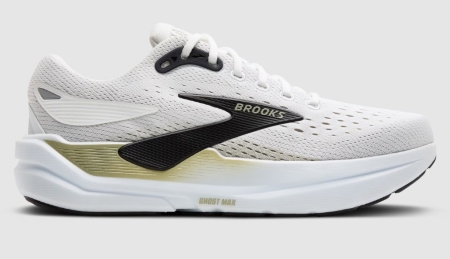
In my max-cushion running shoe ranking, Ghost Max 3 earns points for geometry, width, and predictable protection rather than raw softness. HOKA Bondi feels plusher, Glycerin feels more conventional, and some lighter trainers feel faster. Ghost Max is the one I choose when a rocker and broad footprint are the assignment.
Is Brooks Ghost Max 3 Still the Current Model?
No. Ghost Max 4 is now the current version, while Ghost Max 3 remains available through closeout, marketplace, and Brooks ReStart channels. That does not make version 3 obsolete. It changes the buying question from “is this a good shoe?” to “is this exact fit and listing better for me than the successor?”
A prior model can be the smarter buy when its last fits better, the role is proven, and the seller offers practical returns. It is not automatically smart because a discount badge appears. Sizes and widths become fragmented late in a product cycle, and third-party listings sometimes mix Ghost Max 3, Ghost Max 4, Ghost 18, and Hyperion Max 3 in one search page.
This review covers Brooks Ghost Max 3, model 110464. It does not cover the original Ghost Max, Ghost Max 2, Ghost Max 4, Ghost Max SE, standard Ghost, or Hyperion Max. The Hyperion model is a speed-oriented shoe despite sharing “Max” in the name.
The Brooks Ghost Max 3 product page identifies its DNA LOFT v3 midsole, GlideRoll Rocker, 6 mm offset, broad base, and intended use for orthotics, everyday running, and walking. Availability shown there can change and is not part of my score.
How I Tested the Brooks Ghost Max 3
My test covers 158 verified running miles in a men’s US 10.5, with six structured sessions preserved in the current log. The coverage centers on the jobs this shoe is built to perform: easy running, steady aerobic mileage, long runs, asphalt, Boardwalk, and a completed wet test.
| Test variable | Ken’s test |
|---|---|
| Runner | Ken, 12 years running; about 182 lb during this test |
| Shoe | Brooks Ghost Max 3, men’s US 10.5 |
| Mileage | 158 verified running miles |
| Main surfaces | South Jersey asphalt and Atlantic City-area Boardwalk |
| First key run | 7 miles around Stockton University at about 9:20/mi |
| Best recorded run | 12 miles at controlled, even easy effort |
| Longest run | 16 miles; subtle flattening around mile 12 |
| Evidence maturity | Mature mileage, medium confidence; several logs were backfilled |
One 10-mile session felt flat as early as mile six. A later 16-mile run did not repeat that early collapse: the shoe stayed coherent through roughly mile eight and only became subtly dull around mile 12. I treat the six-mile result as a bad-day data point, not a universal foam expiration time.
That distinction matters because fatigue, sleep, temperature, prior training, and pace can make a midsole feel different. A credible review should preserve contradictory sessions, then look for the pattern. It should not select the most dramatic sentence simply because it sounds memorable.
I did not run a controlled economy test, measure the shoe on a traceable scale, or reproduce a laboratory flexibility protocol. Manufacturer specifications and independent lab measurements are labeled separately. The wider best running shoes guide ranks shoes by assignment rather than turning one lab number into a universal winner.
Ken’s Ranking Rule
Ken’s ranking rule: A max-cushion daily shoe ranks highly only when its extra foam improves the target run without making fit, stability, or pace changes harder. Rocker smoothness can offset weight, but it cannot erase low rebound. By that rule, Ghost Max 3 ranks high for easy linear motion and walking, then falls quickly for speed and narrow-foot control.
This rule keeps “max” from becoming a synonym for “best.” More stack can protect against sharp surface feel, but it also creates leverage and can require more width or stiffness to stay controlled. Ghost Max 3 handles that tradeoff with a broad base and torsional structure rather than GuideRails.
My 7.3 score reflects a narrow but useful role. A runner with orthotics who alternates walking and easy running may rate it much higher. A runner buying one pair for recovery, tempo, and race day should rate it lower. Context is not a loophole in the score; it is the score.
Brooks Ghost Max 3 Specs and Construction
Ghost Max 3 combines full-length DNA LOFT v3, a 6 mm listed drop, a 39/33 mm stack reference, GlideRoll Rocker geometry, double-jacquard mesh, and extensive road rubber. It has no plate and no GuideRails. The broad shape and stiffness of the entire platform provide most of the guidance.
| Specification | Verified reference | What it means on the move |
|---|---|---|
| Weight | Brooks US currently lists 11.2 oz / 317.5 g; independent men’s samples are around 10.7-10.8 oz | Heavy enough to notice when cadence rises |
| Stack | About 39 mm heel / 33 mm forefoot | High protection without the extreme height of some super-max shoes |
| Listed drop | 6 mm | Lower than standard Ghost and Glycerin; rocker strongly shapes transition |
| Midsole | Full-length nitrogen-infused DNA LOFT v3 | Compliant and durable, with modest energy return |
| Geometry | GlideRoll Rocker and broad base | Reduces forefoot bending demand and steadies linear motion |
| Upper | Double-jacquard mesh, padded collar and tongue | Comfortable and roomy, with more material than a speed upper |
| Support | Neutral; no GuideRails or medial post | Stable through platform geometry, not corrective hardware |
The weight discrepancy deserves daylight. Brooks US currently lists 11.2 ounces, while Brooks Australia and Doctors of Running cite 10.8 ounces in a men’s reference size. RTINGS measured 10.68 ounces in its sample. I do not know whether the difference comes from reference conventions, production changes, or page data, so I report the range rather than inventing certainty.
The Brooks Australia technical brief lists 39 mm at the heel, 33 mm at the forefoot, a 6 mm offset, and a 306 g men’s reference weight. Those values align with Doctors of Running, while the current US product page carries the heavier number.
DNA LOFT v3 is a nitrogen-infused foam, but that chemistry does not guarantee a lively ride. Cell structure, density, geometry, rubber coverage, and the runner’s loading pattern all matter. In Ghost Max 3, the foam behaves more like a compliant, durable carrier than a springy performance compound.
RTINGS measured low energy return in both heel and forefoot. I cannot translate its percentages into a predicted pace or calorie cost for an individual runner, but the direction agrees with my field notes: the shoe absorbs and rolls more than it rebounds.
The 6 mm offset also should not be read alone. My heel-drop guide explains why static drop, rocker timing, stack compression, strike, and speed jointly determine lower-leg demand. Ghost Max 3 feels less flat than its number suggests because the rocker starts the transition early.
Ride Feel: Rocker Does More Than the Foam
The Ghost Max 3 ride is muted, broad, and rolling rather than soft and bouncy. DNA LOFT v3 takes the sharpness out of asphalt. The GlideRoll geometry then moves the center of pressure forward before the stiff forefoot would naturally bend. The result is smoother than the foam alone would suggest.
At heel contact
The rear geometry has a meaningful bevel instead of a square wall. At easy pace, my lateral heel landing compresses into that bevel and moves toward the middle without a hard slap. The wide heel keeps the transition from feeling perched.
A heel striker still needs to test the exact landing point. RTINGS measured a broad heel but a high stack, and one geometry ratio cannot predict every runner. My pair felt centered in forward motion. Tight turns and side steps exposed more upper movement than straight running.
Through the midfoot
The midfoot is stiff and planted. There is a deep guidance line and enough sole flare to resist a quick inward or outward collapse, but the shoe does not press one side of the arch like a traditional post. My foot followed the platform rather than fighting it.
That quality makes the shoe feel safe when legs are tired, but it reduces ground adaptation. On uneven Boardwalk transitions or cambered road edges, I feel the whole platform tilt more than I would in a lower, flexible trainer. Stable on flat pavement does not mean agile everywhere.
At toe-off
The early forefoot rocker is the defining feature. The sole does not flex much under the toes, so the curved geometry supplies the transition. When pace remains easy, that timing feels natural and saves me from pushing through a stiff forefoot. When cadence rises, the shoe can feel like it is rolling on its own schedule.
Best Pace and Workouts for Ghost Max 3
My strongest range was roughly 8:30 to 9:30 per mile for easy and steady running. Slower recovery running also works because the rocker remains predictable. Faster running exposes the mass, roomy upper, and low rebound. Pace is individual, so use effort and control rather than copying my numbers.
| Run type | My verdict | Reason |
|---|---|---|
| Recovery run | Very good | Broad base and rocker keep tired-leg movement simple |
| Easy daily run | Excellent | Best balance of cushion, geometry, and predictable fit |
| Steady aerobic run | Good | Works around my 8:30-9:00/mi range before weight dominates |
| Long easy run | Good with a late-run test | Completed 16 miles; subtle dullness around mile 12 |
| Tempo run | Poor | Low rebound and mass make sustained faster running expensive |
| Intervals | Skip | Stiff broad platform is slow to redirect and upper is roomy |
| Walking and standing | Excellent | Rocker, low arch, padding, and orthotic space fit the task |
| PR-focused race | Skip | Comfort-first geometry is not a performance-racing system |
At 9:20 per mile on the first key run, the shoe became background. That is the sweet spot. I could land without precision, settle into aerobic breathing, and let the rocker repeat. The easy-run pace guide explains how to identify that effort without turning another runner’s pace into a target.
At faster pace, the shoe never becomes dangerous or unusable. It simply makes the work feel less coordinated. The foam does not return pressure sharply, and the broad upper requires more lace tension to stop small side-to-side movement. A lighter daily trainer is a better place for unplanned pickups.
For a new runner, that limited speed range may not matter because most mileage should stay easy. Ghost Max 3 belongs in my beginner running shoe decision set when the runner likes a rocker and roomy last. A beginner with a narrow foot may find the shoe harder to control than a simpler standard Ghost.
On a treadmill, the rocker remains smooth but the padded upper can feel warmer and the wide base can seem larger on a narrow belt. My treadmill shoe guide recommends testing belt clearance, ventilation, and pace changes rather than assuming every cushioned road shoe behaves identically indoors.
Long-Run Performance and the Mile-12 Question
I tested Ghost Max 3 to 16 miles, and my useful long-run conclusion is conditional: protection remained, but freshness declined around mile 12. The shoe did not bottom out or become unstable. It felt duller, as though the rocker remained willing while the foam returned less of the pressure I put into it.
The best recorded run was a controlled 12-miler on a still morning. I hit the intended rhythm evenly, the upper did not create hot spots, and the shoe disappeared underfoot. That is strong evidence for easy long runs up to about two hours in my use.
The conflicting 10-miler matters too. On that day, the midsole felt flat around mile six. Because the later 12- and 16-mile sessions did not reproduce such early failure, I do not call six miles the shoe’s limit. I call it evidence that this foam’s perceived rebound is sensitive to the day.
A lighter runner may preserve the sensation longer, but I cannot guarantee that from my body mass alone. A heavier runner may still do better because the broad platform controls compression well. Strike, cadence, temperature, and fatigue can matter as much as scale weight.
Good cushioning but low energy return. That combination explains why the shoe can remain protective while feeling less fresh. Cushioning describes energy absorbed; rebound describes how much and how quickly energy returns. They are related but not interchangeable.
For a half marathon at comfortable effort, Ghost Max 3 can work if the fit is proven. For a marathon, I would require a long run beyond two hours with race socks, insert, fueling, and intended pace. I would not infer 26.2-mile readiness from the pleasant first hour.
Brooks Ghost Max 3 Fit and Sizing
My normal men’s US 10.5 fit true to size, with a roomy forefoot, broad-feeling heel, low arch, and average vertical volume. The shoe did not feel short in my pair. I needed deliberate lace tension to center the heel, but I did not need to size down.
Sizing down to remove volume can move the rocker behind the correct point and crowd the toes. Start with normal running-shoe length. Check a thumb-width in front, heel lift during a brisk walk, arch pressure, and whether the foot translates sideways during turns.
Fit checklist
- Start with your normal running-shoe size and the width you actually use.
- Warm the foot for ten to fifteen minutes before judging toe and arch space.
- Walk downhill and turn sharply to expose heel and lateral movement.
- Do not size down solely to make the padded upper feel snugger.
- Use Wide or Extra Wide only when the foot needs the last, not from the model’s max-cushion label.
- Return the shoe if toes grip, the heel lifts, or the rocker feels mistimed indoors.
Men’s versions were offered in Medium, Wide, and Extra Wide, but prior-generation stock is uneven. My wide-foot running shoe guide explains why a width code, platform width, and internal volume describe different parts of fit.
Orthotics, Walking, and Standing
Orthotic compatibility is one of Ghost Max 3’s strongest and most defensible advantages. The stock insole removes cleanly, the arch is low enough to avoid competing with many inserts, the upper has useful volume, and the broad sole supports a full-length orthotic better than a narrow-waisted trainer.
That does not mean every orthotic works. A thick heel cup can raise the foot into the collar, a rigid insert can change rocker timing, and a wide orthotic can distort the upper. Test the exact shoe and insert together, with the original sockliner removed unless the prescriber instructed otherwise.
For walking, the early rocker reduces the need to bend through a stiff forefoot. The broad base also feels calm during long straight sections. On stairs and tight indoor turns, the height and stiffness remain noticeable. I would test those movements before using it for an all-day job.
Brooks lists orthotics, everyday running, and walking as primary uses. Doctors of Running reached a similar conclusion and noted the low arch, removable insert, broad sole, and upper volume. This is a footwear compatibility observation, not a medical recommendation or treatment claim.
Runners with flat feet do not automatically need a stability shoe. My flat-feet shoe guide starts with fit and comfort, then compares neutral and guided options. Ghost Max 3 can be useful when a broad neutral platform feels better than a rail or post.
Upper, Tongue, and Lockdown
The double-jacquard mesh is soft, padded, and accommodating rather than performance-tight. The collar protects the heel from the stiff counter, and the tongue spreads lace pressure. I did not log blistering during the 16-mile test.
The tongue is not gusseted, so it can drift laterally. That was not a major failure in my pair, but it is another reason to lace deliberately. The large side logos add some structure, yet the foot can still translate during lateral movement.
Breathability is better than the visual bulk suggests, though climate and socks matter. Believe in the Run found the update softer and more breathable than prior versions. RoadTrailRun had mixed warm-weather impressions and recommended thinner socks in humid conditions.
Narrow feet face the largest compromise. Cranking the laces can secure the midfoot while leaving excess space around the heel and forefoot. That can be acceptable for walking and irritating for running turns. A narrow-foot runner should compare standard Ghost 18 before trying to solve the last with lace tension.
Stability: Broad Neutral, Not Corrective
Ghost Max 3 is stable-neutral, not a formal stability shoe. The wide base, sidewalls, guidance line, outsole coverage, and torsional stiffness keep forward motion controlled. There is no medial post and no Brooks GuideRails system.
Brooks uses “Max support” on the product page to describe assisted transition and extra underfoot cushion. That commercial label should not be confused with a stability classification. The standard Ghost Max 3 remains neutral.
At easy forward pace, my foot stayed centered. During tighter turns, the roomy upper allowed more translation than the platform itself. Stability is therefore a system: a wide sole cannot help if the upper does not hold the foot over it.
The Brooks Adrenaline GTS 25 is the clearer choice when GuideRails improve comfort and control. Ghost Max 3 offers more underfoot volume and a stronger rocker. Adrenaline feels more conventional and actively guided. Neither is automatically better for pronation without a direct test.
For heavier neutral runners, Ghost Max 3’s broad base and dense-feeling foam can be more predictable than a narrow soft tower. I tested around 182 lb. The heavy-runner shoe guide considers fit, forefoot depth, and side-to-side control rather than prescribing stack height by body weight.
No shoe can guarantee that knees, shins, or feet will remain pain-free. The knee-pain shoe guide explains why footwear may change comfort but cannot diagnose the source of symptoms or replace progressive rehabilitation.
Grip, Rain, and Surface Limits
My Ghost Max 3 wet test did not produce a major traction failure, and dry-road grip was dependable. The outsole carries extensive rubber, but the contact pattern is relatively smooth. It is designed for roads, track, walking surfaces, and smooth paths, not mud or technical trail.
Some damp-road slippage in one tester. That does not cancel my wet session; it narrows the conclusion. Ordinary wet asphalt can be acceptable while smooth painted, sealed, or contaminated surfaces remain hazardous.
The high, stiff platform also changes how the shoe behaves on camber and broken pavement. It protects against sharp surface feel but adapts less than a flexible trainer. On old Boardwalk transitions, I shorten stride rather than trusting the rocker to solve uneven footing.
My rain-running guide recommends treating paint, metal, leaves, algae, and standing water as separate surfaces. No wet-grip score turns those hazards into ordinary pavement.
Durability After 158 Miles
At 158 running miles, my pair remains fully usable. The outer heel shows expected wear from my lateral landing pattern. The heel foam has minor compression, but the rocker, upper, and lockdown still behave consistently.
The shoe uses enough outsole rubber to feel built for repeated walking and road mileage. That adds weight but protects the midsole from direct abrasion. Doctors of Running reported almost no outsole damage early and expected above-average life; RoadTrailRun also described the platform as durable.
Durability is not the same as freshness. Rubber can remain intact after the midsole sensation changes, and a duller ride does not necessarily mean the shoe is unsafe. My late-run flatness is a performance observation, while visible heel wear is a material observation.
I do not promise a fixed 300-, 400-, or 500-mile lifespan. Surface, stride, walking volume, moisture, heat, and rotation matter. The shoe replacement checklist compares grip, alignment, fit, and ride instead of retiring a pair from one odometer number.
For runners spending much of the week on sidewalks, Ghost Max 3 combines substantial stack with a base that does not feel fragile. It remains one of the rocker-focused options in my running shoes for concrete guide.
Brooks Ghost Max 3 Comparisons
Ghost Max 3 wins when you want a roomy, orthotic-friendly rocker; alternatives win on softness, speed, guidance, or conventional flexibility. These are assignment comparisons, not a universal ladder.
| Comparison | Choose Ghost Max 3 when | Choose the alternative when |
|---|---|---|
| Ghost Max 3 vs Ghost 18 | You want more stack, a stronger rocker, and more orthotic space | You want less bulk, more flex, and a conventional daily ride |
| Ghost Max 3 vs Glycerin 23 | You want a lower drop, broader rocker, and easier walking transition | You want better running energy and deeper heel comfort |
| Ghost Max 3 vs Bondi 9 | You prefer firmer control and a roomier orthotic-friendly last | You want plusher impact absorption and a more established HOKA rocker |
| Ghost Max 3 vs Nimbus 28 | Broad stable-neutral geometry and insert space matter most | You want a softer, more premium running experience |
| Ghost Max 3 vs Vomero 18 | You want a calmer, less bouncy platform for walking and easy running | You want more pace range and a livelier dual-foam ride |
| Ghost Max 3 vs Triumph 24 | You prioritize rocker guidance and width | You prioritize lower weight and daily-run versatility |
Ghost Max 3 vs Ghost 18
Standard Ghost is lower-feeling, more flexible, and easier to use across ordinary daily paces. Ghost Max 3 is taller, broader, and more rockered. I choose Ghost 18 for one-shoe daily training and Ghost Max 3 for recovery, walking, or an insert that needs a stable footprint.
Ghost Max 3 vs Glycerin 23
Glycerin 23 feels more like a running shoe. Its transition is less dominated by rocker geometry, and independent testing found better energy return. Ghost Max 3 has more forefoot protection, more orthotic space, and a lower offset. I choose Glycerin for long easy running and Ghost Max for mixed walking/running duty.
Ghost Max 3 vs HOKA Bondi 9
Bondi 9 feels softer and more cushioned under heavy impact. Ghost Max 3 feels firmer, broader through the middle, and easier to pair with many orthotics. HOKA is the more plush running experience; Brooks is the more utilitarian walking and insert platform.
Ghost Max 3 vs ASICS Gel-Nimbus 28
Nimbus 28 wraps the foot in a more premium upper and supplies a softer cruise. Ghost Max 3 feels less luxurious but more mechanically straightforward. A runner who dislikes deep softness may prefer Brooks. A runner seeking pure easy-run comfort may prefer ASICS.
Ghost Max 3 vs Nike Vomero 18
Vomero 18 has more rebound and a higher pace ceiling. Its dual-foam movement can also feel less settled for someone who wants a firm broad base. I give Nike the progression run and Brooks the walking-heavy travel day or deliberately slow recovery session.
Ghost Max 3 vs Saucony Triumph 24
Triumph 24 is lighter and easier to accelerate. Ghost Max 3 gives a more obvious rolling pathway and more orthotic-friendly volume. Saucony is the better only shoe; Brooks is the clearer specialist when the foot likes its rocker.
For a more conventional lightweight daily role, the Saucony Ride 19 covers a wider pace range with less bulk. It gives up some stack and rocker guidance, which is exactly why the two shoes belong in different assignments.
How Ghost Max 3 Fits a Shoe Rotation
I use Ghost Max 3 as the slow, stable-neutral half of a two-shoe rotation. Pair it with a lighter daily trainer or workout shoe for progression, tempo, and intervals. Use Brooks for recovery, easy road volume, walking-heavy days, and sessions where the orthotic needs a broad platform.
This pairing prevents the Ghost Max from being judged by the wrong job. It also keeps a lightweight shoe from absorbing every slow mile. The daily trainer guide includes lighter partners that make sense when one pair already covers maximal easy-day duty.
I would not pair it with another heavy, stiff, low-rebound max-cushion shoe unless the two fits solve different medical or occupational needs. A rotation should create meaningful assignment differences, not duplicate brand labels.
Who Should Buy the Brooks Ghost Max 3?
Buy Ghost Max 3 if you want a roomy stable-neutral rocker for easy running, walking, or an orthotic, and the exact prior-generation listing fits correctly. It is especially useful for runners who prefer structure from geometry rather than GuideRails.
- Neutral runners who keep most mileage easy and controlled
- Walkers and workers who spend long straight periods on their feet
- Orthotic users who need a removable insole, low arch, and broad footprint
- Medium-to-wide feet that feel cramped in streamlined max-cushion shoes
- Heavier neutral runners who prefer a firm broad base to a narrow soft stack
- Heel-to-midfoot strikers who enjoy an early rocker transition
- Prior-model buyers who can verify version, width, seller, and returns
Who should skip it
- Narrow feet that cannot secure the roomy heel and forefoot
- Runners seeking one shoe for easy days, tempo, intervals, and racing
- Athletes who want high energy return or a flexible natural toe-off
- Anyone who dislikes a strong rocker during walking or slow running
- Runners who need active GuideRails or another formal stability system
- Technical-trail users who need lugs and terrain adaptation
- Buyers choosing version 3 only because a temporary discount looks large
Pain, numbness, persistent arch pressure, or a rocker that feels mistimed is not a break-in requirement. Stop the fit test and choose a different size, width, or geometry. Footwear can change comfort; it cannot diagnose the reason a movement hurts.
Pros and Cons
| What I like | What I would change |
|---|---|
| Smooth GlideRoll transition at easy pace | Reduce mass without narrowing the platform |
| Broad, predictable stable-neutral base | Increase rebound for late long-run freshness |
| True-to-size, roomy fit in my US 10.5 | Offer better narrow-foot lockdown |
| Strong orthotic and walking compatibility | Gusset the tongue to reduce drift |
| Useful outsole and upper life at 158 miles | Add a little more damp-road bite |
Sources, Fact Checks, and Corrections
My ride, pace, fit, long-run, wet-test, and durability conclusions come from the 158-mile log. Brooks supplies product identity and listed construction. Independent sources help resolve the unusual weight discrepancy and check fit, energy return, geometry, and model-to-model changes.
I rejected several archive fields before writing. The saved colorway appeared to belong to another brand. The kitchen-scale weight, measured drop, durometer, flex, and toe-box values lacked traceable test records. A note saying “GuideRails if present” was removed because Ghost Max 3 is neutral and has no GuideRails.
I also did not present the mile-six flat session as a universal long-run limit. Later 12- and 16-mile evidence did not reproduce such early failure. Finally, Brooks’ “Max support” label is marketing language for assisted transition and added cushion, not proof that this is a stability shoe or a treatment for pain.
Ghost Max 4 is now the current model. This article remains intentionally scoped to version 3 because fit, rocker timing, stock, and resale listings are version-specific. The facts should not be transferred automatically to Ghost Max 4.
Frequently Asked Questions
Is the Brooks Ghost Max 3 a neutral or stability shoe?
The Ghost Max 3 is a neutral shoe. Its broad base, sidewalls, rocker, and stiff platform create inherent stability, but it has no medial post or GuideRails. Runners who need active guidance should compare it directly with a stability model rather than treating Brooks’ ‘Max support’ product label as a medical classification.
What is the Brooks Ghost Max 3 best for?
It is best for easy running, recovery miles, walking, standing, and runners who need a broad orthotic-friendly platform. In my 158-mile test, it was most convincing around 8:30 to 9:30 per mile. Weight and low rebound limited its value for tempo work and racing.
Does the Brooks Ghost Max 3 fit true to size?
My usual men’s US 10.5 fit true to size. The shoe is roomy through the forefoot and heel, with a lower arch and average vertical volume. Narrow feet may need more lace tension, while high-volume orthotics can still require a careful indoor fit test.
Is the Brooks Ghost Max 3 good for wide feet?
Yes for many runners. The standard last is already accommodating, and men’s versions were offered in Medium, Wide, and Extra Wide. The upper can feel too spacious on narrow feet. Availability by width is now inconsistent because Ghost Max 3 is a prior-generation model.
Can the Brooks Ghost Max 3 hold orthotics?
It is one of the more orthotic-friendly neutral running shoes I have tested. The insole is removable, the arch is not aggressively raised, the upper has useful volume, and the broad base supports the footprint of many full-length inserts. Orthotic thickness and heel shape still need an individual fit test.
What is the drop of the Brooks Ghost Max 3?
Brooks lists a 6 mm heel-to-toe drop. RTINGS measured 7.6 mm in its sample, which illustrates how production sample and measurement method can differ. On foot, the rocker matters at least as much as the static offset because it controls how early the shoe begins to roll.
Is the Brooks Ghost Max 3 good for long runs?
It can handle easy long runs if the rocker and roomy fit suit you. I tested it to 16 miles. The ride remained coherent through roughly mile 8 and felt subtly flatter around mile 12. I would validate it beyond two hours before selecting it for a marathon.
Can I race in the Brooks Ghost Max 3?
You can finish a comfort-first event in it, but it is not a strong performance-racing choice. The shoe is heavy, unplated, and low in energy return. Faster shoes make pace changes easier, while Ghost Max 3 is designed to keep easy forward motion smooth.
Is the Brooks Ghost Max 3 good for walking and standing?
Yes. Walking and standing may be its best uses. The broad platform, rocker, padded upper, low arch, and removable insole make it practical for long periods on foot. A rocker can feel unfamiliar during slow indoor movement, so test turns and stairs before committing.
Is the Brooks Ghost Max 3 good for heavy runners?
It is a credible option for heavier neutral runners because the base is broad and the foam does not collapse sideways easily. I tested at about 182 lb. Body mass alone cannot prescribe a shoe, and heavier forefoot strikers should pay particular attention to late-run rebound and toe-box hold.
How durable is the Brooks Ghost Max 3?
At 158 running miles, my pair had expected outer-heel wear and minor heel compression but remained functional. Independent reviewers also reported extensive rubber and above-average durability. I do not assign a universal lifespan because gait, surface, walking use, and storage change wear.
Is the Brooks Ghost Max 3 good in rain?
My logged wet test did not produce a major traction failure, but the smooth road outsole is not an all-terrain tread. RoadTrailRun reported some slipping on damp road in one test. Reduce pace on paint, metal, leaves, and smooth wet surfaces regardless of the shoe.
What changed from Ghost Max 2 to Ghost Max 3?
The core 39/33 mm geometry, 6 mm drop, DNA LOFT v3, and GlideRoll concept remained. Version 3 brought a redesigned double-jacquard upper and, according to several testers, a smoother heel and forefoot transition plus a more accommodating true-to-size fit. It is an evolution, not a new category.
Should I buy Ghost Max 3 or Ghost Max 4?
Ghost Max 4 is the current model. Ghost Max 3 still makes sense when its proven roomy fit works better for you and the listing offers a meaningful value with a good return policy. Do not choose the older shoe from discount alone; verify size, width, seller, and whether you prefer its specific rocker.
Is the Brooks Ghost Max 3 worth buying in 2026?
Yes for a runner or walker who wants a roomy, stable-neutral, rockered platform and finds the exact width from a trustworthy seller. It is a weaker buy for narrow feet, speed-focused training, or anyone who can get the current model at similar value. My score is 7.3/10.
Final Verdict
My Brooks Ghost Max 3 review ends at 7.3/10 after 158 miles. The shoe succeeds because the rocker, broad base, roomy upper, and orthotic-friendly shape work as one system at easy pace. It remains durable and comfortable. It does not deliver the rebound, low mass, or close lockdown needed for a broad performance range.
I trust it for recovery, ordinary aerobic runs, walking-heavy days, and many insert setups. I would not rebuy it as my only running shoe, and I would not choose it for a tempo session or PR attempt. The subtle flattening around mile 12 also means I would prove it beyond two hours before a marathon.
In 2026, the best buyer is not simply someone who finds Ghost Max 3 cheaper. It is the runner whose foot already likes this roomy last and whose training actually needs a stable-neutral rocker. Verify model 110464, width, seller, and returns. A correct prior-generation fit beats a newer shoe that does not fit, but a discount never fixes the wrong geometry.

Written by Ken – 12 years of running, 12,500+ miles, 63 shoes tested, and 36 races from 5Ks to a 50K ultra. I run 30-40 miles a week on the Atlantic City Boardwalk and review shoes with repeated training miles, not one-run demos. More about Ken