
This On Cloudsurfer 2 review is based on 211 verified running miles in a men’s US 10.5, including easy runs, progression work, a 13-mile long run, wet roads, boardwalk, and asphalt.
My verdict: Cloudsurfer 2 is a smooth, flexible daily trainer that feels best when I stop chasing pace and let CloudTec Phase roll beneath me. It is firmer and more durable than the previous Cloudsurfer, but low energy return, narrow geometry, an unsecured tongue, and late-run heel irritation keep it out of the top tier. I scored it 7.7/10.
I am 5’10”, 182 pounds, mildly overpronate, and usually land between my heel and midfoot. I run 30–40 miles most weeks around Atlantic City, New Jersey. A lighter neutral runner may experience less compression; a wide-footed or stability-dependent runner may expose the platform’s limits sooner.
Verdict: Buy Cloudsurfer 2 for relaxed road miles, recovery runs, smooth progressions, walking, and runners who prefer a flexible rocker. Skip it for speed sessions, wide forefeet, strong pronation support, or maximum-cushion long runs.
In this review
On Cloudsurfer 2 review: specifications and score
Cloudsurfer 2 combines Helion foam, CloudTec Phase geometry, a stated 9 mm drop, targeted rubber, and no Speedboard.
| Specification | Published or measured value | What it means |
|---|---|---|
| On weight | 261 g / 9.2 oz | Competitive for a cushioned daily trainer |
| My pair | 9.5 oz, men’s US 10.5 | Close to brand weight despite larger sample size |
| Published stack | 37 mm heel / 28 mm forefoot | High heel cushioning with moderate forefoot depth |
| Lab stack | 37.5 mm / 27.1 mm | Independent sample produced a larger offset |
| Drop | 9 mm stated; 10.4 mm lab | Heel-friendly geometry, not a low-drop shoe |
| Midsole | Helion foam with CloudTec Phase | Sequential compression creates the transition |
| Speedboard | None | Flexibility and geometry replace a rigid plate |
| Support | Neutral | No corrective post or stability rail |
| Upper | Engineered mesh, non-gusseted tongue | Comfortable, though tongue movement needs attention |
| Outsole | Updated tread and thicker targeted rubber | Better durability than the prior version |
| My size | Men’s US 10.5, standard width | True in length, snug through the front |
| My mileage | 211 verified miles | Mature ride and early-to-midlife wear assessment |
| My rating | 7.7 / 10 | Smooth and useful, but short on rebound and fit refinement |
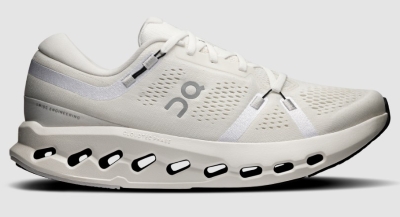
The official On Cloudsurfer 2 page confirms Helion foam, CloudTec Phase, 9 mm drop, neutral support, 261 g weight, updated tread, and the absence of any Speedboard claim.
CloudTec Phase is a structural cushioning system in which computer-shaped cavities compress sequentially, helping the shoe roll from landing toward toe-off.
My Cloudsurfer 2 scorecard after 211 miles
Versatility and smooth transitions lead my scorecard; modest rebound, narrow geometry, and only average durability hold the shoe back.
| Category | Score / 10 | My reason |
|---|---|---|
| Heel cushioning | 7.8 | Protective without the unstable sink of very soft foam |
| Forefoot cushioning | 7.6 | Adequate depth, but less protection than the heel |
| Stability | 7.7 | Controlled foam; platform is narrower than average |
| Flexibility | 6.7 | Easy to bend, though the rocker remains noticeable |
| Fit | 7.7 | True length and excellent heel hold; toe area is not generous |
| Transition | 7.7 | CloudTec Phase rolls smoothly at relaxed cadence |
| Dry grip | 7.3 | Adequate for normal roads, not confidence-inspiring at speed |
| Wet grip | 7.9 | My pair stayed predictable on wet asphalt |
| Durability | 6.8 | Minor heel compression and expected outer-heel wear at 211 miles |
| Versatility | 8.4 | Easy runs, steady miles, walking, and progressions |
| Overall | 7.7 | A dependable smooth trainer, not a performance standout |
On Cloudsurfer 2 review: how I tested it
I logged 211 verified miles across eight structured checks and regular training, including easy, progressive, long, wet, asphalt, and boardwalk runs.
My pair is a men’s US 10.5 in Dark Charcoal/Amber. It weighed 9.5 ounces on my kitchen scale. I used the stock insole and my regular training socks, so fit comments apply to the standard-width retail setup.
The first run began at 4:30 p.m. in October 2025. Long shadows crossed Great Bay Boulevard Wildlife Management Area in Tuckerton as the road cooled. I ran seven miles near 9:20 pace and immediately noticed how easily the shoe rolled for its cushioning level.
That first run also corrected my expectations. I did not feel separate old-style On pods snapping beneath me. The cavities compressed in sequence, creating one connected motion. The sensation was controlled and mildly firm, not marshmallow-soft.
My best session was a 12-mile boardwalk progression. I opened around 9:15 pace and brought the second half down toward 8:10. The rocker stayed smooth, the heel remained centered, and I finished without the heavy-shoe sensation that often appears late in cushioned trainers.
The 13-mile Brigantine–Atlantic City loop produced a more mixed result. My feet remained comfortable through 10 miles, then a hot spot developed at the medial heel. Lockdown was secure, but repeated collar contact became irritating as my form tired.
One eight-mile run also ended with the heel feeling flatter than expected. That experience did not repeat in every long session, which is why I treat it as a load-and-day-dependent limitation rather than proof that the foam always dies at mile eight.
On Cloudsurfer 2 review: how CloudTec Phase works
CloudTec Phase uses collapsing midsole cavities and rocker geometry to sequence compression, producing roll rather than a springboard-style toe-off.
Each cavity deforms as load travels forward. The next section begins collapsing while the previous section releases. The intended result is a smooth transfer of pressure rather than an abrupt hinge. On describes the shapes as computer-optimized and compares the sequence to dominoes.
There is no Speedboard in this shoe. That matters because older On reviews often treat the rigid board as universal across the brand. Cloudsurfer 2 obtains structure from Helion geometry, outsole placement, and its upper, while remaining flexible.
RunRepeat needed only 11.5 N to bend its sample 30 degrees, versus a 15.5 N lab average. That flexibility matches the natural forefoot movement I felt. It is not a plated rocker forcing my toes through one prescribed path.
On Cloudsurfer 2 review: cushioning and ride
The ride is moderately firm, heel-protective, and exceptionally smooth, but it returns less energy than many modern daily trainers.
RunRepeat measured 137 SA of heel shock absorption and 100 SA at the forefoot. Those values explain why the heel handles routine impact well while the front feels less substantial. At my weight, the shoe protects without giving me a deep sinking sensation.
Energy return tells the other half of the story. The same lab measured 52.6% at the heel and 54.1% at the forefoot, both below its average. Smoothness can reduce how much work a transition feels like, but it is not the same as mechanical rebound.
The foam measured 43.8 AC under RunRepeat’s current protocol, firmer than its 35.7 AC average. The phrase “softest On” is relative to the brand’s historically firm shoes. Compared with New Balance Infinion or modern PEBA blends, Cloudsurfer 2 feels controlled rather than plush.
I like that distinction on recovery mornings when overly soft foam makes my ankles search for a stable position. If you want deeper step-in softness, compare the options in my best cushioned running shoes guide.
How the Cloudsurfer 2 performs at different paces
Cloudsurfer 2 excels at easy-to-steady pace, tolerates controlled progressions, and feels flat during intervals or aggressive tempo work.
At 9:00–9:45 per mile, the shoe is in its best zone for me. The heel loads smoothly, cavities collapse without noise or hesitation, and the early forefoot rocker keeps cadence moving. This is why it fits naturally among my daily trainer recommendations.
Between 8:10 and 8:45, the lower mass helps more than the foam. My 12-mile progression worked because I increased effort gradually and maintained rhythm. CloudTec Phase did not fight the pace, but it did not give a large energetic return either.
At interval effort, the ride flattens. I have to create the speed rather than receiving meaningful assistance from the midsole. The flexible forefoot and absent plate are comfortable, yet neither produces the snap I want for repeated hard work.
Use it for easy runs, aerobic cruising, and moderate progression. Add a lighter, livelier shoe if workouts are important. My fartlek training guide explains where a daily trainer can work and where a faster rotation partner helps.
Is On Cloudsurfer 2 good for long runs?
Cloudsurfer 2 can handle routine long runs, but my 13-mile test exposed medial-heel friction and reduced late-run cushioning confidence.
The first 10 miles were comfortable. Heel absorption remained adequate, forefoot protection felt alive, and the rocker kept steps organized. At mile 10, medial-heel warmth became a hot spot. That was a fit-interface issue, not proof that the entire midsole failed.
For the specific On Cloudsurfer 2 long runs question, my evidence supports ordinary weekend mileage rather than repeated marathon-length training.
For runners under 200 pounds with neutral mechanics, it is a credible 10–13 mile trainer. I would hesitate to choose it for frequent 16–22 mile marathon sessions because cushioning depth, rebound, and upper comfort have stronger alternatives. See my long-distance shoe guide.
Be patient before committing it to distance. Complete several shorter runs, then one medium-long run in the exact socks you plan to use. A perfect five-mile fit can become a rubbing problem after swelling and fatigue.
On Cloudsurfer 2 sizing and fit
Cloudsurfer 2 fits true in length for my men’s US 10.5, but its standard last runs snug through the widest forefoot area.
My heel locked immediately and the shoe did not feel short. The forefoot was close without causing toe impact. Runners between sizes, wearing thick socks, or needing natural toe splay should try half a size up—but increasing length is not a clean substitute for width.
RunRepeat’s gel mold measured 93.6 mm at the widest interior point versus 95.2 mm average. Toe width at 73.5 mm was average, and height at 28.0 mm was slightly generous. The restriction therefore occurs farther back than many runners expect.
The upper is not offered in the broad width range found on New Balance models. Wide feet should not assume mesh will solve structural pressure. My wide-foot running shoe guide explains how to separate length, width, and volume.
The tongue is thick—10.6 mm in the lab—and not gusseted. It cushioned lace pressure but could drift slightly. Center it carefully before tying. I struggled more with collar contact after 10 miles than with tongue movement, but both interfaces deserve a test.
Upper comfort and breathability
The dual-layer mesh holds securely and survives abrasion, though padding and average ventilation make it warmer than its perforations imply.
The toe material passed RunRepeat’s abrasion check at 3/5, while heel padding scored a strong 4/5. My pair remains structurally intact at 211 miles. Embroidered eyelets and overlays prevent the upper from feeling shapeless when the road tilts.
Breathability scored 3/5 in the same lab. That is usable across seasons, not a hot-weather specialist. During humid New Jersey runs, I prefer thin technical socks and give the pair a full day to dry. My summer running guide covers heat management beyond footwear.
I had no forefoot blister, but medial-heel rubbing appeared on the 13-mile test. Sock thickness and collar moisture can change that outcome. The practical choices in my anti-blister running socks guide are relevant here.
Is On Cloudsurfer 2 stable?
Cloudsurfer 2 offers adequate neutral stability through controlled foam and upper hold, but its narrow base provides no corrective guidance.
RunRepeat measured the platform at 113.6 mm in the forefoot and 88.8 mm at the heel, both narrower than its averages. The foam is firm enough to reduce uncontrolled sinking, and torsional rigidity rated 3/5. Geometry still leaves less margin when landing off-center.
My mild overpronation remained manageable on flat roads during normal daily runs. On sloped pavement or when fatigued, I wanted a broader heel. I know how reassuring the smooth rocker can feel, but smoothness does not equal pronation control.
This is a neutral running shoe. Runners who already use guidance should not treat the brand’s “medium-high stability” ride label as a medical prescription. My overpronation shoe guide offers structured alternatives; persistent symptoms warrant assessment by a physical therapist or qualified clinician.
On Cloudsurfer 2 outsole and wet grip
The harder, thicker outsole is durable and predictable in my wet-road testing, but laboratory traction measured below the category average.
On increased rubber coverage and reduced tread cavities compared with the earlier Cloudsurfer. The purpose is durability and consistent road contact. My pair held wet asphalt without the sudden boardwalk slide I have experienced in some softer road outsoles.
RunRepeat measured only 0.39 in its forefoot traction test versus 0.52 average. Its rubber registered a hard 85.0 HC. Those results caution against calling the grip exceptional, especially across smooth paint, metal covers, frost, or algae-coated surfaces.
Surface matters more than a single “wet grip” label. Reduce stride on uncertain ground, avoid sharp cornering across painted markings, and use the techniques in my rain-running guide.
Cloudsurfer 2 is for road and treadmill use. The cavity geometry can trap small debris, while the shallow tread and narrow platform are not built for trails.
On Cloudsurfer 2 durability after 211 miles
My pair remains healthy at 211 miles, with expected lateral-heel wear, minor heel compression, an intact upper, and useful rebound remaining.
The outer heel shows the clearest abrasion, matching my lateral contact pattern. Forefoot rubber remains functional and the tread cavities retain their shape. I have not found a split cloud element or exposed foam failure.
Lab durability supports cautious optimism. RunRepeat removed only 0.6 mm of outsole material versus its 1.1 mm average, with 3.0 mm of rubber thickness. Hard rubber often lasts well, although its traction tradeoff remains visible.
Helion has minor permanent compression at my heel, but it still rebounds. One flat-feeling eight-mile run did not become the permanent state of the shoe. This is why repeated routes and multiple sessions are more reliable than one dramatic day.
I would not promise a fixed 400- or 500-mile lifespan. Body mass, strike, surface, rotation, and moisture change wear. Use the outsole and ride checks in my running shoe replacement guide.
On Cloudsurfer 2 vs Cloudsurfer 7 / original Cloudsurfer
Cloudsurfer 2 keeps the smooth CloudTec Phase concept but uses firmer foam, more rubber, greater weight, and a more resilient long-run ride.
The naming is confusing. Cloudsurfer 2 succeeds the 2023 Cloudsurfer commonly called Cloudsurfer 7. On reset the product naming after that model introduced the modern CloudTec Phase direction.
| Feature | Cloudsurfer 2 | 2023 Cloudsurfer / 7 | Winner or tradeoff |
|---|---|---|---|
| Foam | Firmer Helion tune | Softer Helion tune | v2 for control; prior model for softness |
| CloudTec Phase | Yes | Yes | Tie; both emphasize sequential roll |
| Speedboard | No | No | Tie |
| Stated drop | 9 mm | Previously listed around 10 mm | Small practical difference |
| Weight | Heavier | Lighter | Prior model |
| Outsole | More and thicker rubber | Less coverage | v2 for durability |
| Long-run feel | More resilient, still moderate depth | Softer but more likely to flatten late | v2 for most runners |
| Best for | Daily miles and controlled long runs | Soft, short-to-medium easy runs | Preference |
On Cloudsurfer 2 vs daily-trainer alternatives
Choose Cloudsurfer 2 for flexible rolling comfort and design; choose rivals for rebound, width, stability, or deeper long-run cushioning.
| Shoe | Choose it over Cloudsurfer 2 when… | Choose Cloudsurfer 2 when… |
|---|---|---|
| ASICS Novablast 5 | You want more bounce and stronger mixed-pace ability | You prefer a quieter, less trampoline-like transition |
| adidas Adizero EVO SL | You need tempo capability and higher energy return | You prioritize controlled easy-run stability |
| HOKA Clifton 10 | You want a broader base and stronger rocker | You want more natural forefoot flex |
| Nike Pegasus | You need firmer versatility and familiar geometry | You want a smoother, more cushioned heel transition |
| On Cloudmonster 2 | You want more foam and better late-run response | You want lower weight and a smoother roll |
| New Balance 1080v15 | You need wider sizing and softer cushioning | You prefer firmer control and On’s rocker sensation |
For deeper context, read my ASICS Novablast review, HOKA Clifton review, Nike Pegasus review, and On Cloudmonster review.
Who should buy the On Cloudsurfer 2?
Cloudsurfer 2 best suits neutral runners seeking smooth easy miles, moderate firmness, flexible transitions, and one shoe that also works casually.
- Heel-to-midfoot strikers who appreciate a higher drop
- Neutral runners who dislike extremely soft foam
- Daily runners staying mostly between easy and steady effort
- Walkers and travelers who want an athletic shoe with clean styling
- Runners replacing the prior Cloudsurfer but wanting more outsole life
- Beginners whose fit and support needs match a neutral standard-width shoe
It can be a straightforward first trainer when fit is secure. New runners should still understand support and rotation before choosing by appearance; my beginner running shoe guide covers those decisions.
Who should skip the Cloudsurfer 2?
Skip Cloudsurfer 2 if you need wide sizing, stability guidance, highly responsive foam, maximum forefoot cushion, or frequent speed sessions.
- Wide or square forefeet that feel pressure behind the toes
- Runners who know they need a stability shoe
- Tempo-focused runners choosing one shoe for every workout
- Heavy runners wanting deep cushioning beyond 13 miles
- Anyone who dislikes a thick, mobile, non-gusseted tongue
- Buyers expecting the soft sensation of the 2023 Cloudsurfer
Trust me on the fit check: do not accept forefoot pressure because you hope the upper will stretch. A smooth ride cannot rescue the wrong last.
On Cloudsurfer 2 review: final verdict after 211 miles
Cloudsurfer 2 is a polished easy-day trainer whose smooth geometry matters more than its foam rebound, visual technology, or marketing language.
One naming trap is worth clearing up: the the casual Cloud 6 model is the brand’s casual, all-day model, not a substitute for the Cloudsurfer when you are choosing a shoe for running. I keep the two decisions separate because the job is different before the first mile.
The shoe succeeds when used at the correct intensity. CloudTec Phase turns ordinary easy miles into a consistent rolling sequence. Helion is protective enough at the heel, the forefoot bends naturally, and the revised rubber has held up through 211 miles.
The downside is value through performance breadth. Energy return is modest, the platform is narrow, and the upper needed more refinement around the tongue and medial heel. My 12-mile progression was excellent; the 13-mile hot spot explains why I do not treat one best run as the whole verdict.
I would rebuy it as an easy-to-steady trainer, especially if discounted, but I would pair it with a faster workout shoe. It is not the softest or quickest daily option. It is one of the smoothest. Final score: 7.7/10.
On Cloudsurfer 2 review FAQ
Is the On Cloudsurfer 2 true to size?
It was true in length for my normal men’s US 10.5, with excellent heel hold and a snug forefoot. Wide feet, thick socks, or runners between sizes should try it before buying.
Does the On Cloudsurfer 2 have a Speedboard?
No. Cloudsurfer 2 uses Helion foam and CloudTec Phase geometry without a Speedboard. Its transition comes from sequential cavity compression, rocker shape, and flexible construction.
What is the On Cloudsurfer 2 drop?
On states a 9 mm drop. RunRepeat measured 37.5 mm at the heel and 27.1 mm at the forefoot in its sample, creating an independent 10.4 mm drop.
Is On Cloudsurfer 2 soft or firm?
It is softer than many traditional On shoes but firmer than the 2023 Cloudsurfer and many modern plush trainers. I describe it as moderately firm, smooth, and controlled.
Is the On Cloudsurfer 2 a stability shoe?
No. It is a neutral shoe with controlled foam and secure upper hold, but its heel and forefoot platforms measured narrower than average in independent testing.
Is the Cloudsurfer 2 good for long runs?
It can handle routine 10–13 mile runs. My 13-mile test remained comfortable through mile 10 before medial-heel rubbing developed, so verify collar fit before using it for longer distances.
Can I use On Cloudsurfer 2 for tempo runs?
It handles progressions and moderate steady running, but low measured energy return makes it feel flat during hard tempo or interval sessions. A faster companion shoe is preferable.
Is the On Cloudsurfer 2 good for walking?
Yes for neutral feet that fit its standard last. Flexible construction, a smooth rocker, moderate firmness, and clean styling make it useful for walking, travel, and casual wear.
How durable is the On Cloudsurfer 2?
My pair remains healthy at 211 miles with expected outer-heel wear, minor heel compression, intact mesh, and useful rebound. Harder rubber performed strongly in independent abrasion testing.
Is On Cloudsurfer 2 good in rain?
My pair was predictable on wet asphalt, but RunRepeat measured below-average forefoot traction. Use caution on painted lines, metal covers, frost, algae, and other smooth contaminated surfaces.

About Ken — 12 years of running, 12,500+ miles, 63 shoes tested, and 36 races from 5Ks to a 50K ultra. I run 30–40 miles a week around Atlantic City and review every shoe with real training miles, not one-run demos. More about me →