
My On Cloudmonster 3 review after 70 logged miles: this is a protective road trainer with a firm, forward-rolling feel and a secure heel. It made steady miles more interesting for me, but I would not choose it as my one everyday shoe. The fit can be snug through the middle, the ride is less relaxed than its towering sole suggests, and loose stones are a nuisance around the CloudTec openings.
I have run for 12 years, and I usually judge a shoe by the run I would reach for it to do tomorrow. With the Cloudmonster 3, that run is an easy or steady outing on clean pavement. I would reach for a simpler, softer trainer for a tired-leg recovery day and a lighter shoe for speed work. That distinction matters more than calling every thick-soled shoe “max cushion.”
The quick decision
| Question | My answer |
|---|---|
| What does it feel like? | Protective and guided, with a firm push forward rather than a soft sink-in landing. |
| Where does it work? | Easy and steady road miles when I want a pronounced rolling transition. |
| What would stop me buying it? | A snug midfoot, a preference for plush foam, or regular gravel routes. |
| My rating | 6/10 as a personal rotation choice. Interesting and capable, but I prefer other daily trainers. |
I would try it on if you already like the On sensation and want more underfoot protection. If you simply want a comfortable daily shoe with few compromises, start with my cushioned running shoe comparison before paying for this particular ride.
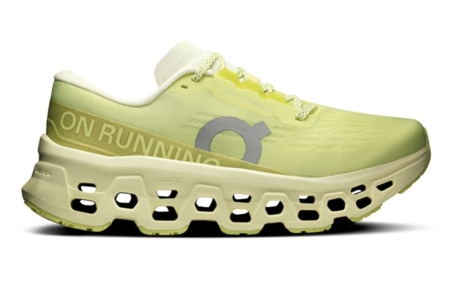
How I Tested the On Cloudmonster 3
I put 70 logged miles into the Cloudmonster 3 on South Jersey roads and boardwalks. I am 182 lb, mildly overpronate, and usually land from heel toward midfoot. I pay particular attention to heel hold, midfoot pressure, and whether the shoe still feels composed when my stride gets less tidy late in a run. Those are the conditions under which this review’s fit and ride verdict applies.
| Test lens | What I observed | What it can tell me |
|---|---|---|
| Easy road and boardwalk miles | The shoe feels protective, firm, and most natural once I settle into a rhythm. | Whether I would use it for ordinary daily mileage. |
| Steady running | The rocker and Speedboard make the transition feel more decisive. | Whether the shoe earns a slot beyond recovery pace. |
| Brief loose-gravel detour | Pebbles can lodge in the open sole geometry. | A practical route limitation, not a full trail-traction test. |
| Fit over repeated runs | Heel hold stayed secure; the midfoot remained the area I would check first. | Who should try the shoe before buying. |
| Wear at 70 miles | Light outsole scuffing, fine midsole creases, and no upper fraying. | Early condition only, not an expected lifespan. |
I did not run a controlled same-day test against Cloudmonster 2, and I do not have a structured wet-grip or marathon-distance series for this pair. When I describe the shoe as stable or protective, I mean how it behaved for my body and routes. I would not convert those impressions into a universal injury, speed, or durability claim.
My most useful check was asking whether I would select it again for the next easy or steady run. The answer was sometimes yes on clean pavement. For tired-leg recovery days and loose-stone routes, the answer was no. That pattern explains the 6/10 personal rating more clearly than a stack of laboratory figures would.
The ride: protection with a mechanical edge
The first thing I notice is height, but the second is structure. The Cloudmonster 3 does not disappear under my foot like a soft foam trainer. I land on its CloudTec elements, move through a fairly stiff middle, and feel the rocker carry me forward. It is a distinct sequence. On clean road at an easy or steady rhythm, I enjoy it; when I slow down and want a gentle recovery shuffle, I am more aware of the firm platform.
That is why I separate cushioning from softness. There is plenty of shoe between my foot and the pavement, and I do not feel unprotected on boardwalk planks or ordinary asphalt. Yet the sensation is controlled rather than pillowy. The Speedboard and rocker are part of what I feel; the stack height alone cannot predict whether you will like this ride.
The shoe becomes more convincing once I am moving steadily. I can let the rocker do its work without forcing a fast cadence. Short pickups are possible, but I would not choose it for repeated hard intervals or track turns. The weight and tall structure make those sessions feel more cumbersome than they need to. This is a daily trainer with personality, not my workout shoe.
If you are choosing between the Cloudmonster 3 and a calmer daily option from the same brand, my Cloudsurfer 2 review is the more useful next read. Decide whether you want an assertive roll or a shoe that asks for less attention.
Fit and upper: check the midfoot before the toe box
The heel held well for me, and the upper wrapped my midfoot securely without requiring aggressive lacing. I appreciate that kind of lockdown on the boardwalk, especially around turns. At the front, the fit did not feel as generous as the outline of the sole might suggest. I would not buy it blind for a broad or high-volume foot.
On lists the model as regular width and true to size. I would still try your usual size with the socks you run in, then walk briskly and jog if the store allows it. Leave a little room for the foot to expand; check for pressure over the top of the midfoot and along the outside of the forefoot. Going up half a size can change length without solving a shape mismatch. If the middle of the shoe already pinches in the shop, I would choose a different last.
The heel collar felt secure without a hard edge in my running. The knit upper also felt breathable during normal training, but I would not infer an all-weather comfort guarantee from that. A hot, humid run can change how any upper and sock combination behaves; on a long day, I pay attention to rising friction at the fifth metatarsal instead of assuming a good first five miles settles the fit.
Why it feels stable, and where that claim ends
For a neutral shoe with this much sole, the Cloudmonster 3 felt planted under my 182 lb frame. The secure heel and guided transition kept me from feeling as though I were balancing on top of the shoe. That is a useful feature for a runner who wants a tall trainer but dislikes a loose, wandering platform.
I would not describe it as a stability shoe or prescribe it for overpronation. My own mild inward roll felt manageable, but a runner seeking more guidance should compare a dedicated stability model. The flat-feet running shoe guide helps separate platform feel from actual support options. Fit, mechanics, and symptoms matter more than a single neutral-versus-stability label.
There is also a trade-off to the controlled ride. The same stiffness that makes the shoe feel settled can feel intrusive if you prefer a flexible forefoot. I would make that a try-on decision: if the first few strides feel like the shoe is steering you, a long run is unlikely to make that sensation disappear for everyone.
Outsole and durability: an early report, not a mileage promise
At 70 miles, my outsole has only light surface scuffing, the upper is intact, and the midsole shows fine compression lines rather than an obvious collapse. That is a reassuring start. It does not tell me how the shoe will feel hundreds of miles later, and I will not turn a short wear check into a replacement interval.
The open CloudTec geometry is the more immediate practical limit. On road and boardwalk it is unobtrusive. On loose gravel, stones can sit in the openings; I stopped to clear them on a mixed-surface detour. If your usual route includes crushed stone or rough shoulders, inspect the sole after a short test and consider a less open outsole design.
I have not done a repeatable wet traction test in this pair. For rainy days, I would be cautious on painted crossings and wet boards, as I am in any road shoe. My running in the rain guide covers the route and pacing decisions that matter beyond the rubber. When the shoe is older, use my replacement checklist to judge your own pair by wear and changing ride feel.
What Changed from the Cloudmonster 2?
The Cloudmonster 3 keeps the family’s road-training purpose, six-millimeter listed drop, Helion foam, and Speedboard. The meaningful redesign is the combination of triple-layer CloudTec, a more pronounced rocker, and a reworked upper and tongue. Those changes explain why the third version deserves a fresh try-on, even if you already know how the second feels. They do not make it an automatic upgrade for every Cloudmonster 2 owner.
| Area | Cloudmonster 2 | Cloudmonster 3 | What I would do |
|---|---|---|---|
| Cushion construction | Dual-density Helion with enlarged CloudTec elements | Dual-density Helion with triple-layer CloudTec | Judge the actual ride, not the number of layers. My pair still feels structured rather than plush. |
| Transition | Nylon-blend Speedboard and rocker | Nylon-blend Speedboard with a more curved rocker | Try a steady jog to see whether the stronger roll matches your stride. |
| Upper and hold | Previous-generation upper | Reworked knit upper and tongue | Check midfoot pressure and heel hold; a design update does not guarantee your fit. |
| Drop | 6 mm listed | 6 mm listed | Do not expect a geometry change to solve a drop preference. |
My 70-mile review tells you how version 3 works for me. It does not prove that its foam lasts longer, runs faster, or fits every foot better than version 2. If your Cloudmonster 2 is comfortable and still has useful life, I would keep running in it. I would consider version 3 when you want a more assertive forward roll or your old pair’s upper never quite worked. Then I would test the new fit before paying for the upgrade.
One naming detail matters at checkout: the standard Cloudmonster 3 uses Helion foam. Helion HF belongs to the Cloudmonster 3 Hyper line. I would not buy the standard model expecting the softer, more energetic Hyper ride.
How I choose it against Bondi, Novablast, and 1080
These comparisons come from what I reach for in my rotation. They are not a claim that I ran a controlled same-day test in all four pairs. The question I ask is which shoe removes the most friction from the run I actually need to do.
| If I need… | My choice | Reason |
|---|---|---|
| A distinctive, guided road cruise | Cloudmonster 3 | I enjoy the firm roll once I find a steady rhythm. |
| A quieter recovery day | HOKA Bondi 9 | It feels simpler and more comfortable to me when pace is not the goal. |
| More bounce from a daily trainer | ASICS Novablast 5 | I find it smoother and more versatile across ordinary training paces. |
| A traditional soft ride | New Balance 1080v13 | It asks less adaptation from my stride, though its feel is a very different preference. |
For me, Bondi and Novablast are easier recommendations to a runner who has not told me they specifically want the CloudTec feel. The Cloudmonster 3 earns its place when that rolling, structured sensation is the feature you are shopping for. If you are deciding where any of these shoes fits in a week of training, use my daily trainer guide to sort the roles.
Who Should Buy the On Cloudmonster 3?
I would put the Cloudmonster 3 on your try-on list when the ride you want is a secure, guided cruise on roads. Its personality is specific enough that “I need more cushioning” is not a complete buying reason.
- Runners who like a pronounced rocker: the forward roll is the main reward. If that movement feels natural during a short jog, the shoe has a clear job in your week.
- Neutral runners who want a settled tall platform: I felt secure at the heel and did not get the loose-on-top sensation some high shoes give me. It remains a neutral shoe, so choose support by your own needs.
- On fans who want a road trainer for real mileage: this pair makes more sense to me for repeated easy and steady runs than a casual Cloud model. Consider the Cloudsurfer 2 if you want a calmer On alternative.
- Runners who value a firm protective feel: if soft foam makes you feel unstable or disconnected, the Cloudmonster’s more controlled landing may be appealing.
I would buy only after the midfoot passes a real try-on. The upper held me well, but a broad or high-volume foot can turn that useful lockdown into pressure. The usual size printed on the box is less important than being able to move without a hotspot building.
My 182 lb experience may be useful if you also want a structured, protective shoe, but body weight alone does not determine the right model. I would compare fit and ride options in my shoe guide for heavier runners before treating this one pair as the answer.
Who Should Skip the On Cloudmonster 3?
I would steer you away when you need the shoe to be soft, quick, or comfortable on loose surfaces. Those are central parts of the buying decision, not minor caveats at the end of a review.
- Soft-recovery shoppers: the shoe protects me from pavement, but its Speedboard and roll feel more mechanical than soothing. I would pick the Bondi 9 for my own slow recovery miles.
- Frequent gravel runners: I have stopped to clear stones from the CloudTec openings. I would not build a regular mixed-surface week around that outsole.
- Speed-session runners: short pickups are possible, but the tall, substantial build is not what I want for repeated intervals or tight turns.
- Wide or high-volume feet: do not assume the tall sole means a roomy upper. If the midfoot is already tight in the shop, look for a different shape.
- Runners seeking corrective stability: my secure feeling in a neutral shoe does not replace guidance chosen for your mechanics or symptoms. Compare structured support options before buying.
I would also hesitate to make this a beginner’s first and only shoe. A new runner has enough variables to learn without having to decide whether a strong rocker is helping or simply unfamiliar. My beginner shoe guide offers a wider starting set.
How I Use the On Cloudmonster 3 in My Shoe Rotation
I do not give the Cloudmonster 3 every cushioned-shoe job. Its useful slot is an easy or steady road run when I want the roll to keep me moving. On a recovery day, I want less shoe sensation; on a workout day, I want less shoe weight. This is how I make that trade-off in my rotation, rather than inventing a fixed seven-day schedule around one model.
| Session or route | My choice | Why |
|---|---|---|
| Easy road run | Cloudmonster 3 when the fit feels good | The protective, guided transition is useful at a repeatable daily rhythm. |
| Steady road outing | Cloudmonster 3 as an option | The rocker feels more rewarding once I settle into a consistent stride. |
| Very easy recovery | Bondi 9 or another simpler cushioned shoe | I prefer a calmer sensation when tired legs are the point of the run. |
| Faster intervals | A lighter workout shoe | The Cloudmonster’s height and structure add work I do not need. |
| Loose gravel or mixed paths | A shoe with a less open outsole | I do not want to stop to remove pebbles. |
| Long-run planning | Conditional, after a successful longer test | Seventy total miles do not justify a marathon-distance comfort promise. |
If the Cloudmonster is your only pair, use it for the road miles it handles well and be honest about the days it does not. If you rotate shoes, I would pair it with a softer recovery option and a lighter workout option. The comparisons above explain which of my tested alternatives fills each role.
The few specifications I would use to decide
| On Cloudmonster 3 specification | What it means for my review |
|---|---|
| 6 mm heel-to-toe drop | A moderate listed offset; the rocker still shapes the transition strongly. |
| 35 mm heel / 29 mm forefoot stack | A substantial road platform, although height does not equal softness. |
| 295 g listed men’s sample weight | Relevant if you want one shoe for fast sessions as well as easy miles. |
| Dual-density Helion foam, triple-layer CloudTec, Speedboard | The combination behind the firm, forward-rolling sensation I describe. |
| Neutral support, engineered knit upper | Try the fit and support feel on your own foot. |
Those are product specifications, not measurements from my own lab. I have kept them separate from what I felt underfoot. I would not choose between two shoes because one has a marginally different bench measurement if the fit and ride point the other way.
FAQ
Is the On Cloudmonster 3 good for running?
Yes. In my 70-mile test it made the most sense for easy and steady road running. I would choose a lighter shoe for intervals and a different outsole for frequent loose gravel.
Does the On Cloudmonster 3 run true to size?
On lists it as true to size. I felt a secure heel and snug midfoot, so I would try your usual size first and judge pressure across the midfoot and toe room while moving. I would not prescribe a half-size change for every foot.
Is the Cloudmonster 3 soft?
It is protective but did not feel plush to me. The rocker, CloudTec elements, and Speedboard create a firm, guided transition rather than a sink-in landing.
Is the Cloudmonster 3 a stability shoe?
No. It is a neutral trainer. I felt steady in it, but my experience does not make it a substitute for a stability shoe selected for your fit or support needs.
How durable is the Cloudmonster 3?
At 70 logged miles, my pair showed light outsole scuffing, fine midsole creases, and no upper fraying. That is an early wear report; I cannot promise a final lifespan from it.
Is it better than the HOKA Bondi 9?
For my easy and recovery running, I would buy the Bondi 9 for its simpler comfort. I would pick the Cloudmonster 3 only when I specifically wanted its firmer, more guided roll.
Would I buy the Cloudmonster 3 again?
No. I respect its secure, protective ride, but it is a 6/10 personal fit in my rotation. I reach more often for smoother daily trainers.
My final call: I would buy the Cloudmonster 3 only after a short run confirms that its midfoot fit and guided roll feel right. It makes clean-road miles engaging and feels more settled than its height suggests. I would still choose Bondi or Novablast for most runners asking me for one uncomplicated daily trainer. The Cloudmonster earns its place for the runner who wants this particular On ride, not merely a thick sole.

Written by Ken — I have spent 12 years running and testing shoes across daily training, long runs, and races from 5K to 50K. I do most of my road testing around Atlantic City and South Jersey. My reviews explain what I observed, what I would buy for my own rotation, and where my test mileage stops supporting a claim. More about me →