
This Saucony Xodus Ultra 4 review is based on 250 verified miles in a men’s US 10.5, including long trail runs, wet roots, mud, sand, creek crossings, gravel, and paved connectors. For higher-mileage trail days, compare these trail shoes for long distances.
Here is my direct verdict: the Xodus Ultra 4 is a protective, stable trail cruiser built for long hours rather than fast splits. Its expanded PWRRUN PB core feels energetic enough to keep heavy legs moving, and Vibram Megagrip fixes the wet-surface weakness of earlier Xodus models. The penalties are weight, a tapered toe shape, and less point-load protection after Saucony removed the rock plate. I scored it 7.8/10.
I am 5’10”, 182 pounds, mildly overpronate, and usually land between my heel and midfoot. I run 30–40 miles most weeks around Atlantic City, New Jersey. My local trails are rooty, sandy, flat-to-rolling, and often wet—not alpine talus. Every personal claim below stays attached to that context.
Verdict: Buy the Xodus Ultra 4 for daily trail mileage, long runs, hiking, and ultras on moderate-to-rocky terrain. Choose a lighter shoe for short racing or fast technical descents. Skip it if your feet need a broad, squared toe box or if most of your route is pavement.
In this review
Xodus Ultra 4 review: specs and score
The Xodus Ultra 4 combines a PWRRUN PB core, supportive PWRRUN frame, 6 mm drop, and full-coverage Vibram Megagrip outsole.
| Specification | Published or tested value | What it means |
|---|---|---|
| Saucony weight | 10.9 oz / 309 g, men’s sample | Heavy for racing, reasonable for a full-rubber ultra shoe |
| My pair | 11.8 oz in men’s US 10.5 | Size and scale protocol explain why personal weights vary |
| Saucony stack / drop | 36 mm heel / 30 mm forefoot; 6 mm | High forefoot protection with a moderate offset |
| Independent lab stack / drop | 37.6 mm / 31.1 mm; 6.5 mm | Close to brand geometry under another protocol |
| Midsole | PWRRUN PB core inside a PWRRUN chassis | Soft, resilient core with a firmer frame for control |
| Sockliner | PWRRUN+ | Thicker, springier insert than basic EVA |
| Outsole | Full-coverage Vibram Megagrip | Reliable wet-rock adhesion and broad durability |
| Lug depth | Saucony: 4 mm; lab: 3.5 mm | All-purpose trail tread, not a deep-mud specialist |
| Rock plate | None | Version 4 removes the woven plate used in version 3 |
| Upper | High-abrasion engineered mesh | Secure and protective, with average ventilation |
| My size | Men’s US 10.5, standard width | True to size for my medium-volume foot |
| My mileage | 250 verified miles | Ten logged sessions plus ordinary trail mileage |
| Ken’s rating | 7.8 / 10 | Excellent stability and wet grip; average speed and toe-room scores |
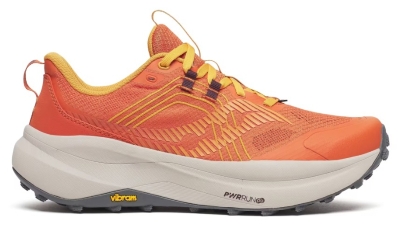
PWRRUN PB is a Saucony expanded-bead PEBA cushioning foam. In this trail running shoe it sits inside a firmer PWRRUN carrier, so the ride is more controlled than an exposed racing-foam slab.
My scorecard after 250 miles
| Category | Score / 10 | My reason |
|---|---|---|
| Heel cushioning | 8.4 | Deep protection that stayed controlled under my 182-pound frame |
| Forefoot cushioning | 8.5 | Plenty of foam for long descents without a mushy toe-off |
| Stability | 8.9 | Wide base, sidewalls, firm carrier, and structured heel |
| Fit | 7.6 | Good midfoot volume, but a tapered and relatively low toe box |
| Dry grip | 8.2 | Secure on dirt, gravel, roots, and moderate rock |
| Wet grip | 8.5 | Major upgrade on damp roots and wet hard surfaces |
| Durability | 7.3 | Usable at 250 miles, with visible lateral wear and reduced freshness |
| Transition | 7.4 | Rocker helps, but mass still appears when pace rises |
| Versatility | 7.5 | Handles many trail surfaces; pavement and deep mud remain weak points |
| Overall | 7.8 | A trustworthy long-distance tool rather than a fast all-rounder |
Xodus Ultra 4 review: how I tested it
I logged 250 miles across long trail runs, wet tests, easy mileage, technical sections, and deliberately unpleasant road connectors.
My first run started at 7:30 a.m. in September on six miles of Estell Manor Park trail. Pine needles covered damp dirt, and the first root garden arrived before the shoe felt broken in. The outsole held; the heel stayed centered; the midsole muted the root edges without erasing the shape of the trail.
The best run was a solo ten-mile loop on the Absegami Trail after a wet week. Mud, standing water, slick roots, and saturated sand exposed the difference between compound grip and lug depth. Vibram adhered well to roots. The 4 mm tread handled shallow mud but began collecting soil once the ground became deeper and sticky.
My longest structured check was 12 miles on the same Bass River system. After a creek crossing near mile six, the upper released water reasonably well. The foam stayed protective over the final rocky sections, although I could identify sharp points more clearly than I would through a plated shoe.
The worst outing included a long concrete connector between trailheads. Full rubber and 11.8 ounces made the shoe feel closer to a light hiker than a road trainer. Runners moving from asphalt should use my road-to-trail transition guide before assuming one shoe can erase the difference between surfaces.
| Mileage phase | What changed | How I used it |
|---|---|---|
| 0–40 miles | Carrier felt firm; upper settled quickly; outsole grip was immediate | Short easy runs and fit checks |
| 41–120 miles | PWRRUN PB core felt smoother; best balance of rebound and control | Long trail runs and wet testing |
| 121–200 miles | Ride remained protective; outer heel lugs began rounding | Routine trail mileage and hiking |
| 201–250 miles | Less rebound at the heel; grip remained dependable on moderate trail | Easy-to-steady running, no priority races |
This is field testing, not a metabolic study. I can describe fit, traction, wear, stability, and perceived effort. I cannot turn GPS pace on changing trail conditions into a precise running-economy benefit.
Xodus Ultra 4 review: ride and cushioning
The ride is soft at contact, stable through loading, and gently rockered rather than aggressively propelled.
The PWRRUN PB core supplies the comfort. The firmer PWRRUN frame keeps that core from spreading sideways when only half the shoe lands on a root. At 182 pounds, I compress the center enough to feel rebound, but the carrier stops the heel from drifting.
That construction explains why the shoe feels less lively than a road racer using related foam. More rubber, a reinforced upper, a wider platform, and the carrier all consume energy while adding control. The result is durable trail comfort, not a trail version of the Endorphin Pro.
At easy pace, the heel-to-forefoot roll feels natural. At steady effort, the rocker helps me maintain cadence as the legs tire. Hard surges are possible, but I struggled to make repeated changes of speed feel crisp because the shoe needs time to redirect its mass.
Soft cushioning held stable by the PWRRUN carrier. That independent agreement matters more than a generic label such as “max cushion.”
If you are comparing road cushioning, use my best cushioned running shoes separately. The Xodus trades road smoothness for rubber coverage, trail hold, and lateral control.
Xodus Ultra 4 review: Vibram traction
Vibram Megagrip is the defining upgrade, delivering reliable adhesion on wet roots, rock, hardpack, and loose-over-firm trail.
The rubber feels tacky when I press a thumb into it, but compound alone is not the whole story. Chevron lugs face forward under the forefoot for drive and reverse under the heel for braking. Full coverage keeps the contact pattern consistent when the foot lands off-center.
RunRepeat recorded a 0.72 forefoot-traction coefficient against a 0.65 lab average at the time of testing. That number is useful for controlled comparison, not a guarantee on every surface. Wet painted bridges, algae, ice, and leaves can overwhelm any rubber.
In shallow mud, the 4 mm pattern bites and releases. In deep clay-like mud, the spacing fills and grip drops. This is an ultra-distance outsole for varied American trail—not a fell-running sole with widely spaced 6–8 mm teeth.
Use the shorter stride and visibility rules in my rain-running guide. Good wet grip helps because it increases the margin for error; it does not make careless foot placement safe.
Xodus Ultra 4 review: sizing and fit
My usual men’s US 10.5 fits securely, with adequate midfoot volume but a tapered, relatively low toe box.
For a quick Saucony Xodus Ultra 4 sizing answer, start true to size if your foot is medium volume. I had enough length, secure heel hold, and room for moderate swelling. On steep descents, I needed careful lacing to prevent the foot from moving forward.
The apparent contradiction—roomy overall but narrow at the toes—makes sense when measured. RunRepeat’s gel mold was 96.6 mm at its widest point, slightly above its trail average. Near the big toe it narrowed to 71.6 mm, below the 74.1 mm average, while vertical clearance measured only 24.5 mm.
- Medium-volume feet: start with your normal Saucony running size.
- Between sizes: compare a half-size up, especially for ultra-distance swelling.
- Wide or square forefeet: try before buying; extra length does not remove toe taper.
- Low-volume feet: add tension through the middle eyelets, not across the toes.
- Steep-descending routes: test lockdown on an incline before committing.
The current US listing shows standard width rather than a dedicated wide option. I know how frustrating that is when the platform looks broad in photos. My wide-foot running shoe guide covers models whose upper shape matches their wide base more closely.
Stability, rock protection, and ground feel
The Xodus Ultra 4 is a neutral shoe with strong inherent stability, built from width, sidewalls, and dual-density foam.
RunRepeat measured a 116.7 mm forefoot base and 97.3 mm heel, both broader than its contemporaneous averages. Those dimensions explain why my mild overpronation felt controlled without a medial post. The firm carrier also rises around the foot instead of leaving it perched on top.
The high stack still has limits. On moderate rock gardens, the platform is calm. On sharply angled rocks or fast sidehills, the distance from foot to ground delays feedback. I slow down before the outsole runs out of grip because the tall platform takes longer to settle.
Version 4 has no rock plate. Saucony removed the woven plate found in version 3. Thick PWRRUN PB, the carrier, a 2.1 mm lab-measured rubber base, and the insole supply most protection. Broad rocks disappear; sharp concentrated points remain easier to identify.
GearJunkie’s field review also confirms the plate removal and frames Vibram as the major trade. For sustained scree or sharp talus, I would choose a plated alternative. For rolling East Coast trail, I prefer the smoother forefoot.
Use the foot-placement cues in my uphill and downhill running guide. Stability features help, but technique and pace decide whether a tall shoe stays controlled.
Upper, lockdown, drainage, and gaiter loop
The engineered mesh balances trail hold with comfort, while the gusseted tongue controls debris and lace pressure.
Durable overlays reinforce likely abrasion zones without turning the upper into a stiff shell. The heel counter is substantial. I had no rubbing, and the collar stayed secure even after water crossings.
The offset lace loops are not decoration. They pull the upper from different angles, helping the midfoot wrap without requiring excessive pressure on one row. I use moderate tension near the toes, firmer tension through the middle, and the top eyelets only for steep descending.
Drainage is adequate rather than fast. After a creek crossing, I felt water leave gradually through the mesh while the thick sockliner retained some moisture. Removing the insole after the run speeds drying.
A D-ring at the forefoot accepts a gaiter hook. Pair it with the options in my trail running gaiter guide when sand, scree, or snow regularly enters around the collar.
Is the Saucony Xodus Ultra 4 waterproof?
No. The standard Xodus Ultra 4 uses engineered mesh and is not a waterproof trail shoe.
Light splashes can bead briefly on reinforced areas, but rain and standing water enter through the mesh. That is not necessarily a flaw. A non-membrane upper breathes and drains better in warm weather, while waterproof membranes mainly delay water entry below collar height.
For creek crossings, use socks that do not hold excess water and avoid cotton. My running sock tests focus on seam placement, moisture handling, and friction—three factors that matter more once a shoe is wet.
Xodus Ultra 4 review: durability after 250 miles
My pair remains usable at 250 miles, with rounded outer-heel lugs, mild forefoot wear, and reduced heel rebound.
For a direct Xodus Ultra 4 durability answer, my pair is past its freshest phase but has not reached structural failure.
The upper has no structural tear. Lace loops remain secure, the toe reinforcement has stayed bonded, and the heel lining is intact. Mud staining is cosmetic. Full outsole coverage has protected the midsole from the cuts and exposed-foam abrasion common in lighter trail shoes.
My lateral heel is the first area to round because that is where I contact the ground. The forefoot edges have softened, but braking and climbing traction remain predictable on moderate dirt. Deep-mud performance declines faster because effective lug depth matters more there.
The downside is gradual foam aging. The shoe did not fail on one run; it simply stopped feeling as fresh. I compare it beside a newer cushioned shoe because memory normalizes slow changes. Be patient with the diagnosis and look for repeated signs, not one tired outing.
I would not promise a universal lifespan. Use the outsole, midsole symmetry, new discomfort, and assigned purpose checks in my running-shoe replacement guide. A physical therapist can add gait analysis when pain or asymmetric wear persists.
After mud, loosen the laces, remove the sockliner, brush dried soil away, and air-dry without direct heat. My trail-shoe washing guide explains why a dryer can damage adhesives and foam.
Saucony Xodus Ultra 4 vs 3
Version 4 adds more PWRRUN PB and Vibram Megagrip, removes the rock plate, and keeps the same stated 36/30 geometry.
| Feature | Xodus Ultra 4 | Xodus Ultra 3 | Winner / tradeoff |
|---|---|---|---|
| Core foam | About 8% more PWRRUN PB volume at forefoot | Smaller PWRRUN PB core | v4 for long-run comfort |
| Stated geometry | 36/30 mm; 6 mm drop | 36/30 mm; 6 mm drop | Tie |
| Outsole | Full-coverage Vibram Megagrip | PWRTRAC | v4 for wet grip |
| Rock plate | None | Woven forefoot plate | v3 for sharp-point protection; v4 for smoother flex |
| Lab lug depth | 3.5 mm | 4.3 mm | v3 for deeper loose ground |
| Lab weight | 11.0 oz | 11.1 oz | Effectively tied across those samples |
| Best use | Wet, varied, long trail | Rockier routes where a plate matters | Terrain decides |
Version 4 is the better shoe for my wet New Jersey routes because Megagrip fixes the issue I felt most often. That does not make it a universal upgrade. A runner who loved version 3 specifically for its forefoot plate may prefer the older protection.
Both versions retain a 6 mm stated offset. If that geometry is new to you, my heel-drop guide explains how offset can shift demand without predicting injury from one number.
Best distances, surfaces, and paces
The Xodus Ultra 4 works best at easy-to-steady effort over long, varied trails where protection matters more than low weight.
| Use | Fit for purpose | Why |
|---|---|---|
| Easy daily trail | Excellent | Stable cushion, secure upper, and durable rubber |
| Long run / ultra training | Excellent | Forefoot depth and rocker help as fatigue builds |
| Hiking | Very good | Traction and comfort; more flexible than a boot |
| Rocky moderate trail | Very good | Thick foam protects, though there is no plate |
| Road-to-trail | Good for short connectors | Stable on pavement, but heavy and rubber-forward |
| Fast technical racing | Fair | Weight and stack slow direction changes |
| Deep mud | Fair | 4 mm lugs lack the clearance of a mud specialist |
Best for: 50K-to-ultra training, long supported trail days, hiking, and runners who want controlled PEBA cushioning with wet grip.
“Ultra” does not mean the shoe carries nutrition or water for you. Use my trail hydration calculator guide and hydration vest comparison to build the rest of the system around route length and conditions.
For pre-dawn or late finishes, the shoe lacks meaningful reflective elements. My trail headlamp tests cover beam shape and runtime; visibility cannot depend on footwear accents.
Xodus Ultra 4 vs key alternatives
Choose Xodus for stable long-distance cushioning and wet grip; choose a rival when agility, toe width, or road comfort leads.
| Shoe | Choose it over Xodus Ultra 4 when… | Choose Xodus Ultra 4 when… |
|---|---|---|
| HOKA Speedgoat | You want lower mass and quicker technical movement | You prefer a broader heel, dual-density control, and smoother long-run feel |
| New Balance Hierro | You want softer cruising and multiple width options | You want more energetic PWRRUN PB and stronger all-around wet grip |
| HOKA Challenger | Your route contains substantial pavement and mild trail | Your route is primarily dirt, rock, roots, and wet ground |
| Brooks Cascadia | You prioritize plated rock protection and technical precision | You prioritize long-distance foam and a less rigid forefoot |
| Saucony Peregrine | You want lighter, lower, faster technical handling | You want more cushioning for long hours |
| Salomon Thundercross | You regularly run deep mud and loose slopes | You want better hard-surface versatility and smoother transitions |
The closest published NextGait comparison is my HOKA Speedgoat review. I would take the Speedgoat for fast, narrow technical trail. I would take the Xodus when stability, forefoot protection, and a measured all-day rhythm matter more.
Who should buy the Xodus Ultra 4?
Buy it for long trail mileage, wet mixed terrain, stable cushioning, and a secure standard-width fit.
- Trail runners training for a 50K, 50-miler, or long time-on-feet event.
- Heavier runners who make unframed soft foams feel unstable.
- Heel-to-midfoot strikers who appreciate a broad rear platform.
- Hikers who want running-shoe cushion with full trail rubber.
- Runners facing wet roots and rock more often than deep mud.
New trail runners should compare it with the easier options in my best beginner trail shoes and learn pacing, safety, and etiquette in the trail running beginner’s guide.
Who should skip it?
- Wide, square-footed runners who need a broad toe shape.
- Short-distance racers who prioritize low mass and fast turnover.
- Runners on sustained sharp talus who specifically want a rock plate.
- Deep-mud specialists who need longer, widely spaced lugs.
- Road-first runners whose trail segment is short and smooth.
Do not buy it as a treatment for downhill knee pain or unstable ankles. Footwear changes comfort and loading, but it does not diagnose a condition. Start with load and technique in my downhill trail knee-pain guide, and seek a clinician if symptoms persist or worsen.
How I would use it in a rotation
I assign Xodus Ultra 4 to easy and long trail days, then use a lighter shoe for speed and technical racing.
A two-shoe trail rotation is enough for most runners. Xodus handles routine mileage, long outings, and wet mixed terrain. The second shoe should solve a specific gap: longer lugs for mud, a lower platform for technical precision, or less mass for racing.
Keep ordinary asphalt training in a road model from my daily trainer guide. That preserves the Vibram lug edges and prevents a trail-specific shoe from becoming an unnecessarily heavy road option.
Xodus Ultra 4 review: final verdict after 250 miles
The Xodus Ultra 4 earns trust through grip, protection, and predictable handling rather than headline speed.
At Estell Manor, I noticed how quickly the outsole settled onto damp roots. At Bass River after rain, the shoe kept a stable rhythm through water, mud, and sand. On concrete, its weight and rubber became impossible to ignore. Those experiences define its real range.
Version 4 is a meaningful update, not a cosmetic one. More PWRRUN PB improves long-run comfort. Vibram Megagrip transforms wet adhesion. Removing the plate smooths the forefoot but gives up some defense against concentrated rock pressure.
Final score: 7.8/10. I would buy it again for long, wet East Coast trail. I would add a lighter plated or lower-stack shoe before racing highly technical mountain terrain.
Xodus Ultra 4 review FAQ
Is the Saucony Xodus Ultra 4 true to size?
My normal men’s US 10.5 fit true to size. The midfoot has adequate room, but the toe box tapers and has below-average vertical volume. Compare a half-size up if you are between sizes or expect major swelling.
Is the Xodus Ultra 4 good for wide feet?
It is roomy at the widest part but tapers near the toes, and the current US listing shows standard width. Wide, square, or high-volume forefeet should try it before buying rather than relying on the broad platform.
Does the Xodus Ultra 4 have a rock plate?
No. Saucony removed the woven rock plate used in version 3. Version 4 relies on thick PWRRUN PB, a PWRRUN carrier, full outsole rubber, and the sockliner for underfoot protection.
Is the Saucony Xodus Ultra 4 waterproof?
No. The engineered mesh upper lets rain and creek water through. It also drains and breathes better than a waterproof membrane in warm conditions.
What is the Xodus Ultra 4 heel-to-toe drop?
Saucony lists a 6 mm drop from a 36 mm heel and 30 mm forefoot. RunRepeat independently measured 37.6 mm and 31.1 mm, a 6.5 mm difference in its sample.
How deep are the Xodus Ultra 4 lugs?
Saucony lists 4 mm lugs; RunRepeat measured 3.5 mm at its test point. The outsole works across varied trail but does not clear deep mud like a widely spaced fell-running tread.
Can the Xodus Ultra 4 run on roads?
It handles short road connectors safely, but its weight and full rubber coverage feel inefficient on longer paved sections. Buy it when trails make up most of the route.
Is the Xodus Ultra 4 good for hiking?
Yes. Stable cushioning, Vibram grip, and a protective upper make it a strong hiking shoe on varied terrain. It does not provide the ankle coverage or heavy-load support of a hiking boot.
How long does the Xodus Ultra 4 last?
My pair remained usable at 250 miles with rounded outer-heel lugs and reduced rebound. Lifespan varies with body mass, gait, terrain, and pavement exposure, so inspect performance rather than replacing at one universal number.
Is the Xodus Ultra 4 suitable for an ultramarathon?
Yes, especially on rolling dirt, forest trail, gravel, roots, and moderate rock. Test its tapered toe shape and downhill lockdown on long runs before choosing it for race day.

Written and reviewed by Ken — founder of NextGait, running since 2014, with 12,500+ miles, 63 shoes tested, and 36 races from 5Ks to a 50K ultra. He runs 30–40 miles a week around Atlantic City and writes from logged training and shoe-testing experience. More about Ken