
This Brooks Caldera 8 review is based on 117 verified miles in a men’s US 10.5, including long trail runs, wet roots, sugar sand, gravel, creek crossings, mud, and road connectors.
My verdict is simple: Caldera 8 is one of the most stable high-cushion trail shoes I have used, and it becomes more convincing as a run gets longer. The broad heel, raised sidewalls, and DNA LOFT v3 take fatigue out of moderate terrain. It is also heavy, slow to turn, warm in summer, and poorly matched to deep mud or aggressive racing. I scored it 7.8/10.
I am 5’10”, 182 pounds, mildly overpronate, and usually land between my heel and midfoot. I run 30–40 miles most weeks around Atlantic City, New Jersey. My local trails are sandy, rooty, wet, and mostly flat-to-rolling. A mountain runner on scree will expose different limits.
Verdict: Buy Caldera 8 for easy trail mileage, long runs, hiking, and ultras on gravel, forest road, roots, and moderate rock. Choose Speedgoat or Cascadia for faster technical work. Choose a dedicated mud shoe for deep winter ground. For rougher ground, compare these trail shoes for technical terrain.
In this review
Brooks Caldera 8 review: specs and score
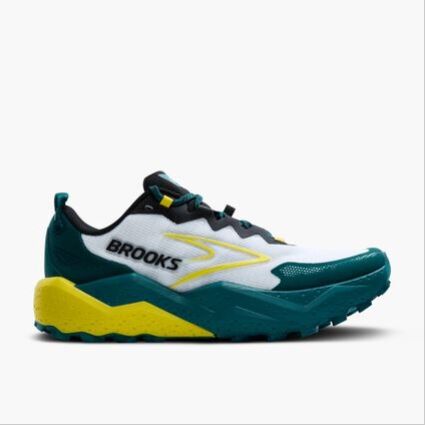
Caldera 8 combines nitrogen-infused DNA LOFT v3, a 6 mm stated drop, raised sidewalls, and TrailTack Green rubber.
| Specification | Published or tested value | What it means |
|---|---|---|
| Brooks weight | 10.6 oz / 300.5 g | Heavy compared with faster trail shoes; sample size matters |
| My pair | 12.0 oz, men’s US 10.5 | Larger size and kitchen-scale protocol explain the difference |
| Brooks drop | 6 mm | Moderate offset suited to heel-to-midfoot transitions |
| Published stack | 38.5 mm heel / 32.5 mm forefoot | High protection without crossing the 40 mm heel mark |
| Independent lab stack / drop | 36.7 mm / 27.9 mm; 8.8 mm | Different sample and measurement protocol produced a larger offset |
| Midsole | Nitrogen-infused DNA LOFT v3 | Soft EVA-based cushioning tuned for comfort and stability |
| Outsole | TrailTack Green, 25% recycled content | Good wet/dry adhesion with multi-directional tread |
| Lug depth | Published: 4 mm; lab: 3.6 mm | Versatile on moderate trail; limited mud clearance |
| Rock plate | No dedicated rock plate | Protection comes from foam depth, rubber, and platform geometry |
| Upper | Quick-dry engineered mesh with TPEE reinforcement | Version 8’s main update |
| My size | Men’s US 10.5, standard width | True to size for my medium-volume foot |
| My mileage | 117 verified miles | Enough for fit, grip, and early-wear findings—not an end-of-life verdict |
| Ken’s rating | 7.8 / 10 | Outstanding stability and cushioning; lower speed and mud scores |
DNA LOFT v3 is a nitrogen-infused Brooks cushioning foam. It is EVA-based and tuned here for a soft, controlled ride rather than race-shoe rebound.
My scorecard after 117 miles
| Category | Score / 10 | My reason |
|---|---|---|
| Heel cushioning | 9.0 | Deep, quiet protection that works well at my body weight |
| Forefoot cushioning | 7.8 | Protective, but less plush than the visual midsole volume suggests |
| Stability | 8.5 | Massive heel base, raised walls, and secure counter |
| Fit | 7.9 | True length and useful volume without sloppy heel movement |
| Dry grip | 9.0 | Excellent on dirt, roots, sand-over-hardpack, and moderate rock |
| Wet grip | 7.8 | Reliable on damp roots; less convincing in packed mud |
| Durability | 7.3 | Minimal wear at 117 miles, but the test is still developing |
| Transition | 6.5 | Smooth at easy pace, slow during repeated accelerations |
| Versatility | 7.6 | Broad trail range, narrow pace range |
| Overall | 7.8 | A stable long-haul platform, not an agile racer |
Brooks Caldera 8 review: how I tested it
I logged 117 miles across four structured checks plus ordinary trail runs, including wet, long, sandy, rocky, and paved segments.
My first run started at 5:00 a.m. in August at Tuckahoe Wildlife Management Area. The sand still held the previous day’s heat. Six miles of fire road gave me packed dirt, loose sugar sand, and a creek crossing near mile three.
The shoe soaked through immediately at the crossing. By the next mile, the quick-dry upper had released much of the slosh. TrailTack held the muddy exit bank, while the wide heel kept my landing calm when one side found firmer ground than the other.
My best run was eight miles on Absegami Trail in early fall. Sugar-sand fire road, roots, moderate rock, and two water crossings let the Caldera do its intended job. I finished without hot spots and did not think about underfoot protection once.
The longest outing was 13 miles through Wharton State Forest. Cushioning stayed consistent late in the run, but quick turns still required deliberate foot placement. The platform is stable after it lands; it is not quick while moving from one line to another.
A long concrete connector exposed the opposite side. Caldera is runnable on pavement, but full trail rubber, broad geometry, and my 12-ounce sample felt wasteful there. Read my road-to-trail transition guide before choosing it for a road-first route.
| Mileage phase | What I noticed | How I used it |
|---|---|---|
| 0–25 miles | Foam felt firmer than its shape implied; heel hold was immediate | Short easy trail and fit checks |
| 26–60 miles | Ride settled; upper flexed more naturally over the toes | Mixed surfaces and wet testing |
| 61–100 miles | Best comfort; no meaningful loss of traction or cushion | Long trail runs |
| 101–117 miles | Minor lateral heel scuffing; midsole still feels close to fresh | Easy-to-steady trail and hiking |
This is field testing, not a metabolic laboratory. I can evaluate fit, surface behavior, stability, comfort, and visible wear. I cannot convert GPS pace over changing terrain into an exact running-economy gain.
Brooks Caldera 8 review: ride and cushioning
Caldera 8 rides soft at the heel, moderate at the forefoot, and smoother than its bulky silhouette suggests.
DNA LOFT v3 compresses slowly under my heel and returns without a sharp bounce. That behavior works on long easy efforts because the landing feels calm rather than exciting. The forefoot is protective, but it never feels as deep as the heel.
The moderate rocker and outsole flex grooves keep the platform from behaving like a solid block. At conversational pace, transition is smooth. At steady pace, I can maintain turnover. During short surges, width and mass take more effort to redirect.
RunRepeat’s current protocol measured 127 SA of heel shock absorption but only 99 SA at the forefoot. Those results help explain my heel-forward experience. They are machine measurements, not promises about how much impact any runner’s body experiences.
I struggled to make fast trail repetitions feel crisp. Be patient if you are moving from a lighter shoe; Caldera rewards an even rhythm, not constant changes of pace.
For road cushioning, compare shoes separately in my best cushioned running shoes. Caldera adds sidewalls, tread, and trail structure that make direct weight or softness comparisons misleading.
Brooks Caldera 8 review: TrailTack grip
TrailTack Green grips hardpack, roots, gravel, and wet rock well, but the closely spaced lugs retain deep mud.
The 4 mm chevrons point forward under the forefoot for drive and reverse under the heel for braking. Angled edge lugs catch during turns. A central cutout lets the outsole adapt slightly instead of forcing the whole rear platform to move as one piece.
On dry trail, grip is one of Caldera’s best features. Sand over packed dirt feels predictable. Damp roots demand normal caution, but I had no sudden loss of adhesion during the Absegami test.
Mud is different. Once the gaps fill, the rubber no longer contacts the ground cleanly. TrailTack can be a good compound and still lose traction because the tread cannot clear soil quickly enough.
RunRepeat measured 3.6 mm lugs and a 0.59 forefoot traction coefficient against its 0.65 trail average. Lab results isolate one condition; my field result is broader: dependable moderate-terrain grip, average deep-mud ability.
Use the visibility and foot-placement rules in my rain-running guide. No outsole cancels wet leaves, ice, algae, or poor line choice.
Brooks Caldera 8 review: sizing and fit
My usual men’s US 10.5 fits true to size, with secure heel hold and average—not foot-shaped—toe space.
For a direct Brooks Caldera 8 sizing answer, start with your normal Brooks running size if your foot is medium volume. I had a thumb’s width in front, no heel lift, and enough room for swelling over 13 miles.
The outside looks much wider than the inside. RunRepeat’s gel mold measured 94.6 mm at the widest interior point and 73.0 mm near the big toe, both close to average. The enormous 104.0 mm heel refers to the platform beneath the foot, not internal width.
- Medium-volume feet: begin true to size.
- Between sizes: compare the half-size up after the feet warm.
- Wide, square forefeet: try before buying; the US listing shows standard width.
- Narrow feet: tighten the offset midfoot loops before using a runner’s knot.
- Ultra-distance use: test the shoe on a descent after two hours, not only in a store.
I know how easy it is to confuse a wide outsole with a wide last. If Caldera presses the big-toe joint, buying extra length may create heel movement without solving shape. Compare alternatives in my wide-foot running shoe guide.
Stability, rock protection, and ground feel
Caldera 8 is a neutral shoe with exceptional inherent stability from its wide heel, raised sidewalls, and secure upper.
The foot sits inside the foam perimeter instead of balancing entirely on top. The rear platform measured 104.0 mm in RunRepeat’s lab, 13.5 mm wider than its trail average. That is the main reason my mild overpronation feels calm at easy pace.
High stack still reduces precision. When one edge lands on a root, the sidewall limits movement, but the warning reaches my foot later than it would in a lower shoe. The platform is stable once planted; it is not nimble between plants.
Caldera 8 has no dedicated rock plate. Thick DNA LOFT v3, outsole rubber, and a reinforced toe bumper supply practical protection. Broad rocks disappear under the foam, while concentrated sharp points remain easier to identify than through a plated Cascadia.
Use the shorter-stride cues in my hill-running guide. A wide base creates margin; it cannot compensate for braking hard or landing across a steep slope.
Upper, lockdown, drainage, and heat
The revised TPEE-reinforced mesh improves hold and drainage, while offset lacing distributes pressure across the midfoot.
Version 8’s quick-dry upper is its main change. The woven structure resists trail abrasion without a heavy external cage. The semi-gusseted tongue stays centered and blocks most debris, while a lace keeper controls loose ends.
The offset lacing path pulls from the medial side and helps center my foot over the broad base. I use light tension near the toes, moderate tension through the middle, and the top eyelets only when descending hold needs work.
At the Tuckahoe crossing, water entered immediately and drained gradually over the next mile. The mesh dries faster than Caldera 7’s denser upper, but the padded collar and sockliner still retain moisture.
Ventilation is merely adequate. On humid summer runs, the upper and thick foam create a warm package. Use socks from my anti-blister running sock guide, and adjust hydration with the cues in my hot-weather running guide.
Is the Brooks Caldera 8 waterproof?
No. Brooks Caldera 8 uses quick-dry mesh and is not a waterproof trail running shoe.
Rain, wet grass, and creek water pass through the upper. The benefit is improved drainage and lower heat compared with a waterproof membrane. For warm creek crossings, I prefer water that can leave over water that enters above a membrane collar and remains trapped.
A trail gaiter can block sand, gravel, and debris, but it does not waterproof the mesh. My trail gaiter comparison explains when the extra barrier is useful.
Brooks Caldera 8 review: durability after 117 miles
At 117 miles, my outsole shows minor lateral-heel scuffing, while the midsole, heel lining, and lacing structure remain healthy.
For a direct Brooks Caldera 8 durability answer, this is an encouraging early report, not a retirement assessment. DNA LOFT v3 still feels close to its settled 30-mile state. The lugs retain their working edges, and I have no structural upper tear.
My lateral heel marks first because that is my contact point. The central rubber cutout exposes some foam, but it has not collected a meaningful gouge. Road connectors scrub lug edges faster than soft trail, so route composition matters.
RunRepeat’s Dremel removed 1.0 mm of outsole rubber against a 0.9 mm lab average. Its toe-mesh result was weaker at 2/5, while heel padding scored 4/5. Those isolated tests identify likely areas to inspect; they do not predict an exact mileage.
The downside of a 117-mile test is uncertainty. I will update the verdict if foam, overlays, or traction change materially. I know how tempting it is to project “500 miles” from clean rubber, but one pair has not earned that claim.
Use the checks in my running-shoe replacement guide rather than one mileage rule. Persistent pain or asymmetric wear deserves assessment from a physical therapist, who may include strength testing and gait analysis.
After mud, remove the sockliner, loosen the laces, brush off dry soil, and air-dry away from heaters. My trail-shoe washing guide explains why machine heat can damage foam and adhesives.
Brooks Caldera 8 vs 7
Caldera 8 keeps version 7’s midsole and outsole architecture, then improves fit, drainage, and upper security.
| Feature | Caldera 8 | Caldera 7 | Winner / tradeoff |
|---|---|---|---|
| Midsole | DNA LOFT v3, same basic geometry | DNA LOFT v3 | Tie; v8 may feel slightly firmer by sample |
| Stated drop | 6 mm | 6 mm | Tie |
| Outsole | TrailTack Green, same lug layout | TrailTack Green | Tie |
| Upper | Quick-dry mesh with TPEE reinforcement | Earlier engineered mesh | v8 for drainage and structure |
| Lacing | Offset path and revised loops | More conventional path | v8 for midfoot hold |
| Ride | Stable, smooth, high-cushion | Nearly identical character | Choose by fit and sale value |
| Best use | Long trail in warm or wet conditions | Same core long-distance use | v8 when upper changes solve a problem |
If Caldera 7 already fits securely and drains well enough for your routes, version 8 is not essential. Upgrade when the revised upper solves heel movement, drying, or abrasion—not merely because the number changed.
Both models state 6 mm drop. My heel-drop guide explains why the lab’s 8.8 mm sample does not invalidate the construction figure; protocols and manufacturing variance can produce different answers.
Best distances, surfaces, and paces
Caldera 8 is strongest at easy-to-steady effort on moderate trail, especially when comfort matters after two hours.
| Use | Fit for purpose | Why |
|---|---|---|
| Easy daily trail | Excellent | Stable, quiet cushioning and dependable grip |
| Long run / ultra training | Excellent | Broad heel and sidewalls help as legs tire |
| Hiking | Very good | Comfort, traction, and secure platform |
| Moderate rocks and roots | Very good | Foam depth protects, despite no plate |
| Road-to-trail | Good for short connectors | Smooth enough, but heavy for prolonged pavement |
| Fast technical racing | Fair | Bulk slows line changes |
| Deep mud | Poor to fair | Lug spacing packs and sheds slowly |
Best for: long trail runs, 50K-plus training, hiking, recovery trail days, and heel strikers who value a broad base.
For long outings, footwear is only one part of the system. Use my trail hydration guide and hydration vest tests to match fluid capacity to weather, duration, and refill access.
Caldera 8 does not include meaningful reflective accents. For early starts and late finishes, choose a beam using my trail headlamp guide rather than relying on shoe visibility.
Brooks Caldera 8 vs key alternatives
Choose Caldera for stable comfort; choose a rival when agility, mud clearance, rock plating, or road efficiency leads.
| Shoe | Choose it over Caldera 8 when… | Choose Caldera 8 when… |
|---|---|---|
| HOKA Speedgoat | You need lower mass, quicker handling, and broader technical range | You prioritize heel stability and a more generous overall fit |
| Saucony Xodus Ultra | You want livelier PEBA cushioning and Vibram wet grip | You prefer a calmer heel ride and wider rear platform |
| New Balance Hierro | You need 2E or 4E widths and softer road-to-trail cruising | You want more rear stability and firmer trail control |
| Brooks Cascadia | You want a rock plate, deeper tread, and more technical precision | You want more cushioning and easier long-run comfort |
| Brooks Divide | You run shorter, easier routes and value lower weight | You need protection for longer trail days |
| HOKA Challenger | Your route includes substantial pavement | Your route is primarily trail and stability matters more |
My closest published comparison is the Speedgoat vs Caldera comparison. Speedgoat is my faster, more technical tool. Caldera is the pair I prefer when fatigue resistance and a broad heel outweigh the need for agility.
Who should buy the Brooks Caldera 8?
Buy it for long moderate-trail mileage, heel stability, quiet cushioning, and a secure standard-width fit.
- Trail runners building toward a 50K or longer time-on-feet event.
- Heavier runners who make narrow max-cushion shoes feel unstable.
- Heel-to-midfoot strikers who benefit from a broad rear platform.
- Hikers who want running-shoe comfort without a rigid boot.
- Runners on forest roads, gravel, roots, sand, and moderate rock.
New trail runners should compare it with the options in my beginner trail shoe guide and learn pacing, safety, and etiquette in the trail running beginner’s guide.
Who should skip it?
- Fast technical racers who prioritize low mass and precise line changes.
- Deep-mud runners who need long, widely spaced lugs.
- Wide, square forefeet that require a dedicated wide last.
- Runners who specifically want a rock plate for sharp talus.
- Road-first runners whose trail segment is short and smooth.
Do not buy it as treatment for downhill knee pain. Shoes can change comfort and loading, but they do not identify the cause. Start with load and technique in my downhill trail knee-pain guide, and seek a clinician for persistent or worsening symptoms.
How I would use it in a rotation
I assign Caldera 8 to easy and long trail days, then use a lighter shoe for racing and technical speed.
A two-shoe trail rotation is enough for most runners. Caldera handles ordinary mileage and long outings. The second pair should solve a clear gap: deeper lugs for mud, a lower plated platform for sharp rock, or less mass for competition.
Keep routine asphalt mileage in a road model from my daily trainer guide. That preserves the TrailTack edges and avoids carrying Caldera’s trail-specific bulk through every paved mile.
Brooks Caldera 8 review: final verdict after 117 miles
Caldera 8 makes long trail miles calmer through width, sidewalls, and controlled cushioning—not speed or dramatic rebound.
At Tuckahoe, it drained a creek crossing and held a muddy bank. At Bass River, it handled sand, roots, and rock without creating a hot spot. On pavement, the same stability package felt bulky. Those three experiences define its intended job.
The update from version 7 is conservative. The upper is more breathable, dries faster, and secures the midfoot better. Underfoot, the shoe remains a steady high-cushion cruiser with moderate lugs and no dedicated plate.
Final score: 7.8/10. I would buy it again for long East Coast trail days, while keeping a lighter, more precise shoe for racing technical terrain.
Brooks Caldera 8 review FAQ
Is the Brooks Caldera 8 true to size?
Yes for my medium-volume foot. My normal men’s US 10.5 provided secure heel hold, adequate toe length, and enough swelling room for a 13-mile trail run.
Is the Brooks Caldera 8 good for wide feet?
The platform is extremely wide, but the interior measures close to average and Brooks currently lists standard width. Wide or square forefeet should try it rather than judging from the outsole.
Does the Brooks Caldera 8 have a rock plate?
No. Caldera 8 uses thick DNA LOFT v3 foam, outsole rubber, sidewalls, and a toe bumper for protection. Choose Cascadia or another plated shoe for concentrated sharp-rock defense.
Is the Brooks Caldera 8 waterproof?
No. Its quick-dry engineered mesh allows water through. The tradeoff is better drainage and ventilation than a waterproof membrane in warm conditions.
What is the Brooks Caldera 8 drop?
Brooks lists a 6 mm midsole drop. RunRepeat independently measured an 8.8 mm difference in its sample, illustrating how construction figures and lab protocols can differ.
How deep are the Caldera 8 lugs?
Published specifications describe 4 mm lugs; RunRepeat measured 3.6 mm. They work well across moderate trail but do not shed deep sticky mud like a widely spaced mud outsole.
Can I run on roads in the Caldera 8?
It handles short paved connectors smoothly, but its weight and broad trail geometry feel inefficient on long road sections. It makes sense when trail is most of the route.
Is the Brooks Caldera 8 good for hiking?
Yes. Stable cushioning, dependable traction, and a protective upper make it a comfortable hiking option on moderate terrain. It does not provide boot-like ankle coverage.
How long does the Brooks Caldera 8 last?
My pair looks healthy at 117 miles, with minor lateral-heel wear and cushioning close to its settled feel. That is too early for a final lifespan claim; terrain, gait, body mass, and pavement exposure all matter.
Is the Brooks Caldera 8 suitable for ultramarathons?
Yes, especially on forest roads, gravel, roots, sand, and moderate rock. Test fit, downhill hold, and mud performance during long training runs before committing to race day.

About Ken — 12 years of running, 12,500+ miles, 63 shoes tested, and 36 races from 5Ks to a 50K ultra. I run 30–40 miles a week around Atlantic City and review every shoe with real training miles, not one-run demos. More about me →