
For mixed dirt, roots, and rock, I would start with the HOKA Speedgoat 7. Its cushioning, secure trail fit, and 5 mm Vibram lugs cover the widest range of routes here. The Saucony Peregrine 16 feels more appropriate for agile daily runs; the Salomon Genesis 2 is my technical-terrain alternative.
The best choice changes with the route. I look first at the surface that causes trouble, then at downhill hold and the time I expect to spend on my feet. These ten shoes cover distinct jobs, from deep mud to road-to-trail runs; the ranking is a shortlist, and the final fit decision belongs on your own feet.
Quick picks: three trail shoes I would try first
| My pick | Best match | Price |
|---|---|---|
| Best overall HOKA Speedgoat 7 | Mixed roots, rock and long trail runs | Check price → |
| Best daily trail Saucony Peregrine 16 | Agile singletrack and regular training | Check price → |
| Best technical control Salomon Genesis 2 | Rock, camber and steep descents | Check price → |
Some Amazon links in this article are affiliate links. If you buy through one, I may earn a commission at no extra cost to you.
How I choose trail running shoes
Start with the surface that usually ends your confidence. For mostly packed dirt, gravel, and dry singletrack, I prefer a balanced 4 mm trail tread or a crossover. Wet roots and rock call for trustworthy rubber plus controlled foot hold. Deep mud needs open, directional lugs that can dig and release. My beginner trail guide explains how I make the first terrain decision.
Then test the descent. I want a heel that stays seated, a midfoot that does not slide, and toes that do not strike the front. More cushioning can protect a long run but can feel less precise on side slopes. A plate can be useful when the course is runnable; it does not automatically help on slow, irregular stepping. I use technical trail technique to separate shoe limits from foot-placement problems.
Match the shoe to the full route. I would not buy an aggressive mud outsole for a run that is half pavement, or a plush ultra shoe for every short climb workout. I also check whether a low-drop change alters calf or Achilles comfort. I weigh terrain match, downhill hold, protection, fit options, and the tradeoff I accept for each shoe. That is how I narrow the list before trying the shoe on the actual route.
How I made these picks. I compared each current model’s construction, outsole, fit options, and intended use against the same route decisions. This is my terrain-and-fit buying judgment, not a controlled head-to-head test with equal mileage in all ten current versions. When I describe a fit or ride check below, it is a step I want the buyer to perform; I do not present an unlogged run as a field result.
10 best trail running shoes: detailed reviews
1. HOKA Speedgoat 7 — Best overall
| Spec | Detail |
|---|---|
| Best terrain | mixed trail, roots, rock, long runs |
| Drop | 5 mm |
| Outsole | Vibram Megagrip; 5 mm lugs |
| Ride and protection | Protective, rolling |
| Fit check | Secure standard fit; wide option |
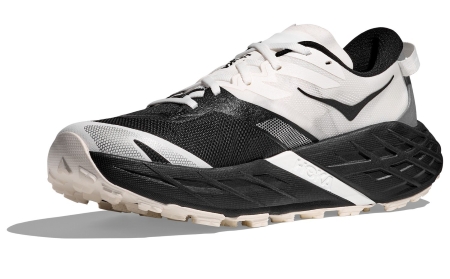
A single trail shoe has to survive the ordinary mixed route: hard dirt at the start, roots under tree cover, loose stones on the descent, and more time out than planned. That is the case for the Speedgoat 7. Its supercritical foam and 5 mm Vibram Megagrip lugs give this list its broadest combination of underfoot depth and real trail tread. I rank it first because it can cover those changes without asking the runner to buy a specialist for every surface.
Fit can decide whether this is the best shoe or the wrong one. I want a thumb-width of front clearance while my heel remains planted on a descent. A broad forefoot should try the wide version before simply sizing up. For a more focused look at this model, I keep a full Speedgoat review; I still fit the current pair rather than relying on the family name alone.
Its strength is the middle ground between two appealing extremes. Peregrine 16 is more nimble when the trail turns sharply; Xodus Ultra 4 gives an endurance runner more underfoot reserve. Speedgoat has enough depth for a long mixed route without becoming a specialist for only one distance. I would try it first when I cannot predict whether next weekend brings a rocky descent or an easy stretch of dirt. The result is a flexible buying choice, not a claim that it wins every terrain test.
I like the grip for variable surfaces, but I would never call any rubber a guarantee on wet roots, algae-covered wood, or ice. For deep clay, I would move to a more open mud pattern. On long pavement connectors, the lugs and trail chassis feel unnecessary; the gravel-road shoe guide is a cleaner match for that route.
Speedgoat 7 is still a substantial shoe. It dulls some trail texture, and its lugs are a poor reason to spend long miles on asphalt. If the route is consistently soft mud, I move to Speedcross 6; if I want sharper steering for short singletrack, I move to Peregrine 16. For the runner whose weekends rarely follow the same trail, this remains my first fitting appointment.
2. Saucony Peregrine 16 — Best agile daily trail shoe
| Spec | Detail |
|---|---|
| Best terrain | singletrack, mixed dirt, short technical routes |
| Drop | 4 mm |
| Outsole | Vibram Megagrip; 4 mm lugs |
| Ride and protection | Direct, nimble |
| Fit check | Secure; wide version offered |
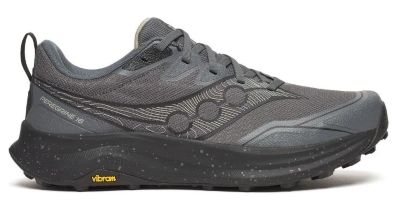
The Peregrine 16 makes its case when the trail twists faster than a tall, soft shoe can respond. Saucony gives it PWRRUN cushioning, a 32/28 mm platform, full-coverage Vibram Megagrip, and 4 mm lugs. I put it in the daily-trail slot because that combination leaves useful protection without making every turn feel like a correction to the midsole. This is the pair I would try for regular singletrack, not for an all-day rocky ultra.
Its lower, more flexible character separates it from the Speedgoat and Xodus. A runner who enjoys placing each foot deliberately may prefer that connection; a runner who feels every stone late in a run may not. I would compare the two Sauconys on the same short descent. Peregrine should feel easier to redirect, while Xodus has more cushioning to spend over time. Neither wins without knowing whether the route rewards agility or sustained protection.
The standard and wide options deserve separate fit trials. I keep the midfoot snug enough that the foot does not slide forward under braking, then check whether the toes still have space to spread after walking downhill. A larger size is not the solution to an upper that is simply too narrow.
I would compare it with a max-cushion shoe on the same downhill, not just on a flat store floor. If sharp stones remain distracting late in the run, the Xodus Ultra review offers more distance-oriented protection. If the trail is mainly smooth gravel with a long asphalt start, the gravel-road shoe guide should feel less choppy. A daily pick earns its place by matching the real route, not by winning every terrain category.
My reservation is distance, not a lack of trail credentials. The 4 mm drop and relatively direct ride deserve a gradual transition for a runner accustomed to higher road shoes. Sharp stones can become tiring when the outing grows long. Buy the Peregrine for its nimble daily role; choose a deeper platform when repeated rocky descents define the day.
3. Salomon Genesis 2 — Best technical control
| Spec | Detail |
|---|---|
| Best terrain | rock, camber, steep uneven ground |
| Drop | 8 mm |
| Outsole | All-Terrain Contagrip; 4 mm lugs |
| Ride and protection | Guided, controlled |
| Fit check | Precise Matryx and Quicklace; regular width |
On broken rock and off-camber ground, the foot moving inside the shoe is often the problem I want to solve first. Genesis 2 earns the control category through its Matryx upper, Quicklace hold, activeCHASSIS, and broad platform. Its 4 mm All-Terrain Contagrip lugs are part of the package, but outsole alone cannot stabilize a loose fit. I want the upper, lacing, and base to work together before I ask the foam to feel especially soft.
My fit test is deliberately demanding here. I tighten the Quicklace, jog downhill, make two sharp turns, and check for pressure across the instep. I also stand on a slanted surface to see whether the outside edge of my foot hangs over the midsole. Salomon’s regular-width, precise hold can be excellent for a narrow-to-average foot and wrong for a high-volume one. There is a Genesis 2 Wide; I would compare it before changing length.
This is the pick for a runner who repeatedly brakes, changes direction, and lands across a slope. I would take Genesis 2 ahead of Hierro v9 on that route because heel and midfoot security matter more there than a plush first step. The shoe’s structured feel is useful only if its shape agrees with the foot. Salomon offers a wide option; I would try that before adding length merely to relieve pressure across the forefoot.
I would not buy Genesis 2 for mostly flat park paths. Its advantage appears when a route asks for repeated corrections and secure braking. If the goal is a first trail shoe for easy ground, my beginner trail-shoe guide gives the more forgiving starting choices.
Genesis 2 asks for a precise fit and gives a firmer, more directed ride than the comfort-first shoes here. Those strengths can become needless restraint on easy park paths. I would leave it to the technical route and choose a simpler daily shoe for smooth dirt. No chassis can substitute for careful foot placement or guarantee against injury.
4. New Balance Fresh Foam X Hierro v9 — Best cushioned cruiser
| Spec | Detail |
|---|---|
| Best terrain | easy long runs, gravel, moderate trail |
| Drop | 4 mm |
| Outsole | Vibram Megagrip with Traction Lug |
| Ride and protection | Soft top layer over firmer base |
| Fit check | Standard, 2E, and 4E options |
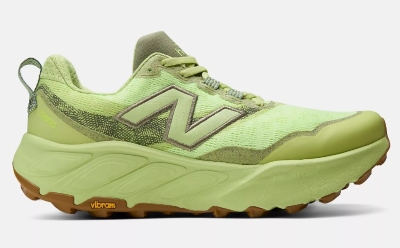
Hierro v9 is the comfort choice for miles of gravel, hardpack, and moderate trail. New Balance pairs a softer Fresh Foam X top layer with a firmer base and Vibram Megagrip traction. That construction makes more sense to me on a repetitive, relatively open route than on a sequence of abrupt rocky side slopes. It is a cruiser: the point is to arrive less distracted by the ground, not to cut every corner at race effort.
Width is a meaningful advantage, but it needs a real fitting. New Balance offers standard, 2E, and 4E options in the current line. A label on the box does not tell me whether the toe shape, midfoot volume, and heel hold all work together. I would use the wide-shoe fit guide to check the actual platform and upper, then walk downhill to make sure the heel does not drift.
The softer upper layer is valuable on repeat landings, but the firmer base matters just as much. I do not want a long-run cruiser that feels comfortable standing still and unsettled on a sloping path. Hierro is at its best when the course stays open and moderately uneven; Speedgoat is a more adaptable first try as roots and rock become frequent. I would make that terrain decision before comparing their step-in softness.
Its softer, weightier ride can lag when a trail demands fast lateral adjustments. Deep mud also calls for a more open tread. I recommend Hierro v9 for easy long outings and mixed hiking or running on moderate ground; I would not make it my only shoe for steep, uneven descents.
5. Saucony Xodus Ultra 4 — Best ultra-distance protection
| Spec | Detail |
|---|---|
| Best terrain | long mixed trail and rocky endurance days |
| Drop | 6 mm |
| Outsole | Vibram Megagrip; 4 mm lugs |
| Ride and protection | PWRRUN PB core in PWRRUN frame |
| Fit check | Endurance-oriented forefoot with secure heel |
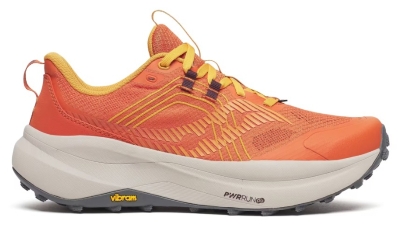
The shoe I want at the start of an ultra is not always the one I want several hours later. Xodus Ultra 4 is here for that later part of the day. Its PWRRUN PB core sits within a steadier PWRRUN frame, with Vibram Megagrip and 4 mm lugs underneath. That arrangement gives the soft foam a more controlled setting and makes the shoe a credible choice for long mixed trails with repeated rock and hard ground.
I rank it for protection that has a purpose. On a trail marathon or runnable ultra, a nimble daily shoe can leave me wanting more underfoot depth; a very soft platform can drift when a path tilts. Xodus occupies the useful middle. I would compare it with Peregrine 16 after the feet have warmed and expanded, paying attention to forefoot room, heel hold, and whether the added bulk feels worthwhile for the actual course.
I would test it after a normal long-run warm-up, when feet have begun to swell. The heel must remain seated while the forefoot has room, and the toes must not hit the front on a descent. A comfortable standing fit can hide a downhill problem. I would also decide whether my route justifies its weight: two hours on smooth singletrack may not. The trail fueling guide covers the wider rotation and fueling choices that matter beyond footwear.
Vibram rubber gives useful mixed-surface grip, but a 4 mm pattern is not my first call for bottomless mud. Nor would I choose this if I wanted a low-to-ground, playful shoe for tight corners. It is a protective endurance specialist; the fact that it can run faster does not change its strongest role.
There is more shoe here than most short outings require. Its 4 mm tread is versatile, but deep clay is a different assignment. I would buy Xodus for long mixed days, keep Peregrine for quick turns and short runs, and choose a dedicated mud shoe when soft ground dominates.
6. Brooks Catamount 4 — Best fast training and racing
| Spec | Detail |
|---|---|
| Best terrain | runnable singletrack, climbs, shorter races |
| Drop | 6 mm |
| Outsole | TrailTack Green |
| Ride and protection | DNA Flash v2 with SkyVault plate |
| Fit check | Performance hold; check swelling room |
Catamount 4 belongs in a race plan with runnable ground. Brooks uses DNA Flash v2 cushioning, a SkyVault plate, and a TrailTack Green outsole to make a shoe that can hold an uphill rhythm without becoming a road racer with token tread. I place it in the fast category because its design rewards forward motion on climbs and open singletrack. The same firm, directed character is a poor reason to wear it for every recovery run.
My first test would be a controlled uphill at the pace I expect to race, followed by a descent where I check toe contact. The upper should keep the foot back without creating a hot spot across the top. At race effort, a small fit problem becomes large quickly. I would compare it with the speedwork shoe guide if the workout involves pavement as well as dirt; not every fast run needs a dedicated trail racer.
The plate does not make speed automatic. I want to know whether the course lets me string steps together or forces me to pick through roots and rocks one landing at a time. On the first course, Catamount is more purposeful than a comfort-first Hierro; on the second, a lower, more adaptable trail shoe may be easier to control. That course distinction matters more than the word ‘plate’ on the box.
I do not assume the SkyVault plate makes it the fastest option for every runner. On slow scrambling, dense roots, and long rocky hiking sections, I value ground feel and lateral control more than propulsion. The plate is useful when there is room to roll forward, less useful when every step is a separate decision.
A snug race fit leaves less room for swelling, and its taut ride may feel severe at an easy pace. I would test toe clearance after an uphill effort before racing in it. Catamount 4 is a specialist for fast training and competition on runnable trails, not a universal replacement for a long-run cruiser.
7. Altra Lone Peak 9+ — Best zero-drop toe room
| Spec | Detail |
|---|---|
| Best terrain | dry mixed trail, hiking, foot-shaped fit |
| Drop | 0 mm |
| Outsole | Vibram Megagrip |
| Ride and protection | Flexible, 25 mm stack |
| Fit check | Original FootShape forefoot |
The Lone Peak 9+ answers a fit and ground-feel question that the high-stack shoes cannot. Its Original FootShape forefoot, level heel-to-toe platform, and Vibram Megagrip outsole suit a runner who already knows they enjoy zero drop and room to spread the toes. I chose the 9+ rather than treating every Lone Peak as interchangeable: the plus version changes the outsole, which matters on mixed rock and damp patches.
If I were switching from a conventional 8-to-12 mm drop shoe, I would start with brief, easy exposure and keep my usual pair in rotation. A zero-drop sole changes the lower-leg demands for many runners. I would monitor calf and Achilles response during the run and the next morning, increasing only when the previous dose feels normal. My zero-drop guide explains how I make that transition without turning it into a universal timeline.
Room up front is only one part of trail fit. If the midfoot slides while the heel stays behind, a generous toe box becomes a liability on a descent. I would check that hold first, then decide whether the flexible 25 mm platform gives enough protection for the route. This is a distinctive choice for shorter mixed trails and hiking; I would not assign it to a runner solely because they describe their feet as wide.
The flexible platform transmits more trail texture than a plush distance shoe, and the roomy front is no substitute for secure midfoot hold. I keep Lone Peak 9+ for runners who value space and connection on their usual ground. If the request is maximum underfoot insulation for a long rocky day, Speedgoat or Xodus makes a stronger starting point. Zero drop is a fit and preference choice, not a promise of better running form.
8. HOKA Challenger 8 — Best road-to-trail
| Spec | Detail |
|---|---|
| Best terrain | pavement, gravel, smooth dirt |
| Drop | 8 mm |
| Outsole | Multi-directional trail lugs |
| Ride and protection | Road-smooth cushion |
| Fit check | Familiar HOKA hold; wide option |
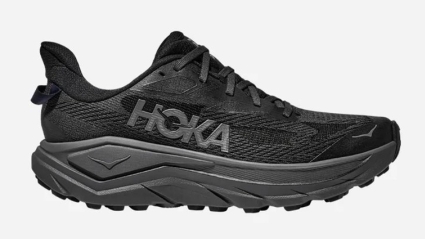
Some trail runs begin on pavement and spend only their middle miles off-road. Challenger 8 fits that route. Its road-friendly cushioning, 8 mm drop, toe protection, and multi-directional lugs make it easier to live with on asphalt and firm gravel than a deep-tread mountain shoe. I recommend it for the runner who wants one pair for the door-to-park loop, provided the trail portion stays relatively smooth.
I choose a hybrid by its weakest section. If the road miles feel awkward, the shoe will stay in the closet; if the trail section turns slick and steep, a comfortable road ride is not enough. Challenger handles the first problem well and has a clear ceiling on the second. On a route with sustained rock, roots, and off-camber descents, Speedgoat 7 or Genesis 2 becomes a more defensible purchase.
Fit on a hybrid still needs a downhill check. I lace it as I would for a road run, then test whether the heel moves and the toes hit the front when I brake. If the road fit is comfortable but the descent fit is loose, I would not take that as a minor issue. The shoe’s purpose is to make the whole route work, including the change in terrain.
The mild tread is the compromise. It cannot dig into deep mud or brake with the same confidence as a technical trail shoe on wet, steep ground. I would use Challenger 8 for pavement, gravel, and easy dirt, and stop calling it a one-shoe answer once the trail itself becomes the hard part. My road-to-trail guide helps draw that line.
9. Salomon Speedcross 6 — Best for soft mud
| Spec | Detail |
|---|---|
| Best terrain | wet soil, loose climbs, soft forest floor |
| Drop | 10 mm |
| Outsole | Mud Contagrip; 5 mm lugs |
| Ride and protection | Protective soft-ground specialist |
| Fit check | Secure Quicklace; close forefoot |
Mud changes the ranking. On soft soil, a rubber compound cannot help much if the tread fails to enter and clear the ground. Speedcross 6 has Salomon’s open, 5 mm Mud Contagrip lugs and a close Quicklace hold for that task. I include it as a condition-specific shoe: when a forest route is repeatedly wet and loose, I would rather have this deliberate outsole than ask a mixed-terrain generalist to behave like a mud specialist.
The key decision is how much of the route is genuinely soft. For one muddy patch in an otherwise hardpack run, Speedgoat is the cleaner compromise. For long stretches of churned earth, Speedcross has the right geometry. Its 10 mm drop may feel familiar to runners coming from higher-drop road shoes, but fit still decides whether the toe box and lacing work through descents and repeated foot lifts.
The Salomon fit is precise. I would check forefoot pressure, lace-pouch placement, and heel security before race day, then run a short wet route in the socks I plan to wear. A tight heel is good; cramped toes are not. For debris-heavy routes, trail gaiters can help, but they cannot fix an upper that fits badly.
Tall lugs feel awkward on pavement and hard slab, and the close forefoot rules out some buyers. I would not confuse this mud traction with a promise on ice, algae, or polished wet rock. It is a second shoe for a recurring condition, not the everyday answer for a route that happens to be damp once in a while.
10. HOKA Tecton X 4 — Best plated trail racer
| Spec | Detail |
|---|---|
| Best terrain | runnable technical races and long climbs |
| Drop | 5 mm |
| Outsole | Vibram Megagrip Litebase; 4 mm lugs |
| Ride and protection | Dual-layer PEBA and parallel carbon plates |
| Fit check | Race lockdown with knit collar |
Tecton X 4 makes sense only when the race gives it room to run. HOKA combines dual-layer PEBA, parallel carbon plates, a Matryx Micro upper, and Vibram Megagrip Litebase with 4 mm lugs. Those are ingredients for sustained forward rhythm on a runnable mountain course, not an excuse to buy the most expensive shoe for every technical trail. I put it in the race slot because its speed-focused construction still has a genuine trail outsole and upper.
The gaiter-like collar can keep debris out, but I still need secure heel and midfoot tension. I check whether the updated lacing holds through a downhill without squeezing the instep, and whether the front has room when feet swell. I would not assume X 3 sizing transfers to X 4. The speedwork-shoe guide gives me a broader race-shoe context before spending at the top end.
I would compare this shoe at two paces: the one I expect to race and the slower stepping forced by a rough section. If the course is mostly fluid climbing and open trail, the plated rocker has a clear job. If the route is a sequence of slow, irregular placements, the same platform can feel less informative. That is why I choose Tecton for a particular course rather than ranking it above every more adaptable trail shoe.
I would test this shoe at race pace on a course-like surface, then deliberately slow to a hike and step across uneven rock. That exposes the tradeoff. On smooth, fast ground, the rocker and foam may help me hold rhythm; on irregular stepping stones, the platform may feel less informative. A premium price is only justified if my actual route uses the fast half of its personality.
The price, high ride, and race fit make a poor case for daily easy miles. I would check heel and midfoot hold with the current X 4, especially after feet swell, rather than borrowing a size decision from the X 3. Deep mud or frequent scrambling sends me toward a different shoe; a fast, runnable trail race is where this one earns its place.
Full comparison: choose by route, not rank alone
| Shoe | Best use | Drop | Main tradeoff |
|---|---|---|---|
| HOKA Speedgoat 7 | mixed trail, roots, rock, long runs | 5 mm | Less precise than a lower shoe on abrupt side slopes |
| Saucony Peregrine 16 | singletrack, mixed dirt, short technical routes | 4 mm | Less underfoot depth than ultra cruisers |
| Salomon Genesis 2 | rock, camber, steep uneven ground | 8 mm | Close fit and firmer control can divide buyers |
| New Balance Fresh Foam X Hierro v9 | easy long runs, gravel, moderate trail | 4 mm | Heavy and less agile on fast off-camber lines |
| Saucony Xodus Ultra 4 | long mixed trail and rocky endurance days | 6 mm | More shoe than shorter outings need |
| Brooks Catamount 4 | runnable singletrack, climbs, shorter races | 6 mm | Taut ride for slow hiking and rocky ultras |
| Altra Lone Peak 9+ | dry mixed trail, hiking, foot-shaped fit | 0 mm | Lower-leg adaptation and less long-run cushion |
| HOKA Challenger 8 | pavement, gravel, smooth dirt | 8 mm | Limited bite on mud and technical wet rock |
| Salomon Speedcross 6 | wet soil, loose climbs, soft forest floor | 10 mm | Tall lugs feel awkward on asphalt and hard rock |
| HOKA Tecton X 4 | runnable technical races and long climbs | 5 mm | High price and reduced ground feel at slow pace |
On wet technical trail I would compare Speedgoat 7 and Genesis 2 first; for soft mud I would choose Speedcross 6. If most miles are easy gravel or pavement connectors, I would shift toward Hierro v9 or Challenger 8. For a long trail race, I would compare the course with Xodus Ultra 4 and Tecton X 4 before paying for a plate. My lug-depth guide and rock-plate guide go deeper on two features buyers often overgeneralize.
Frequently asked questions
Should I buy one trail shoe or a pair for different terrain?
One mixed-terrain pair is enough when your usual routes are similar and the fit holds downhill. I add a second shoe only when the ground asks for a different tool, such as open lugs for frequent deep mud or a smoother hybrid for long pavement connectors.
How much lug depth do I need?
I match the tread to the dominant surface. Around 4 mm works for many mixed trails; a more open 5 mm mud pattern matters when soft ground dominates. Rubber compound, lug shape, and spacing matter as much as the number.
Can I use road running shoes on trails?
On maintained dry gravel or smooth dirt, sometimes. I switch to a trail outsole when roots, loose descents, mud, or angled rock make braking and foot hold more important.
Should trail shoes fit bigger than road shoes?
I do not automatically size up. I fit the shoe with my normal socks, then check heel hold and front clearance on a downhill. A wide forefoot calls for the right shape or width, not simply extra length.
Are waterproof trail shoes better?
Only when the conditions justify them. A waterproof membrane can help in cold, shallow wet conditions, but it runs warmer and water entering over the collar drains more slowly. For warm wet runs I often prefer breathable uppers.
Which trail running shoe is best for wide feet?
I would first fit the wide version of Speedgoat 7 or Hierro v9 and compare it with Altra Lone Peak 9+. I check midfoot and heel hold as carefully as toe space; a roomy front alone does not guarantee a secure trail fit.
How long do trail running shoes last?
There is no reliable single mileage cutoff. I replace a pair when grip is worn for my terrain, the upper no longer holds the foot, or protection and ride deteriorate. Wet rock and abrasive road connectors can wear an outsole differently.
My final verdict
Before buying, I write down the surface that dominates my route, then test heel hold and toe clearance on a descent. If that route changes from week to week, Speedgoat 7 is my first pair to fit. Regular narrow singletrack points me to Peregrine 16; rocky camber points me to Genesis 2. A shoe that fails the fit check loses its place regardless of rank. That one decision is worth more than a longer list of specifications.