
After 192 running miles, I rate the Topo Athletic Atmos 2 a 7.4/10. It is a neutral max-cushion road shoe for runners who want genuine toe-splay room, a 5 mm drop, and a controlled easy-run ride. It is not especially fast or deeply soft, and my pair lost some freshness late in longer runs.
My first useful read came during four miles on the Ocean City Boardwalk, from the Music Pier toward 34th Street, at about 9:10 per mile. The December morning was mild and still. The shoe did not feel pillowy. It felt broad, protective, and slightly restrained, with enough rocker to keep the high forefoot from becoming cumbersome.
That distinction stayed intact through the test. Atmos 2 gives more room where toes spread, then asks the midfoot, heel, and geometry to control the rest of the foot. When that architecture matches you, it is calm and easy to trust. When it does not, more toe room cannot rescue poor heel hold or pressure over a high instep.
Article contents
- Quick verdict
- Model scope
- How I tested it
- Ken’s ranking rule
- Specs and construction
- Why reviews disagree on softness
- Ride and transitions
- Break-in
- Best pace and workouts
- Long-run performance
- Fit and sizing
- Upper and lockdown
- 5 mm drop transition
- Stability
- Grip and weather
- Durability after 192 miles
- Key comparisons
- Rotation advice
- Who should buy or skip
- Pros and cons
- Sources and corrections
- FAQ
- Final verdict
Topo Athletic Atmos 2 Review: Quick Verdict
Bottom line: Atmos 2 is best for neutral runners who want a roomy toe box, a lower 5 mm offset, and reliable protection for easy, recovery, walking, and steady long-run miles. Buy it for fit and controlled comfort. Skip it for deep softness, high-speed snap, corrective stability, or an 8-12 mm heel bias.
| Decision | My finding after 192 miles |
|---|---|
| Score | 7.4/10 |
| Best use | Easy runs, recovery, steady aerobic miles, walking |
| Best pace for me | About 8:30-9:30/mi at 182 lb; translate by effort |
| Fit | True-to-size length in men’s US 10.5; broad toes, more fitted midfoot/rearfoot |
| Longest run | 13 miles; consistent through mile 9, subtly dull near mile 11 |
| Ride | Protective, gradual, moderately responsive; softer after break-in, not marshmallow-soft |
| Stability | Stable-neutral geometry, not a corrective stability shoe |
| Durability | Functional at 192 miles with outer-heel wear and minor heel compression |
| Would I rebuy? | Not automatically; the role is useful but narrower than my best daily trainers |
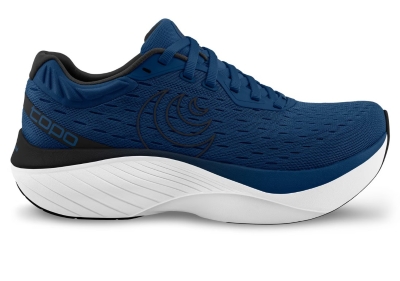
In my max-cushion running shoe rankings, Atmos 2 earns attention for shape rather than spectacle. It protects without hiding the ground behind a very soft foam. That makes it more predictable for some runners and less exciting for those expecting a trampoline.
It also belongs in the broader running shoe decision guide as a specific answer, not a universal one. A roomy anatomical toe box and low drop solve real fit preferences. They do not automatically produce better mechanics, fewer injuries, or a better shoe for every foot.
Model Scope: Atmos 2, Not Every Topo
This review covers Topo Athletic Atmos 2, the second version of the brand’s highest-stack neutral road trainer. It should not be read as a review of the original Atmos, Phantom 4, Specter 2, or another Topo model. The family fit language overlaps, but the stack, foam behavior, rocker, and training role do not.
Topo lists Atmos 2 for daily running and walking, with a neutral support category and maximum cushioning. The model combines a 40/35 mm platform with updated ZipFoam. The phrase “maximum cushioning” describes stack and intended protection; it does not guarantee the softest sensation in the category.
The original Atmos established the broad, high-stack idea. Version 2 adds 2 mm of stack, revises the foam, changes the mesh, and reduces or redistributes outsole coverage. Those edits make it more compliant and flexible, but they also change how quickly the shoe redirects and how planted it feels.
Phantom 4 is the more conventional Topo daily trainer. My Topo Athletic Phantom 4 review is the better reference when you want less stack and a more ordinary daily-training footprint. Atmos 2 is for the runner who wants more separation from pavement and accepts a taller platform.
How I Tested the Topo Atmos 2
I logged 192 running miles in a men’s US 10.5, at about 182 lb, across seven structured test sessions plus ordinary rotation mileage. The useful evidence includes easy and steady runs, a completed wet test, asphalt and Boardwalk surfaces, a cold run around 30 F, and a longest run of 13 miles.
The first key run was four miles at about 9:10 per mile on the Ocean City Boardwalk. The best was a steady 10-miler around Cooper River Park, where the cushion and transition remained consistent. The longest reached 13 miles. That range is enough to judge daily use and early durability, but not to claim marathon performance or a universal lifespan.
I tested the shoe primarily between about 8:30 and 9:30 per mile, with shorter pace changes to find its upper limit. Those numbers describe my aerobic effort, body mass, cadence, and terrain. The easy-run pace guide is the right way to translate the finding to your own training.
My evidence grade is B, or medium confidence. Mileage and core sessions are verified, but several entries were backfilled rather than recorded immediately. I publish that limit because a clean methodology is more useful than false precision. Every ride claim below is either a logged personal observation, a manufacturer fact, or a clearly attributed independent finding.
Ken’s Ranking Rule
Ken’s ranking rule: A max-cushion shoe ranks on what remains controlled after the first-hour comfort fades. I score fit architecture, pace-specific transition, late-run stability, weather behavior, and durability before I reward stack height or a soft step-in feel. Atmos 2 earns 7.4/10 because it protects and fits distinctive feet well, but its speed, cold response, and late-run freshness limit its range.
That rule prevents one pleasant try-on from deciding the review. Soft foam can feel impressive for five minutes and unstable at mile ten. A broad toe box can feel liberating while the heel slips. A high stack can protect the forefoot but make turning less certain. Atmos 2 performs well when all of those systems are judged together.
Topo Atmos 2 Specs and Construction
| Specification | Verified detail | Why it matters |
|---|---|---|
| Category | Neutral max-cushion road shoe | Geometry supplies inherent control, not corrective guidance |
| Stack | 40 mm heel / 35 mm forefoot | High protection with a substantial forefoot |
| Drop | 5 mm | Lower offset than many traditional daily trainers |
| Weight | 9.9 oz in men’s M9, manufacturer reference | Reasonable for stack, but not a lightweight trainer |
| Midsole | Updated ZipFoam | More compliant and energetic than Atmos 1 by design |
| Upper | Recycled engineered mesh | Anatomical toe room with midfoot and heel structure |
| Outsole | Strategic rubber zones | Balances road grip, wear protection, and flexibility |
| Widths | Standard and Wide | Toe-box shape and width option solve different fit problems |
| Intended use | Daily running and walking | Easy mileage is the primary assignment |
The high forefoot is important. A 35 mm forefoot does more than cushion toe-off; it also reduces how much the foot can bend the shoe naturally. Topo addresses that with flex grooves and a gradual rocker. The result feels less rigid than the stack suggests, though it never behaves like a low, flexible trainer.
Topo calls the foam upgraded, lighter, softer, and more energetic. Those are manufacturer comparisons to the prior version, not absolute lab rankings against every competitor. My experience supports “softer than Atmos 1” more than “very soft.” The independent evidence lands in the same nuanced place.
Is the Atmos 2 Soft or Firm? Why Reviews Disagree
The honest answer is that Atmos 2 is softer than Atmos 1 but firmer than many current max-cushion shoes. Both descriptions can be accurate because they use different reference points. A runner coming from the original Atmos notices compliance. A runner coming from a deeply compressive superfoam may call Atmos 2 controlled or even firm.
Body mass changes the answer. At about 182 lb, I compress the midsole more than a much lighter runner at the same pace. I felt enough give to remove harshness but not enough sink to delay the transition. A lighter runner may experience a firmer platform. A heavier runner may engage more cushion, though greater load can also expose late-run fatigue sooner.
Temperature changed my pair too. During one run around 30 F, the foam felt noticeably firmer than it did in mild weather. This was a field observation, not a climate-chamber experiment, so I will not attach a percentage or claim every pair responds identically. It is still useful buying context for runners who train through winter.
Pace creates a fourth reference frame. At easy effort, the heel and midfoot have time to compress and roll. At faster turnover, the foam does not rebound sharply enough to make the shoe feel lively. A shoe can therefore feel comfortable at 9:15 pace and flat at 7:30 without changing material.
Ride: Heel, Midfoot, Forefoot, and Rocker
The Atmos 2 ride is protective and gradual, with a centered heel, broad midfoot, and a late-enough forefoot rocker that rewards steady cadence more than aggressive toe-off. It is not a dramatic rocker. The shoe rolls when loaded, but I still feel the forefoot working through the transition.
Heel landing
At the heel, the foam compresses without collapsing sideways. My outer-heel contact settles toward the center smoothly, especially on flat asphalt. The heel bevel is useful but not highly sculpted. At slow recovery pace, that creates a quiet landing. On steep downhills, the high rearfoot can feel larger than the measured weight suggests. If you want footwear selected specifically for rearfoot landings, compare my best running shoes for heel strikers.
The broad base makes repeated straight-line landings easy to organize. That is why Atmos 2 fits my concrete running shoe criteria: it separates the foot from hard surfaces while retaining enough firmness to avoid constant lateral movement. Protection does not erase the need to manage training load.
Midfoot transition
Through the midfoot, the shoe feels more continuous after break-in. Early runs had a slight block between landing and roll. By roughly 25 miles, the foam and flex pattern worked together more naturally. The waist is not pinched like a race shoe, so the foot has a broad path over the platform.
That broad path helps runners who load the medial or lateral edge late in a run, but it does not force the foot into one line. The upper must still keep the foot centered. On my best 10-mile session, the platform and upper stayed synchronized. During faster changes of direction, the heel hold became the weaker part of the system.
Forefoot and toe-off
The 35 mm forefoot is protective enough for tired metatarsals and long walking days. The foam flexes more than Atmos 1, then rolls through a gradual toe spring. I did not feel a sharp rocker edge. The tradeoff is a less decisive toe-off when I try to accelerate.
Runners with high arches may appreciate the underfoot volume but still need the correct instep fit. The high-arch shoe guide separates cushion from arch contour; a tall stack is not proof that a shoe supports a particular arch shape.
The anatomical toe box can also reduce side pressure for some runners managing forefoot sensitivity. My Morton’s neuroma footwear guide explains why width, depth, rocker placement, and symptom response matter together. This review is not a diagnosis or treatment recommendation.
Break-In: What Changed After 20-30 Miles
My Atmos 2 needed about 20 to 30 miles before the ride felt fully settled. The first run was protective but restrained. By the fourth structured session, the heel-to-midfoot transition was smoother, the forefoot flexed with less resistance, and the upper stopped feeling as new around the lacing row.
The break-in did not turn ZipFoam into a soft superfoam. It reduced the initial blockiness and made the existing geometry easier to access. That distinction matters for returns: if the shoe feels slightly rigid but otherwise fits, several indoor and short-run tests may help. If it causes numbness, toe contact, focal pressure, or uncontrolled heel slip, waiting is a poor strategy.
I would introduce it with two or three short easy runs, not a first-day long run. That also gives calves time to meet the 5 mm offset. Runners new to low-drop shoes should change one variable at a time rather than adding mileage, hills, and a lower offset in the same week.
Best Pace and Workouts
Atmos 2 was strongest for me from about 8:30 to 9:30 per mile, covering easy, recovery, and steady aerobic running. Translate that by effort. The useful result is not the number; it is that the shoe works when breathing is controlled and stride remains repetitive.
| Run type | My rating | Reason |
|---|---|---|
| Recovery run | Very good | High protection and a calm transition reduce the need for precise landing |
| Easy daily run | Excellent | Best balance of cushion, toe room, and platform control |
| Steady aerobic run | Good | Handles moderate pressure without losing its line |
| Long easy run | Good with limits | Consistent through mile 9; subtle dullness near mile 11 in my 13-mile test |
| Progression finish | Fair | Can increase pace, but moderate rebound and lockdown cap enthusiasm |
| Tempo run | Below average | High stack and gradual response make sustained fast work expensive |
| Intervals | Skip | Not quick to redirect or snap off the forefoot |
| Walking | Excellent | Toe room, protection, and gradual rocker fit long straight movement |
For a beginner, this narrow pace strength can be useful because most early running should remain controlled. Atmos 2 appears in my beginner shoe framework when the foot likes lower drop and a broad toe box. A new runner accustomed to high-drop shoes should transition more gradually.
For recovery days, I like the way the shoe accepts an imperfect landing without becoming vague. The recovery-run guide keeps those sessions genuinely easy. Atmos 2 can support the purpose, but no shoe prevents an easy run from becoming too fast.
On a treadmill, the outsole and rocker feel smooth, though the tall broad platform takes more belt space than a streamlined trainer. My treadmill shoe guide recommends testing ventilation, belt clearance, and pace changes instead of assuming a good road shoe will feel identical indoors.
Long-Run Performance
I tested Atmos 2 to 13 miles. It held its cushion and transition well through roughly mile 9, then developed subtle dullness around mile 11. The shoe did not bottom out, tilt, or become painful. It simply returned less of the pressure I put into it, making the final miles feel more managed than assisted.
The best long evidence was the 10-mile Cooper River Park run. At steady effort, the ride remained coherent from beginning to end. The broad forefoot gave my toes room to spread as the foot warmed, and the upper did not produce a hot spot. That is enough for me to trust it for ordinary 90-minute easy runs.
The 13-mile test sets a responsible boundary. I would use Atmos 2 for a comfort-first half marathon only after confirming the fit at goal duration. For a marathon, I would require a rehearsal beyond two hours with intended socks, fueling, and pace. Protection at mile nine is not proof of freshness at mile twenty.
A runner who values underfoot space more than rebound may accept that late dullness. A runner seeking one shoe for long runs with fast finishes should choose a livelier option. The long-distance shoe guide compares late-run control, fuel-related swelling, and pace range rather than ranking by stack alone.
Topo Atmos 2 Fit and Sizing
My normal men’s US 10.5 fit true to size in length. The forefoot is anatomically broad, while the midfoot and rearfoot are more secure and lower-volume than the phrase “wide toe box” may imply. That split architecture is the most important fit fact in this review.
Toe room describes shape at the front, not overall shoe volume. My toes could spread without touching the sidewall, but the lacing area still wrapped the foot. A runner with a broad forefoot and average instep may find that ideal. A runner with a tall instep can feel dorsal pressure even when the toes have space.
The opposite problem appears on low-volume feet. RoadTrailRun reported that one tester wanted more midfoot hold, while Doctors of Running found the rearfoot secure and the lacing area slightly snugger than Atmos 1. Both can be true because foot volume changes how the same upper closes.
Standard versus Wide
Start with Standard if your main need is toe shape rather than full-width volume. Choose Wide when the midfoot, forefoot base, or instep genuinely needs more space. Do not jump to Wide solely because a conventional shoe squeezes the little toe; Topo’s Standard last may already solve that shape problem.
The wide-foot running shoe guide distinguishes length, width, toe-box shape, and vertical volume. Those dimensions should be checked separately. A width label cannot tell you whether the heel, arch, or lacing volume will match.
Indoor fit checklist
- Begin with your normal running-shoe length and usual width.
- Warm the foot for ten to fifteen minutes before judging toe and instep space.
- Keep a thumb-width ahead of the longest toe without using extra length to create width.
- Walk downhill and turn sharply to expose heel lift and lateral movement.
- Check for pressure across the lowest lacing rows, especially with a high instep.
- Try a runner’s loop only after ordinary lace tension is even.
- Return the shoe if toes grip, the heel remains unstable, or pressure creates numbness.
I would not size down to fix heel movement. Shortening the shoe can crowd the toes and move the rocker behind the intended joint line. Adjust lacing first, then compare Standard and Wide or choose a different last. Fit architecture is more important than loyalty to the anatomical-toe-box concept.
Upper, Tongue, and Lockdown
The recycled engineered mesh is comfortable and structured enough for easy running, but lockdown depends on foot volume. The tongue is padded and not gusseted. It spreads pressure well in my pair, though a gusset would make centering more reliable and help low-volume feet feel connected to the platform.
The heel counter has stiffness under generous padding. I had adequate lockdown for easy and long running, not exceptional hold for faster cornering. The collar never became an abrasion problem in my logged sessions. Tight turns exposed more movement than straight Boardwalk miles.
Breathability was acceptable in mild conditions, but I do not have enough high-heat evidence to call it exceptional. Doctors of Running found the plush upper did not run excessively warm. That aligns with my moderate-weather use, while still leaving sock choice and summer humidity as untested variables in my pair.
The upper is one reason I do not automatically rebuy. It is good at the shoe’s main pace, but it does not create the locked, lightweight feel I want when a run becomes faster. Comfort and performance hold are different standards.
Transitioning to the 5 mm Drop
Topo lists a 5 mm heel-to-toe drop, and runners moving from 8 to 12 mm shoes should treat that as a meaningful change. A lower offset can shift demand toward the ankle, calf, Achilles tendon, and forefoot. It does not force a midfoot strike, guarantee better form, or prevent injury.
My transition advice is simple: use Atmos 2 for short easy runs first, alternate with the familiar shoe, and avoid adding hills or speed at the same time. Increase duration only when the next morning feels normal. The heel-drop guide explains why static offset is only one part of perceived geometry.
The high stack softens the sensation of a lower offset but does not erase the loading change. Because the forefoot is also thick, the shoe may feel flatter than a low-stack 5 mm trainer. Calf response, not visual stack, should guide the transition.
A runner already comfortable in 0 to 6 mm shoes may adapt immediately. A runner who uses a high-drop heel for calf or Achilles comfort may prefer a gradual trial or a different model. Footwear choice should support a training plan, not become an ideology.
Stability: Neutral but Broad
Atmos 2 is a stable-neutral shoe, not a formal stability shoe. The broad forefoot, mild sidewalls, sole flare, and centered transition create inherent control. There is no medial post and no corrective rail. That makes the platform predictable without making a medical claim about pronation. For the distinction between normal pronation, overpronation, and supination, see my overpronation versus supination guide.
At easy pace on flat pavement, my foot remained centered. The high stack was noticeable on cambered roads and sharp turns, where upper hold mattered as much as base width. One RoadTrailRun tester found version 2 less stable than Atmos 1, likely because the softer foam and reduced rubber make the platform more flexible.
That comparison does not make Atmos 2 unstable. It means the original was a firmer, more planted reference. Runners who want true guidance should compare models in the daily trainer guide and include a stability shoe in the same indoor test.
For heavier neutral runners, the broad footprint and non-mushy foam can be useful. My heavy-runner shoe guide treats body mass as one input among fit, stack control, forefoot depth, and pace. A broad platform cannot compensate for a loose upper or poorly timed rocker.
Grip, Wet Roads, and Cold Weather
The strategic rubber zones handled dry roads and my ordinary wet-asphalt test without a major traction failure. The outsole is not Vibram, and the shoe is not designed for technical trail. Exposed foam and flex-oriented coverage keep the ride smoother but leave less rubber than an aggressively protected road shoe.
On wet roads, I shorten stride over paint, wood transitions, metal, leaves, and smooth sealed surfaces. My rain-running guide treats those as separate hazards because no single wet-grip label describes them all. Atmos 2 is suitable for normal road rain, not careless cornering.
The cold run around 30 F produced the clearest weather change. The midsole felt firmer and the transition less forgiving than in mild sessions. I did not observe a traction failure or upper problem. One run cannot establish a temperature curve, but winter runners should know that my pair did not feel identical across conditions.
For mixed surfaces, packed park paths are reasonable when dry and smooth. Loose gravel, roots, mud, and steep off-camber terrain expose the tall road geometry. This remains a road and walking shoe.
Durability After 192 Miles
At 192 running miles, my Atmos 2 remains functional. The outer lateral heel shows expected wear from my landing pattern. The heel ZipFoam has minor compression. The upper has retained its shape, the toe box has not stretched into sloppiness, and the transition still resembles the post-break-in ride.
The strategic rubber placement is doing its job where I contact first. Exposed areas show cosmetic abrasion without changing the shoe’s line. I have not seen a structural separation, torn mesh, or collapsed medial edge. That is good early-to-midlife evidence, not proof of a fixed 400-mile lifespan.
Ride durability and material durability should be separated. The outsole can remain usable while the foam feels less fresh late in a long run. My mile-11 dullness appeared before the shoe looked worn out. A runner who uses Atmos 2 only for 45-minute easy runs may perceive useful life differently from a marathon trainee.
The running shoe replacement checklist evaluates traction, alignment, fit, localized compression, and changed ride. I would keep using this pair for ordinary easy mileage while monitoring the lateral heel and whether late-run dullness begins earlier.
Topo Atmos 2 Comparisons
Atmos 2 wins on anatomical toe room, a lower offset, and controlled max-cushion comfort. Its rivals win when you want softer foam, tighter lockdown, more speed, a higher drop, or a more conventional transition. Choose by assignment and fit, not by a category label.
| Comparison | Choose Atmos 2 when | Choose the alternative when |
|---|---|---|
| Atmos 2 vs Atmos 1 | You want softer foam, more stack, and more flexibility | You prefer a firmer, more planted, slightly more uptempo platform |
| Atmos 2 vs HOKA Clifton 10 | Toe shape and 5 mm drop matter most | You want a lighter, smoother conventional daily trainer |
| Atmos 2 vs HOKA Bondi 9 | You want more toe freedom and less underfoot softness | You want a plusher, more pronounced max-cushion rocker |
| Atmos 2 vs ASICS Gel-Nimbus 28 | You prefer controlled foam and anatomical shape | You want a softer premium upper and deeper heel comfort |
| Atmos 2 vs Brooks Glycerin 23 | You want lower drop and more natural toe spread | You want a higher-drop, more traditional premium daily ride |
| Atmos 2 vs Saucony Triumph 24 | Foot shape and stable-neutral breadth lead the decision | You want more pace versatility and quicker turnover |
| Atmos 2 vs ASICS Novablast 5 | You prefer predictable compression and a calm line | You want bounce and progression-run range |
| Atmos 2 vs Mizuno Wave Rider 29 | You want more toe room, stack, and a lower offset | You prefer a more stable heel and traditional rolling daily feel |
Atmos 2 vs Atmos 1
Version 2 is the easier shoe for slow comfort. The extra 2 mm, updated ZipFoam, more flexible forefoot, and altered outsole make it softer and smoother after break-in. Atmos 1 feels firmer and more planted. A runner who liked the original for uptempo stability should not assume the update is automatically better.
The original Atmos review context shows why version numbers matter: the first shoe was already a high-stack neutral platform, but its firmer response and outsole configuration gave it a different personality. I do not transfer first-version measurements to Atmos 2.
Atmos 2 vs HOKA Clifton 10
Clifton 10 feels lighter and more naturally versatile at ordinary daily pace. Atmos 2 offers a broader toe shape and lower offset. I choose Topo when forefoot geometry is the deciding fit factor. I choose HOKA when I want a smoother single-shoe daily role without the same volume contrast between toe box and midfoot.
Atmos 2 vs HOKA Bondi 9
Bondi 9 gives a softer, more isolated landing and a more obvious rocker. Atmos 2 is less plush but more accommodating at the toes. The Bondi feels like a dedicated cushion machine; the Atmos feels like an anatomical daily trainer expanded upward.
Atmos 2 vs ASICS Gel-Nimbus 28
Nimbus 28 delivers more premium step-in softness and a secure traditional upper. Atmos 2 offers more toe spread, a lower drop, and less sink. I would put the ASICS under a runner seeking luxury and the Topo under one seeking shape and a more controlled platform.
Atmos 2 vs Brooks Glycerin 23
Glycerin 23 is the more familiar high-drop neutral trainer, with better rearfoot hold for many average-volume feet. Atmos 2 changes calf loading more and frees the toes. The better choice is largely geometric: conventional fit and offset versus anatomical forefoot and 5 mm drop.
Atmos 2 vs Saucony Triumph 24
Triumph 24 is easier to accelerate and more useful as an only shoe. Atmos 2 feels broader and calmer, with the more distinctive fit. I choose Saucony for a long run that may finish fast and Topo for easy volume when toe pressure is the first problem to solve.
Atmos 2 vs ASICS Novablast 5
Novablast 5 is bouncier and more playful. Atmos 2 is more restrained and easier to place at slow pace. A runner who dislikes unstable-feeling compression may prefer Topo; a runner who wants one neutral trainer to handle progression work will likely prefer ASICS.
Atmos 2 vs Mizuno Wave Rider 29
Wave Rider 29 feels more secure at the heel and more traditional through toe-off. Atmos 2 is roomier up front, more flexible than its height suggests, and lower in offset. I trust Mizuno for a stable conventional daily assignment and Topo for easy miles when toe freedom is non-negotiable.
How Atmos 2 Fits a Shoe Rotation
I use Atmos 2 as the easy and recovery half of a two-shoe rotation. Pair it with a lighter, more responsive trainer for progression runs, tempo, intervals, and racing. That assignment lets Topo solve toe room and pavement protection without asking its gradual foam to perform a speed role it does not enjoy.
A lighter partner from my lightweight running shoe guide creates a meaningful contrast. I would not pair Atmos 2 with another broad, moderate-rebound max-cushion shoe unless the second pair solves a distinct fit or stability requirement.
For runners who own only one shoe, a more versatile daily trainer may be the wiser purchase. The Saucony Ride 19 review represents that simpler role: less specialized toe shape and stack, but easier pace changes. Atmos 2 becomes the better only shoe when conventional forefeet repeatedly create pressure.
Who Should Buy or Skip the Atmos 2?
Buy Atmos 2 if you want anatomical toe room, a 5 mm drop, and controlled high-stack protection for easy running or walking. The best buyer values repeatable comfort more than speed and is willing to choose Standard or Wide from an actual fit test.
- Neutral runners who prefer a broad toe box and fitted midfoot
- Easy and recovery runners who want protection without deep mushiness
- Walkers who value toe spread, a gradual rocker, and high forefoot cushion
- Runners already comfortable in roughly 0-6 mm drop shoes
- Medium-to-wide forefeet that feel tapered in conventional trainers
- Heavier neutral runners who prefer a broad resilient platform
- Long-run athletes who keep pace controlled and validate late-run freshness first
Who should skip it
- Tempo and interval runners seeking sharp rebound and close lockdown
- Runners who want the deepest, softest max-cushion sensation
- High-volume insteps that feel pressure across Topo’s lacing area
- Narrow, low-volume feet that cannot secure the heel in Standard width
- Athletes who rely on an 8-12 mm drop for calf or Achilles comfort
- Runners who need a formal stability system rather than inherent geometry
- Technical-trail users who need lugs, protection, and terrain adaptation
Do not buy it from the toe-box reputation alone. The correct question is whether your toes need anatomical width while your midfoot and heel fit the rest of Topo’s last. That combination is the product. More room everywhere would be a different shoe.
Pros and Cons
| What I like | What I would change |
|---|---|
| True anatomical toe room in my US 10.5 | Improve heel and midfoot adaptability across foot volumes |
| Protective, controlled ride at easy pace | Add late-run rebound without making the platform unstable |
| Smoother and more flexible after break-in | Reduce the 20-30 mile settling period |
| Broad stable-neutral geometry | Keep the same control in cold conditions |
| Upper and ride remain functional at 192 miles | Add a little more rubber confidence on slick road details |
Sources, Fact Checks, and Corrections
My ride, fit, pace, long-run, cold, wet-road, and durability conclusions come from the 192-mile test log. Topo supplies official construction and intended-use facts. Independent reviews help check fit variation, break-in, version changes, and why one reviewer may call the same foam soft while another calls it firm.
I removed several archive claims before writing. A colorway could not be verified. The saved kitchen-scale weight, measured drop, durometer, flex, and toe-box figures lacked traceable records. I use Topo’s 9.9 oz men’s M9 reference and 40/35 mm geometry instead of presenting unsupported measurements as mine.
I also removed a Vibram outsole claim because Atmos 2 uses strategic rubber zones, not a Vibram outsole. I rejected a line about dry feet at mile five because the recorded first run was four miles, and I rejected a summer-humidity description attached to a December session.
The cold finding is deliberately scoped to one 30 F field run. The mile-11 dullness is deliberately scoped to my 13-mile test. Neither is presented as a universal material failure. The 5 mm drop is a geometry fact, not proof that every runner will change strike or reduce injury risk.
Corrections can be sent through the contact details on the About page. When a manufacturer specification changes or a traceable test contradicts this draft, I update the factual field and retain the personal mileage context so readers can see what changed.
Frequently Asked Questions
Is the Topo Athletic Atmos 2 a neutral or stability shoe?
The Atmos 2 is a neutral shoe. Its broad forefoot, sole flare, sidewalls, and relatively centered ride provide inherent stability, but it has no medial post or corrective guidance system. Runners who need active stability should compare it with a dedicated stability shoe instead of treating a wide base as a prescription.
What is the Topo Athletic Atmos 2 best for?
It is best for easy runs, recovery miles, steady aerobic running, walking, and comfort-first long runs. In my 192-mile test, it worked best around 8:30 to 9:30 per mile. It can move faster, but the high stack, moderate rebound, and fit-dependent midfoot hold reduce its value for intervals and racing.
Does the Topo Atmos 2 fit true to size?
My usual men’s US 10.5 fit true to size in length. The toe box allows natural toe spread, while the midfoot and rearfoot are more fitted than the forefoot. That shape can suit a broad forefoot without feeling loose everywhere. High-volume feet and narrow, low-volume feet should both test the lacing area carefully. For length, width, vertical volume, swelling, and toe splay, use my running shoe toe-box fit guide.
Is the Topo Atmos 2 good for wide feet?
Yes for many wide-forefoot runners, and Topo offers Standard and Wide options. The anatomical toe box is not the same as high volume through the whole shoe. A runner with a tall instep may still feel pressure over the laces, while a narrow heel may need more deliberate lockdown even in Standard width.
How soft is the Topo Athletic Atmos 2?
It is softer and more compliant than the original Atmos, but it is not the deepest or mushiest max-cushion shoe. My pair became smoother after roughly 20 to 30 miles. At about 30 F, it felt noticeably firmer than it did in mild conditions. Body mass, pace, temperature, and prior shoe all influence whether a runner calls it soft or firm.
What is the stack height and drop of the Atmos 2?
Topo lists 40 mm at the heel, 35 mm at the forefoot, and a 5 mm heel-to-toe drop. That is 2 mm more stack than the original Atmos. The lower offset can increase calf and ankle demand for runners accustomed to 8 to 12 mm shoes, so a gradual transition is sensible.
Is the Topo Atmos 2 good for long runs?
Yes for comfort-first long runs if its fit and 5 mm geometry suit you. I tested it to 13 miles. Protection and transition remained consistent through about mile 9, followed by subtle dullness near mile 11. I would complete a longer rehearsal before choosing it for a marathon.
Can I use the Topo Atmos 2 for tempo runs?
It can handle short steady pickups, but it is not my first choice for tempo work. The 9.9 oz manufacturer reference weight is reasonable for its category, yet the high platform and moderate rebound do not snap through faster turnover. A lighter, more secure trainer is easier to control when pace becomes the purpose of the run.
Is the Topo Atmos 2 good for walking and standing?
Yes. Topo explicitly positions it for daily running and walking, and the roomy forefoot, protective stack, gradual rocker, and neutral platform fit those tasks well. The 5 mm drop and high stack can feel unfamiliar on stairs or during slow turns, so test those movements before using it for a full workday.
Does the Topo Atmos 2 need a break-in period?
My pair improved over the first 20 to 30 miles. The foam did not transform into a very soft shoe, but the transition became less blocky and the upper settled around the foot. A break-in period should not be used to excuse numbness, sharp arch pressure, toe contact, or unstable heel movement.
Is the Topo Atmos 2 good for heavy runners?
It can be. At about 182 lb, I found the platform protective and controlled rather than collapsible. A heavier runner may appreciate the broad base and resilient foam, but body weight alone does not determine fit or stability. Forefoot depth, strike pattern, cadence, and late-run rebound still need an individual test.
How durable is the Topo Athletic Atmos 2?
At 192 running miles, my pair had expected wear at the outer heel and minor heel compression. The upper, transition, and basic rebound remained functional. I do not assign a universal lifespan because surface, gait, walking use, heat, moisture, and rotation can change wear substantially.
Is the Topo Atmos 2 good in rain?
My completed wet-road test was controlled, and the strategic rubber zones handled ordinary wet asphalt without a major failure. The outsole is not Vibram and is not a technical-trail tread. Painted lines, metal, leaves, algae, and smooth sealed surfaces still require shorter steps and lower speed.
What changed from Topo Atmos 1 to Atmos 2?
Atmos 2 adds 2 mm of stack, uses an updated ZipFoam formulation, revises the engineered-mesh upper, and changes the rubber coverage. It feels softer and more flexible than Atmos 1, but some testers found it less stable and less useful at uptempo pace. It is an evolution toward comfort, not simply more of the original ride.
Is the Topo Athletic Atmos 2 worth buying?
Yes for a neutral runner who values toe freedom, a 5 mm drop, and a controlled max-cushion ride for easy mileage. Skip it if you want deep softness, aggressive speed, a high-drop heel, or corrective stability. My score is 7.4/10 after 192 miles, and I would not automatically rebuy it because its role is narrower than its comfort suggests.
Final Verdict
My Topo Athletic Atmos 2 review ends at 7.4/10 after 192 miles. It succeeds as a controlled max-cushion shoe with genuine toe freedom, a useful 5 mm drop, and enough structure for easy running and walking. The ride became smoother after 20 to 30 miles and remained functional through the full test.
Its limits are equally clear. The upper hold is pace- and volume-dependent. The foam felt firmer during one 30 F run. My 13-mile session exposed subtle dullness around mile 11, and faster running never produced the rebound I expect from a versatile daily trainer.
I would buy Atmos 2 for a broad forefoot that still needs a fitted midfoot, then assign it to easy and recovery mileage. I would not buy it simply because “anatomical” sounds healthier, and I would not use it as my only speed shoe. Fit, drop tolerance, and intended pace should decide the purchase.
That is why I would not automatically rebuy it. Atmos 2 is good at a specific job, but my rotation has shoes with stronger late-run freshness and broader pace range. For the runner whose toes finally fit without making the whole shoe sloppy, that same specialization can be exactly the point.

Written by Ken – 12 years of running, 12,500+ miles, 63 shoes tested, and 36 races from 5Ks to a 50K ultra. I run 30-40 miles a week on the Atlantic City Boardwalk and review shoes with repeated training miles, not one-run demos. More about Ken