
The best running shoes for beginner women over 40 start with secure fit, predictable control, and enough room for normal foot swelling—not an age-based prescription. My top starting comparison is the HOKA Clifton 11 for a smooth neutral ride; choose a stability shoe only when that added guidance solves a problem you can actually feel.
I have spent 12 years testing shoes and watching what ends a new runner’s momentum: not the wrong birthday, but a shoe that rubs at minute 20, slides at the heel, crowds the toes, or feels so unstable that every easy run becomes work. Start with fit and the kind of running you can repeat. Then choose the smallest amount of shoe intervention that solves the actual problem.
Some women experience changes in foot shape, body composition, bone health, sleep, or recovery through midlife and the menopausal transition; others do not, and the timing and symptoms vary widely. It is a reason to pay attention to fit and recovery, not a reason to assume that every woman over 40 needs maximal cushioning or stability shoes.
Below I rank ten current models for US beginners by what they do on ordinary running days. My notes come from running and shoe testing: how the upper settles, whether the platform stays predictable, where a shoe asks the calf or foot to work harder, and who I would steer away from it. They are not diagnoses, injury-prevention promises, or a replacement for a clinician when pain, a suspected bone injury, or a major health change is already in the picture.
📖 What’s in This Guide ▼ Click to expand
- Why Your Body Needs Different Shoes After 40
- The 5 Key Features to Look For
- Quick Picks: Best Running Shoes for Beginners Women Over 40
- 10 Best Running Shoes for Beginner Women Over 40 — Evaluated
- Full Comparison Table
- Neutral vs Stability: Which Do You Need?
- Smart Fitting Tips for Women Over 40
- When to Replace Your Shoes
- Pro Tips for Starting Running Over 40
- FAQ: Running Shoes for Women Over 40
- The Bottom Line
Quick Picks: Best Running Shoes for Beginners Women Over 40
A fit-first shortlist for women beginning or restarting running after 40. The ranking weighs predictable geometry, width choice, upper security, cushioning feel, and the cost of adapting to a different drop. It does not rank shoes by age-based assumptions or claim injury prevention.
| # | Shoe | Best For | Wide? |
|---|---|---|---|
| 1 | HOKA Clifton 11 | Best Overall | D wide |
| 2 | Brooks Ghost 18 | Best All-Rounder | D wide |
| 3 | ASICS Gel-Nimbus 28 | Plush neutral cushion | D wide |
| 4 | HOKA Bondi 9 | Max Cushion | D wide |
| 5 | NB 1080v15 | Long Runs | D + 2E |
| 6 | Brooks Adrenaline GTS 25 | Runners preferring guidance | D + 2E |
| 7 | ASICS GEL-KAYANO 33 | Structured support | Narrow + Wide listings |
| 8 | Saucony Ride 19 | Everyday Trainer | Standard + Wide |
| 9 | ASICS Novablast 6 | Energy Return | Standard + Wide |
| 10 | Nike Pegasus 42 | Conventional responsive ride | D wide |
What Matters More Than an Age Label
‘Women over 40’ is a useful search phrase, not a single foot type. Two runners of the same age can need opposite things: one may want a lighter, flexible trainer after years of consistent mileage; another may be returning after a long break and need a stable, forgiving first month. I do not start by guessing from age. I start with the run in front of you.
Check five things: your current weekly volume, whether you are returning after a break, any previous shoe hot spots, how much room your toes have late in the day, your usual terrain, and whether you have pain that changes the way you walk or run. Those details tell me more than a generic ‘support’ label ever will.
Midlife can also bring individual changes in sleep, recovery, bone health, or menopausal symptoms. Weight-bearing activity and strength work can support general bone and muscle health, but a shoe cannot diagnose low bone density or protect you from a stress injury. NIH guidance recommends talking with a health professional before starting a program if you have osteoporosis, low bone density, or relevant limitations.
My practical rule: solve fit first, build the running load patiently, and let comfort over several ordinary runs outrank the showroom step-in feeling. If a shoe gives you repeatable easy runs, it is doing its job.
| What may change | What to check | Useful shoe response |
|---|---|---|
| Forefoot or toe-room preference | Pressure at the longest toe and widest joint late in the day | Compare the same length in standard and wide; do not automatically size up |
| Heel hold | Lift, collar rubbing, or pressure at the Achilles | Try a runner’s knot only after confirming the shoe is the right volume |
| Comfort underfoot | Whether the shoe feels calm at your actual easy pace | Compare moderate and high cushioning; more foam is not automatically better |
| Stability preference | Whether a neutral or guidance platform feels less intrusive | Choose by side-by-side comfort and control, not age or a wear pattern |
| Recovery capacity | How the body responds later that day and the next morning | Adjust training load first; a shoe cannot compensate for an aggressive progression |
The Five Shoe Decisions I Make With New Runners
1. Secure fit before cushioning. Leave room in front of the longest toe, lock the heel without crushing the instep, and retest late in the day. A plush midsole cannot fix a sliding heel or a cramped forefoot.
2. Match the platform to your easy pace. If a shoe feels broad and calm at your real easy pace, that matters more than how springy it feels for ten steps in a store. New runners need repeatability, not a shoe that demands constant correction.
3. Treat stability as a feel and fit choice, not a diagnosis. A guidance shoe can feel more settled to some runners. It does not ‘correct’ a body, and neutral shoes are not irresponsible by default. Compare both if you can and keep the one that lets your stride stay quiet and unforced.
4. Change heel drop gradually. Drop changes where the work is shared across the lower leg. If you move to a meaningfully lower or higher drop, shorten the first few runs and do not add speedwork in the same week. My heel-drop guide explains the transition without pretending that one number is best for every runner.
5. Protect the habit, not a pace target. Your first shoe should make you want to run again in two days. If pain changes your gait, becomes sharply focal, or keeps returning despite backing off, pause the upgrade cycle and get it assessed before trying a different model.
| Decision | Compare | Keep the shoe when | Reject it when |
|---|---|---|---|
| Cushioning | Moderate versus high stack at an easy pace | Landings feel comfortable and the platform stays controlled | You sink, wobble, or fight the rocker |
| Heel-to-toe drop | A familiar drop versus a meaningful change | The lower leg feels normal during and the morning after a short run | Calf, Achilles, knee, or forefoot symptoms rise after the change |
| Weight | How the shoe feels after 20–30 minutes, not in one hand | The shoe disappears at your repeatable pace | Bulk changes your stride or makes easy running awkward |
| Width and volume | Standard and wide in the same length | Toes move freely while the midfoot and heel stay secure | The upper stretches over the joints or the foot slides inside |
| Neutral versus guidance | Both categories on the same short route | The ride feels natural, quiet, and predictable | The shoe pushes the arch or steers the foot |
How this August 2026 refresh was checked: selection is based on fit range, platform behavior, transition cost, and suitability for repeatable easy running. Specifications were checked against current manufacturer pages for the Ghost 18, Clifton 11, Gel-Nimbus 28, 1080v15, and Pegasus 42. Weight varies by size; availability and model details can change.
10 Best Running Shoes for Beginner Women Over 40 — Evaluated
I evaluated these ten models as starting points, not prescriptions. Where I have direct running experience, it informs the fit and ride description. Current model specifications were checked against manufacturer pages; no mileage claim is used unless it exists in NextGait’s testing record.
1. HOKA Clifton 11 — Best Overall Neutral Starting Point

| Spec | Current detail |
|---|---|
| Stack / drop | 38 mm heel / 30 mm forefoot; 8 mm drop (women’s US 8) |
| Weight | 236 g / 8.3 oz (women’s US 8) |
| Midsole | Compression-molded EVA with Smooth MetaRocker |
| Widths | Standard, wide, and extra-wide listings vary by color |
| Best for | Easy running and walk/run plans when a neutral rocker feels natural |
The HOKA Clifton 11 is my first neutral comparison for a beginner woman over 40 who wants a cushioned, easy-to-understand daily trainer. Its broad platform and rocker can make slow transitions feel orderly without adding a formal stability system.
The useful update is mostly above the midsole: an engineered mesh upper, softer sockliner, and double-lace lock intended to reduce tongue movement. Underfoot, the 8 mm geometry is conventional enough for many beginners, but the rocker still deserves a short adaptation period if you are coming from a flexible walking shoe.
Do not buy it because cushioning sounds protective. Buy it if the heel stays seated, the rocker matches your stride, and the forefoot remains comfortable after 20–30 minutes. Compare the Ghost 18 if you want more traditional flex and less rolling sensation.
Bottom line: A strong neutral starting point, especially when you want a smooth rocker and multiple width options. Skip it if the rocker pushes you forward or the arch shape feels intrusive.
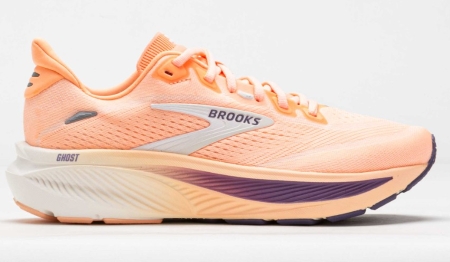
2. Brooks Ghost 18 — Best Conventional Reference
| Decision field | Current detail |
|---|---|
| Drop | 10 mm |
| Weight | 9.2 oz in Brooks’ women’s reference size |
| Midsole | DNA LOFT v3 |
| Fit range | Narrow through Extra Wide in current US listings |
| Best for | A traditional daily-trainer comparison with broad size options |
The Brooks Ghost 18 is the conventional reference in this list. It gives a new runner a familiar flex pattern and a 10 mm drop to compare against the Clifton’s rocker or the Nimbus’s softer max-cushion platform.
The nitrogen-infused DNA LOFT v3 midsole does not make the Ghost universally safer or more durable. What matters in a try-on is whether the heel stays quiet, the forefoot bends without pressure, and the platform feels predictable at an easy pace.
Brooks lists a wide fit range, which lets you compare width without automatically adding length. Try the same size in two widths, then reject the shoe if the narrowest secure option still pinches or the wider option allows heel movement. See my Ghost fit and ride review.
Bottom line: Choose the Ghost 18 when a traditional, moderately firm daily trainer feels more natural than a pronounced rocker or a very soft platform. Do not choose it as a treatment for calf, Achilles, knee, or hip symptoms.
3. ASICS GEL-NIMBUS 28 — Best Plush Neutral Comparison
| Decision field | Current detail |
|---|---|
| Drop | 8 mm |
| Weight | 242 g / 8.5 oz in ASICS’ women’s reference size |
| Midsole | FF BLAST PLUS + PureGEL |
| Support | Neutral, maximum-cushion category |
| Fit range | Standard and Wide US listings |
| Best for | Runners who prefer a soft, substantial neutral platform |
The GEL-NIMBUS 28 is the plush neutral comparison, not a knee- or hip-protection prescription. It belongs beside a more conventional trainer when the runner wants to learn whether deeper, softer cushioning improves comfort without making the stride feel less controlled.
ASICS lists an 8 mm drop, 242 g women’s reference weight, FF BLAST PLUS cushioning, and PureGEL. Those facts describe the shoe; they do not predict pain or injury. The important observation is whether the platform stays centered when walking, jogging, turning, and running at the pace you can repeat.
Use the Wide version when the standard length is correct but the forefoot or instep is compressed. Do not size longer to create width unless toe length also requires it. See my Nimbus fit and ride guide.
Bottom line: Choose the Nimbus 28 when its softness remains stable and uneventful at your easy pace. Skip it when you sink, wobble, or work harder to control the platform.
4. HOKA Bondi 9 — Best Firmer Max-Cushion Rocker

The Bondi 9 is the firmer max-cushion rocker in this comparison. I use it to answer a specific question: does a broad, substantial platform with an obvious rolling transition feel calmer than the lighter Clifton, or simply bulkier?
A rocker can reduce how much the shoe bends through the forefoot, but it does not guarantee lower joint load or prevent injury. Walk first, then jog at an honest easy pace. The roll should occur under you without pulling the body forward or concentrating pressure beneath the arch.
Choose width by joint alignment and heel control, not by the idea that feet inevitably widen at a certain age. Compare the full fit and ride notes in my Bondi 9 review.
Bottom line: Keep the Bondi 9 when its rocker and broad base make easy running feel controlled. Reject it when the platform feels cumbersome, the heel lifts, or the arch contour remains noticeable.
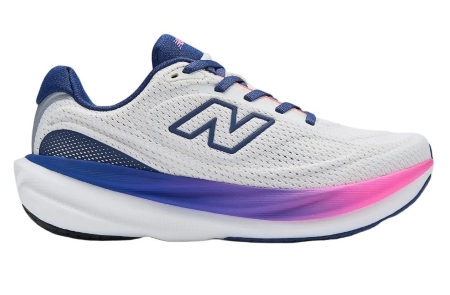
5. New Balance Fresh Foam X 1080v15 — Best for Long Runs
| Spec | Detail |
|---|---|
| Stack height | 37mm heel / 29mm forefoot |
| Drop | 8mm |
| Weight (W US7) | 8.9 oz (252g) |
| Foam | Fresh Foam X |
| Widths | B (standard) + D (wide) + 2E (extra-wide) |
| Best for | Longer runs and tired legs |
When you start venturing past 5K into longer distances, the New Balance Fresh Foam X 1080v15 keeps tired legs feeling fresher — its 37mm stack of plush Fresh Foam X provides a soft, forgiving landing that eats up miles. This is the shoe I recommend for women building up to their first 10K or first half marathon.
New Balance lists Infinion foam and a 6mm drop for the women’s 1080v15. The ride is soft and the model is offered from narrow through extra-wide, making it especially useful for a careful same-length width comparison. A soft platform can feel less controlled to some runners, so assess it at your normal easy pace rather than judging the first step.
New Balance leads the industry in width options: B, D, and 2E widths accommodate virtually any foot shape. If your feet have widened significantly with age, the 2E option is the widest on this entire list. The upper mesh is soft and accommodating, with a secure heel lockdown. Also see my wide feet shoe guide.
| ✅ Pros | ❌ Cons |
|---|---|
| Best width options (B, D, and 2E) | Softer foam compresses slightly faster |
| Plush landing absorbs fatigue on long runs | Less responsive for short, fast efforts |
| 37mm stack for generous cushioning | Slightly heavier than Clifton 11 |
Bottom line: The 1080v15 is the right choice for longer-distance training and for women who need the widest available sizing.
6. Brooks Adrenaline GTS 25 — Best Mild-Guidance Comparison
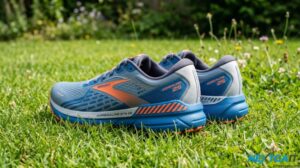
The Adrenaline GTS 25 is the mild-guidance comparison, not the automatic choice for an older runner, a flat arch, or visible pronation. Put it beside the Ghost at the same pace and let comfort and control decide whether the extra geometry helps.
GuideRails and a broad platform can change how the shoe feels at the edges. They cannot diagnose movement or promise to prevent runner’s knee. If the Adrenaline feels quieter without pressing the arch or steering the foot, the guidance has a useful job. If both shoes feel equally controlled, choose the less intrusive option.
Width and volume still need separate checks. A wide upper can solve joint pressure yet create heel movement, so compare the same length before sizing up. See my Adrenaline fit and ride review and the stability-versus-neutral framework.
Bottom line: Choose the Adrenaline only when its mild guidance produces a better side-by-side result. Do not prescribe it from age, arch shape, outsole wear, or a brief gait video.
7. ASICS GEL-KAYANO 33 — Best Maximum-Cushion Stability Option
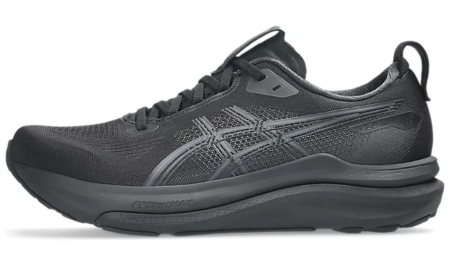
| Spec | Current detail |
|---|---|
| Drop | 8 mm |
| Weight | 259 g / 9.1 oz (manufacturer listing) |
| Midsole | FF BLAST PLUS + FF BLAST MAX |
| Guidance | FLUIDSUPPORT adaptive stability geometry |
| Widths | Narrow, standard, and wide listings available |
| Best for | Runners who prefer a guided, maximum-cushion ride |
The ASICS GEL-KAYANO 33 is the most substantial guidance option here, but it is not a diagnosis for flat feet or age. I use it as a comparison when a runner clearly feels calmer and more centered in a broad, guided platform than in a neutral shoe.
The current model replaces the Kayano 32’s 4D Guidance System with FLUIDSUPPORT and combines two foams: softer FF BLAST MAX above and FF BLAST PLUS below for structure. The result should be judged by the runner’s movement and comfort, not by an arch label.
Try it beside a neutral model at the same easy pace. If the Kayano reduces side-to-side work without pressing the arch or steering the foot, it has earned the extra structure. If both feel equally controlled, choose the simpler shoe. See my Kayano fit and ride guide for the decision framework.
Bottom line: Choose the Kayano 33 when its guided geometry feels measurably better under your stride. Do not prescribe it from foot shape alone.
8. Saucony Ride 19 — Best Everyday Trainer
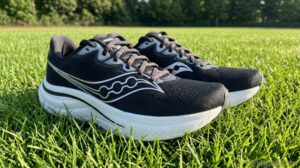
| Spec | Detail |
|---|---|
| Stack height | 33mm heel / 25mm forefoot |
| Drop | 8mm |
| Weight (W US7) | 8.3 oz (235g) |
| Foam | PWRRUN+ |
| Widths | Standard and Wide current US listings |
| Best for | Versatile daily training with energy return |
The Saucony Ride 19 is my pick for beginner women over 40 who want a lighter, peppier daily trainer — at just 8.3 oz, it’s the second-lightest shoe here and provides responsive cushioning that makes 3–5 mile runs feel spritelier. I recommend this for women who don’t want to feel like they’re wearing mattresses on their feet.
The PWRRUN+ platform gives the Ride 19 a balanced daily-trainer role between the softer Nimbus and the more conventional Ghost. Its 8mm drop is a middle option, not a universal sweet spot. It can cover easy running and some quicker work, provided the fit is secure and the runner adapts to the current model rather than relying on memories of an older Ride.
Saucony currently lists standard and Wide versions. Compare them at the same length: the upper should secure the midfoot without crowding the forefoot, and the heel should remain seated in the wider option. If neither version passes both checks, move to the broader fit range of the Ghost 18 or 1080v15. Read my Ride review and learn about running cadence.
| ✅ Pros | ❌ Cons |
|---|---|
| Second-lightest shoe at 8.3 oz | Wide availability varies by color and seller |
| Responsive PWRRUN+ foam with energy return | Less max-cushion for ultra-long runs |
| Sweet-spot 8mm drop | Less plush than Clifton or Nimbus |
Bottom line: Choose the Ride 19 when its balanced transition and current width option fit securely. Pair it with a more cushioned shoe for long runs.
9. ASICS NOVABLAST 6 — Best Energetic Neutral Option
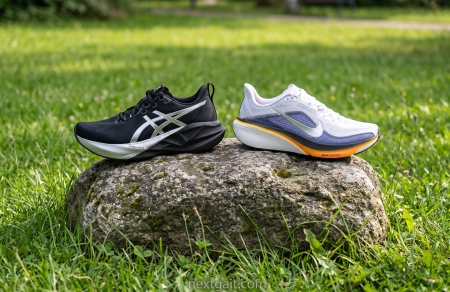
| Decision field | Current detail |
|---|---|
| Drop | 8 mm |
| Weight | 215 g / 7.6 oz in ASICS’ women’s reference size |
| Midsole | FF BLAST MAX + FF TURBO SQUARED forefoot pod |
| Outsole | ASICSGRIP at the forefoot |
| Fit range | Standard and Wide US listings |
| Best for | Runners who prefer an energetic neutral ride |
The NOVABLAST 6 is the energetic neutral option. It gives a beginner a useful contrast with the Ghost: lighter and more animated underfoot, but still a daily trainer rather than a reason to run faster than the plan.
ASICS lists an 8 mm drop, 215 g women’s reference weight, FF BLAST MAX foam, and a forefoot FF TURBO SQUARED pod. Treat the resulting bounce as a preference. It may feel lively to one runner and distracting to another.
Keep it when the heel stays centered and the platform settles quickly after landing. Skip it when the rebound changes your cadence without intent, the forefoot feels unstable, or the upper cannot secure your foot. See my NOVABLAST review.
Bottom line: Choose it for an energetic neutral feel that remains controlled at easy pace—not because bounce guarantees motivation, speed, or lower effort.
10. Nike Pegasus 42 — Best Conventional Responsive Ride
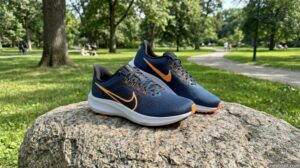
| Spec | Current detail |
|---|---|
| Drop | 10 mm |
| Weight | 243 g / 8.6 oz (women’s US 8) |
| Midsole | ReactX foam + curved full-length Air Zoom unit |
| Upper | Updated mesh with more forefoot and toe-box room than Pegasus 41 |
| Outsole | High-abrasion rubber Waffle pattern |
| Best for | Daily road running with a firmer, responsive feel |
The Nike Pegasus 42 is the conventional responsive option for runners who do not want a tall, soft platform. It remains easy to find in US stores, which makes an in-person comparison and size swap simpler for a first purchase.
Nike changed the cushioning layout from separate Air units in the Pegasus 41 to a curved, full-length Air Zoom unit over ReactX foam. It also gives the forefoot and toe box more room than the prior model. That is useful for swelling, but it does not replace checking heel hold and width under load.
The ride is firmer and more direct than a Nimbus-type max-cushion shoe. Choose it when that feedback feels controlled at walk/run and easy pace. Skip it if the forefoot still feels compressed or if a softer platform makes it easier to stay relaxed.
Bottom line: A versatile, widely available daily trainer for runners who prefer responsive cushioning and a 10 mm drop over a plush rocker.
Full Comparison Table
| Shoe | Use it as this comparison | Keep it when | Reject it when |
|---|---|---|---|
| HOKA Clifton 11 | Neutral rocker | The roll feels natural and the heel stays seated | The rocker pushes or the arch remains noticeable |
| Brooks Ghost 18 | Conventional daily trainer | Flex and 10 mm geometry feel familiar | The heel moves or the forefoot feels stiff |
| ASICS GEL-NIMBUS 28 | Plush neutral | Softness remains centered at easy pace | You sink or work to control the platform |
| HOKA Bondi 9 | Firmer max-cushion rocker | The broad base feels calm rather than bulky | The shoe feels cumbersome or rolls too early |
| New Balance 1080v15 | Soft fit-range option | One width secures heel and frees the joints | Softness or upper volume reduces control |
| Brooks Adrenaline GTS 25 | Mild guidance | It clearly feels calmer than the Ghost | Guidance presses or steers the foot |
| ASICS GEL-KAYANO 33 | Maximum-cushion guidance | The extra structure has a clear comfort benefit | A neutral shoe feels equally controlled |
| Saucony Ride 19 | Balanced 8 mm daily trainer | The transition feels versatile and secure | The fit or current width choice is wrong |
| ASICS NOVABLAST 6 | Energetic neutral | Rebound feels controlled at easy pace | The platform feels distracting or unstable |
| Nike Pegasus 42 | Responsive conventional option | The forefoot has room and the ride feels direct | The upper compresses or cushioning feels too firm |
This table is a try-on sequence, not a medical hierarchy. Compare two contrasting shoes in the same size, at the same pace, and with the socks you will use. The winner is the least intrusive shoe that fits the whole foot.
Neutral vs Stability: Which Do You Need?
Age, arch height, outsole wear, and a short store video do not prove that you need a stability shoe. The useful question is whether guidance improves comfort and control without creating arch pressure or steering the stride.
| Comparison | Neutral starting point | Guidance alternative | Decision rule |
|---|---|---|---|
| Traditional | Brooks Ghost 18 | Brooks Adrenaline GTS 25 | Keep guidance only if the difference is clearly better |
| More cushioned | ASICS GEL-NIMBUS 28 | ASICS GEL-KAYANO 33 | Reject either shoe that feels intrusive or unstable |
| What not to use | Arch height or even wear | Flat arch or medial wear | Static shape and wear are clues, not prescriptions |
| Pain | Do not self-treat with neutral shoes | Do not self-treat with stability shoes | Pain that changes gait needs assessment |
Run or walk-run briefly in both categories. Repeat the comparison after the first impression, because step-in softness can hide poor control. For the full method, read the stability versus neutral shoe guide.
Smart Fitting Tips for Women Over 40
Getting fitted properly is the most underrated step in starting to run after 40. These tips come from personal experience — I’ve learned most of them the hard way.
- Go in the afternoon: Your feet swell throughout the day. Trying shoes on later ensures they’ll be comfortable even on long runs.
- Bring your own socks: Wear the socks you actually run in. This affects fit more than you’d think.
- Thumb’s width at the toe: You need space between your longest toe and the end of the shoe. Your feet slide forward when you run.
- Check for heel slip: Your heel shouldn’t slip significantly with each step. This causes blisters and instability.
- Walk and jog in-store: Don’t just stand there. Do laps. See how they feel at pace.
- Try wide widths: With feet widening after 40, don’t be afraid to ask about D or 2E options. Many brands offer them.
- Don’t buy for looks: The cutest shoe might be the one that sends your shins into a revolt. Function over fashion when starting out.
For comprehensive fitting advice, see my shoe fitting guide.
When to Replace Your Running Shoes
There is no precise retirement mileage that works for every runner and shoe. Distance is a reminder to inspect the pair, not an expiration date.
| Signal | What to compare | Action |
|---|---|---|
| Traction changed | Same wet turn or braking surface | Replace when grip loss creates a control problem |
| Upper no longer secures the foot | Heel hold and side-to-side movement | Retire the shoe if lacing cannot restore fit |
| Midsole deformed | Left versus right and old versus newer pair | Replace when the platform no longer sits or rides predictably |
| The same easy run feels different | Pace, surface, recovery, and another trusted pair | Rule out training/context, then retire a materially changed shoe |
Track mileage, but combine it with outsole wear, upper integrity, platform shape, and your response on a repeatable route. Use my running-shoe replacement checklist for the full comparison.
Pro Tips for Starting Running Over 40
These are training guardrails, not benefits produced by a shoe. Start below your current capacity and change one variable at a time.
- Use walk/run intervals when useful. They make the running dose adjustable without turning every session into a test.
- Keep easy days genuinely easy. Conversation effort is more useful than chasing a pace borrowed from someone else.
- Add volume from your response, not from a universal percentage rule. Repeat a manageable week before adding time, frequency, terrain, or speed.
- Strength train consistently. Choose a repeatable program matched to your history instead of treating shoes as a substitute.
- Respond to pain early. Back off for focal, worsening, night, or gait-changing pain and seek appropriate assessment.
- Use technical socks that fit. Moisture management helps, but wrinkles, seams, and shoe volume still decide whether friction develops.
- Practice fueling and hydration separately from footwear. Route, duration, conditions, and individual needs determine that plan.
For the training progression rather than shoe selection, use my starting-running-after-40 guide. Keeping those tasks separate prevents a product page from pretending to be a training or medical plan.
FAQ: Running Shoes for Women Over 40
These are the questions I get asked most, answered from personal experience.
Is it too late to start running at 40 or 50?
No. Starting in your 40s or 50s can be entirely reasonable. Begin below your current capacity, use walk/run intervals if useful, and leave recovery between sessions. If you have osteoporosis, cardiovascular concerns, unexplained symptoms, or pain that changes your gait, get individualized medical guidance first.
Can running damage my joints after 40?
Running after 40 does not automatically damage healthy joints, and a shoe cannot guarantee protection. Start with a manageable dose, progress from your response rather than a fixed percentage, and keep strength work in the week. Existing or worsening joint pain deserves individualized guidance; do not select Nimbus or Bondi as treatment.
Should I get a gait analysis before buying shoes?
A running-store assessment can help compare size, width, heel hold, and comfort while moving. It cannot diagnose injury or prove that you need neutral or stability shoes, and a brief video does not predict injury. Use it as one side-by-side fitting input, not a prescription.
How are running shoes different from cross-trainers?
A cross-trainer can be acceptable for short walk/run sessions when it fits, stays secure, and feels comfortable. A running shoe usually offers a geometry and upper designed for repeated forward running, but using a cross-trainer does not by itself prove the cause of shin or knee pain. Compare comfort and control rather than relying on the category label alone.
Do I need special insoles for running after 40?
Not because of age alone. An insole changes volume, arch contact, and the way the foot sits in the shoe. Trial one only for a clear comfort or clinical reason, remove the stock sockliner when appropriate, and repeat the fit check. Persistent pain deserves an assessment rather than a sequence of inserts.
How often should I replace running shoes?
There is no precise retirement mileage for every runner and model. Track distance, but also inspect outsole wear, upper security, midsole deformation, traction, and whether the same easy run now produces a different response. Compare with a newer pair when possible. See when to replace running shoes.
What drop is best for women over 40?
Age does not determine the best drop. Start near the geometry you already tolerate, then compare comfort during a short easy run and the next morning. A drop change redistributes work; it is not a treatment for calf, Achilles, knee, or forefoot symptoms.
Should I start with neutral or stability shoes?
Start with the category that feels natural and compare it directly with the alternative. Age, arch shape, outsole wear, and a brief store video do not prove that you need stability. Choose the shoe that fits securely and feels least intrusive at your easy pace. See the neutral versus stability guide.
The Bottom Line
For most beginner women over 40, the best first comparison is between one conventional neutral trainer and one stable, rockered or guidance alternative. The Ghost 18 is the conventional reference, the Clifton 11 supplies the rocker contrast, the Nimbus 28 adds a softer neutral option, and the Adrenaline GTS 25 adds structured guidance. The winner is the model that passes the fit check and still feels uneventful the next morning.
Do not let an age label sell you a corrective shoe. Build the running dose gradually, keep strength work in the week, and respond early to focal or worsening pain. For the training side, use the starting-running-after-40 guide and beginner distance guide.

Written and reviewed by Ken — NextGait founder, runner for 12 years, 12,500+ miles logged, and 36 races from 5K through 50K. Ken runs 30–40 miles per week and evaluates running shoes through fit, ride, training context, and documented product evidence. Read Ken’s testing philosophy and experience.