
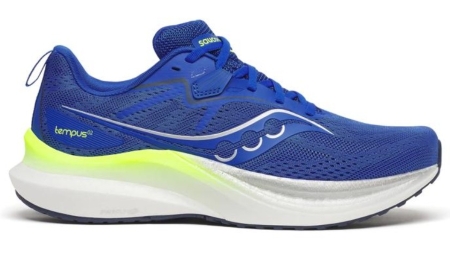
The Saucony Tempus 2 is a performance stability trainer for runners who want real midfoot guidance without giving up the rebound and lower weight of a PEBA-based foam. After 140 miles, I rate it 8.8/10. It handles daily miles, steady long runs, tempo work, and non-elite racing better than most conventional stability shoes.
The reason is its two-part midsole. A responsive PWRRUN PB core sits inside a firmer, asymmetrical PWRRUN frame. The frame is more prominent along the medial heel and midfoot, then wraps the softer core to keep it centered. There is no medial post and no plate. The support comes from geometry, foam placement, sidewalls, width, and a secure upper.
Version 2 is not a ground-up redesign. Saucony kept the Tempus platform and changed the engineered-mesh upper. The new fit is more secure but also narrower through the forefoot and more noticeable around the arch. That makes this a better performance fit for some runners and a clear downgrade for wide feet.
My biggest warning is sizing availability. The original Tempus was sold in a Wide version in the United States. I could not verify a Tempus 2 Wide in Saucony’s current catalogs, and both RTINGS and RunRepeat report a narrow internal fit. Do not buy extra length and assume it replaces a wider platform.
Jump to Section Click to expand
- Quick Verdict
- Ken’s Ranking Rule
- How I Tested
- Specs and Verified Facts
- PWRRUN PB and PWRRUN Frame
- How the Guidance Works
- Ride Feel
- Performance by Pace
- Stability and Pronation
- Fit and Sizing
- Upper and Lockdown
- Grip and Durability
- Tempus 2 vs Tempus 1
- Stability-Shoe Comparisons
- Long Runs and Racing
- Walking and Standing
- Road, Treadmill, and Weather
- Best Rotation
- Who Should Buy
- Who Should Skip
- Sources and Fact Check
- Final Verdict
- FAQ
Saucony Tempus 2 Review: Quick Verdict
Buy the Tempus 2 if you need moderate medial guidance, like a firm-responsive ride, and want one stability shoe that can move from easy running to tempo pace. Skip it if your forefoot is wide, you dislike arch pressure, want a soft recovery cruiser, or expect a major upgrade over the original Tempus.
| Decision | Ken’s Answer |
|---|---|
| Best for | Daily training, tempo runs, steady long runs, and runners needing moderate guidance |
| Ride | Firm-responsive, centered, lightly rockered, and more energetic as pace increases |
| Support | PWRRUN frame, medial sidewall, broad platform, stiff midfoot, and secure upper |
| Fit | True in length for me, snug through the arch, forefoot, and lateral toes |
| Main strength | Rare combination of stability, low weight, and useful pace range |
| Main weakness | Narrow upper and prominent midfoot guidance reduce universal appeal |
| Tempus 1 owners | Upgrade for a more secure upper, not for a different midsole ride |
| Ken’s score | 8.8/10 |
It earns a high place in my best stability running shoes discussion because it solves a problem most brands still treat as a niche: a runner can need guidance and still want to run fast. The Tempus 2 does not feel like a stripped racing shoe, but it is far less cumbersome than a traditional high-support trainer.
For new runners, the shoe makes sense only if the fit and guidance feel natural. My beginner running shoe guide starts with comfort, consistency, and the actual training plan rather than assuming every inward-moving foot needs a stability label.
Quick answer: The Tempus 2 is one of the few genuinely versatile stability trainers. Its PWRRUN PB core adds rebound; its PWRRUN frame controls the platform; its narrow upper is the main deal-breaker.
Ken’s Ranking Rule for the Saucony Tempus 2
Ken’s ranking rule: a performance stability shoe must remain centered when form fades, then get out of the way when pace rises. I do not award extra points because a shoe pushes hard against the arch. Useful guidance keeps the transition predictable without forcing every runner onto one path.
I score this category differently from a neutral daily trainer. Guidance quality, pressure distribution, platform control, upper security, and late-run consistency matter first. Pace range and weight matter next. Cushioning softness matters only when it improves the intended run; a stability shoe does not need to feel plush to be comfortable.
| Ranking Factor | Weight | Tempus 2 | Why |
|---|---|---|---|
| Guidance quality | 25% | 9.1/10 | The frame centers my stride without a hard post sensation |
| Pace range | 20% | 9.2/10 | Works from daily pace through tempo and controlled racing |
| Late-run control | 15% | 9.0/10 | Broad platform and stiff midfoot remain predictable under fatigue |
| Fit and upper | 15% | 7.7/10 | Secure but narrow, with prominent arch and lateral-toe pressure |
| Ride and transition | 15% | 8.8/10 | Responsive core and rocker offset the firm support frame |
| Grip and durability | 10% | 8.4/10 | Good coverage and wear, but independent wet-grip reports conflict |
The score assumes the medial frame meets the foot cleanly. A runner who feels pressure under the arch or fifth toe should score the shoe much lower. Fit is not a small subcategory here; it decides whether the support system feels centered or intrusive.
I also refuse to turn a road sensation into a laboratory result. A Garmin file can document time, distance, and pace. It cannot measure ankle eversion, tibial acceleration, energy return, or injury risk. Independent labs can report their own controlled measurements, and I label those values by source.
How I Tested the Saucony Tempus 2
I logged 140 miles over seven weeks on paved roads, athletic track, gym treadmill, boardwalk, and short sections of clean gravel. The mix included easy mileage, steady running, tempo work, faster repetitions, long-run use, walking, and wet-pavement testing.
I repeated familiar routes to separate shoe behavior from terrain. The track exposed forefoot turnover and cornering. The treadmill highlighted heat and midfoot pressure. Long road miles showed whether the PWRRUN frame became more noticeable as fatigue changed my landing.
| Test Detail | Ken’s Protocol |
|---|---|
| Mileage | 140 running miles over seven weeks |
| Surfaces | Asphalt, concrete boardwalk, track, treadmill, and brief flat gravel |
| Run types | Easy, steady, tempo, intervals, long runs, and short recovery segments |
| Conditions | Dry roads, wet pavement, warm indoor running, and cool outdoor miles |
| Fit checks | Normal and thin technical socks, standard lacing, and heel-lock lacing |
| Tracked | Arch pressure, lateral-toe room, guidance, transition, pace response, grip, and wear |
| Comparisons | Original Tempus concept, Guide, Adrenaline GTS, Kayano, and lighter neutral trainers |
The 140-mile road log and its surface and session notes appear consistently through every saved revision. Body weight, shoe size, caliper, durometer, accelerometer, and gait-angle values do not have retained source records, so this review does not use them.
My test is useful for describing fit, feel, use case, and visible wear. It is not a clinical gait assessment. If you want to structure the faster work used in this evaluation, my tempo run guide explains intensity and duration without turning every workout into a race.
Saucony Tempus 2 Specs and Verified Facts
Saucony lists the men’s Tempus 2 at 9.4 oz or 269 g, with an 8 mm offset and a 33 mm heel/25 mm forefoot stack on its European catalog page. The same page confirms PWRRUN PB cushioning, an asymmetrical supportive PWRRUN frame, improved engineered mesh, and intended use for speed runs, daily runs, and workouts.
| Specification | Source-Labeled Detail | Practical Meaning |
|---|---|---|
| Category | Performance stability road trainer | Built for support without traditional stability-shoe bulk |
| Saucony-listed weight | 9.4 oz / 269 g | Light relative to many moderate-support trainers |
| Saucony-listed offset | 8 mm | Moderate drop with a rearfoot-friendly transition |
| Saucony catalog stack | 33 mm heel / 25 mm forefoot | Official catalog figure; independent methods measure higher |
| Primary foam | PWRRUN PB | PEBA-based responsive core |
| Support foam | Asymmetrical PWRRUN frame | Firmer carrier provides medial and lateral guidance |
| Plate | None | Response comes from foam, geometry, and stiffness rather than a plate |
| Upper update | Improved engineered mesh | More secure performance fit than version 1 |
| Outsole | XT-900 rubber plus exposed foam | Balances traction, durability, and weight |
| Available fit | Standard width in catalogs checked | Wide-foot runners lose the Tempus 1 Wide option |
Stack numbers vary substantially. Doctors of Running and RoadTrailRun cite 38/30 mm. RTINGS measured 37.4/28.0 mm in its sample, while RunRepeat measured 36.8/26.7 mm. Those differences likely reflect measurement protocol, location, and whether the insole is included. I will not merge them into one supposedly exact number.
Weight is more consistent when size is labeled. Doctors of Running and RunRepeat report roughly 9.3 oz or 264 g in men’s US 9, close to Saucony’s listed 9.4 oz. RoadTrailRun lists 8.2 oz or 232 g for women’s US 8. Sample size matters when comparing this shoe with a rival.
The verified headline is simple: 8 mm advertised offset, no plate, a PWRRUN PB core, firmer PWRRUN support frame, and a primarily upper-based update. The draft’s invented “NextGait lab” numbers are not needed to explain why the shoe works.
PWRRUN PB Core and PWRRUN Support Frame
The Tempus 2 combines a responsive PWRRUN PB core with a firmer PWRRUN frame that wraps around it. PWRRUN PB is Saucony’s PEBA-based foam. The carrier is a conventional, denser PWRRUN formulation arranged asymmetrically to provide structure.
The soft core is visible through the center and forefoot. The firmer frame contacts the ground around much of the perimeter and rises along the side of the foot. More material sits under the medial heel and midfoot, where it resists compression and encourages the foot to continue forward.
This is not the same experience as a block of dense foam placed under the arch. A traditional medial post creates a local firmness change. The Tempus frame spreads guidance along the platform, so the transition feels less abrupt. I notice the medial sidewall, but I do not feel a hard edge striking the foot on every step.
PWRRUN PB does not make the shoe soft in the current max-cushion sense. The frame, outsole, broad base, and stiff midfoot temper the core. Underfoot I get resilient compression and a quick return to shape, not a deep sink. The ride is responsive and controlled rather than plush.
Independent laboratories disagree on the exact energy-return percentage because their methods differ. RTINGS measured 77.1% at the heel and 79.8% at the forefoot under its protocol. RunRepeat, using ASTM F1976, reported 69.9% and 72.2%. Those are source-specific results, not values from my pair and not promises about metabolic savings.
The frame also explains why the Tempus feels firmer than an Saucony Endorphin Speed even though both use PWRRUN PB. Foam name alone does not define ride. Carrier material, plate, geometry, rubber, and upper all change how the same family of foam behaves.
How the Tempus 2 Guidance System Works
The Tempus 2 guides through a firmer medial frame, sidewalls, a broad forefoot and heel, a non-flexible midfoot, mild rocker geometry, and a secure upper. The components work together; none should be treated as a standalone correction device.
At heel contact, the outer and rear platform provide a stable landing area. As weight moves inward, the larger medial PWRRUN section resists compression more than the PWRRUN PB core. The foot then encounters a wide, centered forefoot with support foam on both sides.
The shoe feels most guided through the arch and anterior heel. That is useful for runners who want a clear medial reference. It can be uncomfortable for low-volume feet whose arch lands directly on the sidewall, or for neutral runners who do not need the extra pressure.
The stiff midfoot reduces twisting and keeps the softer core from wandering laterally. A small amount of forefoot flex and an early rocker allow toe-off without a plate. I can run faster without feeling that the support structure is holding the rear of the shoe behind me.
This is why I call it a performance stability trainer rather than a neutral shoe with a wide base. The guidance is real and noticeable. It is less intrusive than many posted designs, but the medial structure is not invisible. Runners looking for barely perceptible support should test it rather than trusting the phrase “adaptive guidance.”
Saucony Tempus 2 Ride Feel
The Tempus 2 feels firm-responsive, centered, and lightly rockered, with more rebound as pace rises. It is neither a soft recovery shoe nor a stripped speed shoe. The closest description is a stable daily trainer that becomes more convincing when the run includes steady or faster work.
At easy pace, I feel the frame before I feel the PWRRUN PB. The heel settles, the medial side resists, and the rocker moves me toward the forefoot. The ride is controlled and predictable, but not especially relaxed. After the first few runs, the outsole and upper loosened enough for the transition to feel smoother.
At steady pace, the balance changes. Contact time shortens, the core compresses more purposefully, and the shoe rolls without the heavy heel sensation common in stability trainers. This is its broadest sweet spot: quick enough to be enjoyable, controlled enough for routine mileage.
At tempo effort, the forefoot response becomes clearer. There is no plated snap, but the midsole is stiff enough to act as a lever and the PB core rebounds quickly. I can hold a compact rhythm without fighting a collapsing medial edge.
Ground feel is moderate. The shoe has enough stack to filter rough pavement, but the firmer frame keeps it from feeling disconnected. I can sense camber and turns earlier than in a very soft max-cushion trainer, which helps when the road is not perfectly level.
Runners who want a slower, softer support experience should compare my ASICS Gel-Kayano review. The Kayano family prioritizes comfort and sustained guidance; the Tempus prioritizes response and lower mass.
How the Saucony Tempus 2 Performs by Pace
Recovery and very easy pace
Recovery pace is acceptable, not ideal. The Tempus remains stable and the PB core prevents a dead ride, but the frame can feel firm when I am shuffling. I prefer a softer, less assertive shoe when the purpose is purely restorative.
My recovery run guide explains why effort matters more than making a versatile shoe cover every day. The Tempus can run slowly; it simply does not disappear underfoot at that pace.
Daily and steady pace
Daily and steady running are excellent. The platform feels centered, the weight is reasonable, and the rocker keeps the firm frame from becoming blocky. This is where the shoe can replace a traditional stability workhorse while feeling noticeably more energetic.
Tempo and threshold pace
Tempo is the Tempus 2’s defining advantage. The PWRRUN PB core responds to stronger loading, the upper holds the foot, and the broad forefoot remains predictable. It is not as light or propulsive as a plated neutral trainer, but it is one of the better choices for runners who need moderate guidance during workouts.
Intervals and short repetitions
Short intervals are possible, especially on a straight track, but the shoe is not razor sharp. The broad base and support frame add mass compared with a neutral speed trainer. I use it more readily for longer repetitions and controlled threshold work than for all-out 200s.
For workout design, my interval training guide matches interval length and recovery to the goal. The Tempus is strongest when a repetition is long enough to settle into rhythm.
| Run Type | Grade | Ken’s Take |
|---|---|---|
| Recovery | B | Stable but firmer and more guided than I want for pure recovery |
| Easy daily mileage | A- | Controlled, responsive, and reasonably light |
| Steady running | A | The best balance of guidance and rebound |
| Long run | A- | Reliable late, though fit pressure must be tested |
| Tempo/threshold | A | Rarely feels like a conventional stability shoe |
| Short intervals | B+ | Capable but broad and less agile than a speed shoe |
| Half/full marathon | B+ | Strong non-plated option for runners prioritizing stability |
Is the Saucony Tempus 2 a Stability Shoe?
Yes. The Tempus 2 is a moderate stability shoe with its strongest guidance at the medial midfoot. It is not simply a stable-neutral trainer. The asymmetrical frame, prominent arch sidewall, stiff midfoot, broad base, heel counter, and upper all influence the path of the foot.
That does not mean it “stops pronation.” Pronation is normal, and the amount visible in a video does not diagnose a problem. The shoe changes how the platform compresses and how the foot moves through it. Whether that change is comfortable and useful depends on the runner.
For my test, guidance became most valuable late in steady and long efforts. When landing moved slightly inward, the frame remained firm and the forefoot stayed level. I did not need to tighten the upper to compensate for a soft platform.
Runners with severe support needs may want more rearfoot structure or a more substantial base. Runners with mild needs may find the Tempus ideal because it provides real guidance without the weight of a maximum-support shoe. The category is a spectrum, not a binary label.
My flat-feet running shoe guide explains why arch height, symptoms, comfort, and motion are separate variables. A flat foot does not automatically require this shoe, and a neutral-looking arch does not rule it out.
I removed every claim that the Tempus corrects an exact number of degrees or guarantees alignment. No retained motion-capture file supports those values. A phone video can help compare comfort and gross movement, but clinical questions belong with a qualified professional.
Saucony Tempus 2 Fit and Sizing
The Tempus 2 fits true to size in length for me, with a snug arch, narrow-to-standard forefoot, tapered lateral toe box, secure midfoot, and firm heel counter. The fit is performance-oriented and less accommodating than the original Tempus upper.
| Fit Area | My Experience | What to Check |
|---|---|---|
| Length | True to size | Leave enough room for swelling on long runs |
| Toe box | Tapers near the fifth toe | Watch lateral-toe rubbing and nail contact |
| Forefoot | Narrow to standard | Do not expect the mesh to create platform width |
| Arch | Prominent at first step | A mild sensation may settle; pain or burning should not |
| Midfoot | Secure with light lace tension | Avoid overtightening over the gusseted tongue |
| Heel | Firm counter and good hold | Heel-sensitive runners should test walking and hills |
| Wide version | Not verified for Tempus 2 | Do not confuse it with the original Tempus Wide |
Doctors of Running also found the shoe true to size but snug through the forefoot and toe box, with one tester noticing fifth-toe abrasion over 13 miles. RunRepeat’s internal mold measured narrower than its database average and showed a pronounced taper. That agreement deserves more weight than the upper’s roomy appearance from above.
Do not size up automatically. Extra length can move the heel, arch, and rocker away from the intended position while the platform remains narrow. Try your normal size with race or training socks, then reject the model if the arch or lateral toes stay irritated.
The best running shoes for wide feet guide explains why a real wide last is preferable to buying a longer standard shoe. This is one area where Tempus 2 is less inclusive than its predecessor.
Engineered Mesh Upper and Lockdown
The engineered-mesh upper is the main Tempus 2 update. It provides stronger midfoot containment, a gusseted tongue, moderate collar padding, and a firm heel counter. The fit feels more performance-focused than version 1, but the added structure also increases weight and warmth.
I needed less lace tension than expected. The upper already wraps the midfoot, and pulling hard increased pressure across the top of the foot without improving stability. Even tension and a normal bow worked best for most runs.
Heel lock was secure. The counter is stiff enough to be noticeable when walking uphill or when the collar bends against the Achilles area. I did not treat that structure as protection; heel-sensitive runners should spend time in the shoe before committing to long mileage.
Breathability is mixed. Open areas at the toe allow some airflow, but the structured inner layer traps more heat than the draft claimed. RunRepeat scored the upper 2/5 in its smoke and light tests. My treadmill miles also felt warmer than outdoor running in similar socks.
Use a smooth technical sock because the lateral toe and internal seams can become more noticeable as feet swell. My running socks guide covers thickness and fiber choices without suggesting that socks can rescue the wrong shoe width.
XT-900 Outsole Grip and Durability After 140 Miles
After 140 miles, my pair showed smoothing at the main heel and forefoot contact zones, scuffing on exposed foam, and no outsole failure that changed the ride. XT-900 rubber covers high-wear areas, while open midfoot sections reduce weight and expose the supporting foam.
I will not publish a measured abrasion value or fixed lifespan range for this pair. No retained pre-test measurement supports that precision, and visible rubber condition cannot predict when the midsole, upper, or fit will stop working for a particular runner.
| Wear Area | Finding at 140 Miles | What It Means |
|---|---|---|
| Lateral heel | Moderate surface smoothing | Landing pattern will drive future wear |
| Forefoot rubber | Light smoothing, pattern still visible | Traction remained useful in normal road running |
| Exposed foam | Cosmetic scuffs | Expected where the midfoot lacks full rubber |
| Heel lining | No failure in my pair | Independent abrasion tests suggest checking this area |
| Midsole | Ride remained responsive and centered | No retention percentage is claimed |
| Overall | Good condition for 140 miles | Future life depends on gait, surface, and use |
Grip reports conflict. RunRepeat measured a strong 0.63 in its SATRA wet-traction test, and RoadTrailRun reported good wet-pavement grip. Doctors of Running described outsole traction as poor. In my use, ordinary damp asphalt was secure when I shortened stride, but painted lines, metal, and sharp wet turns still required caution.
The outsole is thick enough to favor training durability over minimum weight. RunRepeat measured 3.7 mm in its sample, not the unsupported 2.5 mm from the old draft. Use my running shoe replacement guide to inspect ride, stability, fit, and rubber rather than relying on a universal mileage.
Saucony Tempus 2 vs Tempus 1
The Tempus 2 is essentially the original Tempus platform with a more structured engineered-mesh upper. The PWRRUN PB core, PWRRUN support frame, outsole layout, 8 mm advertised offset, and overall geometry remain closely related. The ride is evolutionary, not new.
| Feature | Tempus 1 | Tempus 2 | What Changes |
|---|---|---|---|
| Midsole | PWRRUN PB core in PWRRUN frame | Same basic dual-foam system | Little reason to upgrade for ride alone |
| Upper | More accommodating mesh | More structured engineered mesh | Version 2 locks down better and fits narrower |
| Weight | Lighter in comparable samples | About 9.3-9.4 oz men’s | New upper adds a small amount |
| Support | Asymmetrical frame and broad base | Same central guidance concept | Support sensation remains familiar |
| Width | Wide version existed | Standard width in catalogs checked | Wide-foot runners lose an important option |
| Best reason to switch | N/A | More secure performance fit | Upgrade only if version 1 upper felt loose |
Keep the original if it fits well and still has life. The second version does not introduce a newer PWRRUN PB formulation or a lighter frame. Doctors of Running reaches the same broad conclusion: the update is subtle and mainly changes the upper.
Choose version 2 if the old upper required heavy lacing or allowed too much movement. Avoid it if the original Wide was essential. A secure standard-width upper is not a replacement for a wide last.
Saucony Tempus 2 vs Other Stability Shoes
Tempus 2 vs Saucony Guide
Choose the Tempus for faster running and a firmer-responsive PB core; choose the Guide for a simpler, more relaxed daily trainer. The Guide is usually easier at recovery pace and more approachable for runners who do not need a performance fit. Read my Saucony Guide review.
Tempus 2 vs Brooks Adrenaline GTS
The Adrenaline is more traditional, roomier, and better suited to steady daily mileage. Its GuideRails approach feels less concentrated under the arch, while the Tempus is lighter and more responsive at tempo pace. My Brooks Adrenaline GTS review covers the workhorse alternative.
Tempus 2 vs ASICS Gel-Kayano
The Kayano offers more cushioning volume, broader comfort, and a calmer long-run ride. The Tempus is lighter, firmer, and much better for pace changes. Choose ASICS for comfort-first stability; choose Saucony for a workout-capable platform.
Tempus 2 vs HOKA Arahi
The Arahi uses a more rockered, lower-drop HOKA geometry and a firmer conventional foam feel. The Tempus provides more forefoot rebound and an 8 mm advertised offset. Runners sensitive to arch pressure should try both because their guidance contacts the foot differently.
Tempus 2 vs Brooks Hyperion GTS
The Hyperion GTS is the better short-workout and 5K/10K option because it is lower, quicker, and more direct. The Tempus carries more cushioning for daily miles, long workouts, and marathon use. Think lightweight speed stability versus performance daily stability.
Tempus 2 vs neutral daily trainers
A neutral shoe such as the Brooks Ghost offers a less directed transition and a more accommodating daily fit. The Tempus is the better choice only when its guidance and faster ride solve a real need. Support is a feature, not an automatic upgrade.
Long Runs, Half Marathons, and Marathons
The Tempus 2 works well for steady long runs and can race a half or full marathon for runners who prioritize stability over maximum propulsion. Its PWRRUN PB core maintains more life than a basic EVA trainer, while the frame keeps the platform organized as form changes.
Fit is the limit before cushioning. The tapered lateral toe box and arch sidewall become more important as feet swell. Complete at least one long run in the exact sock and lacing setup before racing. A pressure point that grows over 90 minutes will not improve at mile 20.
For a half marathon, the shoe has enough turnover to hold race effort without feeling heavy. For a marathon, it is a reasonable non-plated choice when confidence and guidance matter more than chasing the lowest possible weight. It will not reproduce the efficiency of a carbon racer, and it does not claim to.
Build the distance with my first half-marathon training plan or compare other options in my long-distance running shoe guide. The shoe should support a proven plan, not become the plan.
Heavier runners may appreciate the firm frame and wide external base, but body weight alone cannot predict fit or foam response. My heavy-runner shoe guide separates platform width, cushioning, upper hold, and wear instead of assigning one shoe above a fixed weight.
Is the Saucony Tempus 2 Good for Walking and Standing?
The Tempus 2 is good for brisk walking and mixed run-walk use, but less ideal for long standing if the arch frame feels prominent. Its 8 mm advertised offset, broad base, and rocker move well through a walking stride, while the upper keeps the heel secure.
The PWRRUN frame feels firmer when walking because there is less force to engage the PB core. Some runners will call that supportive; others will feel an arch ridge. Spend time standing and walking before choosing it for an all-day job.
The shoe is not designed for lateral gym work or heavy lifting. Its tall heel and rockered road geometry favor forward motion. A flatter, firmer cross-training shoe provides a more predictable base for loaded squats and side-to-side movement.
Run-walk beginners may enjoy the transition if the fit is clean. My Couch to 5K plan shows how to progress the running intervals without relying on a shoe to control pace or prevent normal early-training soreness.
Road, Treadmill, Track, and Wet-Weather Performance
The Tempus 2 is best on roads and treadmill, capable on track, and acceptable on short clean gravel; it is not a trail shoe. The broad forefoot and rubber pattern work well on pavement, while the exposed midfoot can collect small stones.
On treadmill, the centered platform feels predictable, but the upper runs warm. The belt also makes the support frame more noticeable at slow pace because the surface is uniform. My treadmill versus outdoor running guide explains why the same shoe can feel different in each setting.
On track, the Tempus handles longer repetitions well. The wide base is less elegant on tight bends than a lightweight neutral trainer, but it remains controlled. I would use lane-one turns for threshold work, not choose it specifically for short track racing.
Wet asphalt was manageable in my test. I shortened stride before painted corners and avoided sudden braking. Independent grip results vary enough that I would not call it an all-weather guarantee. Water also increases upper weight and can amplify toe friction.
For treadmill-only use, compare other models in my treadmill running shoe guide. The Tempus makes most sense indoors when guidance and pace range both matter.
Best Running Shoe Rotation with the Tempus 2
Use the Tempus 2 as the daily and workout bridge, then add a softer recovery shoe or a faster race shoe only where needed. Its versatility can reduce the number of pairs in a rotation, but it does not have to perform every job.
| Rotation Role | Suggested Use | What It Adds |
|---|---|---|
| Recovery | Softer support or stable-neutral trainer | Less arch pressure and a calmer easy-day ride |
| Daily/steady | Tempus 2 | Centered transition and useful rebound |
| Tempo/long workout | Tempus 2 | Guidance without conventional stability-shoe mass |
| Short intervals | Optional lightweight speed shoe | Lower weight and quicker direction changes |
| Race day | Tempus 2 or proven stable racer | Choose by distance, fit, and support need |
The Tempus can carry most of a weekly schedule, but use my easy-run pace guide to keep responsive foam from turning relaxed days into moderate days. The shoe feels best when pushed; that does not mean every run should be pushed.
Cadence should respond naturally to pace and anatomy. My running cadence guide explains why the shoe’s rocker can smooth turnover without requiring every runner to target the same steps per minute.
Who Should Buy the Saucony Tempus 2?
Buy the Tempus 2 if you need moderate stability and refuse to accept a slow, heavy trainer for every run. It is particularly good for runners whose inward movement becomes more noticeable with fatigue and who want the same shoe for daily miles and tempo sessions.
- Narrow-to-standard feet that like a secure performance fit
- Runners who want a clear but non-posted medial guidance system
- Mild-to-moderate stability users who still run workouts
- Heel and midfoot strikers who enjoy an 8 mm advertised offset
- Long-run runners who prefer firm-responsive cushioning over plush softness
- Original Tempus users who wanted a tighter upper
- Half- and full-marathon runners prioritizing stable consistency over a plate
It is also a useful option for runners moving from a traditional support model into a lighter shoe. Transition gradually. A lighter trainer can change pace and loading even when it feels more comfortable on the first run.
Who Should Skip the Saucony Tempus 2?
Skip the Tempus 2 if your toes need a true wide platform, the medial frame irritates your arch, or most of your running is slow recovery mileage. Its greatest strengths only matter when the fit is right and the runner uses the pace range.
- Wide or high-volume feet that depended on the original Tempus Wide
- Runners with fifth-toe pressure in tapered Saucony uppers
- Neutral runners who dislike any medial guidance sensation
- Athletes seeking a soft max-cushion recovery shoe
- Short-distance racers who want the lightest and most agile platform
- Heel-sensitive runners who dislike firm counters
- Anyone expecting footwear to diagnose or treat an injury
The shoe is not a treatment for knee pain, Achilles symptoms, or shin splints. Cushioning and guidance alter sensation and movement, but response varies. My knee-pain shoe guide and Achilles shoe guide explain those limits; persistent pain needs qualified assessment.
Sources, Evidence, and Fact-Checking Notes
I separated Saucony’s published specifications, independent lab measurements, outside reviewer observations, and my 140-mile road test. Where stack or grip results conflict, I show the disagreement instead of choosing the number that makes the shoe look best.
- Saucony Tempus 2 official catalog page – PWRRUN PB, PWRRUN frame, upper update, listed 8 mm offset, 33/25 mm stack, and 9.4 oz weight
- Saucony foam technology page – PWRRUN PB material and brand description
- Doctors of Running Tempus 2 review – fit, moderate stability, upper update, ride, and source-labeled size-9 weight
- RunRepeat Tempus 2 lab review – independent stack, fit mold, grip, outsole, breathability, foam, and weight measurements
- RoadTrailRun Tempus 2 review – women’s size-specific weight, fit, ride, wet traction, and Tempus comparison context
Saucony lists 33/25 mm, while outside sources range from 36.8/26.7 mm to 38/30 mm. Saucony advertises an 8 mm offset; RTINGS and RunRepeat measured larger differences in their samples. These are method differences, not evidence that one number can be applied to every pair.
I removed unsupported NextGait values for foam hardness, energy return, ankle deviation, tibial acceleration, flex torque, rubber thickness, and abrasion. I also removed the fixed lifespan prediction, injury-prevention language, 2E recommendation, and body-size rules that were not supported by the draft’s retained records.
Model availability can change because Tempus 2 is no longer new. Verify the exact men’s or women’s U.S. listing, width, and return policy before buying. A marketplace listing for “Tempus Wide” may refer to version 1, not Tempus 2.
Final Verdict: Is the Saucony Tempus 2 Worth It?
The Saucony Tempus 2 is worth buying for narrow-to-standard-footed runners who need moderate guidance and want one stability shoe for daily mileage, long runs, and tempo work. Its PWRRUN PB core gives the ride enough rebound to feel modern, while the PWRRUN frame keeps the platform centered.
After 140 miles, the feature I value most is pace range. The shoe remains controlled when I tire, yet it does not feel like a heavy corrective trainer when I increase effort. That combination is still uncommon.
The update itself is modest. Version 2 adds a more secure engineered-mesh upper, a narrower performance fit, a little weight, and no meaningful new midsole technology. Original Tempus owners with a good fit can keep their current shoe without feeling left behind.
My final score is 8.8/10. I subtract for the tapered forefoot, prominent arch fit, limited width availability, upper warmth, and small generational change. I reward the stable transition, responsive core, low category weight, long-run control, and unusual workout versatility.
The purchase rule is straightforward: if the frame feels supportive and then fades from attention, the Tempus 2 is one of the best performance stability trainers available. If the arch or fifth toe keeps announcing itself, choose another shoe.
Saucony Tempus 2 Frequently Asked Questions
Is the Saucony Tempus 2 a stability shoe?
Yes. It is a moderate stability shoe. A firmer asymmetrical PWRRUN frame surrounds the PWRRUN PB core, with extra medial structure, sidewalls, a broad base, stiff midfoot, and secure upper providing guidance without a traditional medial post.
What is the difference between Saucony Tempus and Tempus 2?
The main Tempus 2 change is a more structured engineered-mesh upper with a snugger performance fit. The dual-foam midsole, 8 mm advertised offset, support concept, and outsole geometry remain closely related to the original.
Does the Saucony Tempus 2 run true to size?
It runs true to size in length for Ken and multiple independent testers, but the forefoot and lateral toe box fit narrow. The arch can also feel prominent. Do not add length as a substitute for a genuinely wider last.
Does the Saucony Tempus 2 come in wide?
Ken could not verify a Tempus 2 Wide in the current Saucony catalogs checked. The original Tempus did have a Wide version, which can create confusing marketplace listings. Wide-foot runners should verify the exact style code before ordering.
How much does the Saucony Tempus 2 weigh?
Saucony lists 9.4 oz or 269 g. Doctors of Running and RunRepeat report about 9.3 oz or 264 g for men’s US size 9, while RoadTrailRun lists 8.2 oz or 232 g for women’s US size 8.
What is the stack height and drop of the Tempus 2?
Saucony’s catalog lists 33 mm heel, 25 mm forefoot, and an 8 mm offset. Independent sources measure higher stacks and larger differences depending on method, including 37.4/28.0 mm at RTINGS and 36.8/26.7 mm at RunRepeat.
Is the Saucony Tempus 2 good for tempo runs?
Yes. Tempo and steady running are two of its best uses. The PWRRUN PB core becomes more responsive as pace increases, while the support frame keeps the platform centered without the mass of many traditional stability shoes.
Can the Saucony Tempus 2 run a marathon?
Yes. It is a capable non-plated marathon shoe for runners who prioritize moderate guidance and familiar cushioning over maximum racing-shoe propulsion. Test the narrow toe box and arch during a long run before race day.
Is the Saucony Tempus 2 good for walking?
It works well for brisk walking and run-walk use. The broad platform and rocker transition smoothly, but the firm support frame can feel prominent under the arch during prolonged standing.
How long does the Saucony Tempus 2 last?
There is no universal lifespan. After 140 miles, Ken saw normal smoothing and exposed-foam scuffs without a ride-changing failure. Durability varies with landing pattern, surface, body mass, fit, and use.
Is the Saucony Tempus 2 good for flat feet?
It can work for flat-footed runners who find the medial frame comfortable and want moderate guidance. Arch shape alone does not determine whether a stability shoe is necessary, and prominent frame pressure can make it unsuitable for some flat feet.
Does the Saucony Tempus 2 have a plate?
No. The Tempus 2 has no carbon or nylon plate. Its responsive feel comes from PWRRUN PB foam, a stiff midfoot, forefoot rocker, and the surrounding PWRRUN support frame.
Disclosure: NextGait is reader-supported. Purchases through affiliate links may earn a commission at no extra cost to you. Affiliate relationships do not change the testing protocol, score, or recommendations.

Written and tested by Ken – NextGait founder, 12-year runner, 12,500+ lifetime miles, 63 shoes tested, and 36 races from 5K through 50K. I run 30-40 miles most weeks and test stability shoes on repeated road loops, faster sessions, long runs, treadmill miles, turns, and wet pavement to separate useful guidance from support that simply feels intrusive. Read Ken’s testing philosophy and bio.