
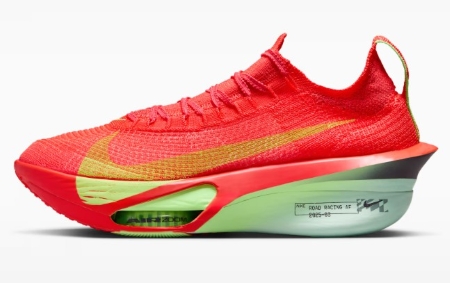
The Nike Alphafly 3 is still one of the strongest marathon racing shoes available in 2026, but it is not an automatic winner for every runner. After 95 miles, I rate it 9.1/10 for marathon-focused racing. Its continuous ZoomX midsole, full-length carbon-fiber Flyplate, and two forefoot Air Zoom units create a smoother and more controlled ride than the Alphafly 2 while keeping the deep forefoot rebound that defines the line.
The important qualifier is fit. The shoe is snug through the arch, the Atomknit upper has little spare structure, and the ride asks you to load the forefoot system with purpose. When the shape and mechanics agree with your foot, it can make long race pace feel unusually repeatable. When they do not, the same arch and rigid platform can become distracting long before mile 26.2.
I tested a men’s US 11 after normally wearing 10.5 in daily trainers. That half-size decision worked for my foot; it is not a blanket sizing rule. Independent testers disagree on whether the model feels short, and Nike does not offer a wide version. Start with your normal racing-shoe size, then judge arch pressure, toe clearance under load, and heel security before deciding.
Jump to Section Click to expand
- Quick Verdict
- Ken’s Ranking Rule
- How I Tested
- Specs and Verified Facts
- ZoomX, Flyplate, and Air Zoom
- Ride Feel
- Performance by Pace
- Running Economy in Plain English
- Stability and Geometry
- Fit and Sizing
- Atomknit Upper
- Grip and Durability
- Roads, Turns, and Weather
- Alphafly 3 vs Alphafly 2
- Race-Shoe Comparisons
- Best Race Distance
- Training and Rotation
- Who Should Buy
- Who Should Skip
- Sources and Fact Check
- Final Verdict
- FAQ
Nike Alphafly 3 Review: Quick Verdict
Buy the Alphafly 3 for half-marathon and marathon racing if you like a highly cushioned, rigid, forefoot-driven ride and the arch fits cleanly. Skip it if you need a wide platform inside the upper, prefer natural forefoot flex, race mainly short distances, or want one shoe for slow daily training.
| Decision | Ken’s Answer |
|---|---|
| Best use | Marathon racing, half marathons, and specific race-pace workouts |
| Ride | Deep, bouncy, rigid, smooth through transition, and most alive at committed pace |
| Fit | Secure and low-volume through the arch; US 11 worked for my usual 10.5 foot |
| Main strength | Sustained cushioning and forefoot response over long race efforts |
| Main weakness | Arch compatibility and poor slow-pace versatility |
| Compared with v2 | Lighter, smoother, and less blocky because the midsole is fully connected |
| Ken’s score | 9.1/10 for its marathon-racing job |
The Alphafly 3 belongs in the top tier of my best lightweight running shoes, though its advantage is not simply low mass. Nike lists approximately 7.7 oz for a men’s US 10, while independent size-9 samples have measured close to 7.1 oz. What separates it from a conventional lightweight shoe is how much race-tuned cushioning it carries at that weight.
This is not the shoe I would hand to every new runner. A beginner preparing for a first event will often get more value from a stable daily trainer and consistent training. My beginner running shoe guide explains that broader starting point. The Alphafly is a specialized option once fit, race goals, and mechanics are known.
Bottom line: The Alphafly 3 is a marathon specialist with an excellent ride and a selective fit. Test the arch before trusting the technology.
Ken’s Ranking Rule for the Nike Alphafly 3
Ken’s ranking rule: a marathon racer earns its score after race pace becomes work, not during the first exciting mile. I reward shoes that preserve rhythm, remain predictable through turns, hold the foot without hot spots, and keep their transition intact late in a long effort. I subtract heavily for fit problems because no foam or plate compensates for an irritated arch at mile 20.
I do not rank a super shoe by bounce alone. A very soft shoe can feel dramatic during strides yet become unstable when fatigue changes landing position. A very stiff shoe can feel efficient at speed yet punish a runner whose ankle or forefoot does not tolerate the geometry. The useful question is whether the whole system helps a specific runner repeat a race stride.
| Ranking Factor | Weight | Alphafly 3 | What Drove the Score |
|---|---|---|---|
| Late-race ride | 25% | 9.5/10 | Cushioning and transition stayed coherent during long marathon-pace work |
| Race-pace response | 20% | 9.6/10 | Air Zoom and Flyplate reward forceful, compact toe-off |
| Fit and lockdown | 20% | 8.3/10 | Secure for me, but arch shape and low volume narrow the audience |
| Stability and turns | 15% | 9.0/10 | Wider plate and connected midsole improve control for a super shoe |
| Weight and upper | 10% | 9.4/10 | Very light package with excellent airflow |
| Grip and wear | 10% | 8.5/10 | Good race grip; exposed foam and heel contact remain gait-dependent |
The 9.1 score is category-specific. It does not mean the Alphafly 3 is a 9.1 daily trainer, walking shoe, or 5K flat. At recovery pace I would score it much lower because the rigid forefoot and sculpted geometry feel awkward when I am not supplying enough force to engage them.
I also separate personal observation from measured fact. My Garmin recorded distance and pace. It did not measure oxygen consumption, joint load, energy return, or muscle fatigue. Those outcomes require controlled equipment and vary by runner. This review describes how the shoe behaved under me and cites independent lab values only when the source and method are clear.
How I Tested the Nike Alphafly 3
I logged 95 miles across six weeks on asphalt, the Atlantic City Boardwalk, a track, and short stretches of flat packed gravel. The test included intervals, tempo work, race-pace sessions, and marathon-specific efforts up to 20 miles. I am 5 feet 10 inches, 182 lb, a neutral runner, and usually land around the midfoot when pace is high.
My test pair was a men’s US 11. I normally use 10.5 in roomy daily trainers, but the extra half size gave my toes better clearance without allowing the heel to move. I used technical socks of different thicknesses, repeated familiar routes, and checked the outsole and exposed ZoomX after each major long effort.
| Test Detail | Ken’s Protocol |
|---|---|
| Total mileage | 95 running miles |
| Runner | 5’10, 182 lb, neutral gait, midfoot-biased at race pace |
| Pair tested | Men’s US 11; daily trainers are usually US 10.5 |
| Surfaces | Asphalt, concrete boardwalk, track, and brief flat packed gravel |
| Sessions | Intervals, tempo, marathon pace, steady long running, and short easy segments |
| Longest efforts | Marathon-specific runs up to 20 miles |
| Conditions | Dry roads, damp pavement, wind, and warm-weather testing |
| Tracked | Fit, pressure, transition, cornering, late-run feel, grip, and visible wear |
I did not use this pair for all daily miles. Reserving it for quality sessions made it easier to compare how the shoe responded when pace and force changed. Easy warm-ups were useful too: they exposed how little the platform gives back when I shuffle, and how quickly it comes alive when stride length and ground force increase.
The 95-mile figure comes from the existing training log behind this review. I preserved that real-use evidence and removed unsupported claims from the previous draft, including home-made percentages for energy return, foam hardness, impact force, and ankle motion. Those values were not backed by retained test records and therefore do not belong in a trustworthy review.
A workout guide can help put this testing in context. My tempo run guide distinguishes controlled threshold work from simply running hard. That matters here because the Alphafly feels more natural at sustained race rhythm than during abrupt stop-start repetitions.
Nike Alphafly 3 Specs and Verified Facts
Nike lists the Alphafly 3 at approximately 218 g or 7.7 oz in a men’s US 10, with an 8 mm heel-to-toe drop. The official U.S. product page identifies a fully connected ZoomX midsole, full-length carbon-fiber Flyplate, two forefoot Air Zoom units, retooled Atomknit upper, notched laces, and a new lightweight outsole material.
| Specification | Verified Detail | Practical Meaning |
|---|---|---|
| Category | Neutral carbon-plated road racer | Built for speed, especially half marathon and marathon |
| Nike-listed men’s weight | Approx. 218 g / 7.7 oz, US 10 | Very light relative to its cushioning volume |
| Nike-listed drop | 8 mm | Moderate offset, but geometry feels more important than the number |
| Midsole | Fully connected ZoomX | Smoother heel-to-forefoot path than Alphafly 2 |
| Plate | Full-length carbon-fiber Flyplate | Adds longitudinal stiffness and shapes the transition |
| Air system | Two forefoot Air Zoom units | Distinct compression and rebound under the metatarsals |
| Upper | Retooled Atomknit | Low mass, high airflow, race-focused containment |
| Width | No dedicated wide version on Nike U.S. | Arch and forefoot compatibility require careful fitting |
| Best official use | Half marathons and marathons | Nike positions it as a long-distance race shoe |
Independent measurements require labels. RTINGS measured a men’s US 9 sample at 200.7 g, with 39.8 mm at the heel, 33.4 mm at the forefoot, and a measured 6.4 mm difference. RunRepeat reported a similarly light size-9 sample. Those numbers do not cancel Nike’s listed 8 mm drop or size-10 weight; sample size, measurement location, and lab method differ.
The defensible answer is: Nike advertises 218 g in men’s US 10 and an 8 mm drop; one RTINGS men’s US 9 sample measured 200.7 g and 39.8/33.4 mm. Presenting every number as if it came from the same shoe and method would create false precision.
I also avoid calling the stack exactly 40/32 mm as an independent measurement. The shoe is designed as a high-stack road racer, but official race legality and laboratory stack protocols are separate questions. Athletes racing under governing-body rules should check the current approved-shoe list and the exact model rather than relying on a review headline.
How ZoomX, the Flyplate, and Air Zoom Work Together
The Alphafly 3 is best understood as one system: soft ZoomX stores and releases energy, the carbon Flyplate controls shape and stiffness, and the forefoot Air Zoom units create a firmer, quicker compression point. None of the three components explains the ride alone.
The fully connected midsole is the defining version-three change. Earlier Alphaflys separated the rear and forefoot visually and mechanically. Version 3 fills that bridge with ZoomX and uses a deep central channel to remove material. Underfoot, the landing no longer feels like it must find two distinct islands before toe-off.
At my weight, the heel and midfoot foam compress easily, but the forefoot does not feel uniformly soft. The Air Zoom units sit under the area where I load during faster running. They resist, then rebound with a more abrupt character than the surrounding foam. That contrast is the source of the Alphafly sensation: soft depth around a pressurized front platform. For how rearfoot, midfoot, and forefoot landings redistribute load, read my heel, midfoot, and forefoot strike comparison.
The Flyplate keeps the long, soft midsole from bending like a daily trainer. I feel the plate most when the heel lifts and the shoe rolls over the forefoot. It does not feel like a spring by itself. It creates a stable lever so the foam and Air units can return the shape they regained after loading.
Runners who land far back can still use the shoe, and the connected midsole makes that path smoother than before. The clearest response arrives when contact progresses quickly toward the Air units. A slow heel-heavy shuffle leaves me perched on the geometry; a compact race stride lets the rocker and forefoot line up. For how rocker location, curvature, and stiffness change transition, read my running shoe rocker-geometry guide.
For training that develops faster mechanics without turning every day into a race, see my running strides guide. Short, controlled strides are also a sensible first test of a rigid racer before using it for a long workout.
Ride Feel: What the Alphafly 3 Actually Feels Like
The ride is cushioned at landing, controlled through the center, and distinctly springy beneath the forefoot. It is smoother than the Alphafly 2, less naturally flexible than a conventional trainer, and more substantial underfoot than Nike’s Vaporfly line.
During the first miles of a marathon-pace session, the shoe can feel almost too easy because the stack filters small road texture and the forefoot responds quickly. That early excitement is not the useful test. The important part is whether cadence, contact point, and cornering remain predictable after an hour or more. For me, they did.
Late in long efforts, I noticed less need to force ankle movement than in the Alphafly 2. I do not claim the shoe saved a measured amount of muscular energy. The observable result was simpler: the transition kept its shape, and I could maintain my familiar race rhythm without fighting a segmented midsole.
The shoe is not silent underfoot. The Air units and broad forefoot can produce a hollow slap, especially on smooth boardwalk or if I reach ahead of my center of mass. That sound is not a performance measurement. Shortening the landing and keeping cadence compact reduced it.
Ground feel is limited. I can sense larger changes in camber and texture, but the stack isolates small detail. That helps on long asphalt stretches and makes me more deliberate around potholes, curb cuts, and broken pavement. A race shoe can be stable within its class and still require attention because it sits high above the road.
Runners who want a lighter daily sensation should compare my HOKA Mach review. A flexible performance trainer will not reproduce the Alphafly’s race response, but it is easier to use at ordinary pace and far less demanding as an everyday shoe.
How the Nike Alphafly 3 Performs by Pace
Easy pace and warm-ups
Easy running is the Alphafly 3’s weakest pace. The plate remains rigid, the Air units are underloaded, and the narrow waist can feel more obvious when I spend longer on the ground. I use easy miles to confirm fit, not because the shoe improves them.
For true recovery running, I prefer a normal trainer and the low-intensity structure in my recovery run guide. Saving the racer also lets me notice when the foam, upper, or outsole changes rather than normalizing the ride through daily use.
Steady and marathon pace
Marathon pace is the center of the design. At a sustained, controlled effort, the connected ZoomX smooths contact and the forefoot system rewards consistent loading. I can settle into the shoe rather than constantly searching for the right landing. This is where version 3 earns its score.
The sensation does not depend on one universal pace. A four-hour marathoner and a sub-three runner produce different forces, but both can benefit if the shoe fits and their stride loads the rocker cleanly. My rule is to test it at personal marathon effort, not at an internet pace threshold.
Threshold and half-marathon pace
At threshold and half-marathon effort, the Alphafly becomes more direct. The Air units feel firmer and turnover quickens, while the wide plate keeps the platform from becoming vague. This range is excellent for my stride, though some runners prefer a lighter, lower racer for the sharper rhythm of 13.1 miles.
5K pace and short intervals
The Alphafly 3 is fast enough for 5K racing, but it is not my first choice. Its stack and forefoot footprint feel larger through tight bends than a lower race shoe. During short repetitions, I spend more attention accelerating the platform and less time enjoying the long-effort cushioning that justifies it.
For structured repetitions, my interval training guide explains why interval duration and recovery should match the adaptation. I would not buy the Alphafly solely for weekly track repeats.
| Pace or Session | Grade | Ken’s Take |
|---|---|---|
| Recovery jog | C | Rigid and awkward when the system is underloaded |
| Easy warm-up | B- | Useful fit check, not the reason to own it |
| Steady running | B+ | Smooth, though more shoe than the pace requires |
| Marathon pace | A+ | Best blend of cushioning, control, and repeatable response |
| Half-marathon pace | A | Fast and protective, with more bulk than some rivals |
| 5K/10K pace | A- | Capable, but a lower and lighter racer can feel more agile |
| Short intervals | B+ | Powerful in a straight line, less natural during frequent changes |
Does the Alphafly 3 Improve Running Economy?
The Alphafly 3 is engineered to improve running efficiency, but no review can promise the same benefit to every runner. Running economy is the oxygen cost of holding a given pace. It is measured in a controlled test, not inferred from bounce, heart rate on one windy run, or a personal best.
Research on advanced footwear generally shows that compliant resilient foam, a stiff plate, low mass, and optimized geometry can reduce metabolic cost on average. The size of that response varies substantially. Foot strike, speed, body mass, ankle mechanics, familiarity, and fit can all change how much a runner benefits. Some runners respond strongly; others respond little or prefer another design.
My 95-mile test supports a performance judgment, not a laboratory percentage. I could hold marathon-specific rhythm comfortably, the forefoot response remained consistent, and the connected midsole felt easier to time than version 2. I cannot turn those observations into an oxygen-savings number.
The practical test is a repeated workout. Run the same controlled race-pace session in the Alphafly and your current racer under similar conditions. Compare perceived effort, pacing stability, foot comfort, and how your form behaves late. Do not chase a tiny heart-rate difference when wind, heat, sleep, and fueling can explain it.
Shoes also cannot replace fitness. My guide to increasing running speed puts workouts, recovery, and progression ahead of equipment. A race shoe can help express training; it cannot manufacture the aerobic work.
Stability and the Continuous Midsole
The Alphafly 3 is stable for a high-stack super shoe, not stable in the way a support trainer is stable. Nike widened the Flyplate, connected the midsole, and shaped a broad heel and forefoot around a narrow central channel. Those choices reduce the disconnected wobble I felt in version 2.
On straight asphalt, I rarely think about stability. The platform compresses centrally and moves forward. On cambered roads, the tall soft heel can still lean toward the low side, and the narrow upper waist does not suit every arch. The shoe manages height well; it does not remove height.
The deep midsole channel matters because it removes weight while leaving two foam rails. When I land near the middle, those rails feel guided. When I catch an edge during a sharp turn, one side can compress before the other. The wider plate limits that motion better than the previous model, but I still shorten stride through hard corners.
This is a neutral racer. It has no medial post and should not be treated as a corrective device. Runners who need more formal support can compare the designs in my best stability running shoes guide, then decide whether a stable-neutral race shoe is enough for race day.
Fatigue changes the answer. A platform that feels secure during four strides may become less predictable after two hours. That is why I insist on at least one long race-pace trial before a marathon. If the arch aches, heel drifts, or ankles work harder as fatigue builds, choose a different racer rather than trying to strengthen around a poor match in the final weeks.
Nike Alphafly 3 Fit and Sizing
The Alphafly 3 has race-accurate length for many runners, a snug and sculpted arch, moderate toe-box height, and a secure heel when the size is right. My men’s US 11 worked even though I usually wear 10.5 in daily shoes. That result reflects my foot and preferred race clearance, not a universal instruction to size up.
RTINGS found its men’s US 9 sample true to size in length but particularly narrow through the arch. Doctors of Running reported mixed tester experiences: one tester felt the upper initially short before it relaxed, while another found the low-volume toe box uncomfortable. The agreement is not about size length; it is that fit deserves more attention than usual. For a fuller framework covering arch, width, volume, flexibility, and asymmetry, use my running foot types guide.
| Fit Area | My Experience | What to Check |
|---|---|---|
| Length | US 11 gave secure race clearance | A thumb-width rule is only a start; test downhill and at race pace |
| Toe box | Adequate for my medium-width forefoot | Look for nail contact as the foot swells |
| Arch | Noticeably sculpted but tolerable | Reject persistent pressure, burning, or edge sensation |
| Midfoot | Locked without heavy lace tension | Do not tighten the thin upper to solve a shape mismatch |
| Heel | Secure with standard lacing | Check lift during acceleration and turns |
| Width options | Standard only in the model checked | Wide or high-volume feet should not assume Atomknit will stretch enough |
Try the shoe with your race sock late in the day, when feet are less fresh. Jog, accelerate, turn both ways, and hold a forward lean. Standing comfort does not reveal whether the plate edge or arch will become intrusive under load.
If the standard shape pinches, do not automatically gain width by adding length. A longer shoe can move the flex and Air-unit position away from your anatomy while leaving the arch shape unchanged. My wide-foot running shoe guide explains why a true wide platform is different from excess length.
I would not plan a marathon around the hope that arch pain will break in. The upper may relax slightly and the sockliner may settle, but the plate, waist, and basic last do not become a different shape. Pressure that increases during a controlled 10- to 15-mile test is a failed fit.
Atomknit Upper, Tongue, and Lockdown
The retooled Atomknit upper is exceptionally light and breathable, with just enough structure to hold a racing fit. Large open areas move air well, while denser yarn zones provide containment around the midfoot. It feels more like a race shell than a padded trainer.
The integrated knit tongue includes targeted padding under the laces. Nike also uses notched laces, which resist slipping better than smooth flat laces. I could set tension once and leave it alone. Pulling harder did not improve the ride; even pressure across the instep worked better.
Heel structure is minimal but effective on my foot. The collar sits low enough to avoid an overbuilt trainer sensation, and the rear shape held during faster running. I did not need a runner’s knot. A different heel shape may need the extra eyelet, but lace lock cannot fix a loose or overly long size.
Breathability was a clear strength in warm testing. The trade-off is weather protection. Wind and water pass through readily, and the upper provides little insulation. That is appropriate for a race shoe designed to reduce weight, but it makes the Alphafly a poor cold-weather casual shoe.
Choose technical socks that fit without folds. I used medium and thin synthetic pairs without blistering. My running socks guide covers yarn, seam, and thickness choices, while my long-run blister prevention guide addresses friction and moisture management beyond the shoe.
Outsole Grip and Durability After 95 Miles
After 95 miles, my Alphafly 3 outsole showed normal cosmetic scuffing, smoothing at my primary contact zones, and abrasion on exposed ZoomX, but no failure that changed the ride. The shoe uses thin rubber coverage around a heavily sculpted base because race weight and traction matter more than daily-trainer armor.
The forefoot rubber gripped dry asphalt and track well. Under the heel, coverage is more selective, so heel strikers may contact rubber edges and exposed foam differently than I did. RunRepeat specifically flags heel-area wear as a concern for some landing patterns. That is a reason to inspect your pair, not proof of one fixed lifespan.
I removed the old fixed lifespan range. No defensible universal number exists. A light forefoot striker on clean asphalt can see a different wear curve from a heavier heel striker on rough concrete. Midsole feel, outsole exposure, stability changes, and upper integrity matter more than a calendar mileage target.
| Wear Area | Finding at 95 Miles | What It Means |
|---|---|---|
| Forefoot rubber | Light smoothing at toe-off zones | Traction remained suitable for road workouts |
| Heel rubber | Minor gait-specific abrasion | Heel strikers should inspect more often |
| Exposed ZoomX | Scuffs and small surface marks | Expected cosmetic wear on an exposed race foam |
| Air Zoom units | No visible damage or ride change | Continue checking for cuts or pressure loss |
| Upper | No tear or seam failure | Minimal knit remained secure |
| Ride | No abrupt loss of response observed | No percentage-retention claim can be made |
Reserve the shoe for long race-specific work and races if value per quality mile matters. Use a normal trainer for easy volume and inspect the racer before important sessions. My running shoe replacement guide explains the performance and fit signs that matter more than one mileage limit.
Grip on Wet Roads, Turns, and Different Surfaces
The Alphafly 3 is a road racer first: dry asphalt and concrete are its best surfaces, damp ordinary pavement is manageable, and mud or technical trail is outside its design. The outsole offers multidirectional texture, but the high stack and smooth race geometry still demand respect on painted lines, metal covers, and wet wood.
On damp pavement, I kept the shoe underneath me and avoided abrupt braking. Traction was adequate in that use. I will not call it waterproof or claim an exact drainage time. Atomknit admits water quickly and sheds some of it through the open weave, while the sock and interior can remain wet.
Tight turns reveal more of the shoe’s height than straight running. I shorten stride before the corner, keep cadence moving, and accelerate after the platform is pointed forward. The wider plate improves confidence compared with Alphafly 2, but it does not make this a nimble racing flat.
Brief packed gravel was possible when flat and dry, but loose stone reduced confidence and can abrade exposed foam. The shoe has no trail lugs and no rock protection. Use road alternatives in poor conditions rather than treating a marathon racer as an all-surface tool.
My rain running guide covers the stride and route changes I use when grip is uncertain. Weather execution matters as much as rubber: no outsole can make a wet painted turn behave like dry asphalt.
Nike Alphafly 3 vs Alphafly 2
The Alphafly 3 is a meaningful upgrade over the Alphafly 2 for most runners because it is lighter, smoother through the midfoot, and better controlled by its wider plate. The fully connected ZoomX midsole is the biggest reason. Version 2 felt segmented and blocky under me; version 3 carries the landing forward with less interruption.
| Feature | Alphafly 2 | Alphafly 3 | Ken’s Take |
|---|---|---|---|
| Midsole | Separated rear and forefoot architecture | Fully connected ZoomX | Version 3 transitions more naturally |
| Weight | Heavier in comparable samples | Nike calls it the lightest Alphafly | Version 3 feels easier to turn over |
| Plate | Full-length carbon plate | Slightly wider full-length Flyplate | Version 3 is more composed in turns |
| Forefoot | Two Air Zoom units | Two repositioned Air Zoom units | Both feel powerful; version 3 integrates them better |
| Upper | Atomknit race upper | Retooled Atomknit | Version 3 contains well with less distraction |
| Ride | Bouncy but disjointed for some runners | Bouncy and continuous | The new version is easier to time late |
| Best reason to switch | N/A | Smoother marathon rhythm | Upgrade for transition, not because v2 became unusable |
I would keep a well-fitting Alphafly 2 if it has already delivered strong races and the segmented ride agrees with your mechanics. Familiarity matters. The third version is better for me, but buying a new model days before a goal marathon creates more risk than any theoretical improvement can offset.
The weight difference must be compared by size and source. Nike lists version 3 at 218 g in men’s US 10, while independent reviews often compare size-9 samples. I do not use a single percentage reduction unless both shoes were weighed in the same size on the same scale.
Nike Alphafly 3 vs Other Race Shoes
Alphafly 3 vs Nike Vaporfly
Choose the Alphafly for maximum marathon cushioning and a broader, more substantial forefoot; choose the Vaporfly for lower mass, sharper agility, and shorter racing. RTINGS reaches a similar category conclusion with the current Vaporfly 4: it favors the lighter Vaporfly for shorter events and the Alphafly for longer races.
Within a Nike rotation, the Nike Pegasus is the daily workhorse, not a race substitute. It handles easy and routine mileage so the Alphafly can stay specific to workouts and races.
Alphafly 3 vs ASICS Metaspeed
ASICS Metaspeed racers feel more conventional through the forefoot because they do not use exposed Air units. They can be easier for runners who want a direct foam-and-plate response. The Alphafly offers a deeper, more mechanical rebound and a more sculpted arch. Fit and preferred loading pattern decide more than brand reputation.
Alphafly 3 vs adidas Adios Pro
The Adios Pro line uses EnergyRods rather than one broad Flyplate and tends to create a rolling, segmented toe-off. The Alphafly delivers a firmer pressurized sensation under the forefoot. Both target long racing, but the foot shapes and transitions feel sufficiently different that a short try-on is not enough.
Alphafly 3 vs Saucony Endorphin Pro
The Endorphin Pro is usually the less exotic and more accessible ride. Its rocker is easy to understand, while the Alphafly supplies more depth and a stronger forefoot event. Runners who want a workout-capable bridge can also read my Saucony Endorphin Speed review; the Speed is more practical for weekly training but not a direct Alphafly race replacement.
Alphafly 3 vs high-stack super trainers
A super trainer may use premium foam and a plate, but it carries more rubber, upper, and durability for training. The ASICS Superblast review illustrates a high-stack option without the same pure race-day focus. Choose a trainer for repeat volume; choose the Alphafly when low weight and race efficiency take priority.
What Race Distance Is the Alphafly 3 Best For?
The marathon is the Alphafly 3’s best distance, followed closely by the half marathon. The shoe can race 5K and 10K, but its cushioning volume, broad forefoot, and long-effort comfort are underused there. A lighter lower-profile racer may change direction faster.
| Distance | Recommendation | Reason |
|---|---|---|
| 5K | Good, not ideal | Fast response but more platform than necessary |
| 10K | Very good | Powerful on straight courses; less agile on technical turns |
| Half marathon | Excellent | Protective at threshold-like effort with strong forefoot response |
| Marathon | Best use | Cushioning and transition remain useful as fatigue builds |
| Ultramarathon road | Conditional | Fit and rigid geometry need testing beyond marathon duration |
| Trail race | No | No lugs, high platform, and exposed road-race foam |
For a first 13.1-mile build, use the gradual progression in my first half-marathon training plan. A shoe should enter the plan during controlled race-pace work, not appear for the first time at packet pickup.
For 26.2 miles, the best shoe is the fastest option that still fits after swelling and fatigue. My beginner marathon plan provides the training context, while my marathon wall guide explains why pacing and carbohydrate availability have a much larger effect on late-race collapse than shoe choice.
How to Train and Race in the Alphafly 3
Use the Alphafly 3 often enough to prove fit and mechanics, but not for every run. My preferred sequence is a short stride session, a controlled tempo, a medium race-pace workout, and at least one long marathon-specific effort before race day. That creates familiarity without turning a specialist into a daily trainer.
| Rotation Role | Suggested Shoe Type | Purpose |
|---|---|---|
| Easy and recovery | Comfortable daily trainer | Build volume without forcing rigid race geometry |
| Steady daily running | Versatile neutral trainer | Handle routine miles and moderate pace |
| Tempo and intervals | Performance trainer or Alphafly occasionally | Develop speed while limiting racer wear |
| Key marathon workout | Alphafly 3 | Validate fit, fueling access, rhythm, and late-run control |
| Race day | Proven Alphafly pair | Use the exact size, sock, and lacing already tested |
A cushioned daily option such as the Nike Vomero creates a clear contrast for recovery days. A lighter flexible option such as the New Balance Rebel can cover faster training without reproducing the Alphafly’s rigid platform.
Keep race-week experimentation low. The final hard session should confirm familiar behavior, not chase proof that the shoe is fast. My recovery and rest-day guide explains why freshness comes from training balance rather than wearing the racer for every confidence run.
Practice fueling in the same shoe because posture and pace affect how easily you drink and take gels. My half-marathon nutrition plan covers shorter-race needs; marathon fueling should be individualized and rehearsed over long efforts.
Who Should Buy the Nike Alphafly 3?
Buy the Alphafly 3 if your main target is a road half marathon or marathon, you respond well to a rigid high-stack racer, and the arch disappears once you run. It is especially compelling for runners who liked the Alphafly concept but found version 2 too segmented.
- Marathon racers who want deep cushioning without daily-trainer weight
- Midfoot and forefoot runners who load the Air Zoom units naturally
- Heel strikers who found earlier Alphaflys abrupt and want a connected transition
- Runners who prefer a broad race platform over a narrow, low racing flat
- Athletes willing to test fit during long race-pace sessions
- Alphafly 2 owners seeking a lighter and smoother update
- Half-marathon runners who value protection more than minimal mass
It can also work for heavier runners who appreciate a substantial platform, but body weight alone does not determine compatibility. The narrow arch, plate stiffness, pace, and landing location matter. There is no weight threshold above which the Alphafly automatically becomes the correct shoe.
Who Should Skip the Nike Alphafly 3?
Skip the Alphafly 3 if the arch creates persistent pressure, your foot needs a true wide option, or you want a flexible shoe for slow and fast running. A race shoe that wins laboratory comparisons but distracts your foot is the wrong race shoe.
- Wide or high-volume feet that spill over the narrow midfoot platform
- Runners who feel arch burning, plate-edge pressure, or numbness during testing
- Athletes who prefer ground feel and natural forefoot flex
- 5K specialists who want the lightest, most agile Nike racer
- Daily runners seeking one shoe for recovery through racing
- People expecting footwear to prevent injury or correct mechanics
- Trail, gravel, or wet technical-course runners who need lugs and lower height
If Achilles symptoms are part of the decision, do not assume the 8 mm drop or rocker is treatment. Load response differs, and rigid plated shoes can change ankle and forefoot demands. My shoe guide for Achilles pain explains the footwear trade-offs, but persistent pain needs individual clinical assessment.
Sources, Evidence, and Fact-Checking Notes
I separated Nike’s product specifications, independent lab measurements, outside wear testing, and my 95-mile road observations. That separation prevents an advertised number from being presented as my measurement and prevents a personal sensation from being framed as a universal biomechanical result.
- Nike Alphafly 3 official U.S. product page – listed size-10 weight, 8 mm drop, ZoomX, Flyplate, Air Zoom units, upper, and intended race use
- Doctors of Running Alphafly 3 review – multi-tester fit, performance, and stable-neutral geometry observations
- RunRepeat Alphafly 3 lab review – independent size-specific weight, breathability, construction, and wear testing
- Runner’s World Alphafly 3 review – tester context, race history, and size-specific weight reporting
Numbers are labeled by source and sample size. Nike lists approximately 218 g in men’s US 10 and an 8 mm drop. RTINGS measured 200.7 g, 39.8 mm heel, 33.4 mm forefoot, and a 6.4 mm difference in a men’s US 9 sample. These are not interchangeable specifications.
The prior article contained unsupported values for foam hardness, plate bending, impact force, ankle motion, and personal energy return. I removed them. This update makes no injury-prevention or joint-protection promise, assigns no personal oxygen-savings percentage, and gives no guaranteed lifespan.
Specifications, colorways, and availability can change. Confirm the exact U.S. model and size before purchase. Competitive athletes should also verify current event and governing-body rules independently because approved-shoe status is time-sensitive.
Final Verdict: Is the Nike Alphafly 3 Worth It in 2026?
Yes, the Nike Alphafly 3 is worth it for a marathon-focused runner whose foot matches the narrow, sculpted fit and whose stride benefits from a rigid forefoot platform. After 95 miles, it remains my favorite Alphafly version because the connected ZoomX midsole turns a previously segmented ride into one continuous transition.
Its best quality is not the first-step bounce. It is how the cushioning, Flyplate, and Air Zoom units continue to cooperate when a long race-pace effort becomes difficult. The platform remains substantial without feeling as blocky as version 2, and the upper holds securely without unnecessary padding.
Its biggest risk is equally clear: fit. The arch and midfoot eliminate some runners before performance matters. I used a half size above my roomy daily trainers, but I would not prescribe that to everyone. Test normal size and a half size up, then reject both if the arch shape itself is wrong.
My final score is 9.1/10 for half-marathon and marathon racing. I would choose a lighter lower racer for a technical 5K, a flexible trainer for daily mileage, and a true wide model for a high-volume foot. For the right runner over 26.2 miles, the Alphafly 3 remains one of the most complete race tools available.
Nike Alphafly 3 Frequently Asked Questions
Is the Nike Alphafly 3 good for a marathon?
Yes. Nike positions the Alphafly 3 for half marathons and marathons, and Ken found its connected ZoomX midsole, carbon Flyplate, and forefoot Air Zoom units most effective during sustained marathon-pace work.
How much does the Nike Alphafly 3 weigh?
Nike lists approximately 218 g or 7.7 oz in a men’s US 10. Independent labs have measured lighter men’s US 9 samples, including 200.7 g at RTINGS, so always compare the same size and method.
What is the drop of the Nike Alphafly 3?
Nike advertises an 8 mm heel-to-toe drop. RTINGS measured a 6.4 mm difference in its men’s US 9 sample, which illustrates how independent methods and measurement locations can differ from advertised specifications.
Does the Nike Alphafly 3 run true to size?
Length is true to size for many runners, but fit is snug through the arch. Ken used a men’s US 11 after usually wearing 10.5 in roomy daily trainers. Start with normal racing size and judge arch pressure, toe clearance, and heel security under load.
Is the Nike Alphafly 3 good for wide feet?
Usually not. Nike does not list a dedicated wide version on the U.S. product page, and independent tests consistently identify a narrow or sculpted arch. Adding length is not the same as getting a wider platform.
Is the Alphafly 3 better than the Alphafly 2?
For Ken, yes. Version 3 is lighter, uses a fully connected ZoomX midsole, and has a slightly wider Flyplate. It feels smoother through transition and more controlled in turns, although a well-fitting Alphafly 2 can still be a strong racer.
Can I use the Nike Alphafly 3 for daily training?
You can, but it is not a good daily trainer for most runners. Its rigid plate, narrow race fit, exposed foam, and awkward slow-pace ride make it better for selected race-pace workouts and races.
Is the Nike Alphafly 3 good for a 5K or 10K?
It is fast enough for both, but Ken prefers it for longer races. The high stack and broad forefoot feel less agile through tight turns than a lower and lighter racer.
How long does the Nike Alphafly 3 last?
There is no universal lifespan. After 95 miles, Ken saw cosmetic ZoomX scuffing and light outsole smoothing without a ride-changing failure. Wear varies with landing pattern, surface, body mass, pace, and use.
Is the Nike Alphafly 3 stable?
It is stable for a high-stack neutral super shoe because of its wider Flyplate, connected midsole, broad heel and forefoot, and side geometry. It is not a formal stability shoe and can still feel tall on cambered roads or sharp turns.
Is the Nike Alphafly 3 waterproof?
No. The open Atomknit upper prioritizes low weight and airflow, so water enters quickly. Use caution on wet paint, metal, and wood even when ordinary damp-road traction feels adequate.
What technology is in the Nike Alphafly 3?
The Alphafly 3 combines a fully connected ZoomX foam midsole, a full-length carbon-fiber Flyplate, two forefoot Air Zoom units, a retooled Atomknit upper, notched laces, and a lightweight road outsole.
Disclosure: NextGait is reader-supported. Purchases through affiliate links may earn a commission at no extra cost to you. Affiliate relationships do not change the testing protocol, score, or recommendations.
Race-day shoe note: Compare fit, plate geometry, and distance use in our best carbon-plated shoes tested side by side before choosing a supershoe.
Compare and choose: Continue with Alphafly vs Vaporfly comparison; best marathon running shoes.

Written and tested by Ken – NextGait founder, 12-year runner, 12,500+ lifetime miles, 63 shoes tested, and 36 races from 5K through 50K. I run 30-40 miles most weeks and judge race shoes through repeat workouts, long race-pace efforts, fit checks, cornering, and wear inspection rather than a single fast run. Read Ken’s testing philosophy and bio.