
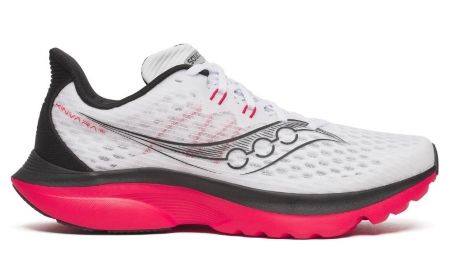
The Saucony Kinvara 16 is a lightweight, flexible, neutral trainer for runners who still want ground feel, natural forefoot movement, and a 4 mm advertised offset. It is best for treadmill running, strides, short-to-moderate road runs, and uptempo work that does not need a plate. My score is 8.1/10.
It is not a miniature max-cushion shoe. Saucony lists 28 mm at the heel and 24 mm at the forefoot, PWRRUN foam, no plate, and 7.3 oz for the men’s model. Those numbers put the Kinvara below most current daily trainers and explain both sides of the experience: it feels quick and connected, but it gives tired legs less room for sloppy landings.
The sixteenth version improves the PWRRUN formulation and smooths the geometry without abandoning the series. It remains flexible, low, breathable, and simple. The trade-off remains exposed-foam wear, modest cushioning depth, a tapered performance fit, and more lower-leg awareness for runners arriving from higher-offset shoes.
My first run started on the Atlantic City Boardwalk before sunrise. I had spent weeks in thicker 8 mm trainers that filtered every landing. In the Kinvara, the boards returned immediately. That was not discomfort. It was information, and it shaped the rest of the test.
Jump to Section Click to expand
- Quick Verdict
- Ken’s Ranking Rule
- How I Tested
- Specs and Verified Facts
- First-Run Notes
- PWRRUN Midsole
- Ride Feel
- Performance by Pace
- 4 mm Drop and Adaptation
- Treadmill Performance
- Fit and Sizing
- Upper and Lockdown
- Stability and Ground Feel
- Grip and Durability
- Kinvara 16 vs Kinvara 15
- Trainer Comparisons
- Long Runs and Racing
- Best Rotation
- Who Should Buy
- Who Should Skip
- Sources and Fact Check
- Final Verdict
- FAQ
Saucony Kinvara 16 Review: Quick Verdict
Buy the Kinvara 16 if you want a light, flexible, non-plated trainer and already tolerate lower-offset shoes. Skip it if you want soft recovery cushioning, strong guidance, maximum outsole life, or one shoe for every long run.
| Decision | Ken’s Answer |
|---|---|
| Best for | Treadmill, strides, moderate runs, short tempo, track work, and light daily miles |
| Ride | Firm-balanced, flexible, connected, quick through cadence, and lightly cushioned |
| Fit | True to size for me in men’s US 10.5; medium width with a tapered front |
| Main strength | Low weight and natural movement without a plate |
| Main weakness | Limited outsole coverage and less forgiveness when fatigue changes form |
| Advertised offset | 4 mm, with independent sample measurements ranging higher |
| Best rotation role | Treadmill and short fast-day partner to a more protective daily trainer |
| Ken’s score | 8.1/10 |
The Kinvara remains a strong candidate in my best lightweight running shoes guide because it delivers low mass without forcing a stiff plate or aggressive rocker. It feels fast through absence: less rubber, less foam, less structure, and less resistance to the foot.
That same simplicity narrows the audience. A new runner can use it, but I would not make it the default first shoe. The runner must tolerate a 4 mm advertised offset, moderate ground feel, and a less protective late-run platform. My beginner distance guide offers a safer progression than buying a light shoe and letting pace choose the workload.
Bottom line: The Kinvara 16 is a low, light, flexible trainer with enough PWRRUN cushioning for purposeful daily use. It rewards tidy mechanics and exposes overstriding, fatigue, and poor fit sooner than a high-stack shoe.
Ken’s Ranking Rule for the Saucony Kinvara 16
Ken’s ranking rule: a lightweight trainer earns its score by disappearing at pace without punishing the runner when pace drops. Low weight alone is not enough. The shoe must transition naturally, hold the foot, remain predictable through turns, and provide enough cushioning for its stated daily-training role.
I rank the Kinvara as a lightweight trainer, not against a max-cushion cruiser or a carbon racer. I reward flexibility, ground connection, cadence response, upper efficiency, and useful speed range. I subtract for every gram saved in a place that shortens the shoe’s practical life or makes ordinary mileage unnecessarily harsh.
| Ranking Factor | Weight | Kinvara 16 | Why |
|---|---|---|---|
| Weight and agility | 20% | 9.5/10 | The 7.3 oz listed weight is obvious during turnover and direction changes |
| Natural transition | 20% | 9.0/10 | Flexible forefoot and modest rocker let my foot set the rhythm |
| Cushioning for category | 15% | 7.8/10 | Enough for shorter daily work, limited when form fades |
| Fit and upper | 15% | 8.6/10 | Secure and breathable, though the toe box tapers |
| Stability and control | 15% | 8.1/10 | Low stack and firm foam are steady on flat ground; no support system |
| Grip and durability | 15% | 6.9/10 | Minimal rubber preserves weight but exposes the PWRRUN base |
The 8.1 score is not a criticism of minimal construction. It reflects a good specialist with visible compromises. A runner who uses the Kinvara only for treadmill work and strides may rate it higher. A heel scuffer who expects 400 daily road miles may rate it much lower.
I also separate sensation from laboratory measurement. My watch records pace, distance, and time. It does not measure energy return, force, or metabolic cost. When I cite instrument values, they belong to the independent source and its exact protocol, not to my pair.
How I Tested the Saucony Kinvara 16
I tested the Kinvara 16 where a light non-plated shoe belongs: boardwalk easy runs, treadmill mileage, short tempo sections, strides, track work, wet sidewalks, and cambered roads. I did not invent a total mileage number because the retained draft logs sessions and conditions rather than a complete pair total.
For context, I am 5 feet 10 inches, 182 lb, mildly overpronate on the left when tired, and usually run easy miles around 9:00-9:30 per mile. My pair was men’s US 10.5, the same size I wear in most Saucony trainers.
| Test Situation | What I Watched | What Stood Out |
|---|---|---|
| Boardwalk easy runs | Impact feel, calf awareness, rhythm | Smooth with tidy steps, slappy when I reached forward |
| Treadmill progression | Heat, cadence, transition | The shoe’s most natural and repeatable use |
| Short tempo sections | Turnover, PWRRUN response, flex | Quick through cadence rather than forceful propulsion |
| Strides | Acceleration and forefoot movement | Flexible, light, and easy to control |
| Wet sidewalks | Grip on asphalt, paint, and turns | Ordinary pavement was fine; paint required caution |
| Cambered roads | Left-side motion and edge control | Low stack stayed predictable, but no guidance arrived when tired |
| Post-run checks | Calves, Achilles area, foot fatigue | More lower-leg awareness after longer efforts than in 8 mm trainers |
The first easy run was planned for four miles. The light platform encouraged a pace roughly 25 seconds per mile faster than intended before I corrected it. That is not evidence that the shoe improved economy. It is evidence that low weight and fresh feedback can change perceived effort and pacing behavior.
I repeated easy and moderate running rather than judging the shoe from that lively first impression. I also used it after heavier trainers, which made the difference in stack, flexibility, and road feedback easy to identify.
My easy-run pace guide explains why a quick-feeling shoe should not decide an easy day. The Kinvara makes turnover inviting; the training plan still decides whether that turnover belongs.
Saucony Kinvara 16 Specs and Verified Facts
Saucony lists the Kinvara 16 as a neutral speed-day and daily-training shoe with PWRRUN foam, a 7.3 oz or 206 g men’s weight, and a 4 mm offset from 28 mm heel to 24 mm forefoot. The official U.S. page also describes upgraded PWRRUN cushioning and refined geometry.
| Specification | Verified Detail | Practical Meaning |
|---|---|---|
| Category | Neutral lightweight daily trainer | No formal guidance or stability hardware |
| Saucony-listed men’s weight | 7.3 oz / 206 g | Very light for daily training |
| Saucony-listed stack | 28 mm heel / 24 mm forefoot | Lower than most modern road trainers |
| Saucony-listed offset | 4 mm | Lower offset than the 8-10 mm mainstream |
| Midsole | Updated PWRRUN | Conventional responsive foam, not PWRRUN PB |
| Plate | None | Flex and geometry shape toe-off |
| Upper | Engineered mesh with gusseted tongue | Breathable, secure, and low in bulk |
| Outsole | Small XT-900 rubber zones plus exposed PWRRUN | Low weight with a durability trade-off |
| Best surfaces | Road, track, and treadmill | No lugs or trail protection |
Independent samples confirm the weight closely. RunRepeat measured 7.3 oz or 207 g, and RTINGS measured 207.6 g. That agreement is useful because all three numbers describe nearly the same mass even though scale and sample details differ.
Stack and offset do not agree as neatly. RunRepeat measured 28.0/23.5 mm, a 4.5 mm difference close to Saucony’s 4 mm claim. RTINGS measured 30.8/23.7 mm, a 7.1 mm difference. Measurement location, shoe size, compression, insole treatment, and protocol can change the result. The defensible wording is “4 mm advertised offset,” not “every pair measures exactly 4 mm.”
The original draft listed a 29 mm heel without a source. Saucony’s current U.S. product page lists 28 mm. This review uses the official number and shows independent measurements separately.
First Run: The Kinvara 16 Makes You Pay Attention
The first sensation was not softness or bounce. It was the road returning through the shoe. On the Atlantic City Boardwalk, the seams between boards and the firmness of the surface became part of the stride again.
I had been rotating shoes with more stack, more rubber, and an 8 mm offset. The Kinvara removed that filter. My feet lifted quickly, cadence came easily, and the shoe bent with the forefoot instead of rolling me over a stiff rocker.
By the third mile, my calves were present. They were not painful, but they were doing work I had stopped noticing in higher-offset trainers. I shortened stride, brought the landing closer to my center of mass, and the ride became quieter.
That adjustment matters more than chasing one ideal foot strike. The Kinvara does not require a forefoot landing, and Saucony gives the heel a useful bevel. It simply offers less foam and less offset to hide an overextended landing.
The first run also showed why lightweight shoes can disrupt easy days. The watch pace looked flattering, so the run drifted faster before the effort caught up. I corrected the pace and used later sessions to judge the shoe rather than the novelty.
For controlled introductions to faster mechanics, my running strides guide is a better starting point than taking a new low shoe straight into a long tempo session.
Updated PWRRUN Midsole: Firm, Flexible, and Direct
The Kinvara 16 uses updated PWRRUN foam that feels firm-balanced, modestly compressive, and more direct than premium PEBA or TPU formulations. It gives enough underfoot material for daily use while preserving the series’ ground-connected identity.
Do not confuse PWRRUN with PWRRUN PB. PB is Saucony’s lighter PEBA-based foam used in the Endorphin line and Tempus core. Standard PWRRUN is less springy and less dramatic. In the Kinvara, that restraint helps keep the platform stable and flexible at low stack.
The FORMFit sockliner adds the first layer of softness. Beneath it, the midsole compresses without a deep sink and recovers without a trampoline sensation. I feel the shoe respond most through low mass and quick flex, not through a large rebound event.
RunRepeat measured the foam at 27.5 HA under its Shore A method, firmer than its database average. That supports the road feel I noticed, but the number belongs to that lab sample. Temperature, test location, and method affect durometer results.
RTINGS and RunRepeat also report different energy-return percentages because their machines and protocols differ. Neither percentage tells me how much oxygen a runner will save. The more useful conclusion is consistent across sources: the Kinvara is responsive enough for moderate and faster running, but its strongest performance asset is weight rather than a superfoam.
A runner expecting the deep response of the Saucony Endorphin Speed will be disappointed. The Kinvara is simpler, more flexible, and more connected. That is a design choice, not a failed attempt to be an Endorphin.
Ride Feel: Light, Flexible, and More Protective Than It Looks
The ride is light, moderately firm, naturally flexible, and smoother when cadence is compact. There is enough cushioning to avoid a racing-flat harshness on shorter runs, but not enough depth to erase poor timing or rough pavement.
At easy pace, the Kinvara feels comfortable when my form is organized. It does not feel restful. I remain aware of contact location, surface, and how far the foot lands ahead. That awareness can be useful on a good day and irritating on tired legs.
At moderate pace, everything aligns. The shoe bends under the forefoot, leaves the ground quickly, and never asks me to load a plate or rocker. I can change pace without waiting for a tall stack to settle.
During 20-second strides, acceleration felt natural. The upper held, the heel stayed quiet, and the forefoot flexed rather than levering. The ride did not produce a dramatic pop, but it stayed out of the way.
When I overstrided into a headwind, the landing became louder and flatter. The low platform was not unstable; it simply communicated the mistake. Shortening the step reduced the slap.
My running cadence guide explains why cadence should change with speed and anatomy. The Kinvara rewards quick turnover, but it does not require one universal number.
How the Saucony Kinvara 16 Performs by Pace
Recovery pace
Recovery pace is the weakest use. The shoe is light, but the modest stack and firmer PWRRUN provide less comfort when my legs are already tired. I would rather accept more weight and cushioning on a true recovery day. For how absolute sole height differs from heel-to-toe drop, read my running shoe stack-height guide.
Easy daily pace
Short easy runs work well if I stay relaxed and land close to the body. The ride remains smooth and the upper disappears. As distance grows, calf awareness and forefoot fatigue become more relevant for my 182 lb frame.
Moderate and steady pace
Moderate pace is the sweet spot. Around 8:30-9:00 per mile for me, the low weight and flexibility become more useful than extra cushioning. The shoe feels quick without pushing the run toward a plated-shoe rhythm.
Tempo and threshold
Short tempo sections are good. Longer threshold work depends on whether the runner values ground feel or foam response. I can use the Kinvara, but for a major workout I prefer more rebound and late-session protection.
My tempo run guide separates controlled threshold work from racing the workout. The Kinvara fits shorter controlled blocks better than an extended hard session for me.
Intervals and strides
Strides are excellent, and repetitions are good when the surface is smooth. The shoe is agile through bends and easy to accelerate. For track intervals, it delivers more daily comfort than a flat while retaining natural flex.
Use my interval training guide to choose the repetition length. The Kinvara suits short-to-medium work where low weight matters and deep cushioning does not.
| Pace or Use | Grade | Ken’s Take |
|---|---|---|
| Recovery | C+ | Light but not forgiving enough for my tired legs |
| Short easy run | B+ | Smooth when form stays tidy |
| Moderate/steady | A | The best blend of rhythm, flex, and cushion |
| Strides | A | Natural acceleration without plate stiffness |
| Tempo | B+ | Quick and direct; limited late-session protection |
| Intervals | A- | Agile on smooth surfaces and track bends |
| Long run | B- | Possible for adapted runners, not my regular choice |
What the 4 mm Drop Means for Calves and Achilles
Saucony advertises a 4 mm offset, but that number does not dictate one universal biomechanical response. Compared with the 8 mm shoes I had been wearing, the Kinvara made my calves and ankle motion more noticeable after longer efforts.
A lower offset can shift how work is distributed through the ankle, knee, and hip, but pace, foot strike, stack, rocker, stiffness, and the runner matter too. Four millimeters is not automatically natural, dangerous, or therapeutic. It is one geometry variable.
My transition rule is conservative: use the Kinvara for a short easy run or strides, then wait long enough to evaluate lower-leg response. Increase either distance or speed next, not both at once. Familiarity from another 4-6 mm shoe reduces the change but does not eliminate it.
Pain is not a break-in requirement. Normal awareness that settles is different from focal Achilles pain, calf strain, or worsening soreness. Persistent symptoms deserve assessment rather than an online shoe prescription.
My running shoes for Achilles pain guide explains why offset can be part of short-term load management without becoming a universal treatment.
Treadmill Performance: The Kinvara 16’s Best Job
Treadmill running is the Kinvara 16’s most convincing use. The belt supplies a consistent surface, so I can benefit from low weight, flexibility, airflow, and ground connection without needing a thick road outsole.
The shoe felt steady during a progression because the low stack reduced unwanted vertical movement and made belt contact easy to time. I could change pace quickly without a large rocker or soft heel lagging behind.
Breathability matters indoors. The engineered mesh moved heat better than the padded daily trainers in my rotation, and the gusseted tongue stayed centered. I did not need to loosen the shoe as the treadmill session progressed.
The outsole trade-off also matters less on a clean belt. Exposed PWRRUN does not encounter the abrasive concrete, gravel, and sharp turns that accelerate outdoor wear. That makes treadmill use an efficient way to preserve the design’s strengths.
I would still choose more cushion for long indoor runs if fatigue causes heavy heel contact. For ordinary steady treadmill mileage, strides, or a gym session with forward running, the Kinvara feels less cumbersome than a traditional daily shoe.
Compare other indoor options in my best treadmill running shoes guide. The Kinvara wins on simplicity, not maximum cushion.
Saucony Kinvara 16 Fit and Sizing
The Kinvara 16 fit me true to size in men’s US 10.5, with secure heel hold, a close midfoot, medium forefoot width, tapered toe shape, and useful vertical toe room. It feels like a performance daily trainer rather than a roomy cruiser.
| Fit Area | My Experience | What to Check |
|---|---|---|
| Length | True to size in US 10.5 | Leave room for swelling without allowing heel movement |
| Toe box width | Medium with lateral taper | Watch pinky-toe pressure after 45-60 minutes |
| Toe box height | Adequate | Big-toe lift was not restricted in my pair |
| Midfoot | Secure | Do not over-tighten the structured lace loops |
| Heel | Locked without a runner’s knot | Check lift during strides and treadmill incline |
| Tongue | Fully gusseted and lightly padded | Spread lace tension evenly over the instep |
| Wide option | Availability varies by sex, size, and market | Verify the exact U.S. listing rather than sizing up |
RunRepeat’s gel mold found slightly below-average width and a pronounced taper near the toes, while RTINGS lists wide sizing as available. That combination is the useful answer: the standard fit runs performance-oriented, and a separate width may exist in selected listings.
Do not gain width by automatically adding length. A longer shoe can loosen the heel and move the forefoot geometry away from the foot while leaving the tapered shape intact. My wide-foot running shoe guide explains why last shape matters more than the size label alone.
I used normal technical socks and did not need a runner’s knot. The upper held securely once I stopped pulling the laces as if I were preparing for a trail descent. Light shoes often need less lace tension because there is less platform mass to control.
Engineered Mesh Upper, Tongue, and Lockdown
The engineered-mesh upper is light, breathable, and more polished than the price or stripped outsole suggests. It combines an outer mesh with an inner structure, a fully gusseted tongue, hybrid eyelets, and enough heel shape to hold the foot without heavy padding.
Airflow was strong on the treadmill and in warm outdoor conditions. RunRepeat also found high ventilation across more than the toe box. The trade-off is weather protection: wind and water enter easily, as expected from a lightweight upper.
The tongue stayed centered through progressions and strides. Its padding is modest but well placed. I got better pressure distribution from even lacing than from pulling the top eyelets hard.
Heel hold was secure without excessive collar structure. The rear shape is less intrusive than a high-support trainer, and that suits the shoe’s natural movement. Runners with a very narrow heel should still test acceleration and incline rather than assuming the low weight prevents lift.
Sock choice can change the tapered front. A thick pair consumes lateral room quickly. My running socks guide and blister-prevention guide cover fit and friction without pretending socks can repair the wrong last.
Road Feel and Stability
The Kinvara 16 is neutral but reasonably stable on flat ground because it is low, firm, flexible, and not excessively narrow at the forefoot. It has no medial post, GuideRails, sidewall guidance system, or plated chassis.
My mild left-side overpronation was not a problem on shorter runs. The shoe let the foot move naturally, and the low center of gravity kept side-to-side movement manageable. On cambered Ventnor roads, I noticed more left ankle motion as fatigue increased.
That is the central stability distinction. A shoe can feel laterally secure because it is low and firm while still offering no correction or guidance. The Kinvara resists tipping; it does not redirect the foot.
The heel is compact relative to many modern trainers, which improves agility but gives a hard heel strike less platform. Midfoot and forefoot landings feel more naturally centered. Heel strikers can use the bevel, but heavy rear contact exposes the limited cushioning sooner. For how rearfoot, midfoot, and forefoot landings redistribute load, read my heel, midfoot, and forefoot strike comparison.
Runners who need formal guidance should compare my Saucony Guide review. The Guide supplies more structure and a broader daily role; the Kinvara supplies less mass and more natural flex.
Outsole Grip and Durability
Durability is the Kinvara 16’s clearest compromise because most of the outsole is exposed PWRRUN foam. Small XT-900 rubber sections protect the lateral heel and forefoot, while sculpted foam and grooves handle the remaining contact.
This arrangement reduces weight and allows flex. It also means abrasion becomes visible sooner than on a fully rubbered daily trainer. Runners who scuff the heel or toe off hard in one location should inspect that zone regularly.
In my use, normal asphalt produced cosmetic smoothing without an abrupt ride change. Wet ordinary pavement felt acceptable. Painted arrows and crosswalk lines demanded shorter steps and less aggressive turning. The shoe is a road and treadmill tool, not a wet-weather specialist.
Independent testing supports the wear concern. RunRepeat’s Dremel test removed 2.0 mm from its small heel rubber pod and measured 2.7 mm outsole thickness. Running Shoes Guru saw minor exposed-foam wear after 50 miles. Those source results do not predict the mileage of my pair, but they identify the same vulnerable design choice.
I will not assign a fixed lifespan. Surface, gait, body mass, cadence, rotation, and contact location change wear. Replace the shoe when cushioning, traction, fit, or stability changes materially, using my running shoe replacement guide.
| Outsole Area | Design | What to Watch |
|---|---|---|
| Lateral heel | Small XT-900 rubber pod | Scuffing and rubber loss for heel strikers |
| Forefoot toe-off | Targeted rubber | Smoothing where propulsion is concentrated |
| Midfoot | Mostly exposed PWRRUN | Cosmetic abrasion and groove damage |
| Wet asphalt | Adequate in controlled running | Brake early and keep steps compact |
| Paint/metal/wood | Low-friction surfaces remain risky | Avoid abrupt turns and acceleration |
| Treadmill | Low abrasion on a clean belt | One of the design’s most efficient surfaces |
My rain running guide covers the stride and route changes that matter more than treating any road outsole as slip-proof.
Saucony Kinvara 16 vs Kinvara 15
The Kinvara 16 keeps the Kinvara 15 concept but updates the PWRRUN cushioning, transition geometry, and upper. It remains a 4 mm advertised-offset, non-plated lightweight trainer with extensive exposed foam.
| Feature | Kinvara 15 | Kinvara 16 | Practical Change |
|---|---|---|---|
| Midsole | PWRRUN | Upgraded PWRRUN formulation | Version 16 feels smoother and slightly more responsive |
| Geometry | Low flexible platform | Refined heel and transition | Rearfoot contact moves forward more cleanly |
| Weight | Slightly lighter in independent samples | Saucony lists 7.3 oz | Version 16 adds a small amount |
| Upper | Light performance mesh | More refined engineered mesh | Better containment and ventilation quality |
| Offset | 4 mm advertised | 4 mm advertised | Lower-offset identity remains |
| Outsole | Limited rubber | Limited XT-900 rubber | Durability concern remains |
Upgrade if the version 15 upper fit poorly or if you want the revised transition. Keep version 15 if it fits, still feels responsive, and low weight is your priority. Version 16 is a refinement, not a new category.
RunRepeat found version 16 about seven percent heavier than its predecessor sample. The difference is small in absolute terms, but weight matters to a series built around minimal mass. Saucony should not let upper polish slowly erase the Kinvara’s main identity.
Saucony Kinvara 16 vs Lightweight Alternatives
Kinvara 16 vs Saucony Ride
Choose the Kinvara for lower weight, 4 mm advertised offset, flexibility, and ground feel; choose the Ride for cushioning depth, daily durability, and long-run range. The Ride is the safer one-shoe trainer. Read my Saucony Ride review.
Kinvara 16 vs Saucony Endorphin Speed
The Endorphin Speed uses premium PWRRUN PB and a plate to deliver stronger propulsion and late-workout protection. The Kinvara is more flexible, natural, and affordable to use for ordinary training. Choose Speed for major workouts and racing; choose Kinvara when you want the foot to control the transition.
Kinvara 16 vs HOKA Mach
The HOKA Mach offers more stack and a stronger rocker while remaining light. It protects better over distance but feels less connected. The Kinvara is lower, more flexible, and better for runners who dislike a rockered platform.
Kinvara 16 vs New Balance Rebel
The New Balance Rebel feels softer and bouncier, with more foam movement underfoot. The Kinvara is firmer, steadier, and more traditional. Choose Rebel for playful rebound; choose Kinvara for direct contact and flex.
Kinvara 16 vs Brooks Ghost
The Brooks Ghost is heavier, higher-offset, more durable, and easier for routine long mileage. The Kinvara is the faster-feeling secondary shoe. They make more sense as rotation partners than direct substitutes.
Kinvara 16 vs max-cushion trainers
An ASICS Gel-Nimbus or HOKA Bondi removes far more surface feedback and carries much more foam. The Kinvara is not a budget version of either. It serves the opposite preference: less shoe and more connection.
Long Runs, 5K/10K Racing, and Half Marathons
The Kinvara 16 can cover long runs and races, but its best distance depends on adaptation, body size, landing, and surface. For me at 182 lb, it is better for shorter daily miles and workouts than as a regular long-run shoe.
A Running Shoes Guru tester completed a 14-mile run with faster segments and found enough protection. That is useful outside context, not proof that every runner will feel the same. My lower legs become more noticeable as distance grows, especially after weeks in higher-offset shoes.
For 5K and 10K racing, the low mass and flexibility work well for runners who do not want a plate. It gives more cushioning than an old racing flat without becoming a modern super shoe. Tight turns also feel natural because the platform is low.
For a half marathon, I would choose it only after a successful long race-pace workout. Most recreational runners will get more late-race help from a deeper performance trainer or plated shoe. Familiarity can still outweigh technology for a runner who thrives in low flexible shoes.
Build the distance with my first half-marathon training plan. The Kinvara should prove itself during training rather than appear for the first time on race morning.
| Distance or Use | Recommendation | Reason |
|---|---|---|
| Strides | Excellent | Light, flexible, and easy to accelerate |
| Track workout | Very good | Low platform handles bends naturally |
| 5K/10K race | Very good | Strong non-plated option with enough daily comfort |
| Half marathon | Conditional | Fit and lower-leg adaptation decide |
| Marathon | Not my choice | Limited cushioning depth and late-race protection |
| Daily long run | Conditional | Works for adapted light-shoe runners, not universal |
Best Shoe Rotation with the Kinvara 16
Use the Kinvara 16 as the light, flexible member of a rotation and let a deeper trainer handle recovery and long mileage. The contrast should expand function rather than duplicate another low trainer.
| Rotation Role | Shoe Type | Purpose |
|---|---|---|
| Recovery | Soft or balanced daily trainer | More cushioning and a relaxed transition |
| Daily long mileage | Saucony Ride or similar | Durability and late-run protection |
| Treadmill/strides | Kinvara 16 | Low weight, flex, and breathability |
| Moderate/short tempo | Kinvara 16 | Natural speed without a plate |
| Major workout/race | Optional plated trainer | More rebound and protection when performance is primary |
The HOKA Clifton can serve as a lighter cushioned partner, while the Ride or Ghost adds more conventional durability. Choose a pairing based on the job you cannot comfortably assign to the Kinvara.
A rotation does not prevent injury by itself. It gives you tools for different workloads. My recovery and rest-day guide keeps the schedule, not the shoe closet, responsible for recovery.
Who Should Buy the Saucony Kinvara 16?
Buy the Kinvara 16 if you value low weight, ground connection, flexibility, and a non-plated transition more than plush cushioning. It is especially useful as a treadmill or faster-day partner to a conventional daily trainer.
- Runners already comfortable in 4-6 mm advertised-offset shoes
- Treadmill runners who want low weight and strong airflow
- Athletes using strides, track repetitions, and short tempo work
- Neutral runners who dislike stiff plates and aggressive rockers
- Kinvara fans who want a refined version of the established formula
- 5K and 10K racers who prefer a flexible non-super-shoe platform
- Gym-to-road runners who do not want a bulky daily trainer
It also makes sense for experienced runners who miss traditional lightweight trainers. The Kinvara has more cushioning than the thinnest flats, but it still lets the foot flex and read the surface.
Who Should Skip the Saucony Kinvara 16?
Skip the Kinvara 16 if you need formal stability, deep recovery cushioning, maximum outsole life, or a spacious standard toe box. Its honest feedback becomes a liability when the runner wants the shoe to hide fatigue.
- Runners whose lower legs are currently sensitive to offset changes
- Heavy heel strikers seeking a forgiving long-run platform
- Wide feet that cannot access or fit the correct wide listing
- Stability-shoe users who need medial or lateral guidance
- Max-cushion runners who dislike surface feedback
- High-mileage runners expecting full-rubber workhorse durability
- Marathoners wanting modern superfoam and plated propulsion
Do not use the shoe to rehabilitate an injury without individual guidance. A low, flexible platform is not inherently strengthening, and a higher shoe is not inherently protective. Comfort, load progression, symptoms, and diagnosis matter more than minimalist language.
Sources, Evidence, and Fact-Checking Notes
I separated Saucony’s published specifications, independent laboratory samples, outside road tests, and my own session notes. Where measurements disagree, the source and protocol stay attached to the number.
- Saucony Kinvara 16 official U.S. product page – category, PWRRUN, listed weight, 4 mm offset, 28/24 mm stack, and intended uses
- RunRepeat Kinvara 16 lab review – independent weight, stack, fit mold, flexibility, ventilation, foam, traction, and outsole testing
- Running Shoes Guru Kinvara 16 review – purchased-pair road, gravel, 50-mile wear, fit, upper, and 14-mile context
- Runner’s World Saucony running shoe guide – current lightweight-trainer category context
Saucony lists 7.3 oz, 28/24 mm, and 4 mm. RunRepeat measured 7.3 oz and 28.0/23.5 mm. RTINGS measured 7.32 oz and 30.8/23.7 mm. The weight converges; the heel measurement does not. This review does not hide that difference.
This review offers no injury-risk promise, fixed energy-savings percentage, gait-correction claim, or universal lifespan. Its PWRRUN foam is not PWRRUN PB, and its stable low ride does not make it a stability shoe.
Availability, colors, and width options can change. Verify the exact U.S. men’s or women’s listing before ordering, especially if a wide version is essential.
Final Verdict: Is the Saucony Kinvara 16 Worth It?
The Saucony Kinvara 16 is worth buying for runners who want a lightweight, low, flexible daily trainer and understand that those qualities come with less cushioning and outsole coverage. It still has a reason to exist because so few modern trainers let the foot move this naturally.
My favorite use is treadmill running, followed by strides, short moderate road runs, and track work. The breathable upper, low platform, and absence of a plate make pace changes easy without turning every session into a high-stack workout.
I would not use it as my only trainer at 182 lb. On recovery days and long runs, I want more cushioning depth and durability. On wet painted surfaces, I want more grip. When my left-side motion increases with fatigue, I want either fresh mechanics or a more guided platform.
The 4 mm advertised offset deserves a gradual introduction for runners coming from 8-10 mm shoes. My calves noticed the change; that is a load-management signal, not evidence that the geometry is good or bad.
My final score remains 8.1/10. The Kinvara 16 earns points for weight, flexibility, upper quality, treadmill feel, and natural speed. It loses points for exposed-foam durability, limited long-run forgiveness, tapered fit, and a use case narrower than the phrase “daily trainer” suggests.
The buying rule is simple: choose it when you want to feel and control the stride. Choose a deeper trainer when you want the shoe to carry more of the late-run burden.
Saucony Kinvara 16 Frequently Asked Questions
Is the Saucony Kinvara 16 good for daily training?
Yes for runners who like lightweight, flexible, lower-offset shoes. It works best for short-to-moderate daily runs, treadmill mileage, strides, and faster sessions. Runners wanting deep cushioning for every long run may prefer the Saucony Ride.
How much does the Saucony Kinvara 16 weigh?
Saucony lists the men’s Kinvara 16 at 7.3 oz or 206 g. RunRepeat measured 207 g and RTINGS measured 207.6 g in their test samples, closely supporting the listed weight.
What is the stack height and drop of the Kinvara 16?
Saucony lists 28 mm at the heel, 24 mm at the forefoot, and a 4 mm offset. RunRepeat measured a similar 28.0/23.5 mm, while RTINGS measured 30.8/23.7 mm, showing that independent protocols can differ.
Does the Saucony Kinvara 16 run true to size?
It ran true to size for Ken in men’s US 10.5. The heel and midfoot were secure, while the toe box felt medium in width with a noticeable lateral taper.
Is the Saucony Kinvara 16 good for wide feet?
The standard upper has a tapered performance fit. Selected wide listings may be available depending on sex, size, and market, so verify the exact U.S. model. Do not add length as a substitute for width.
Is the Saucony Kinvara 16 good for treadmill running?
Yes. Treadmill running is one of its best uses because the shoe is light, breathable, flexible, and low enough to feel controlled on the belt. The clean surface also reduces the exposed outsole foam’s abrasion.
Can I run a half marathon in the Kinvara 16?
Yes if you are adapted to low, flexible shoes and have completed long race-pace training in it. Ken prefers more cushioning for the distance, while an outside tester completed 14 miles comfortably, showing that runner response varies.
Is the Saucony Kinvara 16 a stability shoe?
No. It is a neutral shoe with no medial post, guidance rails, or structured support system. Its low stack and firm foam feel stable on flat ground, but they do not provide formal guidance.
Does the Saucony Kinvara 16 have a plate?
No. The Kinvara 16 has no carbon or nylon plate. Its quick feel comes from low weight, flexible PWRRUN foam, a modest forefoot rocker, and natural toe-off.
How durable is the Saucony Kinvara 16?
Durability is a trade-off because most of the outsole is exposed PWRRUN foam with small XT-900 rubber zones. Wear varies by landing pattern and surface, so there is no defensible universal lifespan.
What changed from Kinvara 15 to Kinvara 16?
Version 16 uses upgraded PWRRUN cushioning, refined transition geometry, and a more polished engineered-mesh upper. The 4 mm advertised offset, flexible non-plated identity, and minimal outsole coverage remain.
Is the Saucony Kinvara 16 good for beginners?
It can work for a beginner who finds it comfortable and progresses gradually, but it is not Ken’s default recommendation. Many new runners benefit from a more forgiving daily trainer while building volume.
Disclosure: NextGait is reader-supported. Purchases through affiliate links may earn a commission at no extra cost to you. Affiliate relationships do not change the testing protocol, score, or recommendations.

Written and tested by Ken – NextGait founder, 12-year runner, 12,500+ lifetime miles, 63 shoes tested, and 36 races from 5K through 50K. I run 30-40 miles most weeks on the Atlantic City Boardwalk and nearby roads. For this review I used the Kinvara 16 on short road runs, treadmill progressions, strides, moderate efforts, wet pavement, and cambered streets to learn where its light, low platform helps and where it asks too much. Read Ken’s testing philosophy and bio.