
Nike Vaporfly 4 vs ASICS Metaspeed Sky Tokyo is a race-day choice I settle with fit and the final miles, not a carbon-plate label. For my short, fast road efforts, I reach first for the Vaporfly 4: its quick turnover suits the way I attack a 5K. For a sustained race-pace block, I give Sky Tokyo the first audition because I can settle into its roll with a little more forefoot room on my foot. Neither gets an automatic marathon endorsement from me. I want the exact pair to pass a long rehearsal before I put it on a start line.
I have 299 running miles in my Vaporfly 4 and 197 in my Metaspeed Sky Tokyo, both men’s US 10.5 D. After 12 years of running, I know the exciting first minute of a super shoe can be misleading. I judge whether I can hold effort, take a turn without steering the shoe, and still tolerate the upper once my feet are warm. My longer recorded run in the Nike reached 19 miles; in the ASICS, 12 miles. That difference limits what I can claim about the last miles of a marathon.
My race card: where I start, and what can veto it
| Race question | My first audition | The reason I would switch |
|---|---|---|
| 5K or 10K on a dry, turning road course | Vaporfly 4 | My forefoot feels compressed or the shoe asks me to brake through corners |
| Continuous half-marathon pace | Metaspeed Sky Tokyo | Its plate timing feels forced or the fit changes as my foot warms |
| Marathon | No winner until a long rehearsal | The 12-mile ASICS log is too short to call its final 10K for me |
| Wet paint, metal covers or slick boardwalk markings | Neither by default | Both have slipped for me on painted wet markings |
| Daily easy running | A regular trainer | I reserve these specialist pairs for pace-specific work |
If the fast option squeezes my toes or makes me hesitate at a turn, its advertised efficiency is irrelevant to my race. Before buying, I compare the role with my carbon-plated race-shoe shortlist; a third shape may solve a fit problem that neither of these can.
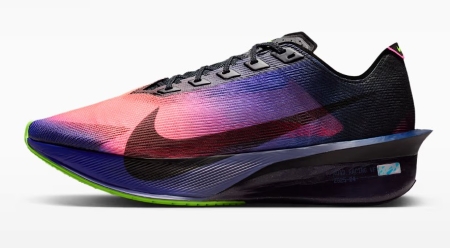
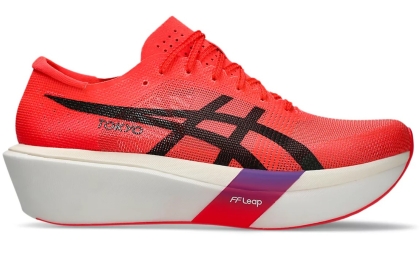
The two outings that explain my preference
On a Tuesday night under the lights at Stockton, I used the Vaporfly 4 for a 5K time trial. At sub-20 pacing, I liked how little delay I felt between landing and the next step. The shoe made a quick turnover feel natural to me. That is why I start with it for a short race: I want to get up to pace, then keep making clean, economical-feeling steps rather than wait for a long stride to unlock the ride. The result belongs to that session, not to a guaranteed time saving for anyone else.
The Metaspeed Sky Tokyo gave me a different memory. Running into ocean headwinds on the Atlantic City boards around 7:05 per mile, I could stay with a sustained effort and came away with a personal best. I do not use that outing to claim it is intrinsically faster than the Nike; the course, wind and day were not controlled. It tells me the ASICS works when I can settle into a longer rhythm without forcing the shoe.
Both shoes also gave me the same warning: wet painted boardwalk markings were slippery underfoot. That happened on a particular surface, so I do not turn it into an all-rain verdict. I shorten my stride across paint and inspect the race route for slick turns instead of trusting a rubber compound name.
What I can stand behind: the short-race turnover and sustained-pace feel are my logged experiences. My mileage is unequal, my ASICS long run stops at 12 miles, and these were not matched laboratory trials. I use them to set a smart audition, not to promise a faster finish.
What each shoe is asking my foot to do
Vaporfly 4 pairs full-length ZoomX foam with a full-length carbon Flyplate. I feel a direct, eager transition when I pick up cadence. It rewards a line where I land, load the foam and get off the front efficiently. I do not need to invent an energy-return percentage to describe that sensation. At easy pace, the same directed feel offers little reason to spend race-shoe miles.
Sky Tokyo has a different stack: FF LEAP foam below, FF TURBO PLUS above, and a relatively flat full-length carbon plate positioned above the FF LEAP layer. Its rocker and foam combination feel better to me when I have room to extend a steady, forceful step. ASICS lists a 5 mm drop for Sky Tokyo. That printed offset does not tell me which shoe will spare my calves or work with my landing; the foam, plate position, platform, fit and pace all matter together.
The exact pairs I can compare on my foot
| What I checked | Nike Vaporfly 4 | ASICS Metaspeed Sky Tokyo |
|---|---|---|
| My logged running distance | 299 miles | 197 miles |
| My longest logged run | 19 miles | 12 miles |
| Foam and plate | Full-length ZoomX and carbon Flyplate | FF LEAP below FF TURBO PLUS; flat carbon plate above FF LEAP |
| Fit in my men’s US 10.5 D | Tapered front; thin socks give my toes workable space | More usable forefoot room on my foot; still a race fit |
| The run that shaped my choice | Stockton 5K time trial: quick turnover at sub-20 pacing | Atlantic City headwind run: sustained rhythm around 7:05 per mile |
ASICS calls Sky Tokyo a stride-style racer. I treat that as a clue for a test, not a gait diagnosis. I do not send a runner to Sky just because a watch reports a certain cadence. I run both shoes at the same planned effort, look for a natural step without reaching ahead of my body, and check whether the sensation survives fatigue. If I must deliberately lengthen my stride to make Sky feel right, I would not choose it for that race. My Alphafly versus Vaporfly comparison shows how another Nike race geometry changes the choice.
Fit is the first hard stop
In my US 10.5 D, Vaporfly 4 is a tapered performance fit. A thin technical sock gives my toes enough workable space, and the midfoot and heel stay secure without my cranking the laces. If I felt repeated little-toe pressure, arch contact or toe impact at the front during a fast downhill, I would reject it no matter how good the 5K workout felt.
My Sky Tokyo gives me more usable forefoot room than my Nike pair after the foot warms, while its heel stays put. That is a personal fit comparison, not a claim that Sky Tokyo is a wide shoe. Its race upper can still feel narrow to someone with a broad forefoot or high instep. I ask the runner to test their own longest toe, little toe and instep separately; going up in length is not a reliable cure for a shoe that has the wrong shape. My fit checklist and width guide help isolate that problem.
- After warming up: I check toe clearance and any rubbing at the little toe, not just the first step in the store.
- At target pace: I check whether the heel lifts, the tongue moves or I need to overtighten the midfoot.
- On a broad turn and mild camber: I want the foot to stay centered without gripping with my toes.
- Late in the run: I pay attention to new pressure or forward slide. That is the fit I would bring to a race.
The distance changes which weakness matters
5K and 10K: a quick shoe still has to corner
My Stockton 5K is the strongest reason to choose Vaporfly 4 first. I can get to pace promptly, and its sharp transition matches my short-race rhythm. For a winding 10K, I rehearse the actual turn profile. If I have to slow too much to place my foot, I would take the steadier option even if the Nike feels more exciting on a straight. My 5K race plan is where I decide the effort before I assign the shoe.
Half marathon: hold form after the first rush fades
For a continuous half-marathon effort, I start my trial in Sky Tokyo. My Atlantic City run tells me I can find an unforced rhythm in it, and my forefoot feels less constrained than in the Nike. I would reverse that choice if the Sky’s roll makes me reach, the upper changes after an hour, or the Vaporfly stays more settled when I run the same intended effort. I compare perceived effort and control, not unmatched watch splits in different weather.
Marathon: I will not turn a 12-mile run into a 26.2-mile claim
My longest recorded Sky Tokyo run is 12 miles; the Vaporfly has reached 19. I can explain why Sky is my first long-race audition, but I cannot say from those logs how its forefoot or upper will behave for me at mile 22. I would run a long session with a late marathon-pace segment in each finalist, use race socks and fueling, then choose the shoe that keeps my foot centered and my pace controlled as I tire. If neither passes, I take a different racer. My marathon pacing guide covers the effort plan that the shoe must support.
Wear and weather: the part a new-shoe bounce test misses
At 299 miles, my Vaporfly outsole shows smoothing in the landing and forefoot zones, and its ZoomX feels softer with visible creases. Its upper remains intact. At 197 miles, my Sky Tokyo has concentrated lateral midfoot rubber wear and moderate foam creasing, but the ride is still usable for its intended work and the upper remains sound. Because the pairs have different mileage and workloads, I cannot make a fair lifespan ranking from these snapshots.
I also do not confuse a shoe that remains runnable with a shoe I would pick for an A race. Before a key event I compare the older pair with my recent workouts: is grip still predictable where I land, is the upper still holding my foot, and does the ride still feel like the one I rehearsed? I keep race shoes in my rotation for specific sessions so I can notice changes rather than wearing them automatically on every easy day.
Sky Tokyo uses ASICSGRIP rubber, but the brand name did not stop my slip on wet boardwalk paint. I make the same distinction for the Nike: one slick marking does not mean every wet road is unsafe, yet neither pair earns blind trust on paint, metal or algae. In bad weather, the route and my ability to run smoothly through hazards can decide more than a claimed speed advantage.
My three-session race rehearsal
- Session one — fit and handling: Easy warm-up, a few relaxed strides and broad turns in the socks I intend to race in. I record toe pressure, heel hold and whether the shoe stays centered.
- Session two — the event rhythm: A controlled block at the effort I can realistically sustain. I compare how naturally I arrive at that rhythm, not a single fast split.
- Session three — tired legs: For a longer race, a long run with late steady or race-pace work. I hold fueling, socks and lacing close to race day and judge the last miles most heavily.
I would not race a new pair after only a living-room try-on. If one shoe wins the first strides but loses toe room or control in session three, I change my pick. If both pass and the race is short, my own tie-break goes to Vaporfly 4; if it is a sustained effort, I start with Sky Tokyo. For model-specific details beyond this head-to-head decision, I keep separate Vaporfly 4 and Sky Tokyo reviews.
FAQ: Vaporfly 4 or Metaspeed Sky Tokyo?
Which is better for a 5K?
I start with Vaporfly 4 for my 5K because its quick transition suited my Stockton time trial at sub-20 pacing. I would switch if its forefoot fit or cornering makes me hesitate on the actual course.
Which would I choose for a half marathon?
Sky Tokyo gets my first sustained-pace audition because I settled into a strong rhythm on the Atlantic City boards and its forefoot feels less restrictive on my foot. The winner still has to pass a warm-foot workout at the planned effort.
Is Metaspeed Sky Tokyo automatically better for a marathon?
No. My longest logged Sky Tokyo run is 12 miles, versus 19 in Vaporfly 4. I would complete a long rehearsal with late marathon-pace work before choosing either shoe for 26.2 miles.
Does a longer stride mean I should buy Sky Tokyo?
No. ASICS positions Sky Tokyo for stride-style runners, but a gait label or watch cadence does not establish which shoe works better for you. I compare both at the same intended effort and reject any pair that makes me force my stride.
Which fits wider feet?
Sky Tokyo gives my US 10.5 D foot more usable forefoot room than my Vaporfly 4, but that does not make it a wide shoe. I test toe space, instep pressure and heel hold after warming up in the socks I will race in.
Can I trust either shoe on wet roads?
I have slipped in both on wet painted boardwalk markings. That experience is specific to a slick surface, not a verdict on every wet road. I inspect the course, slow across paint and test handling before racing in rain.
Which lasts longer?
I cannot call a durability winner from unequal 299-mile and 197-mile logs. Both show wear and intact uppers in my pairs. I decide whether to race an older pair by its current grip, fit and ride rather than a fixed mileage number.
What I would put on the start line
For my next dry 5K, I would lace Vaporfly 4; for a continuous longer race effort, I would audition Sky Tokyo first. The Nike earns my short-race vote through a logged, convincing turnover test. The ASICS earns a serious longer-effort trial through the rhythm I found into an Atlantic City headwind and the extra usable forefoot room on my foot. Neither shoe overrides pressure, slipping or a late-run form change. The race-specific rehearsal—not the plate story—gets the final vote.

Written by Ken — 12 years of running, 12,500+ miles, 63 shoes tested, 36 races from 5Ks to a 50K ultra. I run 30–40 miles a week on the Atlantic City Boardwalk and review every shoe with real training miles, not one-run demos. More about me →