
In this running shoe width guide, the standard I use is simple: the right width keeps my heel and midfoot controlled, supports both metatarsal heads on the platform, and lets every toe lie naturally. I do not judge width by whether stretchy mesh can simply cover my foot.
A “wide” label does not guarantee a wide toe box, broad midsole, high instep, or generous heel. Width, volume, last shape, and platform shape are different variables, so I never let one letter make the decision for me.
My own forefoot is moderately wide. After 12 years of running and fitting 63 shoes, my rule is simple: I buy space where my foot needs it without buying looseness everywhere else. This running shoe width guide shows exactly how I make that call.
My width decision in 30 seconds
Before I study a size chart, I ask three questions:
- Is my foot supported? Both forefoot joints must stay over the sole when I load one leg.
- Are my toes in their natural position? More fabric is irrelevant if the toe box changes their alignment.
- Can the shoe hold me without lace force? I should not need to crush the instep to stop heel lift or side-to-side movement.
If any answer is no, I identify the failing zone before changing size. That prevents the two mistakes I see most often: sizing up to solve width and choosing an indiscriminately wide shoe for one local pressure point.
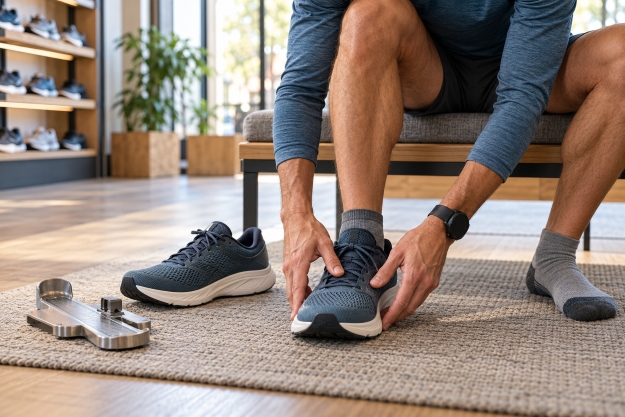
The five fit dimensions hidden inside “width”
| Dimension | What I check | Common failure |
|---|---|---|
| Heel width | Collar contact and lifting | Friction or repeated slip |
| Midfoot width | Platform waist and sidewall contact | Arch-edge pressure or lateral spill |
| Forefoot width | First and fifth metatarsal support | Foot hangs beyond base |
| Toe-box shape | Taper around each toe | Toes pushed inward or overlapping |
| Vertical volume | Space above toes and instep | Tongue pressure, nail contact, or loose wrap |
I evaluate every zone. A shoe can be wide at the toes, narrow through the waist, shallow over the instep, and loose at the heel—all at once. My broader running-shoe fit guide connects these width checks with length, heel hold, and flex position.
What B, D, 2E, and 4E mean
In US running shoes, B is commonly the standard women’s width and D the standard men’s width. Wider offerings often use D or 2E for women and 2E or 4E for men. Narrow options may use 2A, B, or model-specific labels.
These are categories, not guaranteed internal measurements. Brands use different lasts, and even two models from one brand can fit differently. The label also starts from different common baselines, which is why I do not convert a men’s width to a women’s width by letter alone; I explain that trap in my men’s vs women’s running-shoes guide.
A “wide” version may gain only upper material. Another may use a genuinely broader platform. Some also change heel or midfoot volume.
I use the letter to build a shortlist. My foot under load decides whether the execution is wide in the right place.
Measure both feet before choosing a width
I measure both feet while standing in the socks I plan to run in. I record length and the widest forefoot span rather than assuming my street-shoe size still applies.
Feet are often asymmetric. I fit the more demanding foot, then make a modest lacing adjustment on the smaller side if necessary.
A Brannock device or 3D scan can improve the starting point. Neither knows the internal shape of the model I am buying.
My running-shoe size guide explains how I translate foot measurements into a model-specific try-on size.
Wide upper versus wide platform
This is my most important width distinction.
Stretchy mesh may stop pinching while the foot still hangs over the midsole. That creates the appearance of width without a supportive base.
I locate the first metatarsal head near the big-toe joint and the fifth near the outside forefoot. Both should sit on the platform rather than balancing on an edge.
Then I perform a slow calf raise. The forefoot spreads under load. If the upper bulges outward while I feel the sole edge beneath the metatarsal, the shoe is not usefully wide enough.
False width often becomes obvious during turns or late-run fatigue, when the foot pushes laterally through the upper. If the terms platform, sidewall, strobel, and last are unfamiliar, my running-shoe anatomy guide shows where each part sits.
Toe-box width is not forefoot width
Some shoes flare near the toe tips but remain narrow at the ball of the foot. Others support the metatarsals well and then taper aggressively around the toes.
I inspect both zones.
The big toe should not be pushed inward. The smallest toes should not curl, overlap, or sit against a rigid sidewall. The longest toe needs front and roof clearance.
“Anatomical” and “foot-shaped” are marketing descriptions without one standard geometry. I judge the outline against my actual toe pattern.
Runners with a longer second toe need length and height in that lane. My running-shoes-for-Morton’s-toe guide focuses on that specific fit problem.
Volume is the missing third dimension
Width describes horizontal space. Volume includes vertical and circumferential space over the toes, midfoot, instep, and heel.
A high-instep runner can feel crushed in a shoe whose sole is wide enough. A low-volume foot may swim inside a narrow-looking shoe because the upper sits too high.
I use these clues:
- widely separated eyelet rows suggest limited instep room;
- eyelet rows pulled together with upper bunching suggest excess volume;
- inadequate tongue coverage suggests the shoe throat is too shallow;
- heel slip despite correct length may indicate excess rearfoot volume;
- nail contact from above suggests low toe-box height.
Window lacing can relieve one crossing. It cannot create missing volume across the whole upper. My high-instep running-shoe guide covers that distinction. If the pressure is concentrated through the middle rather than the instep as a whole, I use the checks in my tight-across-the-midfoot guide before changing width.
Narrow heel and wide forefoot
This is one of the hardest combinations to fit because an indiscriminately wide shoe may solve the forefoot while losing the heel.
I look for a shaped heel cup, adjustable midfoot wrap, and a platform that widens where the metatarsals actually sit. The last should transition from secure to broad rather than remaining boxy throughout.
A runner’s loop may tune small heel movement. I do not use aggressive top tension to force a large heel mismatch.
The running-shoe lacing guide shows how I separate forefoot and heel tension without crushing the instep.
If I need a heel lock on the tightest possible setting, I compare another last.
Why sizing up is usually the wrong width fix
Going longer can move into a slightly broader part of the shoe, which explains why it sometimes feels better initially. The tradeoffs are easy to miss.
Excess length can cause forward sliding, heel movement, misplaced flex, and toe impact on descents. The arch contour may also move ahead of or behind the foot.
I try the correct wide last before adding length. If the brand does not offer it, I compare a differently shaped model.
Half a size up can be correct when more length is genuinely needed. It should not be a disguise for missing platform width.
My five-zone loaded fit test
This is the repeatable test I use for every candidate. It takes about ten minutes in a store and tells me far more than standing still and checking for a thumb’s width.
1. Start with normal socks and the intended insole
Sock thickness and aftermarket devices change available space. I test the real configuration.
2. Seat the heel and lace neutrally
I loosen every row, place the heel correctly, and retension gradually. A half-laced try-on creates misleading volume.
My goal is even contact, not maximum tightness. If the heel only stays down after I pull the top rows hard, I mark that as a rearfoot-shape problem rather than a successful adjustment.
3. Stand on both feet
I map heel, arch, fifth metatarsal, big-toe joint, toe tips, and toe-box roof.
4. Load one forefoot
Five slow calf raises per side show whether the platform supports normal spread.
I watch the upper as well as the sensation underfoot. Bulging mesh with a metatarsal sitting on the sole edge is accommodation without support, so that candidate fails even if it does not pinch immediately.
5. Jog and change pace
Easy running reveals pressure. Intended pace reveals whether the upper holds as forces rise.
I include a short acceleration rather than judging only at shuffle pace. A shoe can feel spacious while walking yet allow the forefoot to slide or the toes to grip when cadence and braking forces increase.
6. Turn both directions
I watch for the foot sliding through extra upper space or falling over a narrow base.
Both directions matter because one foot may be wider and one side of the upper may hold differently. I use controlled turns, not an aggressive cut that introduces a movement I would never make while running.
7. Stop and reassess
Pressure sometimes becomes clearer after movement. I check for numbness, concentrated redness, or toe displacement.
I loosen the shoe and note whether the sensation resolves quickly. Persistent altered sensation, a sharply defined pressure mark, or toes that remain crowded is not a “maybe”; I move to another width or last.
8. Compare with a known-good pair
Direct A/B testing is more reliable than memory. I use a shoe whose fit has survived real training miles.
Signs a running shoe is too narrow
I reject or resize the shoe when:
- either metatarsal head spills beyond the platform;
- the big toe is pushed inward;
- smaller toes overlap or curl;
- side pressure grows during calf raises;
- the upper creates burning, tingling, or numbness;
- a rigid overlay contacts the fifth metatarsal;
- the insole shows clear edge overhang;
- loosening laces cannot create room without instability.
Numbness is not normal break-in. My running-shoes-causing-toe-numbness guide explains the immediate checks and escalation signs. If the problem is repeated nail contact rather than altered sensation, I use a different diagnostic sequence for black toenails from running shoes.
Signs a shoe is too wide or too voluminous
More space is not automatically safer.
I look for:
- repeated heel lift;
- lateral sliding on turns;
- toes gripping to stabilize;
- upper fabric folding under lace tension;
- eyelet rows touching;
- a tongue that migrates because the wrap is loose;
- forward movement during braking;
- a vague or delayed transition at pace.
When tightening solves movement but creates instep pressure, the last is wrong. I am choosing between looseness and compression instead of getting fit.
My mismatch map: change the right variable first
I do not respond to every fit problem by reaching for a wider shoe. I use the location and timing of the symptom to decide which variable to test next.
| What I feel or see | My first suspicion | What I compare next |
|---|---|---|
| Pressure at both forefoot joints | Platform or forefoot last too narrow | Same length in a true wide platform |
| Toes pushed together but forefoot supported | Toe-box taper mismatch | A straighter toe-box shape, not extra heel width |
| Tongue pressure with stable side support | Insufficient vertical volume | Deeper upper or targeted lacing relief |
| Heel lift with comfortable forefoot | Rearfoot volume too high | More sculpted heel and midfoot wrap |
| Foot slides on turns | Excess volume or weak upper hold | Lower-volume last before sizing down |
| Nail contact only from above | Toe-box roof too low | More vertical toe room; recheck length |
| Outer forefoot hangs over the sole | Platform too narrow | Broader base, regardless of stretchy mesh |
This map keeps me from fixing one zone by damaging another. The winning shoe is not the one with the most room; it is the one that gives each zone the right amount of room and control.
Orthotics change usable width and volume
A rigid or broad orthotic must lie flat. If it curls at the sidewall or bridges a narrow waist, the system is incompatible.
An insert can also lift the foot into narrower upper zones. That reduces heel depth, instep room, and toe-box height even when the shoe’s platform is broad.
I refit every zone after replacing the factory sockliner. I do not stack devices automatically.
My custom orthotics versus OTC insoles guide explains how I test the complete foot–device–shoe system.
Width changes with the shoe’s job
Daily trainers
I want room and control across easy pace, turns, and sustained mileage. The upper should remain quiet rather than require constant adjustment.
Race shoes
A performance upper may fit more precisely, but precise does not mean compressive. My toes still need normal position, and the forefoot must remain on the platform at race pace. I treat that fit tolerance as one part of the larger race shoe vs daily trainer decision.
I test the shoe at target pace before accepting less volume. If speed makes the foot more centered and the upper disappear, the close fit may be purposeful; if it creates numbness or toe displacement, I do not call that performance fit.
Trail shoes
Downhill braking and sidehill loading demand secure midfoot and heel hold. Excess volume lets the foot move; insufficient width creates pressure as terrain pushes laterally.
I leave usable toe clearance for descents but refuse to buy it by loosening the whole forefoot. The trail last must combine front clearance with lateral hold when the platform is tilted.
Long-run shoes
I give duration greater weight. A fit that is merely close in the store often becomes clearly wrong after the foot warms.
Winter shoes
Thicker socks consume volume. I test them rather than assuming the same size and width will work.
Width by common foot combination
| Foot pattern | My starting strategy |
|---|---|
| Wide forefoot, narrow heel | Shaped rearfoot, adjustable midfoot, broad forefoot platform |
| Wide forefoot, high instep | Confirm horizontal base and vertical tongue coverage |
| Narrow forefoot, high instep | Seek depth without unnecessary platform width |
| Low-volume foot | Lower-volume upper with zone-specific lacing |
| One foot wider | Fit demanding foot, tune smaller side modestly |
| Long second toe | Add length and roof clearance in correct lane |
I treat these as search directions, not prescriptions. Every brand implements shape differently.
Buying wide running shoes online
My strongest reference is an exact model, version, size, and width that already works. “I wear 10.5” is not enough information.
I look for model-specific descriptions of platform width, toe taper, instep volume, and heel shape. I also verify whether the wide version changes the midsole or only the upper.
I buy from a seller with a clear return policy and test indoors later in the day. I record the result by zone even when I return the shoe. My in-store running-shoe test gives the full comparison order when I have several candidates.
I keep the tags on, use a clean surface, and compare one variable at a time. Ordering two adjacent widths is more informative than ordering two unrelated models, because I can see whether the wider option changes the platform, upper volume, heel, or all three.
That fit log turns failed purchases into useful data. I record the exact version because a redesign can change the last even when the model name survives.
Break-in versus a width mismatch
Mesh may relax and a stiff overlay may soften slightly. Neither change adds midsole width or moves the edge beneath the foot.
I tolerate mild new-material awareness. I do not tolerate toe displacement, platform spill, hot pressure, or altered sensation.
My practical boundary is direction of change. A slightly stiff overlay that becomes less noticeable during a short indoor test may soften; pressure that grows with loading, heat, or time is evidence of a mismatch, not a break-in plan.
My how to break in running shoes guide separates safe adaptation from a shoe that should go back.
Final acceptance standard
The shoe passes when usable space and control coexist.
My heel stays seated without aggressive lacing. The midfoot is held without arch or tongue pressure. Both metatarsal heads remain supported. Every toe lies naturally with length and roof clearance.
The fit must survive calf raises, intended pace, turns, and a realistic duration test. One foot does not get sacrificed because the other fits perfectly.
I document model version, size, width, socks, insole, and each zone. That record is far more useful than loyalty to a width letter.
Frequently asked questions
Should I size up for wide feet?
I try the correct wide last first. Added length can create heel slip, forward movement, and misplaced flex. I size up only when length also needs to increase.
Is a wide toe box enough?
No. I also need forefoot platform support, compatible midfoot width, correct heel shape, and enough vertical volume.
Are men’s and women’s wide widths the same?
No. Width letters use different common baselines, and model shapes still vary. I compare the exact shoe rather than translating labels blindly.
Do wide running shoes feel slower?
Not inherently. Material and platform changes can affect mass, but a secure, supportive fit may improve control. A loose shoe is not faster because its label is narrower.
Can lacing make a running shoe wider?
Lacing can reduce upper pressure and redistribute tension. It cannot widen the midsole, change toe taper, or add structural volume.
How do I know if the platform is wide enough?
I locate both metatarsal heads and perform a loaded calf raise. They should remain supported by the sole rather than hanging over its edges.
Should my toes touch the sides?
Light material contact can occur, but the upper should not push toes inward, create friction, or compress the foot under load.
Can one foot wear a different width?
Occasionally runners use mixed sizes through specialty programs, but I first fit the more demanding foot and tune the other side conservatively. Large asymmetry may deserve professional fitting.
My bottom line
I fit running-shoe width by zone, not by one letter. The heel, midfoot, forefoot platform, toe-box outline, and vertical volume must work together.
The correct shoe gives my foot usable space while keeping it centered through load, pace, turns, and fatigue. If I must add length, extreme lacing, or stretchy overhang to manufacture width, I choose a different last.

Written by Ken — the recreational distance runner behind NextGait. I use 12 years of running experience, model-to-model comparisons, and loaded fit checks to separate a useful wide fit from extra fabric that only looks roomy. More about me →