
In the Speedgoat vs Caldera comparison, the HOKA Speedgoat 7 is the better trail shoe for most runners. It grips harder, changes direction with less effort, handles more technical ground, and has the wider useful pace range. The Brooks Caldera 8 is the better choice for heel strikers who want a broad, calm platform for easy long runs, hiking, and ultras on moderate terrain. For higher-mileage trail days, compare these trail shoes for long distances.
That verdict comes from 302 logged miles: 185 in the Speedgoat 7 and 117 in the Caldera 8. I am 5’10”, about 182 pounds, usually land between my heel and midfoot, and mildly overpronate when tired. My trail testing includes Pine Barrens sand, packed dirt, gravel, roots, moderate rock, mud, creek crossings, and short road connectors.
Short answer: Buy Speedgoat 7 for mixed or technical trails, wet roots, rock, faster running, and one-shoe versatility. Buy Caldera 8 for easy-to-steady long runs, wide rearfoot stability, hiking, and 50K-plus efforts on gravel roads or moderate forest trail. Neither is a deep-mud specialist or a sensible road-first shoe.
Current models compared: HOKA Speedgoat 7 and Brooks Caldera 8. As of August 10, 2026, Caldera 8 remains the current Caldera on Brooks’ US site; I found no released Caldera 9 product page.
HOKA Speedgoat 7 vs Brooks Caldera 8 at a glance
| Decision | Speedgoat 7 | Caldera 8 | Winner |
|---|---|---|---|
| Overall | More versatile and technically capable | More specialized for slow long-haul comfort | Speedgoat 7 |
| Grip | Vibram Megagrip, 5 mm stated lugs | TrailTack Green, about 4 mm stated lugs | Speedgoat 7 |
| Technical terrain | Quicker placement and stronger traction | Stable after landing but slow between lines | Speedgoat 7 |
| Easy long runs | Protective with a livelier forefoot | Calm heel and broad rear platform | Caldera 8 for heel strikers |
| Ultra racing | Better for mixed and technical courses | Better for nontechnical, hike-heavy courses | Course dependent |
| Fit options | Regular and wide; standard fit is tapered | More relaxed feel, but no foot-shaped toe box | Depends on foot shape |
| Fast trail running | Lighter and more flexible | Heavy and deliberate | Speedgoat 7 |
| Rearfoot stability | Broad and secure | Exceptionally wide heel with raised sidewalls | Caldera 8 |
If this is your first off-road shoe, start with the trail running beginner guide. Trail fit and stability cannot be judged by walking across a level store floor; uneven landings and descents expose the real differences.
Ken’s ranking rule
The more technical, wet, and changeable the trail becomes, the more I favor Speedgoat 7. The longer, slower, and more heel-dominant the run becomes on moderate ground, the more Caldera 8 makes sense.
I do not rank trail shoes by cushioning height alone. I rank the complete sequence: see the line, place the foot, gain traction, absorb the landing, then move to the next line. Caldera is excellent at calming the landing. Speedgoat is better at the whole sequence.
This rule also explains the split ultra verdict. A flat 50K with fire roads, hiking, and tired heel landings favors Caldera. A rocky 50K with wet roots, repeated direction changes, and runnable descents favors Speedgoat.
How I tested both trail shoes
My Speedgoat 7 has 185 verified running miles and a mature wear assessment. My Caldera 8 has 117 verified miles, four structured checks, a completed long run, and wet testing. That is enough for a confident fit and use-case comparison, but Caldera’s final lifespan is still an open question.
I tested both at easy and steady trail effort, over sand, dirt, gravel, roots, moderate rock, wet ground, and road connectors. Speedgoat also completed faster trail work and a 25K race context. Caldera completed a 13-mile Wharton State Forest outing and repeated water-crossing tests.
This is field testing, not a controlled metabolic study. GPS pace on sand cannot be compared directly with pace on hardpack, and one finish time cannot prove that a shoe caused a result. I report surface behavior, fit, stability, comfort, control, and wear, then use lab measurements to explain rather than overwrite those observations.
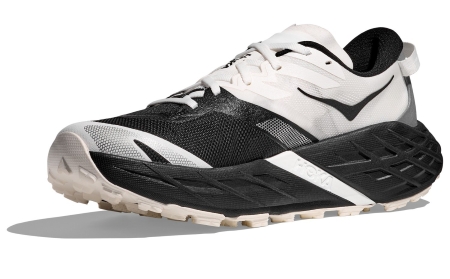
Speedgoat 7 vs Caldera 8 specs
| Specification | HOKA Speedgoat 7 | Brooks Caldera 8 |
|---|---|---|
| Official men’s weight | 9.7 oz | 10.6 oz / 300.5 g |
| Official drop | 5 mm | 6 mm |
| Midsole | Super-critically foamed EVA | Nitrogen-infused DNA LOFT v3 |
| Outsole | Vibram Megagrip with Traction Lug | TrailTack Green rubber |
| Stated lug depth | 5 mm | 4 mm |
| Rock plate | No dedicated plate | No dedicated plate |
| Wide option | Yes | No dedicated wide on current US listing |
| My logged mileage | 185 miles | 117 miles |
| Best use | Mixed and technical trail | Long moderate trail and hiking |
HOKA’s official figures put Speedgoat 7 about 0.9 oz lighter. Independent lab samples widened that gap to 1.0 oz: 9.9 oz for Speedgoat versus 10.9 oz for Caldera. One ounce sounds minor on paper, but repeated line changes make it obvious on trail.
Independent lab comparison
| RunRepeat sample | Speedgoat 7 | Caldera 8 | What it explains |
|---|---|---|---|
| Weight | 9.9 oz / 281 g | 10.9 oz / 309 g | Speedgoat redirects more easily |
| Heel / forefoot stack | 37.7 / 30.3 mm | 36.7 / 27.9 mm | Speedgoat has more measured foam depth |
| Measured drop | 7.4 mm | 8.8 mm | Both measured above brand figures |
| Heel / forefoot shock absorption | 131 / 116 SA | 129 / 111 SA | Both protect; Speedgoat led in this protocol |
| Heel / forefoot energy return | 54.4% / 60.4% | 56.9% / 58.7% | Caldera favors heel; Speedgoat favors forefoot |
| Traction coefficient | 0.77 | 0.59 | Supports Speedgoat’s field grip advantage |
| Measured lug depth | 4.5 mm | 3.6 mm | Speedgoat gets more bite and clearance |
| Heel platform width | 96.0 mm | 104.0 mm | Caldera’s major stability advantage |
Brand drop and lab drop are not interchangeable. Measurement location, sample size, manufacturing variance, and foam compression change the result. The heel-drop guide explains why the listed 5 versus 6 mm difference should not decide this comparison by itself.
Ride comparison: controlled response vs calm cushioning
Speedgoat 7 ride
Speedgoat 7 feels protective first and responsive second. The new supercritical EVA does not behave like a soft road supershoe. It compresses enough to reduce sharp trail pressure, then returns without leaving the foot floating during an angled landing.
The transition is predictable. On packed dirt, the gentle rocker helps me roll forward. On roots and rock, the moderately flexible forefoot lets me adjust without folding. RunRepeat measured 14.4 N in its bend test, close to the trail average and less stiff than Caldera’s 17.0 N.
The most important ride quality is low drama. During a mixed-terrain 25K, I could move from sand to roots to wet banks without relearning the shoe. My finish time belongs to the whole race, not the foam. The relevant evidence is that foot placement and traction remained consistent as the surface changed.
Caldera 8 ride
Caldera 8 feels softest and most useful at the heel. DNA LOFT v3 compresses gradually under my 182-pound frame and settles into an even rhythm. It is comfortable, but not loose. Raised sidewalls keep the foot centered inside the platform instead of balancing above it.
The forefoot is less plush than the midsole silhouette suggests. That matches the lab split: 129 SA at the heel and 111 SA at the forefoot. The shoe still protects well, but heel strikers receive more of its intended benefit than runners who land far forward.
At easy pace, Caldera rolls smoothly. During short surges or repeated turns, its width and mass take more effort to redirect. My phrase for it is stable after contact, not agile before contact. That distinction matters more on trail than on a straight road.
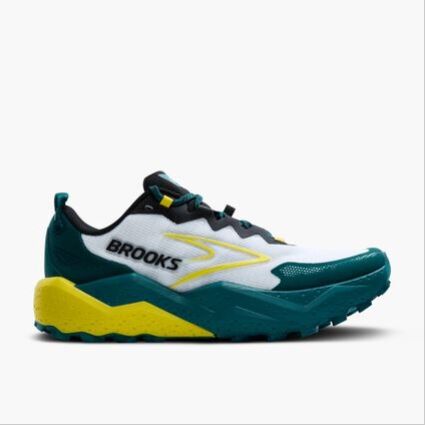
Which shoe wins on each trail surface?
| Surface | Better shoe | Why |
|---|---|---|
| Hardpack | Speedgoat 7 | Lighter and smoother when pace rises |
| Gravel fire road | Caldera 8 for easy pace | Broad heel and calm cushioning |
| Wet roots | Speedgoat 7 | Vibram grip and quicker placement |
| Rocky singletrack | Speedgoat 7 | Better traction and line changes |
| Sugar sand | Speedgoat 7 | Deeper lugs; neither eliminates energy loss |
| Moderate mud | Speedgoat 7 | More lug depth and clearance |
| Deep mud | Neither | Use a deeper, wider-spaced mud outsole |
| Long hiking-run route | Caldera 8 | Heel comfort and planted walking platform |
| Road connector | Speedgoat 7 | Less mass; both are trail-first |
Hardpack and forest roads
This is Caldera’s strongest ground. On a long gravel road at conversational effort, the wide heel and slow-compressing foam make repetitive landings easy to manage. If I plan to hold a stronger steady pace, Speedgoat saves weight and moves through toe-off with less effort.
Roots, rock, and technical singletrack
Speedgoat wins clearly. Its traction coefficient, deeper lugs, lower weight, and less rigid bend create more usable control. Caldera can absorb a rock after I land, but its 104 mm heel and heavier chassis make the approach to that landing slower.
No high-stack shoe replaces line choice. Use the foot-placement and braking cues in my uphill and downhill running guide. A broad platform creates margin; it cannot correct a long braking stride across an angled root.
Sand and loose ground
Pine Barrens sugar sand exposes mass. Caldera’s broad base feels secure, but every step still moves a heavy shoe through a yielding surface. Speedgoat’s deeper outsole and lower weight make it the less costly option, although no shoe turns loose sand into hardpack.
Grip: Vibram Megagrip vs TrailTack Green
Speedgoat 7 has the decisive grip advantage. HOKA uses Vibram Megagrip with Traction Lug and a stated 5 mm pattern. Brooks uses TrailTack Green with roughly 4 mm chevrons. Both work on dry dirt and moderate rock; Speedgoat preserves more margin when the surface turns wet or loose.
RunRepeat measured 0.77 forefoot traction for Speedgoat and 0.59 for Caldera under the same current protocol. I do not translate that coefficient into a fall-prevention promise. It does support what I felt on wet roots and muddy banks: Speedgoat lets me commit sooner.
Caldera’s compound is not poor. On damp roots, gravel, and sand over hardpack, it stayed predictable. The limitation is tread geometry. Closely spaced 3.6 mm lab-measured lugs fill sooner in mud, and rubber cannot grip the ground when packed soil covers it.
For rain, shorten stride before trusting any outsole. The rain-running guide covers wet leaves, painted surfaces, visibility, and braking. Neither shoe is safe on ice without additional traction.
Stability: why Caldera wins at the heel
Caldera 8 has one of the widest measured heels in the category: 104.0 mm versus 96.0 mm for Speedgoat 7. Raised sidewalls cradle the rearfoot, and the stiff heel counter adds structure. For my mild late-run overpronation, easy heel landings feel calm and centered.
That does not make Caldera a corrective stability shoe. It is a neutral shoe with strong inherent stability. A runner who needs clinical guidance should not treat platform width as a prescription, and no shoe can promise injury prevention.
Speedgoat is also stable. Its forefoot is actually 0.8 mm wider in the lab, and its sidewalls hold the foot inside the platform. It wins dynamic stability for me because I can place and recover the shoe more quickly. Caldera wins static rearfoot stability once the heel is down.
High stack still delays trail feedback. If downhill fatigue causes knee discomfort, shoe width is not the full answer. My downhill knee-pain guide covers cadence, braking, strength, and training-load errors.
Fit and sizing comparison
| Fit area | Speedgoat 7 | Caldera 8 |
|---|---|---|
| Length | HOKA recommends a half size up | True to size for me |
| Standard forefoot | Snug and tapered | Average width with slightly less taper |
| Vertical toe room | Higher in lab sample | Average |
| Midfoot | Secure dynamic vamp | Offset lacing and useful volume |
| Heel | Comfortable, controlled collar | Padded and very planted |
| Wide option | Yes | No dedicated wide on current US page |
Speedgoat’s outsole looks wide, but the standard upper is not. RunRepeat’s mold measured 94.8 mm at the widest interior point and only 71.4 mm near the big toe. HOKA now explicitly recommends going up half a size, and regular plus wide widths are available.
Caldera measured 94.6 mm at the widest point and 73.0 mm at the big toe. That is slightly less tapered, not foot-shaped. My normal men’s US 10.5 fits true to size, with enough swelling room over 13 miles and no heel lift.
Do not confuse Caldera’s 104 mm heel platform with internal width. The giant base sits under the foot; it does not create an Altra-style forefoot. Runners who need more space should compare the wide running-shoe guide rather than buying extra length to solve a shape problem.
Test both on a decline after the feet warm. Toes should not hit the front, the heel should not rise, and the upper should hold the midfoot without crushing it. Speedgoat’s wide version is the safer starting point for a broad forefoot; Caldera suits medium-volume feet that want a relaxed but conventional shape.
Which is better by distance?
Trail 5K and 10K: Speedgoat 7
Neither is a minimalist race shoe, but Speedgoat is clearly better for shorter events. It is lighter, bends more easily, and changes line with less effort. Caldera’s heel stability is useful, yet its mass becomes obvious when cadence rises or the course repeatedly turns.
Half marathon and 25K: Speedgoat 7
This is Speedgoat’s best range for me. Cushioning is sufficient, grip covers mixed terrain, and the shoe remains runnable. I completed a Pine Barrens 25K context in it without a late loss of underfoot protection. That does not prove the shoe caused the result; it shows the ride stayed usable for the full distance.
50K: choose by course
Choose Speedgoat for technical 50Ks, wet roots, rock, or courses where you expect to run descents. Choose Caldera for smoother ultras with gravel, forest road, long hiking sections, and a pace that keeps you mostly heel-to-midfoot. Brooks explicitly positions Caldera for 50K-plus trail runs and races.
50 miles and 100K: fit outranks the brand
At ultra distance, small fit errors become large. Speedgoat’s tapered standard forefoot can create pressure as feet swell. Caldera’s extra bulk can accumulate work, but its rear platform and volume may be easier for a heel striker. Test the exact sock, gaiter, and lacing setup for several hours.
Long-course preparation also includes fluid access. Use the trail hydration calculator and guide, then match capacity with the hydration vest comparison. Shoe comfort does not compensate for a fueling or water mistake.
Heel striker, midfoot striker, and body weight
Heel strikers
Caldera makes its strongest case here. The 104 mm heel, raised walls, gradual DNA LOFT v3 compression, and slightly higher measured drop all suit a rearfoot landing. At my weight, the heel settles without feeling unstable or bottomed out.
Speedgoat still works for heel strikers and has strong heel shock absorption. Choose it when traction and technical control matter more than maximum rearfoot width. I would rather land on the smaller Speedgoat heel with good grip than the wider Caldera heel on mud-packed lugs.
Midfoot and forefoot strikers
Speedgoat is the cleaner match. Its lab sample returned more energy at the forefoot, absorbed slightly more forefoot shock, and flexed more easily. Caldera’s sidewalls can feel intrusive near the midfoot, while much of its stability advantage sits behind the landing.
Heavier runners
Both provide enough structure for my 182-pound frame. Caldera’s broad heel is useful when fatigue makes my landing less precise. Speedgoat gives me more protection than its weight suggests and remains easier to move on climbs. Body mass alone does not choose the shoe; strike and terrain decide where that mass loads the platform.
Rock protection without a rock plate
Neither shoe has a dedicated rock plate. Protection comes from foam depth, outsole rubber, stack geometry, and torsional structure. That matters because online comparisons often repeat a Caldera rock-plate claim that Brooks does not make for version 8.
Speedgoat protects better than its lack of plate suggests. The 37.7/30.3 mm lab stack, 2.2 mm outsole thickness, and torsional stiffness spread sharp pressure. Caldera’s thick heel, rubber, wide platform, and 19.4 Nm torsional result perform the same job through bulk rather than a separate insert.
On broad rock, both mute impact. On a concentrated sharp point, I receive more warning than in a plated trail shoe. I prefer that feedback on moderate terrain, but runners on repeated scree may want a dedicated plate.
Water crossings, drainage, mud, and heat
Neither shoe is waterproof. That is usually an advantage for warm creek crossings because water can leave. A waterproof membrane cannot drain water that enters over the collar, and it adds heat during humid summer trail runs.
Caldera’s revised quick-dry upper worked in my Tuckahoe test. A creek crossing soaked the shoe near mile three; the obvious slosh decreased over the next mile. Padding still held moisture, but the upper recovered without losing heel security.
Speedgoat’s woven upper drains and breathes adequately while keeping better debris control. RunRepeat measured average breathability and 51% moisture release in its current three-hour protocol. For repeated sand or grit, add one of the trail gaiters I recommend.
Caldera runs warmer. Its reinforced mesh and padded structure prioritize protection. In summer, thin socks and early hydration matter; the hot-weather running guide covers pace adjustment and heat warning signs.
Road-to-trail use
Speedgoat is the less awkward road connector shoe, but neither belongs on a road-first route. Vibram’s 5 mm pattern and Caldera’s broad TrailTack platform feel slower and less smooth than road rubber. Pavement also abrades lug edges without giving you the traction benefit you paid for.
For two miles of pavement followed by trail, I would tolerate Speedgoat. For an even road-trail split, use the road-to-trail transition guide and choose a hybrid outsole. Caldera is the poorest match when the hard section is long because its mass and width feel wasteful.
Durability and wear
At 185 miles, my Speedgoat’s Vibram lugs still retain useful depth and the midsole remains protective. I see mild heel compression, not a structural failure. The outsole has earned a mature positive judgment on my pair, although exposed midsole areas still need inspection after sharp rock.
At 117 miles, my Caldera shows minor lateral-heel scuffing. DNA LOFT v3 still feels close to its settled 30-mile state, and I have no structural upper tear. That is encouraging early wear, not evidence for a universal 400- or 500-mile lifespan.
Speedgoat’s outsole compound has the stronger lab signal: RunRepeat’s abrasion test removed 0.6 mm of rubber versus 1.0 mm from Caldera. Route composition still matters. A rough road connector can scrub lugs faster than a longer soft trail.
Replace either shoe when traction, stability, upper security, or transition changes consistently, not when foam first creases. Use the checks in when to replace running shoes. After mud, follow the trail-shoe cleaning method and keep both away from machine heat.
Where to buy Speedgoat 7 and Caldera 8
Check model number, width, size, seller, and return terms before ordering. HOKA’s current page recommends going up half a size in Speedgoat 7, while my Caldera 8 fits true to size. The links below lead directly to verified Amazon US product pages.
Who should buy each shoe?
Buy the HOKA Speedgoat 7 if:
- You want one trail shoe for the broadest mix of surfaces and distances.
- Your routes include wet roots, rock, loose dirt, or moderate mud.
- You run descents and change lines frequently.
- You want less weight and more pace range.
- You need a dedicated wide option.
Buy the Brooks Caldera 8 if:
- You are a heel-to-midfoot striker who values a very broad rear platform.
- Your trail pace is mostly easy to steady.
- Your routes favor gravel, fire road, forest trail, and hiking.
- You want a calm platform for long runs or smoother ultras.
- Your medium-volume foot prefers Caldera’s less tapered fit.
Skip both if:
- Most of your route is paved.
- You regularly run deep mud or ice.
- You want a light trail-racing shoe.
- You need a true foot-shaped toe box.
- You prefer low stack and strong ground feel.
When neither shoe is right
New trail runners who want less bulk should start with the beginner trail-shoe shortlist. It separates protective trail shoes from road-to-trail hybrids and explains when aggressive tread creates more compromise than benefit.
For a deeper account of HOKA’s fit, upper, and version-seven changes, read my full Speedgoat 7 review. This comparison contains my complete current Caldera 8 verdict alongside the head-to-head test.
For night ultras, shoe grip is only useful when you can see the line. My trail headlamp comparison covers beam shape, battery planning, and backup-light decisions. For blister control, start with trail-ready anti-blister socks before changing shoe size.
Speedgoat vs Caldera FAQ
Is Speedgoat or Caldera better overall?
HOKA Speedgoat 7 is better overall for most runners because it has stronger grip, lower weight, quicker handling, and a broader range across pace and terrain. Brooks Caldera 8 is better for heel strikers who prioritize rearfoot stability and easy long-distance comfort on moderate trail.
Is Speedgoat 7 or Caldera 8 better for ultras?
Choose Speedgoat 7 for technical ultras with rock, wet roots, runnable descents, and changing surfaces. Choose Caldera 8 for smoother 50K-plus courses with gravel roads, hiking, and slow heel-dominant pacing. Fit after several hours is more important than the brand.
Which has better grip, Speedgoat or Caldera?
Speedgoat 7 has better grip. It uses Vibram Megagrip with deeper lugs, and RunRepeat measured a 0.77 traction coefficient versus 0.59 for Caldera 8. Caldera’s TrailTack Green works well on moderate wet and dry trail but packs sooner in mud.
Which is more cushioned, Speedgoat or Caldera?
Both are highly cushioned, but Speedgoat 7 measured slightly higher in stack and shock absorption. Caldera 8 feels calmer and softer at the heel because of its broad base and DNA LOFT v3 tuning. Speedgoat feels more protective and responsive through the forefoot.
Which is more stable, Speedgoat or Caldera?
Caldera 8 is more stable for heel-dominant, straight-line landings because its heel platform measured 104.0 mm wide. Speedgoat 7 is more dynamically stable on technical trail because it is lighter, grips harder, and is easier to place before contact.
Is Speedgoat or Caldera better for wide feet?
Speedgoat 7 is the safer choice because HOKA offers a dedicated wide version. Its standard toe box remains tapered. Caldera 8 feels slightly less tapered internally but the current US listing does not offer a dedicated wide, and its wide-looking outsole does not equal wide interior space.
Are Speedgoat 7 and Caldera 8 waterproof?
No. The standard Speedgoat 7 and Caldera 8 use breathable or quick-dry uppers without waterproof membranes. Both allow creek water to enter and drain. That is often preferable in warm conditions, but neither keeps feet dry through sustained rain or standing water.
Can I use Speedgoat or Caldera on roads?
Both can handle short road connectors, and Speedgoat 7 is the smoother choice because it is lighter. Neither is ideal for mostly paved routes. Trail rubber and lugs feel slower on road and can wear without providing their intended traction advantage.
Do Speedgoat 7 or Caldera 8 have a rock plate?
No. Neither current model has a dedicated rock plate. Both create practical protection through foam depth, outsole rubber, wide geometry, and torsional stiffness. Runners on repeated sharp scree may prefer a trail shoe with a separate plate.
How long do Speedgoat 7 and Caldera 8 last?
There is no universal mileage. My Speedgoat 7 remains protective with useful lugs at 185 miles. My Caldera 8 shows minor heel scuffing and healthy cushioning at 117 miles. Replace either when traction, stability, upper hold, or ride changes consistently.
Final verdict
HOKA Speedgoat 7 wins the Speedgoat vs Caldera comparison. Its Vibram grip, lower weight, forefoot protection, and quicker handling make it the more complete trail shoe. I would choose it for most trail runs, technical races, wet mixed terrain, and any course that asks me to keep changing lines.
Brooks Caldera 8 wins a narrower job. It is the shoe I would choose for an easy long run, a hike-heavy ultra, or a heel-dominant runner who values a 104 mm rear platform more than speed. It becomes more persuasive as pace slows and the terrain becomes less technical.
If I could keep only one, I would keep Speedgoat 7. If I were planning a long day on moderate forest roads with tired ankles and no pressure to move quickly, Caldera 8 would still earn a place in the car.
Sources and evidence boundaries
- HOKA and Brooks current US product pages for model status, construction, weight, drop, widths, and intended use.
- RunRepeat laboratory pages for sample-specific geometry, traction, cushioning, fit, flexibility, and durability measurements.
- Ken’s verified shoe log: 185 miles in Speedgoat 7 and 117 miles in Caldera 8.

Written by Ken – 12 years of running, 12,500+ miles, 63 shoes tested, 36 races from 5Ks to a 50K ultra. I run 30-40 miles a week on the Atlantic City Boardwalk and review every shoe with real training miles, not one-run demos. More about me.