
The HOKA Speedgoat 7 is the best trail running shoe for most runners in 2026. It combines wet-to-dry grip, long-run protection, secure downhill hold, and enough agility for technical singletrack. Choose Saucony Peregrine 16 for a lower daily trail shoe, Salomon Genesis for rugged control, or Saucony Xodus Ultra 4 for ultra-distance protection.
This is not a ranking of which shoe feels softest in a store. I ranked ten current models from 2,339 logged trail miles, then separated them by the surface and failure mode each design handles best. I am 5’10”, 182 pounds, mildly overpronate, and usually land between heel and midfoot.
Most of my weekly 30 to 40 miles are around Atlantic City, New Jersey. Trail testing includes Pine Barrens sand, wet roots, gravel, packed dirt, shallow mud, rocky sections, camber, climbs, descents, and unavoidable pavement connectors. That gives me strong evidence on mixed East Coast trail, but it does not turn flat sand into Colorado scree.
Quick Picks: Best Trail Running Shoes
If the route changes every week, start with Speedgoat 7. If one condition dominates, use the category winner. A shoe that is brilliant in mud can be poor on pavement, and a smooth crossover can become unsafe-feeling on steep wet rock.
| Shoe | Award | Best match |
|---|---|---|
| HOKA Speedgoat 7 | Best overall | mixed technical trail, long runs, and one-shoe trail rotations |
| Saucony Peregrine 16 | Best daily trail shoe | runners who want agile grip without max-stack bulk |
| Salomon Genesis | Best for rugged technical terrain | rock, off-camber ground, steep grades, and secure hold |
| New Balance Fresh Foam X Hierro v9 | Best cushioned trail cruiser | moderate trails, long easy miles, and wide sizing |
| Saucony Xodus Ultra 4 | Best for ultramarathons | long rugged outings where protection matters more than low weight |
| Brooks Catamount 4 | Best lightweight speed shoe | shorter trail races, climbing, and fast dry-to-damp singletrack |
| Altra Lone Peak 9 | Best zero-drop trail shoe | anatomical toe room, ground feel, hiking, and zero-drop regulars |
| HOKA Challenger 8 | Best road-to-trail shoe | routes mixing pavement, gravel, park paths, and light singletrack |
| Salomon Thundercross | Best for mud | soft ground, steep loose climbs, and wet shoulder-season trail |
| HOKA Tecton X 3 | Best plated trail racer | long runnable races where speed and protection outweigh ground feel |
10 Best Trail Running Shoes: In-Depth Reviews
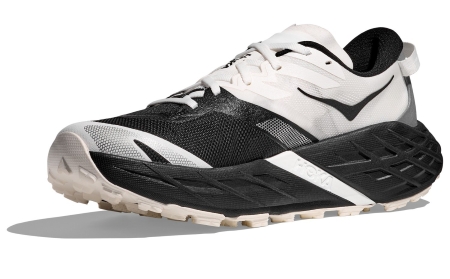
1. HOKA Speedgoat 7 – Best overall
Best for: mixed technical trail, long runs, and one-shoe trail rotations
Manufacturer weight: 8.3 oz / 235 g
Drop: 5 mm
Outsole: 5 mm Vibram Megagrip
Plate/protection: No
Ken’s logged mileage: 185 miles
Trail decision card: Best terrain: Hardpack, rock, roots, gravel, moderate mud
Ride and control: Protective and lively, with enough width underfoot to control the stack
Fit screen: Standard fit is secure rather than roomy; wide is the better move for broad feet
Skip for: Deep mud and runners who want sharp ground feel
The Speedgoat 7 is my best overall trail running shoe because it has the fewest expensive weaknesses. It grips wet roots and rock, protects the forefoot on long descents, and remains controlled when fatigue makes foot placement sloppy. A specialist can beat it in mud or at race pace. Few shoes cover as much ordinary trail this well.
Across 185 logged miles, the useful change from the sixth version is the ride. The supercritical EVA feels less flat without turning the shoe into a loose trampoline. On rolling hardpack, I can settle into the rocker. On awkward rock, the broad outsole and upper tension keep the cushioning from folding sideways.
Vibram Megagrip and 5 mm lugs are the real reason it works beyond buffed paths. The rubber adheres well on damp hard surfaces, while the lug depth handles loose dirt and moderate mud. In deep clay, the pattern reaches its clearing limit. A mud shoe with more open spacing still wins.
The standard upper runs secure and slightly short-feeling compared with roomy trail shoes. My heel stays seated on descents, but broad forefeet should start with the wide version rather than buying extra length. That preserves downhill control and reduces the chance of the foot moving across the platform.
I would buy it for a one-shoe trail rotation, a supported 50K, or long mixed-terrain training. I would skip it for road-heavy routes, deep mud, or runners who want a low flexible platform. The shoe protects skill; it does not replace careful steps on wet diagonal roots.
Related context: my full Speedgoat 7 review.
What I like
- Versatile wet-to-dry grip
- Protective long-run ride
- Secure downhill hold
- Wide option offered
What I do not like
- Standard fit can feel snug
- Too much shoe for tame paths
- Not a deep-mud specialist
- Limited ground feel
Ken’s trail ranking rule: Keep it number one only when the standard or wide fit holds the heel on a tired descent. If deep mud dominates the route, choose Thundercross. If pavement dominates, choose Challenger 8.
2. Saucony Peregrine 16 – Best daily trail shoe
Best for: runners who want agile grip without max-stack bulk
Manufacturer weight: 9.5 oz / 271 g
Drop: 4 mm
Outsole: 4 mm Vibram Megagrip
Plate/protection: Forefoot rock guard
Ken’s logged mileage: 356 miles
Trail decision card: Best terrain: Mixed singletrack, loose dirt, wet rock, short technical routes
Ride and control: Lower and more flexible than the max-cushion picks
Fit screen: Secure midfoot with standard and wide versions
Skip for: Long easy ultras if you need plush underfoot depth
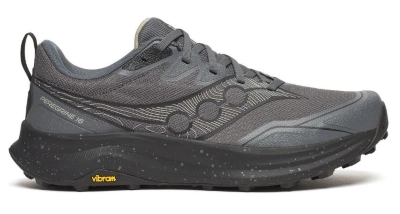
The Peregrine 16 is the daily trail pick for runners who find modern trail shoes too tall. It sits close enough to the ground for quick corrections, yet the 32/28 mm platform and forefoot shield take the sting out of ordinary roots and stones. That balance makes it easy to reach for several days a week.
My log has 356 miles in this model. The PWRRUN ride is firmer and more direct than Xodus Ultra 4, which helps on climbs and switchbacks. It does not provide the same late-run softness. I prefer it through roughly half-marathon trail distance, then choose by surface and how much protection my feet need.
Saucony moved to full-coverage Vibram Megagrip with 4 mm lugs. The result is dependable on wet rock, dry dirt, and loose turns without the disconnected feeling of a deep mud outsole. The lugs are not tall enough to dominate saturated grass or thick clay, but they shed mixed trail debris well.
The high-strength mesh, toe protection, and gaiter compatibility are practical rather than decorative. Fit remains performance-secure through the middle. The available wide version matters because adding length to a standard shoe can loosen the heel while leaving the forefoot pressure point unchanged.
Choose Peregrine when agility, grip, and a predictable low-drop ride outrank plushness. Skip it if your calves are not adapted to 4 mm, you need a very soft long-run shoe, or your local trail is mostly pavement and crushed gravel. It is an all-rounder with a technical bias, not a crossover road shoe.
Related context: trail shoes for beginners.
What I like
- Agile, direct platform
- Full Vibram outsole
- Useful forefoot shield
- Standard and wide versions
What I do not like
- Firm for long easy ultras
- 4 mm drop needs adaptation
- Less protective than max-stack shoes
- Not ideal on long pavement
Ken’s trail ranking rule: Choose Peregrine when fast foot placement matters more than plushness. Move to Xodus Ultra 4 when forefoot fatigue, not agility, is the limiting problem after two hours.
3. Salomon Genesis – Best for rugged technical terrain
Best for: rock, off-camber ground, steep grades, and secure hold
Manufacturer weight: 10.0 oz / 284 g
Drop: 8 mm
Outsole: 4.5 mm All Terrain Contagrip
Plate/protection: ActiveChassis
Ken’s logged mileage: 212 miles
Trail decision card: Best terrain: Rocky, steep, loose, and off-camber technical trail
Ride and control: Dense, controlled cushioning with excellent chassis behavior
Fit screen: Precise Matryx hold; regular width and Quicklace feel can be divisive
Skip for: Broad feet or long pavement connectors
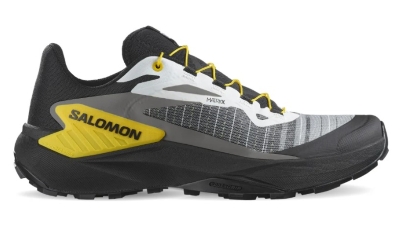
Genesis is the shoe I trust most here when the trail keeps trying to move the foot sideways. The ActiveChassis, dense midsole, Matryx upper, and precise Quicklace hold work as one system. It is less immediately soft than the Hierro, but it stays organized when the landing is angled or the descent gets rough.
After 212 logged miles, its best quality is composure. The shoe does not feel especially fast on flat gravel. On steep, broken ground, it wastes less motion because my foot remains centered and the platform does not roll excessively. That control becomes more valuable when legs are tired than during a clean first mile.
Salomon lists a 34/26 mm stack, 8 mm drop, and 4.5 mm All Terrain Contagrip lugs. The lugs bridge hard and loose surfaces well, though Thundercross digs deeper in mud. Genesis is better when one route mixes stone, dirt, roots, and short wet sections rather than one continuous soft surface.
Fit is the veto. Quicklace is efficient, but it concentrates tension differently from broad flat laces. The regular-width last and internal sleeve hold my midfoot securely. A high-volume or broad foot should try it under load and on a decline before assuming the upper will relax.
Buy Genesis for technical mountain training, rugged long runs, and runners who value precision over plushness. Skip it for road connectors, roomy-toe-box needs, or anyone who dislikes Quicklace. Genesis 2 is listed as coming soon, so I would not transfer this verdict until I have comparable trail mileage in the update.
Related context: climbing and descending technique.
What I like
- Excellent off-camber control
- Durable Matryx upper
- Precise technical fit
- Balanced mixed-terrain lugs
What I do not like
- Regular-width fit
- Quicklace is not for everyone
- Dense rather than plush
- Genesis 2 is approaching
Ken’s trail ranking rule: Genesis wins on control only if Quicklace pressure disappears underfoot. A precise upper that causes numbness is not precision; it is the wrong last.
4. New Balance Fresh Foam X Hierro v9 – Best cushioned trail cruiser
Best for: moderate trails, long easy miles, and wide sizing
Manufacturer weight: 10.9 oz / 310 g
Drop: 4 mm
Outsole: Vibram Megagrip; depth varies by point
Plate/protection: No
Ken’s logged mileage: 327 miles
Trail decision card: Best terrain: Gravel, hardpack, roots, light mud, hiking
Ride and control: High, broad, and protective; smooth rather than quick
Fit screen: D, 2E, and 4E offered, but the toe still tapers
Skip for: Deep mud, sharp direction changes, and fast technical racing
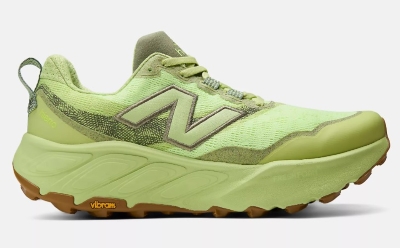
Hierro v9 is the comfortable cruiser of this list. The dual-density Fresh Foam X setup uses a softer layer over a firmer base, so it absorbs repetitive trail chatter without collapsing as much as its appearance suggests. It is excellent for easy and long mileage on moderate terrain, not a disguised technical racer. Read my full New Balance Hierro v9 review for the 327-mile fit, grip, and durability notes.
I logged 327 miles across sand, gravel, roots, wet forest trail, shallow mud, and short road connectors. The shoe remained protective after the first-run softness faded. Its broad base is stable on level and rolling surfaces. High stack and mass become obvious during fast direction changes or sharp off-camber landings.
Vibram Megagrip adhesion is strong, but the lug story needs care. New Balance describes deeper lugs and publishes an approximate 6 mm figure, while independent measurements taken at selected points are shallower. My field conclusion is simpler: strong mixed-surface grip, limited clearance when deep mud packs between the lugs.
The US men’s model comes in D, 2E, and 4E. That is unusually useful, though width labels do not erase toe taper. My heel hold is secure. Runners between sizes should check the front after a warmed-up downhill test instead of assuming more length is always the answer.
Choose it for long easy trail, hiking, broad platform comfort, and real width options. Skip it for racing, deep mud, or repeated steep technical turns. At 327 miles my upper remained intact and lug edges were rounded; I stopped using it for important long runs when rebound became noticeably muted.
Related context: running shoes for wide feet.
What I like
- Comfort over long easy miles
- Broad stable base
- D, 2E, and 4E widths
- Durable upper in my test
What I do not like
- Heavy
- Slow direction changes
- Toe taper despite width choices
- Lugs pack in deeper mud
Ken’s trail ranking rule: Pick Hierro for moderate terrain and time on feet. The moment the route demands repeated hard turns, deep mud clearance, or race turnover, its cushion no longer pays for its mass.
5. Saucony Xodus Ultra 4 – Best for ultramarathons
Best for: long rugged outings where protection matters more than low weight
Manufacturer weight: 10.9 oz / 309 g
Drop: 6 mm
Outsole: 4 mm Vibram Megagrip
Plate/protection: No
Ken’s logged mileage: 250 miles
Trail decision card: Best terrain: Long mixed trail, rocky hardpack, sustained climbing
Ride and control: Plush PWRRUN PB core inside a steadier carrier
Fit screen: More endurance room than Peregrine, with secure heel hold
Skip for: Short fast races or runners who prioritize low mass
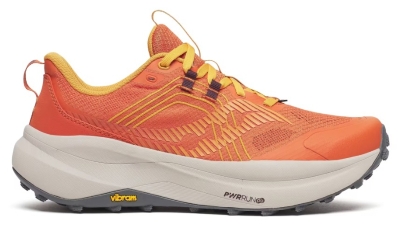
Xodus Ultra 4 wins the ultra slot because its construction stays useful after the trail stops feeling fresh. A soft PWRRUN PB core sits inside a steadier PWRRUN frame, combining comfort with enough lateral structure for uneven ground. It is not light, but the weight buys protection that remains relevant deep into a long day. The full Saucony Xodus Ultra 4 review documents the 250-mile field test behind this pick.
My test pair has 250 logged miles. The ride is more energetic than Hierro v9 and less agile than Peregrine 16. On long runnable climbs, the midsole compresses smoothly without a sharp rocker threshold. On slow technical sections, the broad platform remains manageable, although it cannot create the precision of a lower shoe.
Full-coverage Vibram Megagrip and 4 mm lugs handle rock, hardpack, dirt, and moderate loose ground. Saucony removed the rock plate in this version. The foam depth and outsole still filter most sharp points, but runners who repeatedly strike jagged rock may prefer a firmer plated protection system.
The fit gives the forefoot more endurance room than Peregrine while keeping my heel controlled. I still test it on a decline after an hour because swelling room and downhill security pull in opposite directions. A shoe that feels pleasantly roomy standing still can let the foot slide during braking.
Buy it for long training runs, 50K-to-ultra use, and hikers who want running-shoe cushioning. Skip it for short fast racing, deep mud, or runners who want strong ground feel. I also avoid wasting its outsole on long asphalt connectors, which round lug edges without using their trail benefit.
Related context: long-distance running shoe guide.
What I like
- Protective ultra ride
- Full Vibram coverage
- Stable dual-foam construction
- Good endurance fit
What I do not like
- High mass
- No dedicated rock plate
- Less agile than Peregrine
- Overbuilt for short runs
Ken’s trail ranking rule: Use Xodus when the final third of the run matters more than the first uphill split. If its weight is obvious before fatigue arrives, Peregrine or Catamount is the better tool.
6. Brooks Catamount 4 – Best lightweight speed shoe
Best for: shorter trail races, climbing, and fast dry-to-damp singletrack
Manufacturer weight: 9.5 oz / 269 g
Drop: 6 mm
Outsole: TrailTack Green
Plate/protection: SkyVault propulsion plate
Ken’s logged mileage: 324 miles
Trail decision card: Best terrain: Runnable singletrack, climbing, dry rock, short-to-mid races
Ride and control: Responsive DNA Flash v2 and a climbing-oriented plate
Fit screen: Performance fit with less swelling room than an ultra cruiser
Skip for: Deep mud, very rocky ultras, and easy hiking
Catamount 4 is the fast shoe for runners who still want a real trail chassis. DNA Flash v2 is firmer and more responsive than the plush cruisers, while the revised SkyVault plate is shaped to assist climbing. The shoe feels purposeful at tempo effort without the tall, insulated sensation of a plated ultra racer.
I have 324 logged miles in this version. It comes alive on runnable singletrack and sustained climbs where cadence can stay high. The same taut character is less comfortable during slow hiking or a long recovery shuffle. I rank it for speed because that is the job it performs, not because low weight automatically means better trail control.
TrailTack Green grips dry rock and damp dirt well. It is competent on wet surfaces, but the outsole pattern is not designed to evacuate thick mud like Thundercross. On a route with frequent rock-to-dirt transitions, the lower lug profile feels more predictable than a soft-ground outsole.
The performance upper holds the midfoot firmly and leaves less expansion room than an ultra cruiser. My fit check focuses on the outside forefoot and downhill toe clearance after the foot is warm. The plate should feel like a smooth lever, not a ridge or a reason to alter foot placement.
Choose Catamount 4 for trail tempo work, vertical races, and shorter-to-mid distance events on runnable technical ground. Skip it for deep mud, very rocky all-day outings, or runners who need a broad toe box. Its speed advantage disappears if the upper forces braking or creates a hot spot.
Related context: tempo-run guide.
What I like
- Efficient climbing feel
- Responsive foam
- Secure race upper
- Good dry-to-damp grip
What I do not like
- Limited swelling room
- Taut at easy pace
- Not built for deep mud
- Plate reduces flexibility
Ken’s trail ranking rule: The plate must improve climbing without becoming a pressure point on slow descents. Rank it for speed only after the upper survives a warm-foot race simulation.
7. Altra Lone Peak 9 – Best zero-drop trail shoe
Best for: anatomical toe room, ground feel, hiking, and zero-drop regulars
Manufacturer weight: 11.15 oz / 316 g
Drop: 0 mm
Outsole: MaxTrac
Plate/protection: StoneGuard
Ken’s logged mileage: 153 miles
Trail decision card: Best terrain: Dry technical trail, rock, hiking, moderate loose dirt
Ride and control: Flexible 25 mm platform with direct trail feedback
Fit screen: Original FootShape toe box; midfoot still needs to lock down
Skip for: Abrupt zero-drop transitions or runners wanting plush cushioning
Lone Peak 9 is the zero-drop choice, not a universal wide-foot prescription. Its Original FootShape front lets the toes spread, and the flexible 25 mm platform gives more terrain feedback than the high-stack shoes above. That combination is excellent for adapted runners who value natural forefoot space and precise placement.
My pair has 153 logged miles. On dry rock, dirt, and hiking terrain, I like the way the shoe bends and lets me read the surface. On long rocky descents, the thinner cushioning transmits more impact than Speedgoat or Xodus. Whether that feels connected or underprotected depends on the runner and route.
The MaxTrac outsole and StoneGuard provide versatile dry-to-moderate grip and forefoot shielding. Lone Peak 9+ adds Vibram Megagrip, but I am not assigning my Lone Peak 9 mileage to that outsole. Runners prioritizing wet-rock adhesion should compare the 9+ directly rather than treating the two names as interchangeable.
A broad toe box still needs secure heel and midfoot hold. I use the runner’s loop only when it improves the heel without crushing the instep. On steep sidehill, excess internal movement is as problematic as a narrow toe box, so wide-foot comfort cannot be judged from toe splay alone.
Buy Lone Peak 9 if you already use zero-drop shoes, want a roomy anatomical front, or mix running with hiking. Skip it if you are moving abruptly from an 8-to-12 mm trainer, need max cushioning, or regularly descend sharp rock for hours. Transition the calf and Achilles gradually rather than blaming normal adaptation on the trail.
Related context: heel-drop guide.
What I like
- Anatomical toe room
- Flexible ground feel
- Useful hiking crossover
- Gaiter attachment system
What I do not like
- Zero drop is not plug-and-play
- Modest long-descent cushion
- MaxTrac trails Vibram on wet rock
- Midfoot may feel loose on narrow feet
Ken’s trail ranking rule: Toe room never overrides lower-leg readiness. Choose Lone Peak only when zero drop is already familiar or the transition can be gradual enough to protect training consistency.
8. HOKA Challenger 8 – Best road-to-trail shoe
Best for: routes mixing pavement, gravel, park paths, and light singletrack
Manufacturer weight: 9.7 oz / 275 g
Drop: 8 mm
Outsole: 4 mm multi-directional lugs
Plate/protection: No
Ken’s logged mileage: 169 miles
Trail decision card: Best terrain: Pavement-to-gravel, smooth dirt, park paths, light trail
Ride and control: Road-shoe smoothness with modest trail bite
Fit screen: Familiar HOKA hold; verify downhill toe clearance
Skip for: Mud, wet technical rock, and long rugged descents
Challenger 8 wins road-to-trail because it does not punish the road part. Its geometry rolls more like a daily road trainer, while 4 mm lugs add enough bite for gravel, smooth dirt, and uncomplicated singletrack. That middle ground is useful for runners who leave home on pavement before reaching a park or canal path.
Across 169 logged miles, the shoe felt most natural when the route was roughly balanced between firm surfaces and light trail. It is smoother and quieter on asphalt than Speedgoat. The cost is less braking bite in mud and less confidence when wet rock or steep off-camber ground demands a dedicated outsole.
The 8 mm drop is familiar to many road runners and reduces the abrupt lower-leg change of moving into a 0-to-4 mm trail shoe. Drop does not guarantee comfort, though. Rocker, foam compression, and the way the heel lands on uneven ground still need a real transition test.
Fit is secure through the heel and midfoot. I leave enough front length for descents, then verify that the foot does not slide forward with the laces tightened normally. Buying a half-size larger without controlling the heel can exchange toe contact for blister-producing movement.
Choose Challenger for suburban trail networks, gravel races, park paths, and travel routes with unknown surface splits. Skip it for mud, wet technical rock, or all-day rugged mountains. If more than two-thirds of the route is pavement, a grippy road shoe may be the cleaner answer.
Related context: road-to-trail transition guide.
What I like
- Smooth on pavement
- Enough grip for light trail
- Familiar 8 mm transition
- Good travel versatility
What I do not like
- Light-trail traction only
- Less rock protection
- Weak choice for mud
- Downhill fit needs care
Ken’s trail ranking rule: Challenger wins when asphalt is a meaningful part of every run. Once wet technical terrain or sustained mud becomes normal, a smoother road transition is the wrong compromise.
9. Salomon Thundercross – Best for mud
Best for: soft ground, steep loose climbs, and wet shoulder-season trail
Manufacturer weight: 10.2 oz / 290 g
Drop: 4 mm
Outsole: 5 mm Contagrip TD
Plate/protection: No
Ken’s logged mileage: 176 miles
Trail decision card: Best terrain: Mud, wet soil, soft forest floor, loose steep grades
Ride and control: Soft enough for daily use but defined by deep widely spaced lugs
Fit screen: Snug Quicklace hold; not friendly to every high-volume foot
Skip for: Long road sections, dry slab, and broad forefeet
Thundercross is the mud specialist because its 5 mm lugs are tall, directional, and spaced to find purchase in soft ground. On wet soil and loose climbs, that geometry creates a clearer advantage than changing foam or adding stack. It is the shoe here I pick when the forecast changes the surface, not just the temperature.
My pair has 176 logged miles. The midsole is softer than old-school fell shoes, so it can handle a normal training run without feeling brutally thin. On deep mud, it digs and clears better than Speedgoat or Peregrine. On dry slab and pavement, the same lugs squirm and feel unnecessarily tall.
Contagrip TD balances durability with soft-ground bite. No rubber makes algae-covered wood or ice safe, and I shorten stride on both. The outsole is most effective when the lugs can penetrate. On flat wet rock, surface area and rubber adhesion matter more than lug height alone.
Quicklace and the snug upper keep my foot from separating from the platform in sticky mud. That hold can feel restrictive to broad or high-volume feet. I check tension at the instep after ten minutes because mud running often causes runners to overtighten laces in search of security.
Buy it for rainy shoulder seasons, soft forest trail, steep loose grades, and obstacle-course conditions. Skip it for road-to-trail routes, dry rock-dominant races, or broad feet that cannot tolerate the last. A mud shoe is a useful second shoe, not the best everyday answer for most US runners.
Related context: running in the rain guide.
What I like
- Deep-mud bite
- Effective lug spacing
- Secure Quicklace hold
- More cushioning than a fell shoe
What I do not like
- Awkward on pavement
- Snug last
- Lugs squirm on hard surfaces
- Too specialized for one-shoe use
Ken’s trail ranking rule: Five-millimeter lugs earn their place only when they can penetrate the surface. Do not buy a mud outsole for dry rock and pavement because the tread looks aggressive.
10. HOKA Tecton X 3 – Best plated trail racer
Best for: long runnable races where speed and protection outweigh ground feel
Manufacturer weight: 10.1 oz / 286 g
Drop: 5 mm
Outsole: 4 mm Vibram Megagrip Litebase
Plate/protection: Parallel carbon plates
Ken’s logged mileage: 187 miles
Trail decision card: Best terrain: Runnable mountain races, ultra-distance racing, dry-to-damp mixed trail
Ride and control: PEBA foam and parallel plates produce a protected race roll
Fit screen: Sock-like gaiter and race hold require a careful fit check
Skip for: Very technical scrambling, deep mud, or runners who dislike plates
Tecton X 3 is the plated race choice because the two parallel carbon plates can work independently enough to follow uneven ground better than one rigid road-style plate. PEBA foam adds energy and protection, while Vibram Megagrip Litebase keeps the outsole credible on real trail. It is fast, but still terrain-dependent.
I logged 187 miles in the X 3. It feels best on runnable mountain trail, long climbs, and descents where the line is visible. The foam protects tired feet and the rocker rewards steady momentum. On slow rock hopping, the stack and plates reduce feedback and can make precise micro-adjustments less natural.
The 4 mm lugs bridge dirt, rock, and moderate loose ground. They do not turn the shoe into a mud specialist. I would choose Thundercross for saturated soft terrain and Genesis for slower technical control. Tecton earns its place when the route permits running enough of the time to use its geometry.
The gaiter-like upper and race hold require careful sizing. My test focuses on ankle irritation, forefoot pressure after swelling, and lateral movement on a tired descent. A premium race midsole cannot compensate for an upper that changes foot placement or forces constant lace adjustment.
Choose it for long runnable races and runners already comfortable with plated trail shoes. Skip it for first trail shoes, deep mud, highly technical scrambling, or maximum ground feel. Tecton X 4 is newly announced, so I am keeping this ranking tied to the X 3 miles rather than projecting an upgrade verdict.
Related context: running gear guide.
What I like
- Fast protected ride
- Parallel plate adaptability
- Credible Vibram outsole
- Strong long-race efficiency
What I do not like
- Expensive specialist
- Reduced technical ground feel
- Upper fit can be divisive
- X 4 replacement is imminent
Ken’s trail ranking rule: A plated trail racer belongs in the ranking only if the course is runnable enough to use it and the runner remains centered late. Technical control beats carbon when the line breaks down.
New trail shoes I am watching, not ranking yet
A current guide should acknowledge new models without manufacturing verdicts. Salomon Genesis 2 is listed as coming soon. HOKA Tecton X 4 has been announced, and adidas Terrex Agravic Speed Ultra 2 is now appearing in current 2026 testing. None inherits the position of its predecessor automatically.
A shoe enters this ranking after enough normal, bad, and tired-leg runs to reveal its limits. Early miles can identify obvious fit or grip problems. They cannot establish outsole wear, wet-condition consistency, or how a high stack behaves when coordination fades late in a long run.
I also watch models that solve an omitted category rather than duplicate an existing one. A new gravel shoe, true mud shoe, or stable technical shoe can earn a slot. A nearly identical max-cushion cruiser has to beat Hierro or Xodus at a specific decision, not simply launch later. For a broad, calm max-cushion alternative outside this top ten, read my Brooks Caldera 8 review.
Full trail shoe comparison
| Shoe | Best for | Listed weight | Drop | Outsole | Plate/protection | Ken miles |
|---|---|---|---|---|---|---|
| HOKA Speedgoat 7 | Best overall | 8.3 oz / 235 g | 5 mm | 5 mm Vibram Megagrip | No | 185 |
| Saucony Peregrine 16 | Best daily trail shoe | 9.5 oz / 271 g | 4 mm | 4 mm Vibram Megagrip | Forefoot rock guard | 356 |
| Salomon Genesis | Best for rugged technical terrain | 10.0 oz / 284 g | 8 mm | 4.5 mm All Terrain Contagrip | ActiveChassis | 212 |
| New Balance Fresh Foam X Hierro v9 | Best cushioned trail cruiser | 10.9 oz / 310 g | 4 mm | Vibram Megagrip; depth varies by point | No | 327 |
| Saucony Xodus Ultra 4 | Best for ultramarathons | 10.9 oz / 309 g | 6 mm | 4 mm Vibram Megagrip | No | 250 |
| Brooks Catamount 4 | Best lightweight speed shoe | 9.5 oz / 269 g | 6 mm | TrailTack Green | SkyVault propulsion plate | 324 |
| Altra Lone Peak 9 | Best zero-drop trail shoe | 11.15 oz / 316 g | 0 mm | MaxTrac | StoneGuard | 153 |
| HOKA Challenger 8 | Best road-to-trail shoe | 9.7 oz / 275 g | 8 mm | 4 mm multi-directional lugs | No | 169 |
| Salomon Thundercross | Best for mud | 10.2 oz / 290 g | 4 mm | 5 mm Contagrip TD | No | 176 |
| HOKA Tecton X 3 | Best plated trail racer | 10.1 oz / 286 g | 5 mm | 4 mm Vibram Megagrip Litebase | Parallel carbon plates | 187 |
Read listed weights as orientation, not a clean laboratory ranking. Brands publish different sample sizes, and trail shoes collect water and mud differently. A secure 10-ounce shoe can feel easier than a loose 9-ounce shoe when every landing requires correction.
When terrain is the deciding factor, choose shoes by terrain and use before comparing the trail-specific options below.
Choose trail shoes by terrain
The most useful question is not, ‘What is the best trail shoe?’ It is, ‘What surface repeatedly causes me to brake, slip, bruise, or lose control?’ Match the outsole and platform to that recurring problem. Do not build the choice around the easiest mile of the route.
| Terrain | Start with | Why | Main warning |
|---|---|---|---|
| Smooth dirt and gravel | Challenger 8 | Shallow-to-moderate lugs and a smooth transition | Deep mud tread adds weight and squirm |
| Mixed roots, rock, and dirt | Speedgoat 7 or Peregrine 16 | Speedgoat protects; Peregrine places faster | Choose by distance and desired ground feel |
| Rugged, off-camber technical trail | Genesis | Chassis and upper keep the foot centered | Fit precision matters more than softness |
| Long moderate trail | Hierro v9 | Broad cushion and width choices | High stack is slower in sharp turns |
| Ultra-distance mixed trail | Xodus Ultra 4 | Protective foam inside a stable carrier | Mass is unnecessary for short racing |
| Runnable race trail | Catamount 4 or Tecton X 3 | Catamount is direct; Tecton is more protected | Do not use plates as a substitute for control |
| Dry technical trail with toe-room priority | Lone Peak 9 | Flexible zero-drop platform and anatomical front | Transition gradually from higher drops |
| Mud and soft ground | Thundercross | Deep, spaced lugs penetrate and clear | Poor pavement and dry-slab match |
Newer trail runners should first use my trail running beginner guide to separate smooth paths from genuinely technical terrain. A first trail route with packed dirt and gentle grades rarely needs the same shoe as wet roots, talus, or steep mud.
For descents, a shorter stride and earlier foot placement matter more than a high stack. The downhill knee-pain guide explains how braking and fatigue change the load. No shoe can rescue an overstride repeated for thirty minutes.
Choose by distance and effort
For runs under an hour, prioritize fit, traction, and agility. Peregrine 16 and Catamount 4 keep excess shoe out of the way. For two-to-four-hour outings, Speedgoat 7, Genesis, Hierro v9, and Xodus Ultra 4 add protection that becomes more valuable as feet and stabilizers tire.
On steep grades, shoe choice cannot replace effort control; use the decision cues in my power hiking guide for trail runners.
For an ultra, fit after swelling is a separate performance feature. Xodus Ultra 4 is my first choice for protective mixed trail. Speedgoat 7 is the more agile alternative. Hierro v9 suits moderate runnable courses, while Genesis belongs on slower rugged routes where lateral control matters more than plushness.
Carry systems affect late-run footwork. A bouncing vest, dehydration, or poor trail-fueling execution makes the feet less precise. Compare the best trail hydration vests and use the practical ranges in how much water to carry on a trail run before blaming every late-run stumble on the shoe. If the load is moving independently of your torso, use my guide to stop a running pack from bouncing. For a personal hydration estimate, calculate your loss with the running sweat-rate calculator.
Race effort changes the decision too. Catamount 4 is a direct speed shoe for shorter runnable racing. Tecton X 3 makes more sense when a long course is runnable enough to use its plates and foam. On a slow technical race, Genesis may be faster in practice because it reduces corrections and braking.
How I tested and ranked these shoes
I score five field outcomes: traction, foot control, underfoot protection, fit under fatigue, and durability. I also track road behavior because many US trail runs include connectors. The ranking is not an average of isolated scores; a critical failure on the intended terrain can disqualify an otherwise impressive shoe.
Traction testing separates adhesion from penetration. Wet rock and roots emphasize rubber compound and contact. Mud emphasizes lug depth, direction, and clearing space. Loose descents test braking edges. I repeat surfaces because one clean step does not establish grip, and contamination can change the result.
Control testing includes climbing, descending, camber, turns, and tired easy running. I note heel movement, toe contact, lace pressure, and whether the foot remains centered over the platform. A broad outsole does not create stability if the upper allows the foot to slide on top of it.
Protection testing looks at repeated small impacts and direct sharp pressure. Thick foam filters trail chatter. A rock plate spreads a concentrated strike. Those sensations are not identical, and the better solution depends on whether the route is long and moderately rough or repeatedly jagged under the forefoot.
Durability is functional, not cosmetic. I track lug-edge rounding, torn rubber, upper abrasion, heel-lining wear, foam asymmetry, and changes in the original transition. Mileage in the table documents my evidence. It does not promise that another runner will get the same lifespan.
Ken’s ranking rule: The winning shoe must stay predictable on the hardest repeated surface after the runner is tired. Fresh-leg softness and showroom step-in comfort cannot overrule downhill hold, grip, or late-run control.
Trail shoe fit: test the descent, not the carpet
Try shoes late in the day with the socks you will run in. Stand, climb a ramp, and walk down it. The longest toe should not touch during braking. The heel should not lift, and the foot should not slide across the midsole when the shoe is angled.
Use a technical sock that manages moisture and fits without bunching. My running socks for blister prevention guide covers materials and fit. A thick sock can remove needed volume, while a very thin sock can expose movement that the store fitting hid.
Hot spots usually start with friction, pressure, moisture, or internal movement. Use the diagnostic steps in trail running blister prevention field guide. Do not keep tightening the laces if the real issue is the wrong last or too much shoe length.
Wide feet need width at the correct location. Hierro offers D, 2E, and 4E; Lone Peak offers a broad anatomical front. Neither is automatically right for a narrow heel or low-volume midfoot. A wide toe box that lets the whole foot move sideways can be worse on technical descents.
Heel drop changes load distribution but does not prescribe a strike or injury outcome. Move gradually when changing from an 8 mm Challenger or Genesis to a 0 mm Lone Peak. Calf and Achilles response over several weeks matters more than whether a drop number is fashionable.
Lugs, stack, rock plates, and carbon
Three-to-four-millimeter lugs are the useful middle for hardpack, gravel, and mixed trail. They provide edges without excessive squirm. Five-millimeter and deeper lugs make sense when they can penetrate mud or soft soil. On wet slab, taller is not automatically grippier because usable rubber contact matters.
Outsole compound and geometry work together. Vibram Megagrip is consistently strong across several picks, but the Hierro and Speedgoat behave differently because lug shape, spacing, platform width, and upper control differ. A rubber trademark is not a complete traction verdict.
High stack reduces repeated sharp pressure and can preserve comfort on long descents. It also increases the distance between foot and ground, reduces feedback, and can magnify off-center movement. Speedgoat manages the compromise well. Hierro is steadier on moderate trail than in rapid technical changes.
Rock plates are useful on repeated jagged terrain, but they add stiffness. Peregrine uses a forefoot shield; Catamount uses a plate with a propulsion role; Tecton uses parallel carbon plates. Xodus relies more on foam and outsole depth. Judge the field result, not the presence of a material.
Carbon is not a universal upgrade off-road. A plate can organize the rocker and distribute pressure on runnable trail. During slow, multidirectional foot placement, stiffness may reduce adaptability. The best plated trail shoe is still the wrong shoe when the surface never lets the runner use it.
Waterproof or breathable trail shoes?
For most running, I choose breathable non-waterproof uppers. Water can enter any shoe over the collar. A membrane can then keep that water inside while adding heat and slowing drainage. Warm wet feet plus internal movement is a reliable blister recipe.
Waterproof versions make sense for cold rain, shallow snow, wet vegetation, and slower hiking where keeping external moisture out matters more than drainage. They do not improve outsole grip. ‘GORE-TEX’ describes the upper membrane, not the rubber under the shoe.
For remote routes or fast-changing conditions, pair footwear decisions with the pre-run checks in my trail running safety checklist.
In loose debris or snow, a gaiter can solve the problem without a waterproof shoe. Compare low-profile options in the trail running gaiter guide. Keep the seal comfortable; an overtight cuff can create a new pressure point.
For heat, prioritize airflow, thin socks, and realistic fluid planning. The summer running guide covers pacing and heat management. A breathable upper cannot offset an effort that is too aggressive for the conditions.
What footwear research can and cannot tell us
A 2025 secondary analysis of a randomized trial found that greater perceived cushioning and overall shoe appreciation were associated with lower injury risk. That supports treating comfort as meaningful, but association does not make one comfortable model preventive for every runner.
A focused review of running injury paradigms explains why arch type, pronation control, impact, preferred movement, and comfort cannot be reduced to one shoe-selection rule. Trail surfaces add even more variability, so this guide does not make medical guarantees.
A trail-running footwear and fatigue study found footwear effects on running economy and biomechanics depended on condition and geometry. Its controlled protocol cannot rank the ten models here, but it reinforces that mass, construction, slope, and fatigue interact.
I cross-checked category coverage and model freshness against current testing from iRunFar, RunRepeat, GearJunkie, and REI. Their testers and methods differ, so agreement is context, not a substitute for my logged pairs.
Cleaning, rotation, and replacement
Brush dry dirt first, then use cool water and mild soap. Remove the insole, loosen the laces, and air-dry away from direct heat. The full process is in how to wash trail running shoes. A dryer can damage adhesives, foam, and upper shape.
A two-shoe rotation is enough for most committed trail runners. Use a mixed-terrain daily shoe plus one specialist that solves the local problem: Thundercross for mud, Challenger for road connectors, Catamount for speed, or Xodus for long days. Each shoe should have a distinct job.
Replace by performance signals, not appearance alone. Use the checks in when to replace running shoes: braking traction, uneven foam compression, upper hold, and changes in the original ride. Retire from technical use before the shoe becomes unusable for walking.
Pavement rounds trail lugs without using their advantage. Short connectors are normal. Repeated road mileage is a reason to own Challenger 8 or a road shoe, not a reason to accept declining wet-trail grip in a dedicated technical model.
Frequently asked questions
What are the best trail running shoes overall?
HOKA Speedgoat 7 is Ken’s best overall trail running shoe after 185 logged miles because it balances grip, protection, stability, and long-run comfort across the widest useful range of trail. Peregrine 16 is more agile, and Genesis is more precise on rugged technical ground. For the direct grip-versus-cushion decision, use my Speedgoat 7 vs Brooks Caldera 8 comparison.
How do I choose trail running shoes?
Choose by the worst repeated surface on the route, then verify fit on a decline. Match lug depth and spacing to mud or hard ground, choose enough protection for the distance, and reject any shoe that allows heel lift, toe contact, or side-to-side movement.
Can I use road running shoes on trails?
Road shoes can work on dry, smooth, predictable paths. Use a trail shoe when loose ground, mud, wet rock, roots, sharp debris, or steep descents make outsole grip, upper hold, and underfoot protection meaningful.
What lug depth is best for trail running?
About 3 to 4 mm works well for hardpack, gravel, and mixed trail. Around 5 mm or deeper, with open spacing, is better for mud and soft ground. Compound, lug shape, direction, and spacing matter as much as the headline depth.
Are waterproof trail running shoes better?
Usually not for ordinary running. Waterproof membranes add warmth, weight, and slower drainage. They make more sense in cold sustained wet conditions or snow. A breathable shoe often dries faster when water can enter over the collar.
Should trail running shoes be a half size larger?
Not automatically. Leave downhill toe clearance and room for swelling, but keep the heel and midfoot secure. If more length creates sliding, use the correct wide version or a different last instead of sizing up.
What is the best trail shoe for wide feet?
New Balance Hierro v9 is the best width-system pick here because the men’s US model is offered in D, 2E, and 4E. Altra Lone Peak 9 has the roomiest anatomical toe shape, but its zero-drop geometry requires a separate transition decision.
What is the best trail shoe for mud?
Salomon Thundercross is the best mud shoe in this ranking because its 5 mm directional lugs penetrate and clear soft ground better than the mixed-terrain patterns. It is less comfortable and predictable on long pavement or dry slab.
What is the best trail shoe for ultramarathons?
Saucony Xodus Ultra 4 is Ken’s ultra pick for its protective dual-foam construction, full Vibram outsole, secure endurance fit, and balanced 6 mm drop. Speedgoat 7 is the more agile all-round alternative.
What is the best road-to-trail running shoe?
HOKA Challenger 8 is the best road-to-trail shoe here because it remains smooth on pavement while providing enough 4 mm lug bite for gravel, park paths, and light singletrack. It is not the right choice for deep mud or wet technical rock.
Do trail shoes prevent ankle sprains or running injuries?
No shoe can promise injury prevention. Trail stability depends on fit, platform geometry, surface, fatigue, vision, strength, and foot placement. Choose a comfortable shoe that stays centered underfoot and build technical exposure gradually.
Is more cushioning better for trail running?
Not always. More foam can reduce pressure from rocks and repetitive impact, but it can also reduce ground feel and increase leverage when the foot lands off-center. Use enough protection for the distance without sacrificing control on the route’s most technical section.
Are carbon-plated trail shoes worth it?
They can be useful on long runnable races where low weight, foam rebound, and a rockered transition can operate consistently. They are less useful in deep mud, slow scrambling, and very technical terrain where flexible placement and ground feedback matter more.
How long do trail running shoes last?
There is no universal mileage. Replace or reassign them when lugs lose braking bite, foam compresses unevenly, the upper no longer holds the foot, or the shoe feels less controlled than a fresher baseline. Terrain and pavement exposure can change lifespan dramatically.
Can trail running shoes be used for hiking?
Yes. Speedgoat 7, Hierro v9, Xodus Ultra 4, and Lone Peak 9 all work well for day hikes and fast hiking when their fit matches the foot. Heavy packs, rough off-trail travel, and ankle-protection needs may still favor hiking footwear.
Should I buy a rock plate?
A rock plate helps distribute sharp pressure, but thick foam and outsole rubber can also provide practical protection. Choose a plate for repeated jagged rock, and verify that its stiffness does not make the shoe awkward on climbs, turns, or slower running.
How should trail shoes fit for downhill running?
Use a locked heel and midfoot with enough front length that the longest toe does not touch during braking. Test on a ramp or real descent after the foot is warm. Toe room without lateral hold can still cause blisters and black toenails.
Final verdict
HOKA Speedgoat 7 is the best trail running shoe for most runners because it remains competent across more terrain, distances, and weather than any other pick here. Saucony Peregrine 16 is better for a lower, quicker daily ride. Salomon Genesis is better when rugged control is the main problem.
Choose Hierro v9 for cushioned moderate trail and width options, Xodus Ultra 4 for long protective mileage, Catamount 4 for speed, Lone Peak 9 for zero-drop toe room, Challenger 8 for road-to-trail, Thundercross for mud, and Tecton X 3 for runnable plated racing.
The top shoe is not the one with the deepest lug, softest foam, or newest launch date. It is the one that holds the foot, grips the repeated surface, and stays predictable after fatigue changes how you land. Use the ranking to create a shortlist, then let a warm-foot downhill test make the final decision.

Written by Ken – 12 years of running, 12,500+ miles, 63 shoes tested, and 36 races from 5Ks to a 50K ultra. I run 30-40 miles a week on the Atlantic City Boardwalk and review shoes with repeated training miles, not one-run demos. More about Ken
Pingback: Best Running Shoes of 2026: 14 Pairs Tested