
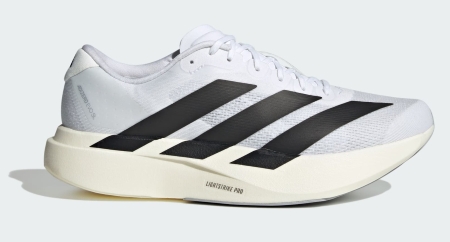
After 359 running miles, the original adidas Adizero EVO SL earns a 7.7/10 from me. It is a light, smooth, full-Lightstrike Pro road shoe that handles ordinary aerobic running, steady miles, and controlled faster work better than most shoes this flexible. It is not a stability shoe, a wet-surface specialist, or a substitute for every plated racer.
My clearest memory is not a track split. It is a February morning in Atlantic City when rain kept turning to wet snow. I ran four miles near the Convention Center, Hard Rock, and Showboat at 9:20 per mile. The shoe felt light and easy to turn over immediately, yet the soft-looking stack did not collapse under my 182-pound test profile.
The useful story emerged later. A 13-mile Boardwalk progression moved from 9:05 pace toward 8:10 in the second half without forcing my stride. A rainy run on the same Boardwalk produced the opposite result: the flat outsole was poor enough on soaked wooden planks that I left the boards for concrete after a near-slip. That contrast defines this review.
Article contents
- Quick verdict
- Which EVO SL this review covers
- How I tested it
- Ken’s ranking rule
- Specs and construction
- Ride feel
- Best pace and workouts
- Long-run performance
- Fit and sizing
- Upper, tongue, and laces
- Stability and biomechanics
- Grip by surface
- Durability after 359 miles
- Key comparisons
- How to use it in a rotation
- Who should buy or skip
- Pros and cons
- Sources and corrections
- FAQ
- Final verdict
adidas Adizero EVO SL Review: Quick Verdict
The EVO SL is best for neutral runners who want one light road shoe for daily miles, steady runs, progression runs, and occasional races. Its strongest trait is pace continuity: it feels natural at aerobic effort and becomes more responsive as pressure increases, without the abrupt lever of a full-length plate.
| Question | My answer after 359 miles |
|---|---|
| Best use | Daily road running, steady runs, progressions, moderate tempo, travel rotation |
| Best tested pace | About 8:30-9:30/mi, with successful progression work down to about 8:10/mi |
| Ride | Light, smooth, moderately soft, elastic, and less mechanically rigid than a plated trainer |
| Fit | True-to-size length in my men’s US 10.5; roomy forefoot volume with a tapered front |
| Stability | Neutral; composed in a straight line, less supportive when the foot spends time at the narrow midfoot |
| Grip | Good on dry road, acceptable on ordinary wet concrete, poor in my test on soaked wooden planks |
| Durability | Still usable at 359 miles, with lateral heel and forefoot wear plus a softer midsole feel |
| Ken’s score | 7.7/10 |
It belongs near the front of my daily trainer decision tree when low mass and pace range matter. It falls behind more conventional trainers when support, upper polish, or all-weather confidence matters more than rebound.
Which adidas EVO SL Does This Review Cover?
This review covers the original road adidas Adizero EVO SL with the thin engineered-mesh upper. It does not cover EVO SL Woven, EVO SL EXO, EVO SL Zip, or EVO SL ATR. adidas now sells several shoes under the EVO SL name, and that makes version control part of the buying decision.
The original model is the lightest and most open-feeling version I tested. EVO SL Woven changes the upper and can change lockdown and perceived volume even though the familiar midsole remains. EVO SL ATR adds a more protective build and more aggressive surface intent. Those updates can solve one weakness while changing weight, fit, or ride.
How I Tested the adidas Adizero EVO SL
My test covers 359 reconciled running miles in a men’s US 10.5, with 14 structured sessions documented in the current log. The core coverage is easy running, long running, a progression, asphalt, Boardwalk planks, winter weather, and a dedicated wet-surface failure.
| Test variable | Ken’s test |
|---|---|
| Runner | Ken, 12 years running; about 182 lb during this test |
| Shoe | Original adidas Adizero EVO SL, men’s US 10.5 |
| Mileage | 359 verified running miles |
| Main surfaces | Atlantic City asphalt, concrete, and wooden Boardwalk |
| First run | 4 winter miles at 9:20/mi in rain and wet snow |
| Longest key run | 13-mile Boardwalk progression from about 9:05 to 8:10/mi |
| Wet test | Soaked Boardwalk planks, followed by a switch to concrete |
| Evidence maturity | Mature mileage; medium confidence because several sessions were backfilled from the running log |
I did not run a controlled laboratory economy test, measure foam hardness with a traceable instrument, or complete a formal track interval protocol in this pair. I therefore do not claim a percentage energy return, an exact in-house durometer, or a race-time benefit. The review separates my observations from manufacturer specifications and independent measurements.
For a broader view of category tradeoffs, my best running shoes guide compares daily trainers, workout shoes, stability models, and racers by assignment rather than treating every light shoe as an all-purpose winner.
Ken’s Ranking Rule
Ken’s ranking rule: A versatile trainer ranks above a faster specialist only when it remains predictable at the slow end, the fast end, and late in the run. Fit or grip failure overrides foam excitement. By that rule, EVO SL ranks very high for dry-road versatility, but wet wood and support needs keep it from being a universal number one.
This rule prevents a light spec from doing all the thinking. EVO SL is one of the strongest options in my lightweight running shoe framework, but the same low mass comes with a thin tongue, limited outsole depth, and less lateral structure than a conventional workhorse.
adidas EVO SL Specs and Construction
The original EVO SL combines a full-length Lightstrike Pro midsole with a small midfoot shank, thin engineered mesh, and strategic rubber coverage. It has no full-length carbon plate and no EnergyRods. The foam and geometry create most of the lively sensation.
| Specification | Verified reference | What it means on the run |
|---|---|---|
| Weight | About 7.9 oz / 224 g in the men’s reference size | Very light for this much cushioning |
| Listed stack | About 38.5 mm heel / 32 mm forefoot | High protection without crossing into an extreme platform |
| Listed drop | 6.5 mm | Moderate offset; felt natural to me across rear-to-midfoot transitions |
| Midsole | Full-length Lightstrike Pro | Elastic response without a separate carrier foam |
| Stiffening | No full-length plate or EnergyRods; small midfoot shank visible in cutaways | Local structure with more forefoot freedom than a plated racer |
| Upper | Thin engineered mesh, non-gusseted tongue | Breathable and light, but requires deliberate lacing |
| Outsole | Continental rubber at the forefoot plus separate heel rubber pieces | Good dry-road contact with exposed foam and limited tread depth |
adidas describes the model as its lightest training shoe at launch and specifies full-length Lightstrike Pro without full-length stiffening elements in the official Adizero launch release. Independent cutaways identify a small plastic shank around the midfoot. Both statements can be true: a local shank is not a full plate or a set of EnergyRods.
The listed 6.5 mm drop is not the only number online. Other labs have reported different values. I use the manufacturer figure for the spec table and treat independent numbers as sample-specific checks, not competing universal truths.
The practical drop question is whether the transition and lower-leg demand suit you. My heel-drop guide explains why the printed offset cannot predict calf or Achilles response by itself; foam compression, rocker, strike, speed, and individual mechanics all contribute.
Ride Feel: Why EVO SL Works Without a Full Plate
The ride is smooth first, bouncy second, and aggressive only when the runner makes it aggressive. Lightstrike Pro compresses enough to soften impact, then recovers quickly enough that the shoe does not feel sleepy. The forefoot can flex more naturally than a carbon racer, while the small shank prevents the center from feeling completely unstructured.
At easy pace
At roughly 9:20 per mile on my first run, the heel-to-midfoot transition felt clean and quiet. I did not have to land on one exact point to make the shoe work. That matters on easy days, when foot placement varies and the point is aerobic volume rather than extracting maximum propulsion.
The caveat is that this is not a deeply relaxing recovery shoe. At very slow pace, the low mass remains pleasant, but the upper and narrow waist do less stabilizing than a broader daily trainer. On tired legs I notice the platform more than I do in a heavier, calmer shoe.
At steady pace
Steady running is the EVO SL sweet spot in my test. Between about 8:30 and 9:00 per mile, pressure moves through the midsole fast enough to reveal the foam response without turning the forefoot into a rigid lever. The shoe feels efficient because the transition wastes little motion, not because it launches the body forward on its own.
This is why pace descriptions need runner context. My steady pace may be another runner’s tempo or easy pace. Use breathing and effort to identify the role. My easy-run pace guide shows how to separate aerobic control from a number copied from somebody else’s review.
At faster pace
When I moved toward 8:10 pace late in the 13-miler, the shoe became firmer and more directional. The rocker was present but not bossy. I could increase cadence and pressure without waiting for a thick platform to settle. That makes EVO SL a good progression and moderate-tempo option.
It does not reproduce the fixed lever of a carbon racer. At hard interval effort, some runners will prefer more stiffness and a sharper toe-off. Others will like that EVO SL lets the foot bend and adjust. My test log does not contain a formal interval session, so I stop short of calling it my proven track-workout shoe. The interval training guide can help match the shoe to the actual session rather than the label.
Best Pace and Workouts for the adidas EVO SL
EVO SL performed best for me from controlled easy effort through progression and moderate tempo running. It can move faster, but the tested evidence is strongest in that middle range. The table below distinguishes what I completed from what I would still validate before a key event.
| Run type | My verdict | Reason |
|---|---|---|
| Easy run | Good | Low mass and smooth transition; less relaxing than a broad recovery trainer |
| Steady aerobic run | Excellent | Lightstrike Pro responds without requiring plated-shoe mechanics |
| Progression run | Excellent | Handled a 13-mile progression from about 9:05 to 8:10/mi |
| Tempo run | Good with a fit test | Responsive enough, though less rigid than a dedicated workout shoe |
| Short intervals | Plausible, not proven in my log | Low mass helps, but I did not complete a formal interval protocol |
| Recovery run | Acceptable | Light, but neutral geometry may ask more from tired stabilizers |
| Half marathon | Credible unplated option | Test long-run fit and forefoot protection first |
| Marathon | Runner-dependent | Long-run support and calf response matter more than the shoe’s low weight |
For threshold work, the EVO SL gives a less mechanical option than many plated trainers. My tempo run guide explains the difference between threshold control and simply running hard. The shoe is at its best when it helps lock into effort without turning the first mile into a surge.
Long-Run Performance
The 13-mile progression was the strongest run in my EVO SL test because the shoe stayed coherent as both distance and pace increased. I started near Tropicana, headed south toward Ventnor, and opened around 9:05 per mile. The second half moved gradually toward 8:10. The upper held, the forefoot stayed protected, and the transition never became awkward.
Not every long run was equally lively. Around mile 10 in an ordinary Boardwalk long run, I recorded a subtle loss of freshness. At my body mass, repeated loading can make a moderate forefoot stack feel different from a deeper long-run shoe. That does not contradict the better progression: pace, fatigue, temperature, and the day’s legs change how foam is loaded.
My conclusion is narrower than “good for any distance.” EVO SL can support a half-marathon-length run for me and may cover a marathon for the right neutral runner. I would not choose it for 26.2 miles based on a short tempo. Use a long progression, then compare calf fatigue, forefoot comfort, and late-run control with the options in my marathon shoe guide.
adidas EVO SL Fit and Sizing
My normal men’s US 10.5 fit true to size, with useful forefoot volume, secure heel hold, and a front that still tapers toward the toes. That combination explains why online fit reports sound contradictory. The shoe can feel roomy at the ball of the foot and close near the big and small toes at the same time.
I would not size down merely to remove forefoot volume. Shortening the shoe can move the tapered front into the toes and change where the rocker sits under the foot. Start with normal running-shoe size. Check a thumb-width of front space, heel lift during a short jog, and whether the fifth toe touches after the foot warms.
Narrow feet may need a more deliberate lace setup or a slightly thicker sock. Broad feet should not assume the relatively wide forefoot makes this a true wide shoe; the toe shape, midfoot waist, and upper volume all matter. A separate wide last is not consistently available for the original model.
The treadmill is useful for the fit test because it allows several pace changes without committing to an outdoor loop. My treadmill shoe guide explains why heat, ventilation, and belt interaction can reveal different fit problems than standing in a store.
Upper, Tongue, and Laces
The engineered mesh is light and breathable, while the non-gusseted tongue and thin laces are the least polished parts of the shoe. The upper does enough to support the midsole without making EVO SL feel like a heavy trainer. It does not provide the locked-in precision of the best race uppers.
My heel stayed secure without a recorded blister or repeated stop, but the tongue needs to lie flat before the laces are tightened. Because it is thin and not attached along the sides, uneven tension can create a fold or allow migration. Pulling the top eyelets hard can trade movement for instep pressure.
I use a two-stage setup: snug the midfoot first, flatten the tongue, then tighten the final eyelets only enough to hold the heel. Double-knot the thin laces. If the foot slides laterally even after that, do not keep increasing pressure. The last or upper may be wrong for your foot.
This is not only my concern. More runner and independent lab reviews identify the tongue or laces as a weak point. That agreement supports the construction critique, but the severity remains foot-dependent; some testers reported no tongue movement.
Stability, Flexibility, and Strike Pattern
EVO SL is neutral and reasonably controlled in a straight line, but it does not supply the rearfoot and midfoot guidance of a stability trainer. The forefoot platform is broad enough to land confidently. The heel and waist are less generous, and the soft upper contributes little sidewall structure.
The small shank resists some twisting through the center. It does not turn the shoe into a corrective device. A runner who moves quickly from heel through midfoot may find the bevel and rocker smooth. A runner who spends longer at the midfoot or needs lateral support may feel the platform search side to side, especially at slow pace or under fatigue.
Rearfoot strikers can use EVO SL, but extreme lateral heel loading may concentrate wear on the separate heel rubber pieces. Midfoot strikers are likely to find the geometry most natural. Forefoot strikers get flexibility and Lightstrike Pro response without a rigid plate, but should still assess calf and metatarsal load over longer runs.
Do not change cadence to fit the shoe. My running cadence guide explains why step rate changes with pace, body dimensions, and task. If EVO SL feels stable only when you manufacture an unfamiliar turnover, it is not the right daily trainer.
Neutral mechanics and quicker transitions suit the platform better than prolonged loading through the narrow midfoot. That is a selection clue, not a diagnosis or an injury-prevention promise.
Outsole Grip by Surface
Dry pavement is the EVO SL outsole’s best surface; wet grip depends sharply on texture. The Continental forefoot rubber has enough contact for ordinary road running, while the heel uses separate clear-rubber pieces. Flat geometry and shallow texture become more important when water sits on a smooth surface.
| Surface | Confidence | My take |
|---|---|---|
| Dry asphalt | High | The shoe felt secure during easy and progressive road running |
| Dry concrete | High | Predictable contact and clean toe-off |
| Wet concrete | Moderate | Usable when pace and cornering were controlled |
| Wet wooden Boardwalk | Low | Near-slip around mile two; I moved to the concrete sidewalk |
| Painted lines or metal covers | Low to moderate | Flat rubber gives little margin when the surface is slick |
| Loose gravel | Low | No lugs and exposed foam; not a regular mixed-surface choice |
The apparently conflicting lab and field reports make sense when surface is included. A traction machine tests a defined material and load. Road reviewers may run on rough wet concrete, smooth asphalt, painted crossings, or wood. My result is specific: I do not trust this original outsole on soaked Boardwalk planks.
For wet days, route and behavior matter as much as compound. Shorten the stride, avoid sharp turns over markings, and move around standing water when visibility allows. My running-in-the-rain guide covers those decisions. EVO SL ATR is the variant to investigate when mixed-weather grip is the primary need.
Durability After 359 Miles
My pair remained runnable at 359 miles, but the outsole and midsole no longer looked or felt new. Wear concentrated at the lateral heel and forefoot flex zone. The Lightstrike Pro felt softer by hand and slightly less crisp on some later long runs. The upper did not produce a logged structural failure.
| Component | 359-mile condition | Decision impact |
|---|---|---|
| Forefoot rubber | Visible wear around the flex and loading zone | Monitor grip and exposed foam rather than appearance alone |
| Lateral heel | Most obvious rubber wear | Relevant for rearfoot loaders and scuffers |
| Lightstrike Pro | Softer and less fresh by feel | Compare ride symmetry and late-run protection with earlier logs |
| Engineered mesh | No recorded tear in my test log | Continue checking flex points and eyelets |
| Tongue and laces | Functional, still fiddly | Construction annoyance rather than retirement trigger |
Lightstrike Pro can retain useful rebound after cosmetic creasing, so wrinkles alone do not retire the shoe. I compare left and right compression, grip in the usual route, heel hold, forefoot protection, and whether my gait changes to avoid discomfort. The running-shoe replacement test provides a better process than one fixed mileage number.
adidas EVO SL Comparisons
EVO SL wins when you want the most foam response with the least rigid hardware; alternatives win on stability, upper refinement, or specialization. These comparisons use assignment and ride, not a generic better-or-worse verdict.
| Comparison | Choose EVO SL when | Choose the alternative when |
|---|---|---|
| EVO SL vs Rebel v5 | You want a more structured transition and better long-run depth | You want softer flexibility and easier unstructured pace changes |
| EVO SL vs HOKA Mach 7 | You want more foam response and long-run range | You want a firmer, more stable, lower-feeling unplated workout shoe |
| EVO SL vs Endorphin Speed 5 | You dislike a pronounced plated rocker and want natural flex | You want a nylon plate and more organized threshold or interval mechanics |
| EVO SL vs Novablast 5 | Low mass and faster transitions matter most | You want a broader, calmer daily ride with more easy-day comfort |
| EVO SL vs Pegasus 42 | You want a livelier foam and better uptempo ability | You want conventional durability, predictable geometry, and a less specialized feel |
EVO SL vs New Balance Rebel v5
Rebel v5 feels softer and more flexible, making it easier to change pace during fartlek and relaxed pickups. EVO SL has a clearer forward transition and more long-run authority under my body mass. I choose Rebel when freedom is the goal and EVO SL when the session extends into sustained steady work.
EVO SL vs HOKA Mach 7
Mach 7 is firmer, more stable, and more precise underfoot. EVO SL feels deeper and more elastic. The HOKA is my cleaner choice for short unplated speedwork; adidas is better when one run moves from easy pace into a long progression.
EVO SL vs Saucony Endorphin Speed 5
Endorphin Speed 5 uses a nylon plate and a more assertive rolling geometry. It organizes threshold pace better, but the structure remains present during warmups and recoveries. EVO SL asks more from the runner’s foot and ankle while allowing a more natural transition at varied pace.
EVO SL vs ASICS Novablast 5
Novablast 5 is the calmer daily trainer. Its broader geometry and relaxed upper make easy miles simpler, particularly when tired. EVO SL feels lighter and sharper. The choice is not cushioning versus no cushioning; it is broad everyday composure versus a faster, less supported platform.
EVO SL vs Nike Pegasus 42
Pegasus 42 is more conventional in ride, upper, and outsole behavior. EVO SL offers more excitement and a higher pace ceiling. I would give adidas the progression run and Nike the week where durability, route variety, and predictable daily fit matter more than rebound.
How the EVO SL Fits a Running-Shoe Rotation
EVO SL can be a one-shoe rotation for a neutral road runner, but it is better as the lively half of a two-shoe setup. Pair it with a broader, calmer trainer for recovery days and poor-weather miles. Use EVO SL for steady runs, progressions, and selected workouts.
A shoe such as the Saucony Ride 19 covers the conventional side of that rotation: easy mileage, predictable structure, and less concern about preserving a lightweight upper. EVO SL then handles the days when the pace may change. Runners who already own a plated workout shoe can use EVO SL for aerobic and progression work instead of duplicating roles.
I would not pair it with another narrow, soft, neutral shoe if stability fatigue is already the problem. Rotations should diversify load and assignment, not just branding. A wet-weather trainer or stable daily shoe adds more than a second shoe with the same strengths and weaknesses.
Who Should Buy the adidas Adizero EVO SL?
Buy the original EVO SL if you are a neutral road runner who values low mass, smooth transitions, and useful pace range more than maximum support. It is especially compelling for runners who dislike full-length plates but still want premium foam under daily and steady mileage.
- Neutral runners building a one- or two-shoe road rotation
- Runners who mix easy mileage, steady runs, progressions, and moderate tempo work
- Midfoot strikers and quick heel-to-midfoot transitions
- Traveling runners who want one light shoe for several road assignments
- Half-marathon runners who prefer an unplated race option
- Runners whose normal foot shape fits the roomy forefoot and tapered toe
Who should skip it
- Runners who need a formal stability platform or strong lateral guidance
- Anyone who regularly runs on wet wood, loose gravel, or debris-covered paths
- Wide-foot runners who need a verified wide last rather than extra upper volume
- Runners who want a thick, gusseted tongue and simple lace lockdown
- Athletes who expect carbon-racer stiffness for hard intervals and racing
- Recovery-day runners who prefer a broad, quiet, highly structured platform
Persistent pain, numbness, or a feeling that the ankle is falling off the platform is not a break-in project. Stop and choose a different geometry. A shoe review can describe selection clues; it cannot diagnose gait or guarantee injury outcomes.
Pros and Cons
| What I like | What I would change |
|---|---|
| Full-length Lightstrike Pro at unusually low weight | More secure tongue construction |
| Smooth across easy, steady, and progression pace | More confidence on wet smooth surfaces |
| Natural forefoot movement without a full plate | A little more width and support through the midfoot |
| Enough protection for my tested 13-mile progression | More robust lateral heel rubber attachment and coverage |
| True-to-size length in my usual US 10.5 | A dedicated wide option for the original last |
Sources, Fact Checks, and Corrections
I checked model construction and current version names against adidas, then used independent cutaways and multi-run reviews to resolve unclear details. Personal ride, fit, grip, and durability conclusions come from my 359-mile log. Manufacturer and lab claims are labeled rather than presented as my measurements.
The original EVO SL does not use EnergyRods. An old 10.5-ounce note conflicted with the identified model and verified reference weights. Untraceable in-house foam-hardness and drop measurements were also excluded. If adidas changes the upper, outsole, or geometry while retaining the EVO SL name, the version scope above must be updated before transferring this verdict.
Frequently Asked Questions
Is the adidas Adizero EVO SL a daily trainer or a speed shoe?
It can serve as either for a neutral runner. In my 359-mile test, it was most convincing from ordinary aerobic running through steady and moderate uptempo work. It is lighter and livelier than a traditional daily trainer, but less rigid and aggressive than a plated race shoe. For the wider race-day field, compare my best carbon-plated running shoes.
What pace is the adidas Adizero EVO SL best for?
My useful range was about 8:30 to 9:30 per mile for daily and steady running, with a 13-mile progression finishing near 8:10 per mile. Pace is individual, so effort and control matter more than copying those numbers.
Does the adidas Adizero EVO SL fit true to size?
My usual men’s US 10.5 fit true to size. The forefoot had useful volume, while the toe shape still tapered toward the front. Narrow feet may need more lace adjustment, and broad or high-volume feet should test the shoe after the foot warms.
Should I size down in the adidas EVO SL?
I would not size down automatically. Extra forefoot volume does not mean the shoe is too long, and shortening the shoe can crowd the tapered toe. Start with your normal running-shoe size and judge heel hold, toe clearance, and lateral movement while running.
Is the adidas EVO SL good for wide feet?
It can work for some medium-to-moderately-wide feet because the forefoot is relatively generous, but the toe tapers and adidas does not consistently offer the original model in a dedicated wide last. A warm-foot try-on is more reliable than the width label alone.
Does the adidas Adizero EVO SL have a carbon plate?
No. The original EVO SL has no full-length carbon plate or EnergyRods. Independent cutaways show a small midfoot shank that adds local structure, while the forefoot remains more flexible than a conventional plated racer.
Is the adidas EVO SL stable?
It is a neutral shoe with limited formal guidance. The forefoot is reasonably broad, but the midfoot and heel do not provide the support of a stability trainer. Runners who depend on lateral support should test it late in a run or choose a more stable platform.
Is the adidas EVO SL good in rain?
Grip depends on the surface. My pair was acceptable on ordinary wet concrete, but wet Boardwalk planks were unsafe enough that I changed surfaces after a near-slip. It is not my choice for wet wood, painted markings, loose gravel, or winter debris.
How long does the adidas Adizero EVO SL last?
My pair reached 359 running miles with visible wear at the lateral heel and forefoot flex zone and a softer midsole feel than when new. That is one runner’s result, not a universal lifespan. Retire or reassign it when grip, alignment, fit, or ride changes enough to affect the intended run.
Can I run a half marathon in the adidas EVO SL?
Yes, if the fit and neutral geometry work for you. Its low mass, full-length Lightstrike Pro, and natural forefoot movement make it a credible unplated half-marathon option. I would complete a long progression in it before race day.
Can I run a marathon in the adidas EVO SL?
Some runners can. I would choose it for a marathon only after a long race-pace test confirms forefoot protection, calf response, stability, and grip. Runners who benefit from a more rigid lever or deeper late-race support may prefer a dedicated marathon shoe.
What is the difference between EVO SL, EVO SL Woven, and EVO SL ATR?
This review covers the original road EVO SL with engineered mesh. EVO SL Woven changes the upper and lockdown. EVO SL ATR uses a more protective upper and a more aggressive outsole for mixed weather. Do not transfer fit or grip conclusions between them without checking the exact product name.
Final Verdict
My adidas Adizero EVO SL review ends at 7.7/10 after 359 miles: excellent on dry roads, genuinely versatile, and more natural than a plated super trainer. The 13-mile progression is the reason I would buy it again. The wet Boardwalk failure, thin tongue, and neutral midfoot are the reasons I would not recommend it to everyone.
Choose it when you want one light shoe to move from daily mileage into steady and controlled faster running. Skip it when your route is slick, your foot needs strong guidance, or your ideal trainer has a polished upper and a broad recovery-day platform. EVO SL is impressive because it covers a lot without a full plate, not because it erases tradeoffs.

Written by Ken – 12 years of running, 12,500+ miles, 63 shoes tested, and 36 races from 5Ks to a 50K ultra. I run 30-40 miles a week on the Atlantic City Boardwalk and review shoes with repeated training miles, not one-run demos. More about Ken