
This New Balance 1080v15 review is based on 309 verified running miles in a men’s US 10.5, including easy runs, long runs, progression work, summer heat, and wet pavement.
The short verdict: the 1080v15 is the first 1080 in several generations that feels genuinely modern. Infinion replaces Fresh Foam X, removes noticeable weight, and gives the shoe more rebound without turning it into a speed trainer. Its best qualities are soft impact protection, natural transitions, width availability, and all-day comfort. Its limits are lateral stability, a warm upper, exposed midfoot foam, and treacherous grip on wet wooden boardwalks. My score is 7.6/10.
I am 5’10”, 182 pounds, mildly overpronate, and usually land between my heel and midfoot. I run 30–40 miles most weeks around Atlantic City, New Jersey. That matters: a lighter neutral runner may find this platform more stable than I did, while a heavier runner may compress the soft foam sooner.
Verdict: Buy the 1080v15 for easy mileage, recovery runs, long steady runs, walking, and a comfortable first shoe. Skip it if you need pronation control, a firm platform, reliable wet-boardwalk traction, or a dedicated tempo shoe.
In this review
New Balance 1080v15 review: specs and score
The 1080v15 pairs soft Infinion foam with a stated 6 mm drop, flexible geometry, targeted rubber, and four men’s width options.
| Specification | Published or tested value | What it means |
|---|---|---|
| New Balance weight | 9.2 oz / 261 g, men’s sample | Light for a highly cushioned daily trainer |
| My pair | 10.4 oz, men’s US 10.5 | Size and scale protocol explain the difference |
| Stated stack | 40 mm heel / 34 mm forefoot | High cushioning with a 6 mm offset |
| Independent lab stack | 37.0 mm / 30.6 mm | Different sample and measurement protocol |
| Drop | 6 mm stated; 6.4 mm lab | Close agreement and a moderate-offset ride |
| Midsole | Infinion | Supercritical TPEE/EVA blend according to independent material analysis |
| Plate | None | Flex and foam—not a plate—shape the transition |
| Upper | Contoured perforated mesh | Soft, accommodating, but slower to dry |
| Outsole | Targeted rubber; exposed midfoot foam | Less mass and good flex, with wear exposure in the center |
| Widths, men | B, D, 2E, 4E | Narrow through extra-wide availability in the USA |
| Widths, women | 2A, B, D, 2E | Four width choices in the USA |
| My mileage | 309 verified miles | Mature durability and ride assessment |
| My rating | 7.6 / 10 | Excellent comfort; stability and surface-specific grip reduce the score |
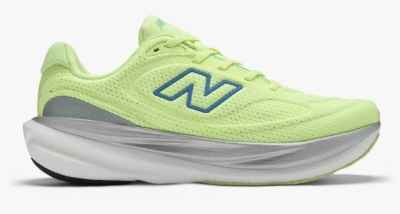
Infinion is a new New Balance cushioning platform introduced here in the 1080v15. Independent analysis describes this implementation as a supercritical TPEE-based foam blended with EVA.
My 309-mile scorecard
Comfort leads my scorecard, while lateral stability and wet wooden surfaces create the clearest limits for this soft neutral trainer.
| Category | Score / 10 | My reason |
|---|---|---|
| Heel cushioning | 8.4 | Deep compression without hard bottoming at my weight |
| Forefoot cushioning | 7.9 | Protective and flexible, though less alive late in long runs |
| Stability | 7.5 | Secure heel counter cannot fully offset soft foam and compact platform |
| Fit | 8.3 | True length, comfortable knit, and excellent width availability |
| Transition | 7.8 | Natural roll from heel bevel through flexible forefoot |
| Dry grip | 7.9 | Dependable on asphalt, concrete, and dry boardwalk |
| Wet grip | 7.6 | Acceptable on wet pavement; poor on slick wood |
| Durability | 7.3 | Still runnable at 309 miles with obvious outsole wear and foam softening |
| Versatility | 7.5 | Easy-to-steady range, not my interval or race choice |
| Enjoyment | 7.8 | Comfortable and easy to trust when the route suits it |
| Overall | 7.6 | A strong high-mileage comfort shoe with specific tradeoffs |
New Balance 1080v15 review: how I tested it
I logged 309 verified miles across 12 structured checks and regular training, including long, easy, progressive, hot, and wet runs.
My test pair is a men’s US 10.5 in Cool Grey/Metallic Silver. It weighed 10.4 ounces on my kitchen scale. I used my normal training socks and did not add an orthotic, so every fit and stability comment refers to the stock configuration.
The first run began at 6:45 a.m. on an August morning in Ocean City. Beach haze was already building, and sunscreen had started running before the first quarter mile. I covered seven boardwalk miles from the Music Pier toward 34th Street at roughly 9:10 per mile.
The surprise was not softness. I expected that. It was how little shoe I felt during the transition. The heel compressed, the broad bevel moved me forward, and the forefoot bent instead of forcing a rocker. By the turnaround, I knew the pair had a rotation role.
My best session was supposed to be easy. At mile three, the shoe felt settled enough that I progressed and ran the final five miles near 7:50 pace. The 1080v15 did not become a super trainer, but the lower mass let me change gears without dragging the midsole behind me.
The long-run check went beyond 10 miles from the inlet toward Smithville Mansion. At mile eight, the foam remained comfortable and I had no hot spots. Around mile 10, I noticed more heel compression and less forefoot rebound, yet my legs were still protected.
The wet test exposed the shoe’s most serious surface problem. Rain turned wooden boardwalk planks slick enough that I nearly lost my footing around mile two. I moved to the adjacent concrete sidewalk, where the rubber became predictable again. “Wet grip” is not one universal property; rubber can behave very differently on wood and pavement.
New Balance 1080v15 review: what Infinion feels like
Infinion feels soft and compressive at landing, then returns enough energy to avoid the flat, slow sensation of older 1080 midsoles.
New Balance’s marketing emphasizes cushioning, energy return, and long-lasting performance. Those are three separate questions. Cushioning describes impact attenuation. Energy return describes how much mechanical energy the material gives back in a controlled test. Durability asks how the feel changes after repeated loading.
RunRepeat measured 147 SA at the heel and 126 SA at the forefoot for shock absorption. Its energy-return test produced 65.9% at the heel and 69.1% at the forefoot. Those numbers support what I felt: high protection, with more response than the 1080v14, but not the aggressive rebound of a plated racer.
The same lab measured the foam at 21.5 AC, 29% softer than its v14 sample. This helps explain why opinions split. A neutral runner who likes compression may call it relaxing. A runner who dislikes sinking, or who needs a firm medial edge, may call it vague.
At 182 pounds, I compress the heel easily but do not feel it collapse immediately. The sensation is a controlled sink followed by a quiet release. It works best when I let cadence stay natural rather than trying to force a sharp toe-off.
Cold performance is noteworthy. RunRepeat’s sample became only 2% firmer after cold exposure, versus a much larger lab average. That does not guarantee identical feel in every winter, but it suggests Infinion is less temperature-sensitive than many EVA-dominant daily trainers.
New Balance 1080v15 ride at easy, steady, and faster paces
The 1080v15 is excellent from recovery pace through steady running, usable for progressions, and inefficient for repeated hard intervals.
At 9:00–10:00 per mile, the shoe is in its best zone for me. Impact feels muted, the heel bevel prevents a blocky landing, and the flexible forefoot keeps each step natural. This is where it earns a place beside the shoes in my best recovery running shoes guide.
At 8:00–8:30 pace, it remains coherent. The weight reduction matters more than an explosive foam sensation. My feet turn over without fighting a large heel, and the upper holds well enough through gentle corners. That makes it more versatile than a pure recovery model.
Near 7:50 pace, as in my progression run, the shoe can work for controlled blocks. It is not what I would choose for 400-meter repeats, threshold intervals, or race pace. There is no plate, the foam compresses deeply, and the upper prioritizes comfort over competition lockdown.
If you are building a simple rotation, use the 1080v15 for easy and long mileage, then add a lighter shoe for workouts. My daily trainer guide explains when one versatile pair is enough and when two shoes solve different jobs better.
New Balance 1080v15 review: long-run performance
Yes—the 1080v15 protects well over long steady runs, though heavier runners may notice late-run compression in the forefoot.
My mile-eight checkpoint was positive: no hot spot, no lace pressure, and the cushioning still felt responsive. By mile 10, the heel had softened slightly and the forefoot felt less springy. Protection remained; the character simply became calmer.
I would trust it for normal weekly long runs and marathon base mileage. For long runs containing large blocks at marathon pace, I would prefer a lighter, firmer super trainer. Browse my long-distance running shoe comparisons if pace work is a major part of the session.
Runners above 200 pounds should pay particular attention to late-run forefoot feel. My test cannot define a universal weight limit. Body mass, cadence, strike location, and temperature change how quickly soft foam reaches its compressed state.
New Balance 1080v15 sizing and fit
The 1080v15 fits true to size for my medium-volume foot, with secure heel hold, average internal shape, and useful stretch.
I wore my normal men’s US 10.5 in standard D. Length was correct, the heel stayed down, and the upper allowed enough swelling room beyond 10 miles. I did not need a runner’s knot, although the extra eyelet is available if your heel is narrower.
The standard-width shoe should not be confused with an anatomically broad toe box. RunRepeat’s gel mold measured 94.8 mm at the widest interior point and 73.2 mm at the toe—both essentially average. The stretch makes it forgiving, but it does not create a foot-shaped front.
For the common New Balance 1080v15 wide feet question, my answer is precise: the width range is excellent, but the standard D last is not unusually wide.
New Balance’s width menu is the real advantage. Men’s sizing runs from narrow B through D, 2E, and 4E in the USA; women’s runs from 2A through B, D, and 2E. If standard feels tight, buy the correct width instead of adding length. My wide-foot running shoe guide covers the checks I use.
High-volume feet should still try the shoe with their normal socks. Raised contouring and a padded heel make the upper feel more structured than a loose knit. The removable 4.3 mm lab-measured insole permits an orthotic, but replacing it changes space and underfoot feel.
Upper comfort, breathability, and walking use
The contoured mesh is soft and secure enough for long runs, but its padding retains more moisture than the perforations suggest.
The tongue distributes pressure well, and the stiff 4/5 lab-rated heel counter is cushioned enough that I never felt an edge. My pair produced no blister or hot spot. For blister-prone runners, socks still matter; see my running sock guide.
Breathability is adequate, not exceptional. RunRepeat scored airflow at 67 BR versus its 72 BR average, then measured only 40% drying potential versus 53% average during a three-hour protocol. That aligns with summer runs where the shoe ventilated but stayed damp around the padded heel.
For humid conditions, lighter socks and proper drying matter. Do not put the pair in a dryer; heat can damage adhesives and foam. Be patient with air drying. The mild-soap and airflow steps in my shoe-cleaning method also apply here.
The 1080v15 is also an excellent walking and travel shoe for neutral feet. It flexes naturally, feels lighter than its cushioning suggests, and the upper accommodates normal daily swelling. It belongs in the comfort-first group in my best cushioned running shoes, provided soft foam does not make you unstable.
Is the New Balance 1080v15 stable?
The 1080v15 is a neutral shoe with secure rearfoot hold, but its soft foam and compact base provide limited lateral guidance.
This neutral running shoe can look more supportive than it is. RunRepeat measured only 108.9 mm across the forefoot platform, well below its 115.1 mm average. The 91.4 mm heel is average, not exceptionally wide. Deeply compressive foam sits on that compact base.
My mild overpronation was manageable on level roads when fresh. Late in long runs, I could feel more medial movement than in the firmer 880v15 or a true stability shoe. I struggled most on sloped pavement, where one side of the foam compressed before the other.
A stiff heel counter improves lockdown, but lockdown is not the same as motion control. Runners who already know they need structured guidance should use my overpronation shoe guide or obtain a professional assessment instead of expecting a neutral cushioned shoe to correct mechanics.
New Balance notes that the shoe received the APMA Seal of Acceptance. That recognition does not make it a treatment for pain or a universal choice for flat feet. If symptoms persist, footwear selection is not a substitute for evaluation by a qualified clinician or physical therapist.
Outsole grip: good on roads, poor on wet boardwalk
Targeted rubber grips normal wet asphalt well, but my pair became dangerously slick on rain-soaked wooden boardwalk planks.
The outsole uses separate heel and forefoot rubber patches with exposed Infinion through the midfoot. Deep longitudinal channels allow flex. This design helps the shoe shed weight and bend naturally, though it leaves soft foam available for cosmetic scuffing.
RunRepeat recorded a 0.59 forefoot traction coefficient, improving on 0.52 for its v14 sample and exceeding its current average. I agree on asphalt and concrete. Braking and cornering remained predictable in ordinary rain.
Wet wood was different. The broad flat contact patches could not bite through the film on the boardwalk, and my second-mile slide was enough evidence to leave that surface. If your route includes timber bridges or a boardwalk, shorten stride, avoid painted markings, and follow the surface-specific precautions in my rain-running guide.
This is a road shoe, not a trail shoe. It can cross compact park paths, but exposed foam, shallow tread, and limited lateral stability are poor matches for loose dirt, roots, or mud.
New Balance 1080v15 durability after 309 miles
My 1080v15 remains runnable at 309 miles, with lateral-heel wear, forefoot abrasion, and roughly 15% more softness by feel.
The upper is intact. I have no split at the flex point, no blown side seam, and no hole above the big toe. That matches the lab’s strong 4/5 toebox durability result. Heel lining wear deserves watching; the same test scored that area 3/5.
Rubber wear is concentrated where my gait predicts it: lateral heel at contact and forefoot near toe-off. The working rubber remains, but edges have rounded. RunRepeat measured 1.0 mm of material loss in its Dremel protocol and 3.0 mm of outsole thickness.
Infinion has not gone dead, though my pair no longer feels like mile one. By side-by-side hand compression and repeat-route feel, the midsole is about 15% softer than new. That is an estimate, not an instrumented measurement. The heel settles deeper and the forefoot recovers more slowly late in a run.
I am approaching retirement decision territory, not declaring a fixed lifespan. Replace shoes based on ride change, asymmetric wear, and recurring discomfort—not a universal mileage number. My shoe replacement checklist explains the process.
New Balance 1080v15 vs 1080v14
The 1080v15 is a substantive upgrade: Infinion replaces Fresh Foam X, cuts about one ounce, increases rebound, and restores versatility.
| Feature | 1080v15 | 1080v14 | My pick |
|---|---|---|---|
| Midsole | Infinion | Fresh Foam X | v15 for softness and response |
| Brand weight, men | 9.2 oz | About 10.1 oz in comparable independent sample | v15 clearly |
| Stated stack | 40 / 34 mm | 38 / 32 mm | v15 for protection; lab heel was unchanged |
| Stated drop | 6 mm | 6 mm | Tie |
| Lab energy return, heel | 65.9% | Lower in the same lab protocol | v15 |
| Lab softness | 29% softer than lab’s v14 sample | Firmer | Preference: v15 plush, v14 controlled |
| Forefoot platform | More compact | Broader | v14 for stability |
| Grip coefficient | 0.59 lab | 0.52 lab | v15 on road; neither for slick wood |
| Best use | Easy, long, and some steady progression | Easy and recovery running | v15 for a broader rotation role |
If you like the controlled, wider v14 specifically because it feels stable, do not assume the new shoe is automatically better for you. If weight and flat response frustrated you in v14, version 15 solves the right problems.
New Balance 1080v15 vs key alternatives
Choose 1080v15 for the softest natural ride and width range; choose its rivals for stability, stronger rocker, or faster rebound.
| Shoe | Choose it over 1080v15 when… | Choose 1080v15 when… |
|---|---|---|
| New Balance 880v15 | You want a firmer, more stable, traditional daily trainer | You prioritize softness, lower drop, and lower-feeling mass |
| ASICS Novablast 5 | You want a livelier ride for mixed-pace sessions | You want more width choices and gentler easy miles |
| HOKA Clifton 10 | You prefer a firmer, stronger rocker and guided transition | You prefer forefoot flexibility and deeper step-in softness |
| Nike Vomero 18 | You want a broader platform and substantial dual-foam protection | You want a lighter, more flexible ride |
| Brooks Glycerin | You value a more planted heel and structured upper | You want less weight and a softer transition |
| Nike Vomero Plus | You want more explosive ZoomX rebound | You want width availability and less towering geometry |
For deeper comparisons, read my ASICS Novablast review, HOKA Clifton review, and Nike Vomero review. Those models overlap in daily mileage but feel very different underfoot.
Who should buy the New Balance 1080v15?
The 1080v15 best serves neutral runners seeking soft daily cushioning, long-run comfort, flexible transitions, and unusually broad width availability.
- Neutral runners who prefer soft rather than firm cushioning
- New runners who want one comfortable road shoe for easy and steady mileage
- High-mileage runners seeking a protective recovery and long-run option
- Wide and extra-wide feet that need genuine 2E or 4E sizing
- Heel-to-midfoot strikers who benefit from the bevel and 6 mm geometry
- Walkers and travelers who value low weight with substantial cushioning
It is a credible beginner choice because the ride is intuitive and the fit menu is unusually complete. My beginner running shoe guide covers the larger question of fit, training load, and whether neutral support is appropriate.
Who should skip it?
Skip the 1080v15 if you need medial guidance, dislike deep foam compression, race frequently, or run on wet wooden surfaces.
- Runners who know they require a stability shoe
- Heavy heel strikers who routinely bottom out soft midsoles
- Anyone who wants a firm, highly controlled daily trainer
- Tempo and interval specialists buying one shoe primarily for speed
- Boardwalk runners who train through frequent rain
- Trail runners needing lugs and lateral security
I know how tempting maximum softness can be when your legs feel beaten up. More compression is not automatically more protective for every runner. If the shoe makes your ankle search for stability, a firmer platform may feel better even with less step-in softness.
How I use the 1080v15 in my rotation
I assign the 1080v15 to recovery, easy, and long aerobic runs, then switch to a firmer shoe for speed or sloped roads.
My useful pace band is about 8:30–9:30 per mile, with room slower on recovery days. It can progress toward 7:50, as my best session proved, but that is a capability rather than its main purpose.
During summer, I rotate it rather than wear it on consecutive sweaty days because the heel padding dries slowly. The practical heat-management steps in my summer running guide matter more than choosing a white colorway.
On concrete-heavy routes, the shock absorption is a real asset. I still vary surfaces and workload rather than treating cushioning as immunity from training errors. See my concrete running shoe guide for that distinction.
New Balance 1080v15 review: final verdict after 309 miles
The 1080v15 is a comfortable, lighter, more responsive 1080 whose Infinion upgrade succeeds despite limited stability and wet-wood grip.
This is the most meaningful generational update in the line for years. Infinion does not merely rename the foam. The shoe is lighter, softer in a measured lab sample, more energetic, and easier to move through steady paces than v14.
It is not flawless. The soft compact platform is a poor substitute for guidance. The upper holds moisture. Rubber works on wet road yet failed me on wet wooden planks. At 309 miles, my pair shows honest wear and has softened noticeably.
Still, when a neutral runner asks me for a comfortable first shoe or a high-mileage easy-day companion, 1080v15 belongs on the short list. It protects without feeling enormous, bends instead of dictating, and comes in widths that many competitors ignore. Final score: 7.6/10.
New Balance 1080v15 review FAQ
Is the New Balance 1080v15 true to size?
Yes for my medium-volume foot. My normal men’s US 10.5 gave me correct length, a secure heel, and enough swelling room beyond 10 miles. Select the proper width rather than sizing longer to gain space.
Does the New Balance 1080v15 use Fresh Foam X?
No. Version 15 replaces Fresh Foam X with Infinion. New Balance describes it as a new cushioning technology, while independent material analysis identifies a supercritical TPEE-based blend containing EVA.
What is the New Balance 1080v15 drop?
New Balance states a 6 mm heel-to-toe drop. RunRepeat measured 37.0 mm at the heel and 30.6 mm at the forefoot, producing 6.4 mm in its independent sample.
Is the New Balance 1080v15 good for wide feet?
Yes when purchased in the correct width. Men’s versions include D, 2E, and 4E, plus narrow B. The standard interior is average rather than naturally broad, so wide feet should not simply buy standard.
Is the New Balance 1080v15 a stability shoe?
No. It is a neutral shoe with a secure heel counter but very soft foam and a compact forefoot platform. Runners requiring structured pronation control should consider a stability model.
Can I use the 1080v15 for long runs?
Yes. It remained protective beyond 10 miles in my testing. I noticed more heel compression and less forefoot rebound late in the run, so runners who want long pace blocks may prefer a firmer super trainer.
Can I race in the New Balance 1080v15?
You can finish a 5K through marathon in it if comfort matters more than speed. It has no plate and is not optimized for racing, so experienced runners will usually prefer a lighter race shoe.
Is the New Balance 1080v15 good for walking?
Yes for neutral walkers who enjoy soft cushioning. Its flexible forefoot, moderate drop, low relative weight, and multiple widths work well for walking and travel. Stability-sensitive walkers should test it first.
How durable is the New Balance 1080v15?
My pair remains runnable at 309 miles. It has meaningful lateral-heel and forefoot wear, an intact upper, and approximately 15% more midsole softness by feel. Lifespan varies with gait, body mass, surface, and rotation.
Is the New Balance 1080v15 good in rain?
It grips ordinary wet asphalt and concrete adequately, but my pair was dangerously slick on wet wooden boardwalk planks. Its padded heel also dries slowly, so allow airflow between wet runs.

About Ken — 12 years of running, 12,500+ miles, 63 shoes tested, and 36 races from 5Ks to a 50K ultra. I run 30–40 miles a week around Atlantic City and review every shoe with real training miles, not one-run demos. More about me →