
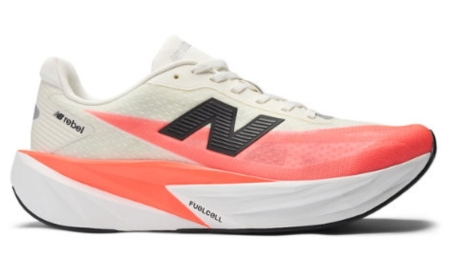
The New Balance FuelCell Rebel v5 is a soft, light, flexible daily trainer that feels best on easy-to-steady runs and short pace changes. After 60 miles, I rate it 7.8/10. Its PEBA/EVA FuelCell midsole and low weight make ordinary mileage feel less mechanical, but my pair also developed faster exposed-foam wear than I expect from a daily workhorse.
The v5 is more cushioned and more relaxed than Rebel v4. That makes it easier to use for recovery runs and longer outings, but less sharp when the session asks for a quick, rigid toe-off. It is not a plated speed shoe hiding in a daily-trainer upper.
Fit is true to my normal running-shoe length, with useful toe space and a snugger arch and midfoot. The upper holds well without feeling built up. The ride is neutral, centered enough for my normal mileage, and noticeably less settled on sharp turns or uneven wet boardwalk planks.
Buy it for lightweight daily running, easy miles, steady aerobic work, strides, and travel. Skip it if outsole longevity, wet grip, firm propulsion, or structured guidance ranks above low weight and soft flexibility.
Jump to Section Click to expand
- Quick Verdict
- Ken’s Ranking Rule
- What This Rewrite Corrects
- How I Tested
- 60-Mile Timeline
- Specs and Evidence
- Price and Value
- Fit and Sizing
- Upper and Lockdown
- FuelCell Ride
- Performance by Pace
- Long Runs
- Stability
- Grip and Durability
- Rebel v5 vs v4
- Key Comparisons
- Decision Matrix
- Training Rotation
- Who Should Buy
- Who Should Skip
- Pros and Cons
- Sources and Corrections
- Final Verdict
- FAQ
New Balance Rebel v5 Review: Quick Verdict
The Rebel v5 is a lightweight neutral daily trainer with a soft, flexible ride and enough range for easy runs, steady mileage, strides, and controlled tempo work. It is not my first pick for wet routes, hard intervals, or runners who consistently destroy exposed midsoles. To match those faster sessions with the right footwear, compare my running shoes for speedwork.
| Decision | Ken’s Answer |
|---|---|
| Best for | Easy runs, daily mileage, steady runs, strides, travel, treadmill |
| Ride | Soft, flexible, light, mildly bouncy, more relaxed than aggressive |
| Fit | True to my normal length; snug arch/midfoot; accommodating toe area |
| Official weight | 223 g / 7.9 oz on the current men’s U.S. product page |
| Official drop | 6 mm |
| Midsole | FuelCell blend of PEBA and EVA |
| Plate | None |
| Main strength | Low weight with real daily-run cushioning |
| Main weakness | Exposed-foam wear and insecure wet-boardwalk grip in my test |
| Ken’s score | 7.8/10 after 60 miles |
Within my running-shoe ranking framework, the Rebel v5 sits between a conventional daily trainer and a lightweight performance trainer. It is more relaxed than the second label suggests and more playful than the first.
It can work for runners choosing a first shoe from my beginner running-shoe guide, provided the soft neutral platform feels controlled during a try-on. A beginner does not automatically need a stability shoe, but no reviewer can assign support from a pronation label alone. For the distinction between normal pronation, overpronation, and supination, see my overpronation versus supination guide.
Bottom line: Rebel v5 makes easy and steady mileage feel light without using a plate. The trade is a softer, less structured platform and an outsole layout that showed concerning exposed-foam wear in my 60-mile sample.
Ken’s Ranking Rule for the Rebel v5
Ken’s ranking rule: a lightweight daily trainer must remain useful after the first-run bounce stops being novel. I score ride quality, pace range, fit, long-run cushioning, stability, grip, observed durability, and value. Low weight earns attention; it does not excuse a weak outsole.
| Ranking Factor | Weight | Rebel v5 | Reason |
|---|---|---|---|
| Ride quality | 22% | 8.6/10 | Soft, fluid, and light without a plate |
| Pace versatility | 18% | 8.4/10 | Easy through controlled tempo; less convincing for hard reps |
| Fit and upper | 16% | 8.3/10 | Secure, low-bulk, good toe space, snug arch |
| Distance cushioning | 14% | 8.4/10 | Comfortable through my 11.8-mile longest run |
| Stability | 10% | 7.5/10 | Centered for a neutral shoe; soft and flexible under fatigue |
| Grip | 8% | 5.8/10 | Fine dry, less trustworthy on rain-wet boardwalk wood |
| Observed durability | 8% | 5.0/10 | Exposed foam scuffed early in my pattern |
| Value | 4% | 6.8/10 | Broad use, offset by uncertain outsole life |
The weighted result is 7.8. A smooth midfoot striker on clean asphalt may score the shoe higher. A runner with a hard lateral heel strike, abrasive roads, or frequent rain may score it lower.
This method also resolves the old article’s conflicting 7.0 and 9.1 ratings. One documented formula now supports every appearance of the score in the article and schema.
What This New Balance Rebel v5 Rewrite Corrects
The previous article mixed a 60-mile update with stale higher-mileage language, two overall scores, unsupported in-house testing authority, and incompatible lifespan estimates. Those errors made otherwise useful on-foot notes difficult to trust.
| Old Problem | Correction in This Review |
|---|---|
| Current and stale mileage in the same article | Uses the latest 60-mile test record only |
| 7.0 and 9.1 overall scores | One weighted 7.8 score |
| Unsupported in-house laboratory claims | Removed; external measurements name their source |
| Exact material, gait, pressure, and joint data | Removed because no supporting test record exists |
| Fixed total-lifespan projections | Reports wear at 60 miles without promising retirement mileage |
| Medical and injury-prevention prescriptions | Replaced with fit, ride, and stability observations |
| Stack figures presented as official | Separates the brand page from two lab protocols |
| Absolute best-in-class language | Uses role-specific recommendations and named trade-offs |
The current WordPress revision is the controlling record. Earlier revisions support the route categories but not the current mileage. Where the current copy still contained an old 210-mile sentence, I treated it as stale rather than evidence.
That restraint matters for GEO. A short, qualified answer with provenance is easier for a reader or an answer engine to reuse than a dramatic claim built on conflicting numbers.
How I Tested the New Balance Rebel v5
I logged 60 miles over roughly eight weeks on Atlantic City roads, boardwalk, track, and treadmill sessions. My current test notes identify a body weight of 182 lb, normal weekly volume around 30-40 miles, temperatures from roughly 54 to 82 degrees Fahrenheit, and a longest run of about 11.8 miles.
| Test Element | Recorded Context | What I Evaluated |
|---|---|---|
| Total mileage | 60 miles | Ride consistency, fit, outsole, upper |
| Surfaces | Road, concrete, boardwalk, track, treadmill | Grip, stability, transition, wear |
| Easy/recovery | Roughly 9:40-11:15 per mile | Slow-speed comfort and control |
| Steady running | Roughly 8:00-9:40 per mile | Natural rhythm and efficiency feel |
| Tempo work | Roughly 6:50-8:00 per mile | Compression, turnover, flexibility |
| Faster repetitions | Short track work faster than tempo | Acceleration and toe-off limits |
| Longest run | About 11.8 miles | Late-run cushioning and stability |
| Weather | About 54-82 degrees Fahrenheit | Upper comfort and foam consistency |
Those pace bands are context, not prescriptions. Route, wind, workout design, fatigue, GPS error, and fitness change what a pace means. Use effort and the method in my easy-run pace guide rather than copying my watch.
The latest article does not preserve a trustworthy test-pair size or a weighed mass for my pair. I will not backfill either number. Brand and independent weights below belong to their stated samples.
I evaluated the stock shoe with ordinary running socks. I did not perform controlled metabolic, pressure, force-plate, motion-capture, abrasion-machine, or material-hardness tests. Those measurements belong only to the independent sources named later.
My 60 miles are enough for a developed ride and early-wear review, not a lifetime test. The durability conclusion is therefore specific: my exposed foam wore quickly, while the shoe remained runnable at the last logged mile.
What Changed from Mile 1 to Mile 60
The Rebel v5 required little ride break-in, but the upper settled and the outsole story became clearer by 60 miles. The soft midsole character was present immediately rather than appearing after several weeks.
| Checkpoint | What I Noticed | Interpretation |
|---|---|---|
| Miles 0-10 | Soft landing, snug arch, minor heel movement early | Fit needed lacing refinement more than foam break-in |
| Miles 10-25 | Easy pace became the clear sweet spot | Light mass and flexible forefoot suited relaxed rhythm |
| Miles 25-40 | Steady and tempo work exposed limited snap | Compression is pleasant but not plate-like propulsion |
| Miles 40-50 | Track work confirmed fast capability, not specialization | Short reps work; hard repeated turnover is not the best use |
| Miles 50-60 | Longest run stayed cushioned; exposed foam wear was obvious | Distance comfort and outsole confidence moved in opposite directions |
The ride did not turn flat by 60 miles. I could still recognize the same soft compression and light transition from the first week. That does not prove the foam will retain identical feel through any specific future mileage.
The upper remained intact in the current 60-mile record. A stale sentence assigning much higher upper mileage was removed because it belongs to a superseded revision and cannot describe this test.
Wear should be judged by function as well as appearance. Exposed foam scuffs faster than rubber, but cosmetic roughness is different from a change in traction, balance, or ride. My concern rose because the scuffing appeared early in high-contact areas and wet grip was already a weakness.
New Balance Rebel v5 Specs: Official vs Measured
New Balance officially describes the Rebel v5 as a neutral road shoe for everyday and quick runs, using a PEBA/EVA FuelCell blend, engineered mesh, FantomFit support, a 6 mm drop, and a current listed weight of 223 g or 7.9 oz. The current U.S. page shows Standard D and Wide 2E for the men’s style reviewed.
| Specification | Source | Reported Result |
|---|---|---|
| Category | New Balance | Neutral road shoe for everyday and quick runs |
| Midsole | New Balance | FuelCell blend of PEBA and EVA |
| Official weight | New Balance current U.S. page | 223 g / 7.9 oz |
| Official drop | New Balance | 6 mm |
| Upper | New Balance | Engineered mesh with FantomFit bonded support |
| Plate | Construction and independent inspection | None |
| Measured weight | RunRepeat | 220 g / 7.8 oz |
| Measured weight | RTINGS | 227.3 g / 8.02 oz |
| Measured stack/drop | RunRepeat protocol | 33.0/26.7 mm; 6.3 mm |
| Measured stack/drop | RTINGS protocol | 36.2/29.2 mm; 7.0 mm |
The brand page available during this audit does not publish heel and forefoot stack heights. Some retailer and review spec sheets list 35/29 mm, but the two independent measurements differ enough that repeating one number as universally exact would be misleading.
Weight also changes with size, width, color, manufacturing tolerance, and scale method. The useful conclusion is not that one source is wrong; it is that the Rebel v5 is genuinely light for a cushioned daily trainer.
The phrase “PEBA/EVA” describes ingredients, not a guaranteed ride. Geometry, foam proportions, density, outsole, upper, and the runner determine the finished behavior. New Balance does not publish the blend ratio on the product page used for this audit.
New Balance Rebel v5 Price and Value
Placing it in the normal daily-trainer range rather than premium super-trainer territory. Current price and stock change by color, width, retailer, and season, so this review does not present a temporary sale as the shoe’s permanent value.
| Value Question | Ken’s Answer |
|---|---|
| Worth launch MSRP for dry-road daily training? | Yes, if low weight and soft flexibility are priorities |
| Worth it as a wet-weather workhorse? | No; my boardwalk grip result reduces value for that role |
| Worth it for hard workouts only? | Usually no; a firmer speed trainer gives more structure |
| Worth upgrading from Rebel v4? | Only if you want more cushioning or a more conventional upper |
| Can I calculate cost per mile yet? | No; 60 miles is too early for a defensible final-lifespan estimate |
At full MSRP, the Rebel v5 earns its value through broad daily use rather than a specialized technology premium. The shoe can cover easy runs, steady work, strides, treadmill sessions, and some long runs, which reduces the need for several narrowly assigned trainers.
The outsole caveat changes the equation. A lower purchase price does not automatically create better value if your gait and surfaces wear through the exposed foam quickly. I would inspect the lateral heel and forefoot after the first 30-50 miles before deciding how much weekly volume to assign it.
Tom’s Guide reported the same U.S. launch MSRP and framed the Rebel against the ASICS Novablast and Adidas Evo SL. I use the launch figure only as historical buying context; the availability button on this page leads to the current retailer result.
New Balance Rebel v5 Fit and Sizing
The Rebel v5 fit true to my normal running-shoe length, with an accommodating toe area and a snugger arch and midfoot. I would not size up automatically. Choose Wide 2E before adding unnecessary length if width is the issue.
| Fit Area | Ken’s 60-Mile Result | Buying Guidance |
|---|---|---|
| Length | True to normal length | Start with your usual running-shoe size |
| Toe area | Comfortable room without loose sliding | Standard should suit many average-width feet |
| Arch/midfoot | Noticeably snug | Try on if high-volume through the instep |
| Heel | Minor early movement, controlled after lacing adjustment | Use the rear eyelet before changing size |
| Width | Standard worked for my foot | Men’s U.S. page currently shows D and 2E |
| Volume | Performance-oriented rather than plush | Thick orthotics can change lockdown and space |
New Balance says the shoe is designed for a snug fit and suggests sizing up when between sizes. That is compatible with my result: normal length worked, but the arch was the restrictive zone.
RunRepeat measured above-average toe width and reported true-to-size voting, while RTINGS found excellent length consistency and a somewhat snug arch. Those independent findings support the shape of my experience without making it universal.
Wide-footed runners should use the fit process in my wide running-shoe guide. Width labels are starting points; arch shape, toe taper, volume, and sock choice still matter. For a fuller framework covering arch, width, volume, flexibility, and asymmetry, use my running foot types guide.
Upper, Tongue, and Lockdown
The upper succeeds because it adds just enough structure to control the soft platform without making the shoe feel heavy. FantomFit overlays support the engineered mesh, while the padded zones remain modest.
The tongue stayed centered for me once the laces were set evenly. RunRepeat identified a semi-gusseted construction and measured a thin tongue; that matches the low-bulk feeling without requiring me to claim the measurement as my own.
Heel security was adequate rather than exceptional during the first few miles. A more deliberate top-eyelet tension removed most movement. I did not need a runner’s knot for every session, though narrow heels may prefer one.
Warm-weather comfort was good in my 54-82 degree test range, but independent results conflict. Tom’s Guide praised ventilation in hot conditions, while RunRepeat rated breathability below its average. Mesh perception depends on socks, humidity, speed, and test method.
The low-bulk upper makes Rebel v5 a strong treadmill-running option. It also packs easily for travel. Neither use eliminates the need to test lateral stability before gym work; this remains a road-running shoe.
FuelCell Ride: Soft Compression Without a Plate
Rebel v5 feels soft first, light second, and propulsive third. The midsole compresses readily under load, then returns with a mild rebound. The flexible forefoot lets the foot roll and bend naturally instead of forcing a rigid lever.
At easy pace, those traits work together. The shoe lands quietly, transitions without a hard edge, and does not ask for a precise strike. Its low weight keeps the soft foam from feeling cumbersome.
At steady pace, the ride feels most complete. There is enough compression to smooth the road, enough forefoot rebound to maintain rhythm, and no plate stiffness to fight when pace changes gradually.
At hard tempo or interval effort, the same flexibility becomes a limitation. The forefoot bends instead of loading as a stiff lever, and the soft foam can feel as though it absorbs the first part of the push before returning it.
Independent energy-return percentages cannot be merged. RunRepeat measured 59.8 percent at the heel and 67.3 percent at the forefoot. RTINGS measured 72.1 and 75.2 percent under a different system. Both found the forefoot livelier than the heel; neither makes the shoe a race-style propulsion device.
This is why I describe the Rebel as bouncy in sensation but moderate in propulsion. Bounce is a runner’s perception of compression and rebound. Propulsion also depends on stiffness, geometry, timing, mass, and how the shoe matches the runner.
For runners building aerobic volume, the soft ride pairs naturally with the effort discipline in my Zone 2 training guide. The shoe does not keep a run easy; the runner still does.
How the Rebel v5 Performs by Pace
Recovery pace
Recovery running is a strong use when soft flexibility feels good to your legs. The shoe remains light at slower cadence, though the heel can feel less organized than a firmer, broader workhorse. My recovery-run guide explains why slowing down matters more than selecting the softest shoe.
Easy daily pace
Around 9:40-11:15 per mile in my log, Rebel v5 felt relaxed and natural. This is the safest answer to “what is the Rebel v5 best for?” The upper disappears, the foam compresses comfortably, and plate-free flexibility is an advantage.
Steady aerobic pace
Around 8:00-9:40 per mile, the low mass becomes more noticeable. Turnover rises without the shoe feeling forced, and the forefoot provides enough rebound for a smooth cruise. This was my favorite balance of cushioning and responsiveness.
Tempo pace
Around 6:50-8:00 per mile, Rebel v5 remains capable but less decisive. It handles controlled tempo blocks, especially when the workout moves between easy and fast segments. A dedicated tempo shoe feels sharper when the entire session stays hard. See my tempo-run guide for workout structure.
Intervals and short repetitions
Short track repetitions are possible because the shoe is light. Repeated hard accelerations expose the soft heel, flexible forefoot, and limited snap. For the training purpose and recovery demands, use my interval training guide.
The shoe does not need a plate to run fast. It simply lacks the stiff, timed lever many runners now expect from speed trainers. Runners who prefer natural flex may see that as freedom rather than a flaw.
Is the New Balance Rebel v5 Good for Long Runs?
Yes for runners who already tolerate soft, flexible neutral shoes; my longest run was about 11.8 miles and cushioning remained comfortable. I would not turn one successful long run into a universal marathon recommendation.
Compared with Rebel v4, the v5 carries more material underfoot and feels less thin late in a run. The heel and forefoot remain connected without a hard plate transition. That makes relaxed long-run rhythm easier.
The limitation is structure. As fatigue rises, a soft heel and flexible forefoot ask the foot and ankle to manage more motion than a firmer, rockered trainer. That is a ride observation, not an injury prediction.
At 182 lb, I did not bottom out the shoe during my longest logged run. I did become more aware of lateral movement on uneven sections and of the outsole wear afterward. A lighter or more efficient runner may experience a different ceiling.
For half-marathon training, Rebel v5 can cover easy miles, progression runs, and some long runs. My first half-marathon plan shows where those sessions fit, while race-day shoe choice should follow rehearsed comfort and goals.
Runners comparing it with options in my long-distance shoe guide should decide whether low weight or stronger late-run guidance matters more. Rebel v5 prioritizes the former.
Stability: Neutral, Centered, and Still Soft
Rebel v5 is a neutral shoe with mild geometric stability, not a stability model. A broad ground-contact shape and sidewalls help center the ride, while soft foam and a flexible forefoot reduce how much guidance those features provide.
RTINGS rated lateral stability highly and measured a wide outsole platform. Doctors of Running reached a more nuanced conclusion: the shoe has mild guidance elements but remains truly neutral because softness and flexibility offset them. My 60 miles align more closely with the second description.
Straight road running felt controlled. Slow treadmill running was also predictable. Sharp corners, slanted surfaces, and uneven wet planks made the heel feel less settled. Those conditions matter more than a static pronation label.
The article no longer says the shoe provides “zero support” or mechanically amplifies ankle drift. Both are stronger claims than the evidence permits. Neutral geometry can include centering features without becoming corrective footwear.
Runners who know they prefer formal guidance can compare models in my stability running-shoe guide. Runners who are symptom-free should choose by comfort and control rather than trying to self-diagnose gait from outsole wear.
Higher body weight does not automatically disqualify the Rebel. It can increase foam compression and wear, but comfort and control remain individual. My heavy-runner shoe guide explains the practical fit and durability checks.
Outsole Grip and Durability After 60 Miles
My Rebel v5 showed visible exposed-foam scuffing and high-contact smoothing by 60 miles, while the rubber remained functional. That is early enough to lower my durability score, but it is not evidence for a fixed retirement mileage.
| Area | Condition at 60 Miles | What It Means |
|---|---|---|
| Lateral heel | Visible smoothing near my contact path | Monitor if the edge changes landing feel |
| Exposed midfoot foam | Scuffed and roughened | Expected to mark faster than rubber |
| Forefoot exposed foam | Visible abrasion near flex zones | Avoid rough gravel and abrasive chip seal |
| Rubber coverage | Still attached and functional | No delamination recorded |
| Midsole feel | No obvious dead zone | Ride remained recognizable at 60 miles |
| Upper | No structural failure in current log | Promising, not a lifetime verdict |
RunRepeat’s machine test found favorable rubber abrasion but also measured thinner-than-average rubber and extensive exposed foam. Doctors of Running saw exposed-midsole wear at 26 miles without rubber damage. Running Shoes Guru reported significant lateral heel wear after about 75 miles. Those findings show why “outsole durability” and “exposed-foam appearance” must be separated.
Wet grip was my larger practical concern. Dry asphalt and track were fine. On a rain-wet wooden boardwalk, I had two brief slips and reduced pace. RunRepeat measured near-average forefoot traction, while Doctors of Running reported no rainy-day traction issue. Surface material and stride can explain part of the disagreement.
I would keep Rebel v5 mainly on road, treadmill, and track. On rainy days, the caution steps in my rain-running guide matter more than any generic wet-grip label.
Do not replace the shoe because a foam edge looks rough. Replace or rotate it when grip, ride consistency, upper hold, or wear symmetry changes enough to affect the run. My replacement checklist gives a functional process.
New Balance Rebel v5 vs Rebel v4
Rebel v5 is softer, taller, more cushioned, and more daily-oriented than Rebel v4; Rebel v4 feels lower, firmer, and sharper. The v5 improves comfort but gives up part of the stripped-down identity that made older Rebels distinctive.
| Feature | Rebel v4 | Rebel v5 | Practical Difference |
|---|---|---|---|
| Ride | Lower and more direct | Softer and more relaxed | v5 favors easy and long running |
| Cushioning | Less depth underfoot | More protective volume | v5 reduces late-run thinness |
| Weight | Lighter | Slightly heavier but still light | Difference is small in daily use |
| Upper | More divisive tongue/heel fit | More conventional lockdown | v5 is easier to fit for many runners |
| Forefoot | Sharper, relatively direct | Flexible with mild rebound | v4 feels better for fast turnover |
| Best role | Lightweight speed-leaning trainer | Lightweight daily trainer | Choose by session priority |
Independent sources disagree on the exact stack increase because both geometry and measuring protocols differ. The direction is not disputed: v5 has more underfoot material and a softer daily-training bias.
I would upgrade from v4 only if the old shoe feels thin on longer runs, the tongue or heel bothers you, or you want a softer easy-day role. If you love v4 for quick cadence and ground feel, v5 may feel less rebellious.
This is not a universal improvement. It is a change in job description. The v5 makes the Rebel easier to recommend to more daily runners, while making it less special for runners who wanted a minimal, unplated speed shoe.
New Balance Rebel v5 vs Key Daily Trainers
Rebel v5 wins on low weight and soft flexibility; rivals win when the run needs firmer propulsion, conventional durability, deeper cushioning, or more structure. The closest alternative depends on the role you want to protect.
Rebel v5 vs HOKA Mach 7
Choose Rebel v5 for softer compression and a more flexible forefoot. Choose the HOKA Mach 7 for a firmer, more directed transition and a stronger fast-day identity. The HOKA feels more organized; the Rebel feels more natural.
Rebel v5 vs Saucony Endorphin Speed 5
Rebel v5 is softer, simpler, and easier at relaxed pace. The Saucony Endorphin Speed 5 uses a plate and speed-oriented geometry, making it the better choice for tempo, intervals, and race-specific training.
Rebel v5 vs Nike Pegasus 42
Rebel v5 is much lighter and softer. The Nike Pegasus 42 feels denser, more traditional, and more outsole-focused. Choose Rebel for fun daily miles; choose Pegasus for a planted workhorse feel.
Rebel v5 vs ASICS Novablast
Rebel v5 is lower-bulk, more flexible, and easier to pack. The ASICS Novablast offers a larger, more rockered cushioning experience. Choose by whether you prefer foot-shaped flex or geometry-led roll. For how rocker location, curvature, and stiffness change transition, read my running shoe rocker-geometry guide.
Rebel v5 vs Saucony Ride
Rebel v5 is softer and lighter, while the Saucony Ride is the more conventional daily platform. Ride suits runners who want predictable structure; Rebel suits runners who want less shoe around the foot.
Rebel v5 vs Brooks Ghost
Rebel v5 feels livelier and less built up. The Brooks Ghost provides a more substantial upper, firmer platform, and workhorse character. The decision is light flexibility versus traditional consistency.
Rebel v5 vs Adidas Adizero Evo SL
Choose Rebel v5 for softer easy-run comfort, more natural flex, and a calmer daily feel. Choose Adidas Adizero Evo SL for firmer rebound, a more aggressive rocker, and faster workout intent. Independent reviewers consistently place the Evo SL on the speed side of this decision and the Rebel on the comfort side.
Rebel v5 vs New Balance 1080
Rebel v5 is the lighter and more nimble New Balance option. The 1080 family provides a larger cushioning experience and a more relaxed max-cushion role. Pick Rebel when pace range and low mass matter; pick 1080 when easy-run depth and a more substantial platform matter most.
Rebel v5 Decision Matrix
| Your Priority | Buy Rebel v5? | Reason |
|---|---|---|
| Light easy-day shoe | Yes | Soft cushioning without conventional trainer weight |
| One shoe for easy plus controlled tempo | Yes, with caveats | Broad pace range but limited hard-effort snap |
| Wet-weather reliability | Probably not | My wet-boardwalk confidence was low |
| High-abrasion road durability | Probably not | Exposed foam wore early in my pattern |
| Natural forefoot flexibility | Yes | No plate or stiff shank |
| Strong rocker or plated propulsion | No | Soft flex defines the ride |
| Formal stability guidance | No | Neutral shoe with only mild centering geometry |
| Long-run shoe under 12 miles | Often | Worked well through my 11.8-mile test |
| Marathon race shoe | Goal-dependent | Comfort-first option, not a dedicated racer |
| Travel and treadmill | Yes | Light, packable, quiet, and comfortable |
The matrix is intentionally conditional. Shoe choice is an interaction between the product, runner, route, pace, and goal. A single verdict cannot flatten all five.
For improving pace rather than merely buying a faster-feeling shoe, use the training principles in my running-speed guide. Footwear can support the workout; it cannot replace it.
How I Would Use Rebel v5 in a Training Rotation
I would assign Rebel v5 to easy runs, aerobic mileage, strides, moderate progression work, treadmill sessions, and some long runs. I would keep a grippier workhorse for rain and a firmer or plated shoe for hard workouts.
| Session | Rebel v5 Role | Why |
|---|---|---|
| Recovery run | Primary option when soft flex feels comfortable | Low weight and easy compression |
| Easy mileage | Primary role | Natural, quiet, low-effort transition |
| Steady run | Excellent | Best balance of rebound and control |
| Tempo | Secondary option | Capable, but not especially snappy |
| Intervals | Occasional short reps | Low weight helps; flexible forefoot limits lever |
| Long run | Useful through tested distance | Cushioning stayed comfortable to 11.8 miles |
| Rain | Rotate out when possible | Personal wet-boardwalk slips |
| Race | Comfort-first, not performance-first | No plate and moderate propulsion |
A rotation is not mandatory. It is useful here because the Rebel’s weaknesses are specific. A durable rain shoe preserves the Rebel for clean, dry miles, while a workout shoe gives hard sessions the structure this flexible model lacks.
On concrete-heavy routes, compare the Rebel’s light softness with the more substantial choices in my concrete running-shoe guide. Surface hardness does not dictate one correct cushioning style.
Who Should Buy the New Balance Rebel v5
Buy Rebel v5 if you want a soft, light, non-plated road shoe and accept that flexibility and exposed foam are part of the design.
| Runner or Use | Why It Fits |
|---|---|
| Neutral runners who dislike heavy trainers | Cushioned without a bulky feel |
| Easy-to-steady mileage | Ride is smoothest at relaxed and aerobic pace |
| Midfoot and forefoot runners | Flexible forefoot and moderate drop feel natural |
| Heel strikers who tolerate soft foam | More rearfoot cushioning than older Rebels |
| Runners who add strides | Low weight supports short pace changes |
| Traveling runners | Packable and useful for several session types |
| Treadmill users | Quiet, light, and comfortable indoors |
| Rebel v4 users wanting more cushioning | Clear shift toward daily comfort |
The best buyer understands the shoe’s role before ordering. Rebel v5 is versatile inside daily training, but it does not replace a plated workout shoe, a max-cushion cruiser, a stability model, and a wet-weather workhorse all at once.
Who Should Skip the Rebel v5
Skip Rebel v5 if you need firm guidance, aggressive wet grip, maximal outsole coverage, or a sharp speed-work toe-off.
| Runner or Need | Why to Look Elsewhere |
|---|---|
| Runners hard on lateral heels | My sample smoothed early near that contact path |
| Frequent wet-boardwalk or slick-surface running | Personal grip confidence was low |
| Runners who prefer firm foam | FuelCell compresses deeply |
| Hard interval specialists | Flexible forefoot lacks a stiff lever |
| Runners seeking formal stability | Neutral platform only |
| Very high-volume feet | Arch and midfoot can feel snug |
| Trail and rough-gravel use | Exposed foam and road outsole are vulnerable |
| Buyers prioritizing maximum service life | 60-mile wear creates uncertainty |
Skipping this shoe does not mean it is poorly designed. The same choices that create the light, flexible ride reduce rubber coverage and structural stiffness. The question is whether those trade-offs match your routes and training.
New Balance Rebel v5 Pros and Cons
| Pros | Cons |
|---|---|
| Genuinely light for a cushioned daily trainer | Exposed foam showed early abrasion in my pair |
| Soft PEBA/EVA ride without a plate | Wet wooden boardwalk grip was insecure |
| Excellent easy and steady pace feel | Less snappy for hard tempo and intervals |
| Comfortable through an 11.8-mile run | Soft flexibility may feel vague under fatigue |
| Good toe space with secure overall fit | Arch and midfoot may feel snug |
| Improved daily comfort versus Rebel v4 | Less sharp and distinctive than Rebel v4 |
| Useful for road, track, and treadmill | Not designed for trail or rough gravel |
| Wide option on current men’s U.S. page | No formal guidance system |
The pros describe why I enjoyed reaching for the shoe. The cons explain why it did not earn a 9-level score. A high-quality review should make both sides useful before the reader reaches checkout.
Sources, Evidence Labels, and Major Corrections
This review separates manufacturer facts, independent measurements, independent on-foot opinions, and Ken’s 60-mile observations. Numbers remain attached to their source because test protocols are not interchangeable.
| Evidence Used | Source | Role in This Review |
|---|---|---|
| Weight, drop, use, foam, upper, widths, fit note | New Balance U.S. | Manufacturer specifications and positioning |
| Stack, weight, fit mold, flex, traction, abrasion, return | RunRepeat | Independent lab measurements |
| Stack, weight, platform, return, stability, use scores | RTINGS | Independent instrumented and on-foot testing |
| Ride, rainy traction, fit, stability mechanics | Doctors of Running | Independent multi-tester perspective |
| 40-mile ride, upper, outsole, long-run use | Tom’s Guide | Independent run-test context |
| 120 km ride, v4 differences, fit, outsole wear | Running Shoes Guru | Independent contrasting durability result |
| 60 miles, pace bands, surfaces, fit, wet slips, wear | Ken’s latest retained WordPress test record | Personal experience and final score |
Major corrections include deleting the unsupported NextGait lab section, exact gait and pressure claims, a fixed total-life prediction, joint-protection language, and medical exercise prescriptions.
The article also removes stale 210-mile sentences, resolves the 7.0-versus-9.1 score conflict, corrects the bio’s weekly-mileage typo, and adds a Product review schema that satisfies the required review field.
Official and measured stack figures are no longer blended. Independent energy-return numbers remain protocol-specific and are used only to support the narrower observation that the forefoot tested livelier than the heel.
The result is less sensational and more useful: Rebel v5 is a very good lightweight daily trainer with meaningful outsole and wet-surface caveats in my sample.
Final Verdict: Is the New Balance Rebel v5 Worth It?
The New Balance FuelCell Rebel v5 is worth considering if you want a light, soft, flexible daily trainer for mostly dry roads and easy-to-steady running. After 60 miles, I rate it 7.8/10.
Its best trait is not raw bounce. It is the way low weight and compliant foam remove bulk from normal mileage. The shoe feels relaxed at easy pace, smooth at steady pace, and willing enough for short tempo changes.
The v5 also makes the Rebel line more approachable. It has more long-run cushioning than v4, a more conventional upper, and enough geometric width to feel centered for a neutral shoe.
My hesitation is durability confidence. Exposed foam wore visibly by 60 miles, and rain-wet boardwalk grip produced two brief slips. Independent outsole results are mixed, so I report my pair rather than projecting a universal lifespan.
For dry road runners who rotate shoes and value a soft, natural forefoot, Rebel v5 is easy to enjoy. For one-shoe buyers who prioritize rain, rugged rubber, and predictable high-mileage wear, a conventional workhorse is the more defensible purchase.
New Balance Rebel v5 Frequently Asked Questions
Is the New Balance Rebel v5 good for daily training?
Yes. Rebel v5 is strongest for easy runs, steady daily mileage, strides, treadmill sessions, and controlled tempo work. Its low weight and soft, flexible midsole make it versatile, while outsole wear and wet grip limit its workhorse appeal for some runners.
How many miles did Ken test the New Balance Rebel v5?
Ken tested the Rebel v5 for 60 miles over roughly eight weeks on road, concrete, Atlantic City Boardwalk, track, and treadmill sessions. The longest logged run was about 11.8 miles.
What are the New Balance Rebel v5 weight and drop?
The current New Balance U.S. men’s product page lists 223 g or 7.9 oz and a 6 mm drop. Weight varies by size, width, color, and manufacturing tolerance.
What is the New Balance Rebel v5 stack height?
The current New Balance product page used in this audit does not publish heel and forefoot stack. RunRepeat measured 33.0/26.7 mm, while RTINGS measured 36.2/29.2 mm. Different protocols produce different results.
Does the New Balance Rebel v5 have a carbon plate?
No. Rebel v5 has no carbon or nylon plate. Its soft PEBA/EVA FuelCell midsole and flexible forefoot create a natural transition rather than a stiff racing-shoe lever.
Does the New Balance Rebel v5 run true to size?
It matched Ken’s normal running-shoe length, with useful toe room and a snugger arch and midfoot. New Balance calls the fit snug and suggests sizing up only when between sizes.
Is the New Balance Rebel v5 good for wide feet?
The current men’s U.S. page shows Standard D and Wide 2E. Ken recommends choosing the wide version instead of adding length when width or midfoot volume is the problem.
Is the New Balance Rebel v5 a stability shoe?
No. It is a neutral shoe. A broad ground-contact shape and sidewalls provide mild centering, but soft foam and forefoot flexibility keep it from functioning as a formal stability model.
Is the New Balance Rebel v5 good for long runs?
It can be. Ken remained comfortable through about 11.8 miles. The soft flexible ride suits some long-run mechanics, while runners wanting a rigid rocker or more guidance may prefer a different shoe.
Can the New Balance Rebel v5 handle tempo runs?
Yes, especially controlled tempo blocks and progression runs. It is light and mildly bouncy, but the flexible forefoot is less snappy than a plated or firmer performance trainer during sustained hard efforts.
How durable is the New Balance Rebel v5?
Ken’s pair showed early exposed-foam abrasion and high-contact smoothing by 60 miles but remained runnable. Independent results vary, so this review does not promise a fixed retirement mileage.
Is the New Balance Rebel v5 good in rain?
Dry grip was adequate, but Ken experienced two brief slips on a rain-wet wooden boardwalk. Independent wet-grip reports differ, so test the shoe cautiously on the specific wet surfaces you use.
What changed from New Balance Rebel v4 to v5?
Rebel v5 is softer, taller, more cushioned, slightly heavier, and more daily-oriented. Rebel v4 feels lower, firmer, and sharper for faster turnover, while v5 is easier for relaxed and longer running.
Who should not buy the New Balance Rebel v5?
Runners prioritizing firm guidance, aggressive wet grip, maximum outsole coverage, trail use, or a stiff speed-work toe-off should look elsewhere. High-volume feet should also try the snug arch before buying.
How much did the New Balance Rebel v5 cost at launch?
Current prices vary by retailer, color, width, and season, so value should be judged using the price available when you buy and the shoe’s suitability for your routes.
Disclosure: NextGait is reader-supported. Purchases through affiliate links may earn a commission at no extra cost to you. Affiliate relationships do not change the testing notes, score, or recommendations.

Written and tested by Ken – NextGait founder and 12-year runner with 12,500+ lifetime miles, 63 shoes personally tested, and 36 races from 5K through 50K. Ken runs 30-40 miles most weeks in Atlantic City, New Jersey. This review draws on 60 Rebel v5 miles across roads, the Atlantic City Boardwalk, track, and treadmill sessions, including easy runs, steady efforts, tempo work, faster repetitions, and a longest run of about 11.8 miles. Read Ken’s testing philosophy and bio.