
My best waterproof road running shoe for most runners is the Brooks Ghost 18 GTX. It gives me the most straightforward answer for everyday road miles in cool rain: a conventional daily-trainer ride with a waterproof GORE-TEX upper. I would try the ASICS Novablast 6 GTX for more bounce or the ASICS GT-2000 15 GTX when I specifically want a guided ride. These are three different fits and feels, not interchangeable “best” shoes.
I buy waterproof road shoes for cool, persistent rain—not just because a forecast shows a shower. A membrane limits rain entering through the upper, but it can run warmer, dry slower, and cannot stop water pouring over the collar. Wet-road grip is a separate decision. I judge each pair by its exact waterproof version, road ride, outsole, fit penalty and value for the job.
Quick Picks: The 3 Waterproof Road Shoes I Would Try First
| My pick | Best for | Decision point | Check price |
|---|---|---|---|
| Brooks Ghost 18 GTX | Most steady road mileage | Balanced ride; verify GTX fit | Check price & sizes |
| ASICS Novablast 6 GTX | A livelier wet-weather ride | Bouncy platform; check cornering | Check price & sizes |
| ASICS GT-2000 15 GTX | A guided, stable option | Try on for midfoot comfort | Check price & sizes |
I may earn a commission from these Amazon links at no extra cost to you. I check the exact waterproof model, size and seller before buying; a non-waterproof version with the same family name is a different shoe.
Explore this guide
Waterproofing and Wet-Road Grip Are Two Different Jobs
A waterproof membrane blocks rain entering through the upper; outsole rubber and tread influence how the shoe holds a wet surface. I never take a GORE-TEX label as proof of grip on painted crosswalks, metal covers, algae, frost, or ice. I slow down and shorten my stride across those surfaces. If my route is mostly dirt or loose gravel, I would use my road-to-trail decision guide instead of treating a road shoe as a trail shoe.
The 7 Best Waterproof Road Running Shoes: In-Depth Reviews
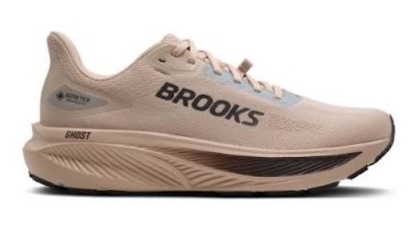
1. Brooks Ghost 18 GTX — Best overall for steady road mileage
| What I check | My read |
|---|---|
| Weather protection | GORE-TEX layer |
| Ride | Balanced, familiar daily-trainer feel |
| Best use | Regular easy and steady miles in cool rain |
| Main tradeoff | Not my first choice for sharp speedwork |
I put the Ghost 18 GTX first because it solves the ordinary rainy-run problem without asking a runner to adapt to an extreme platform. Brooks pairs a waterproof GORE-TEX layer with the balanced, softly cushioned Ghost road geometry. For the runner who wants to lace up at the same easy-to-steady pace on a drizzly Tuesday, that is a more useful promise than an exciting five-minute test jog.
What earns the Ghost its first-place slot is the familiar training job: I can use it for repeated easy and steady miles rather than saving it for a narrow workout. The GTX upper still deserves a separate fit test. I would try this exact version in my intended socks, check forefoot room and heel hold, then take a short rainy run before assigning it long mileage. Experience with a standard Ghost cannot prove the GTX version has identical volume, ventilation or wet-road traction.
I would put this beside my usual daily trainer on the same paved loop. The useful question is whether the waterproof upper lets the foot relax while the Ghost still disappears under me at easy pace. I check the heel after a wet turn and the toe box after the foot has warmed up; a membrane that makes me loosen the laces until the heel slips is a failed fit. On a smooth, cold, rainy route, the Ghost earns first place by being reliably ordinary.
My verdict: I would choose this for predictable winter training and skip it for sharp intervals. The membrane is likely to feel warmer than an open-mesh Ghost; in a humid summer downpour, I would rather let a breathable shoe drain. If the GTX upper pinches or the outsole feels uncertain on my route, the “best overall” label does not rescue the fit.
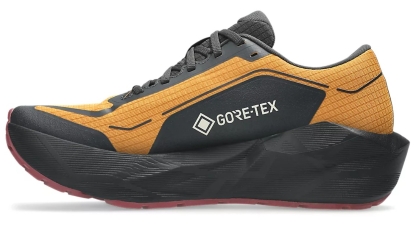
2. ASICS Novablast 6 GTX — Best lively ride
| What I check | My read |
|---|---|
| Weather protection | GORE-TEX Invisible Fit |
| Ride | Bouncy, high-cushion neutral ride |
| Best use | Rainy daily runs when I want more spring |
| Main tradeoff | Soft, elevated feel is less grounded |
If rain normally sends me back to a dull shoe, the Novablast 6 GTX is the option I would try first. ASICS combines waterproof Invisible Fit construction with FF BLAST MAX cushioning and spring-oriented geometry. I choose it for a runner who enjoys an energetic daily trainer and wants that sensation in cool wet weather, not for someone seeking firm, low-profile ground contact.
I would check how calmly it corners on painted crossings and cambered streets. ASICS adds ASICSGRIP at the forefoot, but rubber design is not a guarantee on every slick surface. The elevated, springy ride can feel less settled when my legs are tired, so I would test controlled turns and a moderate easy run before making it my only wet-weather trainer. I also want to know whether the lined upper feels restrictive around my toes after 30 minutes, not merely on first try-on.
I would test the Novablast at easy pace first and add a few controlled pickups only after the shoe feels settled. Bounce can make a damp road run enjoyable, but the high, springy platform asks me to pay attention at corners. The GTX version also deserves its own size check rather than an assumption from the mesh Novablast. If I want a less animated landing, I go back to Ghost; if I want a distinctly quicker-feeling session, I compare the speedwork shoe guide without expecting a waterproof trainer to replace a race shoe.
I would choose it over the Ghost when bounce matters more than a conventional, quietly stable ride. If the tall platform feels uncertain after a wet turn, I would take the calmer Ghost instead.
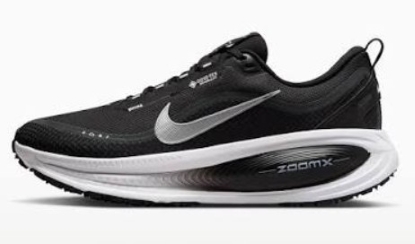
3. Nike Vomero 18 GORE-TEX — Best maximum cushion
| What I check | My read |
|---|---|
| Weather protection | GORE-TEX lining |
| Ride | Soft ZoomX-over-ReactX cushion |
| Best use | Long easy runs on wet pavement |
| Main tradeoff | Bulkier and potentially snugger than the standard upper |
The Vomero 18 GORE-TEX is my comfort-first option for repeated pavement miles in cold rain. Nike combines ZoomX over ReactX with a waterproof lining and a Storm-Tread outsole. That pairing matters: the membrane addresses water from above, while the wet-weather outsole addresses the separate issue of traction underfoot.
I would not transfer a fit verdict from the standard Vomero 18 to the GORE-TEX version without trying it on; a lined upper can change pressure over the instep and toes. With thicker socks, I still demand a locked heel and enough room for foot swelling instead of automatically sizing up. I would also check whether the heel feels stable when turning on wet pavement at the end of a long run.
The Vomero makes sense when I am covering long straight pavement, not weaving quickly through tight urban turns. I check whether the soft heel compresses evenly late in the run and whether Storm-Tread feels predictable on the actual streets I use. More cushioning is useful only if I keep my line through a wet corner. I compare the underlying comfort priorities in my cushioned-shoe guide, then let the waterproof upper and wet outsole decide whether this version earns a winter rotation slot.
My verdict: I would choose it when long-run comfort is the priority and skip it for fast track work. Its deeper cushioning may be welcome on repetitive pavement yet feel bulky to a runner who wants direct ground feel. Nike’s reflective details add visibility, but they do not replace lights or high-visibility clothing in traffic.
4. Nike Pegasus 42 GORE-TEX — Best responsive road option
| What I check | My read |
|---|---|
| Weather protection | GORE-TEX lining |
| Ride | ReactX plus full-length Air Zoom |
| Best use | Brisk daily runs in wet weather |
| Main tradeoff | Firmer, more directed feel than plush options |
The Pegasus 42 GORE-TEX is the one I would try when my wet-weather shoe still needs to pick up the pace. The current version uses a full-length Air Zoom unit with ReactX foam; Nike also specifies a Storm-Tread outsole and more forefoot room than the Pegasus 41. Those are meaningful version-specific reasons to choose the 42, not a recycled verdict from an older Peg.
On damp roads I value a secure midfoot even more than I do on dry straightaways. I would lace this shoe for a firm hold, run a few controlled corners, and see whether the upper crease or toe spring suits my stride. The 10 mm drop may feel familiar to some heel strikers, but drop alone cannot tell me whether a shoe fits or stays comfortable.
I value the Pegasus when the forecast is wet but the workout is still a normal road run with a few brisk sections. The full-length Air Zoom unit gives it a clearer forward response than the Vomero. My check is whether that response stays smooth when I shorten my stride near puddles and painted lines; I do not chase pace across low-grip patches. If the 42 GTX upper feels too firm over the instep, I would rather change models than hope it stretches into a comfortable fit.
I would buy it for mixed easy and quicker miles. I would pass if I want the soft, broad sensation of the Vomero or if the waterproof upper presses my instep. I would fit the waterproof upper separately from the ordinary Pegasus before deciding.
5. ASICS GT-2000 15 GTX — Best guided stability
| What I check | My read |
|---|---|
| Weather protection | GORE-TEX upper |
| Ride | Support-oriented road geometry |
| Best use | Runners who want guidance in wet-weather training |
| Main tradeoff | Fit and exact ride need an in-person check |
For a runner who already prefers a stable road shoe, I would not steer them toward a bouncy neutral model merely because it has a membrane. The GT-2000 15 GTX is a current waterproof entry in ASICS’ stability line. Its purpose here is a more guided rainy-day alternative to the Novablast, not a promise that a stability shoe fixes an injury or every pronation pattern.
I would compare it against the Ghost and On Cloudrunner on my own foot, paying attention to midfoot pressure, heel hold, and whether the guidance feels natural as I tire. I also want a true paved-road outsole: a shoe can be waterproof and supportive yet still feel awkward on long, smooth sidewalks.
This is the guided pick I would compare with Ghost 18 GTX on a flat, repeatable route. I want the support to feel quietly centered, especially after 30 minutes, with no arch or sidewall pressure. I do not choose it from a wet-footprint test. My stability-shoe guide explains when a guided platform earns a place; my overpronation guide is a separate fit question. A waterproof lining does not make unnecessary support useful.
I would buy it if a guided shoe already works for me and this lined upper passes the fit test. I would skip it when a neutral shoe feels stable and comfortable without extra structure.
6. On Cloudrunner 3 Waterproof — Best non-GTX stable alternative
| What I check | My read |
|---|---|
| Weather protection | On waterproof construction |
| Ride | Wide, steady CloudTec platform |
| Best use | Cool, wet commutes and easy runs |
| Main tradeoff | Less responsive for faster sessions |
Not every waterproof road shoe needs a GORE-TEX label. On lists the Cloudrunner 3 Waterproof as a road-running model with a waterproof upper and a notably stable, everyday platform. I would try it for the runner who prioritizes a centered landing and a secure, structured feel over playful rebound.
I would take care not to confuse it with the regular Cloudrunner 3 or the Cloudrunner 3 Max. The waterproof model is the one relevant here. On describes its ride as low in responsiveness, which I consider a useful honest tradeoff: I would use it for routine miles and walking-heavy days, not threshold repeats.
I would consider the Cloudrunner for a runner who splits the day between a steady road run and a long wet walk. Its broad base and restrained response should feel more composed than exciting. That makes the buying test simple: does the heel sit securely and does the upper stay comfortable over the toes once the shoe is warm? If I want one shoe for both activities, I still fit this waterproof version on its own rather than rely on the ordinary Cloudrunner’s fit.
For me, its steady role makes the upper fit the decisive question; I would test that before paying for the waterproof version. If it feels constricting or too firm, I would go back to the Ghost or compare a standard shoe for warm rain.
7. ASICS GT-1000 15 GTX — Best lower-cost wet-weather support
| What I check | My read |
|---|---|
| Weather protection | GORE-TEX upper |
| Ride | FF BLAST with 3D GUIDANCE SYSTEM |
| Best use | Rainy pavement plus occasional park paths |
| Main tradeoff | Lugged sole is more mixed-terrain than pure road |
The GT-1000 15 GTX is my practical-value candidate when the route crosses wet sidewalks, gravel cut-throughs, or park paths. ASICS gives the current GTX model FF BLAST cushioning, 3D GUIDANCE SYSTEM support, and a lugged outsole. That is a more specific use case than calling it the cheapest all-purpose road shoe.
Those lugs are also the limitation. If every mile is smooth asphalt, I would compare the Ghost or GT-2000 first; a mixed-terrain tread is not automatically smoother or safer on wet paint, metal grates, or ice. The waterproof upper can keep rain out in modest puddles, but water over the collar will still find its way in.
The GT-1000 belongs here because some road routes are interrupted by park paths and gravel shoulders. Its lugged outsole gives it a different role from the road-smoother GT-2000. I would keep it for those mixed routes only if the tread feels composed on the asphalt sections; a more rugged outsole does not promise traction on wet metal or ice. If the unpaved part is substantial, my gravel-road shoe guide helps decide whether a true hybrid or trail shoe fits better.
I would choose it for a stable, versatile winter commute or run at a lower list price. I would not market it as a pure road-speed shoe or treat its construction as proof of long-run durability.
How I Rank Waterproof Road Shoes
I rank the exact waterproof versions by whether the model exists for US buyers, whether its road ride matches a clear training job, what the outsole offers in wet conditions, and which fit or heat penalty might change my choice. I use verified construction and model details to build the shortlist. I have not represented these seven waterproof variants as side-by-side field-tested pairs or assigned test mileage I cannot substantiate. The recommendations are purchase decisions to confirm on the runner’s own foot and route.
My first actual-pair check would be a short cool-rain run on familiar pavement: note entry at the collar and seams, pressure under thicker socks, grip through controlled turns, heat buildup, and drying afterward. One failure in fit or footing would override my published ranking. I would also confirm the exact waterproof variant, size, seller and return policy before clicking buy. For the wider day-to-day context, see my rain-running tips and gear.
How I Choose a Waterproof Road Running Shoe
- Start with weather: for cold rain and repeated puddle splash, I value a membrane. In warm, humid rain, I often prefer open mesh that drains and dries faster.
- Choose the ride first: Ghost for an ordinary daily trainer, Novablast for bounce, Vomero for deep cushion, Pegasus for a brisker feel, or a guided model only if I like that type of support.
- Try the exact waterproof variant: I wear the socks I plan to run in and check toe room, instep pressure and heel lockdown. The standard shoe is not a fit guarantee.
- Inspect the surface: I want a road outsole that feels trustworthy on my route. Waterproofing does not create traction on ice; I adjust route and pace when the surface is hazardous.
- Think beyond the upper: rain pants and socks can channel water through the collar. I do not buy a waterproof shoe expecting it to function like a sealed boot.
If pavement impact comfort is the main question, my concrete-running shoe guide tackles that separately. For a lined upper that changes toe or instep room, I use my running shoe size guide before deciding whether to change size. For foot friction in soaked socks, I use the fit and fabric advice in my running-sock guide.
My Three-Run Wet-Road Fit Check
I do not decide from a dry-store try-on alone. I first fit the exact waterproof model indoors with my normal cold-weather socks, checking toe room, instep pressure and heel lockdown. I then run a short familiar loop in light rain, keeping the pace easy and avoiding genuinely hazardous surfaces. Finally, I repeat at the distance and pace I expect to use regularly, checking for heat, rub and later-day discomfort.
| Check | What I want | My reason to pass |
|---|---|---|
| After 10 minutes | Secure heel, free toes, no lace pressure | Membrane or thick socks make the upper restrictive |
| On wet turns | Predictable placement on ordinary asphalt | Shoe feels unstable or rubber slips on my route |
| After the run | No hot spots; shoe dries acceptably before next use | Sweat buildup or trapped water outweighs rain protection |
No road shoe makes wet paint, metal, frost or ice safe. If the outsole has worn smooth, I use my running-shoe replacement check before blaming the membrane. For a warm summer shower, I often choose a breathable trainer and use my rain-running gear guide instead of paying the heat penalty of a waterproof upper.
I use my concrete-running shoe guide when pavement impact comfort matters more than weather protection. For the lined upper itself, my running-shoe sizing guide and running-sock guide help me solve fit and friction before I buy a longer shoe to gain width.
Full Comparison: Ride, Use and Main Caveat
| Shoe | Ride / support | My best use | Watch for |
|---|---|---|---|
| Brooks Ghost 18 GTX | Balanced, familiar daily-trainer feel | Regular easy and steady miles in cool rain | Not my first choice for sharp speedwork |
| ASICS Novablast 6 GTX | Bouncy, high-cushion neutral ride | Rainy daily runs when I want more spring | Soft, elevated feel is less grounded |
| Nike Vomero 18 GORE-TEX | Soft ZoomX-over-ReactX cushion | Long easy runs on wet pavement | Bulkier and potentially snugger than the standard upper |
| Nike Pegasus 42 GORE-TEX | ReactX plus full-length Air Zoom | Brisk daily runs in wet weather | Firmer, more directed feel than plush options |
| ASICS GT-2000 15 GTX | Support-oriented road geometry | Runners who want guidance in wet-weather training | Fit and exact ride need an in-person check |
| On Cloudrunner 3 Waterproof | Wide, steady CloudTec platform | Cool, wet commutes and easy runs | Less responsive for faster sessions |
| ASICS GT-1000 15 GTX | FF BLAST with 3D GUIDANCE SYSTEM | Rainy pavement plus occasional park paths | Lugged sole is more mixed-terrain than pure road |
Frequently Asked Questions
Are waterproof road running shoes worth it?
For my cool, frequent rain runs, yes—if the exact membrane shoe fits and grips well. For warm showers, I often choose breathable mesh and accept wet feet because the shoe drains faster.
Does GORE-TEX keep feet completely dry?
No. It resists water through the upper, but water can enter over the collar and feet can still feel damp from sweat. I treat it as rain protection, not a watertight seal.
Are waterproof shoes safe on wet pavement or ice?
Waterproofing says nothing about traction. I assess outsole grip separately and slow down on paint and metal. None of these road shoes makes ice safe.
Should I size up for a waterproof version?
Not automatically. I try the exact GTX or waterproof version in my intended socks, allowing toe room without heel slip. A membrane can change interior volume compared with the standard shoe.
Can I use a waterproof road shoe on trails?
I will use one on a smooth park path, but technical dirt, mud and rock require a trail-specific outsole and stability. The GT-1000 15 GTX has mixed-terrain lugs, yet I still would not make it my technical-trail shoe.
My Final Recommendation
I would start with the Brooks Ghost 18 GTX for dependable everyday road miles in cool rain. I would choose the ASICS Novablast 6 GTX if I want more energy underfoot, or the ASICS GT-2000 15 GTX if I already prefer a guided ride. The right final answer is the waterproof variant that fits my foot securely and behaves predictably on my wet route—not the one with the biggest membrane logo.

About Ken
I am Ken, the runner behind NextGait. I have spent 12 years running and comparing footwear for NextGait. I separate confirmed product details from firsthand testing, and I make my final buying call only after fit and route conditions are considered. Read more about my approach.