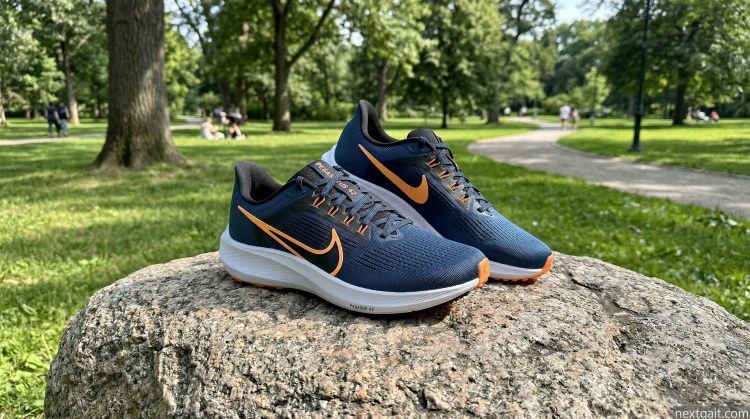
The Nike Pegasus 42 is a durable, stable, high-drop daily trainer that feels smoother than Pegasus 41 but remains more dependable than exciting. After 150+ miles, I rate it 8.1/10. It is best for easy running, ordinary daily mileage, short steady efforts, walking, treadmill use, and runners who prefer a grounded ride.
The headline update is a curved, full-length Air Zoom unit inside ReactX foam. It connects heel and forefoot contact more smoothly than the separate units in Pegasus 41. It does not turn the shoe into a tempo trainer. Independent testing found average or below-average energy return, and that matches the limits I felt when pace increased.
Pegasus 42 succeeds through consistency: a comfortable upper, secure heel, improved forefoot room, predictable 10 mm geometry, good road grip, and durable rubber. Its trade-offs are weight, a thin-feeling forefoot, limited rocker, and a ride that lacks the rebound of newer supercritical-foam trainers.
Buy it if you want one conventional workhorse for two or three weekly runs plus gym and casual use. Skip it if you want soft recovery cushioning, a light tempo shoe, low-drop geometry, or a forefoot-focused long-run trainer.

Jump to Section Click to expand
- Quick Verdict
- Ken’s Ranking Rule
- How I Tested
- 150-Mile Timeline
- Specs and Verified Facts
- Full-Length Air Zoom
- Ride Feel
- Performance by Pace
- Long Runs
- Performance by Surface
- Fit and Sizing
- Upper and Lockdown
- Stability
- Grip and Durability
- Pegasus 42 vs 41
- Key Comparisons
- Decision Matrix
- Training Rotation
- Who Should Buy
- Who Should Skip
- Sources and Corrections
- Final Verdict
- FAQ
Nike Pegasus 42 Review: Quick Verdict
The Pegasus 42 is a safe daily-trainer choice for runners who value fit, durability, stability, and a traditional heel-to-toe transition more than low weight or high rebound. It is a better Pegasus 41, but not a category reset.
| Decision | Ken’s Answer |
|---|---|
| Best for | Easy runs, daily mileage, short steady runs, treadmill, walking, gym |
| Ride | Balanced-firm, smooth, grounded, heel-cushioned, restrained rebound |
| Fit | True to normal Nike length for me; more forefoot room than Pegasus 41 |
| Official weight | Approx. 300 g / 10.59 oz in men’s US 10 |
| Official drop | 10 mm |
| Midsole | ReactX foam with curved full-length Air Zoom |
| Plate | None |
| Main strength | Reliable daily function and outsole durability |
| Main weakness | Heavy for its stack with limited forefoot cushioning and speed response |
| Ken’s score | 8.1/10 |
In my best running shoes framework, Pegasus 42 ranks as a dependable workhorse rather than a performance leader. That distinction matters: reliability can be the right priority even when lighter, softer, and livelier shoes exist.
It is also a sensible candidate for beginner running shoes because the ride is predictable and the upper is forgiving. A beginner does not need the most technologically aggressive shoe; the fit still has to work.
Bottom line: Pegasus 42 is smoother, roomier, and grippier than Pegasus 41. It remains a heavy, traditional daily trainer whose strongest arguments are durability, comfort, and consistency, not exceptional energy return.
Ken’s Ranking Rule for the Nike Pegasus 42
Ken’s ranking rule: a workhorse daily trainer earns its score by staying predictable after the novelty disappears. I reward fit security, smooth transitions, pace usefulness, surface grip, durability, and comfort that remains recognizable beyond 100 miles.
I do not award points merely because a shoe contains an Air unit. A mechanical feature matters only when the finished shoe improves the run. I also do not compare a conventional trainer with a carbon racer and call the slower shoe a failure.
| Ranking Factor | Weight | Pegasus 42 | Why |
|---|---|---|---|
| Daily ride consistency | 22% | 8.5/10 | Stable and smooth from easy through short steady running |
| Fit and upper | 18% | 8.8/10 | Excellent heel hold, plush tongue, improved forefoot room |
| Pace versatility | 16% | 7.2/10 | Works when pace rises gradually; heavy for workouts |
| Cushioning | 14% | 7.5/10 | Good heel protection, limited forefoot depth |
| Grip and durability | 12% | 9.0/10 | High-abrasion rubber and favorable wear |
| Stability | 10% | 8.5/10 | Grounded geometry and secure upper without guidance |
| Value | 8% | 8.0/10 | Broad utility and long service trend offset the weight |
The weighted result rounds to 8.1. Heel strikers and long-time Pegasus users may score it higher. Forefoot strikers, low-drop runners, and athletes used to lightweight superfoams may score it much lower.
My run log supports the personal fit, pace, surface, and wear sections. Nike supplies official specifications and design claims. Lab figures belong to the named third-party protocol; I did not recreate those tests at home.
How I Tested the Nike Pegasus 42
I logged more than 150 miles across Atlantic City Boardwalk planks, asphalt roads, concrete, and treadmill sessions. The retained WordPress revision history carries the same 150+ mile claim, surfaces, workout categories, pace ranges, and long-run distances from the earliest saved version.
| Test Element | Documented Range | What I Evaluated |
|---|---|---|
| Total distance | 150+ running miles | Ride consistency, outsole, upper, late-run feel |
| Surfaces | Road, concrete, boardwalk, treadmill | Grip, noise, hardness, transition, heat |
| Easy pace | About 9:00-10:00 per mile | Daily rhythm and cushioning |
| Recovery pace | About 10:00-11:30 per mile | Slow-speed stability and comfort |
| Steady and tempo | About 7:15-9:00 per mile | Weight, rebound, transition |
| Intervals | About 6:30-7:15 per mile | Acceleration and turnover limits |
| Long runs | 10-16 miles | Forefoot comfort and ride under fatigue |
| Comparison | Pegasus 41 and current daily trainers | Direction of update, not a controlled trial |
The retained article does not preserve a trustworthy test-pair size or controlled surface percentages, so I do not invent them here. Official and lab weights use their own stated reference sizes and should not be assigned to my pair.
I kept the stock removable insole and used ordinary running socks. The shoe followed my normal Nike running length, while the front felt less restrictive than Pegasus 41. Fit observations are personal even when independent reviewers reach a similar conclusion.
The faster sessions confirmed capability, not specialization. Completing a tempo segment in Pegasus 42 does not make it my first tempo choice. Sleep, route, wind, fatigue, and workout structure affect pace, so I avoid treating one watch metric as proof of midsole efficiency.
The previous draft used cadence and stride-length differences to prove the shoe caused biomechanical improvement. Those comparisons cannot isolate footwear from route, fatigue, pace, measurement error, or normal run-to-run variation, so they have been removed.
Runners reproducing the easy work should use effort, not a copied pace. My easy-run pace guide and recovery-run guide explain the training intent.
What Changed from Day 1 to 150+ Miles
Pegasus 42 felt ready early and retained the same balanced-firm personality through 150+ miles. The upper settled around the foot, the rubber smoothed in high-contact areas, and the foam lost some freshness, but the basic transition remained consistent.
| Checkpoint | What I Observed | What It Means |
|---|---|---|
| First 20 miles | Secure upper, smooth heel-to-forefoot connection, firm-balanced foam | No major break-in required |
| 20-60 miles | Daily rhythm felt settled; rubber remained sharp | The shoe established its workhorse role |
| 60-100 miles | Forefoot felt less forgiving on longer outings | Long-run ceiling became clearer |
| 100-150+ miles | Ride remained usable; high-contact rubber showed normal smoothing | Positive durability result, not a future-mileage promise |
The full-length Air unit made transitions feel more connected than Pegasus 41 from the start. I did not experience a delayed release after 20 or 30 miles. Familiarity improved timing; it did not create a dramatic new bounce.
The forefoot was the first area where fatigue became noticeable on longer runs. That is consistent with independent measurements showing less stack and shock absorption up front than at the heel. It does not establish a universal distance cutoff.
The outsole remained one of the shoe’s strongest components. Cosmetic smoothing did not become a grip failure. I saw no reason to retire the pair at 150+ miles, but I will not turn that snapshot into a guaranteed 400- or 500-mile result.
Owners should watch for repeated discomfort, meaningful traction loss, uneven wear that changes the ride, damaged upper hold, or a midsole that no longer feels consistent. My running-shoe replacement guide covers those checks.
Nike Pegasus 42 Specs and Verified Facts
Nike publishes Pegasus 42 as a responsive road-running shoe with ReactX foam, a curved full-length Air Zoom unit, a 10 mm drop, an updated MR-10 2.0 last, lightweight mesh, and a high-abrasion rubber outsole. Nike lists approximately 300 g for a men’s US 10.
| Specification | Published Detail | Practical Meaning |
|---|---|---|
| Category | Neutral responsive daily road trainer | General training without formal guidance |
| Men’s reference weight | Approx. 300 g / 10.59 oz, US 10 | Heavy relative to many similar-stack trainers |
| Drop | 10 mm | Heel-biased geometry |
| Midsole | ReactX foam | Balanced rather than super-soft or highly rebounding |
| Air unit | Curved full-length Air Zoom | Smoother connection across landing patterns |
| Plate | None | Air unit is not a carbon or nylon plate |
| Upper | Lightweight breathable mesh | Plush secure fit with added forefoot room |
| Last | MR-10 2.0 | Updated from Pegasus 41 |
| Outsole | High-abrasion rubber with flex grooves | Grip and durability are core strengths |
| Widths | Regular and Wide shown on current U.S. page | Availability varies by size and color |
Nike’s current U.S. page does not publish stack height. Independent sources differ by method. RTINGS measured 37.4/26.7 mm and 10.7 mm drop. RunRepeat measured 36.0/22.0 mm and 14.0 mm. The large forefoot disagreement is why this review labels every measurement with its source.
Independent weights vary by sample and size. RTINGS recorded 282.6 g, RunRepeat 286 g, and The Run Testers 305 g in a men’s US 10. Nike’s approximately 300 g reference is the appropriate official figure.
Nike states ReactX is 13 percent more responsive than previous React technology. That comparison concerns foam generations, not Pegasus 42 versus Pegasus 41 and not whole-shoe running economy. The prior article incorrectly converted it into a different claim.
The official page says the full-length Air Zoom unit provides Nike’s highest energy return from heel to toe-off. That is manufacturer positioning. Independent whole-shoe tests do not show category-leading return, so the review presents both pieces of evidence.
Does Full-Length Air Zoom Make Pegasus 42 Faster?
The full-length Air Zoom unit makes Pegasus 42 smoother than Pegasus 41, but it does not make the shoe unusually fast or springy. Its main benefit is continuity: runners no longer have to load separate heel and forefoot units.
The Air unit is a pressurized flexible chamber encased by ReactX. It deforms under load and returns toward its original shape. The surrounding foam, outsole, stack, geometry, upper, and runner all influence how that mechanism feels.
On easy runs, I noticed a cleaner heel-to-midfoot transition than in Pegasus 41. The sensation was organized rather than explosive. At faster pace, the shoe still carried substantial mass and lacked the forward rocker of many performance trainers.
RunRepeat measured 57.1 percent heel and 61.2 percent forefoot energy return, around its averages. RTINGS measured 70.4 and 71.8 percent under a different protocol and rated overall energy return low. Cross-lab percentages are not interchangeable, but neither source found a major performance leap.
RTINGS reported less than a one-percent heel improvement and no meaningful forefoot improvement versus its Pegasus 41 sample. That directly challenges the previous article’s unsupported claim of a 15-percent whole-shoe gain.
An Air unit also does not remain unchanged forever by definition. The finished ride depends on foam, bonding, pressure, rubber, and structure. My pair remained functional at 150+ miles; I cannot isolate or guarantee the lifespan of the internal unit.
The useful conclusion is narrower and stronger: full-length Air improves transition consistency across foot strikes. It does not remove the Pegasus trade-offs of weight, moderate foam response, and limited forefoot depth.
Ride Feel: Smooth, Grounded, and Conventional
Pegasus 42 lands with reasonable heel cushioning, moves through a stable middle, and leaves the forefoot with a direct rather than springy toe-off. The ride feels familiar to long-time Pegasus runners.
Heel strikers receive the best version of the shoe. The 10 mm geometry, rearfoot cushioning, bevel, and full-length Air path work together to create a predictable landing. RunRepeat also identified it as particularly suitable for heel-first mechanics.
Midfoot contact feels firm-balanced. The moderate stack and flexible construction provide more road information than max-cushion trainers. The shoe is not wide underneath, but it avoids the lateral movement associated with very soft foam.
Forefoot strikers face the main limitation. Independent measurements and shock-absorption testing show less material and protection at the front. My long-run fatigue also arrived there before the heel felt depleted.
The shoe has greater toe spring than Pegasus 41, according to Nike, but only a modest rocker in practice. The sole bends and the toe curves upward; it does not roll the runner forward like a strongly rockered trainer.
On concrete, the heel felt adequately protected while the forefoot remained direct. Runners choosing from my concrete running shoe guide should decide whether that ground feel is welcome or tiring.
The 10 mm drop does not make the shoe universally better for heel strikers or worse for everyone else. Stack distribution, foot strike, pace, tissue tolerance, and training history matter. It simply creates a more heel-biased sensation than lower-drop rivals.
How the Nike Pegasus 42 Performs by Pace
Recovery pace
Recovery running works when you prefer a firmer, stable platform. The shoe remains controlled as cadence drops, though runners who want deep softness will prefer a Vomero, Nimbus, or another max-cushion model.
Easy daily pace
Around 9:00-10:00 per mile in my log, Pegasus 42 feels most natural. The upper disappears, the heel transition smooths out, and the weight becomes less noticeable once rhythm settles. This is the shoe’s primary job.
Steady aerobic pace
Short steady running is credible. The full-length Air path feels more connected than Pegasus 41, and the direct forefoot gives a stable push-off. The shoe becomes less appealing as the effort depends on quick acceleration.
Tempo pace
I completed tempo segments around 7:15-8:00 per mile, but capability is not preference. The 300 g reference mass, flat geometry, and average return make the effort feel more labored than in a modern performance trainer. See my tempo-run guide for the workout purpose.
Intervals
Intervals around 6:30-7:15 per mile exposed the same weakness. The upper holds well, but the shoe does not accelerate or turn over like a lighter trainer. My interval guide is better paired with a purpose-built workout shoe.
| Pace or Use | Ken’s Grade | Reason |
|---|---|---|
| Recovery | B+ | Stable and predictable, but not plush |
| Easy daily | A | The ride, fit, and durability align here |
| Steady aerobic | B+ | Smooth enough for gradual progression |
| Long easy | B | Heel holds up; forefoot can tire late |
| Tempo | B- | Possible, yet heavy and insufficiently energetic |
| Intervals | C+ | Secure but slow to accelerate |
| Racing | C+ | Durable finish option, not a performance advantage |
| Walking and gym | A- | Grounded, stable, and comfortable |
Long Runs and Distance Limits
Pegasus 42 can cover long runs, but my confidence drops when the session extends beyond roughly 10-13 miles or emphasizes forefoot loading. I completed runs up to 16 miles; that does not make it my preferred long-run shoe.
The heel remained comfortable and the upper allowed normal swelling. The forefoot felt less protective as duration increased, particularly once form and cadence changed under fatigue. That pattern agrees with RunRepeat and RTINGS cushioning results.
For a first half marathon, Pegasus 42 can be a finish-focused option if it has already passed race-pace long runs. My first half-marathon plan provides enough practice to make that decision before race day.
Marathon use is possible but not optimal for most runners. The shoe is durable and stable, yet the weight, forefoot protection, and limited return compare poorly with modern long-distance options in my long-distance shoe guide.
A heel striker who dislikes tall soft shoes may prefer Pegasus 42 for distance. A forefoot striker or runner who values late-run rebound likely will not. Distance recommendations should follow tested comfort, not a universal mileage label.
Road, Boardwalk, Treadmill, and Light Paths
Pegasus 42 is at its best on asphalt and smooth concrete, where the rubber grips and the grounded platform feels predictable. It also handles treadmill running and dry boardwalk planks well.
On asphalt, the transition is quiet and controlled. The rubber protects the foam from direct abrasion and adds a firm layer to toe-off. This was the clearest expression of the traditional Pegasus workhorse character.
Boardwalk planks introduce seams and occasional dampness. The outsole remained secure in ordinary conditions during my test. Wet wood can change rapidly with algae, paint, and salt, so one pair cannot establish safety across every section.
On a treadmill, the low-to-moderate stack feels stable and the upper manages heat reasonably well. The platform is less soft than the belt-plus-max-cushion combination some runners dislike. My treadmill shoe guide includes lighter options for faster sessions.
The outsole can tolerate smooth packed paths, but Pegasus 42 is not a trail shoe. It lacks lugs, rock protection, and a trail upper. Wet leaves, loose gravel, roots, and angled terrain require different judgment than urban pavement.
For rain, traction is only one part of risk. My rain-running guide covers painted lines, visibility, route choice, and wet braking.
Nike Pegasus 42 Fit and Sizing
Pegasus 42 followed my normal Nike running-shoe length and gave me more forefoot room than Pegasus 41, with a secure heel and close midfoot. The update is more accommodating, not anatomically wide.
| Fit Area | My Experience | Buyer Check |
|---|---|---|
| Length | Normal Nike running length | Keep normal front clearance |
| Heel | Secure with no meaningful slip | Firm counter may affect sensitive heels |
| Midfoot | Close and well anchored | High insteps should monitor lace pressure |
| Forefoot | Roomier than Pegasus 41 | Still conventional rather than foot-shaped |
| Toe height | Adequate in my pair | Independent mold data is near average |
| Widths | Regular and Wide on current Nike U.S. page | Availability varies |
Nike says the MR-10 2.0 last adds room at the toes and forefoot. RunRepeat’s interior mold measured 96.5 mm at the widest area, slightly above its average, while the big-toe width and height were close to average.
Independent wear reviewers disagree at the edges. The Run Testers found normal sizing and a roomy toe box; Running Shoes Guru found its pair narrow enough to consider a half-size change or Wide. That range is a reason to try the shoe, not a reason to declare either tester wrong.
Use the Wide version for width rather than automatically adding length. Sizing up can move the flex point and reduce heel hold. My wide-feet shoe guide separates toe shape, ball width, instep volume, and heel fit.
The removable insole allows another insert physically, but volume and geometry change when an orthotic is added. This review does not claim compatibility with a prescription device or a particular diagnosis.
Upper, Lockdown, and Breathability
The redesigned upper is Pegasus 42’s clearest strength: soft mesh, a secure heel, a centered semi-gusseted tongue, and a more accommodating forefoot create reliable daily lockdown.
The tongue is unusually padded. RunRepeat measured 9.1 mm, well above its database average, and found strong moisture management under its newer breathability protocol. The padding improves lace comfort but adds weight and can feel warm.
Tom’s Guide also found the upper comfortable but noted that the padded tongue and collar could feel oppressive in heat. My treadmill use was comfortable, though the shoe never felt as airy as a minimal workout upper.
The hybrid eyelet system distributes pressure effectively, and the tongue loop prevents drift. I did not need extreme lace tension for heel hold. That is important because a heavy daily trainer feels more cumbersome when the upper allows motion.
Durability is mixed by component. RunRepeat’s machine test found weak toebox material abrasion resistance but strong heel-padding durability. My upper remained functional through 150+ miles. Standardized vulnerability and one favorable road sample can coexist.
Reflective heel details improve recognition in headlights but do not replace a vest, lamp, or route awareness. Treat them as a secondary feature rather than a safety guarantee.
Is the Nike Pegasus 42 Stable?
Pegasus 42 is stable for a neutral trainer because the foam is controlled, the stack is moderate, the heel counter is structured, and the upper holds the foot well. It is not a stability shoe.
I felt secure at easy pace, on treadmill belts, and across boardwalk seams. The shoe did not feel soft enough to roll laterally, and its high drop concentrated cushioning at the heel.
The external platform is not unusually broad. RunRepeat measured below-average forefoot and heel widths, while RTINGS still rated overall stability positively. That shows why platform width alone cannot define stability.
There is no medial post or formal guidance structure. Runners seeking more support should compare fit and comfort in my stability running shoe guide and overpronation shoe guide.
Flat feet do not automatically require stability shoes, and a neutral shoe does not diagnose gait. Persistent pain, repeated instability, or a significant change in movement deserves assessment from a qualified clinician.
Outsole Grip and Durability After 150+ Miles
The updated high-abrasion rubber outsole is Pegasus 42’s strongest objective performance feature. It gripped roads, concrete, treadmill belts, and ordinary damp boardwalk sections while remaining functional after 150+ miles.
Nike revised the classic Waffle layout with more complex rubber placement and flex grooves. The forefoot bites predictably without turning the shoe rigid, and the exposed areas reduce some outsole mass.
RunRepeat measured a 0.50 forefoot traction coefficient and 0.8 mm abrasion in its machine test, both favorable results. Its measured 2.6 mm outsole thickness is below database average, showing that compound performance matters alongside rubber depth.
My pair developed smoothing at the lateral heel and forefoot contact zones without a functional traction loss. The wear did not justify the previous article’s exact remaining-performance percentages. Visual appearance is not a calibrated capacity measurement.
No universal lifespan follows from this result. Runner mass, foot strike, scuffing, route texture, weather, rotation, and acceptable wet grip all change replacement timing. The defensible claim is 150+ miles with usable function.
Runners with higher body mass may value the firm platform and rubber, but fit and comfort still lead. My guide for heavier runners avoids prescribing a category from body weight alone.
Nike Pegasus 42 vs Pegasus 41
Pegasus 42 is smoother, roomier, and better gripping than Pegasus 41, but it remains close in ride character and becomes slightly heavier. The update is meaningful for fit and transition, not transformative for speed.
| Feature | Pegasus 42 | Pegasus 41 | Ken’s Take |
|---|---|---|---|
| Air Zoom | Curved full-length unit | Separate heel and forefoot units | V42 connects landing patterns more smoothly |
| Foam | ReactX | ReactX | Core foam character remains familiar |
| Fit | MR-10 2.0 with more toe and forefoot room | Closer front | V42 is more accommodating |
| Toe geometry | Greater toe spring | Less toe spring | V42 transitions slightly more easily |
| Upper | Softer updated mesh and revised lacing | Previous mesh | V42 improves comfort and pressure control |
| Outsole | Updated rubber layout and flex grooves | Previous Waffle layout | V42 grip is a real improvement |
| Weight | Official 300 g in men’s US 10 | Generally lighter | V42 pays for the Air redesign in mass |
| Performance | Smoother, still moderate return | Familiar daily workhorse | No urgent upgrade for happy v41 owners |
My most consistent difference was the absence of separate-unit sensation through the forefoot. The full-length construction feels more continuous. It does not create the strong snap described in the previous draft.
Upgrade if Pegasus 41 feels lumpy, tight at the toes, or insecure on wet roads. Keep Pegasus 41 if it fits, has usable life, and you expect a dramatic speed benefit from version 42.
Nike Pegasus 42 vs Similar Daily Trainers
Pegasus 42 vs Brooks Ghost 18
The Brooks Ghost 18 offers a conventional daily ride with more forefoot protection and a less Air-specific feel. Pegasus is firmer and more grounded. Choose Ghost for comfort; Pegasus for rubber, gym crossover, and Nike fit.
Pegasus 42 vs HOKA Mach 7
The HOKA Mach 7 is substantially lighter and better suited to faster daily running. Pegasus has a more traditional high-drop ride and tougher workhorse identity. Mach for pace; Pegasus for durability and conventional feel.
Pegasus 42 vs HOKA Clifton 10
The HOKA Clifton 10 is taller, softer, and more rockered. Pegasus is firmer, more flexible, and more grounded. Clifton suits easy and longer comfort; Pegasus suits runners who dislike tall soft platforms.
Pegasus 42 vs Saucony Ride 19
The Saucony Ride 19 is lighter and offers a more modern foam-only daily transition. Pegasus provides the more structured heel and proven rubber feel. Ride is the broader runner; Pegasus is the sturdier traditional option.
Pegasus 42 vs ASICS Novablast
The ASICS Novablast feels softer, bouncier, and better for progressive running. Pegasus feels calmer and more stable underfoot. Choose Novablast for energy; Pegasus for restraint and durability.
Pegasus 42 vs Nike Vomero 18
The Nike Vomero 18 provides much deeper cushioning for recovery and long runs. Pegasus is more grounded and gym-friendly. Vomero for comfort volume; Pegasus for ordinary short-to-medium daily work.
Pegasus 42 vs Saucony Endorphin Speed
The Saucony Endorphin Speed is lighter, plated, and built for workouts. Pegasus is calmer and more durable for easy mileage. They belong in a rotation rather than a direct either-or contest.
Daily Trainer Decision Matrix
Choose Pegasus 42 when a durable, secure, high-drop, grounded daily trainer fits the brief. Choose another model when softness, forefoot cushioning, low mass, or speed versatility leads.
| Shoe | Choose It When | Trade-Off vs Pegasus 42 |
|---|---|---|
| Nike Pegasus 42 | You want traditional daily reliability and durable grip | Heavy and limited at faster pace |
| Brooks Ghost 18 | You want conventional comfort with more forefoot cushion | Less grounded and less Nike-specific fit |
| HOKA Mach 7 | You want a light, faster daily trainer | Less workhorse feel |
| HOKA Clifton 10 | You prefer soft, rockered easy mileage | Taller and less direct |
| Saucony Ride 19 | You want a lighter all-purpose neutral trainer | Less structured heel sensation |
| ASICS Novablast | You prioritize bounce and progression runs | Less calm and grounded |
| Nike Vomero 18 | You want recovery and long-run cushioning | Heavier-feeling and less gym-friendly |
The Pegasus remains a credible one-shoe option for recreational runners. It is less convincing for runners who regularly combine easy mileage with demanding speed work.
Best Training Rotation with Pegasus 42
I would use Pegasus 42 for easy daily mileage, short steady runs, treadmill sessions, walking, and gym work, then pair it with a lighter trainer for tempo, intervals, and racing.
| Training Job | Primary Shoe | Reason |
|---|---|---|
| Recovery | Pegasus 42 or softer recovery shoe | Choose stable firmness or deeper softness |
| Easy daily | Pegasus 42 | Its clearest role |
| Steady aerobic | Pegasus 42 | Smooth when pace rises gradually |
| Long run | More cushioned long-run shoe | Better forefoot protection |
| Tempo and intervals | Light performance trainer | Lower mass and stronger return |
| Race day | Proven race-specific shoe | Better efficiency and turnover |
A simple Nike rotation pairs Pegasus 42 with Vomero for recovery and long runs, then adds Pegasus Plus or a race shoe for quality work. Brand matching is optional; role matching is what matters.
Rotation does not replace rest or workload control. A durable outsole can outlast the runner’s readiness for another hard session.
Who Should Buy the Nike Pegasus 42
Buy Pegasus 42 if you want a conventional daily trainer that feels secure, stable, durable, and familiar across ordinary training and daily life.
- Heel strikers who prefer a 10 mm drop
- New runners wanting a predictable workhorse
- Two- or three-day-per-week runners using one primary shoe
- Long-time Pegasus owners seeking smoother transitions and more toe room
- Road and treadmill runners who value outsole grip
- Runners who dislike tall, soft, highly rockered shoes
- People mixing easy running with walking and light gym use
The shoe is especially easy to understand. Its first-run personality is close to its 100-mile personality, which reduces the chance that the buyer is surprised after break-in.
Who Should Skip the Nike Pegasus 42
Skip Pegasus 42 if you want a lightweight tempo trainer, deep forefoot cushioning, low-drop geometry, or highly energetic foam. Those needs conflict with the shoe’s workhorse design.
- Forefoot strikers who need substantial front cushioning
- High-cadence speed runners sensitive to shoe mass
- Runners who want a soft max-cushion recovery feel
- Athletes seeking one shoe mainly for tempo and intervals
- Low-drop runners who dislike a heel-biased transition
- People needing formal stability or motion guidance
- Anyone buying a shoe as treatment for pain or injury
A high durability score cannot rescue a fit or ride mismatch. New or worsening symptoms deserve assessment from a qualified clinician rather than a recommendation based on a product category.
Sources, Evidence, and Major Corrections
This review separates Ken’s 150+ mile log, Nike’s official product statements, independent lab results, and outside wear-test perspectives. That separation improves verifiability for readers, search engines, and answer systems.
| Evidence | Source | Use in This Review |
|---|---|---|
| Official weight, drop, ReactX, Air Zoom, last, upper, outsole | Nike Pegasus 42 product page | Manufacturer specifications and design claims |
| Return, shock absorption, stack, fit mold, traction, wear, upper | RunRepeat | Independent lab measurements |
| Return, cushioning, stack, platform, running-use scores | RTINGS | Independent testing under Methodology 0.12 |
| Fit, smooth transition, easy pace, weight and alternatives | The Run Testers | Independent on-foot perspective |
| 35-mile run test, fit, weight, pace limitations | Tom’s Guide | Independent multi-workout context |
| Upper, forefoot, long-run and Pegasus 41 comparison | Running Shoes Guru | Independent contrasting perspective |
| 150+ miles across road, boardwalk, treadmill and workouts | Ken’s retained run log | Personal fit, ride, pace, surface, and wear observations |
Major corrections include removing market-leading speed language, absolute Air-versus-foam comparisons, and the unsupported idea that the update provides a verified whole-shoe percentage gain over Pegasus 41.
The article no longer claims exact biomechanical benefits from stride length, cadence, knee sensation, foot strike, or pressure. A watch comparison and personal comfort difference cannot isolate footwear causation.
Fixed retirement mileage and exact remaining-performance percentages are gone. My pair remained functional at 150+ miles; future lifespan depends on the runner, surface, gait, rotation, weather, and grip tolerance.
Official and measured specifications are now separated. Nike publishes 10 mm drop and no current stack figure; independent stack and drop results vary materially by protocol.
The resulting score is lower than the old article but more defensible. Pegasus 42 is a good workhorse with clear strengths, not a category-dominating tempo shoe.
Final Verdict: Is the Nike Pegasus 42 Worth It?
The Nike Pegasus 42 is worth buying for runners who want a durable, stable, comfortable, high-drop daily trainer with a grounded feel. After 150+ miles, I rate it 8.1/10.
The full-length Air Zoom unit improves smoothness and removes the separated-unit sensation of Pegasus 41. The updated last and upper add useful forefoot room, while the outsole remains dependable. These are real improvements.
The Air redesign does not make Pegasus 42 unusually energetic. ReactX stays balanced rather than bouncy, the shoe is heavy for its stack, and the forefoot can feel thin during long or fast running.
I would use it for easy daily mileage, recovery when I want firmness, short steady runs, treadmill work, walking, and the gym. I would rotate another shoe for long runs, tempo, intervals, and racing.
That may sound less dramatic than the old verdict, but it is a stronger recommendation. Pegasus 42 works because it is predictable, comfortable, grippy, and hard to surprise, not because it rewrites the physics of daily trainers.
Nike Pegasus 42 Frequently Asked Questions
Is the Nike Pegasus 42 good for daily training?
Yes. Pegasus 42 is strongest for easy runs, ordinary daily mileage, short steady efforts, treadmill running, walking, and gym use. It is less convincing for tempo, intervals, and long forefoot-heavy runs.
What are the Nike Pegasus 42 weight and drop?
Nike publishes approximately 300 g or 10.59 oz for a men’s US 10 and a 10 mm heel-to-toe drop. Independent samples vary by size, color, and measurement method.
What is the Nike Pegasus 42 stack height?
Nike’s current U.S. page does not list stack height. RTINGS measured 37.4/26.7 mm, while RunRepeat measured 36.0/22.0 mm. Different protocols produce different results.
Does the Nike Pegasus 42 have a plate?
No. Pegasus 42 has no carbon or nylon plate. It uses a curved full-length Air Zoom unit inside ReactX foam, which is structurally and functionally different from a racing plate.
Does the Nike Pegasus 42 run true to size?
It followed Ken’s normal Nike running-shoe length and felt roomier in the forefoot than Pegasus 41. Independent reviewers disagree at the fit edges, so narrow, wide, and high-volume feet should try it.
Is the Nike Pegasus 42 good for wide feet?
The updated standard last provides more toe and forefoot room than Pegasus 41, and Nike lists a Wide fit on its current U.S. page. It remains a conventional toe shape rather than an anatomical last.
Is the Nike Pegasus 42 a stability shoe?
No. It is a neutral shoe. Firm-balanced foam, moderate stack, a structured heel, and secure upper provide inherent stability, but there is no medial post or formal guidance system.
What changed from Nike Pegasus 41 to Pegasus 42?
Pegasus 42 replaces separate heel and forefoot Air Zoom units with a curved full-length unit, adds a roomier MR-10 2.0 last, greater toe spring, softer updated mesh, revised lacing, and a new outsole layout.
Is the Nike Pegasus 42 good for long runs?
It can cover long runs, and Ken used it up to 16 miles. The heel remains comfortable, but forefoot cushioning and shoe weight make it less attractive beyond roughly 10 to 13 miles for many runners.
Can you race in the Nike Pegasus 42?
Yes for a comfort-first finish when it is already proven in training. It is not a performance racer, and lighter shoes with stronger energy return are better choices when time matters.
How durable is the Nike Pegasus 42?
Ken’s pair remained functional after 150+ miles, and independent outsole abrasion testing is favorable. No universal lifespan can be promised because runners, surfaces, weather, rotation, and replacement thresholds differ.
Is the Nike Pegasus 42 good for walking and the gym?
Yes. Its grounded platform, secure upper, rubber grip, and controlled foam suit walking, treadmill sessions, and light gym use. It is not a dedicated lifting or lateral-training shoe.
Disclosure: NextGait is reader-supported. Purchases through affiliate links may earn a commission at no extra cost to you. Affiliate relationships do not change the testing notes, score, or recommendations.
Where it fits in a rotation: Use my best daily trainer running shoes before deciding whether this model matches the pace you run most often.
Direct comparison: See the Nike Pegasus versus ASICS Novablast comparison when these two daily trainers are your final choices.