
My Saucony Guide 19 verdict after more than 124 running miles: 8.4/10. I reach for it when the plan says easy, steady, or walk, and I want the shoe to keep me centered without a hard post under my arch. Its broad CenterPath platform did that quietly on Atlantic City roads and boardwalk seams. The same width and 277 g weight of my US 10 pair became much more obvious when I ran 6 × 1 km. This is a reliable daily stability shoe, not my answer to every pace.
I have spent 12 years running, racing, and testing shoes. Over six weeks I logged more than 200 km of running in this pair, plus roughly 15 km of walking that I keep separate from the run total. My longest outings reached 25 km. I will explain the Guide 19 through the decisions I make while wearing it: whether the guidance helps, how the fit behaves late, where the pace ceiling appears, and what 124 miles can honestly tell me about wear.
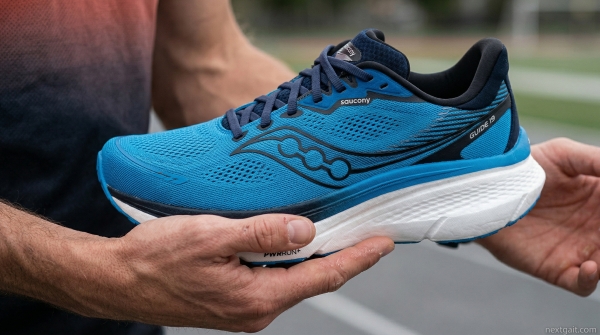
The Short Verdict: A Stability Shoe That Stays in the Background
| Decision | My answer |
|---|---|
| Best role | Recovery and easy road miles, steady aerobic runs, moderate long runs, walking |
| My rating | 8.4/10 for its daily stability role |
| Test | 200+ km / 124+ running miles over six weeks, plus about 15 km / 9 mi walking |
| Fit | True to my Saucony men’s US 10; close midfoot, secure heel |
| Best quality | Broad, quiet guidance without an intrusive medial post sensation |
| Main compromise | Weight and modest rebound when the session turns fast |
I buy a shoe like this for the ordinary work that fills most weeks. CenterPath gives me a planted landing when I am tired, but the forefoot still flexes enough for a natural walk. I would not spend this money expecting a light, exciting tempo trainer. If that is the priority, I move to a faster shoe rather than asking the Guide 19 to become one.
Jump to a Section
How I Tested the Saucony Guide 19
My run log breaks down into about 120 km of easy running, 60 km of long runs, and 20 km of tempo or threshold work. I added about 15 km of walking separately. The long-run set included 18, 21, and 25 km outings, approximately 11.2, 13.0, and 15.5 miles. The fast work included a controlled 6 × 1 km session. I used asphalt, Atlantic City Boardwalk, concrete, smooth packed paths, and treadmill miles rather than judging the shoe on a single flat loop.
I wore my normal Saucony length, men’s US 10, regular socks, and the stock removable insole; my kitchen scale read 277 g / 9.8 oz for the test pair. I alternated shoes on some recovery days, so I do not assign next-day leg freshness solely to the Guide. I watched for arch pressure, heel slip, late-run forefoot fatigue, behavior on a road camber, and traction as the rubber smoothed. I did not test it with a custom orthotic or measure injury risk or running economy.
| Work in my log | Distance | What it showed me |
|---|---|---|
| Easy running | 120 km / 74.6 mi | The shoe’s most natural rhythm and quiet guidance |
| Long runs | 60 km / 37.3 mi | Consistent protection, with personal forefoot fatigue later in the longest efforts |
| Tempo and threshold | 20 km / 12.4 mi | Capable, but heavy and muted as I ask for speed |
| Walking, counted separately | About 15 km / 9.3 mi | Broad rearfoot and flexible forefoot are comfortable at walking pace |
What Changed Between Day 1 and Mile 124
The Guide 19 did not need a dramatic break-in. In the first ten miles, the upper held my heel and the midfoot felt close without creating a hot spot. CenterPath was barely noticeable when I ran relaxed. By 50 miles, the easy-run flow felt familiar, but tempo still lacked the response I wanted. Familiarity improved how naturally I moved in the shoe; it did not change the fundamental character of PWRRUN or remove its weight.
At about 75 miles I saw small areas of rubber smoothing without a traction change. At 124-plus running miles, the upper still held shape, the outsole still worked on my usual roads, and the ride felt consistent at easy pace. The speed verdict was equally stable: a controlled repetition was possible, but an acceleration never felt crisp. I value this progression because it tells me which impressions lasted, rather than treating a lively shop-floor try-on as a review.
What CenterPath Actually Feels Like When I Run
The Guide 19 uses a wide platform, raised sidewalls, rocker shaping, and asymmetric sole geometry to keep the foot traveling over the middle of the shoe. I do not feel a single hard medial block telling my arch where to go. On straight asphalt, I mostly notice a calm, broad landing. On mild camber and later in a long run, the walls become more useful: my foot feels contained over the foam rather than hanging off an edge.
That is mild, distributed guidance in my stride, not a promise to correct someone else’s gait. I have seen runners assume that a large sole means a wide interior or that a flat arch automatically requires a stability label. Neither shortcut decides fit. My overpronation shoe guide and flat-feet guide explain why I start with how the shoe feels at running pace. If a sidewall presses persistently into my arch, I treat that as a poor match, not as helpful “correction.”
The platform is especially reassuring at easy cadence, when I am not loading a shoe with much momentum. It does not feel as directive as older posted stability models I have worn. Still, a runner who wants a narrow, low-to-the-ground feel will notice how much shoe surrounds the foot. I consider that a real design trade-off, not a flaw that disappears with more miles.
The PWRRUN Ride: Protection Before Propulsion
The revised PWRRUN feels soft-balanced at initial heel contact and more structured under my midfoot. It takes the edge off concrete and boardwalk boards without collapsing into a deep pocket under my 182-lb frame. The heel bevel and rocker help me roll forward, while the forefoot has more bend than the broad silhouette suggests. That flexibility is one reason the Guide works for walking as well as running.
What I do not get is the eager push-off of a premium speed foam. At an easy 9:00-per-mile rhythm, I stop thinking about the shoe, which is exactly the point. When I try to accelerate, I feel the platform absorb some of the urgency. I cannot convert that sensation into an energy-return percentage or a time cost; I can choose a shoe that better matches the workout. For an easy-day model, the Guide’s restraint is useful. For a pace-driven model, it is the limit.
| Published design detail | How I use it |
|---|---|
| PWRRUN foam, no plate | Comfortable, flexible daily transition rather than a rigid race feel |
| 35 mm heel / 29 mm forefoot; 6 mm offset | Enough cushion for road mileage without a steep heel-to-toe step |
| CenterPath sidewalls and broad base | Quiet guidance as my form becomes less tidy |
| Engineered mesh upper | Adaptable forefoot with a secure midfoot in my US 10 |
| XT-900 outsole rubber | Predictable road grip with targeted central forefoot coverage |
| 9.7 oz / 275 g men’s reference weight | A useful reference; my separate US 10 pair measured 277 g |
Where the Guide 19 Works—and Where I Change Shoes
Recovery and easy pace
Between about 8:51 and 9:39 per mile, where I logged most of the test, the Guide feels settled. The broad base gives me room to relax my landing, the upper stays secure, and I do not feel tempted to race an easy day. It is a sensible partner for the effort discipline in my easy-run pace guide. At a slower recovery shuffle, the forefoot flex keeps the shoe from becoming a rigid platform.
Steady aerobic work and long runs
A gradual move to steady pace works. The rocker becomes easier to use with some momentum, though the shoe still feels large rather than nimble. My 18-, 21-, and 25-km runs showed consistent cushioning through normal long-run distance. Beyond roughly 20 km I began to notice more forefoot fatigue, most clearly toward the end of the longer outings. I cannot isolate that to the shoe, my training load, or foot mechanics, so I treat it as a personal limit to retest, not a universal 12-mile cutoff.
Tempo, 6 × 1 km, and racing
At roughly 7:38–8:03 per mile, I could complete controlled tempo work, but the 277 g pair felt workmanlike. In the 6 × 1 km workout, each new acceleration reminded me of the mass and modest rebound. I would use the Guide for an incidental tempo block inside a normal run; for a dedicated tempo session or repeated intervals, I want a quicker shoe. A finish-focused first half marathon could still be reasonable if this exact pair has passed long race-pace practice.
Why I Also Like It for Walking
I walked roughly nine miles beyond the 124-plus running miles. At walking pace, the heel bevel and wide rearfoot felt calm, and the forefoot bent more naturally than I expected from the shoe’s size. The upper was comfortable from the first wear. I would happily use it for errands or a walk-run day when I want one pair on my feet.
Walking does expose fit differently: the medial sidewall can feel more present without the rhythm of running, and feet may swell across an all-day shift. I would test the shoe indoors before committing it to a full day of standing. The same broad, supportive-feeling platform that I like on the Boardwalk will not suit every arch or every insole.
Fit and Sizing: Broad Platform, Standard Interior
My normal Saucony men’s US 10 gave me about a thumb’s width at the front, a secure heel, and no meaningful slip during the run test. The midfoot felt slightly close on my wider foot, while the forefoot mesh adapted without a hot spot. I did not need a runner’s knot. The important distinction is that the sole looks extremely wide from above, but the space inside the upper is closer to a normal-width running shoe.
I check the fifth-toe side, lace pressure over the instep, and heel hold after a warm-up. If the sides press, I try the proper wide or extra-wide version where available rather than adding length and shifting the flex point. Saucony lists those width options for men in its current range. My wide-foot shoe guide walks through that fit decision. The stock insole is removable, but I did not test an orthotic; replacing it changes both volume and the feel of CenterPath.
| Fit zone | My US 10 | What I would check |
|---|---|---|
| Length | True to my usual Saucony size | Running clearance after a warm-up |
| Heel | Secure without special lacing | Slip on turns and when walking downhill |
| Midfoot | Close on my wider foot | Sidewall and instep pressure at easy pace |
| Forefoot | Adaptable mesh, normal internal width | Fifth-toe contact and swelling in a longer run |
| Orthotic space | Stock insole only in my test | Combined volume and support with the actual insert |
The tongue stayed centered and spread lace pressure well. My heel did not rub over the six-week test. Breathability was comfortable on my usual roads; in wet weather the mesh absorbed some water, but lockdown remained intact. I still slow down over painted lines and metal covers, as I describe in my rain-running guide.
Grip and Durability After 124 Running Miles
My XT-900 outsole remained useful after 124-plus miles. I saw light smoothing at the lateral heel and push-off zones, with central forefoot rubber still defined. The upper held its shape and I could not identify a clear change in easy-pace cushioning. Dry asphalt, Boardwalk, ordinary damp pavement, and short smooth packed connectors were predictable underfoot. I would not take this road outsole onto technical or muddy trail.
The Guide 19 puts rubber at the central forefoot where Guide 18 left more foam exposed, while using cutouts in parts of the outsole to keep flex. I prefer that precise description to saying it simply has “more rubber everywhere.” Its early wear looks good for my pattern, but I will not promise a fixed retirement mileage. I watch traction, uneven compression, upper hold, and whether the shoe still feels normal at a familiar pace; my replacement checklist explains those signs.
What Changed from the Guide 18?
Saucony kept the CenterPath idea and refined the parts around it: a revised PWRRUN blend, more forefoot flexibility, a new engineered-mesh upper, and the targeted central forefoot rubber. On my foot, version 19 feels softer at first contact and rolls through walking and easy running more naturally. It does not feel like a new level of guidance; if I already liked the Guide 18’s support, I would recognize the family immediately.
I would not replace a sound Guide 18 because a new number appeared on the box. I would choose the 19 when I wanted its easier forefoot bend and additional rubber under my usual push-off area. I would keep the 18 if its firmer character and current fit were working well, especially at a meaningful discount. Version 19 still carries enough mass that the update does not turn it into a workout shoe.
The Stability-Shoe Shortlist I Would Build
| Alternative | I choose it when… | I choose Guide 19 when… |
|---|---|---|
| Saucony Ride 19 | Neutral support is enough and I want a lighter everyday feel | The broader, guided platform makes ordinary miles more comfortable |
| Saucony Tempus 2 | I want support with a quicker workout response | I want a calmer, more flexible easy-day and walking shoe |
| Saucony Endorphin Speed 5 | I want a fast training partner and can use a neutral plated feel | I want geometry-led guidance for daily mileage |
| Brooks Adrenaline GTS 25 | A more traditional, higher-drop transition fits me | I prefer a lower-offset, broader, more flexible ride |
| ASICS Gel-Kayano | I want a plush, substantial stability cruiser | I want less shoe around my foot and easier forefoot bend |
| ASICS GT-2000 | I want a more compact daily support platform | I prefer the Guide’s broad, planted footprint |
| HOKA Arahi | I prefer a more directed rocker sensation | I want more natural flex and a broader rearfoot |
I would narrow this list by trying the Guide against one neutral shoe and one different stability design, all in the socks I actually use. The support label alone cannot tell me which midfoot shape disappears on my foot. I use the same practical comparison in my stability-shoe guide.
How I Use the Guide 19 in My Rotation
The Guide gets recovery days, most easy road runs, steady aerobic mileage, moderate long runs, treadmill sessions, and walking. That is substantial work. For a tempo-focused day I reach for a lighter support option such as Tempus 2, or the Endorphin Speed 5 when its neutral platform works for me. For a goal road race I use a proven race shoe. This pairing lets the Guide do its best job often rather than judging it by a task it was never built to win.
If I owned only one pair, I could use the Guide for an occasional stride or short pickup. I simply would not buy it with the expectation that it will feel quick across an entire training plan. Its value comes from repeated ordinary miles and from working at walking pace too. A runner whose week is mostly tempo sessions would spend more wisely on a different primary shoe.
Who Should Buy the Saucony Guide 19?
- I would recommend it to a runner who feels more comfortable on a broad, gently guided platform than in a soft neutral trainer.
- I would choose it for easy and recovery mileage where predictable landing and a quiet support feel matter more than bounce.
- I would consider it for a walk-run schedule or a runner who wants the same pair for road running and everyday walking.
- I would shortlist it for a Guide 17 or 18 wearer who wants more forefoot flex and targeted rubber, after checking the updated fit.
- I would try the wide or extra-wide version when the standard upper presses but the underfoot ride is otherwise right.
The best reason to buy it is comfort that remains consistent when I tire. I would test it on a real run, because the broad base can feel different once the foot warms and the route turns.
Who Should Skip the Saucony Guide 19?
- I would skip it if most of my week is fast tempo, intervals, or racing and I want one shoe for all of that.
- I would look elsewhere if a broad heel or raised medial wall feels intrusive under my arch. Persistent pressure is a fit problem, not a break-in target.
- I would choose a lower, lighter shoe if narrow paths and sharp turns dominate the route.
- I would use a trail model for mud, loose rock, or technical ground rather than stretching this road outsole beyond its design.
- I would not buy it for an orthotic without trying the exact shoe-and-insert combination.
A stable-feeling shoe does not need to feel corrective. If a lighter neutral trainer already lets me run comfortably, I would compare it directly before adding guidance I do not enjoy.
My Final Verdict After 124+ Miles
I rate the Saucony Guide 19 8.4/10 for the work it actually does. Across more than 124 running miles and nine separate walking miles, its CenterPath geometry stayed calm, the fit remained secure, and the outsole kept its road grip. The shoe made easy and steady days feel predictable without the old hard-post sensation. I could run 6 × 1 km in it, but the workout made its weight and muted response clear.
I would keep it for the broad middle of my week and pair it with a quicker shoe for quality sessions. My buying test is whether the midfoot shape disappears while I run and stays comfortable as the miles add up. If it does, Guide 19 is a useful, repeatable stability trainer. If the sidewall presses or I need one shoe to feel fast, I choose another model.
Saucony Guide 19 FAQs
Is the Saucony Guide 19 a stability shoe?
Yes. I experience mild, distributed guidance from its broad CenterPath platform and raised sidewalls, without a traditional hard medial post sensation.
What are the Guide 19 weight, stack, and drop?
Saucony lists about 9.7 oz / 275 g for the men’s reference, a 35 mm heel, 29 mm forefoot, and 6 mm drop. My men’s US 10 test pair weighed 277 g on my kitchen scale.
Does the Guide 19 have a plate?
No. Its smooth transition comes from PWRRUN foam, the heel bevel, rocker shaping, CenterPath geometry, and a flexible forefoot.
Does the Saucony Guide 19 run true to size?
My normal Saucony men’s US 10 fit true to length with a secure heel. The midfoot was close on my wider foot, so I would check width separately from length.
Is the Guide 19 good for wide feet?
The sole is very broad, but the standard upper is not unusually wide inside. Saucony offers men’s wide and extra-wide options in its current range, subject to size and color availability.
Is the Guide 19 good for long runs?
I used it on 18-, 21-, and 25-km outings. Protection stayed consistent, although I noticed mild forefoot fatigue later in the longest runs. That is my experience, not a fixed distance limit.
Can I run tempo sessions in the Guide 19?
I completed controlled tempo work and 6 × 1 km repetitions, but the weight and modest rebound make it less enjoyable than a quicker workout shoe.
Is the Guide 19 comfortable for walking?
It was for me over roughly 15 km of walking. The broad rearfoot, heel bevel, flexible forefoot, and secure upper worked well, though another runner may feel the medial wall differently at walking pace.
How durable is the Guide 19?
At more than 124 running miles, my outsole showed light smoothing and the upper and easy-pace ride remained sound. I cannot infer a guaranteed total lifespan from one pair.
Can I use orthotics in the Guide 19?
The stock insole is removable, but I tested only that stock setup. An orthotic changes internal volume and the way the foot meets the raised walls, so I would try the exact combination before buying.

Written by Ken — 12 years of running, 12,500+ miles, 63 shoes tested, 36 races from 5Ks to a 50K ultra. I run 30–40 miles a week on the Atlantic City Boardwalk and review every shoe with real training miles, not one-run demos. More about me →