
This Saucony Kinvara 16 review comes after 359 verified miles in my own pair, and my verdict is that the shoe makes one of the clearest bargains in modern running footwear. In exchange for deep cushioning and an automatic rocker, I get low weight, natural flexibility, a roomy toe-off, and enough road feedback to manage my stride. I give it 7.5/10.
I have spent 12 years running and testing shoes, and the Kinvara is not a model I recommend by saying “light is better.” Lightness only helps when the runner can use the freedom it creates. The Kinvara 16 works best for me when I am running between roughly 7:00 and 8:45 per mile, landing near the midfoot, and willing to let my feet and lower legs participate.
It can cover daily mileage and long runs—I took my pair to 20 miles—but it is less forgiving than a conventional cushioned trainer when heat, fatigue, or poor form enters the run. If you want to compare the category first, start with my best lightweight running shoes. If you want to know whether this particular bargain suits you, keep reading.
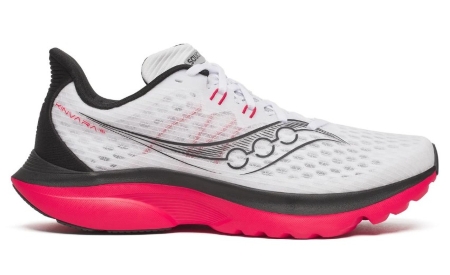
My decision in 20 seconds: Buy the Kinvara 16 if you want a 7.8-ounce, 4 mm-drop trainer that bends with your foot and feels direct at easy-to-steady pace. My men’s US 10.5 fits true to size, gives my toes room to spread, and locks my heel securely. Skip it if you want max cushioning, formal stability, or a shoe that hides tired form. I would buy it again, but only for the runner and role it actually serves.
Updated October 2026 after reconciling this review with my 359-mile training and wear record.
My Verdict: A Shoe That Gives Control Back to the Runner
My Saucony Kinvara 16 review lands at 7.5/10 because the shoe is honest about what it removes. There is no plate, no tall rocker, and no massive foam stack deciding the stride for me. The forefoot flexes, the 4 mm geometry lets me move over the shoe naturally, and the light upper does not fight quick turnover.
On an early asphalt-path run, I settled near 8:12 per mile and immediately understood the appeal. The ride felt balanced and unpretentious. My midfoot landing rolled into toe-off without a noticeable hinge, and the upper gave my toes space without loosening the heel.
The same honesty creates the limit. The Kinvara does less to protect a sloppy landing or stabilize a tired ankle. At 182 pounds, I can use it for substantial mileage, but I need to respect the difference between a flexible daily trainer and a soft recovery shoe.
| Decision | My Answer After 359 Miles |
|---|---|
| Best role | Light daily mileage, steady runs, strides, and simple uptempo work |
| Ride | Flexible, direct, smooth, and moderately cushioned |
| Best pace range for me | About 7:00–8:45 per mile |
| Fit | True to size with generous horizontal toe room |
| Main strength | Low weight and natural forefoot movement |
| Main weakness | Less protection and stability when fatigue degrades form |
| My score | 7.5/10 |
| Would I buy it again? | Yes, as a lightweight rotation tool |
This is not the default answer for every runner. My best running shoes guide starts with the training job and runner profile because low weight is only one part of the decision.
How I Tested the Saucony Kinvara 16
I logged 359 verified running miles in a men’s US 10.5 Kinvara 16 across asphalt and wooden boardwalk routes. My structured coverage includes easy runs, long runs, and wet-condition running, with long-run notes reaching 20 miles. I tracked pace response, lower-stack control, fit after swelling, outsole smoothing, foam softening, and upper integrity.
My context matters. I weigh 182 pounds, run 30–40 miles most weeks, have a medium arch and slightly wide forefoot, and generally land from the rearfoot toward the midfoot. A lighter runner or committed forefoot striker may find the same amount of foam more protective than I do.
| Test Detail | My Record | What I Evaluated |
|---|---|---|
| Total distance | 359 verified miles | Ride change, wear, upper integrity |
| Long-run coverage | Up to 20 miles | Late-run protection and stability |
| Primary surfaces | Asphalt and wooden boardwalk | Road feel, transition, grip |
| Runner profile | 182 lb, men’s US 10.5, slightly wide forefoot | Foam compression and fit after swelling |
| Pair | Bright Crimson/Obsidian | Material and outsole wear visibility |
I did not treat a single fast run as proof of race performance or a low drop as an injury solution. The evidence here describes what the shoe did in my training. It does not promise that a particular geometry will change another runner’s mechanics or pain.
The Four Bargains the Kinvara 16 Asks Me to Make
I understand the Kinvara best as four exchanges rather than a list of features. Each benefit has a cost, and the right buyer is the runner who wants both sides of the deal.
Bargain 1: less weight for less automatic protection
My pair weighs 7.8 ounces, which is light enough to disappear during steady running and strides. The trade is a compact 29 mm heel and 25 mm forefoot rather than a modern max-cushion stack. I feel more of the road, and the shoe gives me less margin when my landing gets heavy.
If those numbers feel abstract, my guide to running-shoe stack height explains how underfoot depth changes protection, leverage, and ground feedback.
Bargain 2: flexibility for less imposed stability
The forefoot bends easily, so my toes and metatarsals participate in toe-off rather than riding a stiff rocker. That makes the transition feel natural and easy to time. It also means the shoe does less to hold a tired foot in one path. The Kinvara is neutral and moderately stable, not corrective.
Bargain 3: a 4 mm drop for more lower-leg participation
The heel and forefoot sit close enough in height that I move through the shoe rather than down a steep ramp. I like that sensation at a midfoot-oriented stride. A runner coming directly from a rigid 10–12 mm trainer may notice the calves and ankles doing more work, especially if mileage and pace rise together.
Bargain 4: simplicity for fewer pace-saving technologies
There is no plate to stiffen the lever and no aggressive rocker to carry poor timing. When I run well, the Kinvara feels efficient and quick. When I overstride or lose cadence, the shoe tells me. My running cadence guide explains the rhythm cue I use instead of trying to force a specific foot strike.
My rule: I buy the Kinvara for the work my body gets to do, not for the work the shoe promises to remove.
PWRRUN Ride and Pace: The Middle Is Better Than the Extremes
The Kinvara 16 feels best when I run with intent but not desperation. PWRRUN gives me a responsive, moderately firm base, while the PWRRUN+ sockliner adds a softer first contact. The result is smoother than a racing flat and more direct than a conventional daily trainer.
At very slow recovery pace, I notice the limited cushioning depth more than the low weight. Between easy and steady pace, the shoe comes alive: the flexible forefoot follows my foot, the heel stays quiet, and the 7.8-ounce package is easy to reposition.
For short controlled speed, I like it. Strides let the shoe use its flexibility without exposing the foam for too long; my guide to running strides shows how I add them without turning an easy day into a full workout.
For sustained threshold work, the Kinvara can perform, but it does not give me the snap or energy conservation of a plated trainer. My tempo run guide is where I would use a more specialized shoe when the whole session depends on holding pace.
What the 4 mm Drop Asks From the Runner
A 4 mm drop is not automatically natural, efficient, or safer; it is simply a different geometry. It suits me when I am landing near the midfoot and keeping the stride underneath my body. It asks more attention when I am tired and reaching ahead.
I would not change drop, pace, and weekly volume at the same time. If you are coming from a high-drop shoe, introduce the Kinvara on shorter easy runs, then judge calf, ankle, and foot response over the following day before adding distance. That is load management, not a claim that everyone needs an adaptation period.
Your landing label alone should not decide the purchase. My guide to heel, midfoot, and forefoot striking explains why the full stride matters more than where a shoe first touches the road.
Fit and Upper: Toe Freedom Without Heel Drift
I wear my normal men’s US 10.5 D in the Kinvara 16. Length is correct, and the toe box gives me generous horizontal space for natural splay. The FormFit cradle shapes the midfoot without squeezing it, while the contoured heel cup prevents slip as pace increases.
The breathable mesh feels light but did not become fragile in my use. Reinforced eyelets let me adjust midfoot tension without distorting the upper, and the gusseted tongue stayed centered without lace bite. This is one of the reasons the shoe can feel fast without using a race-style upper.
Runners with wide feet should distinguish toe splay from total shoe volume. The shape worked for my slightly wide forefoot, but a high-volume foot may need more depth. My wide-foot running shoe guide covers that distinction.
| Fit Area | My Experience | Buying Decision |
|---|---|---|
| Length | True to size | Start with your normal running-shoe size |
| Toe box | Generous horizontal splay room | Good for my slightly wide forefoot |
| Midfoot | Adjustable, low-pressure lockdown | Reinforced eyelets hold tension well |
| Heel | Firm cradle with no meaningful slip | Secure during progressive pace |
| Upper | Light, breathable, and structurally sound | Performance feel without fragility in my pair |
The Long-Run Boundary: Capability Is Not the Same as Preference
I ran the Kinvara 16 as far as 20 miles, so I know it can cover long distance under my stride. The foam continued absorbing impact past 90 minutes, the medial platform held together as I tired, and the roomy forefoot prevented blister hotspots on those logged coastal runs.
I still would not call it the easiest long-run choice for most runners. On an exposed hot 14-miler, heavy sweat saturation created minor friction near my fifth metatarsal. The problem was not a structural failure; it was a reminder that a light upper, lower stack, heat, and long exposure reduce the margin for error.
I would use the Kinvara long when I am adapted to the geometry and want a direct, steady experience. I would choose more cushioning when recovery or late-run forgiveness matters most. My long-distance running shoe guide separates those priorities.
What 359 Miles Changed—and What Survived
At 359 verified miles, my Kinvara 16 was still runnable but clearly mature. I measured about 1.6 mm of smoothing through the main landing zone and forefoot drive area. The PWRRUN foam showed deep structural creasing and noticeable softening under my weight.
The softening changed the ride more than the upper changed the fit. The mesh remained structurally sound with no blowouts, the reinforced eyelets held, and the heel continued locking securely. The shoe became less crisp, but it did not suddenly collapse.
I would retire this pair based on ride and wear symmetry, not because it crossed an arbitrary number. My running-shoe replacement checklist covers the warning signs I use: new discomfort, uneven wear, loss of tracking, or a flat response that changes the run.
Kinvara 16 vs the Alternatives I Have Run In
This Saucony Kinvara 16 review becomes clearer when I compare flexibility, stability, and break-in character rather than marketing categories. Each alternative gives up a different part of the Kinvara experience.
| Alternative | Choose Kinvara 16 When | Choose the Alternative When | My Decision |
|---|---|---|---|
| Mizuno Wave Rider 29 | You want more flexibility and natural toe-off | You want more stability and a structured platform | Kinvara for freedom; Wave Rider for control |
| Brooks Ghost 18 | You want immediate comfort and lower weight | You value a ride that improves after break-in | Choose by feel and patience |
| ASICS Gel-Cumulus 28 | You value grip and a more direct ride | You want a different balance of weight and cushioning | Kinvara for connection; Cumulus for conventional comfort |
Kinvara 16 vs Mizuno Wave Rider 29
The Wave Rider gives me more stability, while the Kinvara lets my forefoot move more naturally. My Mizuno Wave Rider review is the better route if you want a structured daily platform. I choose Kinvara when flexibility is the purpose.
Kinvara 16 vs Brooks Ghost 18
The Kinvara felt more comfortable to me on day one. The Ghost became more convincing after break-in and supplies a more traditional daily-trainer experience. Read my Brooks Ghost review if you want more shoe underneath you; choose Kinvara for immediate freedom and low weight.
Kinvara 16 vs ASICS Gel-Cumulus 28
The Kinvara gave me the grip and directness I preferred, while the Cumulus changes the weight-and-cushioning equation. My ASICS Gel-Cumulus review is the better reference for runners who want a conventional trainer instead of a low, flexible one.
Who Should Buy the Kinvara 16—and Who Should Skip It
Buy the Kinvara 16 if you actively want the feedback and flexibility that many modern trainers remove. Do not buy it merely because the spec sheet says light.
Buy it if you:
- Want a light, flexible, non-plated trainer
- Prefer a 4 mm drop and direct transition
- Use one shoe for easy-to-steady runs and strides
- Value toe splay without heel looseness
- Are willing to manage adaptation and tired-form limits
Skip it if you:
- Want deep cushioning for every long run
- Need formal stability or a rigid rocker
- Prefer a high-drop geometry
- Expect race-shoe propulsion from a daily trainer
- Want the shoe to hide heavy or inconsistent landings
My final answer is a qualified yes. The Saucony Kinvara 16 stayed useful through 359 verified miles because it offers a kind of simple, flexible ride that is becoming rare. I would buy it again for light daily mileage, steady running, and strides. I would pair it with a more protective shoe for recovery and fatigue-heavy long runs.
Saucony Kinvara 16 FAQ
Does the Saucony Kinvara 16 run true to size?
Yes for me. My normal men’s US 10.5 D gave me correct length, generous horizontal toe room, secure midfoot adjustment, and no meaningful heel slip. High-volume feet should still check depth rather than judging width alone.
What is the drop and stack height of the Kinvara 16?
My pair measures about 29 mm at the heel and 25 mm at the forefoot, with a 4 mm drop. That creates a lower, more flexible and connected ride than most current daily trainers.
Is the Saucony Kinvara 16 good for daily training?
Yes for runners who like a light, flexible and moderately cushioned shoe. It worked best for me from easy-to-steady pace and for strides. Runners who want deep protection every day should use a more cushioned trainer.
Can the Saucony Kinvara 16 handle long runs?
Yes, if you are adapted to its 4 mm geometry and modest stack. I ran it up to 20 miles with consistent cushioning and fit, but I prefer more protection when recovery or late-run forgiveness is the main goal.
Is the Saucony Kinvara 16 good for speedwork?
It is good for strides, steady running and controlled uptempo work because it is light and flexible. I would choose a more responsive plated or rocker-driven shoe for sustained threshold sessions and racing.
Is the Saucony Kinvara 16 a stability shoe?
No. It is a neutral shoe with moderate inherent stability from its lower platform and secure upper. It does not use a medial post, GuideRails, or another formal guidance system.
How durable is the Saucony Kinvara 16?
My pair remained runnable at 359 verified miles. I measured about 1.6 mm of outsole smoothing, and the foam had creased and softened noticeably. The mesh, eyelets and heel structure remained intact without blowouts.

Written and tested by Ken – NextGait founder, 12-year runner, 12,500+ lifetime miles, 63 shoes tested, and 36 races from 5K through 50K. I run 30-40 miles most weeks on the Atlantic City Boardwalk and nearby roads. For this review I used the Kinvara 16 on short road runs, treadmill progressions, strides, moderate efforts, wet pavement, and cambered streets to learn where its light, low platform helps and where it asks too much. Read Ken’s testing philosophy and bio.