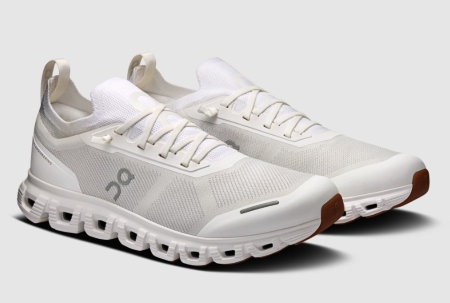
After 124.6 mixed-use miles in the On Cloud 6, my verdict is simple: this is a very good travel and commuting shoe, but it is not the running shoe its name and athletic shape may lead you to expect. I rate it 8.2/10 for lifestyle use and 5.8/10 for running.
I wore my men’s US 10.5 pair for six weeks across Atlantic City concrete, asphalt, treadmill walking, gym sessions, errands, and short recovery jogs. Most walking sessions ran 5 to 8 miles. My jogging tests were deliberately shorter, usually 2 to 3 miles around 10:30 per mile, because the shoe told me early that more distance was not its best job.
What stood out was not softness. The CloudTec pods compress, but the ride stays low, controlled, and moderately firm. I could feel the pavement more clearly than I do in a modern daily trainer. The nylon Speedboard kept each step organized, yet it never produced the spring or protection I want for regular training.
The fit was easier than the Cloud 5 for my medium-width foot, and the elastic speed laces made the shoe genuinely useful for travel. The trade-off was precision: once I started jogging, I wanted the conventional laces. That distinction between easy daily wear and real running defines the entire Cloud 6 experience.

Jump to Section Click to expand
- Quick Verdict
- Ken’s Ranking Rule
- How I Tested
- 124.6-Mile Timeline
- Specs and Verified Facts
- CloudTec and Speedboard
- Walking and All-Day Comfort
- Can You Run in It?
- Fit and Sizing
- Speed Lacing
- Upper and Breathability
- Stability and Support
- Grip and Durability
- Cloud 6 vs Cloud 5
- Gym and Treadmill Use
- Travel and Work
- Key Comparisons
- Decision Matrix
- Shoe Rotation
- Who Should Buy
- Who Should Skip
- Sources and Corrections
- Final Verdict
- FAQ
On Cloud 6 Review: My Quick Verdict
I would buy the On Cloud 6 for airports, commuting, city weekends, casual offices, and errands. I would not buy it as my primary running shoe, long-shift work shoe, or solution for strong stability needs.
The first few steps feel neat and controlled. The heel pods compress just enough to take the edge off pavement, then the board guides the foot forward without forcing an aggressive rocker. It feels more like a refined casual sneaker than a soft trainer.
After an hour of mixed walking and sitting, that formula works. After several uninterrupted miles on concrete, I become more aware of the modest stack and thin underfoot package. The Cloud 6 never turned harsh in my test, but it also never developed the deep, quiet cushioning I prefer for long runs or a full standing shift.
| Decision | My Answer |
|---|---|
| Best use | Travel, commuting, errands, casual walking, light gym work |
| Useful backup | Short treadmill warm-ups and occasional 2-3 mile easy jogs |
| Best pace | Walking near 15:00/mile; relaxed jogging near 10:30/mile or slower |
| Ride | Grounded, moderately firm, flexible, stable, low in rebound |
| Fit | True to size for me in men’s US 10.5; roomier than Cloud 5 |
| Durability result | Functional after 124.6 mixed-use miles; outsole stronger than upper |
| Lifestyle score | 8.2/10 |
| Running score | 5.8/10 |
My one-sentence verdict: The Cloud 6 makes daily movement easier because it is light, breathable, and quick to put on, but regular runners should choose a real trainer with more cushioning depth and better lockdown.
If running is the main purpose, start with my best running shoes guide. If the day is mostly airports, sidewalks, transit, and casual wear, the Cloud 6 is much easier to justify.
Ken’s Ranking Rule for the On Cloud 6
Ken’s ranking rule: I score a shoe for the job it is designed to do, then I separately test the job buyers may mistakenly expect it to do. On markets the Cloud 6 as an all-day lifestyle shoe. Its 8.2 score reflects that role. The 5.8 running score answers a different question.
For lifestyle use, I care most about step-in convenience, walking comfort, fit after the foot warms up, urban grip, breathability, and whether the shoe remains pleasant after repeated real-world use. For running, I shift the weight toward impact protection, lockdown, response, pace range, and late-run comfort.
| What I Ranked | Weight | Cloud 6 | My Reason |
|---|---|---|---|
| Walking comfort | 22% | 8.0/10 | Smooth and controlled, but not deeply cushioned |
| Travel convenience | 20% | 9.2/10 | The elastic laces and broad opening genuinely save time |
| Fit and hold | 16% | 8.3/10 | Good for my medium foot; less precise at jogging pace |
| Upper and ventilation | 12% | 8.8/10 | Airy during warm Atlantic City days |
| Grip and durability | 12% | 8.2/10 | Rubber remained functional after 124.6 miles |
| Versatility | 10% | 7.2/10 | Good around workouts, limited within workouts |
| Value | 8% | 6.9/10 | Premium positioning for a narrowly defined role |
I do not award extra points because the shoe has a Speedboard. A plate only matters if it improves the task in front of me. Here it helps walking transitions and structure; it does not make the Cloud 6 a fast trainer.
How I Tested the On Cloud 6
I logged 124.6 mixed-use miles over six weeks from April through May 2026 in a men’s US 10.5 pair. I am calling them mixed-use miles because most came from walking and daily wear, not from running. Presenting the entire total as running mileage would distort what I actually did.
| Test Detail | My Log | What It Revealed |
|---|---|---|
| Total distance | 124.6 mixed-use miles | Ride consistency, fit changes, grip, and visible wear |
| Surfaces | About 50% concrete, 30% asphalt, 20% treadmill | Hard-ground comfort and urban traction |
| Walking sessions | Usually 5-8 miles | Swelling room, lace pressure, and underfoot fatigue |
| Jogging sessions | Usually 2-3 miles | Running hold, impact feel, and sensible distance limit |
| Pace range | About 15:00 walking to 10:30/mile jogging | Behavior in its intended and secondary roles |
| Conditions | Roughly 50-82 F, dry and humid | Ventilation and day-to-day comfort |
| Lacing | Elastic and conventional setups | Convenience versus lockdown |
| Reference shoe | My used Cloud 5 | Direction of fit, heel, and debris changes |
My most useful test days were not the first ones. They were the long city days when my feet had warmed up, the treadmill sessions when I could compare walking and jogging without a surface change, and the final weeks when novelty had worn off.
I kept the stock removable sockliner. I also switched from the elastic speed laces to the conventional laces included in the box. That single change mattered more for jogging security than any break-in effect in the midsole.
I did not use the Cloud 6 for tempo work, intervals, or a long run. That was intentional, not an omission. My short jogs already showed inadequate cushioning depth and upper hold for those sessions, so assigning it hard workouts would have produced risk without answering a sensible buyer question.
What Changed During My 124.6-Mile Test
The upper and elastic laces settled; the ride did not transform. The Cloud 6 felt grounded on day one and remained grounded at mile 124.6. Buyers waiting for it to become soft after break-in are waiting for a different shoe.
| Checkpoint | What I Felt | What It Meant |
|---|---|---|
| First wear | Easy entry, clean heel transition, mild elastic pressure | Travel convenience was obvious immediately |
| First two weeks | Upper relaxed and speed laces became less noticeable | Step-in comfort improved more than ride softness |
| Middle of test | Concrete feedback remained clear on uninterrupted walks | The modest stack set the comfort ceiling |
| Final weeks | Rubber still gripped; exposed foam showed ordinary smoothing | Outsole function outlasted the fresh cosmetic look |
| 124.6 miles | No functional outsole failure; upper still usable | Good result for my pair, not a universal lifespan promise |
The elastic laces became easier to ignore once the upper settled, but they never gained the precision of normal laces. On faster walks, stairs, and short jogs, I still noticed the difference in heel control.
The CloudTec channels collected occasional debris throughout the test. Compared with my Cloud 5, the shallower geometry trapped fewer small stones, but it did not eliminate the familiar need to check the sole after rough gravel.
I will not turn 124.6 miles into a 400- or 500-mile prediction. A commuter can wear the outsole slowly while damaging the upper against curbs; another person can keep the mesh pristine while dragging the heel. My shoe replacement guide uses functional signs instead of a single mileage rule.
On Cloud 6 Specs and Verified Facts
On lists Cloud 6 as an all-day lifestyle shoe with an 8 mm drop, 267 g men’s reference weight, bio-attributed Zero-Gravity foam, CloudTec geometry, a nylon Speedboard, speed lacing, a removable sockliner, and a wider opening.
| Specification | Official Detail | Practical Meaning |
|---|---|---|
| Category | All-day lifestyle / active-life shoe | Walking and casual use, not dedicated road training |
| Men’s reference weight | 267 g / 9.4 oz | Light relative to many walking shoes |
| Women’s reference weight | 216 g / 7.6 oz | Different reference size from men’s |
| Drop | 8 mm | Familiar heel lift for walking and casual wear |
| Midsole | Bio-attributed Zero-Gravity foam with CloudTec | Low-profile pods create compression and transition |
| Speedboard | Nylon 6 | Adds structure; not a carbon racing plate |
| Closure | Elastic speed laces; standard laces included | Convenient or adjustable setup |
| Upper | Recycled polyester and TPU components | Breathable, structured lifestyle construction |
| Fit update | Wider opening and revised heel | Easier entry and broader fit than Cloud 5 |
| Wide option | Separate Cloud 6 Wide model listed by On | Standard and Wide are distinct products |
On does not publish stack height on the current U.S. product page. Independent measurements are close to one another: RunRepeat found 28.3 mm heel and 19.5 mm forefoot; RTINGS found 29.2 and 19.8 mm. Their measured drops were 8.8 and 9.4 mm, respectively.
Independent weights also sit near the official figure. RunRepeat measured 274 g in men’s US 9, while RTINGS measured 268.2 g. A stated reference weight should not be assigned to every size, color, or sample.
The former article called the upper 100 percent recycled and described the Speedboard as thermoplastic without specifying its resin. On currently lists recycled polyester and TPU in the upper and Nylon 6 for the board. The revised table uses those material statements.
Dynamic retail price is intentionally absent from the schema and body. Price can change by color, region, date, and promotion; the linked retailer is the appropriate place to verify current availability.
CloudTec, Zero-Gravity Foam, and the Speedboard
Cloud 6 combines low-profile hollow CloudTec elements with bio-attributed Zero-Gravity foam and a nylon Speedboard to create a structured but flexible walking transition. The system feels more grounded than the cloud name suggests.
CloudTec elements deform as the foot loads and then release as weight moves forward. The sensation is subtle because the stack is modest and the foam itself is not especially soft. RunRepeat measured the compound slightly firmer than its walking-shoe average.
The Speedboard runs inside the midsole to organize flex and transition. It is not a rigid carbon plate, and it does not deliver racing-shoe propulsion. RunRepeat measured average bending flexibility and moderate torsional rigidity despite the board.
RTINGS measured 59.0 percent heel and 62.9 percent forefoot energy return in its protocol. RunRepeat measured 54.1 percent under a different walking-shoe protocol. Those values cannot be compared directly, but both describe restrained rebound rather than superfoam behavior.
A mechanical return percentage is not a metabolic saving. It does not prove that Cloud 6 reduces effort by the same percentage, protects a joint, aligns a knee, or prevents fatigue. It describes one sample under the source’s loading method.
The official bio-attributed material statement refers to renewable feedstock such as waste cooking oil under a certified sourcing system. It does not mean the finished foam is biodegradable or made entirely from recycled cooking oil.
The practical result is simple: the pods soften a firm base enough for city movement, while the board prevents the shoe from feeling floppy. The system is better at smooth walking than energetic running.
The On Cloud 6 Ride: What Walking Feels Like
The Cloud 6 ride feels low, controlled, and moderately firm, with a small amount of pod compression followed by an easy forefoot release. It is not plush, bouncy, or aggressively rockered.
At my normal walking rhythm near 15:00 per mile, I landed on a compact heel that felt stable before the pods compressed. The compression was noticeable but brief. I then felt the Speedboard organize the middle of the step, and the flexible forefoot allowed my toes to finish naturally.
That sequence worked especially well during commuting: short sidewalk sections, station platforms, stairs, sitting, then walking again. The shoe did not feel bulky when the day kept changing. It also stayed quiet underfoot instead of slapping the pavement.
On uninterrupted concrete, I reached the limitation sooner. After several miles, the pavement felt closer and the thin sockliner offered little extra insulation. My feet were not in pain, but I wanted more cushioning depth than I did during stop-and-go travel.
The Speedboard contributes structure, not a racing sensation. I felt it most as consistency through the midfoot. The shoe did not fold unpredictably between pods, yet it remained flexible enough that I never felt I was balancing on a rigid plate.
This is why descriptions of the Cloud 6 as either “soft” or “hard” miss the point. The foam itself is on the firmer side, while the hollow pods add local compression. The combined ride is forgiving enough for city use but still communicates the ground.
For long days dominated by concrete, compare deeper options in my concrete shoe guide. The Cloud 6 wins on low weight and convenience, not maximum shock absorption.
Running in the On Cloud 6: Ride and Pace Limits
I found the Cloud 6 acceptable for short, easy jogging around 10:30 per mile, but I would not use it as a daily running shoe. The transition remains smooth when cadence rises, yet the cushion and upper reach their limits quickly.
During 2- to 3-mile recovery jogs, the first mile felt better than I expected. The shoe was light on foot, the 8 mm published drop felt familiar, and the forefoot flexed without fighting me. A traveler who wants twenty easy treadmill minutes can make it work.
By the later part of those jogs, I noticed two problems. First, the low forefoot left more pavement feedback than I want for repeated running. Second, the elastic laces allowed enough upper movement that my foot and the platform did not feel completely synchronized.
Switching to standard laces improved heel hold and midfoot control. It did not add foam, rebound, or long-run protection. That experiment clarified the boundary: part of the Cloud 6 running problem is fit, but the larger part is that it is a lifestyle midsole.
Best Pace for the On Cloud 6
| Pace or Session | My Verdict | Why |
|---|---|---|
| Casual walking around 15:00/mile | Best use | Stable landing, natural flex, easy transition |
| Brisk walking | Very good | Low mass and firm platform respond cleanly |
| Easy jogging around 10:30/mile or slower | Usable for 2-3 miles | Smooth enough, but cushioning and hold are limited |
| Recovery running | Emergency or travel backup | Ground feedback becomes tiring compared with a trainer |
| Steady or tempo running | Skip | Too little rebound and insufficient performance lockdown |
| Intervals | Skip | The Speedboard does not create a fast-shoe response |
| Long runs | Skip | Modest stack and casual upper are wrong for the job |
I am not giving a faster cutoff pace because I did not run a formal tempo test in this shoe. The honest recommendation comes from the tested range: relaxed jogging was possible, but the design gave me no reason to extend the distance or raise the intensity.
When I travel with planned workouts, I would pack a true daily trainer such as the Brooks Ghost, Nike Pegasus, or Saucony Ride. All three sacrifice some slip-on convenience but provide a much larger running range.
Runners unsure what “easy” should feel like can use my easy-run pace guide. A conversational effort reduces intensity; it does not change the intended category of the shoe.
On Cloud 6 Fit and Sizing: My Experience
The On Cloud 6 fit true to size for me in men’s US 10.5. My medium-width foot had enough ball-of-foot room and toe height without sliding during ordinary walking. The opening felt clearly easier than the Cloud 5.
| Fit Area | What I Felt | Who Should Pay Attention |
|---|---|---|
| Length | Normal true-to-size clearance | Stay with usual size unless between sizes |
| Toe box | Accommodating, not anatomical or extra wide | Wide forefeet should try Cloud 6 Wide |
| Midfoot | Comfortable with elastic pressure | High insteps should test both lace systems |
| Heel | Secure enough walking, less precise jogging | Narrow heels may need conventional laces |
| Opening | Broader and easier than Cloud 5 | Excellent for travel and foot swelling |
| Vertical volume | No toenail pressure in my pair | Use trip or work socks during fitting |
The fit changed with activity. Walking straight ahead, the elastic system held me well enough. On stairs, quick turns, and jogging, I could feel the heel and midfoot move before the sole followed. Conventional laces reduced that delay.
Medium-width feet are the safest match. A narrow foot may find the new opening too generous, especially if the Cloud 5 already fit perfectly. A genuinely wide foot should not treat “roomier” as a substitute for the separate Wide model.
If your instep is high, pay attention to the elastic band during the first ten minutes and again after the foot warms up. The laces relaxed during my test, but a pressure point in the store should not be dismissed as guaranteed break-in.
For more detail on width versus volume, see my wide-feet shoe guide. Those are different fit variables, and the Cloud 6 is more generous in opening and overall accommodation than in true forefoot width.
Speed Lacing vs Standard Laces
I kept the elastic speed laces for airports, errands, and ordinary walking; I used the included conventional laces for jogging and faster movement. Neither setup is universally better.
The elastic laces are the reason the Cloud 6 earns such a strong travel score. I could step in without crushing the heel, and the bootie-style tongue stayed centered. That convenience remained useful long after the novelty wore off.
The compromise is that one elastic tension must serve the forefoot, instep, and heel. My foot could tolerate that at walking pace. When I jogged, I wanted more tension near the top eyelets without squeezing the forefoot, which the standard laces allowed.
Travel swelling can reverse the preference. After several hours sitting, elastic give may feel better than a fixed knot. On a day with a treadmill run or many stairs, conventional laces are more secure. I changed the setup according to the day rather than forcing one system to do everything.
Upper, Heel Construction, and Breathability
The Cloud 6 upper is light, airy, and built around easy entry, with a wider opening and revised heel construction compared with Cloud 5. It looks clean enough for casual clothing while retaining athletic ventilation.
RunRepeat gave breathability 4 out of 5 and documented large ventilation pores with little forefoot obstruction. That result matches my warm-weather use from roughly 50 to 82 F: the upper managed heat better than leather or dense knit lifestyle shoes.
The tongue is fully connected at both sides in independent teardowns, which helps keep it centered. Padding is moderate rather than plush. The construction wraps the midfoot without adding the heavy overlays typical of supportive walking shoes.
The revised heel is easier to enter, but heel experiences vary. That Fit Friend found it more spacious and potentially less secure than Cloud 5, while On says it offers more support. My walking hold was adequate; running exposed more movement.
Durability has a split profile. RunRepeat’s abrasion testing found below-average toebox material durability but decent heel padding. My upper remained usable at 124.6 miles. A lab vulnerability and a favorable individual sample can both be true.
Reflective logo details improve visibility but do not make the shoe high-visibility safety gear. For dark commutes or wet streets, my rain-running safety guide covers lighting, route choice, and surface awareness.
Stability and Support: My On-Foot Read
The Cloud 6 felt laterally stable to me because it sits low, uses a moderately firm platform, and does not compress unpredictably. That is inherent stability, not corrective support.
On curb transitions and quick sidewalk turns, my heel settled without the delay I often feel in tall, soft shoes. The Speedboard helped the midfoot move as one unit, while the forefoot remained flexible enough for natural walking.
I did not feel a medial post, pronounced arch contour, or active guidance. A runner who overpronates does not automatically need those features, but anyone who already knows they prefer structured support should not interpret the stable base as a stability-shoe replacement.
The distinction matters: a shoe can resist wobble while doing little to guide foot motion. RTINGS also found strong lateral stability, while RunRepeat characterized support as modest. My experience fits both observations.
For dedicated guidance options, use my stability running shoe guide or overpronation guide. Footwear can alter comfort and movement, but this review is not a diagnosis or treatment recommendation.
On Cloud 6 Durability and Grip After 124.6 Miles
My pair remained fully usable after 124.6 mixed-use miles. The high-contact rubber showed normal smoothing, the exposed foam looked more worn than the protected zones, and the mesh upper remained intact in my use.
| Area | Condition at 124.6 Miles | My Read |
|---|---|---|
| Heel rubber | Surface texture softened, no functional failure | Good urban durability in my pair |
| Forefoot rubber | Wear visible but coverage still effective | No meaningful grip loss noticed |
| Exposed foam | Cosmetic scuffing and smoothing | Likely to look old before rubber fails |
| CloudTec channels | Occasional debris | Better than Cloud 5, not debris-proof |
| Mesh upper | Still usable with no failure in my test | Avoid abrasion against curbs and rough edges |
| Heel lining | No test-ending damage | Check if you frequently step in without loosening |
Grip was dependable on ordinary city pavement, including damp sidewalks. I did not record an unusual slip. I still treated painted markings, leaves, oily floors, and winter surfaces as separate hazards because no urban outsole makes those conditions predictable.
The outsole is the more convincing durability story. Independent abrasion testing from RunRepeat also found very little damage to the rubber, while its upper abrasion result was weaker. That matches the design: substantial rubber protects the main contact points, but large areas of mesh and exposed foam remain vulnerable.
I would expect appearance to deteriorate before walking function. The white foam edges and pod channels expose scuffs, and rough curbs can damage mesh in a way straight pavement mileage does not. That is why I report the condition at 124.6 miles rather than promise a retirement mileage.
Compared with my Cloud 5, fewer small stones stayed wedged in the revised channels. Gravel can still interrupt the ride, and this is not a trail shoe. I would keep it on urban pavement and treat wet paint, leaves, and loose debris with normal caution.
On Cloud 6 vs Cloud 5
Cloud 6 is a fit-and-convenience refinement, not a complete redesign. It keeps the low-profile CloudTec identity while opening the fit, changing the heel, adding a new sockliner, and revising the geometry.
| Feature | Cloud 6 | Cloud 5 | Practical Difference |
|---|---|---|---|
| Opening | Wider and easier to enter | Closer opening | V6 is better for slip-on use and swelling |
| Sockliner | New step-in design | Previous sockliner | V6 feels easier immediately |
| Heel | Re-engineered and more spacious | Closer heel hug | V6 can help entry but hurt narrow-foot hold |
| Fit | More accommodating standard upper | Narrower overall | V6 includes more medium-volume feet |
| Outsole channels | Shallower in key areas | Deeper rock-catching gaps | V6 picks up fewer small stones |
| Ride | Similar low-profile grounded character | Similar | No major cushioning transformation |
| Best upgrade reason | Cloud 5 felt tight or awkward to enter | Keep it if secure and comfortable | Fit matters more than version number |
WearTesters and RunRepeat both characterize the update as modest. That is accurate. Cloud 6 is better executed for many medium-width feet, but owners expecting much more foam or athletic performance will not find it.
Narrow feet may prefer Cloud 5 because its heel and upper hug more closely. That Fit Friend specifically identified this trade-off. The newer model is not automatically better when the old last already fit.
Upgrade when the wider opening, toe volume, or revised heel solves a real problem. Do not retire a functional Cloud 5 solely for a generation number; the core experience remains recognizable.
Gym and Treadmill Use
Cloud 6 works for treadmill walking, warm-ups, machines, and light general gym sessions, but it is not my choice for heavy lifting, lateral court work, or serious running.
The low stack and moderate firmness feel stable on machines. Treadmill walking is smooth, and the breathable upper helps indoors. Short easy jogging is possible with standard laces, though cushioning remains limited.
For strength training, the compressible pods and curved sole are less direct than a flat lifting shoe. For lateral classes, elastic laces do not provide the containment of a training upper. Stability in a straight walking test does not prove multi-direction performance.
Use my treadmill shoe guide if the belt is the primary use. A dedicated trainer offers better repeated-running comfort, while Cloud 6 is more convenient when the workout is mostly walking and machines.
For interval sessions or sustained tempo, rotate to a performance model. My interval guide and tempo-run guide explain why pace-specific footwear and warm-up matter more as speed rises.
Travel, Commuting, and Work
Travel is Cloud 6’s clearest win. It is light enough to pack, easy to remove at security, breathable in warm terminals, visually clean, and capable of handling a day that alternates sitting with city walking.
The elastic laces reduce friction in exactly the moments a travel shoe should: early departures, hotel exits, and repeated on-off use. The separate standard laces preserve a more secure option for long walking days.
For commuting, the compact sole feels less bulky on stairs and transit than a max-cushion trainer. Reflective details add a small visibility benefit. The upper also crosses into casual workplaces more easily than bright performance shoes.
For jobs spent continuously on hard floors, try before committing. Some testers loved the all-day feel; RunRepeat found the shock absorption and support lacking. A nurse, retail worker, and office commuter impose very different demands despite all using the phrase all day.
Cloud 6 is not waterproof. The regular mesh favors airflow. On sells separate waterproof variants, but those have different materials, fit, weight, and ventilation and should not inherit this review automatically.
On Cloud 6 vs Similar Shoes
Cloud 6 vs On Cloudtilt
Cloudtilt offers deeper cushioning and is a better choice when long standing or continuous walking dominates. Cloud 6 is more compact, more traditional-looking, and easier to pack. Choose cushioning depth or travel minimalism.
Cloud 6 vs On Cloud X
Cloud X is the more athletic option for gym work and short runs, with stronger performance lockdown. Cloud 6 wins on casual slip-on convenience. They share brand styling but solve different jobs.
Cloud 6 vs Brooks Ghost
The Brooks Ghost is a true daily running trainer with deeper cushioning and conventional lacing. Cloud 6 is the cleaner travel shoe. Choose Ghost for repeated running and Cloud 6 for commuting.
Cloud 6 vs Nike Pegasus
The Nike Pegasus offers greater running range and a more secure athletic upper. Cloud 6 is easier on and off and feels less bulky casually. Pegasus is the one-shoe travel choice when workouts are planned.
Cloud 6 vs Saucony Ride
The Saucony Ride is more cushioned and more capable from easy through steady running. Cloud 6 is lighter in purpose, more grounded, and more convenient. Ride for training; Cloud 6 for movement between training.
Cloud 6 vs HOKA Clifton
The HOKA Clifton provides a stronger rocker and much deeper running cushion. Cloud 6 feels lower, firmer, and more casual. Clifton is better for miles; Cloud 6 is better for a compact silhouette.
Cloud 6 vs ASICS Gel-Nimbus
The ASICS Gel-Nimbus is a plush max-cushion running shoe and is substantially more shoe underfoot. Cloud 6 is lighter and simpler for travel. Nimbus favors comfort depth; Cloud 6 favors convenience.
Cloud 6 vs HOKA Bondi
The HOKA Bondi offers a broad, rockered, high-cushion experience often preferred for long standing. Cloud 6 feels more flexible and less conspicuous. Bondi for support underfoot; Cloud 6 for mobility and style.
On Cloud 6 Decision Matrix
Choose Cloud 6 when easy entry, breathable travel comfort, and a grounded casual ride lead the decision. Choose another model when sustained cushioning or athletic performance matters more.
| Primary Need | Best Direction | Why |
|---|---|---|
| Airport and city travel | On Cloud 6 | Slip-on convenience, light feel, breathable upper |
| Regular road running | Brooks Ghost or Saucony Ride | More cushioning and training-specific lockdown |
| Long standing shifts | Cloudtilt, Bondi, or another proven comfort shoe | Greater underfoot depth |
| Gym classes and short runs | On Cloud X | More athletic containment |
| Maximum cushioned running | Nimbus or Bondi | Taller, more protective platforms |
| Wide casual fit | Cloud 6 Wide | Purpose-built width rather than stretching standard |
| Narrow secure fit | Try Cloud 5 or conventional laces | Cloud 6 opening may feel loose |
People with heavier builds should still choose by fit and comfort rather than body mass alone. My shoes for heavier runners guide evaluates platform behavior without assuming everyone needs a stability model.
How Cloud 6 Fits into a Shoe Rotation
I use Cloud 6 around training rather than as the center of training. It handles commuting, errands, travel, treadmill walking, and short warm-ups while a dedicated running shoe covers mileage.
| Job | Primary Shoe | Reason |
|---|---|---|
| Commute and errands | Cloud 6 | Fast entry and comfortable urban movement |
| Travel day | Cloud 6 | Packable feel and easy security removal |
| Short hotel jog | Cloud 6 if necessary | Acceptable backup, not preferred trainer |
| Easy running | Dedicated daily trainer | More cushioning and secure lacing |
| Long run | Proven long-run shoe | Better depth and late-run fit |
| Tempo and intervals | Performance trainer | Lower mass and stronger energy return |
A traveler trying to pack one pair should prioritize the hardest planned activity. If real runs are on the schedule, pack a running shoe that also walks well. If the trip is primarily airports, museums, and meals, Cloud 6 makes more sense.
Runners preparing for a first race should not use casual mileage to replace training. My beginner 10K plan separates easy runs, quality work, and recovery so each shoe role stays clear.
Who Should Buy the On Cloud 6
Buy the On Cloud 6 if you want a light, breathable, polished shoe for travel and daily movement, and you prefer a grounded ride over a tall, soft platform. Medium-width feet are the most natural match.
- Frequent travelers who value fast on-off convenience
- Urban commuters combining sidewalks, transit, stairs, and sitting
- Medium-width feet that found the Cloud 5 opening too snug
- Walkers who prefer road feel and flexibility over deep cushioning
- Casual-office users who want athletic comfort without a bulky silhouette
- Gym users doing machines, treadmill walking, and short warm-ups
- People who will use conventional laces when more hold is needed
The ideal Cloud 6 day is varied rather than relentless. Airports, museums, errands, a commute, and a casual meal suit it. The shoe stays easy to wear and visually versatile while providing more structure than a flat fashion sneaker.
It is also a sensible second shoe in a runner’s rotation. I used it around training while a dedicated trainer handled real mileage. That separation kept the Cloud 6 in the role where it felt best.
Who Should Not Buy the On Cloud 6
Skip the Cloud 6 if you need one shoe for regular running, long runs, speed sessions, nonstop standing on concrete, strong arch guidance, or precise narrow-foot lockdown. Those are not small compromises; they sit outside the shoe’s best role.
- Runners building weekly mileage or training for a race
- Anyone seeking a soft, high-stack ‘walking on clouds’ sensation
- Workers who already know they need deep cushioning for a full hard-floor shift
- Narrow feet that fit securely in the Cloud 5
- Very wide feet considering the standard width instead of Cloud 6 Wide
- Tempo and interval runners expecting propulsion from the Speedboard
- Trail walkers who need lugs, protection, and debris control
- Anyone expecting footwear to diagnose or correct pain
For a one-pair trip that includes planned runs, I would choose the Pegasus, Ghost, or Ride and accept the less convenient entry. The hardest activity should decide which shoe goes in the bag.
For beginners starting a structured running program, my beginner shoe guide and Couch to 5K plan provide a more appropriate starting point.
Sources, Evidence, and Corrections
This review separates Ken’s 124.6-mile mixed-use log, On’s published product statements, independent wear testing, and named lab measurements. That separation makes each conclusion traceable and reduces the chance that an AI system quotes a manufacturer claim as independent fact.
| Evidence | Source | Use in This Review |
|---|---|---|
| Category, weight, drop, materials, technologies, fit update | On Cloud 6 official page | Manufacturer specifications and positioning |
| Shock absorption, return, stack, fit mold, traction, flexibility, wear | RunRepeat | Independent walking-shoe laboratory data |
| Weight, stack, platform, plate, running return and cushioning | RTINGS | Independent running-shoe protocol |
| Travel role, fit, intended use, version context | WearTesters | Independent on-foot review |
| Long-walk comfort and travel use | OutdoorGearLab | Independent walking perspective |
| Cloud 5 comparison, narrow-foot trade-off, debris and wear | That Fit Friend | Independent purchased-pair perspective |
| 124.6 miles over six weeks | Ken’s retained mixed-use log | Personal fit, walking, jogging, treadmill, and wear observations |
The largest correction is category accuracy. The old draft described Cloud 6 like a protective daily running shoe. On calls it an all-day lifestyle model. The revised verdict evaluates it primarily for walking, commuting, travel, and casual wear.
The fake NextGait laboratory section is gone, including precise foam hardness, limb-motion, impact, force, flex, width, stack, and rubber values. Independent numbers now name the outlet and protocol responsible for them.
Medical and biomechanical promises are also gone. The Speedboard does not prove knee alignment, tendon protection, posture correction, pressure reduction, or injury prevention. A low-profile stable feel is a ride observation, not a treatment result.
Fixed lifespan predictions and percentages for improved breathability, grip, wear, and Cloud 5 durability have been removed. The defensible result is that my pair remained usable at 124.6 mixed-use miles.
The score is now role-specific. An 8.2 lifestyle score and 5.8 running score communicate more than one inflated overall number because they answer two distinct buyer questions.
Final Verdict: Is the On Cloud 6 Worth It?
Yes, the On Cloud 6 is worth it for the right buyer: someone who wants travel convenience, breathable daily comfort, a low-profile ride, and clean styling. After 124.6 mixed-use miles, I stand by an 8.2/10 lifestyle score.
My strongest memory of the shoe is how little friction it added to a busy day. I stepped in quickly, walked without feeling bulky, sat without a tall heel getting in the way, and moved through warm weather without an overheated upper.
My running memory is different. The first easy mile was workable, but the modest stack and casual lockdown became more obvious as the jog continued. Conventional laces helped the hold; they could not turn the midsole into a daily trainer.
Fit is the most meaningful improvement over Cloud 5. My medium-width foot appreciated the wider opening and extra accommodation. Narrow-footed Cloud 5 fans should try before buying because easier entry can also mean less hold.
Durability was good where it mattered most: the rubber remained functional at 124.6 miles. The exposed foam and upper deserve more care, and I would not convert one favorable pair into a universal lifespan claim.
I will keep the Cloud 6 for airports, commuting, errands, casual offices, treadmill walking, and light gym days. I will reach for a real running shoe whenever the plan says miles, pace, or long run. That is not a criticism of the Cloud 6. It is the clearest way to buy it for what it actually does well.
On Cloud 6 Frequently Asked Questions
Is the On Cloud 6 a running shoe?
On positions Cloud 6 as an all-day lifestyle shoe. It can handle short easy jogs or treadmill warm-ups, but it is not designed as a primary daily running trainer for regular mileage.
Is the On Cloud 6 good for walking all day?
It works well for travel, commuting, and mixed walking days. Its low-profile cushioning may feel insufficient for continuous standing or uninterrupted hard-floor walking, so comfort should be tested for the intended duration.
Does the On Cloud 6 run true to size?
It ran true to size for Ken in men’s US 10.5. On also labels the fit true to size. The opening and forefoot are more accommodating than Cloud 5, while narrow feet may need standard laces.
Is the On Cloud 6 good for wide feet?
The standard Cloud 6 is roomier than Cloud 5 but is not equivalent to an extra-wide last. On lists a separate Cloud 6 Wide model for shoppers who need more width.
What is the On Cloud 6 drop and weight?
On publishes an 8 mm heel-to-toe drop and a men’s reference weight of 267 g or 9.4 oz. Independent samples vary slightly by size and measurement method.
Does the On Cloud 6 have a plate?
Yes. It uses a Nylon 6 Speedboard inside the midsole. This is a flexible structural board for all-day performance, not a carbon racing plate or proof of high propulsion.
What is Zero-Gravity CloudTec?
Cloud 6 uses hollow CloudTec elements made with bio-attributed Zero-Gravity foam. The pods compress during loading, while the Speedboard helps organize the transition. The result is grounded rather than plush.
Are On Cloud 6 shoes slip-on?
Yes. The standard model comes with elastic speed laces for easy on and off. Conventional laces are also included and provide more adjustable lockdown for faster walking or short jogging.
What changed from On Cloud 5 to Cloud 6?
Cloud 6 has a wider opening, new sockliner, revised heel construction, updated geometry, a more accommodating upper, and shallower outsole channels that tend to catch fewer small stones.
Is the On Cloud 6 good for the gym?
It works for treadmill walking, warm-ups, machines, and light general exercise. It is not ideal for heavy lifting, aggressive lateral classes, or serious treadmill running.
Is the On Cloud 6 waterproof?
The standard Cloud 6 reviewed here is not waterproof and prioritizes breathability. On sells separate waterproof versions with different materials, weight, ventilation, and fit.
How durable is the On Cloud 6?
Ken’s pair remained functional after 124.6 mixed-use miles. Independent outsole abrasion testing is favorable, but upper wear, surfaces, foot drag, body mechanics, and rotation prevent a universal lifespan prediction.
Disclosure: NextGait is reader-supported. Purchases through affiliate links may earn a commission at no extra cost to you. Affiliate relationships do not change my testing notes, scores, or recommendations.