
Saucony Ride 19 vs Brooks Ghost 18: after 110 miles in my Ride and 380 in my Ghost, I would start with the Saucony for a runner who wants a softly rolling daily shoe with more room to spread the toes. I would start with the Brooks for a runner who likes a firmer, more familiar heel-to-forefoot transition and wants one dependable pair for easy road mileage and walking. Neither choice is a universal upgrade. The right answer is the pair whose fit and movement still work when the easy run becomes a long one.
I run in men’s US 10.5 on a 182-pound frame, mostly around Atlantic City roads and boardwalks. Twelve years of running have taught me to judge a daily trainer by the ordinary miles: the slow start, the moment my feet swell, and the last miles on tired legs. I give my 380-mile Ghost record more weight when discussing wear; my newer Ride has not had the same time to age.
Saucony Ride 19 vs Brooks Ghost 18: the short answer
| If your priority is… | My starting pick | Check before paying |
|---|---|---|
| A gentle roll through easy miles | Ride 19 | The rocker does not push your stride too early |
| A more traditional heel-to-toe feel | Ghost 18 | Its higher heel feels natural when walking and jogging |
| More horizontal toe spread on my size 10.5 foot | Ride 19 | Upper volume remains comfortable after warm-up |
| A known long-mile wear record from my log | Ghost 18 | Its padding and upper suit your foot |
| Speed intervals or racing | Neither | Choose a dedicated faster shoe |
The distinction is not simply soft versus firm. Ride 19 uses a broader, more rockered platform, so I feel the shoe shape the transition. Ghost 18 asks less of my step geometry: I land at the heel, move through the middle, and flex off the front. The latter can feel reassuring or dull depending on what you want from a daily trainer.
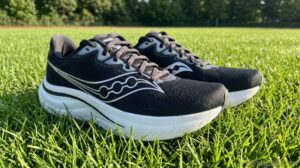
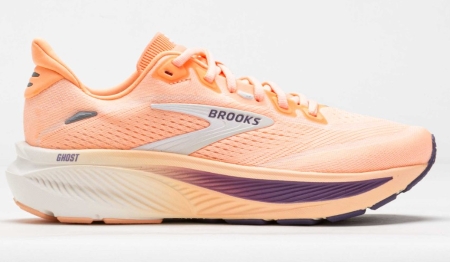
The exact versions behind my verdict
| Detail | Saucony Ride 19 | Brooks Ghost 18 |
|---|---|---|
| My running log | 110 miles | 380 miles |
| My size | Men’s US 10.5 | Men’s US 10.5 |
| Listed drop | 8 mm | 10 mm |
| Midsole | Reworked PWRRUN+ foam | Nitrogen-infused DNA LOFT v3 |
| Shape I notice | Broader base and more continuous roll | More conventional heel and flexible forefoot |
| Longest run in my log | 13 miles | 19 miles |
| Fit cue | Toe spread and rocker timing | Front volume and heel hold |
That is 490 miles across two separate pairs, not a 490-mile controlled comparison. The gap between 110 and 380 matters most for durability: I can describe how my Ghost changed over time, while the Ride still needs more miles before I make the same judgment. I would not convert those unequal logs into a lifespan ranking.
Why the ride feels different when the pace stays easy
Ride 19: cushioned roll, with the foot on a broad platform
Ride 19’s PWRRUN+ sits within a wider, more rounded sole than the older Ride shape I remember. At an 8:15 rhythm from Albany Avenue on the Atlantic City Boardwalk, I felt enough cushion to mute the hard surface without losing all sense of where my foot landed. The transition rolls forward gently. I do not have to drive a plated lever, but I do notice that the shoe prefers its own arc. My Saucony Ride review gives the broader family context.
I would not sell Ride 19 as a light workout shoe just because it can follow a progression. In a short 5K sprint session, it felt bulky when I pressed toward sub-6:30 intervals. That experience is consistent with where I place it: an easy-run and long-steady tool, with enough life for a modest change in pace, rather than my first pick for hard repeats.
Ghost 18: a quieter, more traditional sequence
Ghost 18’s DNA LOFT v3 protects me without making the stride feel like it is riding a large rocker. Its 10 mm listed drop and more flexible forefoot give me a familiar sequence from landing to toe-off. On the cool Margate beach shoulder in damp sea mist, I could stop thinking about the shoe and cruise; my pair felt secure on that particular asphalt. That is the point of Ghost for me: dependable daily rhythm, not a dramatic bounce. My Brooks Ghost review covers the line more fully.
The same calm personality has a limit. When I want to lift cadence sharply, Ghost feels less interested than a tempo trainer. It is not a failed speed shoe; it is a daily shoe doing a different job. I would choose it over Ride only if its heel height, forefoot flex, and fit feel better to me through the slow and tired portions of the run.
Easy day, long day, walk: my session-by-session choice
| Session | Ride 19 on my foot | Ghost 18 on my foot | My choice |
|---|---|---|---|
| Short easy road run | Soft, steady roll | Uncomplicated, flexible transition | Foot preference |
| Recovery shuffle | Rocked cushion keeps me moving | Familiar heel-led feel | Whichever stays genuinely easy |
| Ordinary daily mileage | More toe room and a broad base | Predictable fit and step | Ride for my current fit |
| Long aerobic run | My log reaches 13 miles | My log reaches 19 miles | Ghost: longer test log, not proven better |
| Walk plus run | Test the rocker at walking speed | More conventional walking motion for me | Ghost |
| Fast interval workout | Bulky at short, hard pace | Limited quick-turnover appeal | Neither |
The long-run row is not a race between unequal logs. I have more direct evidence for Ghost past 13 miles. Ride may perform well beyond my present log, but I will not invent that result. If your weekly run alternates easy and tempo work, my daily trainer versus tempo shoe guide explains why I keep a faster pair for the sharper days.
Ride 19’s 8 mm versus Ghost 18’s 10 mm drop: a clue, not the answer
Saucony lists 8 mm for Ride 19; Brooks lists 10 mm for Ghost 18. I can feel a more heel-led entry in Ghost and a broader rolling transition in Ride, but the two-millimeter figure alone does not create that difference. Foam compression, heel bevel, forefoot flex, and the point where I land all contribute.
I would not choose drop to treat or prevent an injury. When I switch between these shapes, I use an ordinary easy run to notice whether my calves, arch, heel, or step timing suddenly feel unusual. If I start modifying my stride to make a new shoe work, I reassess the fit and the training load instead of forcing a spec-sheet preference.
Fit after the feet warm is my first veto
In my men’s US 10.5, Ride leaves room for natural toe spread and secures my heel without needing an aggressive lace pull. I still check vertical room above the toes and the volume under the tongue: horizontal width does not guarantee that the upper will feel spacious after an hour. The broader platform only helps if my foot remains centered inside it.
Ghost fits my 10.5 D foot predictably, with a padded rearfoot and enough room at the front for my normal easy miles. Another runner may experience its front volume differently, especially once the feet swell. I stand, walk, and jog in both wearing my usual socks. My warm-foot shoe-fit checklist covers toe clearance, heel movement, and instep pressure as separate checks.
My six-step store test for these two
- Start with normal running socks and check toe width plus space above the nails.
- Walk for several minutes; compare Ghost’s heel entry with Ride’s rocker at walking speed.
- Jog easily until the first-step novelty fades.
- Try a gentle curve or mild road crown and notice whether the foot remains centered.
- Lift cadence briefly, then return to the pace of your usual daily run.
- Recheck the tongue, sidewall, and heel before deciding.
Stability, wet conditions, and what I know about wear
Both are neutral daily trainers. Ride’s broad sole gives me platform area; Ghost’s familiar heel and less aggressive rocker give me confidence in a different way. Neither label guarantees control on a sloped road. I watch whether the shoe stays under my foot as I tire, and whether I need to grip with my toes or adjust my landing.
A damp Margate outing in Ghost felt secure on my pair, but an 11-mile Atlantic City run in heavy rain showed another side: by mile six the upper was saturated, and the last five miles felt heavy and noisy. That does not mean the outsole failed; water retention and traction are separate questions. I have not logged an equivalent downpour in Ride 19, so I will not declare a wet-weather winner. My outsole and grip guide explains how I inspect different surfaces.
At 380 miles, my Ghost has smoothing on the main rubber contact zones and deeper foam creasing with a softer feel, while its upper remains structurally sound. At 110 miles, my Ride shows minor outsole scuffs, fine foam creases, and no mesh damage. Both are useful observations; they are not proof that one model lasts longer. I check the same familiar route as the miles accumulate and retire a pair when fit, stability, or ride quality no longer suits its job.
Who I would point toward each pair
- Buy Ride 19 if you enjoy a softly rolling daily run, want more toe spread on a foot like mine, and accept that my durability log is still young.
- Buy Ghost 18 if you prefer a more traditional heel-led step, value the familiar fit, and want a daily shoe I have followed through 380 miles.
- Buy neither if the upper pressures your foot, the transition makes you change your stride, or your missing shoe is for interval pace.
- Keep your current daily shoe if it already makes easy and long road runs comfortable. A new version is not automatically a better match.
Their roles overlap enough that I would seldom buy both for a small rotation. My running-shoe rotation guide helps give a second pair a distinct job. If Ride’s easy roll feels too relaxed and you want a closer, more direct shoe, my Pegasus 42 versus Ride 19 comparison tests that choice. If you are choosing within the Ghost family of comparisons, my Clifton 10 versus Ghost 18 guide asks whether a more rockered alternative would actually suit your stride.
FAQ: Ride 19 vs Ghost 18
Is Saucony Ride 19 or Brooks Ghost 18 better for everyday running?
For my foot, Saucony Ride 19 is the more pleasant easy-mile starting point because its broad, softly rolling platform and toe room suit me. Brooks Ghost 18 is the safer starting point when you want a familiar, flexible transition and a well-known fit.
Which feels softer, Saucony Ride 19 or Brooks Ghost 18?
On my foot, Saucony Ride 19 feels more softly rolling underfoot; Brooks Ghost 18 feels more controlled and traditional. That is a ride preference, not a lab softness measurement. I would compare them while jogging at my real easy pace rather than pressing the midsole in a store.
Which is better for long runs, Saucony Ride 19 or Brooks Ghost 18?
I have taken Brooks Ghost 18 to 19 miles and Saucony Ride 19 to 13 miles. My direct late-run evidence therefore reaches farther in Ghost, but that does not prove it is better for every runner. I would still let warm-foot fit decide.
Is Ghost 18 a stability shoe?
Brooks Ghost 18 is a neutral daily trainer with a stable-feeling ride for me. Saucony Ride 19 is neutral too. A steady platform is not the same as a support model selected for an individual need.
Can I walk in both Ride 19 and Ghost 18?
Yes. I would test Saucony Ride 19 and Brooks Ghost 18 at walking speed before buying. Ghost’s more conventional heel-to-forefoot motion is my first pick for a mixed walking and running day; Ride may win if its rocker feels natural to you.
Which lasts longer, Saucony Ride 19 or Brooks Ghost 18?
I cannot name a durability winner between Saucony Ride 19 and Brooks Ghost 18 from my unequal logs. My Ghost has 380 miles with a sound upper and visible sole aging; my Ride has 110 miles with minor wear. I need a more mature Ride log before making a direct lifespan claim.
My final verdict
I would begin with Saucony Ride 19 for the runner who wants a softer, broader, more rolling daily trainer. I would begin with Brooks Ghost 18 for someone who wants a familiar 10 mm heel-led step, flexible forefoot, and a model my own log has carried much farther. I would buy the pair that still feels natural after a warm easy run. That decision matters more than declaring one universally better from two uneven wear histories.

Written by Ken — 12 years of running, 12,500+ miles, 63 shoes tested, 36 races from 5Ks to a 50K ultra. I run 30–40 miles a week on the Atlantic City Boardwalk and review every shoe with real training miles, not one-run demos. More about me →