
Saucony Endorphin Speed 5 vs adidas Adizero Boston 13: if I had to pick one workout shoe from my 230 miles in the Speed 5 and 220 in the Boston 13, I would keep the Saucony. It changes gears more willingly in my fartleks and feels kinder over a long session. I would choose the Boston when I wanted a more grounded, firmer long-run trainer that comes alive on a climb or a steady effort. Both can train fast; they ask my foot to get there in different ways.
I have spent 12 years running and reviewing shoes, but the useful part of this comparison is specific: two men’s US 10.5 pairs under my 182-pound frame on South Jersey roads and boardwalks. I compare the warm-up, the work, and the tired final miles. A shoe that wins the fast rep but ruins the easy miles around it is a poor one-pair choice.
My quick answer before the details
| If your week needs… | I start with… | The reason I might switch |
|---|---|---|
| Fartleks and frequent pace changes | Endorphin Speed 5 | Its rocker feels too insistent at easy pace |
| A steady tempo plus the long run around it | Boston 13 | The firmer heel tires your foot |
| A performance fit with more toe spread | Endorphin Speed 5 | The upper still presses your instep |
| A more direct, grounded training feel | Boston 13 | Its front shape or tongue creates pressure |
| Slow recovery every day | Neither | Choose a comfortable daily trainer |
| All-out short intervals or a peak race | Neither by default | Try a lighter, race-specific pair |
The Saucony is the easier recommendation if the shoe must cover mixed-pace work and long workouts. The adidas makes more sense when I want a firmer road feel and a stable, deliberate platform over sustained running. If neither feels comfortable through an easy warm-up, I do not let plate technology settle the sale.
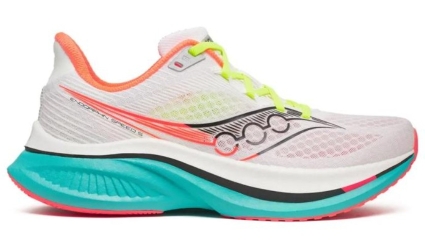

The exact shoes and miles behind this comparison
| Detail | Saucony Endorphin Speed 5 | adidas Adizero Boston 13 |
|---|---|---|
| My running log | 230 miles | 220 miles |
| My size | Men’s US 10.5 | Men’s US 10.5 |
| Listed heel-to-toe drop | 8 mm | About 6 mm |
| Midsole and structure | PWRRUN PB with a semi-rigid nylon plate | Lightstrike Pro over Lightstrike 2.0 with EnergyRods 2.0 |
| Upper on my foot | Secure heel and more toe spread | Snug midfoot and performance-oriented front |
| Longest outing in my log | 20 miles | 16 miles |
| My main role | Tempo, fartlek, and long workout | Steady workout and long road training |
The listed drop is a reference, not a measured prediction of how my calves feel. Boston specifications vary slightly by market and measurement method; I focus on the lower-drop, firmer sensation I actually get from my pair. The two logs are separate training histories, not a controlled 450-mile head-to-head experiment.
Why these two “fast trainers” do not feel interchangeable
Speed 5: the rocker helps when I change gears
Saucony puts a semi-rigid nylon plate between PWRRUN PB foam layers. On my foot, the sole rolls smoothly without the uncompromising lever sensation I get from a race-focused carbon shoe. Between the Atlantic City piers, I could surge around 6:45 pace, settle again, and feel the shoe keep up with each cadence change. That responsive, less punishing transition is why I give the Speed 5 my mixed-workout vote. My full Endorphin Speed review follows the line in more detail.
I would not call it a substitute for every racing flat. During a fast 5K sprint session, I noticed rotational weight and bulk once I pressed toward sub-6:30 intervals. The same cushioning that lets me carry speed through a longer workout does not disappear when I want a very quick, short rep. That is a useful limit, not a flaw for its main job.
Boston 13: rods, two foams, and a firmer platform
Boston 13 layers Lightstrike Pro above Lightstrike 2.0 and uses EnergyRods 2.0 rather than the Saucony’s single nylon plate. The forefoot has a more purposeful push for me, while the heel feels more direct and less accommodating at a shuffle. On the 4% rise of the Route 52 causeway bridge, the adidas gave me crisp turnover on repeated climbs. I appreciate that when the workout asks me to hold form under effort rather than float through changing gears.
I feel more of the road in Boston. “Firmer” is not automatically faster, and a rod system does not produce free propulsion. My stride must meet the platform well enough to use it. At steady tempo it clicks for me; at the very easy start and finish of a long session, I notice the firmer underfoot feel more than I do in Speed 5.
The workout test: warm-up, tempo, recovery, long run
| Part of the run | Speed 5 in my use | Boston 13 in my use | My pick |
|---|---|---|---|
| Easy warm-up | Smoother and more forgiving | Firm but manageable when legs are fresh | Speed 5 |
| Fartlek with pace changes | Quick to settle into the next gear | Better once the effort steadies | Speed 5 |
| Sustained road tempo | Smooth, lively, and protected | Direct and purposeful | Fit and feel decide |
| Bridge or rolling repeats | Able to respond, but feels more cushioned | My clearest Boston session | Boston 13 |
| Long workout with faster blocks | My log reaches 20 miles | My log reaches 16 miles | Speed 5 on my evidence |
| Slow recovery day | Can do it, but the plated roll remains | Firmness is hard to ignore | Neither first |
Those outcomes are about session purpose, not an absolute minutes-per-mile cutoff. I define tempo as a controlled, sustained effort I can complete without chasing sprint mechanics. My tempo-run guide explains how I set that effort. If most of your week is truly easy running, my daily trainer versus tempo shoe guide helps decide whether either plated trainer should be your only pair.
Plates and rods do not remove the fit problem
In my US 10.5, Speed 5 holds my heel while leaving noticeably better horizontal toe spread. Its lightweight upper lets me adjust midfoot tension without crushing the front. Boston 13 locks down the middle of my foot firmly, but I have less spare room when my toes expand late in a session. I would not assume “true to size” means equal usable space across these two lasts.
Boston also gave me a clear warning on a humid 12-miler: its tongue shifted sideways and the lace knot pressed into my instep. I check that exact pressure point after the shoe warms, especially before a long workout. I would rather adjust the lacing or leave the shoe than overtighten it to preserve a fast feel. Even in the roomier Saucony, I still verify heel hold and space over the toenails. My running-shoe fit checklist gives the full sequence.
My five-minute try-on for a speed trainer
- Wear the socks you use for workouts and check both width and height at the toes.
- Jog at warm-up effort first; notice whether you have to alter your landing.
- Lift cadence briefly, then settle into a controlled tempo rhythm.
- Run a gentle turn or camber and check heel hold and sidewall pressure.
- Recheck tongue position and instep tension, especially in Boston 13.
- Only choose the pair that still works when you return to easy effort.
Stability, grip, and the last miles of a workout
The Speed 5 feels more cooperative as I fatigue because its forefoot gives my toes room and its transition remains smooth. The Boston gives me a firmer, more planted sensation on steady road work. Neither is a motion-control shoe; I judge whether my own foot stays centered on a mild road crown and whether I must make extra corrections at the end of the run. If I do, I stop calling that pair the winner for long workouts.
Boston 13 uses a Lighttraxion outsole with Continental rubber at the toe-off area. Speed 5 has expanded rubber coverage in the heel and a central groove. I do not turn those names into a universal wet-grip ranking. On painted lines, metal plates, and damp boards, I slow down and judge the contact under that day’s conditions. My outsole-rubber guide explains why the rubber layout matters more than a single material label.
At 230 miles, my Speed 5 shows wear near my lateral midfoot landing zone and moderate foam creasing, while the upper remains intact. At 220 miles, my Boston also shows localized rubber wear and creasing without an upper failure. I cannot translate these nearby mileage marks into an exact lifespan for either shoe. I repeat a familiar workout, watch whether the fit stays secure, and retire the pair from fast work if its ride no longer supports the assigned pace.
Which one would I actually buy?
- I would buy Speed 5 for fartleks, tempo sessions with changing pace, and long workouts where a forgiving forefoot matters. It is my more versatile fast-training choice.
- I would buy Boston 13 for a firmer, more direct road feel, steady tempo blocks, and climbs—after checking the tongue and front-of-foot fit.
- I would buy neither as my only shoe if most miles are slow recovery, or if either plate/rod geometry makes me change my natural stride.
- I would keep my current trainer if I lack a distinct workout gap. New hardware alone is not a training purpose.
I would not put both into a small rotation without a specific reason: their tempo and faster long-run roles overlap. My rotation guide helps me give every pair a separate job. If a runner wants to move from a daily trainer to a workout shoe, I first decide whether the missing session is short and sharp, or sustained and aerobic; that choice matters more than a plate label.
FAQ: Endorphin Speed 5 vs Boston 13
Is Endorphin Speed 5 or Boston 13 better for tempo runs?
For my changing-pace tempo and fartlek work, I choose Speed 5. For a steady road tempo or a climb, Boston 13 makes a strong case. I let the easy warm-up and fit decide when both feel quick enough.
Which is better for long runs?
My Speed 5 log reaches 20 miles and my Boston 13 log reaches 16. I prefer Speed 5 for a long run with faster blocks because it stays more forgiving for me late in the session; Boston works when I want a firmer, steady rhythm.
Is the nylon plate in Speed 5 the same as Boston 13 EnergyRods?
No. Speed 5 uses a semi-rigid nylon plate with PWRRUN PB; Boston 13 uses EnergyRods within a Lightstrike Pro and Lightstrike 2.0 setup. I feel a smoother roll in Saucony and a more direct, purposeful forefoot in adidas.
Which shoe fits a wider forefoot?
My Speed 5 gives my toes more usable room in the same US 10.5. Boston secures my midfoot but can feel more restrictive in front. I would test both after a warm-up rather than size up solely from a width label.
Can either shoe replace a daily trainer?
They can handle some easy mileage, but I would not make either my first choice if slow recovery dominates the week. I want the fast-training role to justify the plated structure and the shoe to remain comfortable at warm-up pace.
Do I need both in one rotation?
Usually not. I can separate their roles only if I consistently use Speed 5 for changing-pace sessions and Boston 13 for firmer steady efforts, and both fit without compromise. Otherwise one of them is enough.
My final verdict
My pick is Saucony Endorphin Speed 5 for the runner who wants one performance trainer to carry fartleks, tempo work, and long sessions with pace changes. I would choose adidas Adizero Boston 13 when the runner enjoys a firmer, road-connected ride and primarily runs steady workouts or climbs. My 450 logged miles explain the preference; your own warm-foot comfort and the final easy miles of a workout should confirm it.

Written by Ken — 12 years of running, 12,500+ miles, 63 shoes tested, 36 races from 5Ks to a 50K ultra. I run 30–40 miles a week on the Atlantic City Boardwalk and review every shoe with real training miles, not one-run demos. More about me →