
Are expensive running shoes worth it? Sometimes—but only when the extra money buys a benefit I can name, feel, and use often enough. After 12 years of running, I have learned that price is a poor shortcut for quality. A premium shoe can be the cheapest decision in my rotation if it fits perfectly and solves an important job. It can also be the most expensive mistake if I buy technology my stride never uses.
I do not ask, “Is this shoe worth $200?” I ask, “What does the extra money change for this runner, on this run, compared with the best cheaper alternative?” That question keeps the logo, launch hype, and retail price from making the decision for me.
My verdict before the math
For most runners, the sweet spot is a well-fitting daily trainer—not the cheapest shoe and not the most advanced one. I spend more when a premium feature clearly improves race performance, reduces shoe weight without ruining comfort, gives me the exact fit I need, or handles a specialized surface better. I spend less when two shoes perform the same job equally well.
| If the extra money buys… | My decision |
|---|---|
| A better color, story, or limited release | I keep my money. |
| Fit that removes heel slip or toe pressure | I consider paying more. |
| A measurable race-day advantage I can actually use | I treat it as performance equipment. |
| More foam but less control | I choose the simpler shoe. |
| Durability without sacrificing the intended ride | I compare cost per useful run. |
| A feature I cannot explain | I do not pay for it. |
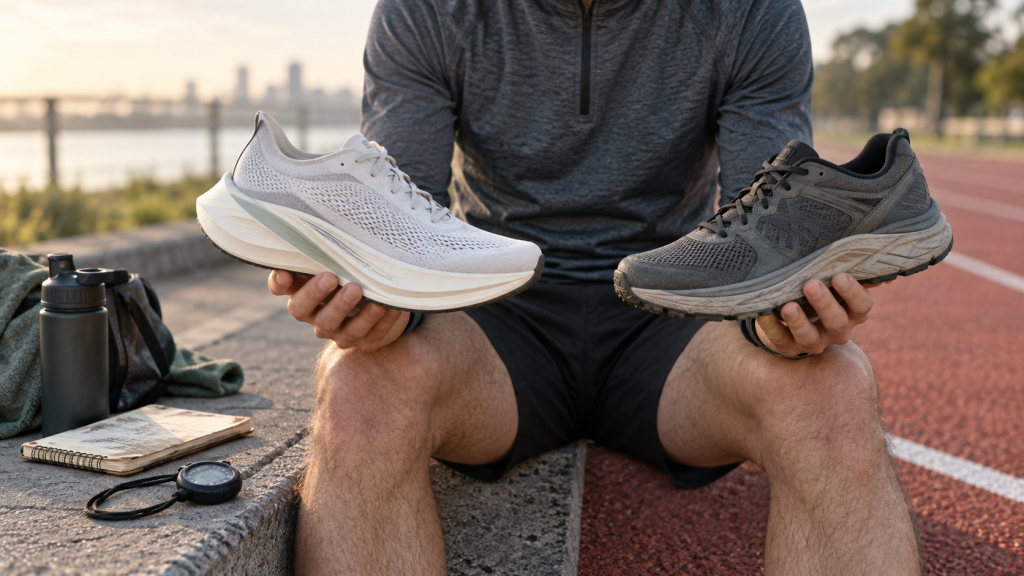
Price is a label; value is a relationship
An expensive shoe is not automatically overpriced. “Expensive” describes the receipt. “Worth it” describes the relationship between the shoe, the runner, and the job.
A high-end carbon racer may be good value for a runner chasing a personal best after months of specific training. The same shoe may be poor value for a new runner who needs one dependable pair for easy miles. A conventional daily trainer bought on sale can be extraordinary value if it fits, stays predictable, and gets worn four times a week.
This is why I start with role and fit before I look at price: define the runner and the job, then narrow the shoe—not the other way around.
Ken’s four-account value ledger
I keep four mental accounts whenever a premium shoe tempts me. The shoe has to create value in at least one account without producing a serious debt in another.
Account 1: fit value
Fit is the account I refuse to overdraw. A cheaper shoe that holds my heel, gives my forefoot room, and creates no pressure point is worth more to me than a premium shoe that does not. No foam or plate can rescue the wrong shape.
I check fit after my feet are warm: thumb-width length, room for toe splay, secure midfoot, no arch ridge, and no heel movement on an incline. If I am choosing extra length just to gain width, the last is wrong. My toe-box fit checks help separate a sizing problem from a shape problem.
Account 2: job value
Every shoe gets one written job before I buy it: daily mileage, long runs, recovery, speed sessions, racing, technical trail, or something equally specific. “It looks fast” is not a job.
Premium materials make the strongest case when the job rewards them. Low mass, highly resilient foam, a tuned plate, and coordinated rocker geometry can improve running economy for many runners. The response is still individual, and the complete shoe matters more than the plate alone. For race-day candidates, I compare the purpose and tradeoffs in my carbon-plated running-shoe guide.
For easy mileage, the value test changes. I care more about fit, stable cushioning, outsole coverage, and whether the shoe disappears under me. A good daily trainer often earns more value than a spectacular racer because it solves more of my actual week.
Account 3: use value
A shoe cannot return value from the closet. I estimate how often I will honestly use it, not how often I imagine using it on purchase day.
Suppose Shoe A costs less but never feels right, so I avoid it after five runs. Shoe B costs more but handles three weekly runs for months. Shoe B can have the lower cost per useful run. The word useful matters: miles completed in discomfort are not a bargain.
| Value measure | My calculation | What it reveals |
|---|---|---|
| Cost per planned use | Purchase price ÷ realistic number of runs | Whether the role is frequent enough to justify the spend |
| Cost per useful mile | Purchase price ÷ comfortable, role-appropriate miles | Whether apparent durability was actually usable |
| Upgrade cost | Premium price − best acceptable alternative | The real amount paid for the extra feature |
| Cost of a mismatch | Price − recoverable return or resale value | Why return policy and fit testing matter |
Account 4: compromise debt
Every design has a bill. A very light shoe may sacrifice rubber or structure. A tall soft shoe may lose cornering precision. A rigid racer may feel efficient at pace and awkward while jogging. A durable trainer may feel heavier and less lively.
I write down the compromise before I buy. If it conflicts with the shoe’s main job, I walk away. If it affects a situation the shoe will rarely face, I may accept it. That is a better decision than pretending a premium model has no downside.
What a higher price can genuinely buy
- Lower weight at a given level of cushioning. Advanced foams can give designers more cushioning or resilience without the mass of a conventional material.
- A coordinated performance system. Foam, plate stiffness, rocker, stack, and upper can work together to reduce the energy cost of running.
- More precise construction. Thin engineered uppers, targeted reinforcement, and shaped platforms can improve hold without adding bulk.
- Specialized protection or traction. Trail compounds, rock protection, weather materials, and surface-specific outsoles can justify extra cost when the route demands them.
- A better solution for an unusual fit. Sometimes the only last that truly works for a foot happens to sit in a more expensive model.
Those are possibilities, not promises. I still test the complete shoe. Premium ingredients assembled around the wrong shape or geometry do not create premium value.
What the higher price does not guarantee
More comfort
Comfort is personal. My mildly wide forefoot can reject an expensive narrow upper in thirty seconds. A less glamorous shoe with the right last wins immediately.
Fewer injuries
I never treat price as injury insurance. Training load, recovery, previous injury, strength, health, terrain, fit, and shoe transitions all matter. A premium shoe can change load; it cannot make reckless progression safe.
More speed for every runner
Advanced racing shoes improve economy on average, but individual response varies by model. One runner may gain a meaningful advantage while another dislikes the rocker, cannot stabilize the platform, or runs no better. I buy the shoe that works with my movement, not the technology category in the product name.
Longer life
Price and durability do not move together. A racing shoe may deliberately trade outsole coverage and upper structure for weight. A simpler trainer can outlast it. I retire shoes by behavior and condition, not by prestige or a universal mileage number; my running-shoe replacement test shows the signs I track.
My checkout rule: prove the upgrade, not the shoe
I compare the premium candidate against the best acceptable cheaper shoe. The cheaper shoe is the control. The expensive shoe must prove the upgrade.
- Name the role. I write one sentence: “I need this shoe for…”
- Set the control. I choose the least expensive shoe that already fits and can do the job.
- Name the paid difference. Lower weight, better fit, race economy, traction, or another concrete benefit.
- Test at the relevant effort. A race shoe gets tested near race rhythm; a daily trainer gets tested when relaxed and when tired.
- Price the compromise. I note instability, stiffness, limited use, or shorter expected life.
- Make the no-story decision. If I removed the logo and launch story, would the difference still deserve the upgrade cost?
If I cannot finish those six steps, I am not ready to buy. I return to my broader best running shoes guide and compare by role rather than price tier.
When I pay more without regret
- A goal race matters to me. The premium racer fits, feels controlled at pace, and clearly beats my current option.
- The fit is unusually good. A more expensive last solves a recurring problem without creating another.
- The shoe will be used frequently. A daily or long-run model owns a large part of my training week.
- The terrain requires specialized design. Traction, drainage, protection, or weather performance is essential rather than decorative.
- The upgrade survives fatigue. The benefit is still present late in the intended run, not just during a fresh five-minute test.
- The budget is genuinely available. I am not trading away race entry, food, sleep, medical care, or consistent training for footwear.
When I choose the cheaper shoe
- The fit and ride are equally good.
- The premium feature does not serve the written job.
- The shoe will be used too rarely to justify the upgrade.
- The expensive option asks me to tolerate instability, pressure, or an awkward rocker.
- Last year’s model has the same fit and function at a lower price.
- I am a beginner who still needs to discover basic preferences.
For a new runner, I prefer a comfortable, stable, versatile first pair and money left for consistent training. My beginner running-shoe guide prioritizes that foundation instead of prestige features.
Three runners, three different answers
The new runner building a habit
I put nearly all the budget into fit and versatility. This runner needs a shoe that handles easy run-walk sessions, feels predictable, and creates no obvious pressure. I would rather buy a proven daily trainer and keep money available for a second pair later than spend everything on race technology before preferences are clear.
The regular runner replacing one worn pair
I start with the current shoe as the control. What worked, what failed, and what job will the replacement own? If a premium daily trainer improves the exact weakness—perhaps forefoot comfort late in long runs—then I can justify the upgrade. If it merely feels livelier for thirty seconds, I keep comparing.
The trained runner targeting a personal best
This is where I am most willing to pay for advanced footwear. The race has a date, the runner has done the work, and small performance gains have real value. I still require a race-pace test, secure fit, stable cornering, and no troubling response afterward. Expensive becomes reasonable because the use is narrow but important—not because the shoe needs to be worn every day.
The smartest ways to spend less
- Buy the previous version. I do this when the last, geometry, and use case remain suitable; I do not assume every update is better.
- Use a real return window. A short run reveals more than standing on store carpet.
- Compare the upgrade cost. A $30 difference deserves a different discussion from a $100 difference.
- Do not build a fantasy rotation. I buy the next missing role, not three overlapping shoes.
- Track actual use. My log exposes which shoes earn their place and which stories I should stop buying.
Frequently asked questions
Are expensive running shoes better than cheap ones?
Not automatically. Higher prices can buy lighter materials, responsive foam, plates, specialized outsoles, or more complex construction. The cheaper shoe is better when it fits more securely and performs the required job with fewer compromises.
Do beginners need expensive running shoes?
No. I want a beginner in a comfortable, secure, versatile shoe that matches the foot and training surface. Premium race technology is optional and often less useful than learning consistent pacing and load progression.
Are carbon-plated running shoes worth it?
They can be worth it for a goal race when the complete shoe fits, feels controlled at race pace, and produces a benefit you value. They are poor value when the geometry fights your stride or the shoe rarely leaves the closet.
Do expensive running shoes last longer?
No. Price does not guarantee durability. Lightweight racers may use less rubber and structure, while a less expensive daily trainer may remain useful longer. Judge wear by ride, fit, outsole, and structural condition.
Is last year’s running shoe a good buy?
Often, yes. I buy the previous version when I know the fit and function suit me and the shoe is new, authentic, and returnable. I check what changed before assuming the newer version is an upgrade.
Should I buy a premium daily trainer or a race shoe first?
I buy the shoe that fills the larger real need. For most runners with one pair, that is a dependable daily trainer. I add a premium racer when a specific race goal and enough training use justify it.
How much should I spend on running shoes?
Spend enough to get the right fit and function without sacrificing higher-priority needs. I do not use one universal budget. I compare the upgrade cost with the specific benefit and the number of useful runs I expect.
My final value call
Expensive running shoes are worth it when the paid difference improves a job that matters to you—and survives real running, fatigue, and honest use. They are not worth it because a brand calls the foam premium, because a professional wears them, or because the original price is high.
My order is always the same: fit first, job second, proof third, price fourth. When a premium shoe wins in that order, I am comfortable paying for it. When it does not, the cheaper shoe is not a compromise. It is the smarter decision.

Written by Ken — a running specialist with 12 years of experience, 12,500+ miles, 63 shoes tested, and 36 races from 5K to 50K. I evaluate shoes by fit, role, ride behavior, and the value they return through real training—not by launch price. More about my testing approach.