
For ordinary track workouts, my best running shoe is the Brooks Hyperion 3. It feels secure through the bends and still behaves naturally when I jog between reps. For shorter, sharper work I consider the Nike Streakfly 2; for an unplated ride, the Saucony Kinvara 16.
This is a guide to shoes for training on a 400-meter track—not a list of track spikes or a promise of meet legality. I care about the whole session: warm-up, fast reps, turns and recovery.
Quick Picks: My Top 3 Track-Workout Shoes
| My pick | Shoe | Why it fits the session |
|---|---|---|
| Best overall | Brooks Hyperion 3 | Controlled bends; easy-to-fast range |
| Best for fast short reps | Nike Streakfly 2 | Aggressive, light race feel |
| Best unplated | Saucony Kinvara 16 | Flexible, simple workout rhythm |
10 Best Running Shoes for Track Workouts: In-Depth Reviews
The first four reviews use mileage noted in my running log. The remaining six are considered fit-and-use shortlists based on each shoe’s current design; I do not give them invented test miles. I rank these as training shoes on a track, not as interchangeable competition spikes.
1. Brooks Hyperion 3 — Best all-around track workout shoe
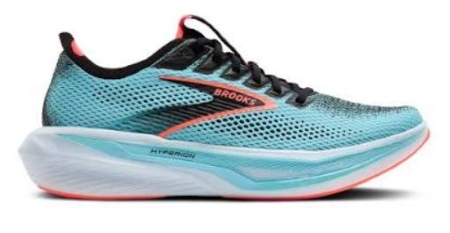
I reach for the Hyperion 3 when the session mixes strides, longer reps and jogging recoveries. It asks the least adjustment of me between those three gears.
My 304-mile log includes track intervals and compact speed sessions. In my regular size, the heel stayed secure and the upper felt precise without extra bulk. On repeated left-hand bends, that dependable hold matters more to me than a spectacular first straight. The responsive but relatively direct ride lets me feel the change from 400-meter pace to recovery pace instead of pushing me through every step.
Where I draw the line: I would not make it my most cushioned long-run shoe, and I would check forefoot room before a very long track session. For a mixed workout, though, this is the pair I would test first.
2. Saucony Kinvara 16 — Best unplated, flexible option
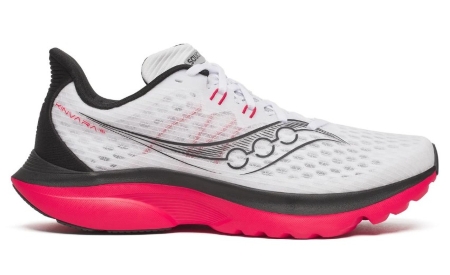
The Kinvara 16 is the shoe I would hand to a runner who wants to do the work rather than feel a plate dictate the rhythm.
I logged 359 miles in this pair, using it for short tempos, strides and uncomplicated daily runs. Its forefoot gave my toes horizontal space while the heel remained held, a useful combination when I accelerate into a bend. The low-bulk, flexible ride makes 200s and 400s feel different from the more rockered shoes here, and the easy jog between reps feels natural rather than forced.
Where I draw the line: Sparse outsole coverage showed wear earlier than on fuller-rubber trainers in my log. I also want more protection for a long, tired-leg road run at my weight; that is not the job I rank it for.
3. Nike Streakfly 2 — Best for short, fast repetitions
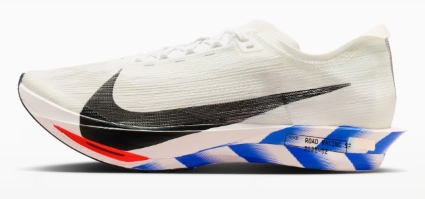
When I want a genuinely sharp 200- or 400-meter session, the Streakfly 2 is the most race-like option I would bring to a non-spike workout.
My 227-mile log covers fast road repeats and hill work. The close midfoot and tapered forefoot felt secure on my US 10.5 D foot, but I would never assume that shape works for a broader foot. Nike builds this road racer on a spike-inspired last with a low offset and carbon plate. That explains its aggressive, forward feel; it does not turn it into a track spike or make it appropriate for every meet.
Where I draw the line: The direct geometry and tight front are too demanding for my relaxed recovery days. I would save it for fast, deliberate work and confirm the facility or competition rules before using it in an event.
4. adidas Adizero Takumi Sen 11 — Best for 5K-paced track reps

The Takumi Sen 11 comes into its own for me when the intervals look like a 5K or 10K rehearsal rather than a set of all-out sprints.
I have 270 logged miles, including fast road repetitions and track-adjacent sessions. Its close midfoot fit works best for me with thin socks, and the lower-feeling race stance lets me place the foot cleanly as I leave the curve. I like it for a sequence such as 5 × 1,000 meters, where I need repeatable rhythm more than a single explosive lap.
Where I draw the line: It is less forgiving for broad feet and for slow, relaxed running. Because it is designed for road racing, I treat it as a track-workout option—not a blanket recommendation for sanctioned track competition.
5. ASICS Hyper Speed 6 — Best simple value speed shoe

If I wanted a no-fuss, lower-cost shoe for regular intervals, I would start my comparison with the Hyper Speed 6.
ASICS positions it for quick training and racing and uses lightweight engineered mesh. I would judge it on the basic questions: does the heel stay still through eight left turns, can I relax on the recovery jog, and does the forefoot remain comfortable by the last rep? Its appeal is not an exotic plate story; it is a lighter, straightforward shoe that can keep the session itself in focus.
Where I draw the line: I do not have a personal mileage log for this version. A runner who wants a highly cushioned long-rep shoe should compare the more protective options below.
6. ASICS Magic Speed 5 — Best controlled carbon workout choice

The Magic Speed 5 is where I would look if I wanted a plated training shoe without immediately reaching for a fragile-feeling flagship racer.
This version has a lower stack than its predecessor and a reconfigured carbon plate. That design gives me a clear test: run a controlled set of 800s, then ask whether the shoe stays composed on the bend and still lets me jog the recovery normally. It is a better fit for longer, purposeful repetitions than for a first-ever speed session in which the runner is still learning pacing.
Where I draw the line: The plate and firmer race geometry may feel unnecessary at easy paces. This is a design-based shortlist pick, not a claim that I have logged miles in this exact shoe.
7. Saucony Endorphin Speed 5 — Best for longer repeats and track nights
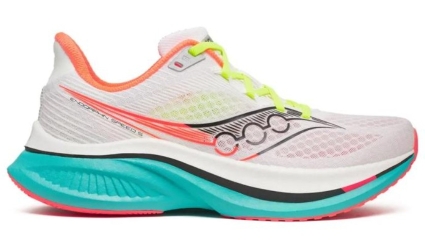
The Endorphin Speed 5 is the option I would pack for 800s, mile repeats or a club track night that starts and ends away from the oval.
Its semi-rigid nylon plate and responsive foam aim for a smoother transition than the most aggressive carbon racers. That matters when my workout includes a warm-up, several hard laps, recovery jogs and a cool-down in the same pair. I would compare it directly with the Hyperion 3: the Saucony asks more of the rocker, while the Brooks feels more neutral between paces.
Where I draw the line: I would not buy it just because it is plated. If the rolling sensation makes my foot placement feel vague in the curve, I would choose the simpler trainer.
8. adidas Adizero Adios 9 — Best traditional fast-road feel
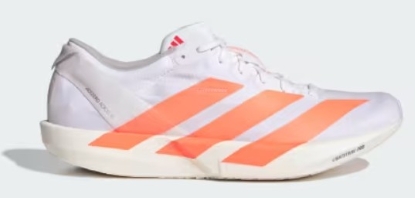
The Adios 9 is my shortlist choice for a runner who dislikes a tall, highly rockered shoe on the track.
The current Adios line is built around lightweight speed rather than maximal cruising. I would put this shoe through 200-meter strides, a bend-to-straight transition and one longer repeat to learn whether its direct feel remains comfortable when the workout lasts more than a few minutes. It is a sensible comparison against the Kinvara: both speak to runners who want to feel their own cadence, but fit and underfoot protection decide which wins.
Where I draw the line: I have not logged this model personally. I would not promise a traditional shoe is automatically faster, and I would not choose it for plush recovery miles.
9. New Balance FuelCell Rebel v5 — Best cushioned unplated interval trainer
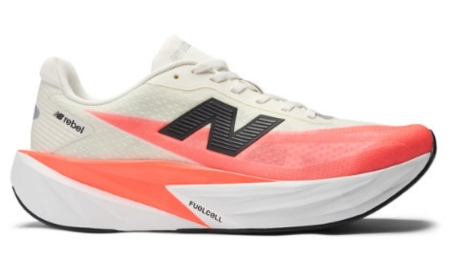
For a runner who wants one lively shoe for the track and normal weekly mileage, I would compare the Rebel v5 before buying a narrow racer.
New Balance combines an engineered mesh upper with a responsive PEBA/EVA-based ride and a wider platform than its predecessor. In a session of longer reps, I would value the protection and easy-to-fast range; on 200s, I would test whether its softer bounce still feels precise through the bend. It is the practical crossover in this list, not the most stripped-down pick.
Where I draw the line: Its softer ride may feel less planted when I drive hard out of the curve. I am judging its design and use case here, not presenting unlogged track mileage.
10. HOKA Mach 7 — Best secure tempo-to-track crossover
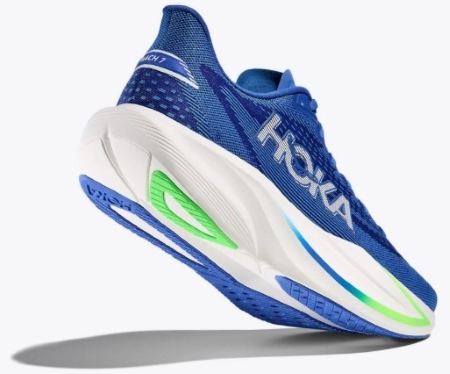
The Mach 7 is the one I would try when a snug midfoot and a responsive everyday platform matter more than a plated racing sensation.
HOKA kept the lively supercritical-foam concept of the Mach 6 but refined the creel-jacquard upper and tongue. The internal gusset is intended to keep the fit connected, while sticky forefoot rubber gives me a concrete reason to test its grip through a track bend. I would check the tongue and heel after repeated turns, then see whether the shoe can carry my warm-up, tempo intervals and cool-down without a change of footwear. This is a fit-and-use decision, not an assumption that every newer upper fits better.
Where I draw the line: Its close fit may still be wrong for a broad or high-volume foot. I have no personal track mileage log for Mach 7, so I would confirm its hold and grip in a real workout before ranking it above my logged pairs.
At a Glance: Which Track-Workout Shoe Fits Which Session?
I use this comparison to narrow the list before deciding on fit. “Logged” means I have personal mileage in that exact version; “shortlist” means I am judging the current design and would still confirm it in a workout. The workout matches are my choices, not laboratory performance rankings.
| Shoe | Where I would use it | Evidence and main tradeoff |
|---|---|---|
| Brooks Hyperion 3 | Mixed reps and recovery jogs | 304 miles logged; check forefoot room |
| Saucony Kinvara 16 | 200s, 400s and unplated tempo | 359 miles logged; lighter outsole coverage |
| Nike Streakfly 2 | Fast 200s and 400s | 227 miles logged; narrow, aggressive fit |
| adidas Adizero Takumi Sen 11 | 5K-paced 800s and 1,000s | 270 miles logged; close midfoot fit |
| ASICS Hyper Speed 6 | Simple interval training on a budget | Design-based shortlist; confirm bend grip |
| ASICS Magic Speed 5 | Controlled, longer plated repetitions | Design-based shortlist; plate may feel unnecessary at easy pace |
| Saucony Endorphin Speed 5 | 800s, mile repeats and full track nights | Design-based shortlist; rocker may not suit every turn |
| adidas Adizero Adios 9 | Direct-feeling short-to-middle reps | Design-based shortlist; less plush for recovery |
| New Balance FuelCell Rebel v5 | Longer reps plus weekly mileage | Design-based shortlist; test soft ride on bends |
| HOKA Mach 7 | Tempo-to-track crossover | Design-based shortlist; check snug fit and tongue |
How I Test a Shoe on the Track
I do not judge a shoe by one flying straight. I warm up in it, run several controlled strides, then complete repetitions that match the intended workout. I pay attention to the same left-hand bend each lap: if the heel drifts, the forefoot pinches or the platform makes me brace, the shoe loses ground even if it feels lively on the straight.
The recovery jog is my second filter. An aggressive racer can feel excellent at 5K pace yet awkward for 90 seconds of easy running. For short, sharp repetitions I tolerate that compromise; for a mixed or longer interval session I favor a shoe that changes gears smoothly. I also inspect the outsole after use because rubber coverage and grip matter on the actual track surface. My log is a record of one runner’s use, not a controlled head-to-head lab trial; for the six unlogged versions, I make a fit-and-design judgment rather than claiming test results.
Track Trainer or Spike? How I Make the Call
For normal training, I usually prefer a lightweight road shoe: I can warm up, complete the session and cool down without changing footwear. A spike has a more specialized role in race-specific practice. It may demand a different loading pattern, and I would introduce it gradually rather than wear it for an entire first workout.
I separate training suitability from competition legality. Even if a shoe feels excellent on the oval, I check the meet’s current rules before using it in a race. My 5K and 10K race-shoe guide covers short road racing; my non-plated racing picks cover another fast-feeling option. Neither list replaces an event rulebook.
How I Choose the Right Pair for My Workout
- 200s and 400s: I prioritize precise fit and an unambiguous grip. Streakfly 2 is my aggressive option; Kinvara 16 is the simpler one.
- 800s to mile repeats: I want a shoe that settles into repeatable rhythm. Hyperion 3, Takumi Sen 11 and Endorphin Speed 5 answer that job differently.
- Warm-up and cool-down in one pair: I lean toward Hyperion 3, Rebel v5 or Mach 7 rather than a race-only feel.
- Fit through turns: I use my running-shoe fit check and toe-box guide before deciding whether the shoe remains secure without squeezing.
- Match effort to the day: On windy or hot tracks I use effort-based training rather than forcing every split. A quick shoe is not permission to race every session.
Frequently Asked Questions
Can I wear road-running shoes on a rubber track?
Yes, for ordinary training I usually choose a secure road-running shoe. It lets me warm up, run repetitions and jog recoveries in one pair. I still check that its outsole grips the actual surface, especially when the track is wet.
Do I need track spikes for ordinary track workouts?
No. I reserve spikes for event-specific preparation when the facility and coach allow them. I introduce them gradually instead of treating them as a replacement for my everyday interval shoe.
Are carbon-plated road shoes legal in track races?
I would not assume so. A carbon plate does not, by itself, tell me whether a shoe meets a particular competition rule. I check the current event regulations and approved footwear list before racing; this guide ranks training use, not meet legality.
What matters most on a 400-meter track?
I look for a heel and midfoot that stay put through repeated left-hand curves, predictable grip on the actual surface, and a ride I can control at both rep and recovery pace.
Which shoes would I choose for 200-meter or 400-meter repeats?
For fast, deliberate short reps I would try the Nike Streakfly 2 if its close fit works for me. For a simpler unplated feel I would take the Saucony Kinvara 16. Neither wins if the heel shifts or the forefoot pinches through the bends.
Which shoes make more sense for 800-meter or mile repeats?
I start with the Brooks Hyperion 3 when I want one predictable shoe for the full session. The adidas Adizero Takumi Sen 11 is a sharper 5K-paced option, while the Saucony Endorphin Speed 5 makes more sense when I want a rolling plated ride through longer reps and recovery jogs.
Should I pick a plated shoe for intervals?
Only if it helps me execute the workout. A plate can make longer fast repetitions feel smooth, but I often prefer a simpler shoe for learning pace, short technical reps or relaxed recovery jogs.
How should a track-workout shoe fit?
I want a secure heel and midfoot without toe compression. I test it in my workout socks at the planned pace and check for pressure after several turns, not only while standing in a store.
Which shoe is best for a first track session?
I would start with a familiar, well-fitting lightweight trainer such as the Brooks Hyperion 3 or Saucony Kinvara 16 rather than buying an aggressive racer before I know what the workout demands.
My Final Recommendation
I would start with the Brooks Hyperion 3 for a typical track session because it covers the bends, fast work and recovery jog without asking me to change shoes. I would choose the Nike Streakfly 2 when the workout is short and fast enough to justify its sharper fit, or the Saucony Kinvara 16 when I want an unplated, flexible feel.
Before buying any of them, I would run at least one workout that resembles my real session. A shoe that stays quiet on the last bend is worth more to me than a shoe that wins only the first straight.

Written by Ken — 12 years of running, 12,500+ miles, 63 shoes tested, 36 races from 5Ks to a 50K ultra. I run 30–40 miles a week on the Atlantic City Boardwalk and review every shoe with real training miles, not one-run demos. More about me →