
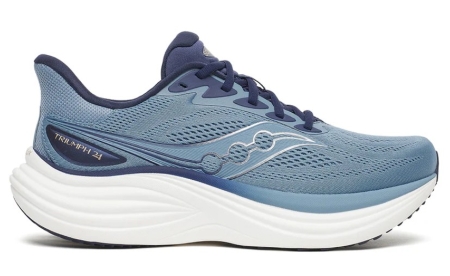
Saucony Triumph 24 vs ASICS Gel-Nimbus 28: after 205 miles in my Triumph and 260 in my Nimbus, I would choose the Saucony when I want a notably soft landing that still lets an easy run pick up naturally. I would choose the ASICS after a demanding training week, when my only job is to settle into a quiet recovery rhythm and stay comfortable late. Both offer a lot of cushion; the real question is whether you want that cushion to feel springy and mobile or calm and contained under your foot.
I tested men’s US 10.5 pairs on my 182-pound frame, mainly on Atlantic City roads, boardwalks, and nearby coastal routes. Twelve years of running have made me cautious about judging a premium trainer by the first step. I compare how it lands, how the foot sits inside it, and whether the last third of a long easy run still feels under control.
Saucony Triumph 24 vs ASICS Gel-Nimbus 28: my quick decision
| Your main need | My starting pick | What could change my mind |
|---|---|---|
| A very soft daily and long-run feel | Triumph 24 | The deep compression feels unstable on your stride |
| Deliberate recovery after hard training | Gel-Nimbus 28 | Its tall geometry or upper feels intrusive |
| An easy run that may become steady | Triumph 24 | You prefer a firmer, more contained transition |
| A settled fit after the feet swell | Gel-Nimbus 28 | You need more space or a different heel hold |
| Fast intervals or a race | Neither first | Use a shoe built for that session |
My default is Triumph for a single cushioned trainer across easy and long days; it feels more willing to change rhythm. For a rotation that already has a quicker daily shoe, I reach for Nimbus as the calmer recovery partner. I would not buy either simply because a foam name sounds more advanced.
The exact versions and mileage behind this verdict
| Detail | Saucony Triumph 24 | ASICS Gel-Nimbus 28 |
|---|---|---|
| My running log | 205 miles | 260 miles |
| My size | Men’s US 10.5 | Men’s US 10.5 |
| Listed drop | 10 mm | 8 mm |
| Midsole construction | incrediLUX cushioning | FF BLAST PLUS with rearfoot PureGEL |
| Feel I get | Deep, soft compression with a smooth roll | Substantial, more contained underfoot ride |
| Longest run in my log | 15 miles | 17 miles |
| My first fit check | Foot centered over soft foam | Forefoot room and heel lockdown |
These 465 miles are two separate running histories, not a controlled test with equal conditions. Nimbus has 55 more logged miles, so my wear assessment is a little more mature for that pair; these logs cannot establish which model lasts longer. A different foot, temperature, or pace could reverse which one feels softer to you.
Two kinds of maximal cushion under my feet
Triumph 24: soft compression with some energy left
The key change in Triumph 24 is incrediLUX. I feel a deeper compression on landing than I do in Nimbus, then a smooth, rounded transition that keeps the shoe from feeling stuck beneath me. Along the Margate seawall, 90 minutes on concrete and wooden planks passed with much less surface harshness than I expected from such a light-feeling high-cushion shoe. My Saucony Triumph review covers the family in more detail.
That softness is also its test. On a flat, even road I enjoy how the foam gives way and returns; on a road crown or a slow walk, I check whether I am making small side-to-side corrections. A wide base and rocker help me stay composed, but they do not make a highly compressible foam equally stable for every runner. I would test it beyond a shop floor before giving it a full week of recovery mileage.
Nimbus 28: protection without chasing a bounce
Nimbus 28 combines FF BLAST PLUS with PureGEL at the rearfoot. After a 50-mile training week, I ran 14 recovery miles on the boardwalk and valued the way my pair let me hold a quiet, unhurried rhythm. It has ample material between my foot and the road, yet it does not feel like the same deep, playful compression as Triumph. Its appeal to me is predictability late in a tired run. My Gel-Nimbus review goes into the single-shoe experience.
A tall platform has boundaries. An accidental detour onto loose sand made my Nimbus feel awkward to correct laterally, so I keep it on the roads and firm boardwalks for which I choose it. I also check whether its forefoot roll agrees with my own timing. A shoe can feel wonderfully protected on smooth asphalt and still ask too much on uneven ground.
What I choose through a training week
| Session | Triumph 24 in my use | Nimbus 28 in my use | My choice |
|---|---|---|---|
| Recovery after a hard week | Soft landing, but more motion underfoot | Calm rhythm on my 14-mile recovery outing | Nimbus |
| Ordinary easy road run | Pleasantly soft and willing to roll | Steady and substantial | Triumph |
| Long aerobic run | My log reaches 15 miles | My log reaches 17 miles | Fit and late-run control |
| Gentle progression | Easier for me to change rhythm | Can move, but I notice its size | Triumph |
| Walking mixed with running | Test the foam compression at slow contact | Test the rocker and tall base | Walk in both |
| Short fast intervals | Not my preferred quick-turnover tool | Not my preferred quick-turnover tool | Neither |
These rows are about the purpose of the run, not a universal minutes-per-mile chart. If my easy shoe makes me speed up or fight my foot placement, it has missed its job. I keep faster sessions separate; my daily trainer versus tempo shoe guide explains why.
Triumph 24 vs Gel-Nimbus 28 drop: why 10 mm versus 8 mm is only part of the ride
Triumph 24 lists a 10 mm heel-to-toe drop and Nimbus 28 lists 8 mm. Yet the softness of Triumph’s heel, the forefoot rocker of each shoe, and where I load the sole can change the sensation more than those two millimeters. I would not claim the listed drop tells me exactly what a calf or Achilles will feel after an hour.
When I switch between them, I use a normal easy run to watch my step timing, heel placement, and whether I have to steer around the foam. I introduce a new geometry without changing the rest of my training at the same time. If discomfort persists or my form changes to accommodate a shoe, I reassess the fit and training plan rather than forcing a specification-based choice.
Fit after warm-up: the first veto
In my US 10.5 Triumph, I have generous horizontal toe spread, an anchored heel, and adjustable midfoot hold. I still check vertical room over the nails and whether the foot stays centered when the soft sole compresses. Room in front cannot rescue a heel that wanders or sidewalls that press as the foot warms.
Nimbus also fits me true to size. Its upper gives my forefoot useful expansion after ten miles, while the padded heel collar locks down without rubbing. That combination is a large part of why I trust it on recovery long runs. I would check that the upper does not need overtightening to secure a narrower heel on another foot. My running-shoe fit checklist separates toe width, upper volume, instep pressure, and heel hold.
My short try-on before spending on a cushioned shoe
- Wear the socks you actually run in and check both horizontal and vertical toe space.
- Walk slowly to compare the Triumph’s deep compression with the Nimbus transition.
- Jog easily until the novelty of the first step fades.
- Try a mild road crown or broad turn and notice side-to-side corrections.
- Lift the pace a little, then return to the easy effort you will use most.
- Check the heel and instep after warming; do not solve slip by crushing the laces.
Road control, traction, and the wear I can actually see
Both are neutral high-cushion road shoes. My Nimbus feels more centered when I am tired; Triumph feels softer and more mobile. Neither is a substitute for a support model chosen for a specific need. If stability is the unresolved question, my Kayano versus Nimbus comparison shows how I separate support from cushioning.
I judge outsole grip on actual asphalt, damp boards, paint, and metal covers rather than by a rubber name. On a new wet surface I slow down and pay attention to the pair’s age and contact pattern. My outsole and traction guide gives the checks I use. Neither shoe has a logged head-to-head wet-surface test in my records, so I will not crown a rain winner.
At 205 miles, my Triumph shows localized rubber wear and moderate foam creasing, with the upper still sound. At 260 miles, my Nimbus has rubber smoothing and deeper creasing with a softer feel, again without upper failure. Different mileage and different routes make an exact lifespan comparison unreliable. I repeat a familiar easy route and ask whether fit, transition, and late-run control still meet the shoe’s assigned job.
Who I would buy each pair for
- Buy Triumph 24 if you want a deeply soft but mobile high-cushion trainer for ordinary easy miles and long runs, and the foam stays centered under your stride.
- Buy Gel-Nimbus 28 if recovery and unhurried long roads dominate the week, and you prefer the more contained feeling I get from my pair.
- Buy neither if either tall platform demands constant corrections, the upper fails after warm-up, or your missing role is a fast workout shoe.
- Keep your current pair if it already makes easy miles comfortable without a fit or control problem.
I would seldom buy both for a small rotation because the easy and long-road roles overlap. My rotation guide helps me decide whether a second cushioned pair adds a distinct purpose. If you are weighing a different recovery geometry altogether, my Bondi 9 versus Nimbus 28 comparison is the logical next step.
FAQ: Saucony Triumph 24 vs ASICS Gel-Nimbus 28
Does Saucony Triumph 24 feel softer than ASICS Gel-Nimbus 28?
On my feet, Saucony Triumph 24 compresses more deeply and feels more buoyant, while ASICS Gel-Nimbus 28 feels more contained. That is my road-run impression from men’s US 10.5 pairs, not a lab softness ranking. Compare both at your normal easy pace, not just while standing.
Which is better for recovery runs: Saucony Triumph 24 or ASICS Gel-Nimbus 28?
I choose ASICS Gel-Nimbus 28 after a demanding training week because its more contained ride helps me keep a quiet, unhurried rhythm. I choose Saucony Triumph 24 when I want a softer landing and a more mobile transition, as long as the deep compression stays centered under my stride.
Which is better for long runs: Saucony Triumph 24 or ASICS Gel-Nimbus 28?
My ASICS Gel-Nimbus 28 log reaches 17 miles; my Saucony Triumph 24 log reaches 15. I start with Nimbus for an intentionally slow long run and Triumph for one that may gently build in pace. Those unequal distances do not prove a universal winner: late-run fit and control can reverse my choice for another runner.
Are Saucony Triumph 24 and ASICS Gel-Nimbus 28 stability shoes?
No. Saucony Triumph 24 and ASICS Gel-Nimbus 28 are neutral, high-cushion road shoes. Triumph has a broad base and Nimbus feels centered to me, but a stable sensation in my stride is not the same as an individually selected support shoe.
Can I walk in Saucony Triumph 24 and ASICS Gel-Nimbus 28?
Yes, but I would walk in both before buying. Saucony Triumph 24’s soft foam remains compressed longer at walking speed on my foot; ASICS Gel-Nimbus 28 has a tall platform and shaped transition. The more comfortable walking feel for you may not be the one you prefer while running.
Which lasts longer: Saucony Triumph 24 or ASICS Gel-Nimbus 28?
I cannot rank their lifespan from my current pairs. I have 205 miles in Saucony Triumph 24 and 260 in ASICS Gel-Nimbus 28, on different runs and surfaces. Both show outsole wear and foam creasing but no upper failure in my log. I would recheck ride and control on a familiar route rather than infer a replacement date from those unequal totals.
Do I need both Saucony Triumph 24 and ASICS Gel-Nimbus 28 in a rotation?
Usually not. Saucony Triumph 24 and ASICS Gel-Nimbus 28 overlap on easy and long road runs. I would keep both only if the Triumph reliably fills my mobile cushioned-day role and the Nimbus fills a distinct calm recovery role without duplicating another shoe.
My final verdict
If I needed one premium cushioned daily trainer, I would begin with Saucony Triumph 24 for its very soft, more mobile ride. If I wanted a dedicated recovery partner after demanding training, I would begin with ASICS Gel-Nimbus 28 for its quiet, settled late-run behavior on firm roads. My 205- and 260-mile logs explain those choices; the winner for your foot is the pair that still feels natural after the easy run has warmed you up.

Written by Ken — 12 years of running, 12,500+ miles, 63 shoes tested, 36 races from 5Ks to a 50K ultra. I run 30–40 miles a week on the Atlantic City Boardwalk and review every shoe with real training miles, not one-run demos. More about me →