
Running gait analysis is most useful when it answers one real decision—not when it grades every angle in your stride. After 12 years in running, I have learned to distrust the dramatic freeze-frame. A useful analysis begins with a question, reproduces the task that matters, separates observation from interpretation, and ends with a small test I can repeat.
I call this my Gait Analysis Decision Room. The room has seven stations: Frame the Question, Match the Test, Recreate the Task, Capture the Run, Read the Layers, Run One Experiment, and Retest the Decision. If a report cannot travel through those stations, I do not let its numbers change a runner’s training, footwear, or rehabilitation plan.
This guide is about measurement and decisions. For the wider explanation of motion, force, joint work, and load sharing, use my running biomechanics guide. For practical cues and whole-body technique, use my proper running form guide. They support gait analysis, but they do not own the same job.
My quick verdict: Start with the least complex test that can answer your question. Record the conditions. Change one variable. Retest under the same conditions. A more expensive system is only better when its extra measurement changes the decision.
What running gait analysis actually does
A running gait analysis records and interprets selected features of how you run in a defined condition. That condition includes speed, surface, slope, footwear, warm-up, fatigue, symptoms, camera position, and the measurement system. Remove the condition and even a precise number loses much of its meaning.
I divide the output into three layers. Observation tells me what was measured or seen. Interpretation proposes why it may matter. Decision states what I will test next, at what dose, and when I will check again. Many weak reports stop after observation and disguise a label as a prescription.
A gait analysis is not a scan for hidden defects. It cannot identify the cause of pain from one angle, guarantee injury prevention, prove that an asymmetry is harmful, or choose a shoe from pronation alone. Video can show visible motion and timing; it cannot directly measure joint force, muscle force, or tissue stress.
The Gait Analysis Decision Room
| Station | The question on my board | The output I require |
|---|---|---|
| 1. Frame | What decision must improve? | One specific question |
| 2. Match | What is the simplest adequate test? | Home, retail, clinical, or lab |
| 3. Recreate | Which task reveals the issue? | Pace, terrain, shoe, fatigue |
| 4. Capture | Can I repeat the recording? | Standard views and conditions |
| 5. Read | Which pattern is repeatable and relevant? | Observation separated from inference |
| 6. Experiment | What single lever will I test? | Small dose and stop rule |
| 7. Retest | Did the complete response improve? | Movement, comfort, function, next day |
This sequence protects me from two common errors: collecting measurements with no purpose and treating a visible difference as the cause of a problem. I want every number to earn its place by changing—or deliberately not changing—a decision.
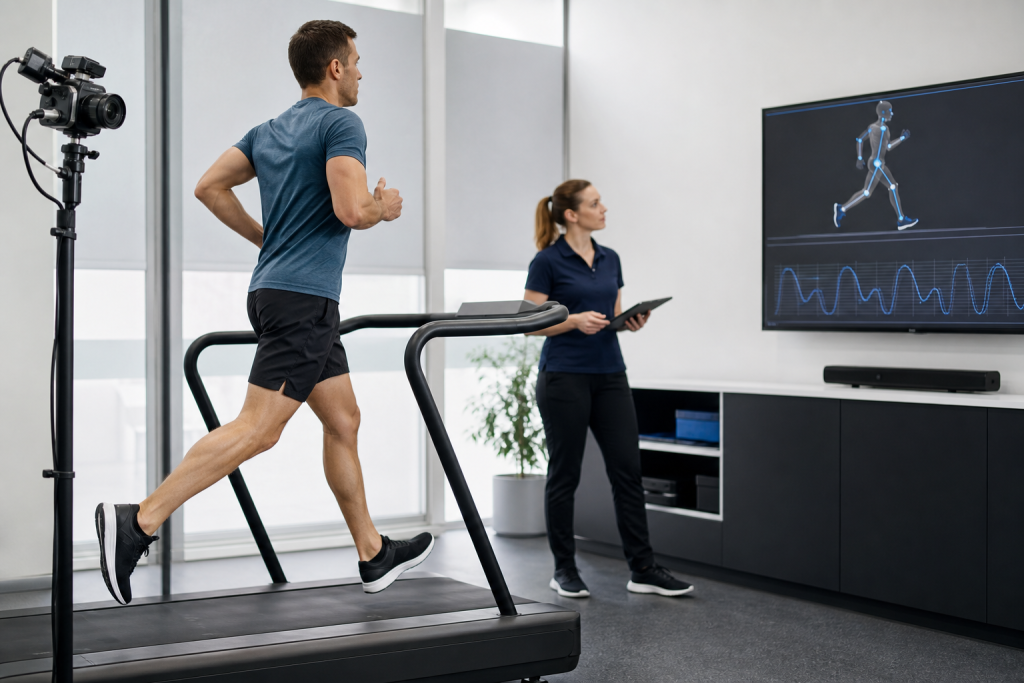
Station 1 — Frame the decision question
Before I open a camera app, I finish this sentence: “I need this analysis to help me decide whether…” That final clause controls the test. “Look at my form” is too broad. “Decide whether my mechanics change when lateral knee discomfort appears after 35 minutes” is useful.
I usually place the question in one of five rooms:
- Comfort: Why does one shoe or surface feel awkward?
- Symptoms: Does a repeatable movement change appear with a known symptom?
- Performance: Does coordination deteriorate at target pace or late in a session?
- Return to running: Is current exposure tolerated, and what should progress next?
- Technique: Does one cue produce a useful change without a worse trade-off?
I also write what the test does not need to decide. If I am comparing a runner’s rhythm fresh versus fatigued, I do not need to classify every foot motion or prescribe a new shoe. Narrow scope makes interpretation stronger.
Station 2 — Match the test to the question
Home or field video
I use a phone when the question concerns visible timing, contact position, trunk and pelvis behavior, arm action, step width, or a change across pace and fatigue. It is excellent for screening and comparison when the setup is repeatable. It is not a force plate in your pocket.
Retail running assessment
A store session can help compare fit, comfort, shoe feel, and obvious movement changes during short trials. I treat it as a fitting service, not a medical evaluation. A brief treadmill clip does not diagnose overpronation, identify an injury cause, or prove that a stability category is necessary.
Clinical two-dimensional analysis
I choose a clinician when pain, a complicated history, return from injury, or a persistent one-sided problem requires gait to be combined with symptoms, training load, strength, mobility, and an examination. The camera is one part of that reasoning process.
Instrumented or three-dimensional laboratory analysis
I reserve a lab for questions that truly need synchronized three-plane motion, ground-reaction force, plantar pressure, muscle activity, or detailed modeling. More variables create more interpretation work. If the extra data will not alter the intervention, I do not pay for the spectacle.
My rule is simple: match measurement depth to decision depth. A runner choosing between two comfortable daily shoes rarely needs a 3D model. A complex case with conflicting clinical findings may.
Station 3 — Recreate the run that matters
Gait is not one permanent signature. It changes with pace, grade, surface, fatigue, footwear, pain, instructions, and familiarity with a treadmill. A measurement describes a test condition, not the whole runner.
If symptoms appear late, a fresh 60-second clip can miss the decision. I first capture a safe baseline, then reproduce the relevant duration or controlled fatigue without turning the assessment into a reckless pain challenge. If the question is race pace, I include race pace after an appropriate warm-up.
I record speed rather than relying on “easy” or “fast.” I record treadmill grade, outdoor surface, shoe model, and symptom rating. If the runner normally trains outside, I remember that a belt provides a controlled and repeatable environment but may not reproduce every outdoor behavior. My treadmill versus outdoor running guide explains that trade-off.
I also keep footwear constant unless shoes are the variable. Drop, rocker, cushioning, width, stiffness, and fit can change the runner’s motion or perception. When drop is part of the question, I separate the measurement from the broader transition decision in my heel-drop guide.
Station 4 — Capture a repeatable run
A clean protocol matters more than cinematic slow motion. I stabilize the camera, keep it level, place it far enough away to reduce perspective distortion, and avoid a wide-angle lens when possible. I capture several normal strides instead of selecting the strangest frame.
My minimum phone-video setup
- Warm up until the running pattern and pace are representative.
- Record the exact shoe, surface, slope, pace, symptom level, and fatigue state.
- Film a side view with the camera approximately level with the runner’s lower body.
- Film directly from behind without standing so close that lens distortion dominates.
- Capture at least several consecutive strides in each view.
- Repeat the relevant pace or late-run condition only when it is safe.
- Keep the same setup for any after-change comparison.
For a treadmill, I allow enough time for the runner to settle. For overground video, I use a marked section so the runner is not accelerating, turning, or reaching for the camera. A stride during acceleration is a different task from steady running.
I prepare the body for the tested speed rather than jumping from standing to a fast clip. My running warm-up process provides the framework. The goal is representative movement, not a surprise test.
Station 5 — Read five layers without overreaching
Layer 1: Rhythm and timing
I start with cadence, contact timing, flight timing, step-to-step consistency, and how rhythm changes with speed or fatigue. Cadence only makes sense beside pace. I never assign 180 steps per minute as a universal standard. My running cadence guide explains when a modest experiment may be useful.
Layer 2: Contact geometry
I observe where the foot meets the ground relative to the moving body, the shin angle, knee position, step width, and visible horizontal reach. I do not diagnose overstriding from heel contact alone. A heel can touch near the body, and a forefoot can land too far ahead.
Foot strike is a description, not a moral category. My foot-strike guide separates contact pattern from injury claims and explains the load trade-offs among common patterns.
Layer 3: Segment coordination
I follow the trunk, pelvis, hip, knee, foot, and arms as a connected system. A pelvic drop may accompany a trunk strategy. A crossover step may relate to step width, hip motion, route camber, or fatigue. I ask what happens before and after the visible feature rather than isolating it.
Layer 4: Loading clues
Sound, visible stiffness, vertical motion, tibial angle, and braking behavior can generate hypotheses. They do not reveal internal tissue load. A quieter landing is not automatically safer, and a lower value in one metric can shift demand elsewhere.
Layer 5: Variability and durability
I compare several steps and both sides. Small differences are normal. Perfect symmetry is not my target. I care whether a pattern repeats, grows under the relevant task, connects with the runner’s goal, and changes predictably when I test a plausible lever.
| Finding | What I can say | What I cannot conclude | My next question |
|---|---|---|---|
| Rearfoot contact | The heel touched first in this condition | It caused injury or needs correction | Where did contact occur and how did load transfer? |
| Cadence of 164 | Step rate was 164 at this pace | It is universally too low | What happens at other speeds or with a small cue? |
| Pelvic drop | A visible frontal-plane pattern repeated | Weakness is the cause | Does it relate to symptoms, fatigue, or task? |
| Pronation | The foot adapted under load | A stability shoe is mandatory | Is it comfortable, repeatable, and relevant? |
| Asymmetry | The measured sides differed | The difference is harmful | Is it larger than normal variability and does it matter? |
| Louder contact | Sound changed in this setup | Internal force is known | Did speed, shoe, surface, or fatigue also change? |
How I separate observation from a useful inference
I use four filters before I act on a finding:
- Repeatability: Does it appear across multiple strides and the same task?
- Relevance: Does it connect to the runner’s question, symptom timing, or performance goal?
- Modifiability: Can a safe cue, exposure, shoe, strength input, or training adjustment change it?
- Response: Does changing it improve the complete outcome rather than only the picture?
This is where many analyses fail. A screenshot can be accurate yet irrelevant. An angle can be different without being harmful. An intervention can change motion without improving pain or function. Association does not prove that one gait feature caused an injury.
I especially resist labels such as “collapsed,” “broken,” or “bad biomechanics.” They turn a conditional observation into an identity. My job is to describe the task, identify a testable relationship, and preserve the runner’s confidence while I investigate.
Station 6 — Run one controlled experiment
I change one main variable at a time. Possible levers include a small cadence cue, a posture cue, step-width awareness, a different shoe, a surface change, load reduction, strength work, or more recovery. I do not stack all of them and then pretend I know which one helped.
If visible reaching is the target, I use the decision process in my overstriding guide. If the pattern looks more like a capacity problem that appears with fatigue, I may prioritize my strength-training framework instead of forcing a permanent conscious cue.
I introduce a gait cue in short, easy exposures. I watch breathing, perceived effort, calf and Achilles response, comfort, pace, and coordination. A cue that produces a prettier frame but raises effort, creates new pain, or requires constant tension has not passed my test.
For a runner managing symptoms, I define an acceptable response and a stop rule before the session. My pain-monitoring rules provide a consistent way to judge the run and the following day. I do not use gait retraining to push through a worsening problem.
Station 7 — Retest the decision, not the pose
I repeat the same pace, shoe, surface, grade, camera view, and comparable fatigue state. Without that control, I may attribute a speed change or camera shift to the intervention.
My reassessment scorecard has five lines:
- Movement: Did the target feature change consistently?
- Comfort: Did the runner feel more natural, stable, or relaxed?
- Function: Did pace, duration, or task tolerance improve?
- Cost: Did effort rise or did demand move to another area?
- After-effect: What happened later that day and the next morning?
I keep the change only when the whole scorecard supports it. Sometimes the best result is “no meaningful difference,” which saves the runner from weeks of unnecessary technique work. Sometimes the video improves first while symptoms do not; that tells me to reconsider the hypothesis rather than increase the cue.
Seven common findings and how I decide
Low or high cadence
I compare cadence at the same speed and within the runner’s own pattern. I consider a modest change only when it addresses a defined issue and the runner can tolerate it. I do not chase a universal number.
Foot landing ahead of the body
I check speed, shin angle, braking clues, trunk position, and whether the reach repeats. Contact in front of the hips is not sufficient by itself to prove harmful overstriding.
Rearfoot, midfoot, or forefoot strike
I keep the label descriptive. A forced strike change can move work between the knee, ankle, foot, and calf. I need a reason, a gradual dose, and a response worth the trade-off.
Pronation or supination
I observe how the foot accommodates load, but I never choose support from a rear-view clip alone. Comfort, fit, symptoms, history, and the behavior of the entire limb matter more than a frozen arch.
Pelvic drop, knee motion, or crossover
I look for a consistent sequence and test whether width, cadence, trunk strategy, capacity, or fatigue affects it. I do not assume one muscle is weak because one angle appears large.
Vertical bounce or stiffness
I ask whether the pattern affects economy, comfort, or control at the relevant speed. Less bounce is not automatically better; running still requires elastic motion and flight.
Left-right asymmetry
I check measurement error, anatomy, previous injury, turns, camber, fatigue, and normal variability. I intervene only when the asymmetry is repeatable, relevant, and responsive to a sensible test.
When a professional gait analysis is worth it
I consider a professional assessment when pain persists or recurs, a return-to-running plan keeps failing, the problem appears only at a specific pace or duration, a major asymmetry follows injury or surgery, or a coach needs measurements unavailable from ordinary video.
I also use professional help when the decision carries real consequence. A complex medical history, altered sensation, unexplained weakness, or a rapidly worsening pattern deserves more than self-analysis. Gait data can support clinical reasoning; it cannot replace diagnosis.
Questions I ask before booking
- Who performs the assessment, and what is their scope and experience?
- Will the test reproduce my relevant pace, shoe, surface, or fatigue state?
- Which measures will be collected, and why do they matter to my question?
- Will history, symptoms, training load, strength, and mobility be considered?
- What deliverables will I receive: video, report, plan, cue, or follow-up?
- How will we decide whether a recommended change worked?
- What would make the provider refer me elsewhere?
I am cautious when the sales pitch promises to find the “perfect gait,” guarantees injury prevention, diagnoses from a foot scan, or prescribes a shoe category before discussing comfort and context. Equipment does not replace reasoning.
Four decision-room examples
Discomfort that appears late in a run
I compare an early clip with a safe late-run clip at the same speed. If cadence, contact position, pelvic control, or trunk strategy changes, I still do not declare a cause. I test load, recovery, pacing, strength, and one movement lever while tracking the complete response.
A runner who wants to become faster
I record easy pace and target pace. I look for rhythm, stiffness, arm-leg coordination, and unnecessary tension. The decision may be technique, but it may also be fitness, pacing, or strength. A single “efficient-looking” angle is not a performance guarantee.
A shoe that feels unstable
I compare shoes at the same pace after fit is checked. I observe step width, confidence, foot placement, and fatigue, but comfort remains primary. A visible pronation difference is not enough to prescribe support.
A runner returning after injury
I use gait as one checkpoint alongside symptoms, exposure, strength, confidence, and next-day behavior. The question is not whether both sides look identical. It is whether the current task is controlled and tolerated well enough for the next progression.
Safety boundaries I will not cross
Running gait analysis does not diagnose a stress fracture, tendon tear, nerve problem, vascular issue, or joint disease. New trauma, inability to bear weight, major swelling, progressive weakness, numbness, chest pain, fainting, fever, night pain, or pain worsening at rest needs appropriate medical assessment.
For ordinary injury-risk decisions, I place gait inside the larger system of exposure, tissue capacity, recovery, health, terrain, and footwear. My running injury-prevention guide explains that wider view. No gait score makes abrupt training spikes safe.
I also avoid aggressive retraining during a painful flare. Changing mechanics creates a new load distribution, even when the cue reduces one visible metric. I dose it like training and stop when symptoms, coordination, or next-day response move in the wrong direction.
Mistakes I avoid
- Judging one dramatic frame instead of several strides.
- Testing at a pace unrelated to the runner’s question.
- Comparing before and after clips with different camera angles.
- Calling normal pronation, heel strike, or asymmetry a defect.
- Using video language to imply forces that were never measured.
- Changing cadence, shoes, posture, and training load simultaneously.
- Celebrating a prettier clip without checking effort and symptoms.
- Letting a retail fitting substitute for clinical assessment.
- Paying for more technology without a decision it can change.
Frequently asked questions
What is a running gait analysis?
A running gait analysis is a structured recording and interpretation of selected running features under defined conditions. I use it to answer a specific question about comfort, symptoms, performance, return to running, or technique.
Can gait analysis diagnose a running injury?
No. It can contribute useful movement and timing information, but diagnosis requires history, symptoms, examination, and sometimes additional testing. One angle or foot-scan result cannot identify the cause of pain.
Is a running-store gait analysis useful?
It can be useful for comparing fit, comfort, and shoe feel during short trials. I treat it as a fitting aid, not a medical test or a reliable way to predict injury.
Can I analyze my running gait with a phone?
Yes, for visible timing and movement comparisons when the setup is repeatable. A phone video cannot directly measure joint force, muscle force, internal tissue stress, or a medical diagnosis.
Do I need a 3D running gait analysis?
Usually not. I choose 3D or instrumented testing only when its extra variables are necessary for a complex clinical or performance decision that simpler video cannot answer.
Should I change every asymmetry seen on video?
No. Some asymmetry is normal or task-dependent. I act only when a difference is repeatable, relevant to the runner’s goal or symptoms, modifiable, and improved by a controlled test.
Should gait analysis be done on a treadmill or outdoors?
I use the environment that best answers the question. A treadmill improves control and repeatability; outdoor running may better reproduce the runner’s normal terrain and variability. I document the choice and avoid treating the two conditions as identical.
My final decision
I do not use running gait analysis to manufacture a perfect stride. I use it to make one uncertain decision clearer.
My sequence is always the same: Frame the Question, Match the Test, Recreate the Task, Capture the Run, Read the Layers, Run One Experiment, and Retest the Decision. The method is deliberately conservative because gait changes redistribute work; they do not erase it.
The best report is not the one with the most angles. It is the one that tells me what was observed, what remains uncertain, what to test next, how much to test, and what result would make me keep, modify, or abandon the change.

Written by Ken — a running specialist with 12 years of experience, more than 12,500 miles logged, 63 shoes tested, and 36 races from 5K to 50K. I use gait analysis to improve decisions, not to grade bodies.
My rule is simple: reproduce the task, separate observation from inference, change one lever, and retest the runner’s complete response. More about my testing approach.