
No running shoe is clinically proven to treat IT band syndrome. Start with diagnosis and training-load decisions, then use footwear as a controlled comfort comparison: familiar geometry, secure fit, a platform that feels predictable, and no abrupt change in drop or guidance.
In 12 years of running, I have learned not to credit the last shoe change for a recovery that also involved rest, load changes, strength work, time, and gradual return. A shoe can feel better. That does not show that it reduced IT-band stress, corrected mechanics, or prevented recurrence.
The ten models below create useful contrasts—neutral versus guided, conventional versus rockered, moderate versus high cushioning, and standard versus wide fit. They are not rehabilitation devices or a substitute for assessment when lateral-knee pain is persistent, worsening, swollen, traumatic, unstable, or changing your gait.
⚡ Quick Answer: Best Running Shoes for IT Band Syndrome
Do not sort these choices into “neutral ITBS” and “overpronation ITBS.” Pronation is not the diagnosis. Compare one familiar neutral model with one clearly different platform, keep the trial short, and evaluate the during-run and delayed response.
📖 What’s here ▼ Click to expand
- What Is IT Band Syndrome?
- What to Look for in a Shoe
- How I Evaluated These Shoes
- Quick Picks: 10 Best Shoes for ITBS
- #1 HOKA Clifton 10 — Best Overall
- #2 Brooks Glycerin GTS 23 — Best Stability
- #3 HOKA Arahi 8 — Best Lightweight Stability
- #4 Brooks Ghost 18 — Best Neutral Daily Trainer
- #5 ASICS Gel-Nimbus 28 — Best Max Cushion
- #6 Saucony Ride 19 — Best Stable Neutral
- #7 ASICS Gel-Kayano 32 — Best for Overpronation
- #8 Saucony Tempus 2 — Best Performance Stability
- #9 New Balance 1080v15 — Best Wide Fit
- #10 HOKA Bondi 9 — Best for Recovery Runs
- Head-to-Head: Clifton 10 vs Glycerin GTS 23
- Full Comparison Table
- Return-to-Run Protocol
- 6 ITBS Mistakes Runners Make
- FAQ
Quick Picks: Best Running Shoes for IT Band Syndrome (2026)
Here are ten try-on starting points ranked by platform behavior, fit, cushioning, and transition. The order is not an ITBS safety score and does not predict a medical outcome.
| Shoe | Comparison role | Main stop rule |
|---|---|---|
| HOKA Clifton 10 | Broad neutral rocker | Reject if the rocker feels forced or symptoms rise later |
| Brooks Glycerin GTS 23 | Plush guidance | Reject if GuideRails or arch contact feels intrusive |
| HOKA Arahi 8 | Lighter guidance | Reject if the frame steers the foot |
| Brooks Ghost 18 | Conventional neutral baseline | Reject if fit or 10mm listed drop is an uncomfortable change |
| ASICS Gel-Nimbus 28 | Soft neutral | Reject if the soft platform feels unstable |
| Saucony Ride 19 | Balanced neutral | Reject if sidewalls or forefoot fit create pressure |
| ASICS Gel-Kayano 32 | Structured guidance | Reject if neutral feels more natural in the same trial |
| Saucony Tempus 2 | Responsive guidance | Do not use faster feel to accelerate return-to-run loading |
| New Balance 1080v15 | Multiple widths | Reject excess room that allows sliding |
| HOKA Bondi 9 | Broad max-cushion rocker | Reject if height or low-drop rocker feels less controlled |
- Neutral runners with ITBS: HOKA Clifton 10, Brooks Ghost 18, ASICS Nimbus 28
- Overpronators with ITBS: Brooks Glycerin GTS 23, HOKA Arahi 8, ASICS Kayano 32
- Recovery runs: HOKA Bondi 9, ASICS Nimbus 28
- Stable neutral daily training: Saucony Ride 19, HOKA Clifton 10
- Wide feet with ITBS: NB 1080v15 (4E), Saucony Ride 19 (2E), ASICS Kayano 32 (4E)
What Is IT Band Syndrome? (And Why Your Shoes Matter)
IT band syndrome is a common source of lateral-knee pain in runners, but current explanations are more complex than a single friction mechanism. Training exposure, tissue sensitivity, movement, strength, and anatomy may contribute differently by runner.
IT band syndrome describes activity-related pain near the outside of the knee. Compression and sensitivity around local tissues are discussed in current models, but a shoe page cannot confirm the diagnosis, name one damaged structure, or infer inflammation from pain alone.
The IT band isn’t a muscle — it’s a thick band of fascia that runs from your hip to just below your knee.
Hip strength and pelvic control may be relevant for some runners, but weakness is not a universal cause. Assessment should determine whether a strength or movement finding is meaningful and modifiable for the individual.
| Possible contributor | What the evidence allows | What it does not prove |
|---|---|---|
| Training-load change | Often belongs in the history and load-management plan | That one percentage rule prevents injury |
| Hip strength or running kinematics | May differ in some runner subgroups and can be assessed | One universal weak-glute or valgus cause |
| Hills, camber or repeated route exposure | May modify symptoms for an individual | That a surface alone caused the condition |
| Footwear change | Can alter comfort and the way a run feels | That width, drop, cushioning or stability treats ITBS |
Dynamic knee or pelvic movement can be one clinical finding, not a primary universal driver of IT band syndrome. Similar movement can appear in pain-free runners, and symptoms require an individual differential diagnosis.
Medical and selection boundary: Shoes alone cannot diagnose, cure, or treat ITBS. Rehabilitation and running limits depend on the actual diagnosis and the runner. Use the pain-monitoring rules for stop/modify/seek-care decisions and the criteria-based return-to-running plan only after appropriate clearance; persistent, worsening, swollen, traumatic, or gait-changing pain deserves assessment.
What to Look for in Running Shoes for IT Band Syndrome
A useful comparison shoe should fit securely, feel stable to the runner, and avoid an abrupt geometry change. No combination of width, cushioning, drop, or support is ideal for every runner with lateral-knee pain.
| Footwear variable | Compare | Do not assume |
|---|---|---|
| Fit | Heel hold, toe room, instep pressure and late-run security | That a wide base fits a wide foot |
| Platform | Conventional, rockered, neutral and guided at the same easy pace | That a measured width reduces knee stress |
| Cushioning | Controlled versus unstable feel | That more stack protects the IT band |
| Heel-to-toe drop | Familiar geometry versus a deliberate gradual change | That 6–10mm is an ITBS treatment range |
| Delayed response | Symptoms later that day and next morning | That a pain-free ten-minute trial clears a full run |
For more on cushioning science, see my cushioned shoe guide.
Ken’s rule: do not choose neutral or stability from an ITBS label. Compare both when appropriate. A broad neutral platform can feel calm; a guidance shoe can also feel calm. Neither category directly targets the IT band.
How I Evaluated These Shoes for IT Band Syndrome
| Editorial check | Method | Limit |
|---|---|---|
| Fit | Compare length, width, heel hold and instep pressure | Fit cannot diagnose the source of lateral-knee pain |
| Platform feel | Use the same easy pace for neutral, rockered and guided shoes | Subjective stability does not measure IT-band stress |
| Transition cost | Note differences in drop, rocker and guidance from the current shoe | A new geometry is another load variable |
| Delayed response | Check symptoms later that day and the next morning | A good first run does not clear progression |
| Evidence | Separate manufacturer specifications, research and editorial judgment | No model-specific clinical-outcome evidence was found |
Editorial disclosure: product access does not establish an ITBS benefit. Recommendations here are comparative footwear judgments and remain separate from medical evidence. For more on how I evaluate shoes, check my complete shoe selection guide.
#1. HOKA Clifton 10 — Best Overall for IT Band Syndrome
Best for: ITBS runners who need platform stability without medial posts.

| Spec | HOKA Clifton 10 |
|---|---|
| Drop | 8mm |
| Stack Height | 42mm heel / 34mm forefoot |
| Weight | 9.8 oz / 277g (men) | 8.0 oz / 226g (women) |
| Widths | D, 2E |
| Midsole | CMEVA foam |
| Geometry | MetaRocker™ |
| Platform | Wide, inherently stable |
HOKA’s signature MetaRocker geometry is particularly valuable for ITBS. It guides your foot through a smooth heel-to-toe transition, naturally shortening your stride.
The Clifton’s rocker is easy to feel, which makes it a useful contrast with the conventional Ghost 18. A rocker may change the transition sensation; it does not prove shorter stride, lower knee load, or ITBS protection.
The Active Foot Frame creates a cradled platform without a traditional medial post. Whether that feels calmer than guidance is an individual comparison, not a rule for ITBS. For a deeper comparison with the Bondi, see my Bondi vs Clifton guide.
#2. Brooks Glycerin GTS 23 — Best Stability for IT Band Syndrome
The Glycerin GTS 23 combines DNA TUNED cushioning with GuideRails. It is the plush guidance comparison in this list. GuideRails do not directly treat lateral-knee pain, so compare the shoe with a neutral model and keep it only when guidance feels less intrusive.
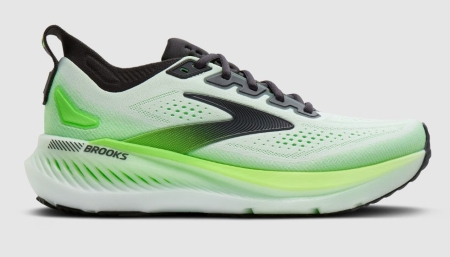
| Spec | Brooks Glycerin GTS 23 |
|---|---|
| Drop | 8mm (reduced from 10mm in GTS 22) |
| Stack Height | 38mm heel / 30mm forefoot (+2mm forefoot vs GTS 22) |
| Weight | 10.8 oz / 306g (men) | 9.6 oz (women) |
| Widths | B, D, 2E |
| Midsole | Nitrogen-infused DNA TUNED |
| Stability | GuideRails® integrated support |
| Upper | Triple jacquard warp knit (new) |
The GTS 23 is a significant upgrade from the GTS 22 for ITBS.
The extra 2mm of forefoot cushioning absorbs more impact at toe-off — the stride phase where IT band tension peaks. The lower 8mm drop (down from 10mm) creates a more balanced platform that I find more stable during fatigued running.
Unlike rigid medial posts that force your foot into a specific path, GuideRails manage excess knee movement — exactly where IT band pain occurs.
#3. HOKA Arahi 8 — Best Lightweight Stability for IT Band Syndrome
The Arahi 8 is HOKA’s lightest stability shoe — an excellent option for ITBS runners. who need mild pronation control without the weight penalty of traditional stability shoes. Best for: ITBS runners who find the Clifton too neutral.
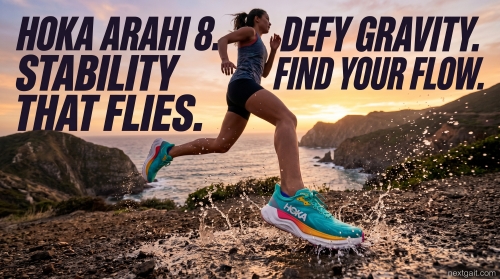
| Spec | HOKA Arahi 8 |
|---|---|
| Drop | 5mm |
| Stack Height | 40mm heel / 35mm forefoot |
| Weight | 9.5 oz / 269g (men) | 8.1 oz (women) |
| Widths | D, 2E |
| Midsole | Compression-molded EVA |
| Stability | H-Frame + J-Frame guidance |
| Geometry | MetaRocker™ |
The H-Frame wraps a firmer structure around a softer core. That produces a different guidance feel from a medial post, but neither design can be selected from an ITBS label alone. See my stability vs neutral guide for the full breakdown.
#4. Brooks Ghost 18 — Best Neutral Daily Trainer for IT Band Syndrome
The Brooks Ghost 18 is America’s best-selling daily trainer, and for good reason. Its balanced, predictable DNA LOFT v3 ride makes it an excellent choice for ITBS runners who don’t need stability features.
Best for: ITBS runners who need reliable consistency and foam that holds up past mile 400.
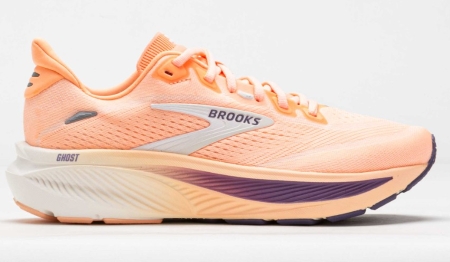
| Spec | Brooks Ghost 18 |
|---|---|
| Drop | 10mm |
| Stack Height | 36mm heel / 26mm forefoot |
| Weight | 10.0 oz / 283g (men) | 9.0 oz (women) |
| Widths | B, D, 2E |
| Midsole | Nitrogen-infused DNA LOFT v3 |
| Upper | Triple jacquard engineered air mesh (new) |
| Sockliner | OrthoLite® X-60 (new for v18) |
For ITBS runners, consistency matters enormously. Foam breakdown in aging shoes is a common ITBS trigger that many runners overlook.
The Ghost 18 is the conventional neutral reference point, with a manufacturer-listed 10mm drop and DNA LOFT v3 cushioning. Retirement timing varies; a thumb press cannot validate remaining performance. If you’ve been running in beginner shoes and developed ITBS, the Ghost is a reliable step up without aggressive biomechanical changes.
The v18 upgrade adds a new triple jacquard mesh upper for better breathability and an OrthoLite X-60 sockliner for improved step-in comfort. The segmented crash pad changes the heel transition. That construction is not evidence of lower lateral-knee load.
#5. ASICS Gel-Nimbus 28 — Best Max Cushion
The Nimbus 28 is the soft neutral comparison. ASICS lists FF BLAST PLUS, PureGEL, an 8mm drop and a lighter women’s build than version 27; those specifications do not establish ITBS benefit.
Best for: Heavier ITBS runners needing maximum shock absorption at 182 lbs+.
| Spec | ASICS Gel-Nimbus 28 |
|---|---|
| Drop | 8mm |
| Stack Height | 43.5mm heel / 35.5mm forefoot |
| Weight | 9.4 oz / 266g (men) | 8.2 oz (women) |
| Widths | D, 2E, 4E |
| Midsole | FF BLAST™ PLUS + PureGEL™ |
| Upper | Lightweight engineered knit (redesigned) |
| Outsole | HYBRID ASICSGRIP™ |
For heavier runners dealing with ITBS, the Nimbus is especially valuable because the dense foam doesn’t bottom out under heavy loads.
Width availability can help fit, while the soft platform may feel controlled or unstable depending on the runner. Compare same-length widths and assess the delayed response.
ASICS reports a lighter update and uses HYBRID ASICSGRIP. Do not assign a fixed outsole life; surface, runner and use change wear.
#6. Saucony Ride 19 — Best Stable Neutral for IT Band Syndrome
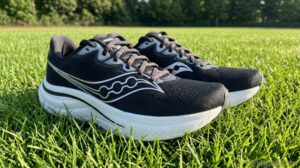
The Saucony Ride 19 is a balanced neutral comparison with PWRRUN+ and an 8mm drop. Its geometry may feel stable, but it is not shown to minimize knee motion or treat ITBS.
Best for: ITBS runners who want an ultra-lightweight daily trainer without intrusive stability features.
| Spec | Saucony Ride 19 |
|---|---|
| Drop | 8mm |
| Stack Height | 36mm heel / 28mm forefoot |
| Weight | 8.9 oz / 255g (men) | 7.7 oz / 218g (women) |
| Widths | D, 2E |
| Midsole | PWRRUN+ (reformulated expanded TPU) |
| Upper | Breathable engineered mesh with secure midfoot wrap |
#7. ASICS Gel-Kayano 32 — Best for Overpronation with IT Band Syndrome
The Kayano 32 is built for ITBS runners who have confirmed overpronation. Its 4D Guidance System provides adaptive stability that adjusts in real time as your form deteriorates during long runs — exactly when IT band tension peaks.
Best for: Confirmed overpronators with concurrent ITBS.

| Spec | ASICS Gel-Kayano 32 |
|---|---|
| Drop | 8mm |
| Stack Height | 40mm heel / 32mm forefoot |
| Weight | 10.9 oz / 311g (men) | 9.5 oz (women) |
| Widths | D, 2E, 4E |
| Midsole | FF BLAST™ PLUS + PureGEL™ |
| Stability | 4D Guidance System |
The FF BLAST PLUS ECO foam is soft and responsive — not the rigid ride of old stability shoes.
#8. Saucony Tempus 2 — Best Performance Stability for IT Band Syndrome
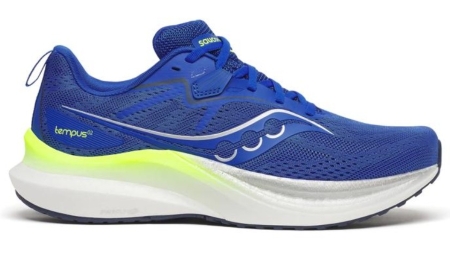
The Tempus 2 is Saucony’s responsive guidance comparison. Faster feel is not clearance to maintain workouts during recovery; loading still follows symptoms, function and the rehabilitation plan.
| Spec | Saucony Tempus 2 |
|---|---|
| Drop | 8mm |
| Stack Height | 37mm heel / 29mm forefoot |
| Weight | 9.4 oz / 266g (men) | 8.0 oz (women) |
| Widths | D, 2E |
| Midsole | PWRRUN PB core + PWRRUN frame |
| Stability | Dual-density wrap design |
Additionally, at 9.4 oz, it’s one of the lightest stability shoes available.
The dual-density design wraps a PWRRUN frame around a PWRRUN PB core. It feels more responsive than many guidance shoes, but responsiveness does not establish an efficient stride or safe tempo progression.
#9. New Balance 1080v15 — Best Wide Fit for IT Band Syndrome
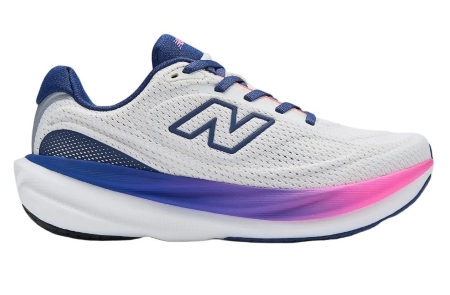
The 1080v15 offers the widest size range on this list — 4 width options from. Narrow to 4E Extra Wide — plus a new Infinion midsole that is lighter and more durable than the previous Fresh Foam X. Best for: ITBS runners with wide feet who need proper fit to avoid gait compensation.
| Spec | NB 1080v15 |
|---|---|
| Drop | 6mm |
| Stack Height | 38mm heel / 32mm forefoot |
| Weight | ~9.5 oz / ~270g (men) | ~8.0 oz (women) |
| Widths | B, D, 2E, 4E |
| Midsole | Infinion (supercritical foam — new) |
| Geometry | Rocker geometry |
| Upper | Two-layer breathable mesh |
Fit still matters: a cramped toe box or slipping heel makes the shoe a poor choice. Do not turn that observation into a specific ITBS mechanism.
The 1080v15’s rocker geometry promotes smooth transitions that reduce abrupt forces at the knee. The 6mm drop is lower than most shoes here, which encourages a shorter stride — beneficial for ITBS. For runners with plantar fasciitis combined with ITBS, this shoe addresses both.
#10. HOKA Bondi 9 — Best for Recovery Runs

| Spec | HOKA Bondi 9 |
|---|---|
| Drop | 5mm |
| Stack Height | 43mm heel / 38mm forefoot |
| Weight | 10.8 oz / 307g (men) | 9.1 oz (women) |
| Widths | B, D, 2E |
| Midsole | Super-critical EVA |
| Geometry | Extended MetaRocker™ |
| Platform | Widest HOKA platform |
Also, the 5mm drop creates a nearly flat platform ideal for walk-run intervals during ITBS rehab. The Extended MetaRocker guides your foot smoothly from heel strike through toe-off.
The Bondi 9 uses a dense, broad platform and pronounced rocker. Body mass alone does not determine whether it is controlled or appropriate; compare it with a conventional trainer.
Head-to-Head: HOKA Clifton 10 vs Brooks Glycerin GTS 23
My top two picks represent the fundamental debate for ITBS runners: neutral stability via platform. width (Clifton) versus guided stability via GuideRails (GTS 23).
| Question | HOKA Clifton 10 | Brooks Glycerin GTS 23 |
|---|---|---|
| Category | Neutral rocker | Guidance with plush cushioning |
| Primary comparison | Does the rocker feel natural? | Does guidance feel less intrusive than neutral? |
| Fit risk | Rocker or volume mismatch | Arch, sidewall or heel pressure |
| ITBS claim | None | None |
| Decision | Use the calmer individual response; do not infer correction or treatment | |
Comparison result: use the Clifton 10 for a neutral-rocker contrast and the Glycerin GTS 23 for a guidance contrast. There is no default winner for ITBS.
Choose the Glycerin GTS 23 only if you have confirmed overpronation contributing to your ITBS. When in doubt, go neutral.
Full Comparison
This comparison covers footwear variables only. Match fit and familiar geometry; keep rehabilitation decisions separate.
| Shoe | Comparison role | Main fit question |
|---|---|---|
| HOKA Clifton 10 | Footwear comparison—not ITBS treatment | Does it fit securely and feel predictable without a negative delayed response? |
| Brooks Glycerin GTS 23 | Footwear comparison—not ITBS treatment | Does it fit securely and feel predictable without a negative delayed response? |
| HOKA Arahi 8 | Footwear comparison—not ITBS treatment | Does it fit securely and feel predictable without a negative delayed response? |
| Brooks Ghost 18 | Footwear comparison—not ITBS treatment | Does it fit securely and feel predictable without a negative delayed response? |
| ASICS Gel-Nimbus 28 | Footwear comparison—not ITBS treatment | Does it fit securely and feel predictable without a negative delayed response? |
| Saucony Ride 19 | Footwear comparison—not ITBS treatment | Does it fit securely and feel predictable without a negative delayed response? |
| ASICS Gel-Kayano 32 | Footwear comparison—not ITBS treatment | Does it fit securely and feel predictable without a negative delayed response? |
| Saucony Tempus 2 | Footwear comparison—not ITBS treatment | Does it fit securely and feel predictable without a negative delayed response? |
| New Balance 1080v15 | Footwear comparison—not ITBS treatment | Does it fit securely and feel predictable without a negative delayed response? |
| HOKA Bondi 9 | Footwear comparison—not ITBS treatment | Does it fit securely and feel predictable without a negative delayed response? |
What This Footwear Evaluation Can and Cannot Show
It can describe fit, upper contact, platform feel, rocker behavior, guidance, and the practical cost of changing geometry. It cannot measure IT-band compression, establish a diagnosis, prove a causal movement fault, predict recovery, or show that one model prevents recurrence.
Rehabilitation and Return-to-Running Boundary
A shoe ranking cannot prescribe an ITBS strengthening schedule or return-to-run protocol. Diagnosis, exercises, running limits, and progression belong to a qualified clinician and the condition-specific plan. Use the site’s pain-monitoring rules for general triage and its criteria-based comeback framework after appropriate clearance.
6 ITBS Mistakes Runners Make With Running Shoes for IT Band Syndrome
These six mistakes confuse a footwear comparison with diagnosis, clearance, or rehabilitation.
| Mistake | Why it weakens the decision | Better move |
|---|---|---|
| Self-diagnosing all lateral-knee pain as ITBS | Other conditions can present in the same area | Seek assessment when the pattern is unclear, persistent or severe |
| Changing shoes, load and exercises together | You cannot identify the useful or aggravating variable | Change one variable at a time when clinically appropriate |
| Using pronation as the root cause | It oversimplifies a multifactorial problem | Compare comfort and follow individualized findings |
| Using a pain-free first mile as clearance | Symptoms can appear later or after the run | Use criteria and delayed-response checks |
| Following a fixed 10% rule or recovery calendar | Capacity and irritability differ | Progress from function and response, not a universal percentage |
| Believing new shoes replace rehabilitation | Footwear is only one variable | Keep diagnosis, loading and rehabilitation upstream |
FAQ
What are the best running shoes for IT band symptoms?
There is no clinically proven best model. The ranked shoes are try-on starting points for fit, platform feel, cushioning, and familiar geometry; they do not diagnose or treat lateral-knee pain.
Should I wear stability or neutral shoes for lateral-knee pain?
Choose from an individual comparison, not a pronation label. A stable neutral or structured shoe may feel better to a particular runner, but neither category is a universal ITBS treatment.
What causes IT band syndrome in runners?
ITBS is multifactorial. Training exposure, tissue sensitivity, strength, movement, anatomy, and recovery may contribute differently, and lateral-knee pain has other possible diagnoses.
Can I run with suspected IT band syndrome?
Do not self-clear from a pain score or a rest-day count. Stop for sharp or escalating pain, gait change, swelling, instability, or worsening daily function; use the site’s pain-monitoring framework and seek assessment when the pattern is unclear or persistent.
How long does IT band syndrome take to improve?
There is no universal four-to-eight-week window. Diagnosis, irritability, daily function, capacity, treatment, and response to graded loading determine progression.
Does heel drop matter for IT band symptoms?
Drop changes lower-limb mechanics but no range is best for every runner with lateral-knee pain. Avoid abrupt changes and judge the whole shoe and delayed response.
Is foam rolling useful for IT band symptoms?
Foam rolling may change short-term comfort for some people, but it does not lengthen the IT band or establish a diagnosis. It should not replace progressive exercise and load management selected for the individual.
When should I replace running shoes if I have ITBS?
Replace a shoe when fit, traction, platform stability, or comfort has meaningfully deteriorated. There is no universal mileage at which a shoe causes an ITBS flare.
What exercises prevent IT band syndrome?
No single exercise guarantees prevention. Hip and knee strengthening may be useful parts of a broader program when matched to the runner’s findings and progressed appropriately.
Can orthotics help IT band symptoms?
An orthosis may be trialed for a specific assessed need, but it is not routinely required and does not replace diagnosis, exercise, or load management.
Final Thoughts
The HOKA Clifton 10 is my first footwear comparison here because its broad platform and rocker give a clear contrast with a conventional daily trainer. That is an editorial fit judgment, not evidence that it reduces IT-band stress or treats lateral-knee pain.
Compare one shoe variable at a time, keep the first test short, and judge fit, gait, and the later-day and next-morning response. Persistent, worsening, traumatic, swollen, unstable, or gait-changing symptoms need assessment rather than another product experiment.
⚠️ Disclaimer: This content is for informational purposes only and should not replace professional medical advice. IT band syndrome can be a chronic injury.
If you have persistent lateral knee pain, consult a sports medicine professional or physical therapist. See our full disclaimer.

Written and reviewed by Ken — NextGait founder, runner for 12 years, 12,500+ miles logged, and 36 races from 5K through 50K. Ken evaluates footwear as one comfort variable within diagnosis-led load management and rehabilitation; he does not present a shoe as an ITBS treatment. Read Ken’s testing philosophy and experience.