
Nike Pegasus 42 vs Saucony Ride 19: I have run 145 miles in the Nike and 110 in the Saucony. I choose Pegasus when I want a close-fitting daily shoe that responds cleanly to a modest pickup. I choose Ride when the workout is mostly easy or steady and I want more forefoot room with a gentler roll. My first veto is fit after the foot warms; an exciting first mile cannot rescue a hot spot at mile ten.
Both pairs are men’s US 10.5 D on my 182-pound frame. My routes include Atlantic City roads, boardwalk planks, and the exposed Brigantine sea wall. After 12 years of running, I no longer call a daily trainer versatile just because it can complete several kinds of runs. It earns that word only if the fit and effort stay right for each session.
My answer in 30 seconds
| Your main use | My first pick | What could overturn it |
|---|---|---|
| Routine runs plus brief strides | Pegasus 42 | Toe-side pressure or heel-to-forefoot timing feels forced |
| Relaxed easy-to-steady mileage | Ride 19 | The broader base feels sluggish on your natural cadence |
| A hot or humid longer outing | Ride 19 | Upper volume or heel hold is wrong for your foot |
| One pair for mixed weekly sessions | Fit decides | Choose the shoe that does not change your planned effort |
| Fast 5K repetitions | Neither | Use a lighter workout shoe |
The Nike gives me a more athletic, held-together sensation. The Saucony lets me settle into an easy rhythm with more room across the front. I would rather pick the shoe that performs the missing job in my week than declare a single overall winner.

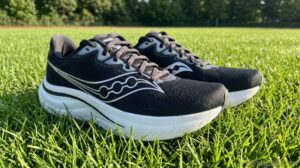
The pairs behind my verdict
| Detail | Nike Pegasus 42 | Saucony Ride 19 |
|---|---|---|
| My running log | 145 miles | 110 miles |
| My size | Men’s US 10.5 D | Men’s US 10.5 D |
| Listed drop | 10 mm | 8 mm |
| Current midsole design | ReactX foam and curved full-length Air Zoom | Reformulated PWRRUN+ foam |
| My fit cue | Close midfoot and a performance-shaped forefoot | More horizontal toe room with a held heel |
| My ride cue | Direct and athletic | Plusher, wider, smoother at easy pace |
| Evidence limit | A growing 145-mile record | A shorter 110-mile record |
The Pegasus 42 uses a curved full-length Air Zoom unit. I keep that version detail straight because older Pegasus designs used different Air Zoom layouts. Likewise, the Ride 19 has a softer, broader personality than some earlier Rides. I will not transfer an old model’s reputation to these shoes.
My 145 Nike miles and 110 Saucony miles are separate training logs, not a controlled same-day experiment. I use the Brigantine pickup and the Boardwalk easy run to explain where each pair worked for me, then check the less flattering sessions: Pegasus gave me toe-side friction in heat, while Ride felt cumbersome at my fast 5K effort. That combination is more useful than adding their mileage and announcing an overall winner.
What actually happens under my foot
Pegasus 42: a contained, more direct ride
On a flat Brigantine sea-wall run, Pegasus 42 let me hear almost nothing from the landing: the upper stayed quiet, the shoe turned over smoothly, and I did not think about the transition. ReactX and the full-length Air Zoom construction explain why it can feel responsive, but the useful observation is simpler: I can make a controlled pickup without first fighting a big rocker. My Pegasus 42 review covers the shoe on its own.
The close midfoot works for me with thin technical socks. I still feel a performance taper up front on my foot, even though this version offers more forefoot space than its predecessor. That distinction matters: an updated last does not guarantee enough width for every runner. On an unusually hot 14-mile outing, sweat and swelling brought a small hot spot by my fifth metatarsal. I would rather disclose that weak point than call the fit universally secure.
Ride 19: a softer roll built for repeatability
The Ride 19 lets my forefoot spread more naturally and rolls through easy pace without much demand from me. On the Atlantic City Boardwalk, I settled into an 8:15 rhythm that felt comfortably unremarkable in the best sense. Its PWRRUN+ cushioning and broader platform make routine miles pleasant, but they also give the shoe a different purpose from a quick workout trainer. My Ride 19 review goes deeper into that individual pair.
My fastest 5K sprint session exposed its ceiling: when I asked for repeated sub-6:30 interval pace, the Ride felt bulky in rotation. That does not make it a poor daily trainer. It tells me to use it for the mileage it handles well and choose a different shoe for hard repetitions.
Ten versus eight millimeters is only the beginning
Pegasus 42 lists a 10 mm heel-to-toe drop; Ride 19 lists 8 mm. The difference matters less to me than the combination of heel compression, toe spring, rocker timing, and upper hold. Nike’s curved front helps the shoe leave the ground without a pronounced cruiser feel. Saucony’s broader, softer base rolls more deliberately at easy pace. I can see the numbers on a box, but I have to run to know which transition leaves my stride alone.
I check calf and heel response when I change shoes, especially if one geometry is new to my rotation. I never assign a medical benefit to either drop. If a fit problem or a changed gait appears, I shorten the trial and reassess instead of asking a shoe to break in around pain.
The session-by-session choice
| Session | Pegasus 42 in my use | Ride 19 in my use | My decision |
|---|---|---|---|
| Recovery jog | Capable, but the close fit stays noticeable | Easy roll and more forefoot room | Ride |
| Ordinary daily run | Direct, quiet turnover | Soft and settled | Fit and preference |
| Steady run with a short pickup | The more natural first choice for me | Can follow, but not my quickest tool | Pegasus |
| Long, warm aerobic outing | I watch for toe-side friction as my foot swells | I trust the room, then check heel hold | Ride if fit holds |
| Short fast intervals | Better of the two, still not my dedicated choice | Felt bulky at my fast 5K effort | Neither |
| Walk-run day | Secure at running cadence | Softer at the slower reset | Walk in both before buying |
I use effort and purpose, not one fixed minutes-per-mile threshold. A speed that is easy for one runner is a workout for another. If either shoe only feels good when I accidentally speed up, it has failed the easy-day job. My daily trainer versus tempo shoe guide explains when I move to a different category.
Fit after twenty minutes beats fit in the first minute
In my 10.5 D, Pegasus 42 wraps the midfoot closely and secures the heel. Ride 19 gives me more horizontal toe room while still holding the rearfoot. I do not assume a broad toe box means high vertical volume; a runner with a tall forefoot or instep needs to check that dimension separately. I also would not size longer just to create width and then accept heel movement.
My quick test is to stand in running socks, jog easily, make two broad turns, lift cadence briefly, and repeat after the foot warms. I check the little-toe side in Pegasus and the heel/instep balance in Ride. A lacing change is reasonable for a nearly right fit, but repeated numbness, rubbing, or a sliding foot ends the comparison. My running-shoe fit checklist is the next step when either pair feels close but uncertain.
Long runs, surface changes, and late-run control
I have used both for substantial aerobic outings, but my logs are still young: 145 miles in Nike and 110 in Saucony. The Pegasus hot spot appeared on a 14-mile exposed, humid run. The Ride has handled a 13-mile long run comfortably in my record. I would give the Saucony the first audition when my feet tend to swell, while making sure its heel does not loosen as cadence drops. I would give the Nike another chance in cooler conditions and thin socks before turning one hot day into a universal veto.
On boardwalk planks and mild road camber, I ask whether the foot stays centered without little ankle corrections. Both are neutral trainers. The Ride’s broader shape can feel calmer, while the Pegasus’s closer upper can hold me well when the last matches. Neither should be mistaken for a corrective stability model. On wet paint, metal covers, or sandy turns, I slow down and judge that specific surface; dry-road confidence does not transfer automatically. My outsole-rubber guide explains why a compound name never wins a grip verdict by itself.
Durability and value: what my mileage can support
At 145 miles, my Pegasus shows localized rubber wear at my landing zone while the upper remains sound. At 110 miles, my Ride has only light outsole scuffing and fine midsole creases. Those observations are useful checkpoints, but neither log is old enough to claim a final lifespan. Road texture, body mass, weather, and rotation can change the outcome. I repeat the same familiar route as mileage grows and look for loss of hold or a ride change, not an arbitrary replacement number.
Value is the session a shoe actually covers. If Pegasus saves me from buying a second pair for ordinary daily miles and short pickups, that matters. If Ride makes easy miles and longer aerobic work more comfortable on my foot, that matters more than a hypothetical faster ceiling. My rotation guide helps me spot when the two would simply duplicate one another.
My buying rule
- Choose Pegasus 42 if you like a closer midfoot, direct daily ride, and modest pace changes, and its forefoot remains comfortable when warm.
- Choose Ride 19 if you want more toe room, a smooth easy-to-steady roll, and a broader platform for routine mileage.
- Choose neither if both fail your warm-foot fit, or if your missing shoe is really a fast workout or support model.
- Keep your current trainer if it already performs the same weekly job without a fit or wear problem.
I would rarely buy both for a small rotation. They overlap across daily road mileage; the split only makes sense if the Nike handles controlled quicker days and the Saucony is clearly better for relaxed runs on your foot. I name that distinct role before I spend.
FAQ: Pegasus 42 vs Ride 19
Is Nike Pegasus 42 or Saucony Ride 19 better for daily running?
I start with Pegasus 42 for a close, direct daily ride and brief pickups. I start with Ride 19 for more toe room and calmer easy-to-steady mileage. Warm-foot fit can reverse the choice.
Does Pegasus 42 have full-length Air Zoom?
Yes. Pegasus 42 pairs ReactX with a curved full-length Air Zoom unit. I would not use the Air Zoom layout of an older Pegasus to describe this version.
Which shoe has more toe room?
Ride 19 gives my US 10.5 D forefoot more horizontal room. Pegasus 42 has an updated roomier front than the prior model, but its performance shape still feels closer on my foot.
Which is better for long runs?
I would first try Ride 19 if toe swelling is the main concern, then confirm heel hold late in the run. Pegasus 42 can handle long aerobic miles for me, but a hot 14-mile day produced toe-side friction.
Which is faster?
For a controlled pickup, Pegasus 42 feels more natural to me. Neither is my first shoe for fast intervals; Ride 19 felt cumbersome in my quick 5K session.
Do I need both?
Usually not. Their daily-mileage roles overlap. I would buy both only if the Nike clearly serves modest quicker work and the Saucony clearly improves easy days without duplicating another pair.
My final verdict
For my own training week, Ride 19 wins the easy-to-steady job because its forefoot fits me with less negotiation. Pegasus 42 is the pair I would use when I want a closer, more direct feel and a modest pace pickup. I would make the purchase only after a warm-foot trial, then judge whether the last ten minutes still feel as good as the first. My 145 and 110 miles give me a real starting point, not permission to decide for another foot.

Written by Ken — 12 years of running, 12,500+ miles, 63 shoes tested, 36 races from 5Ks to a 50K ultra. I run 30–40 miles a week on the Atlantic City Boardwalk and review every shoe with real training miles, not one-run demos. More about me →