
Quick answer: The HOKA Challenger 8 is my best running shoe for gravel roads because it moves cleanly from pavement to hardpack while its broad base and 4 mm lugs stay useful on ordinary loose sections. I choose the Salomon Aero Glide 4 GRVL for cushioned long runs and the Nike ACG Pegasus Trail for the widest range of wet and mixed surfaces.
Gravel is not one surface. A smooth rail trail, a crowned farm road, and an eroded access road ask for different levels of grip and protection. After 12 years of running, I choose by particle size, grade, camber, braking security, and pavement percentage—not by assuming every unpaved route needs an aggressive trail shoe.
Quick Picks: My Top 3 Gravel-Road Shoes
| Best for | Shoe | Why I pick it | Price |
|---|---|---|---|
| Best overall | HOKA Challenger 8 | My most balanced road-to-gravel pick for pavement connectors, hardpack, and ordinary crushed-stone roads. | Check price |
| Best cushioned gravel specialist | Salomon Aero Glide 4 GRVL | A gravel-specific, high-cushion option for long miles on fine aggregate and rolling dirt roads. | Check price |
| Best mixed-surface versatility | Nike ACG Pegasus Trail | A dependable choice when the route moves repeatedly between pavement, wet gravel, and moderate trail. | Check price |
If your route is rougher than ordinary gravel, do not force one of these three to do a mountain shoe’s job. My road-versus-trail shoe guide shows where I draw that line.
10 Best Running Shoes for Gravel Roads: In-Depth Reviews
I rank these by use case rather than pretending one outsole wins everywhere. The right shoe should stay predictable on the loosest part of your actual route and still feel reasonable on the firm sections needed to reach it.
1. HOKA Challenger 8 — Best overall
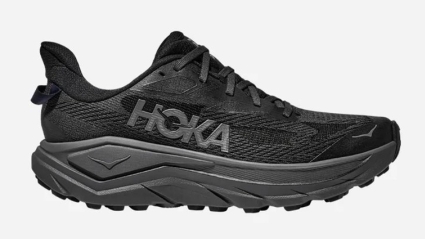
My gravel verdict: This is the crossover I trust first when a route contains meaningful pavement, groomed hardpack, and ordinary crushed stone.
I logged 169 running miles in the Challenger 8 on mixed road, hardpack, and crushed-stone routes. What kept it at the top was not maximum grip. It was the lack of a bad transition when the surface changed. The compression-molded EVA feels like a cushioned daily trainer on pavement, while the broad landing base and multidirectional 4 mm lugs give me enough bite to stop treating every loose patch cautiously.
The 8 mm drop and road-shoe-like upper make it easier to introduce than many trail shoes. My usual size held the heel securely without a trail-race squeeze, and the forefoot had enough structure to keep my foot centered on crowned gravel. The refreshed fit is more useful than adding aggressive overlays that would only make the shoe warmer.
I use it for daily gravel miles, mixed-surface long runs, and travel when I do not know exactly what the route will become. I skip it for deep mud, sharp technical descents, or large loose rock where shallow crossover traction runs out. If your route is mainly pavement, start instead with my broader best running shoes guide.
2. Salomon Aero Glide 4 GRVL — Best cushioned gravel specialist
The Aero Glide 4 GRVL is the shoe I shortlist for long, nontechnical gravel where comfort and rhythm matter more than rock armor. Its 41 mm heel, 33 mm forefoot, optiFOAM² midsole, and Reverse Camber geometry create a substantial rolling platform. The 2.5 mm Gravel contaGRIP outsole is tuned for gravel and pavement rather than deep trail.
That combination makes sense on canal paths, crushed limestone, and rolling dirt roads. I expect it to filter small stone chatter better than a low, firm hybrid, and the broad contact area should feel calmer than a narrow high-stack road shoe. The quickLACE neo system deserves a deliberate setup: I want even hold across the instep, not one hard pressure point.

Choose it when: Most of the route is runnable gravel, the long-run feel matters, and your worst surface is loose fine aggregate—not mud or jagged rock.
I would not choose it for technical trail disguised as gravel. Its tall cushioned build and shallow lugs trade ground feel and deep bite for efficiency. That is a good trade only when it matches the route.
3. Nike ACG Pegasus Trail — Best mixed-surface versatility
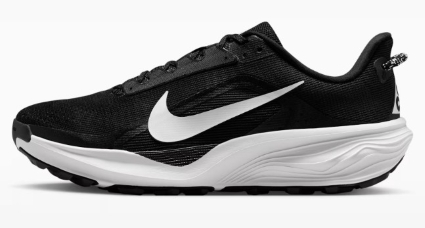
The ACG Pegasus Trail moves higher in my list when weather and route variety are uncertain. Nike increased the ReactX stack, widened the forefoot, and uses its All Terrain Compound outsole for wet traction. At approximately 10.8 ounces in a men’s US 10 with an 8 mm drop, it is not the lightest option, but the mass buys a more substantial mixed-terrain platform.
I see it as the choice for a runner who starts at the front door, crosses wet pavement, reaches a gravel park loop, and may add moderate trail before coming home. The wider toe box is useful only if the heel and midfoot still lock down; extra space that lets the foot rotate is not comfort on a sloped road.
Compared with the Challenger 8, I give Nike the edge when wet grip and moderate trail capability matter more. I give HOKA the edge when road smoothness and an easy daily rhythm dominate. Neither is my first choice for deep mud or highly technical rock.
4. ASICS BLAZEBLAST — Best for faster groomed gravel
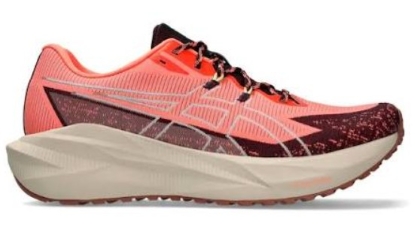
BLAZEBLAST is the speed-oriented outlier in this group. ASICS combines FF BLAST MAX foam with a forefoot trampoline pod and a 2.5 mm ASICSGRIP outsole. The result is aimed at runnable, nontechnical trails—the exact territory where a lively road shoe can feel exciting but underprotected.
I would use it for faster gravel sessions, progression runs, and smooth park loops where the surface is firm enough to reward rebound. The low lug depth should keep it efficient on connectors, while the outsole coverage gives me more confidence than exposed road foam. A published women’s reference of 7.8 ounces shows the design priority, but weight comparisons must stay attached to size and gender.
The boundary is lateral control. High, energetic foam still has to stay centered on washboard and road crown. I would make the first run easy, add gentle S-turns, and test one controlled downhill before using pace. Runners who prioritize calm stability should compare the Divide 6 instead.
5. Brooks Divide 6 — Best value
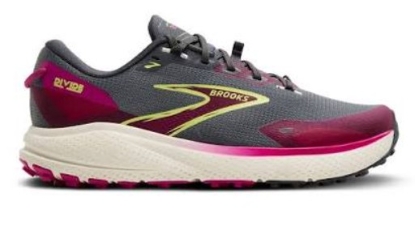
After 90 logged miles, the Divide 6 remains my value pick because it behaves honestly. The balanced cushioning is not dramatic, the approximately 10.5-ounce build is not especially light, and the ride does not imitate a super trainer. What it gives me is a familiar road-trainer fit, an 8 mm drop, and an all-terrain outsole that feels secure on uniform crushed aggregate and park connectors.
I like the heel hold and the way the platform resists twisting under me on a crowned rail trail. The upper is protective without the narrow, wrapped sensation of a race-oriented trail shoe. Early wear in my pair has been modest, although 90 miles is not a universal durability verdict.
The tradeoff: Divide 6 feels heavier and less lively on long pavement sections. I buy it for predictability and price discipline, not for tempo-day energy.
For a beginner building a first gravel rotation, that plain competence is a strength. It leaves room in the budget for the training that actually creates fitness.
6. Brooks Ghost Trail — Best familiar road-shoe feel
Ghost Trail is the easiest recommendation for someone who already likes the ordinary Ghost but needs a more capable outsole. Brooks keeps the 8 mm drop and balanced nitrogen-infused cushioning, then adds TrailTack Green rubber, 3 mm lugs, a secure heel, and protective material around the toe and mudguard.
The ride should feel less foreign than a traditional trail shoe during pavement warm-ups. I would use it on city parks, groomed trails, and gravel roads where the main concern is traction and upper durability rather than underfoot rock protection. At about 10.6 ounces in the men’s reference, it is a comfort-first hybrid, not a lightweight race tool.
I choose it over Divide 6 when cushioning familiarity and a smoother daily ride justify the extra cost. I choose Divide when simplicity and value matter more. Both need a real camber test because a familiar upper does not guarantee that every foot stays centered.
7. On Cloudsurfer Trail 2 — Best smooth ride
Some trail shoes interrupt the stride with a stiff, blocky transition. Cloudsurfer Trail 2 takes the opposite approach. Its CloudTec Phase cushioning and Helion foam are shaped for a soft sequence from landing to toe-off, while Missiongrip rubber and larger chevron lugs add the traction a road Cloudsurfer lacks.
I would put it on short to moderate nontechnical routes where smoothness is the priority: fine gravel, packed dirt, and a meaningful pavement approach. The men’s model is listed at 287 grams with an 8 mm drop, so the experience is cushioned rather than minimal. The improved heel fit matters because soft platforms become less forgiving when the rearfoot moves inside the shoe.
Skip it when: Your gravel road includes large angular stone, repeated hard braking, or technical side slopes. A smooth ride cannot replace protection and platform control.
8. Mount to Coast H1 — Best lightweight long-distance hybrid
H1 is the most interesting low-lug option here. At a published 8.5 ounces in men’s US 9, it pairs a 35/29 mm stack with a 6 mm drop and only 2 mm lugs. That tells me exactly where it belongs: long mixed routes where efficient pavement and hardpack running matter more than deep loose-surface bite.
The CircleCELL midsole is cushioned without turning the shoe into a heavy trail cruiser, while the VersaGrip outsole covers mixed terrain. I particularly like the logic of the dual-zone upper and TUNEDFIT lacing: gravel camber often requires different hold through the front and rear of the shoe, and one uniform lace pull does not always solve both.
I choose H1 for dry groomed gravel, light trail, and routes with substantial road mileage. I move away from it when 2 mm lugs are clearly below the braking demand. If the loosest corner makes me shorten every step, the shoe is underbuilt for that route regardless of how efficient it feels elsewhere.
9. New Balance Fresh Foam X Hierro v9 — Best for rough gravel
The Hierro v9 is where I move when gravel becomes rough enough to punish a crossover. Its dual-density Fresh Foam X midsole uses a softer upper layer over a firmer stabilizing layer, while the Vibram Megagrip outsole uses deep lugs and micro-traction. Toe Protect and a gusseted tongue add protection from stone and debris.
That package is heavier—about 10.9 ounces in the listed men’s reference—and the 4 mm drop changes loading compared with the 8 mm hybrids above. The weight and traction are justified on eroded access roads, wet rock mixed into gravel, and larger angular stone. They are unnecessary baggage on a manicured towpath.
My 327-mile Hierro v9 review is the better place for its detailed wear and fit story. In this ranking, its job is clear: choose protection and grip when the route has crossed beyond easy gravel.
10. adidas Terrex Agravic 4 — Best firm and agile option
Agravic 4 is for runners who prefer a direct platform to a soft gravel cruiser. The Lightstrike midsole keeps the shoe relatively light, while the Continental rubber outsole supplies wet-and-dry traction. The published 8.47-ounce reference and 8 mm drop make it more agile than the protective Hierro without reducing it to a road outsole.
I would choose it for faster rough-gravel runs, firm forest roads, and runners who dislike waiting for thick foam to settle before toe-off. The TPU overlays and regular trail fit should be checked carefully across the forefoot; secure is useful, compressed is not.
It sits tenth because its firmer, more trail-specific personality is less universal than the crossovers above—not because it is a weaker shoe. On a rougher route, it can outrank several cushioned models. That is why I let the surface reorder the list.
How I Rank Running Shoes for Gravel Roads
I rank the failure point first. On groomed gravel, the usual failure is inefficiency: too much lug, stiffness, or weight. On variable county-road gravel, it is lateral movement on crown and loose edges. On rough access roads, it is missing protection or braking grip.
| Ranking lens | What I check | What loses points |
|---|---|---|
| Surface match | Particle size, compaction, grade, camber, and pavement percentage | A shoe built for a different category of gravel |
| Braking and cornering | Controlled downhill braking, S-turns, and loose edges | Skating, delayed bite, or foot movement inside the upper |
| Platform control | Whether the midsole stays centered under tired mechanics | Soft foam that becomes lateral wobble |
| Protection | Stone filtering, toe coverage, and debris management | Pressure points, cuts, or trapped stone |
| Mixed-route efficiency | Road noise, transition, mass, and lug drag | An outsole that solves one loose section but punishes the rest |
My field sequence is repeatable. I walk the loosest corner, run the route easily, then add controlled pace only after the shoe passes. I record braking confidence, stone retention, road noise, foot movement on camber, and visible outsole damage. Wet gravel gets a separate test because dry grip does not predict water, clay, or slick embedded rock.
Mileage stays attached to the exact model. Challenger 8 has 169 logged miles in this ranking and Divide 6 has 90. Hierro v9 has a separate 327-mile review. For newer models, I keep the verdict to construction, fit logic, and route role until the longer log matures; I do not borrow another tester’s mileage and present it as mine.
The deeper mechanics live in my guides to trail-shoe lug depth and outsole grip compounds. Rubber, lug geometry, contact area, and upper hold work as one system.
How to Choose Running Shoes for Gravel Roads
Classify the roughest recurring section
I divide gravel into three practical categories. Groomed hardpack includes rail trails and fine crushed limestone; 2–3 mm lugs are usually enough. Variable gravel includes crown, washboard, pea gravel, and loose shoulders; I want more platform width and multidirectional bite. Rough access road adds larger rock, erosion, steep grades, and occasional mud; that is where a protective trail shoe earns its weight.
Count pavement before buying traction
A route that is 70% pavement should not feel miserable for the sake of one gravel mile. I start with a crossover when roads dominate and move toward trail construction as the loose percentage and braking risk rise. My road-to-trail shoe guide organizes that compromise.
Fit for camber and swelling
I test in the socks I actually use. The heel and midfoot must stop lateral sliding without crushing the instep, and the forefoot needs room after the foot warms. I run both directions on a safe cambered section because a shoe can feel centered in one direction and collapse toward the low side in the other. My running-shoe fit checks apply before I judge traction.
Use my three-surface test
- Surface 1 — pavement: Listen for lug slap, check transition, and notice whether the outsole feels harsh or unstable.
- Surface 2 — packed gravel: Run easy, turn gently, and check whether small stones lodge in grooves or exposed foam.
- Surface 3 — the route’s loose limit: Use controlled braking and climbing only where safe; stop if the shoe skates or the foot moves inside it.
If the route becomes rocky or technical, compare technical-terrain shoes and decide whether a rock plate adds useful protection. If mud is a regular feature, my mud-versus-rock guide owns that decision instead of this gravel list.
My non-negotiable: I do not test maximum grip by taking maximum risk. If a loose descent, traffic, poor visibility, or weather makes the test unsafe, I slow down or turn around.
Frequently Asked Questions
What are the best running shoes for gravel roads overall?
I choose the HOKA Challenger 8 for most mixed road-and-gravel routes because it balances road comfort, a stable platform, and useful 4 mm traction. I choose the Salomon Aero Glide 4 GRVL for softer long-run cushioning and the Nike ACG Pegasus Trail when wet traction and surface variety matter more.
Do I need trail running shoes for gravel roads?
Not for every gravel road. Groomed crushed limestone and dry rail trails often work best with a road-to-trail crossover. I move toward a true trail shoe when the route adds loose climbing, larger embedded rock, erosion, mud, or steep braking.
Can I use ordinary road shoes on gravel?
Yes, on dry and well-groomed gravel, provided the road shoe has enough outsole coverage and a stable platform. I avoid road shoes with large areas of exposed foam, stone-catching channels, or soft narrow midsoles when the surface is loose or sharply cambered.
How deep should lugs be for gravel running?
For fine hardpack, I usually prefer broad 2–3 mm lugs because they stay quiet on pavement. Four-millimeter lugs add useful bite for mixed and loose gravel. Deeper lugs are not automatically better; they can feel unstable and inefficient on compact surfaces.
Are waterproof shoes better for wet gravel roads?
Only when cold water exposure matters more than ventilation. A waterproof membrane can keep splash out, but it also holds heat and can trap water that enters over the collar. For warm rain, I usually prefer a breathable upper and dependable wet-surface rubber.
What cushioning works best on gravel roads?
I want enough cushioning to filter repeated stone pressure without becoming laterally vague. High stack can be comfortable, but platform width and foam control matter more than softness alone. The shoe should remain centered on road crown and loose edges.
How should gravel running shoes fit?
I want a secure heel and midfoot so the foot does not slide on camber, plus enough forefoot room for toe spread and swelling. Downhill toe contact, persistent arch pressure, or gripping with the toes are fit failures, not break-in requirements.
Can I use gravel shoes for road running?
Yes, when the outsole uses shallow, closely spaced lugs and the transition stays smooth. Challenger 8, Aero Glide 4 GRVL, Ghost Trail, Cloudsurfer Trail 2, and H1 are the clearest road-friendly options here. Aggressive rubber will feel louder and wear faster on pavement.
How long do gravel running shoes last?
I do not use one universal mileage number. Sharp aggregate, body mass, braking, wet grit, and pavement percentage change wear. I replace a pair when grip, cushioning, upper hold, or platform control changes enough to affect the job, not when the odometer reaches a round number.
My Final Recommendation
For most runners whose gravel route mixes pavement, packed dirt, and ordinary crushed stone, I would buy the HOKA Challenger 8. Its 169-mile record in my rotation supports the balance I care about: road comfort without giving away the traction and platform control that make a crossover useful.
I would choose the Salomon Aero Glide 4 GRVL for long, smooth gravel where cushioning is the priority, and the Nike ACG Pegasus Trail when wet surfaces and moderate trail expand the job. When gravel becomes larger, steeper, and more eroded, I would stop chasing crossover efficiency and move to the New Balance Hierro v9. The surface—not the ranking number—makes the final call.

Written by Ken — 12 years of running, 12,500+ miles, 63 shoes tested, 36 races from 5Ks to a 50K ultra. I run 30–40 miles a week on the Atlantic City Boardwalk and review every shoe with real training miles, not one-run demos. More about me →
Pingback: Best Trail Running Shoes (2026): 10 Picks for Mud, Rock & Long Runs